AI Tools and Software Sentiment Report: Week of February 2, 2026
February 2, 2026
This report covers aggregated public online discussion of AI tools and software, drawing on mentions analyzed for January 26, 2026 through February 2, 2026. The numbers here summarize the tone of community chatter collected from public sources, not any verdict on how well these products actually work. Across the latest complete week, our digest tracked 2,218 products in total, of which 57 cleared the bar of at least 10 relevant mentions to be ranked.
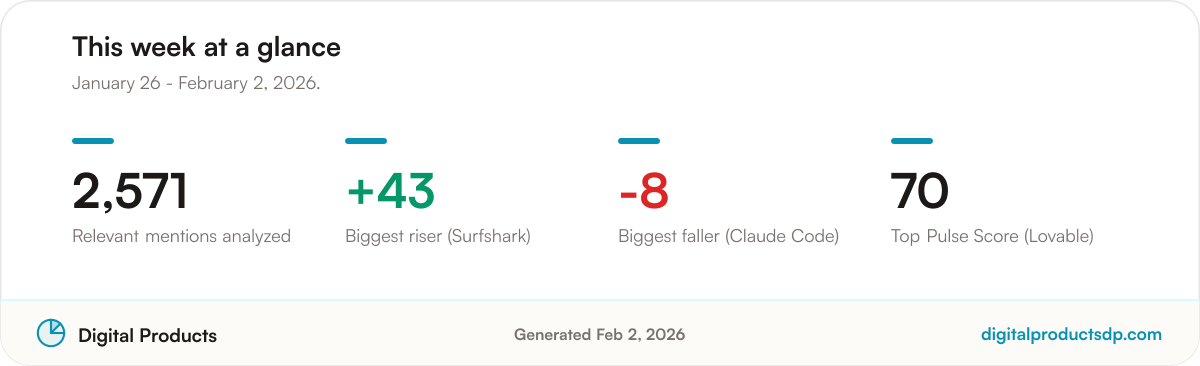
In all, 2,571 relevant mentions were analyzed for the period running from January 26, 2026 through February 2, 2026. That figure spans coding assistants, AI chat and image tools, cloud storage, security software, CRM platforms, project management apps and more. The spread of categories is wide, so read every score below as a snapshot of conversation tone, with the sample size attached so you can weigh how thin or thick each read is.
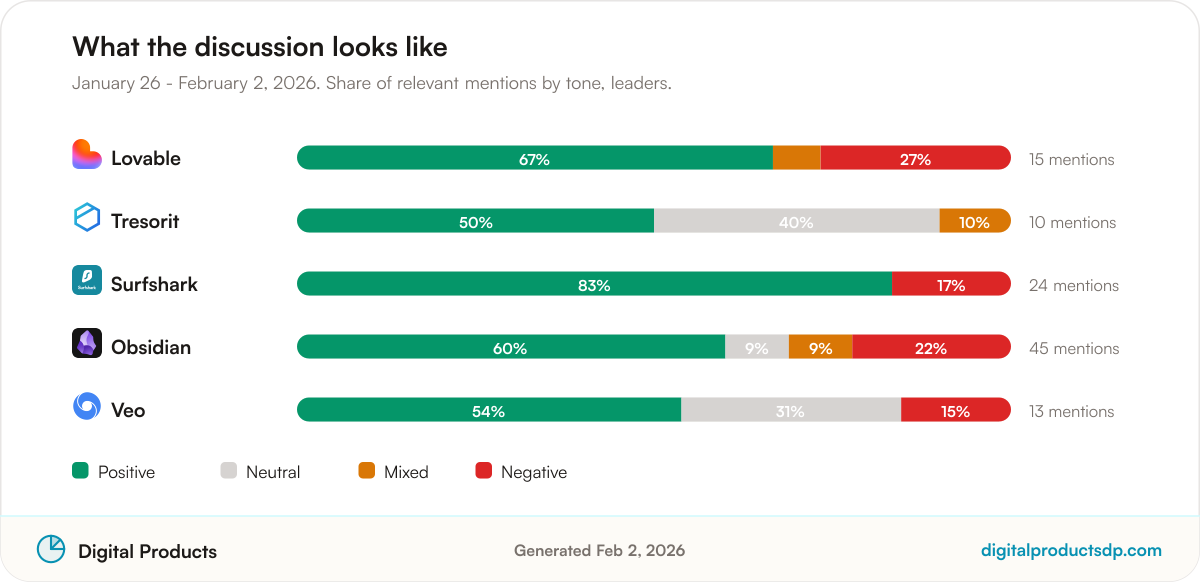
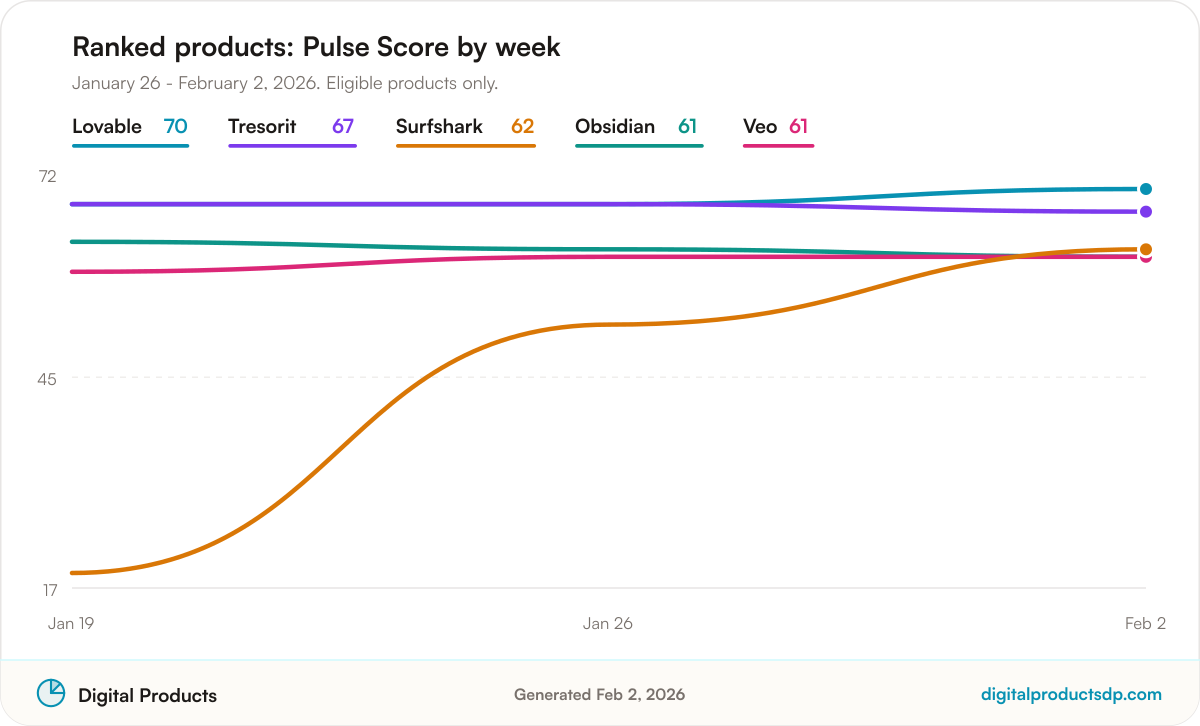
The coding tool Lovable led the latest week with a Pulse Score of 70, based on 15 mentions over the period. The cloud storage product Tresorit followed at 67, based on 10 mentions, which is the minimum sample to qualify for ranking. Behind them came the security tool Surfshark at 62, based on 24 mentions, the project management app Obsidian at 61, based on 45 mentions, and the AI video tool Veo at 61, based on 13 mentions.
Two things stand out reading down the list. First, the top five span five different categories, so no single product type dominated positive discussion this period. Second, the sample sizes vary sharply. Obsidian's 45 mentions give a steadier read than Tresorit's 10 or Veo's 13, where a handful of comments can swing the tone. Treat the higher-volume entries as the more reliable signals.
Category View
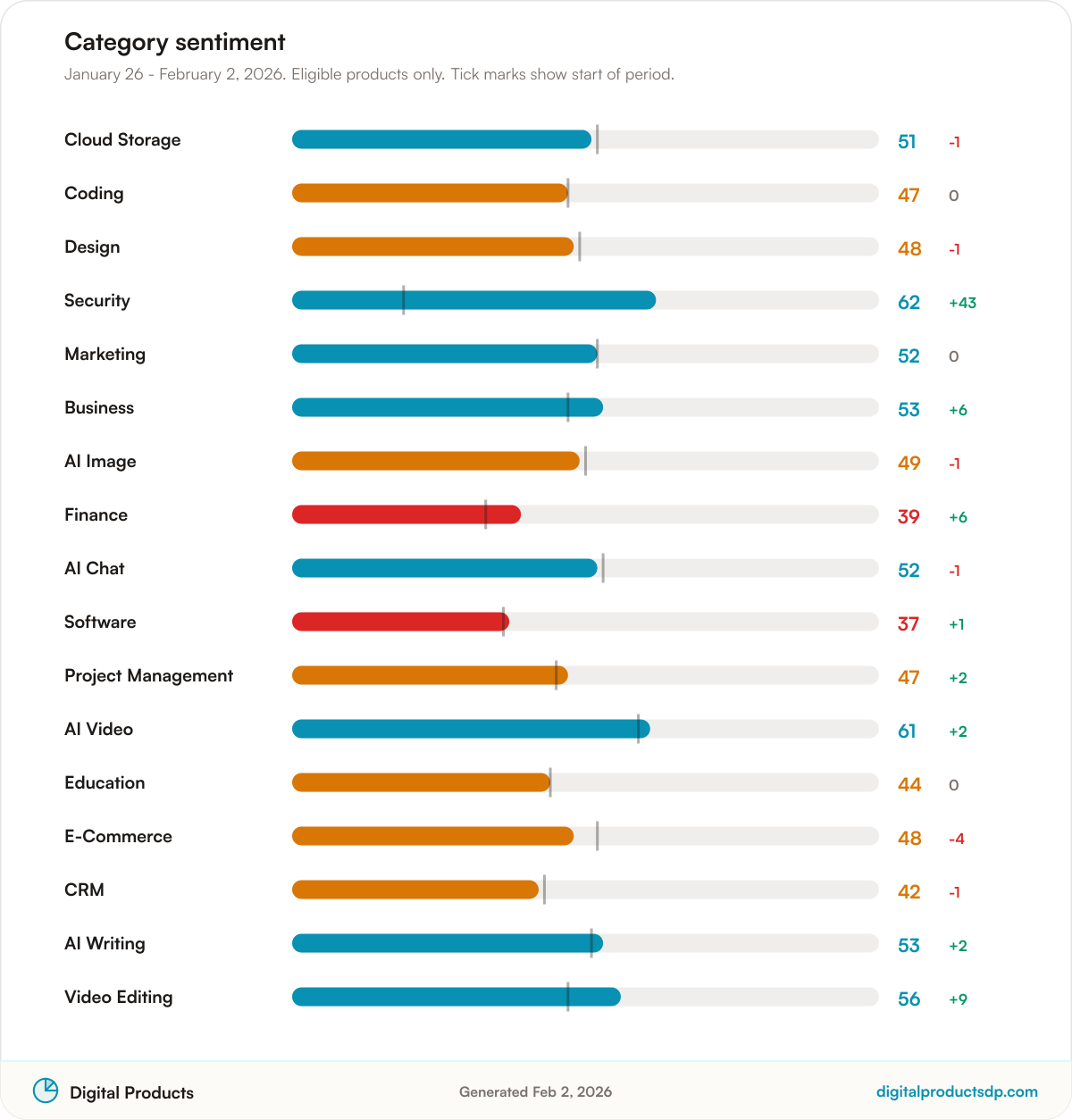
At the category level, the most dramatic shift was security, which moved from an average of 19 to 62 across the period, a swing driven heavily by Surfshark's turnaround. Other categories moved far less. Business sentiment rose from 47 to 53 and video-editing climbed from 47 to 56, while ai-video edged from 59 to 61 and ai-writing from 51 to 53. Several categories were essentially flat, including coding at 47, marketing at 52, education at 44 and software at a low 36 to 37. A few softened slightly, with e-commerce slipping from 52 to 48, ai-image from 50 to 49, and crm from 43 to 42. Finance remained among the lower categories, moving from 33 to 39, suggesting persistent caution in public discussion around those products.
Biggest Movers
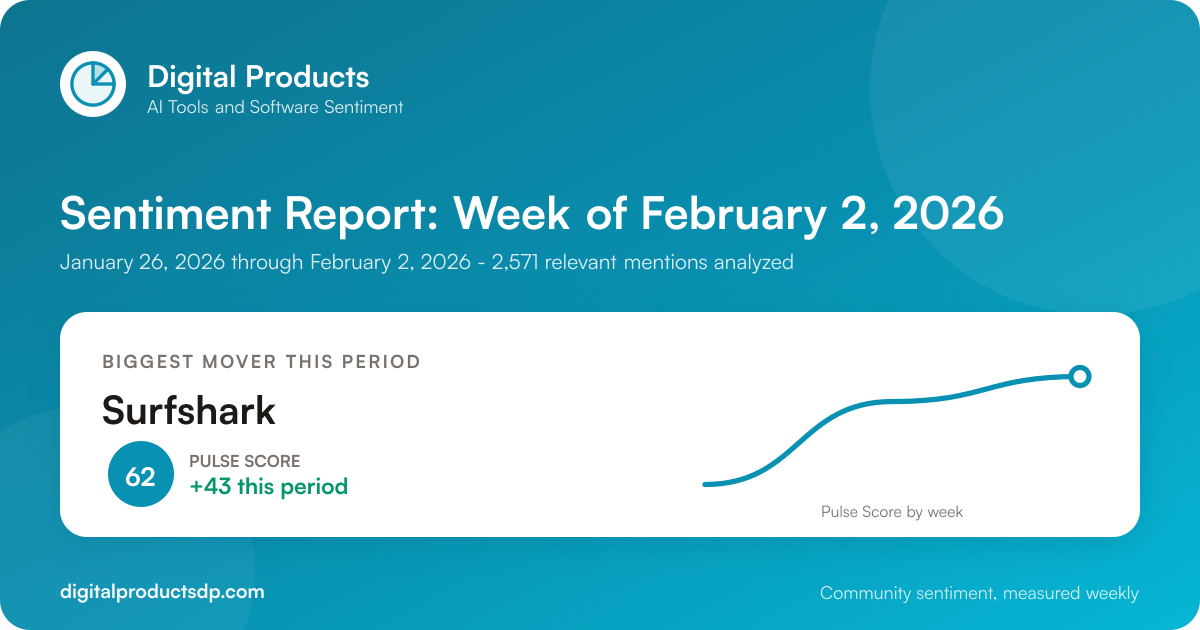
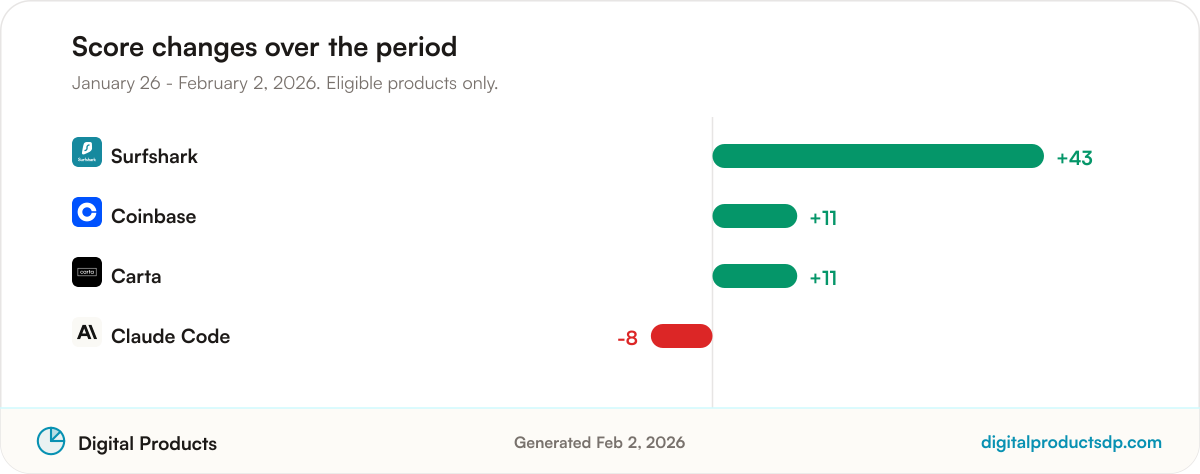
Surfshark (security), up from 19 to 62, based on 24 mentions. This was the largest swing of the period. Its latest-week praise leaned on fair pricing, which drew 29 mentions, followed by strong features at 11 and easy to use at 7. Complaints were comparatively light, with comparisons to rivals, missing features and pricing too high each registering only a small handful of mentions. The pattern suggests discussion turned toward value, and with relatively few loud complaints, the tone lifted sharply from its low starting point.
Coinbase (finance), up from 39 to 50, based on 11 mentions. Praise centered on strong features at 20 mentions, easy to use at 17 and new releases at 10. Complaints clustered around bugs at 9, poor support at 8 and missing features at 8. The improvement reads as feature and release interest outweighing the support and reliability grumbles, though at 11 mentions this remains a thin sample worth watching rather than treating as settled.
Carta (finance), up from 30 to 41, based on 17 mentions. The conversation here was modest in volume, with praise touching feature requests, strong features and easy to use, and complaints noting bugs, reliability and missing features in small counts. The rise lifted Carta off a low base without pushing it into clearly positive territory, so the read is improving but still cautious sentiment.
Claude Code (coding), down from 67 to 59, based on 109 mentions. This was the biggest faller and, with 109 mentions, one of the more reliable reads among movers. Praise remained substantial, led by strong features at 249, AI quality at 124 and easy to use at 113. But complaints were also heavy in absolute terms, with bugs at 72, reliability at 39 and missing features at 34. The slide suggests that even amid strong feature appreciation, accumulating bug and reliability chatter weighed on the tone.
GitHub Copilot (coding), down from 57 to 50, based on 53 mentions. Praise focused on strong features at 58, AI quality at 25 and new releases at 24. Complaints, however, were larger, with bugs at 113, reliability at 74 and missing features at 60. When complaint volume outweighs praise volume this clearly, a downward move in tone is consistent with the data.
Perplexity (ai-chat), down from 55 to 49, based on 49 mentions. Here the complaint mix was distinctive. Pricing too high led at 21 mentions, followed by comparisons to rivals at 18 and privacy concerns at 13. Praise covered strong features at 19, AI quality at 18 and comparisons to rivals at 13. The pricing and privacy threads appear to have pulled sentiment down even as feature and quality discussion held up.
Spotlight: Lovable
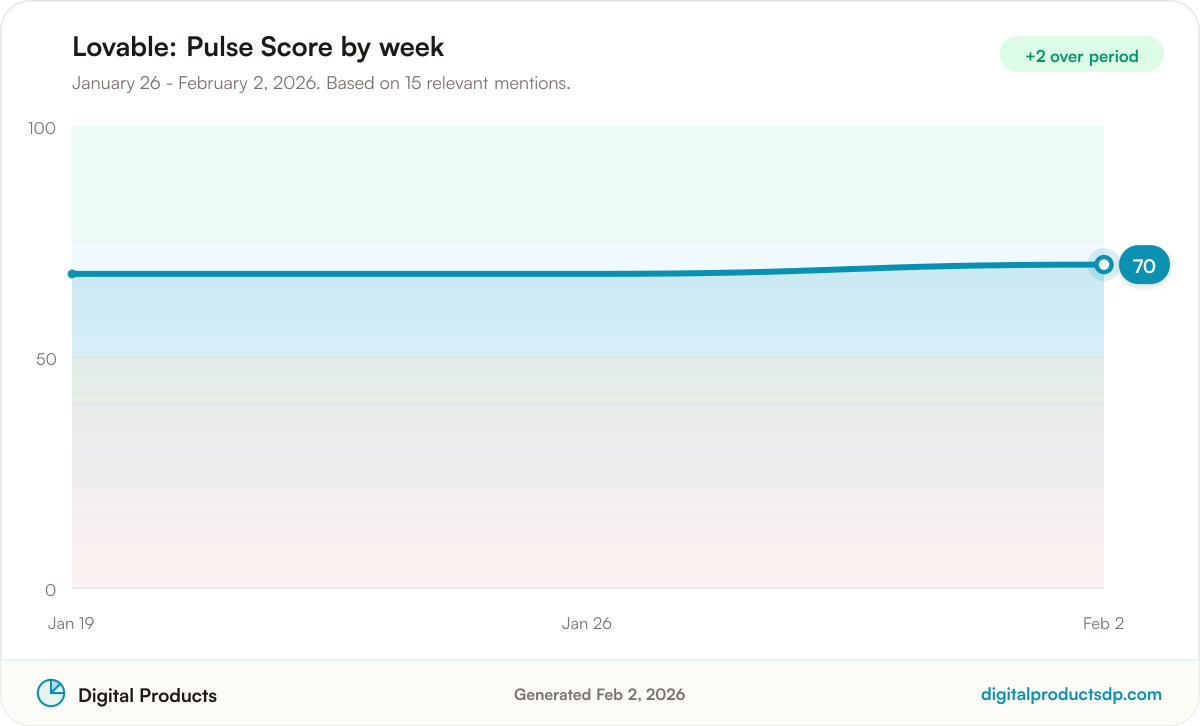
Lovable, a coding tool, finished the period with the highest Pulse Score on the board at 70, based on 15 mentions over the period. Its weekly series held steady and then ticked up, reading 68 on January 19, 2026, 68 on January 26, 2026 and 70 on February 2, 2026. That is a calm, slightly rising trajectory rather than a dramatic surge, which fits a small but consistently favorable pool of discussion.
The theme breakdown is light in raw counts, which is expected at this sample size. Praise pointed to polished UI at 8 mentions, strong features at 5 and new releases at 3. Complaints were minimal, with downtime, reliability and privacy concerns each at a single mention. With so few negatives surfacing, the positive UI and feature notes carried the tone.
The caveat worth repeating is volume. Fifteen mentions is just above the threshold to qualify, so Lovable's lead should be read as a clean but narrow signal. A single week of heavier discussion could move it in either direction, and the steadiness of its three-week line is itself the most useful detail here.
Themes Driving the Conversation
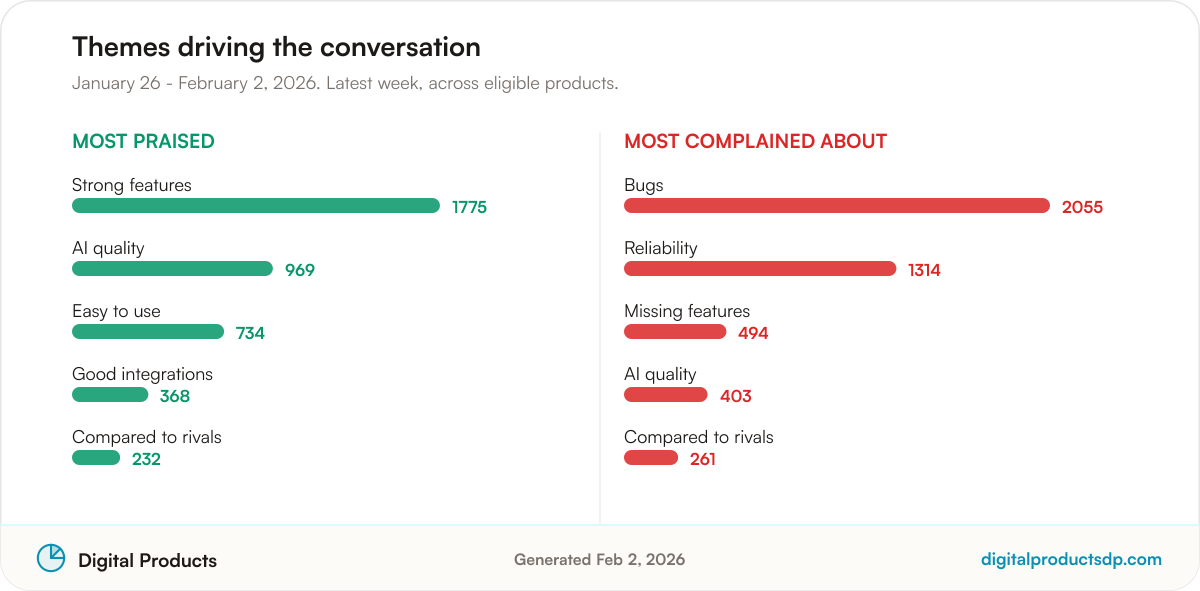
On the praise side, strong features dominated with 1,775 mentions, far ahead of AI quality at 969 and easy to use at 734. Good integrations followed at 368 and comparisons to rivals at 232. The feature theme shows up across the largest conversations, including Claude Code with 249 feature mentions, Claude with 229, ChatGPT with 183 and Stripe with 84, which tells us much of the positive chatter centered on what these products can do rather than how reliably they do it.
Complaints told a sharper story. Bugs led every other theme at 2,055 mentions, with reliability second at 1,314, followed by missing features at 494, AI quality at 403 and comparisons to rivals at 261. These bug and reliability threads were concentrated in some of the most-discussed products: Loom recorded 211 bug mentions and 135 reliability mentions, Stripe logged 188 bug and 158 reliability mentions, Vercel showed 170 bug and 151 reliability mentions, and ElevenLabs carried 118 bug and 74 reliability mentions. The contrast is the through-line of the period: communities praised capability while complaining loudly about stability.
Watchlist
Many tracked products did not clear the 10-mention threshold this period and so were left out of the rankings. This is a matter of discussion volume, not a judgment on quality. Among the closer ones, ActiveCampaign, Calendly, Trello and Pika each landed at 9 relevant mentions, just short of the bar, while Wrike, HeyGen and Kling reached 8, and Ahrefs reached 7. Devin and Synthesia each had 6, alongside Klarna, SingleStore, Asana, Leonardo AI, Klaviyo and Flux in the same low range.
Others were quieter still, with QuillBot, Sudowrite, Jasper, Foxit and 10Web at 5, Coursera and ZoomInfo at 4, and a long tail at 3 or fewer including Linear, Anyscale, NordPass, McAfee and TikTok. A large number of tracked products recorded zero relevant mentions in the period. None of these should be read as negative signals. Thin samples are excluded precisely because a handful of comments can produce an unstable score, and a product can return to the rankings the moment discussion picks up.
What To Watch Next Week
First, watch whether Surfshark holds its gains. Its move from 19 to 62 was the period's largest, but it rests on 24 mentions and was driven substantially by fair pricing discussion. Monitor whether that value narrative sustains or whether the small complaint threads around rivals and pricing grow.
Second, keep an eye on the coding assistants. Both Claude Code, based on 109 mentions, and GitHub Copilot, based on 53 mentions, fell this period under heavy bug and reliability chatter even as their feature praise stayed strong. Whether that stability complaint volume eases is the key thing to track.
Third, watch the finance category, which rose from 33 to 39 with Coinbase and Carta both climbing off low bases. These were thin samples, so the question is whether the improvement is the start of a trend or a one-week blip tied to release and feature interest.
Frequently Asked Questions
Which product had the highest Pulse Score this period?
Lovable, a coding tool, had the highest Pulse Score at 70, based on 15 mentions over the period.
Which product moved the most this period?
Surfshark moved the most, rising from 19 to 62 over the period, a gain of 43 points based on 24 mentions.
What was the overall mood across categories?
Mood was mixed and mostly steady, with security swinging up from 19 to 62 and video-editing rising from 47 to 56, while many categories such as coding at 47 and marketing at 52 stayed roughly flat. Bugs were the top complaint theme with 2,055 mentions.
How many mentions were analyzed this period?
A total of 2,571 relevant mentions were analyzed across 57 ranked products for the week of February 2, 2026.
About This Data
Pulse Scores summarize the tone of public online discussion on a 0-100 scale and reflect community sentiment, not a verdict on a product's quality or a recommendation. We report on complete calendar weeks only, and products with fewer than 10 relevant mentions in the period are excluded from rankings to avoid unstable reads on thin samples.
Public discussion is collected from Hacker News, Stack Exchange, GitHub, Bluesky, the Apple App Store, and YouTube. Automated sentiment analysis can misread sarcasm, jokes, or niche context, mention volumes vary widely between products, and scores can move week to week. Any company that wants to respond is welcome to reach out. For how scores are calculated, see our methodology.