AI Tools and Software Sentiment Report: Week of July 27, 2026
July 28, 2026
This edition of our sentiment tracker looks at aggregated public online discussion about AI tools and broader software, from design apps to coding assistants to CRM platforms. The figures here summarize the tone of what people said in public forums and comment threads, not any verdict on how well these products actually work. Every number below traces to a single fact sheet for the period, and we have kept our own commentary to interpretation rather than guesswork.
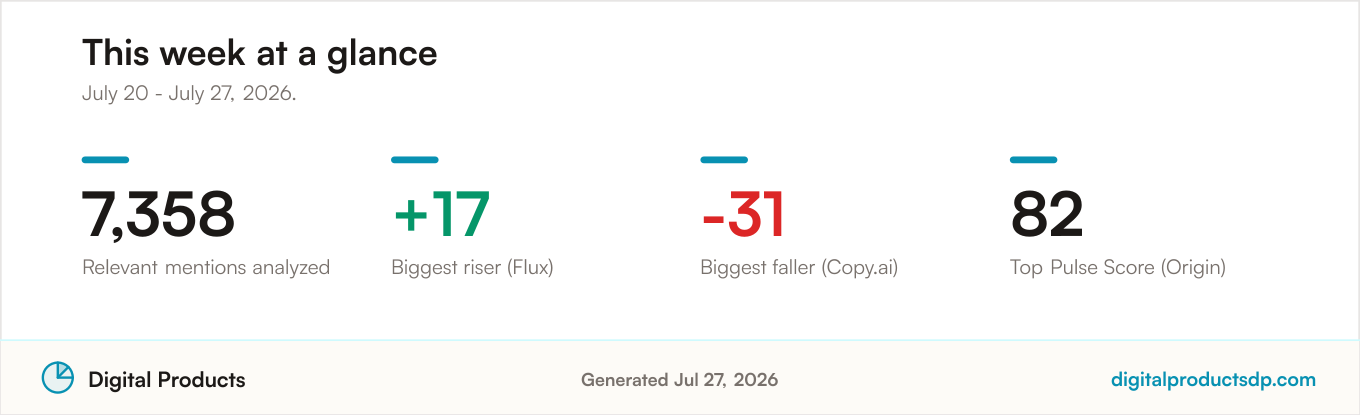
The mentions analyzed for July 20, 2026 through July 27, 2026 cover 66 products that cleared our minimum volume bar, drawn from 7,358 relevant mentions in total. Across that pool, the mood was steady at the top and turbulent at the edges, with a small handful of products accounting for most of the movement. We tracked 2,248 products in all, though the vast majority did not reach the threshold to be ranked this period.
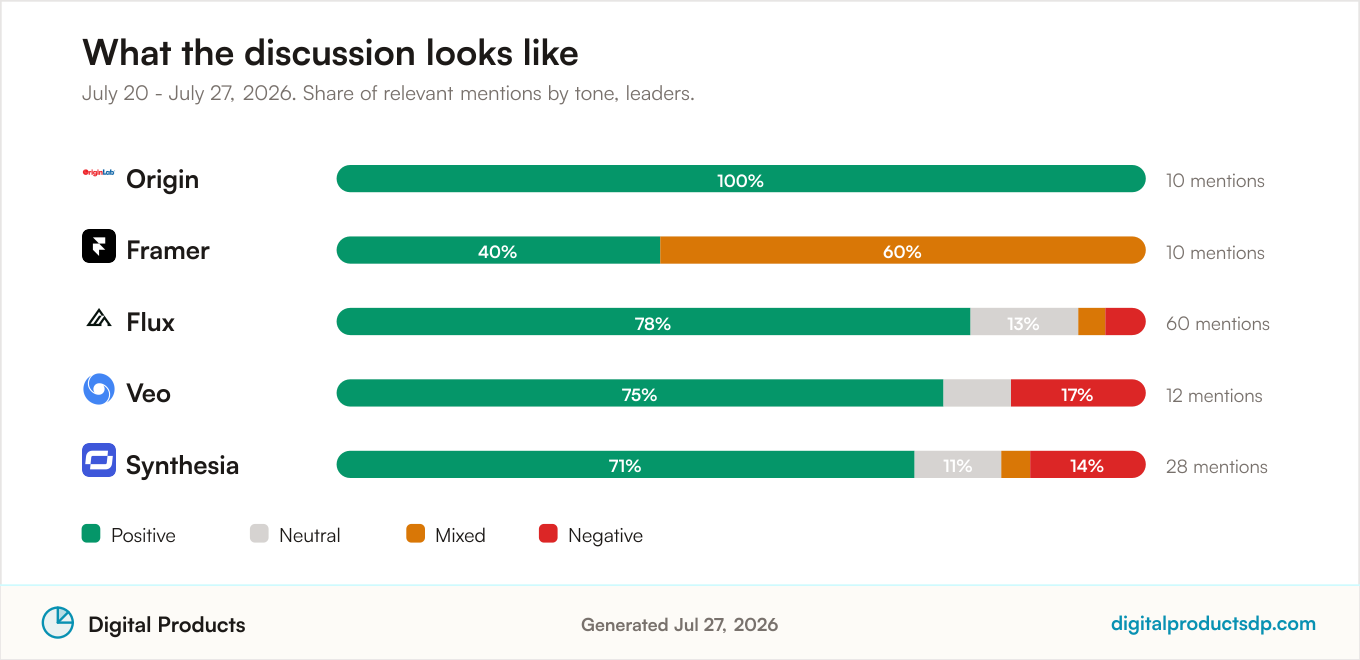
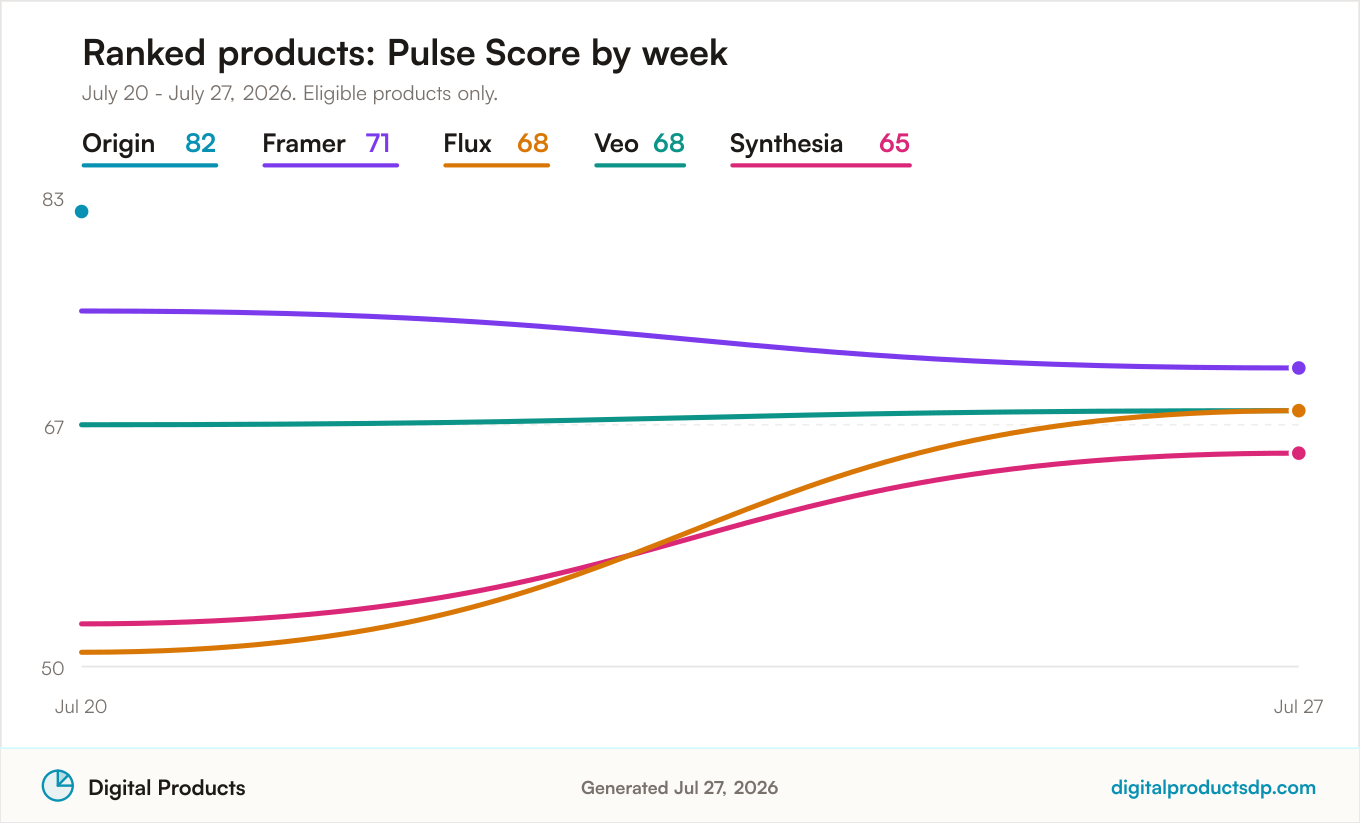
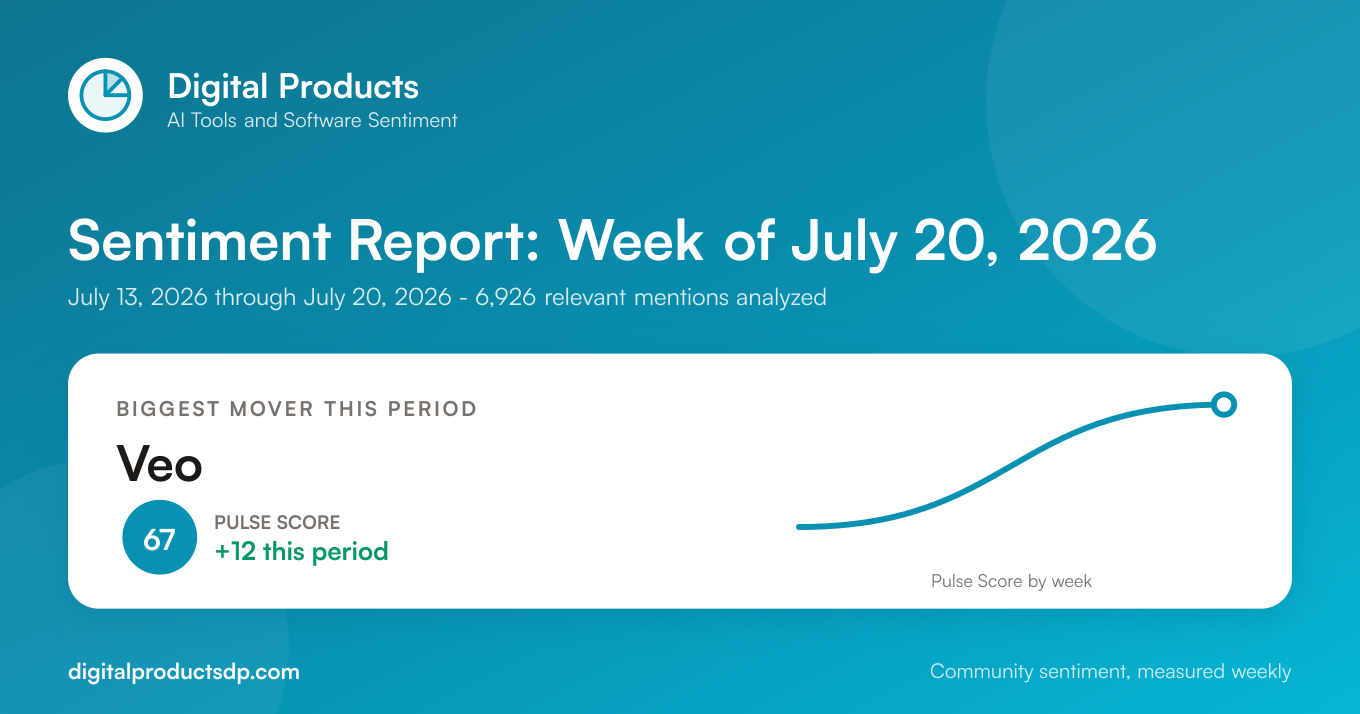
Origin sits at the top with a Pulse Score of 82, based on 10 mentions over the period, edging out Framer at 71, based on 10 mentions. Both leaders drew on thin samples, so their scores should be read as reflecting a small and possibly self-selecting slice of discussion rather than a broad consensus. Flux and Veo tie at 68, though Flux carries far more weight with 60 mentions analyzed against Veo's 12.
Synthesia rounds out the visible leaders at 65, based on 28 mentions. What stands out across this group is the mix of categories: a software product, a design tool, an AI image generator, and two AI video tools. Sentiment leadership this period was not concentrated in any single category, and the leaders with the largest samples, Flux and Synthesia, were also two of the biggest risers, which suggests their high scores were earned on rising momentum rather than a static reputation.
Category View
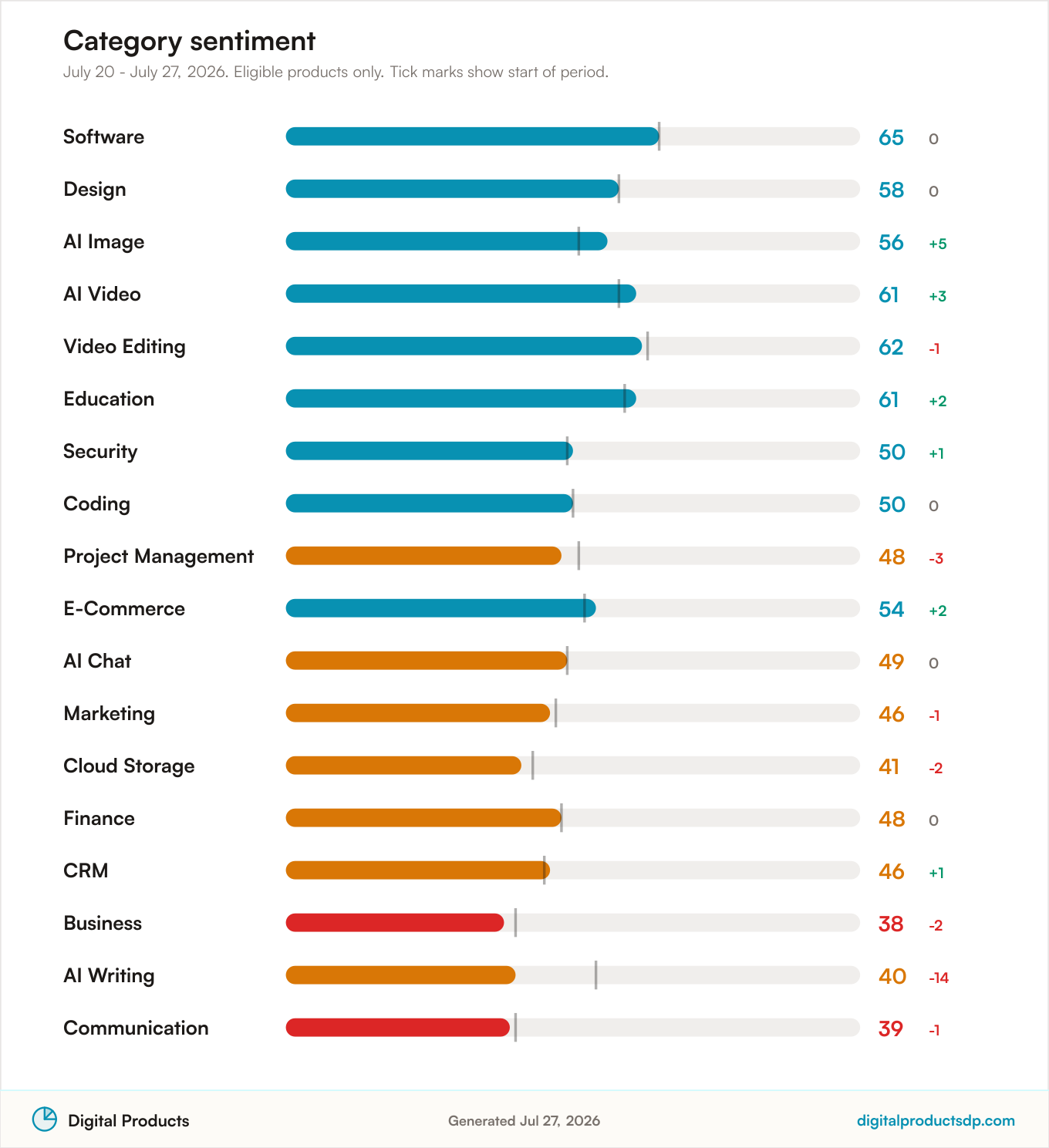
At the category level, most groups held close to where they started. Software was flat at 65, the highest category average, while ai-video ticked up from 58 to 61 and ai-image rose from 51 to 56, the largest category gain this period. On the softer side, ai-writing fell from 54 to 40, the sharpest category decline, and project-management slipped from 51 to 48. Business sat lowest of all, moving from 40 to 38, with communication close behind at 40 to 39. Security, coding, finance, and ai-chat barely moved, staying within a point of where they began, which points to a period where category-wide mood was stable and the real action happened at the individual product level.
Biggest Movers
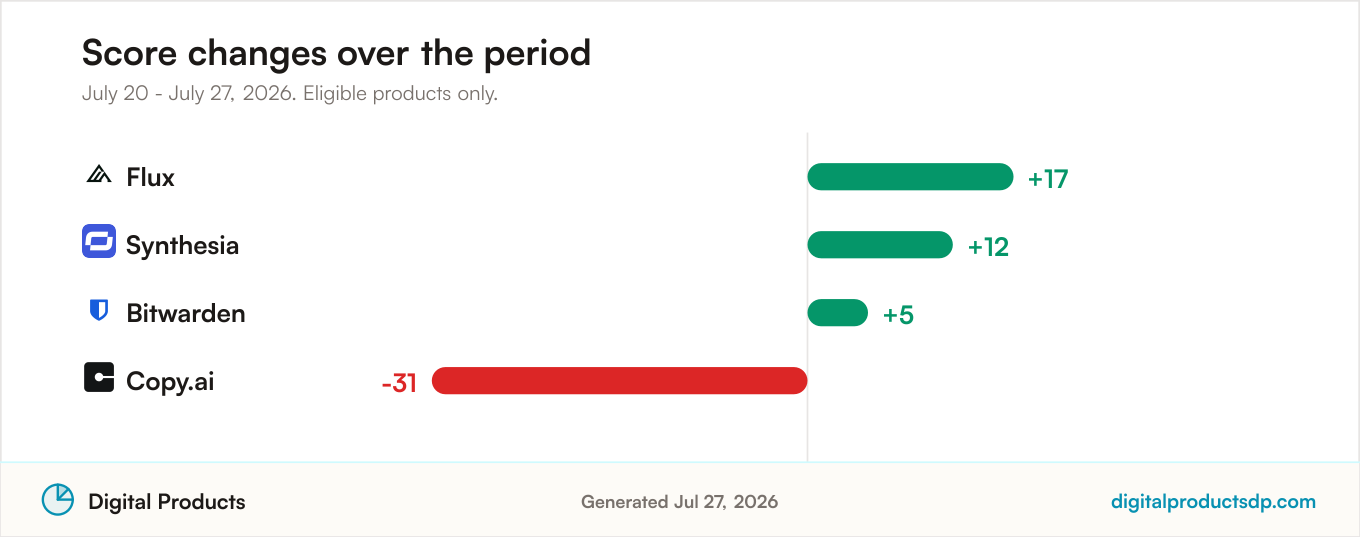
Flux (riser, +17, 51 to 68, based on 60 mentions): Flux posted the largest gain of any ranked product. Its praise themes lean heavily on New releases (42 mentions), Strong features (40 mentions), and AI quality (39 mentions), a pattern that fits a product where fresh output is driving enthusiasm. Complaints were comparatively light, led by Bugs (7 mentions), Performance (5 mentions), and Reliability (4 mentions), which suggests the upside discussion outweighed friction this period.
Synthesia (riser, +12, 53 to 65, based on 28 mentions): Synthesia's climb tracks a similar shape. Praise centered on Strong features (23 mentions), AI quality (21 mentions), and New releases (18 mentions), while complaints stayed modest around Downtime (3 mentions), Reliability (3 mentions), and Pricing changes (2 mentions). The release-and-quality combination shows up again here, echoing the ai-video category's overall rise.
Bitwarden (riser, +5, 55 to 60, based on 46 mentions): Bitwarden's smaller but steady gain came alongside praise for Strong features (25 mentions), Good integrations (16 mentions), and Easy to use (14 mentions). Its complaints, Bugs (7 mentions), Missing features (7 mentions), and Lacking integrations (4 mentions), point to a discussion where integration was cited on both sides, a sign of an engaged user base weighing what works against what is still missing.
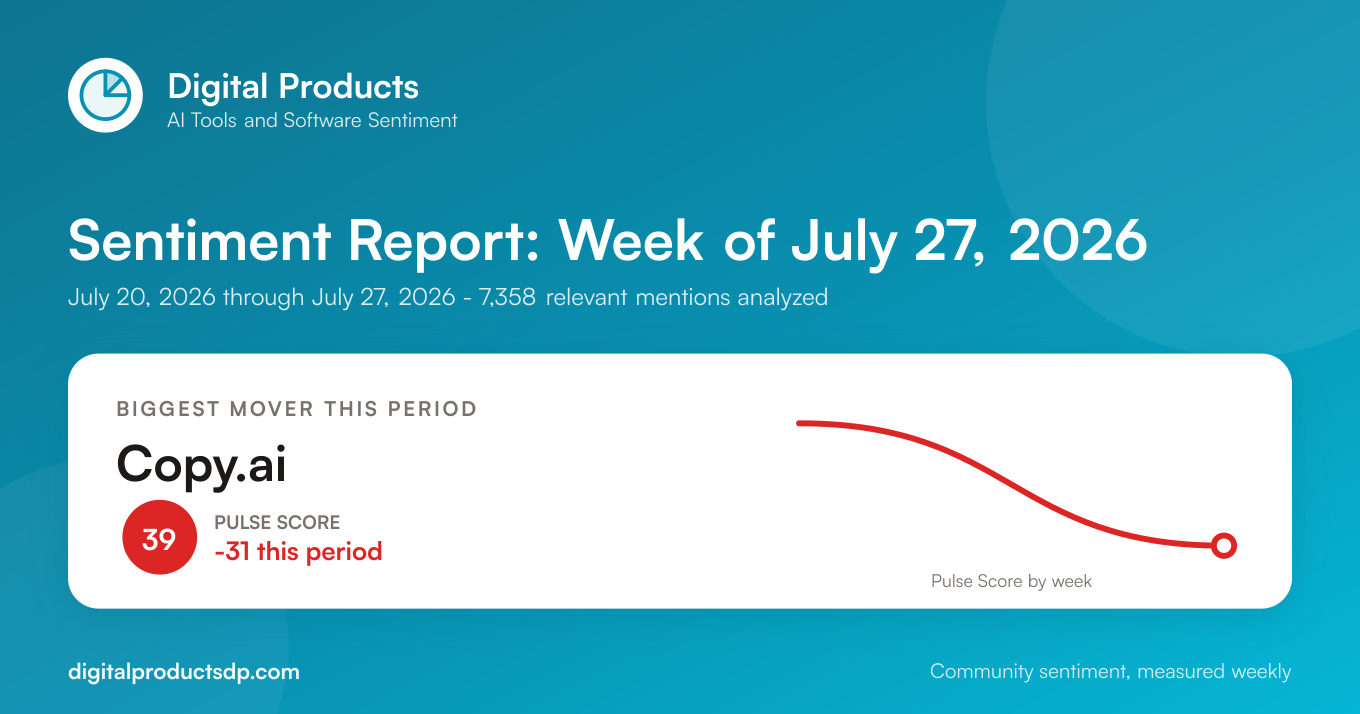
Copy.ai (faller, -31, 70 to 39, based on 11 mentions): Copy.ai posted the steepest drop of the period. With only 11 mentions, the score is sensitive to a small number of posts, and the complaint mix helps explain the swing: AI quality (8 mentions), UI frustrations (4 mentions), and Compared to rivals (3 mentions) dominated a thin sample. Its praise themes, Strong features (3 mentions), Easy to use (3 mentions), and Fair pricing (2 mentions), were too light to offset the negative tone.
Monday.com (faller, -12, 52 to 40, based on 67 mentions): Monday.com's decline came on the largest sample among the fallers, giving it more weight. Complaints were led by New releases (10 mentions), Compared to rivals (9 mentions), and Reliability (6 mentions). The appearance of New releases as a complaint rather than a praise theme is notable, and it lines up with the broader softening in project-management, which slipped to 48 as a category.
Google Photos (faller, -6, 55 to 49, based on 18 mentions): Google Photos slipped more gently. Its complaints centered on Missing features (3 mentions), Pricing changes (2 mentions), and Privacy concerns (2 mentions), against praise for Strong features (5 mentions), Easy to use (3 mentions), and Good integrations (2 mentions). The spread is narrow enough that the move reflects a mild cooling rather than a sharp turn.
Spotlight: Origin
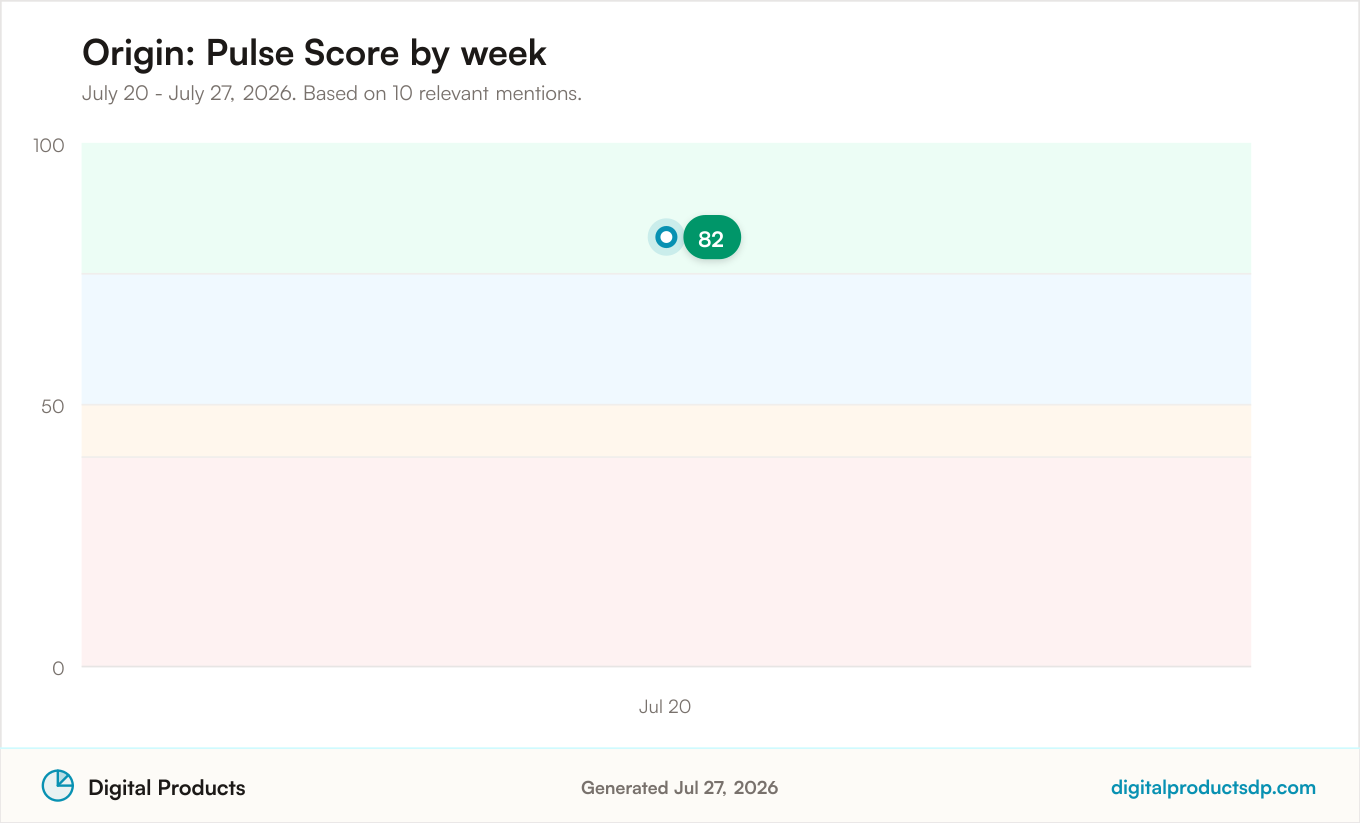
Origin holds the top Pulse Score at 82, based on 10 mentions over the period. In the weekly series it registers a single reading of 82 on July 13, 2026, so its position is best understood as a snapshot from a small but uniformly positive pool of public discussion rather than a trend line built over multiple weeks.
The theme breakdown is unusually clean. Origin's praise concentrated on Strong features (14 mentions), Easy to use (6 mentions), and Polished UI (3 mentions), and notably it recorded no complaint themes at all this period. That absence of recorded complaints, paired with feature and usability praise, is what lifts the score to the top of the board.
The caveat is sample size. With 10 mentions, Origin sits right at the ranking threshold, so its lead should be read as a positive but narrow read that could shift quickly if discussion volume grows. A clean complaint sheet is easier to maintain across 10 mentions than across hundreds, and readers should treat this as an early, favorable signal rather than a settled reputation.
Themes Driving the Conversation
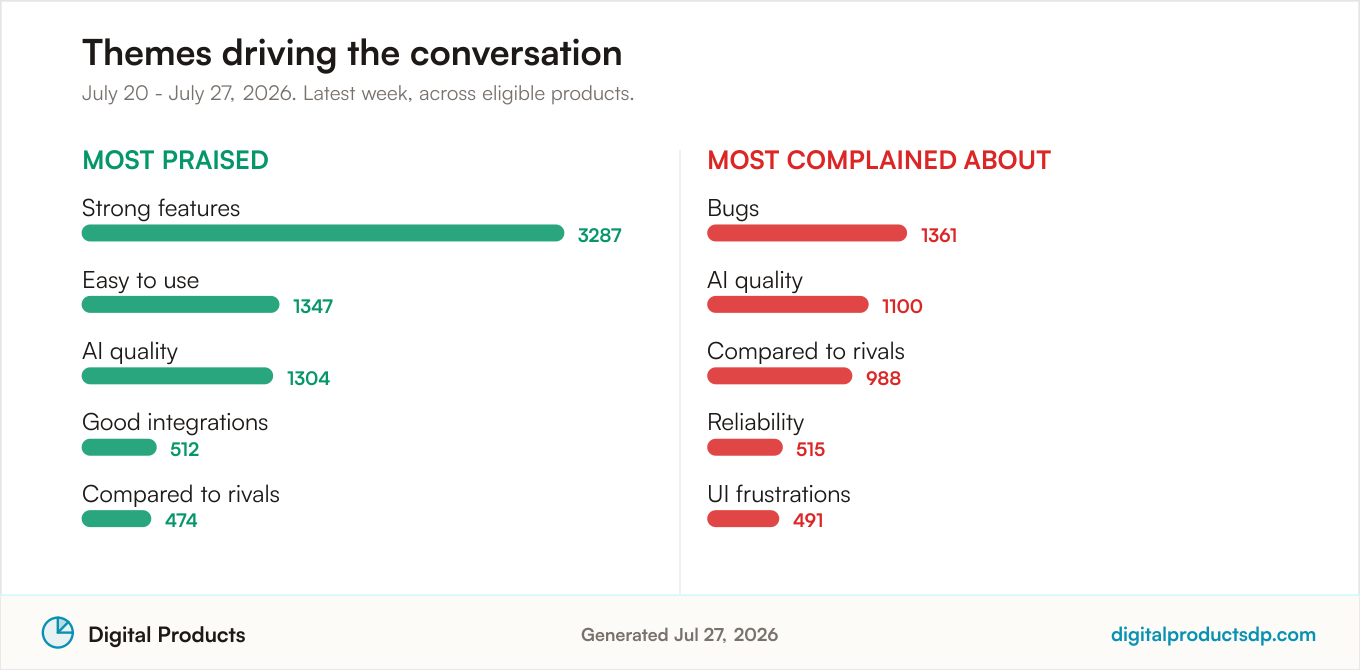
On the praise side, Strong features led by a wide margin with 3,287 mentions, followed by Easy to use at 1,347 mentions and AI quality at 1,304 mentions. Good integrations (512 mentions) and Compared to rivals (474 mentions) rounded out the top five. The feature-and-usability pairing shows up across the leaders and risers alike, from Origin's Strong features and Easy to use praise to Claude Code, whose Strong features theme alone drew 428 mentions, and Obsidian, with 171 mentions of Strong features and 149 of Easy to use.
On the complaint side, Bugs topped the list with 1,361 mentions, followed by AI quality at 1,100 mentions and Compared to rivals at 988 mentions, then Reliability (515 mentions) and UI frustrations (491 mentions). AI quality appearing prominently as both a praise and a complaint theme reflects a split conversation, visible in products like ChatGPT, where AI quality drew 255 complaint mentions, Grok with 261, and Gemini with 146. Bugs, meanwhile, showed up across coding and productivity tools such as Cursor (90 mentions) and Claude Code (89 mentions), underlining reliability as the most common friction point this period.
Watchlist
Many tracked products did not reach the 10-mention threshold this period and so were left out of the rankings. This is a statement about discussion volume, not about quality. Products like Aider (9 relevant mentions), Pipedrive (9 relevant mentions), Dropbox (9 relevant mentions), VEED (7 relevant mentions), Oracle Cloud (7 relevant mentions), and Jasper (7 relevant mentions) came close but fell short, and their scores would be unstable on samples that thin.
Others sat lower still, including NordPass (6 relevant mentions), Red Hat (6 relevant mentions), GitLab (6 relevant mentions), Deel (6 relevant mentions), Autopilot (6 relevant mentions), Leonardo AI (5 relevant mentions), Apple Notes (5 relevant mentions), and Thinkific (5 relevant mentions). A large number of tracked products, from Runway to Sora to Microsoft Copilot, recorded zero relevant mentions in the period. When volume is this low, even a couple of posts can swing a read dramatically, which is exactly why we hold these products out until they clear the bar. If any of them draws a burst of discussion next period, it could enter the rankings quickly.
What To Watch Next Week
First, watch whether Flux and Synthesia can hold their gains. Both rose on New releases and AI quality praise, and release-driven enthusiasm can fade once the novelty settles, so it is worth monitoring whether their scores stabilize near the high 60s or drift back toward where they started.
Second, keep an eye on Copy.ai and Monday.com. Copy.ai's -31 swing came on just 11 mentions, so a modest change in volume could move it sharply in either direction. Monday.com's -12 came on a larger sample of 67 mentions with New releases cited as a complaint, which is worth watching to see whether that friction persists.
Third, the split personality of the AI quality theme is worth tracking. It ranked among both the top praise themes (1,304 mentions) and the top complaint themes (1,100 mentions), and how that balance tips will shape the mood of ai-chat and ai-writing, the latter of which already fell to 40 as a category this period.
Frequently Asked Questions
Which product had the highest Pulse Score this period?
Origin had the highest Pulse Score at 82, based on 10 mentions over the period, ahead of Framer at 71.
Which product moved the most this period?
Copy.ai moved the most, falling from 70 to 39, a drop of 31 points, based on 11 mentions. Among risers, Flux gained the most, climbing from 51 to 68, a rise of 17 points, based on 60 mentions.
What was the overall category mood this period?
Most categories were stable. Software was the highest at 65 and held flat, ai-image and ai-video rose modestly, while ai-writing fell from 54 to 40 and business was lowest at 38.
How many mentions were analyzed this period?
A total of 7,358 relevant mentions were analyzed across 66 eligible products, out of 2,248 products tracked overall.
About This Data
Pulse Scores summarize the tone of public online discussion on a 0-100 scale and reflect community sentiment. They are not a verdict on a product's quality and not a recommendation. We report on complete calendar weeks only, and products with fewer than 10 relevant mentions in the period are excluded from rankings to avoid unstable reads on thin samples.
Public discussion is collected from Hacker News, Stack Exchange, GitHub, Bluesky, the Apple App Store, and YouTube. Automated sentiment analysis can misread sarcasm, jokes, or niche context, mention volumes vary widely between products, and scores can move week to week. Any company that wants to respond to what it sees here is welcome to reach out. For how scores are calculated, see our methodology.