AI Tools and Software Sentiment Report: Week of July 20, 2026
July 21, 2026
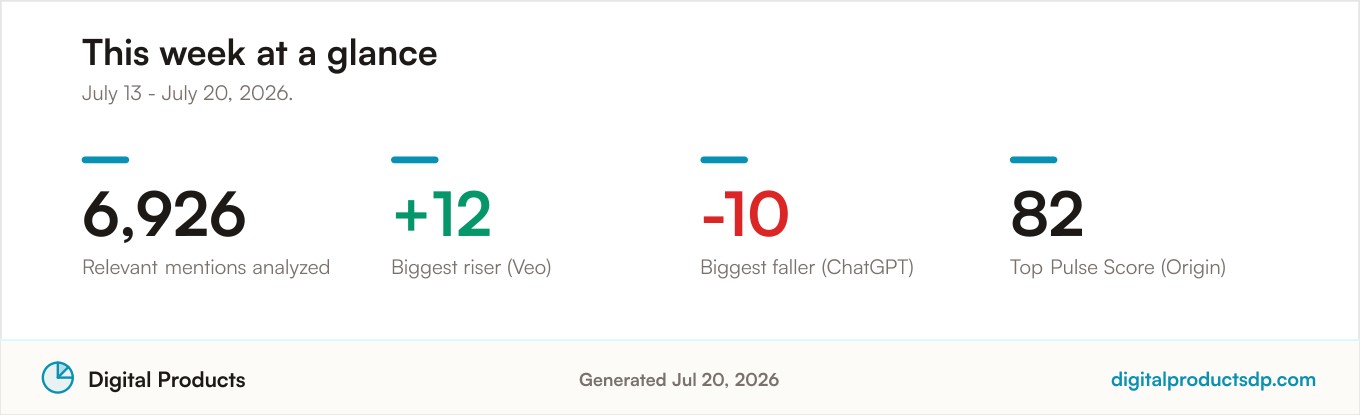
This edition covers aggregated public online discussion of tracked AI tools and software, drawn from complete calendar weeks. The mentions analyzed for July 13, 2026 through July 20, 2026 total 6,926 relevant mentions across the products that cleared our ranking threshold. As always, the numbers here describe the tone of community sentiment, not a verdict on how well any product actually works.
Across the period running from July 13, 2026 through July 20, 2026, 2,248 products were tracked, with 58 eligible for rankings after clearing the minimum of 10 relevant mentions. That leaves a wide field of products with too little discussion to score, and it concentrates the meaningful signal in a smaller set of familiar names. Below we read the leaderboard, the category picture, the biggest movers, and the themes shaping the conversation.
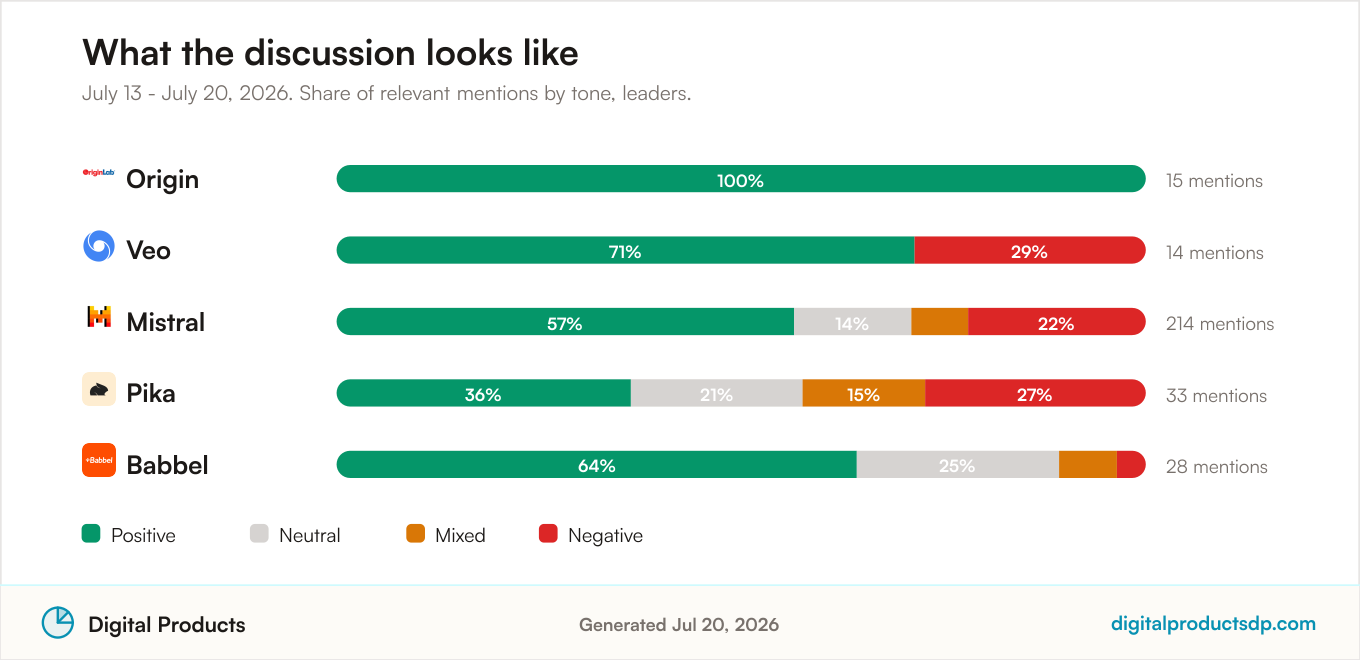
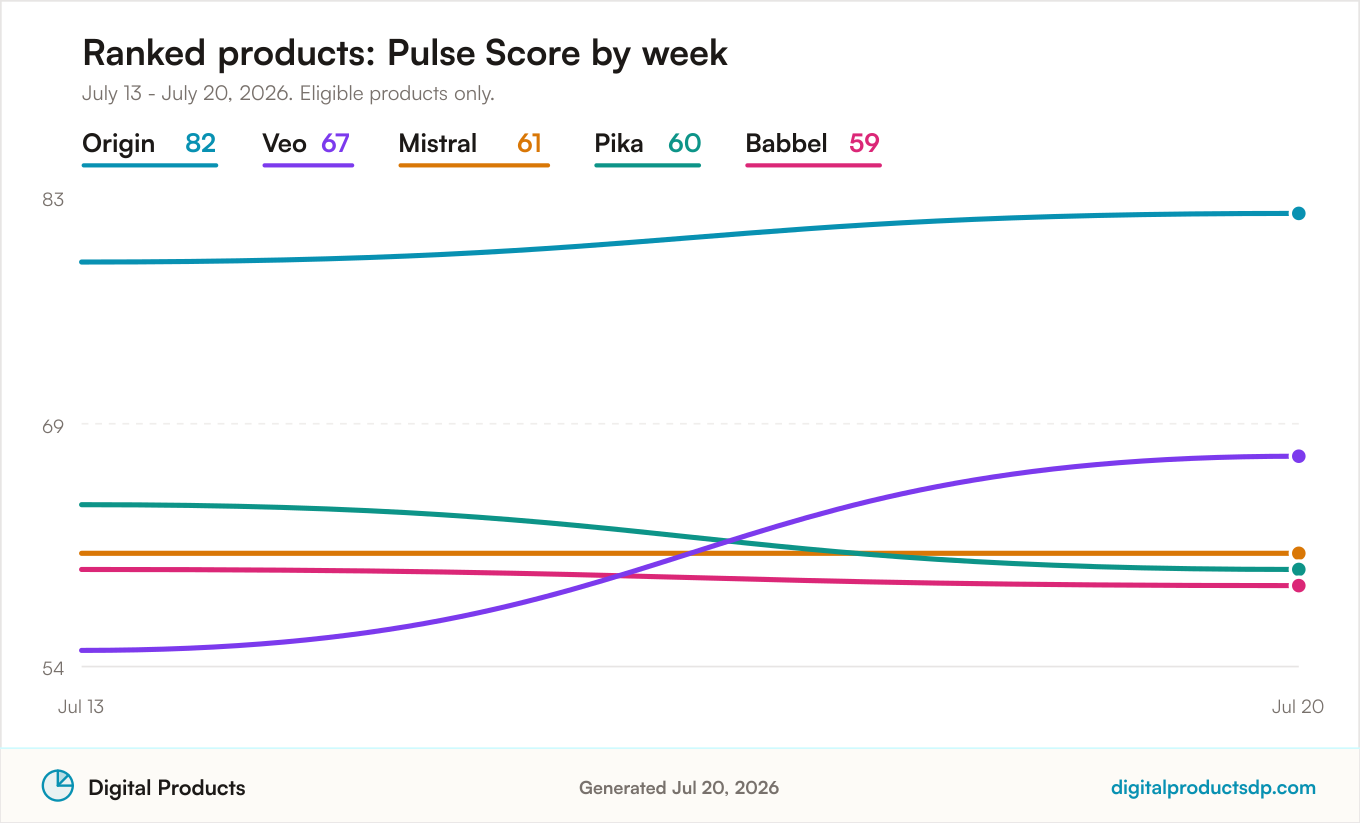
Origin sits at the top of the ranked field with a Pulse Score of 82, based on 15 mentions over the period. Veo follows at 67, based on 14 mentions, then Mistral at 61, based on 214 mentions, Pika at 60, based on 33 mentions, and Babbel at 59, based on 28 mentions. The spread between the top score and the fifth-place score is modest, which suggests the leading tone was broadly positive rather than dominated by a single standout.
It is worth noting how different the sample sizes are behind these scores. Origin and Veo each rest on small mention counts, while Mistral's 61 is supported by a much larger 214 mentions. A leader built on a thin sample can move quickly week to week, so the ranking should be read alongside those volumes rather than as a fixed order of merit.
Category View
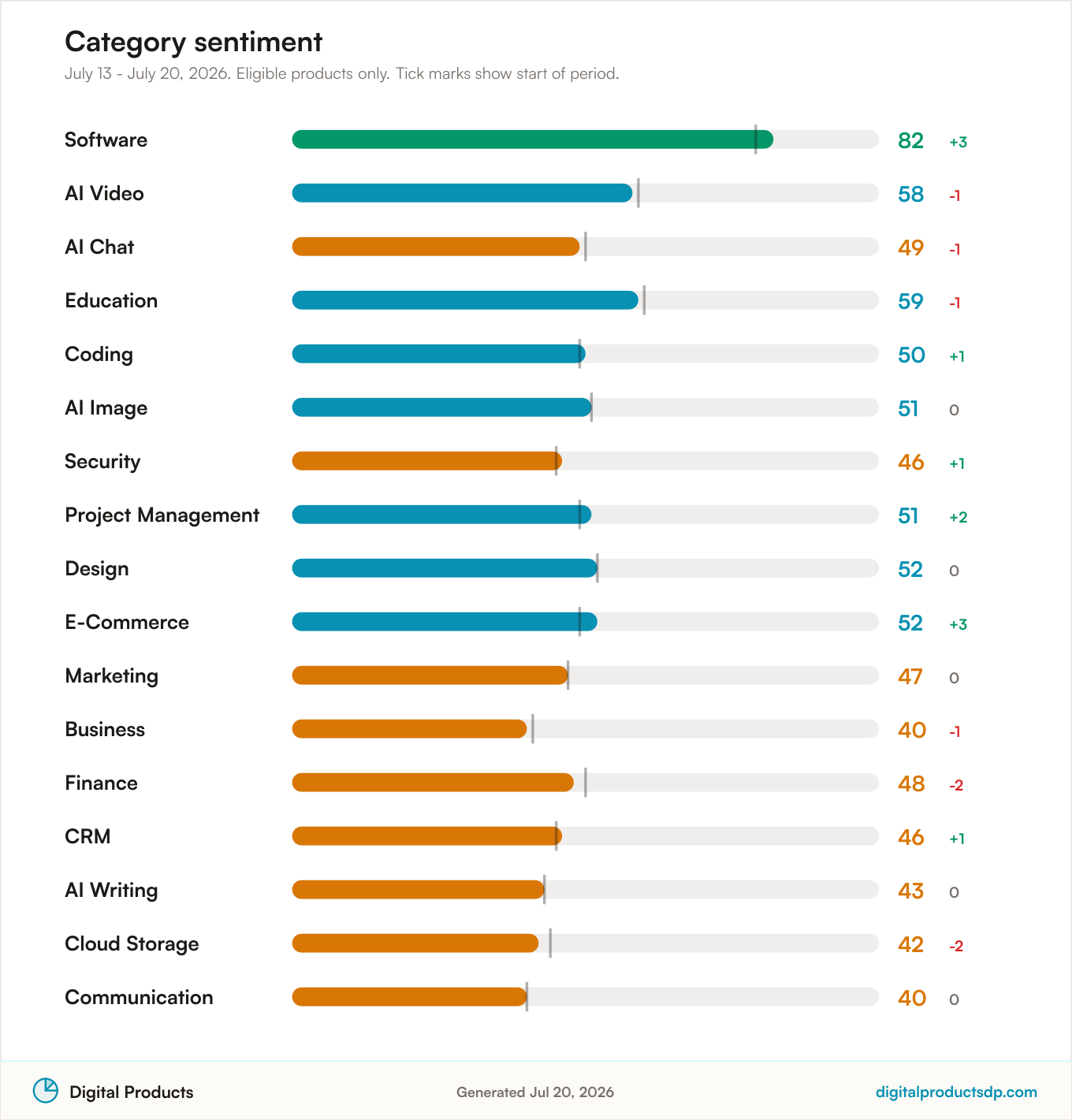
At the category level, software led and firmed, moving from 79 to 82, the highest average in the set. E-commerce rose from 49 to 52, project-management from 49 to 51, and coding edged up from 49 to 50. Several categories were essentially flat, including design at 52, ai-image at 51, marketing at 47, ai-writing at 43, and communication at 40. On the softer side, ai-chat slipped from 50 to 49, education from 60 to 59, finance from 50 to 48, cloud-storage from 44 to 42, and business from 41 to 40. The overall picture is one of small shifts rather than sweeping category-wide swings, with software clearly out front and communication and business anchoring the lower end of the community mood.
Biggest Movers
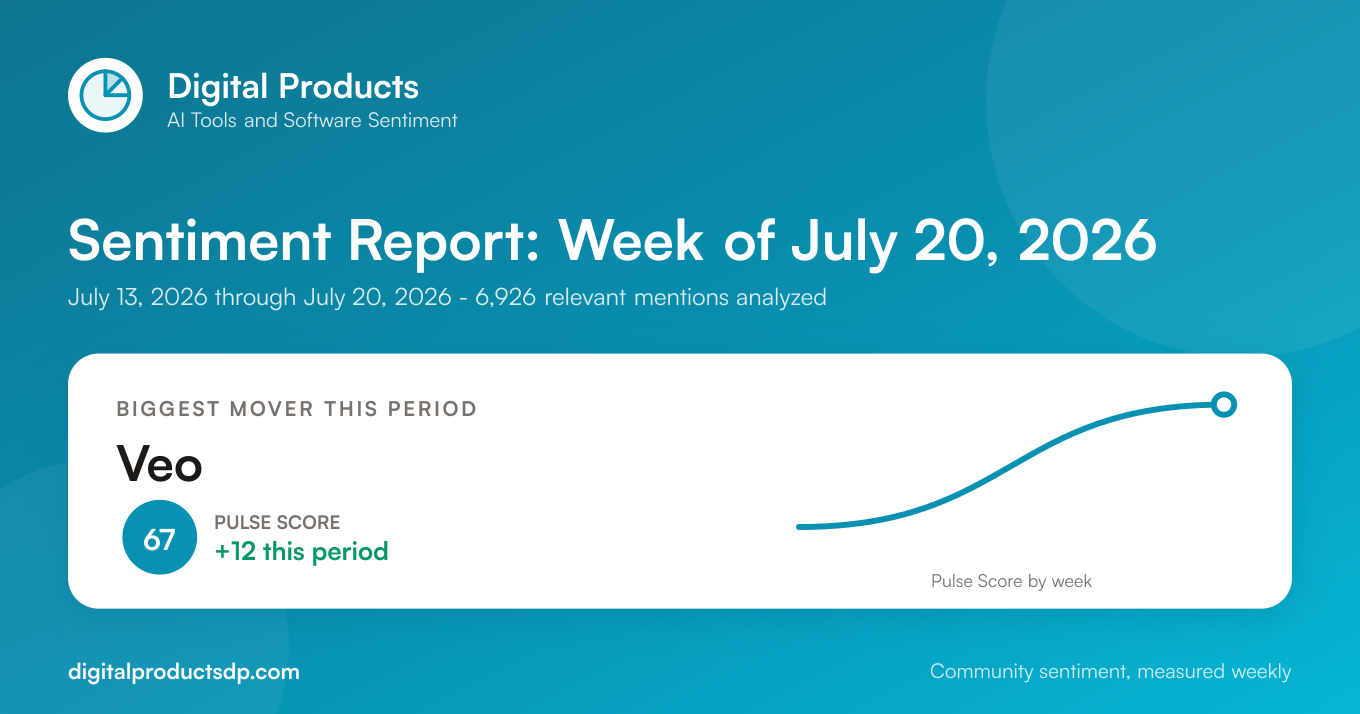
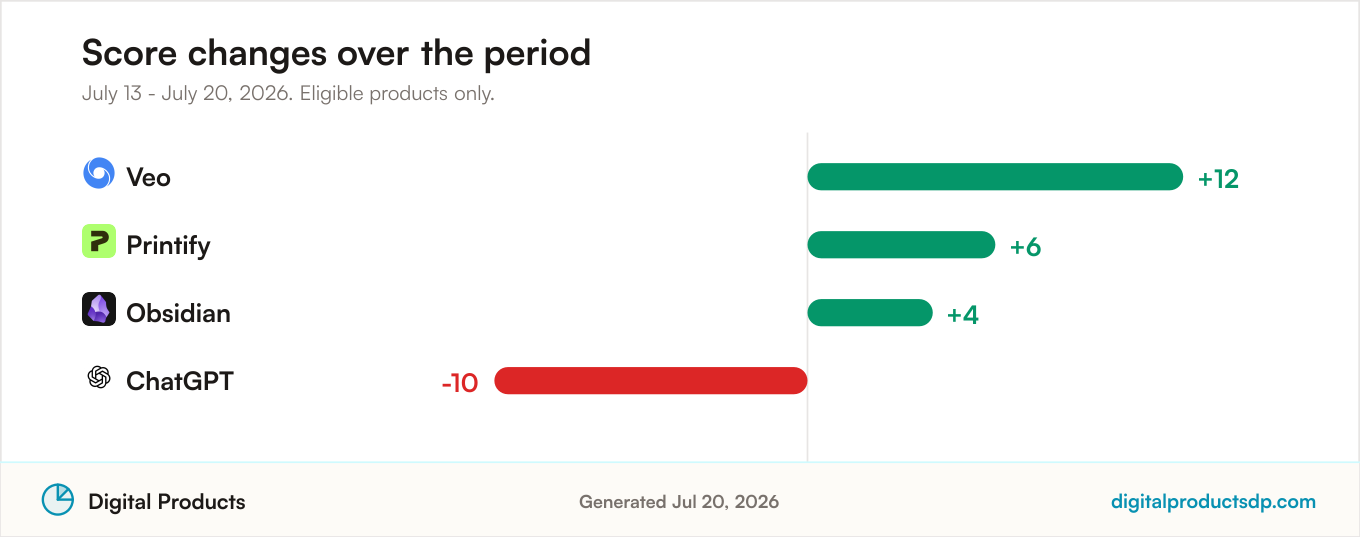
Veo (riser, +12, 55 to 67, based on 14 mentions). Veo posted the largest gain of the period. Its praise themes were led by AI quality with 10 mentions, Strong features with 10, and New releases with 8, a combination that points to positive chatter around fresh capability. Complaints were light and evenly spread, with Bugs, Performance, and Reliability each recorded twice, so the negative signal was thin relative to the praise. On a 14-mention base, the move is notable but should be read as an early-stage swing.
Printify (riser, +6, 49 to 55, based on 14 mentions). Printify climbed six points. Its praise leaned on Strong features with 7 mentions, followed by Compared to rivals with 3 and Good integrations with 2. The complaint side featured Downtime and Reliability, each with 4 mentions, plus one mention of Compared to rivals. That mix suggests appreciation for the feature set even as reliability questions lingered in the discussion.
Obsidian (riser, +4, 54 to 58, based on 200 mentions). Obsidian rose four points on the largest sample among the risers. Praise was dominated by Strong features with 110 mentions and Easy to use with 102, with Good integrations adding 29. Complaints centered on Missing features with 32 mentions, Bugs with 30, and UI frustrations with 25. The heavy praise around usability and depth appears to have outweighed the recurring gaps that users flagged.
ChatGPT (faller, -10, 51 to 41, based on 358 mentions). ChatGPT saw the steepest decline, and it did so on a large 358-mention base, which makes the move harder to dismiss as noise. Its complaint themes were led by AI quality with 181 mentions, then Bugs with 72 and Hallucinations with 66. Praise still registered, with Strong features at 89, AI quality at 50, and Easy to use at 49, but the volume of AI quality complaints far outweighed the AI quality praise this period.
Synthesia (faller, -6, 59 to 53, based on 15 mentions). Synthesia dropped six points on a small sample. Praise was modest, led by Strong features with 7 mentions, AI quality with 3, and Fair pricing with 2. Complaints were spread thinly across Pricing changes, Compared to rivals, and Downtime, each recorded twice. With so few mentions, the swing is best treated as a light read rather than a firm trend.
HeyGen (faller, -5, 58 to 53, based on 41 mentions). HeyGen slipped five points. Its praise leaned on Strong features with 19 mentions, AI quality with 12, and Easy to use with 7. Complaints were led by Compared to rivals with 8, Missing features with 7, and Pricing too high with 6, pointing to competitive comparisons and cost concerns weighing on the tone.
Spotlight: Origin
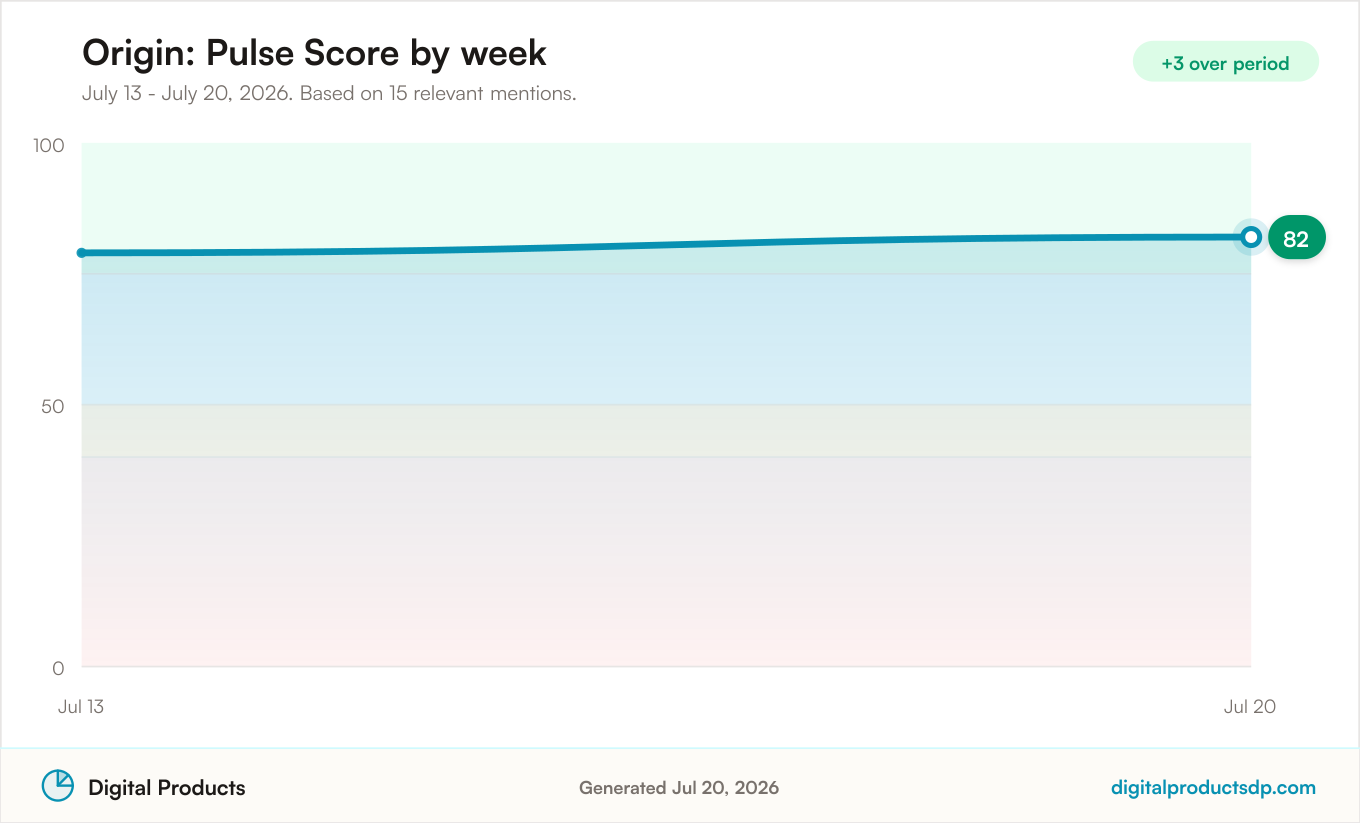
Origin, a software product, holds the top Pulse Score at 82, based on 15 mentions over the period. Its weekly series shows a rise from 79 on July 6, 2026 to 82 on July 13, 2026, a small but upward step that put it above the rest of the ranked field.
What stands out about Origin this period is the clean shape of its discussion. Its praise themes were Strong features with 14 mentions, Easy to use with 6, and Polished UI with 3, and no complaint themes were recorded at all. That absence of logged complaints is unusual and helps explain why its score sits at the high end, though it is also a function of the modest sample.
The practical caution is the same one that applies across the leaderboard: 15 mentions is a thin base, and a product with no recorded complaints one week can look different once volume grows. For now, the community signal around Origin is consistently positive, driven by its feature set and ease of use, and it earns the top spot on tone rather than on scale of discussion.
Themes Driving the Conversation
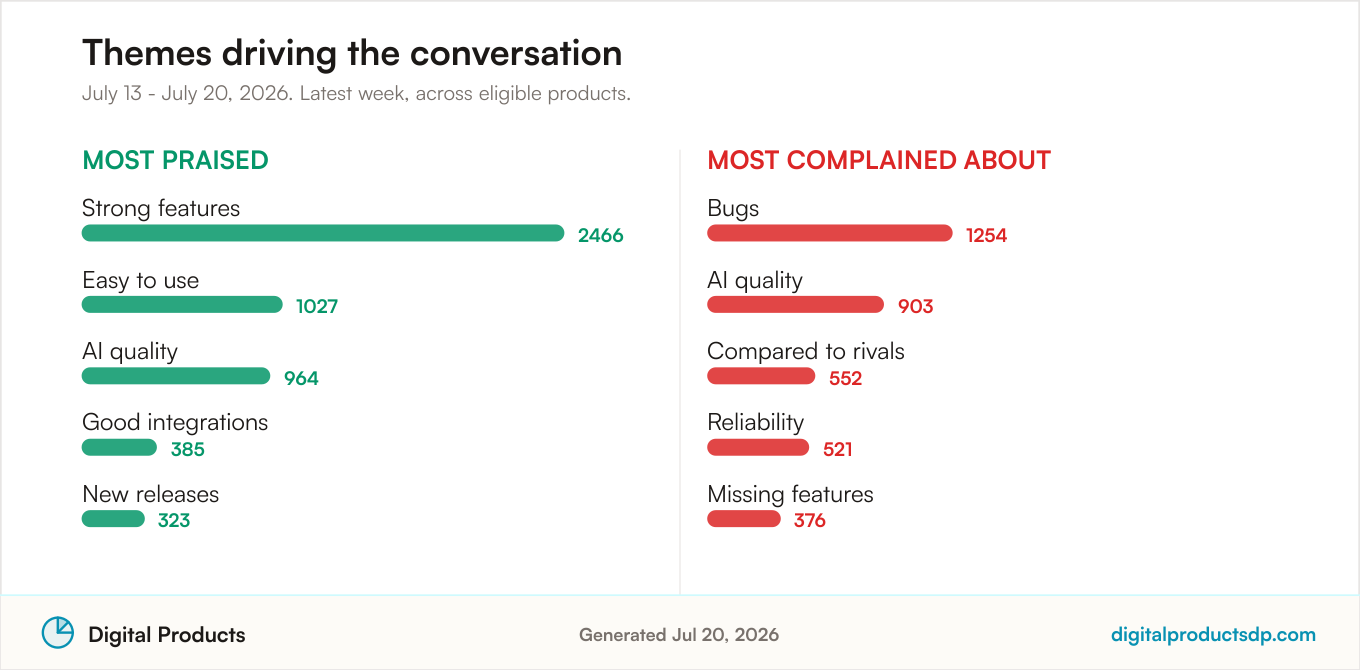
On the praise side, Strong features led by a wide margin with 2,466 mentions, followed by Easy to use with 1,027, AI quality with 964, Good integrations with 385, and New releases with 323. Strong features shows up as the leading praise for many products, including Origin, Mistral, Cursor, Claude, and Salesforce, which is why it towers over the rest of the list. AI quality as praise was concentrated in products like Midjourney, DeepSeek, Gemini, and Claude, while Easy to use featured heavily in the discussion around Obsidian, Canva, and Trello.
On the complaint side, Bugs led with 1,254 mentions, followed by AI quality with 903, Compared to rivals with 552, Reliability with 521, and Missing features with 376. Bugs surfaced across a broad range of products, including Cursor, GitHub Copilot, Salesforce, and Foxit. AI quality appears on both lists, and as a complaint it was heaviest for ChatGPT with 181 mentions and Grok with 268, showing that the same theme can pull sentiment in opposite directions depending on the product. Reliability drove complaints for DigitalOcean, Coinbase, and Shopify, while Compared to rivals shaped the conversation around HubSpot, Wix, and DeepSeek.
Watchlist
A large number of tracked products did not reach the 10-mention threshold this period and are therefore excluded from the rankings. This is a matter of discussion volume, not a judgment on quality. Several came close, including Attio with 9 relevant mentions, Aider with 8, Oracle Cloud with 8, Atlassian with 8, and VEED with 7. Others sat lower, such as Sublime Text and Leonardo AI with 6 each, Red Hat with 6, Writesonic with 5, and QuillBot, Scaleway, Tresorit, edX, Descript, and Thinkific with 4 each.
Products in this group can move into the ranked set quickly if a release, news item, or community thread lifts their mention counts past the threshold. Until that happens, any read on their sentiment would rest on too few data points to be stable, so we hold them here rather than assign them a rank. It is a reminder that most of the 2,248 tracked products simply do not generate enough weekly public discussion to score reliably in a given period.
What To Watch Next Week
First, watch whether Veo holds its gain. Its jump from 55 to 67 came on just 14 mentions with praise centered on AI quality and new releases, so the question is whether that positive tone persists as volume grows or fades as an early spike.
Second, watch ChatGPT's AI quality complaints. With 181 AI quality complaint mentions against 50 AI quality praise mentions this period, and a 10-point drop on a large 358-mention base, the balance between those two is the clearest thing to monitor for whether sentiment stabilizes or slides further.
Third, watch the software category and Origin specifically. Software led at 82 and Origin topped the leaderboard with no recorded complaints, so it is worth monitoring whether that clean signal continues once its mention count builds beyond the current 15.
Frequently Asked Questions
Which product had the highest Pulse Score this period?
Origin, a software product, had the highest Pulse Score at 82, based on 15 mentions over the period.
Which product moved the most this period?
Veo was the biggest riser, climbing from 55 to 67 for a 12-point gain, based on 14 mentions, while ChatGPT was the biggest faller, dropping from 51 to 41 for a 10-point decline, based on 358 mentions.
What was the overall category mood?
Shifts were small, with software leading and firming from 79 to 82, e-commerce rising from 49 to 52, and lower-scoring categories like business at 40 and communication at 40 anchoring the bottom.
How many mentions were analyzed this period?
A total of 6,926 relevant mentions were analyzed across the 58 products that were eligible for ranking, out of 2,248 tracked products.
About This Data
Pulse Scores summarize the tone of public online discussion on a 0-100 scale and reflect community sentiment. They are not a verdict on a product's quality and not a recommendation. We report on complete calendar weeks only, and products with fewer than 10 relevant mentions in the period are excluded from rankings to avoid unstable reads on thin samples.
Public discussion is collected from Hacker News, Stack Exchange, GitHub, Bluesky, the Apple App Store, and YouTube. Automated sentiment analysis can misread sarcasm, jokes, or niche context, mention volumes vary widely between products, and scores can move week to week. Any company that wants to respond is welcome to reach out. For how scores are calculated, see our methodology.