AI Tools and Software Sentiment Report: Week of August 3, 2026
August 4, 2026
Welcome to this week's rundown of aggregated public online discussion about the AI tools and broader software products we track. This report reflects community sentiment gathered from public conversation, not a verdict on product quality. Every figure below traces to the sentiment data collected for the reporting window.
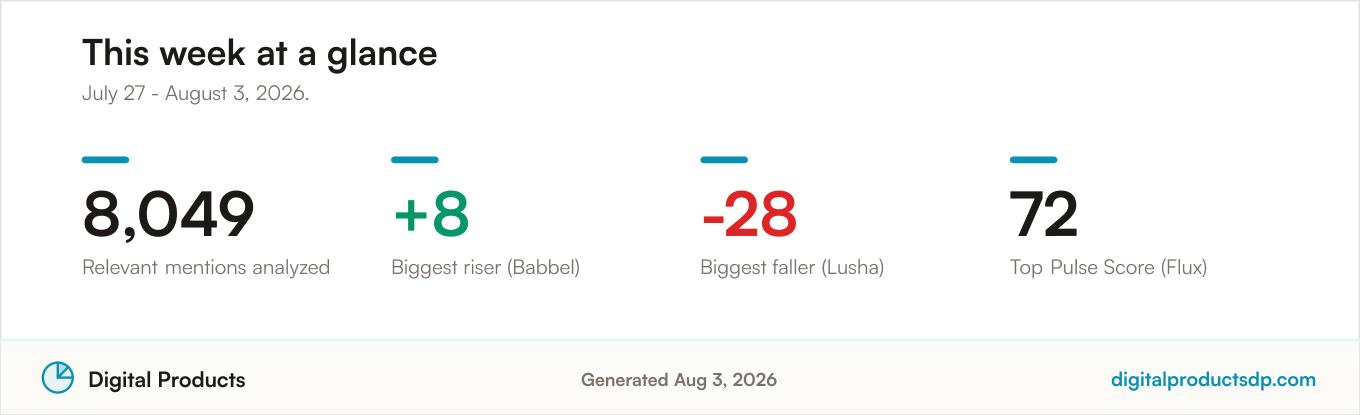
The numbers here cover mentions analyzed for July 27, 2026 through August 3, 2026. Across that window we processed 8,049 relevant mentions spread across 2,248 tracked products, of which 66 cleared the minimum threshold of 10 relevant mentions needed to earn a ranking. Everything that follows is drawn from that pool of public chatter.
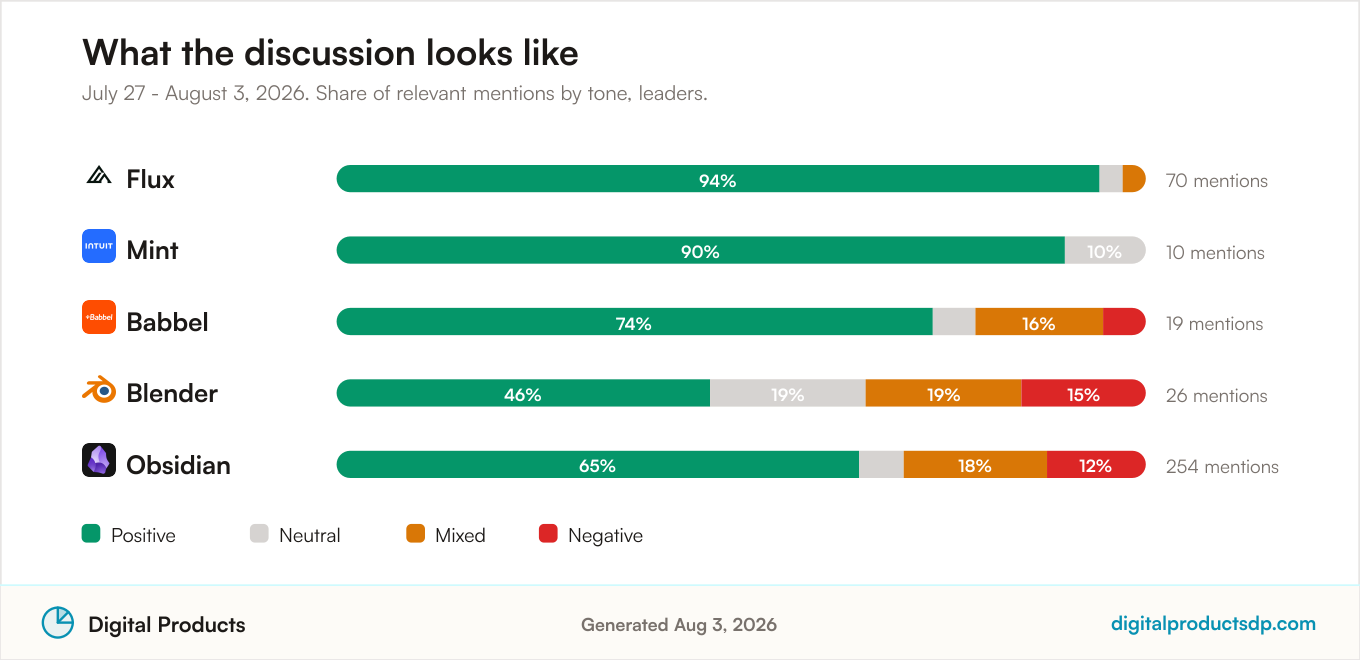
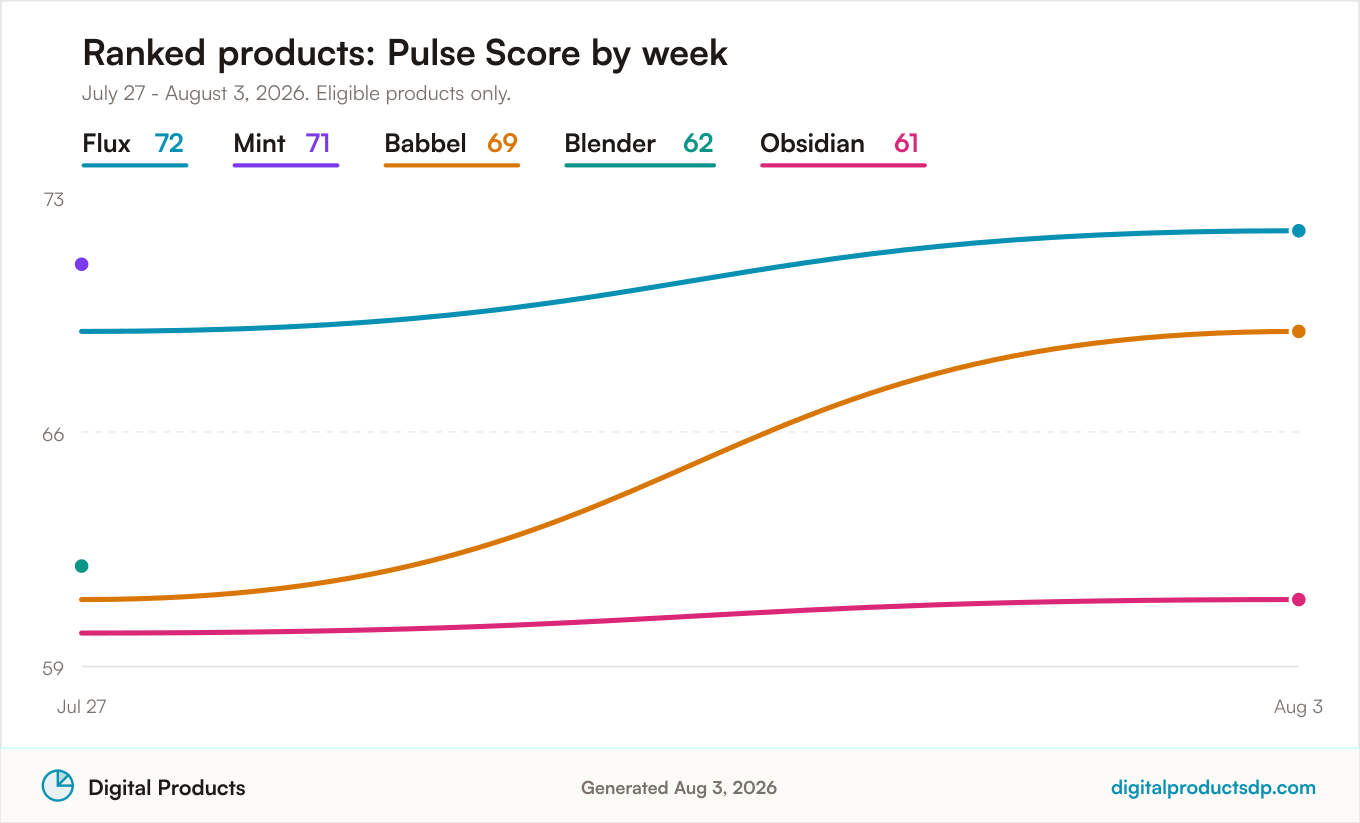
Flux sits at the top of the leaderboard with a Pulse Score of 72, based on 70 mentions over the period. Mint follows at 71, though that read rests on just 10 mentions, the minimum needed to qualify. Babbel lands third at 69 based on 19 mentions, with Blender at 62 based on 26 mentions and Obsidian at 61 based on a far larger 254 mentions.
The spread among these leaders is worth noting. Obsidian's score of 61 carries the weight of the deepest sample in the top five, which makes its position more stable than the thinner reads above it. Mint and Babbel, by contrast, are built on small mention counts, so their scores can move more sharply week to week. The leaderboard rewards tone, and here the tone at the top skews positive across both AI and non-AI categories.
Category View
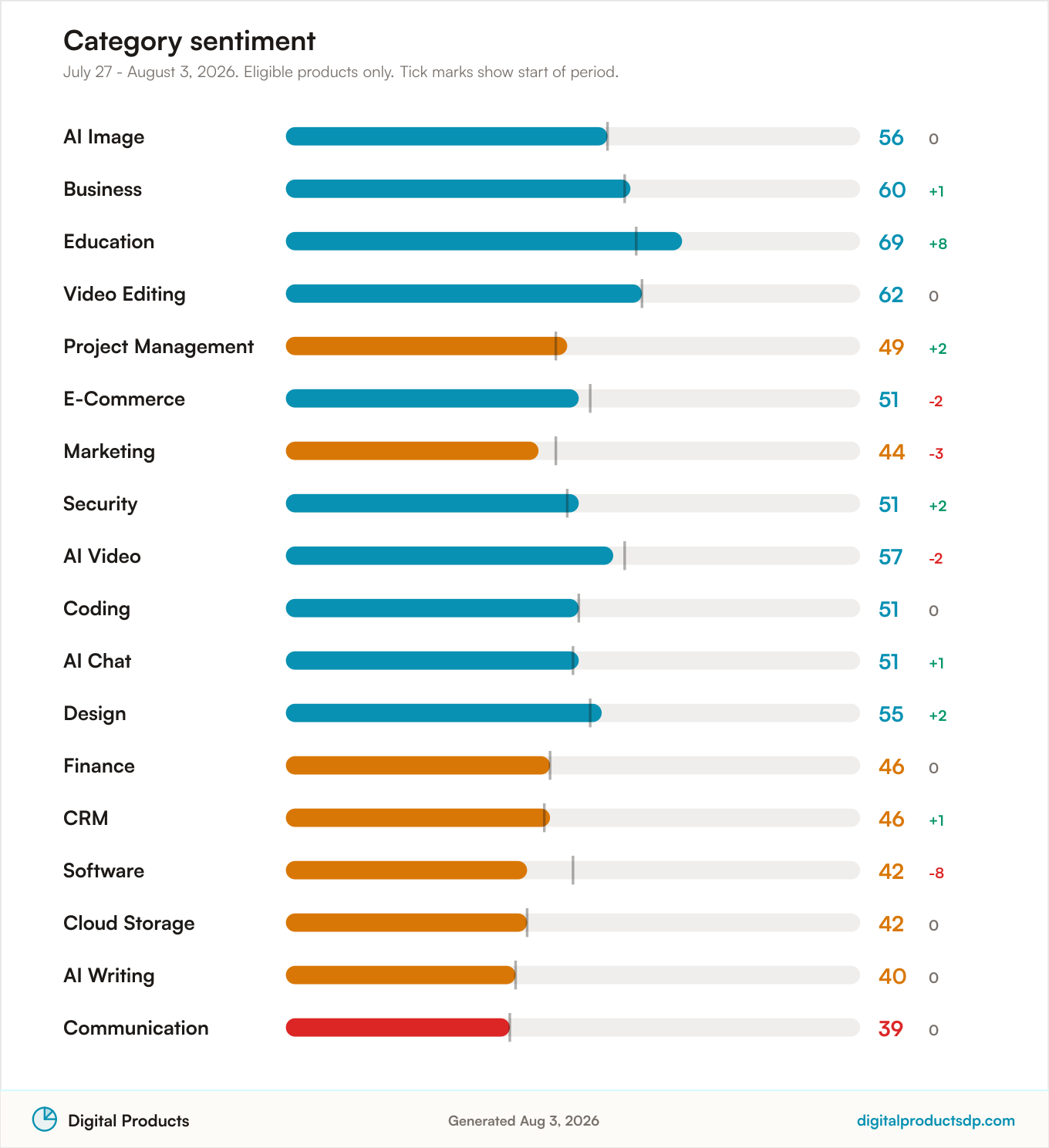
At the category level, education showed the largest positive shift, moving from 61 to 69 over the period. Business ticked up from 59 to 60, design from 53 to 55, and security from 49 to 51. Several categories held flat, including ai-image at 56, video-editing at 62, coding at 51, finance at 46, and cloud-storage at 42. On the downside, software slid from 50 to 42, marketing eased from 47 to 44, e-commerce from 53 to 51, and ai-video from 59 to 57. The lowest-sitting category was communication at 39, unchanged across the window. These are averages across eligible products only, so a single sharp mover inside a small category can pull the group.
Biggest Movers
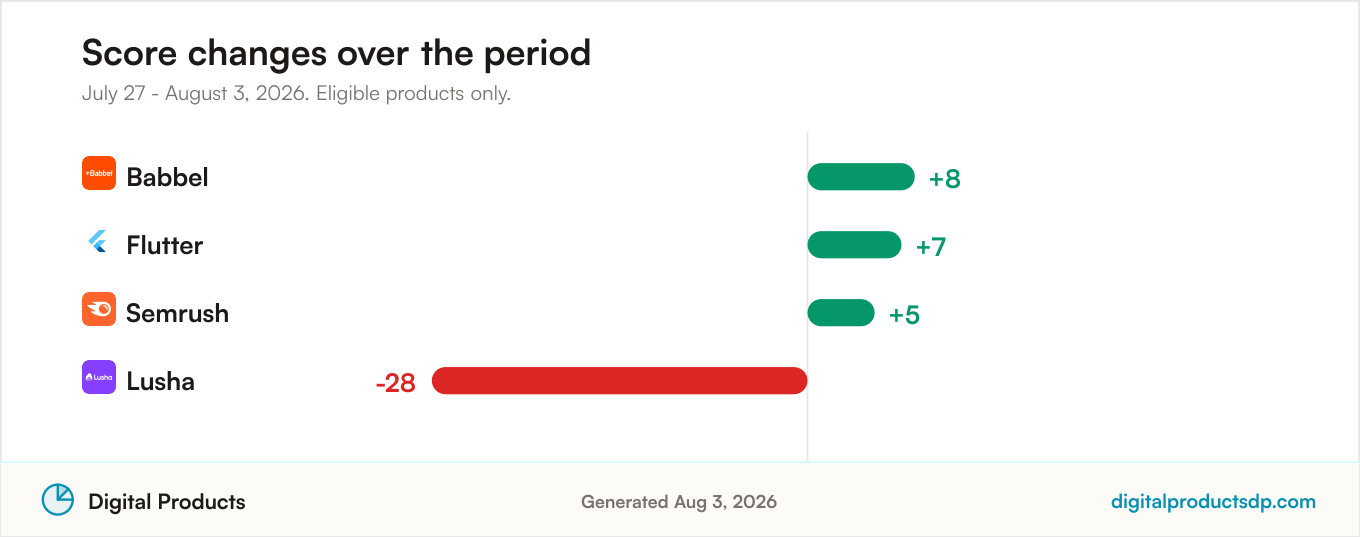
Babbel (up 8, from 61 to 69, based on 19 mentions): The education product posted the strongest rise of the period. Its praise themes leaned heavily on ease of use, with 20 mentions, and strong features, with 19 mentions, alongside 8 mentions comparing it favorably to rivals. Complaint volume was light by comparison, with just a single mention each for learning curve, comparison to rivals, and missing features. That lopsided balance between plentiful praise and sparse complaints is consistent with an upward move.
Flutter (up 7, from 51 to 58, based on 15 mentions): Flutter's climb was anchored by praise for strong features, cited 9 times, with easy to use and mobile app each drawing 2 mentions. On the complaint side, UI frustrations and missing features each drew 2 mentions and pricing too high one. With praise concentrated on capability and complaints staying thin, the tone shifted upward across the window.
Semrush (up 5, from 56 to 61, based on 45 mentions): The marketing product rose on a broader base than the other risers. Praise centered on strong features, with 27 mentions, followed by AI quality at 8 and good integrations at 7. Complaints were led by comparison to rivals at 7, pricing too high at 3, and bugs at 3. The praise-heavy mix, resting on a healthier sample of 45 mentions, supports a more grounded read than the thinner risers above it.
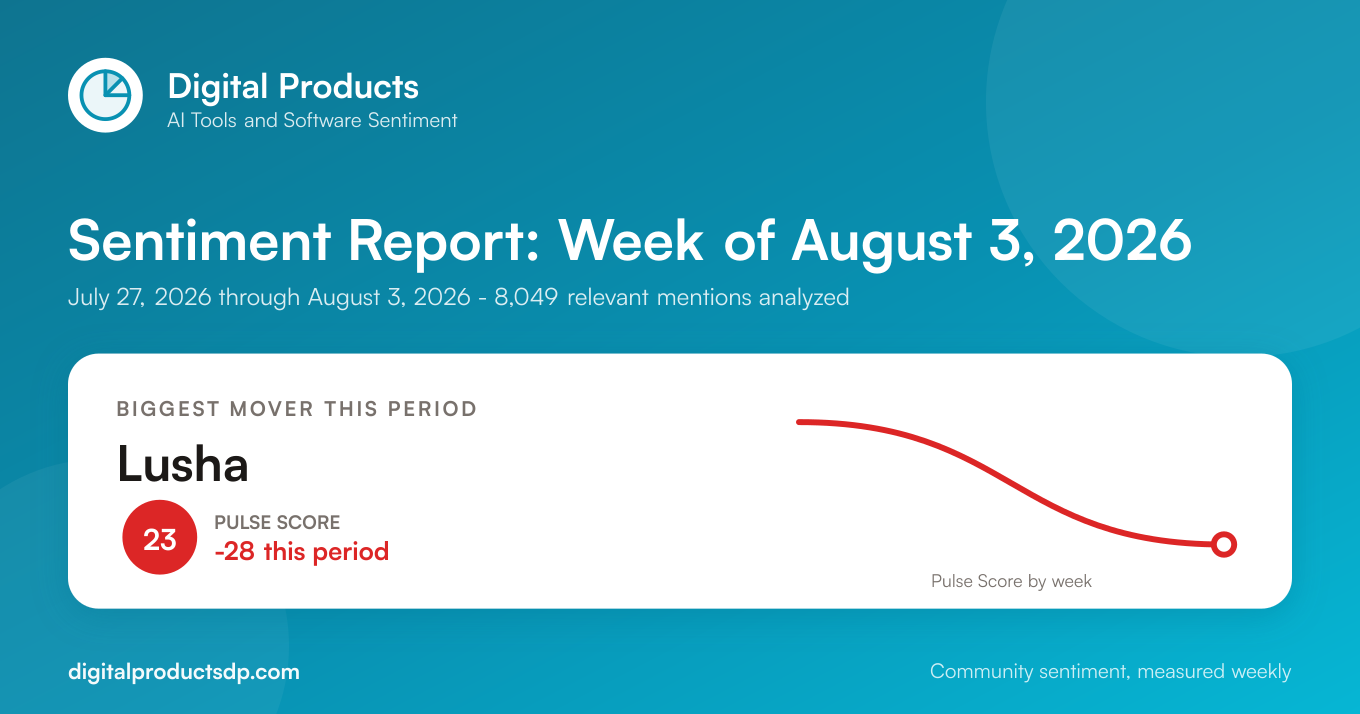
Lusha (down 28, from 51 to 23, based on 10 mentions): Lusha recorded the steepest fall of the period, and its theme breakdown explains why. Praise was nearly absent, with just a single mention each for strong features and good integrations. Complaints dominated, led by privacy concerns at 9 mentions, security-related discussion at 3, and downtime at 1. On a sample of only 10 mentions, a cluster of privacy-focused complaints can drive a dramatic swing, so this read should be treated as a thin and volatile one.
JFrog (down 14, from 52 to 38, based on 11 mentions): The fall here was reliability-driven. Complaints were led by bugs at 19 mentions and reliability at 14, with missing features at 6. Praise was comparatively muted, with strong features at 4, security praise at 3, and new releases at 3. When complaint volume around bugs and reliability outweighs praise this clearly, a downward move follows.
Shopify (down 7, from 48 to 41, based on 243 mentions): Shopify's decline stands out because it rests on the largest sample among the fallers, 243 mentions. Its praise was substantial, led by strong features at 108 mentions, good integrations at 41, and easy to use at 36. But complaints were heavy too, with comparison to rivals at 52, reliability at 47, and missing features at 45. The move down reflects competitive comparison and reliability chatter weighing against an otherwise feature-positive conversation.
Spotlight: Flux
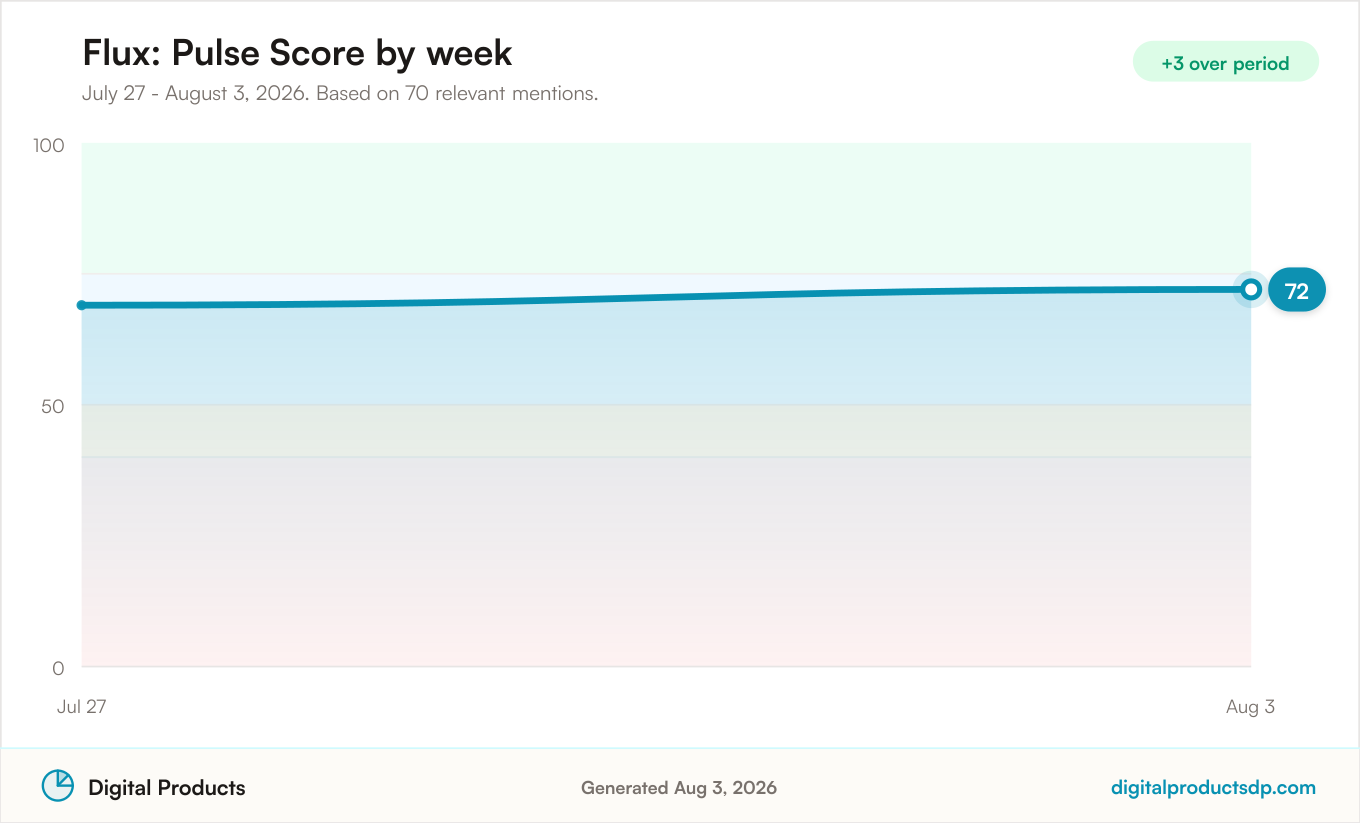
Flux, in the ai-image category, took the top Pulse Score this period at 72, based on 70 mentions. Its weekly series shows a rise from 69 on July 20, 2026 to 72 on July 27, 2026, a steady climb rather than a sudden jump. That consistency, paired with a reasonable sample for a specialized image tool, makes it the clearest positive read among the leaders.
The praise themes tell a coherent story. New releases led with 63 mentions, followed by strong features at 58 and AI quality at 55. For an AI image tool, that combination points to a conversation focused on fresh capability and output quality, the two things public discussion of generative image products tends to reward most.
Complaints were present but modest in volume. Bugs drew 7 mentions, performance 5, and reliability 3. Against praise counts in the fifties and sixties, that complaint load is light, which is consistent with a score sitting at the top of the board. The read here is that the community conversation around Flux this period skewed positive on new output and features, with only scattered friction reported.
Themes Driving the Conversation
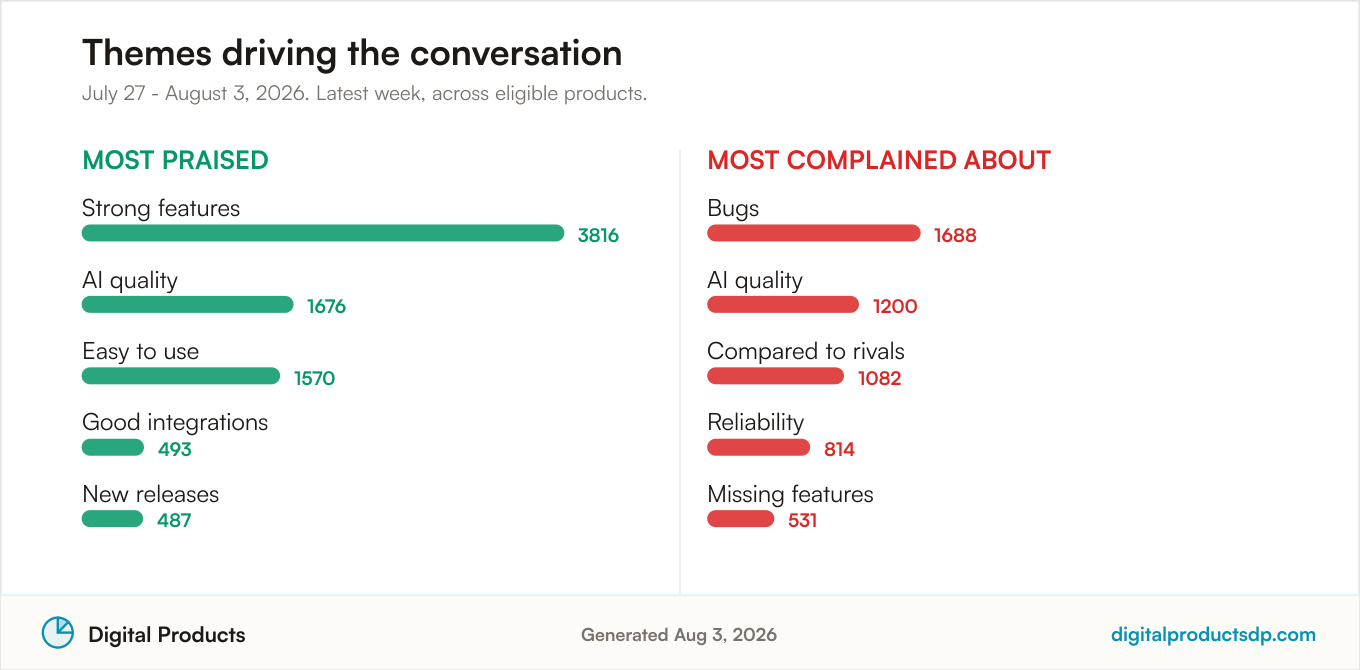
On the praise side, strong features was by far the most-discussed theme this period, with 3,816 mentions, appearing across a wide swath of products from Claude Code and Claude to Salesforce, Shopify, and Obsidian. AI quality followed with 1,676 mentions, driven by conversation around products like Claude, Gemini, DeepSeek, and Midjourney. Easy to use drew 1,570 mentions, with Canva, Obsidian, and Babbel among the products pushing it. Good integrations at 493 mentions and new releases at 487 rounded out the top praise themes, with GitHub Copilot and Coinbase notable contributors to the new releases conversation.
On the complaint side, bugs led with 1,688 mentions, surfacing across products including Vercel, Stripe, and McAfee, all of which carried heavy bug-related discussion. AI quality also appeared as a complaint theme with 1,200 mentions, notably around ChatGPT, Gemini, and Grok, where quality cut both ways in the conversation. Comparison to rivals drew 1,082 mentions, reliability 814, and missing features 531. The presence of AI quality on both the praise and complaint lists is a reminder that a single theme can pull in opposite directions depending on the product and the tone of the discussion around it.
Watchlist
A large number of tracked products did not reach the 10-mention threshold this period and so are absent from the rankings. This is a matter of discussion volume, not a judgment on quality. Products fall below the line simply because public conversation about them was too thin this week to produce a stable read.
Several products landed just under the cutoff with 9 mentions each, including Framer in design, Aider in coding, Bluehost in cloud-storage, and Jira in business. A few sat at 8 mentions, among them Attio in crm, Jasper in ai-writing, Shippo in business, Deel in business, NordPass in security, and Veo in ai-video. Others registered lighter volume still, such as AWeber and ActiveCampaign in marketing at 7 each, Box, Google Photos, and OneDrive in cloud-storage at 7 each, and Luma AI and Pika in ai-video at 7 each. Products like these can cross into the rankings quickly if their mention counts pick up, so they are worth monitoring even though they are not scored this period.
Beyond these near-misses, the bulk of the tracked catalog registered very few or zero relevant mentions in the window. That long tail is normal for a catalog this large, where a small share of products draws the majority of public discussion in any given week.
What To Watch Next Week
First, watch whether Flux holds the top spot. Its rise from 69 to 72 was gradual and its complaint load was light, but its 70-mention sample is modest, so a shift in the new releases conversation that drove 63 of its praise mentions could move the read quickly.
Second, keep an eye on the thin-sample fallers, Lusha and JFrog. Lusha's drop to 23 rested on just 10 mentions dominated by privacy concerns, and JFrog's slide to 38 on 11 mentions was bug and reliability driven. Because both reads are built on small samples, they could rebound or deepen depending on how much discussion they draw next week.
Third, watch the software category, which fell from 50 to 42, the sharpest category decline of the period. With bugs and reliability leading the complaint themes overall, and products like Vercel and Stripe carrying heavy bug and reliability mention counts, it is worth tracking whether that pressure eases or spreads.
Frequently Asked Questions
Which product had the highest Pulse Score this period?
Flux, in the ai-image category, had the highest Pulse Score at 72, based on 70 mentions over the period.
Which product moved the most this period?
Lusha moved the most, falling 28 points from 51 to 23 based on 10 mentions. On the upside, Babbel rose the most, gaining 8 points from 61 to 69 based on 19 mentions.
What was the overall category mood this period?
Mixed. Education led the gains, rising from 61 to 69, while software fell the most, from 50 to 42. Many categories held flat, and communication sat lowest at 39.
How many mentions were analyzed this period?
A total of 8,049 relevant mentions were analyzed across 2,248 tracked products, of which 66 met the 10-mention threshold to be ranked.
About This Data
Pulse Scores summarize the tone of public online discussion on a 0-100 scale. They reflect community sentiment, not a verdict on a product's quality and not a recommendation. We report on complete calendar weeks only, and products with fewer than 10 relevant mentions in the period are excluded from rankings to avoid unstable reads on thin samples.
Public discussion is collected from Hacker News, Stack Exchange, GitHub, Bluesky, the Apple App Store, and YouTube. Automated sentiment analysis can misread sarcasm, jokes, or niche context. Mention volumes vary widely between products, and scores can move week to week, so small-sample reads deserve extra caution. Any company that wants to respond to what it sees here is welcome to reach out.
For more on how these scores are calculated, see our methodology.