AI Tools and Software Sentiment Report: Week of August 10, 2026
August 11, 2026
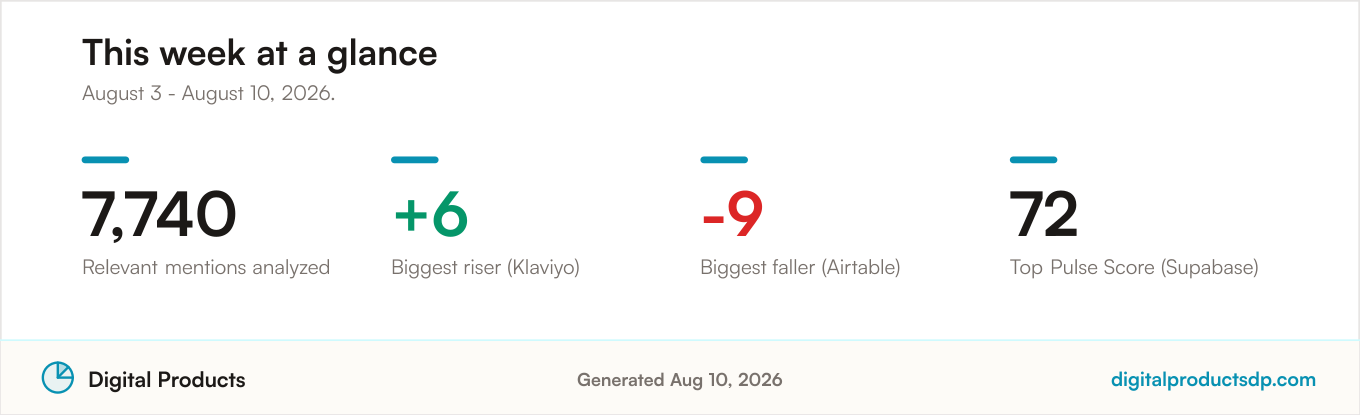
This week's sentiment report covers aggregated public online discussion of tracked AI tools and software, drawing on mentions analyzed for August 3, 2026 through August 10, 2026. Across that window we processed 7,740 relevant mentions spanning 73 products that cleared the ranking threshold, out of 2,248 products tracked in total. The figures below describe the tone of public chatter, not a verdict on any product's underlying quality.
The reporting period running from August 3, 2026 through August 10, 2026 produced a familiar pattern. A small group of developer-focused and creative products held the top of the leaderboard, a cluster of well-known names slipped, and complaint volume stayed heavily weighted toward bugs and reliability. Because sentiment is measured on a 0-100 Pulse Score scale, small week-to-week shifts are best read as directional signals rather than precise rankings, especially where mention counts are thin.
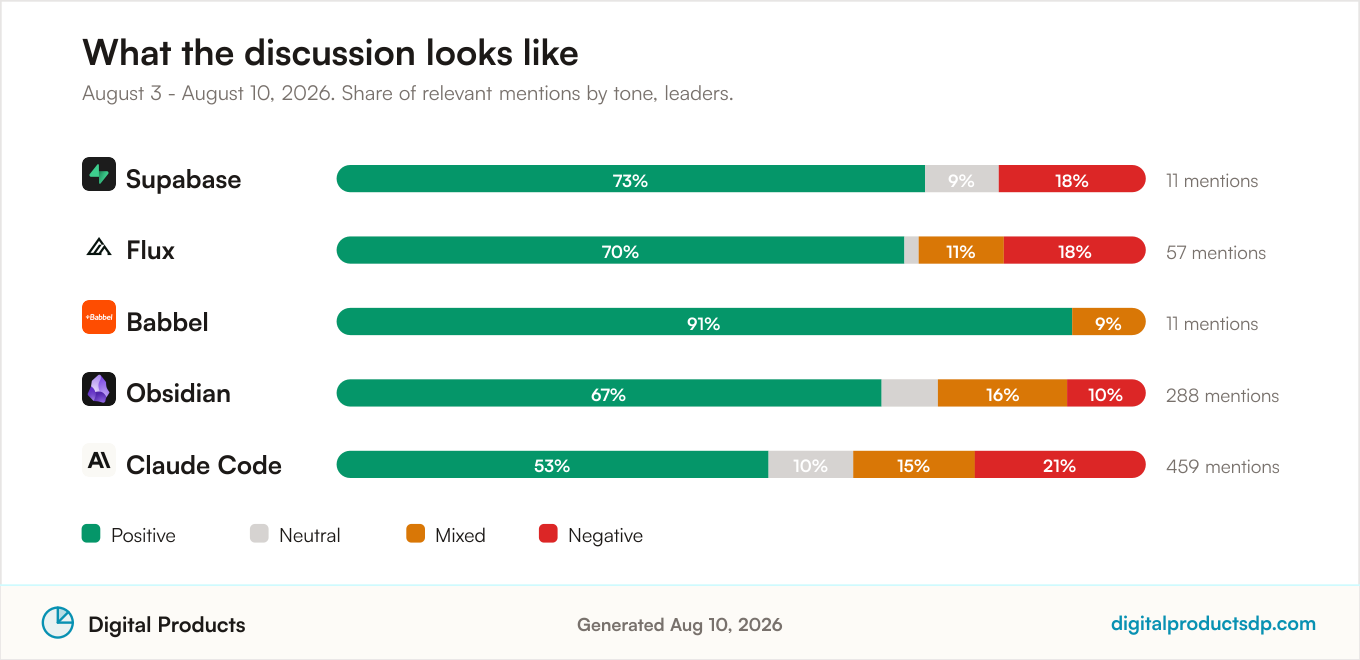
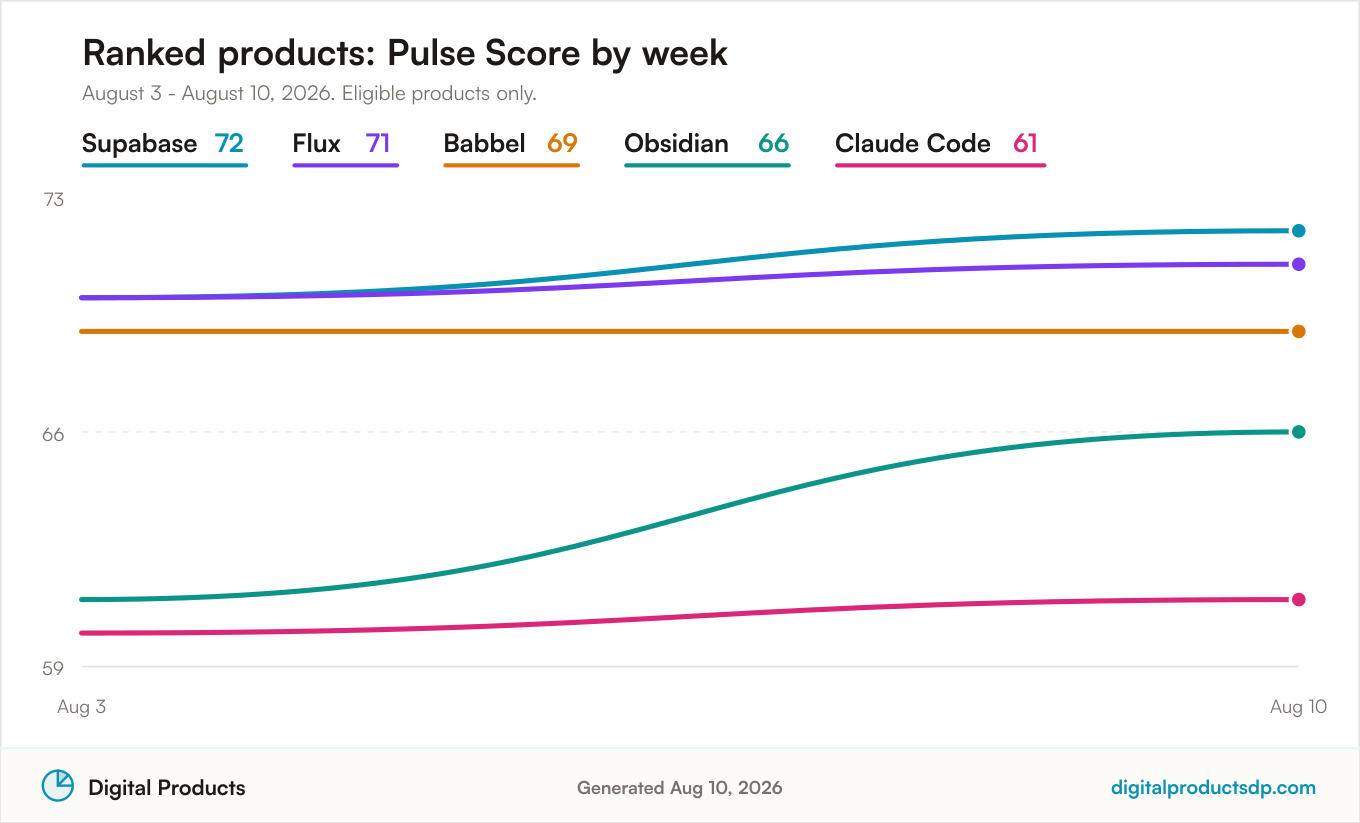
Supabase tops the board with a Pulse Score of 72, based on 11 mentions over the period. It is followed closely by Flux, an AI image tool, at 71 based on 57 mentions, and Babbel, the language education product, at 69 based on 11 mentions. Two of the three leaders sit on small samples, so their positions should be read with that caveat in mind. Obsidian, a project management and note tool, holds a score of 66 on a much heavier 288 mentions, which makes its standing one of the more stable reads at the top.
Claude Code rounds out the visible leaders at 61, based on 459 mentions, the largest sample among the top five. That combination of a strong score and heavy discussion volume is notable because sentiment tends to compress as mention counts grow. The gap between the top score of 72 and the fifth-place score of 61 is modest, underscoring that the leading tier this period is tightly bunched rather than dominated by a single standout.
Category View
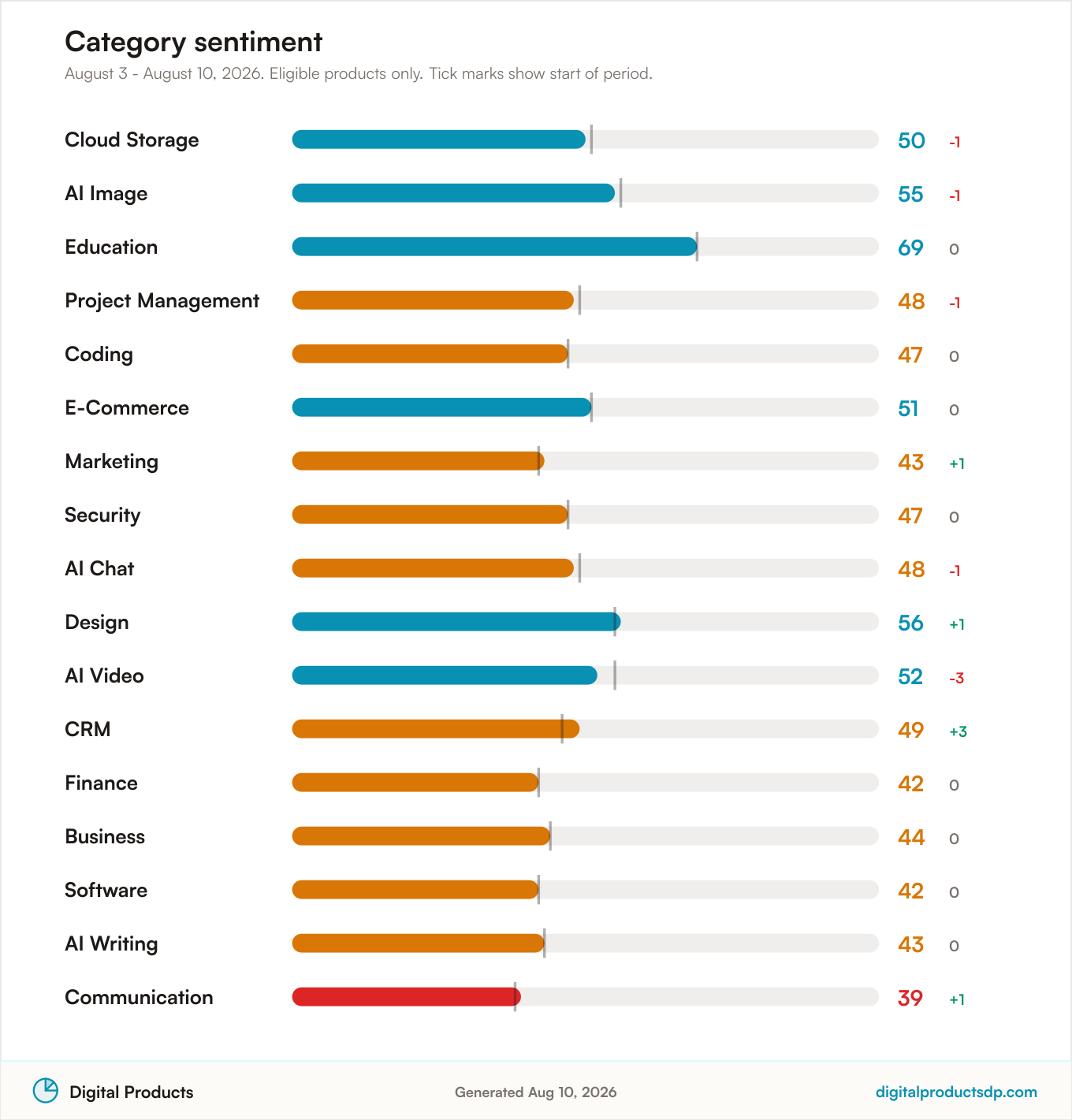
Category averages moved only slightly across the period, which is typical for aggregated groups where individual product swings tend to cancel out. Education held steady at 69, the highest category average recorded, while ai-video fell the most at the category level, moving from 55 to 52. CRM rose from 46 to 49, the largest positive category shift, and marketing edged up from 42 to 43. Coding held flat at 47, security stayed at 47, and finance stayed at 42. Communication remained the lowest-scoring category, inching from 38 to 39. The stability across most groups suggests that the notable action this period happened at the level of individual products rather than across whole categories.
Biggest Movers
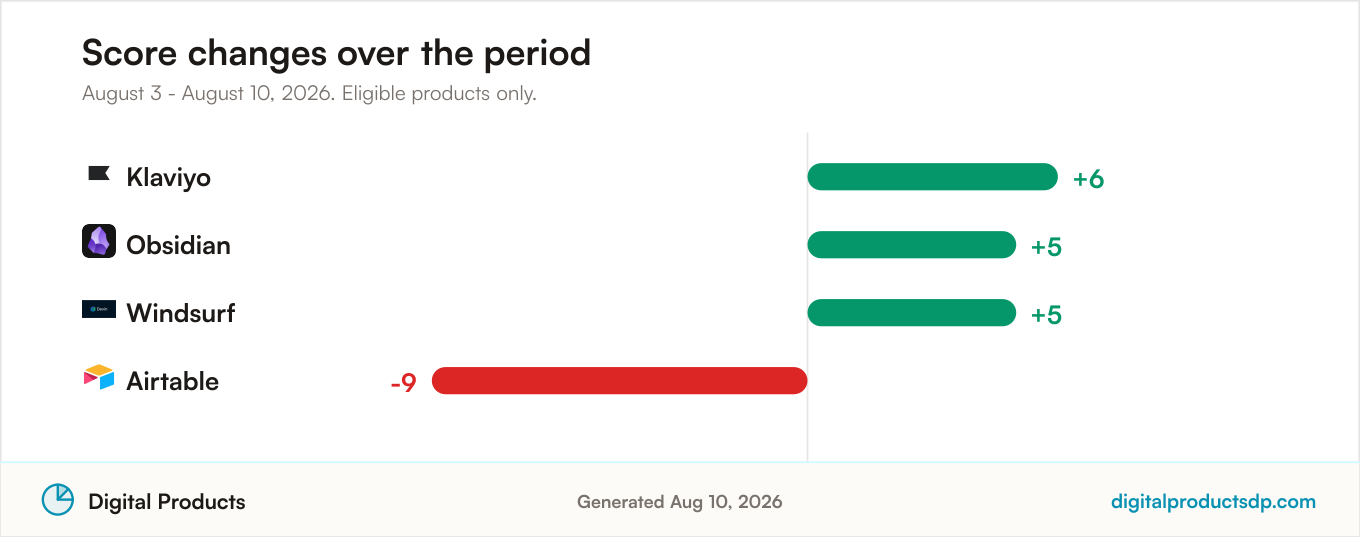
Klaviyo (riser, plus 6, from 46 to 52, based on 33 mentions). The marketing platform posted the largest positive move of the period. Its praise chatter clustered around Strong features with 12 mentions and New releases with 12 mentions, alongside AI quality with 10 mentions, a mix that suggests recent product activity drew favorable notice. The lift came despite ongoing complaint themes led by Reliability with 9 mentions and Bugs with 8 mentions, so the improvement in tone appears to have outweighed rather than erased those concerns.
Obsidian (riser, plus 5, from 61 to 66, based on 288 mentions). Obsidian's rise is the most heavily sampled of the risers, which makes it the most durable-looking move. Praise leaned on Strong features with 271 mentions and Easy to use with 233 mentions, plus Good integrations with 83 mentions. Complaints were comparatively light and centered on UI frustrations with 29 mentions and Missing features with 27 mentions, a pattern consistent with a mature tool whose core is well liked even as some users push for polish.
Windsurf (riser, plus 5, from 40 to 45, based on 40 mentions). The coding tool climbed off a low base. Its praise was modest, led by Strong features with 11 mentions and Good integrations with 10 mentions, while complaints outweighed praise in raw counts, with Bugs at 17 mentions, Missing features at 13, and Reliability at 9. The score improvement from a starting point of 40 suggests the tone of discussion shifted upward even while unresolved bug and reliability chatter persisted.
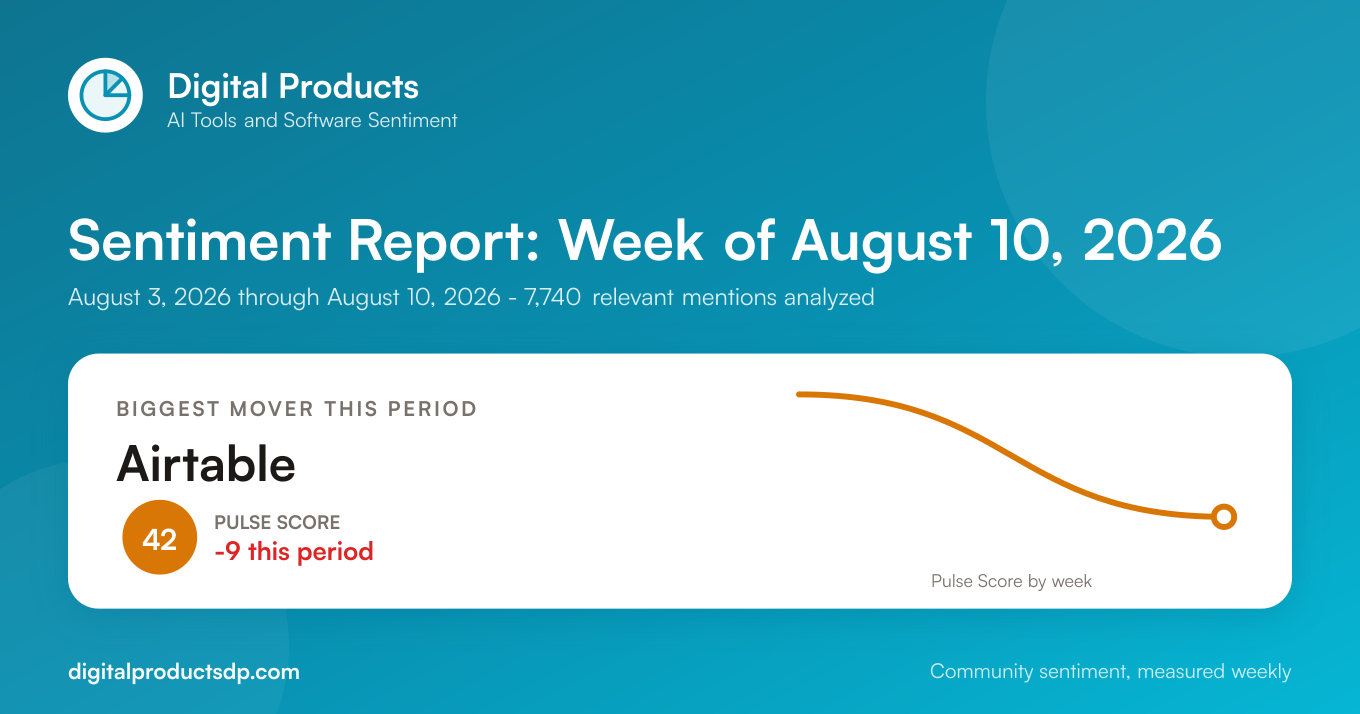
Airtable (faller, minus 9, from 51 to 42, based on 156 mentions). Airtable recorded the steepest drop of the period. The complaint mix points to the cause: Pricing changes led complaints with 44 mentions, ahead of Compared to rivals at 34 and Missing features at 32. Praise still registered around Strong features with 32 mentions and Easy to use with 24, but pricing-related discontent appears to have driven the negative swing in tone.
DALL-E (faller, minus 6, from 47 to 41, based on 56 mentions). The AI image tool slid as complaint chatter about AI quality reached 39 mentions, well ahead of its AI quality praise at 14 mentions. Compared to rivals added 21 complaint mentions and Missing features another 16. With negative AI quality discussion outnumbering the positive by a wide margin, the drop lines up with a period where users were weighing output against alternatives.
Pika (faller, minus 4, from 56 to 52, based on 22 mentions). The ai-video tool eased back on a thinner sample. Praise centered on Strong features with 12 mentions and Easy to use with 7, while complaints were led by Bugs at 8 mentions, UI frustrations at 5, and Reliability at 4. The move is smaller and rests on fewer mentions than the other fallers, so it is best read as a mild softening rather than a decisive shift.
Spotlight: Supabase
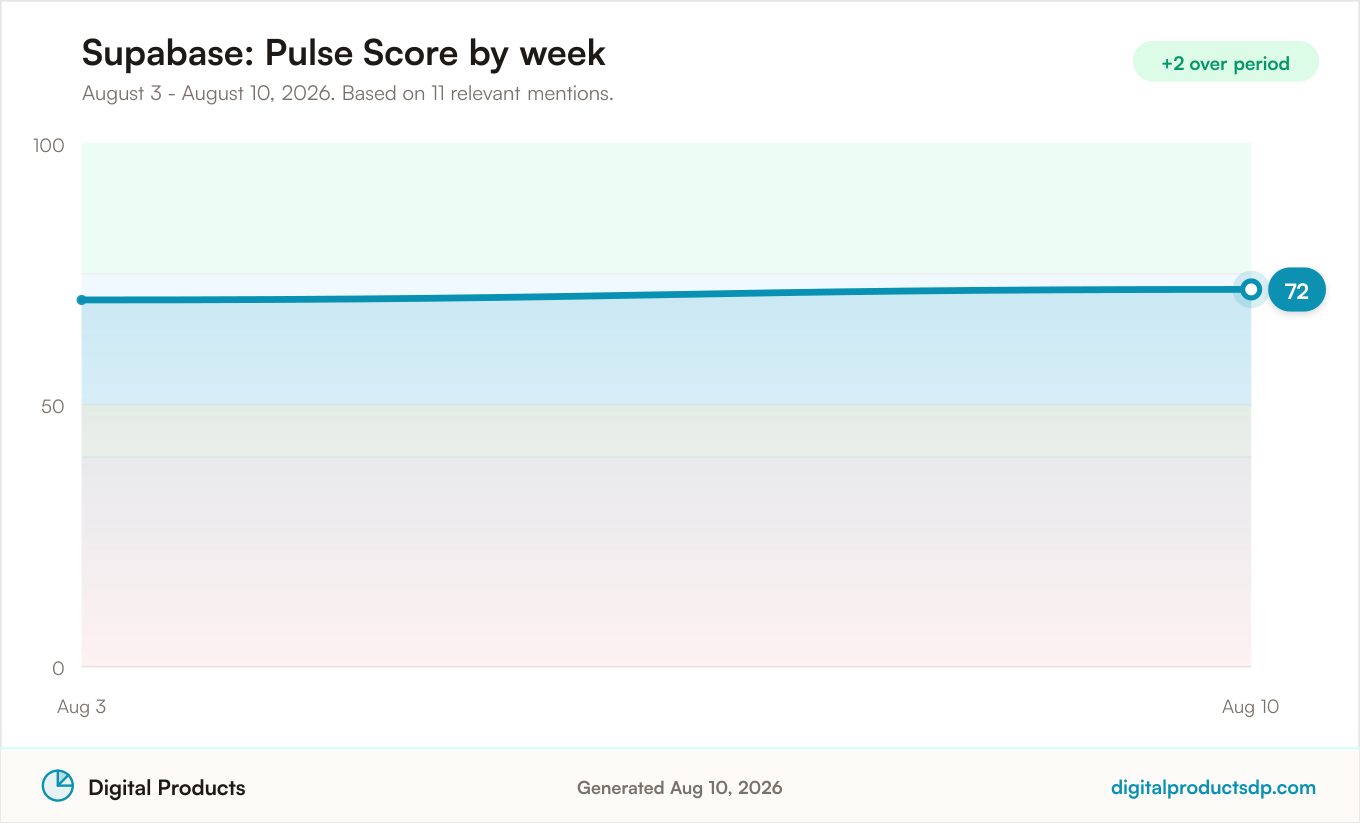
Supabase leads the board with a Pulse Score of 72, based on 11 mentions over the period. Its weekly series shows a steady climb, moving from 70 on July 27, 2026 to 72 on August 3, 2026. That is a small change, but it kept the cloud-storage product at the front of the pack even as the broader cloud-storage category average dipped slightly from 51 to 50.
The theme breakdown helps explain the favorable tone. Praise was led by Strong features with 61 mentions, Easy to use with 58 mentions, and Performance with 41 mentions, a combination that points to appreciation for both capability and day-to-day usability. Complaints were notably light, with Bugs at just 5 mentions, Downtime at 4, and Reliability at 4. That low complaint volume relative to praise is a meaningful part of why the score sits at the top.
The important caveat is sample size. With 11 mentions, Supabase clears the ranking threshold but sits on a thin base, meaning its position can move more easily than products discussed hundreds of times. The read here is that public discussion of Supabase was both positive and heavily feature-focused this period, while acknowledging that a small number of mentions carries more week-to-week volatility than the leaderboard's heavier-sampled entries.
Themes Driving the Conversation
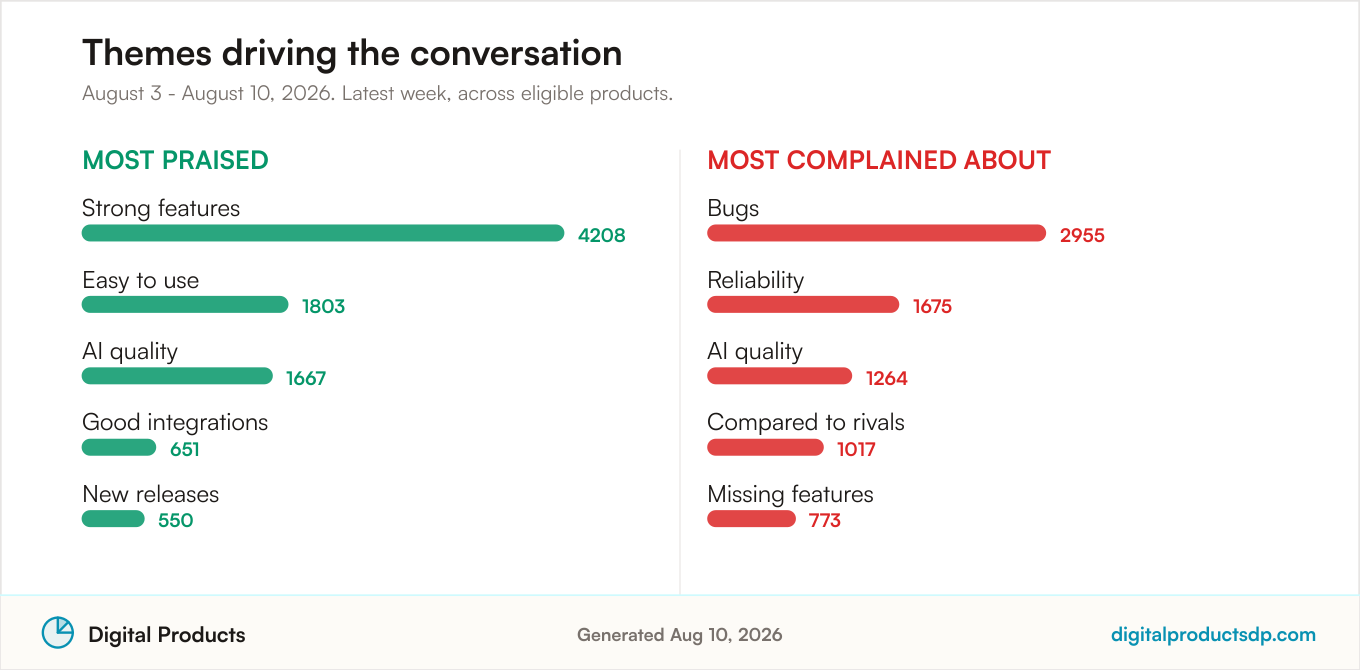
On the praise side, Strong features dominated with 4,208 mentions, far ahead of any other positive theme. Easy to use followed with 1,803 mentions and AI quality with 1,667 mentions, then Good integrations with 651 and New releases with 550. The scale of the Strong features theme reflects products across the board, from Claude Code's 470 feature-praise mentions and Claude's 384 to Obsidian's 271 and Canva's 227. Easy to use was carried heavily by Canva with 290 mentions and Obsidian with 233, while AI quality praise was concentrated in chat and model products such as Claude with 296 mentions and DeepSeek with 256.
On the complaint side, Bugs led with 2,955 mentions, followed by Reliability with 1,675 and AI quality with 1,264. Compared to rivals drew 1,017 complaint mentions and Missing features 773. The bug and reliability themes were driven by infrastructure and platform products, including Stripe with 193 bug mentions, Cloudflare with 186, Docker with 180, and Terraform with 174, alongside heavy reliability chatter for Cloudflare at 153 and Stripe at 152. AI quality as a complaint was concentrated in chat products, most visibly ChatGPT with 294 mentions and Grok with 276, a reminder that the same theme can appear as praise for one product and criticism for another.
Watchlist
Many tracked products did not reach the 10-mention threshold this period and are therefore excluded from the rankings. This reflects insufficient discussion volume, not a judgment about quality. Several products landed just short, including Synthesia and Flutter with 9 relevant mentions each, Foxit and Shippo also at 9, and AWeber, LM Studio, Veo, Mullvad, Brevo, and ActiveCampaign at 8 relevant mentions each. A step below, Kimi and CoreWeave drew 7 relevant mentions, while Aider, Suno, Sudowrite, MasterClass, and Deel each recorded 6.
Others sat lower still: Box, Framer, edX, and Bluehost each at 5 relevant mentions, and QuillBot, PlanetScale, NordPass, Luma AI, Squarespace, Infisical, and Astro each at 4. A large number of tracked products, including Runway, Databricks, Zapier, and many CRM and security tools, recorded zero relevant mentions this period. Products in this group would need a meaningful uptick in public discussion before their scores could be reported with confidence, since thin samples produce unstable reads. We flag them here so readers know they remain tracked even when the volume is too low to rank.
What To Watch Next Week
First, watch whether Airtable's decline continues or stabilizes. Its 9-point drop was tied specifically to Pricing changes, which led its complaints with 44 mentions. If that discussion cools, the tone could recover; if it persists, the softness may extend into the next period. Pricing-driven sentiment shifts often depend on whether the underlying change stays in the conversation.
Second, keep an eye on the small-sample leaders. Supabase at 72 and Babbel at 69 both cleared the threshold on just 11 mentions each. Their standings are genuine but sensitive to volume, so a modest change in how many people discuss them could move their scores more than it would for heavily sampled products like Obsidian at 288 mentions or Claude Code at 459.
Third, monitor the bug and reliability themes among infrastructure products. With Bugs at 2,955 mentions and Reliability at 1,675 mentions leading all complaints, and names like Stripe, Cloudflare, Docker, and Terraform each carrying triple-digit bug counts, any easing or worsening of that chatter is likely to move several scores at once in the coding and cloud-storage categories.
Frequently Asked Questions
Which product had the highest Pulse Score this period?
Supabase had the highest Pulse Score at 72, based on 11 mentions over the period. Flux followed at 71 based on 57 mentions, and Babbel placed third at 69 based on 11 mentions.
Which product moved the most this period?
Airtable moved the most, falling 9 points from 51 to 42 based on 156 mentions. On the upside, Klaviyo rose the most, gaining 6 points from 46 to 52 based on 33 mentions.
What was the overall category mood this period?
Category averages were mostly flat. Education was the highest at 69, communication the lowest, moving from 38 to 39, and ai-video showed the largest category decline, from 55 to 52, while CRM rose from 46 to 49.
How many mentions were analyzed this period?
We analyzed 7,740 relevant mentions across 73 products that met the ranking threshold, drawn from 2,248 products tracked in total.
About This Data
Pulse Scores summarize the tone of public online discussion on a 0-100 scale and reflect community sentiment, not a verdict on a product's quality or a recommendation. We report on complete calendar weeks only, and products with fewer than 10 relevant mentions in the period are excluded from rankings to avoid unstable reads on thin samples.
Public discussion is collected from Hacker News, Stack Exchange, GitHub, Bluesky, the Apple App Store, and YouTube. Automated sentiment analysis can misread sarcasm, jokes, or niche context, mention volumes vary widely between products, and scores can move from week to week. Any company that wants to respond to its coverage is welcome to reach out. For more on how scores are calculated, see our methodology.