AI Tools and Software Sentiment Report: Week of July 6, 2026
July 7, 2026
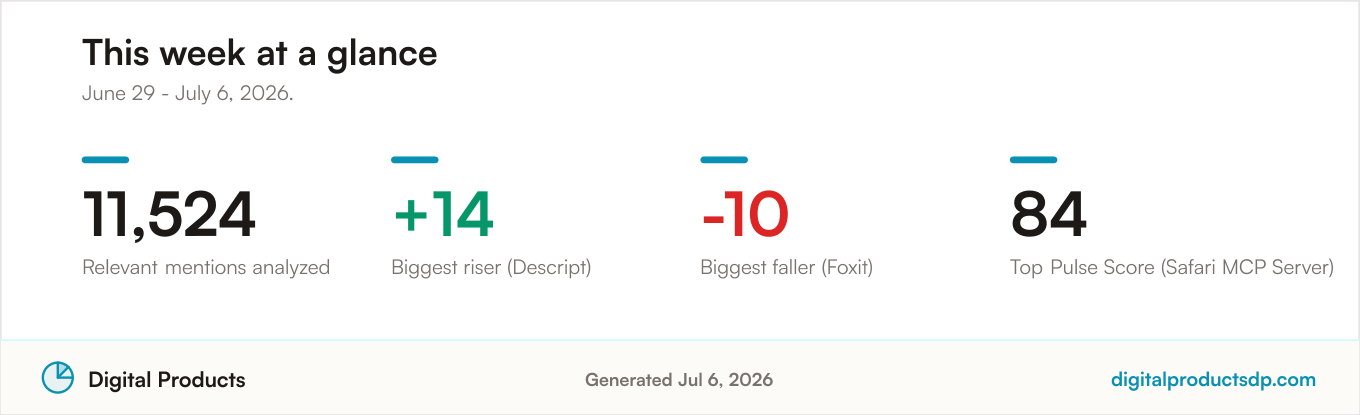
This edition of our sentiment report covers aggregated public online discussion analyzed for June 29, 2026 through July 6, 2026. Across that window we processed 11,524 relevant mentions drawn from public sources, spanning a tracked universe of 2,246 products, of which 145 cleared the threshold of at least 10 relevant mentions needed to be ranked. The figures here summarize the tone of community sentiment and public chatter, not any verdict on how well these products actually work.
The picture for the period running from June 29, 2026 through July 6, 2026 is one of a broad, low-scoring middle with a handful of standouts at the top. Coding tools claimed the top slot, complaint volume was heavily concentrated in bugs and reliability chatter, and several products with thin sample sizes posted large week-to-week swings. We read all of it below, always tying scores back to the themes that drove them.
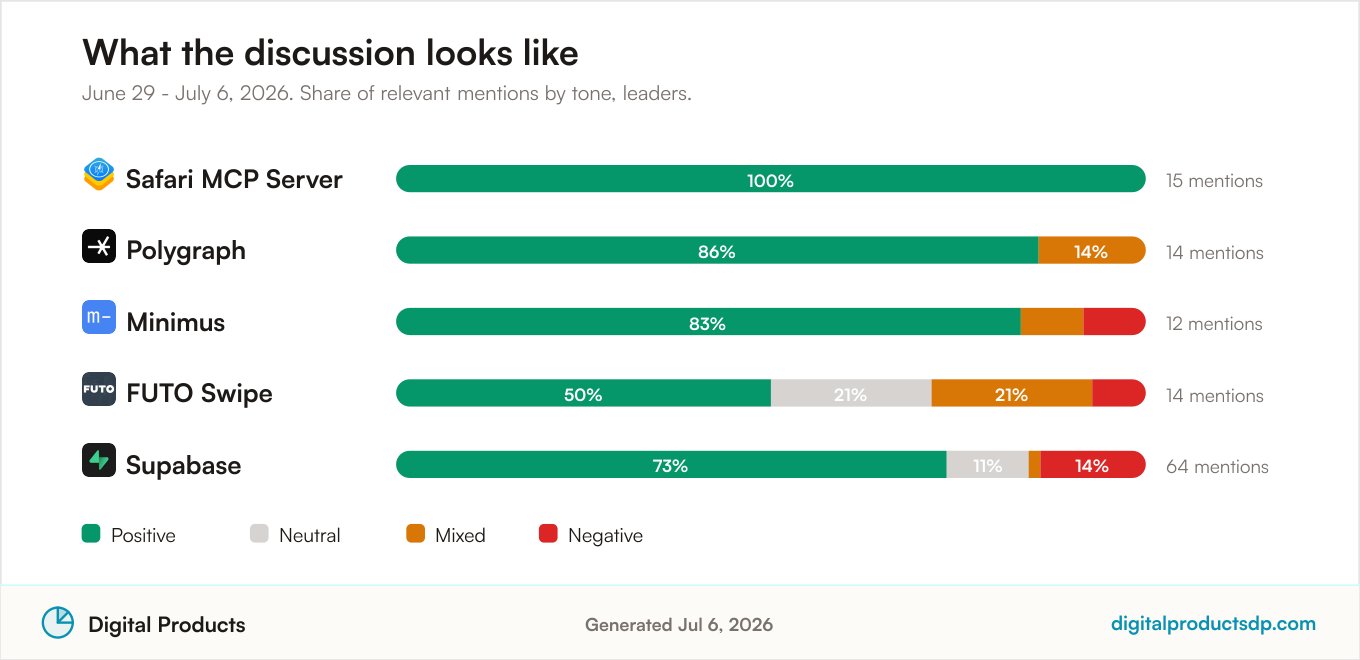
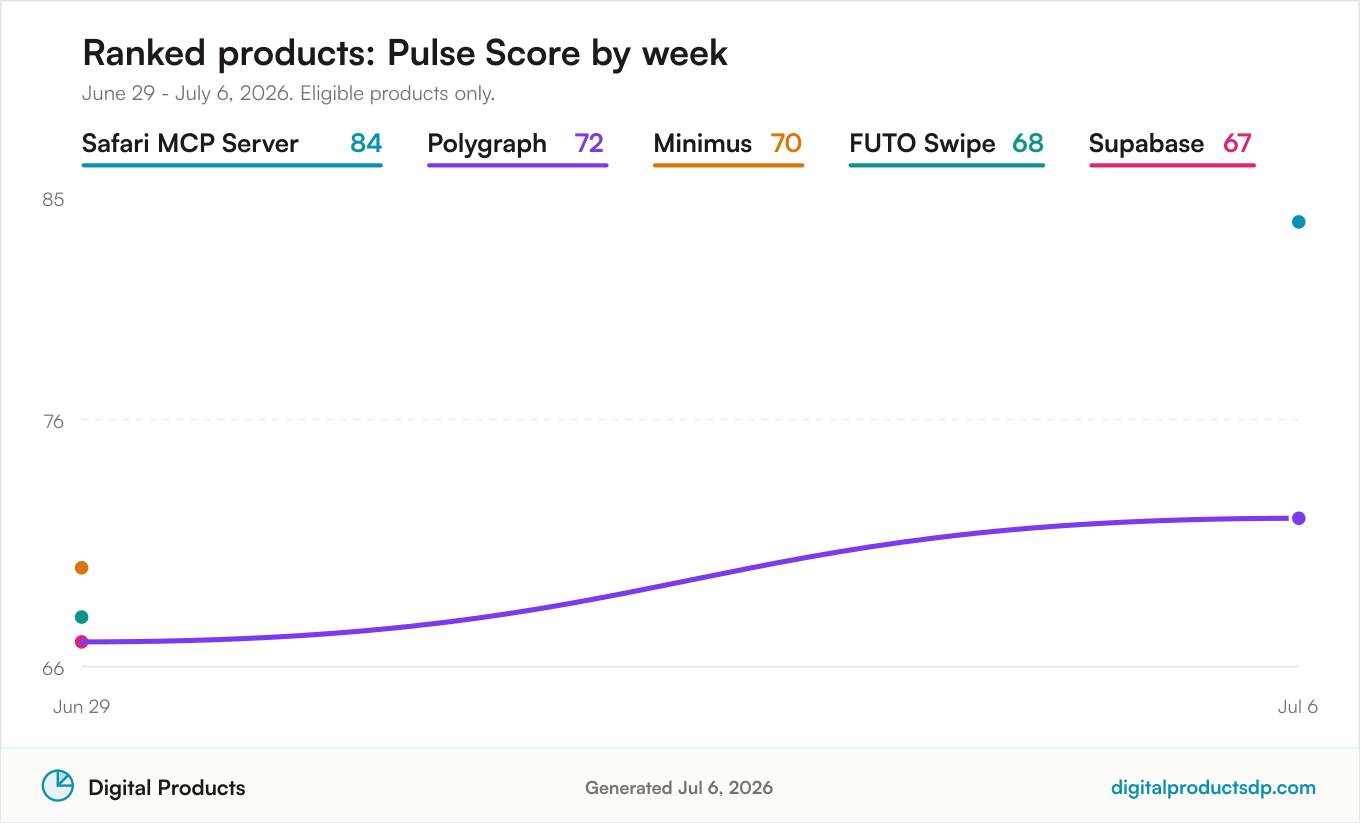
The top of the board is led by Safari MCP Server, a coding tool, with a Pulse Score of 84 based on 15 mentions over the period. Behind it sits Polygraph, also in coding, at 72 based on 14 mentions, and Minimus, a cloud-storage product, at 70 based on 12 mentions. FUTO Swipe follows at 68 based on 14 mentions, with Supabase, a cloud-storage product, rounding out the leaders at 67 on a considerably deeper base of 64 mentions.
A note on sample size matters here. Four of the five leaders sit on samples between 12 and 15 mentions, which means their scores reflect a small, concentrated slice of public discussion. Supabase is the exception, with 64 mentions supporting its 67, so its read is the most stable of the group. High scores on thin samples can move sharply week to week, and readers should weigh the leaderboard with that in mind.
Category View
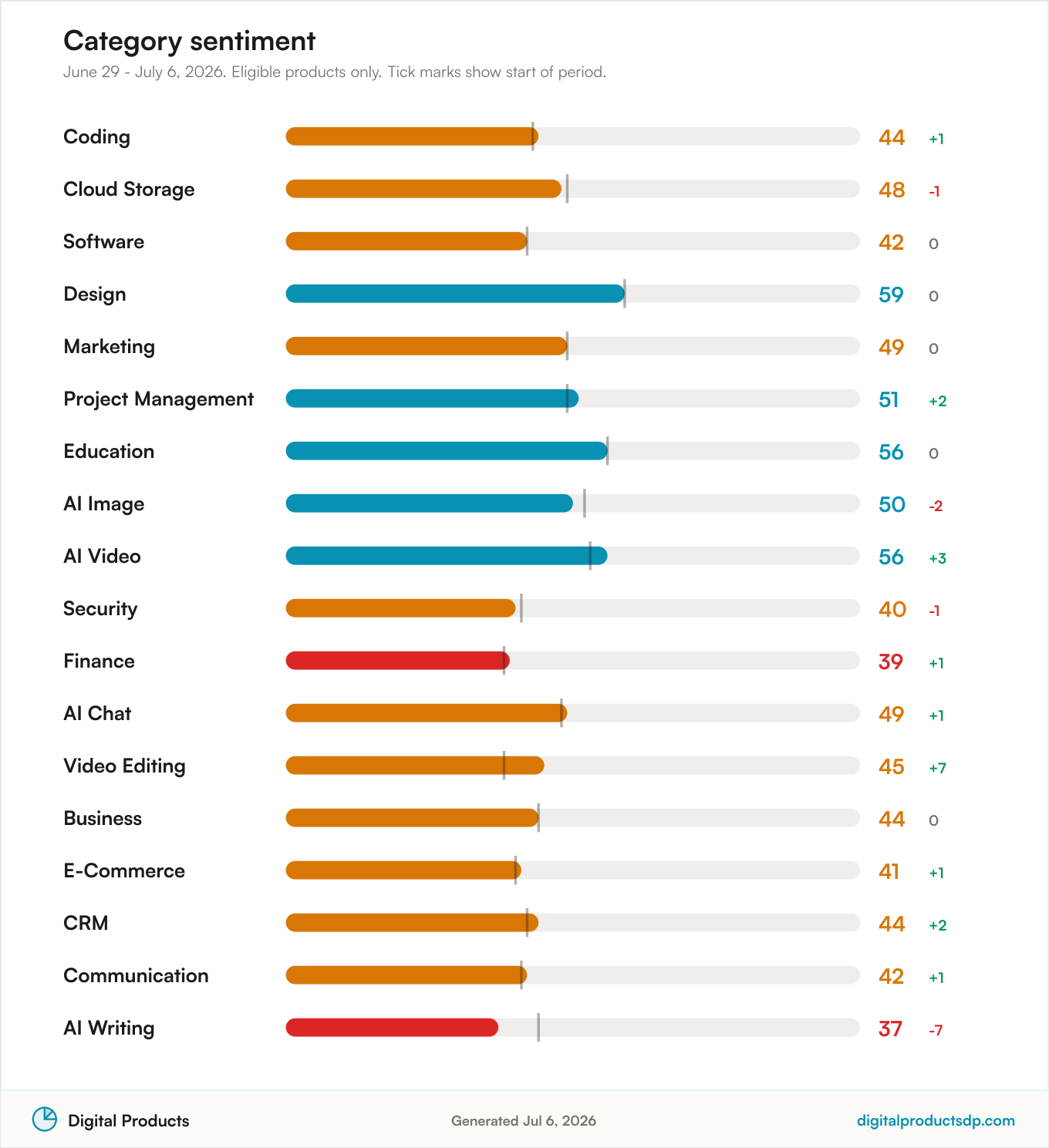
At the category level, most movement was small. Design held steady at 59, the highest category average both at the start and end of the period, while education stayed at 56 and ai-video edged up from 53 to 56. Video-editing showed the largest positive category shift, moving from 38 to 45, while ai-writing fell the furthest, dropping from 44 to 37. Coding ticked up from 43 to 44, cloud-storage slipped from 49 to 48, and software held flat at 42. The overall impression is a market clustered in the 40s to 50s, where category-wide sentiment barely budged and the more dramatic stories live at the individual product level.
Biggest Movers
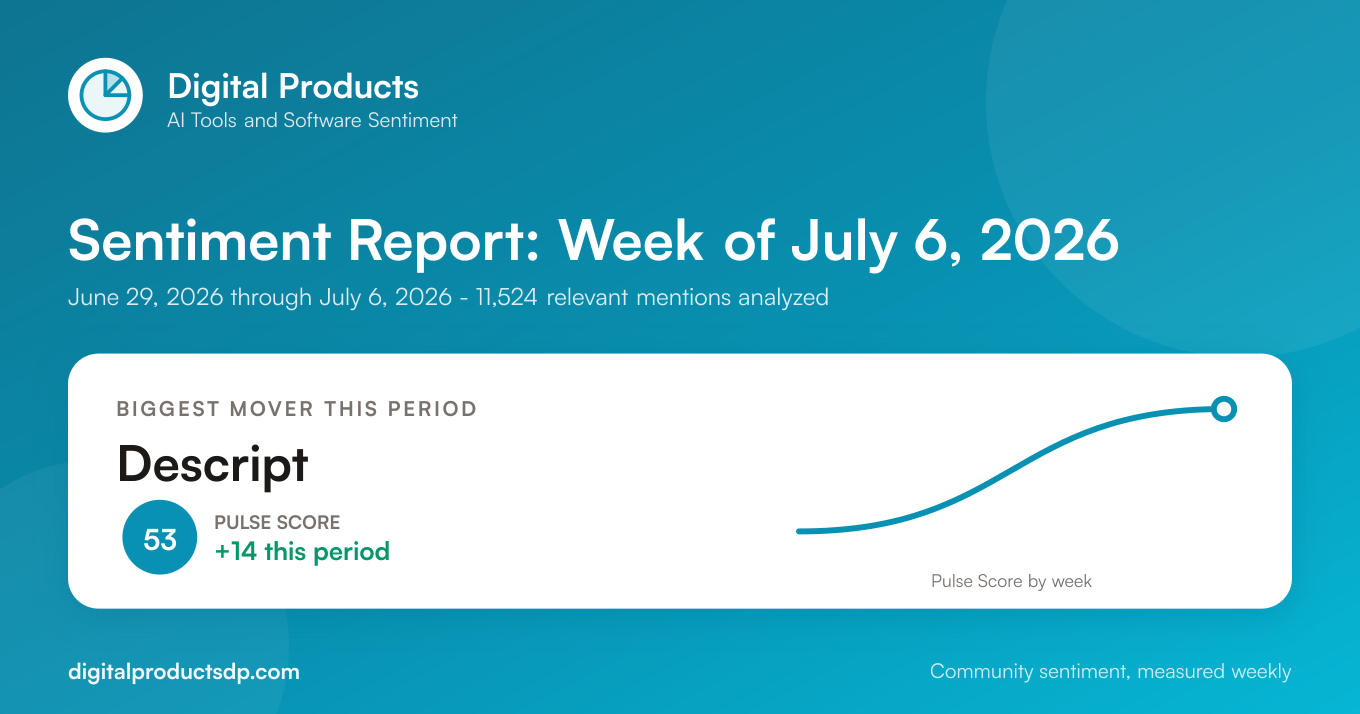
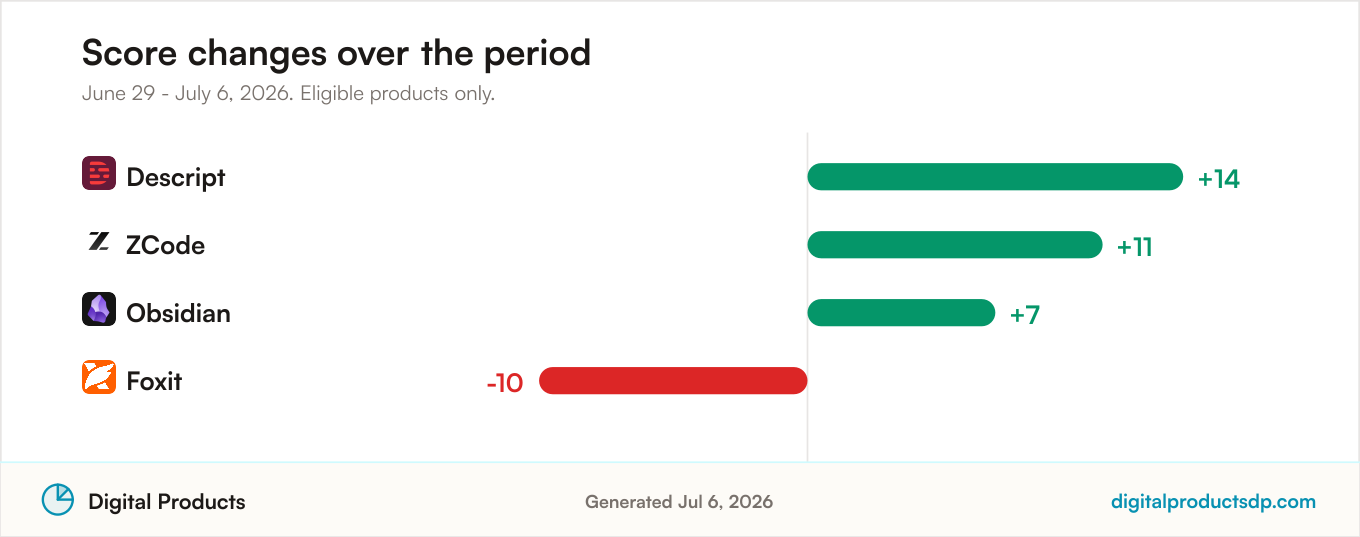
Descript (up 14, from 39 to 53, based on 21 mentions). The biggest riser of the period is the video-editing and audio tool Descript. Its praise chatter centered on strong features, cited 10 times, with AI quality and comparisons to rivals also drawing positive mentions. The complaint side was lighter and more scattered, led by missing features, pricing too high, and comparisons to rivals. With praise concentrated on capability and complaints thinly spread, the tone of discussion tilted meaningfully more positive across the two weeks.
ZCode (up 11, from 29 to 40, based on 109 mentions). ZCode posted the second-largest gain and did so on the deepest sample of any mover, 109 mentions, which makes its climb one of the more meaningful moves this period. Its praise leaned on new releases, cited 19 times, alongside strong features and AI quality. That said, complaint volume remained heavy, with bugs cited 42 times, reliability 31 times, and missing features 22 times. The improvement reads as public discussion warming to new releases even as durable concerns about stability persisted.
Obsidian (up 7, from 52 to 59, based on 94 mentions). The note-taking tool Obsidian rose to 59 on a solid base of 94 mentions. Praise was dominated by strong features, cited 68 times, with easy to use at 53 and good integrations at 21 rounding out the positives. Complaints clustered around bugs at 17, missing features at 17, and UI frustrations at 15. The wide gap between heavy feature praise and comparatively modest complaint counts helps explain the upward move.
Foxit (down 10, from 57 to 47, based on 11 mentions). Foxit was the steepest faller of the period, on a thin base of just 11 mentions. Its praise chatter noted strong features, comparisons to rivals, and performance. On the complaint side, bugs led with 10 mentions, effectively matching the entire positive conversation, alongside comparison chatter. On a sample this small, a concentrated run of bug complaints can pull the score down sharply, and that appears to be the driver here.
Surfshark (down 7, from 64 to 57, based on 17 mentions). The security product Surfshark slipped to 57 on 17 mentions. Its praise centered on fair pricing, cited 15 times, with strong features and ease of use also noted. Complaints were led by comparisons to rivals at 6, privacy concerns at 4, and missing features at 2. Positive pricing chatter kept the score respectable, but the rise in comparative and privacy discussion weighed on sentiment.
Grammarly (down 7, from 44 to 37, based on 43 mentions). The ai-writing tool Grammarly fell to 37 on 43 mentions. This one stands out because its single largest theme of any kind was a complaint: AI quality, cited 31 times, far outweighing the 4 positive AI quality mentions. Bugs at 15 and missing features at 14 added to the pressure, while praise for strong features at 12 and ease of use at 7 was not enough to offset it. Grammarly's slide mirrors the broader ai-writing category drop from 44 to 37.
Spotlight: Safari MCP Server
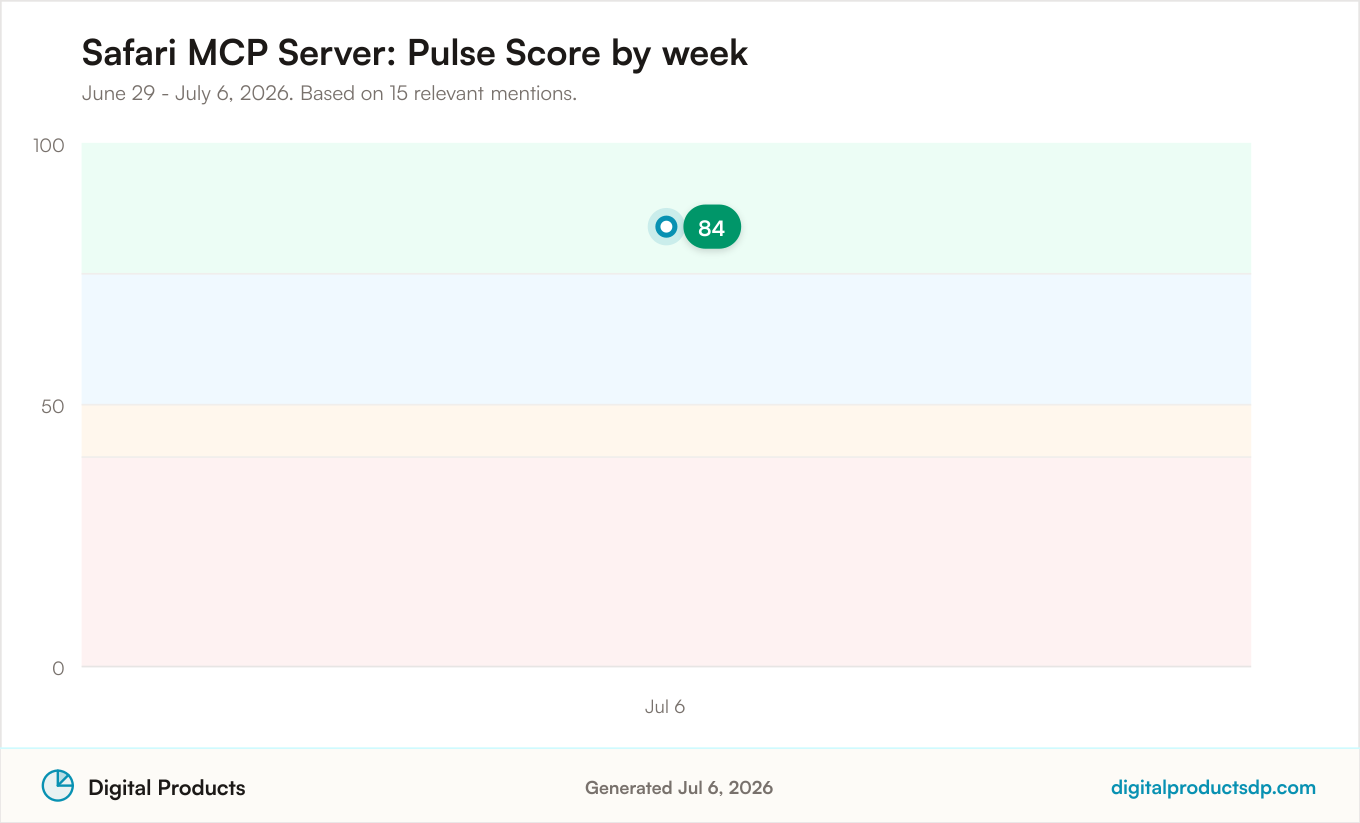
Safari MCP Server, a coding tool, topped the board with a Pulse Score of 84 based on 15 mentions. Its weekly series in this period shows a single tracked reading, at 84 for the week ending June 29, 2026, so there is no prior week within the data to measure a trend against. That makes the 84 a snapshot of a small, positive burst of public discussion rather than an established pattern.
What drove the tone was unusually clean. Praise themes were strong features, cited 18 times, new releases at 13, and easy to use at 9. Notably, the fact sheet records no complaints for Safari MCP Server this period. A conversation with clear feature and release enthusiasm and no logged negative themes is the kind of profile that produces a top-of-board score.
The caveat is the same one that applies across the leaders: 15 mentions is a small sample. A complaint-free, praise-heavy read on that volume can be genuine early enthusiasm, but it is also more sensitive to a handful of new posts than a product like Supabase with its 64 mentions. This is a product worth watching to see whether the positive tone holds as discussion volume grows.
Themes Driving the Conversation
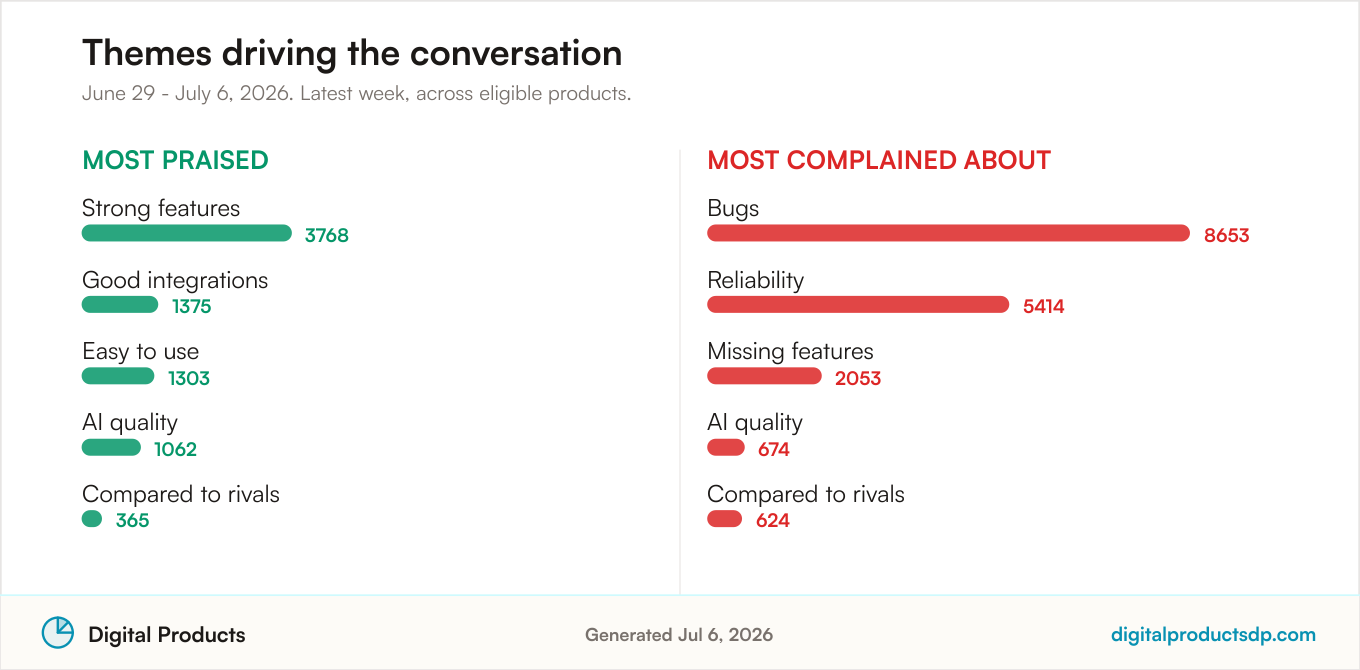
On the praise side, strong features led decisively with 3,768 mentions, more than the next three themes combined. It anchored the positive conversation for leaders and movers alike, from Safari MCP Server's 18 feature mentions to Obsidian's 68 and Supabase's 59. Good integrations followed at 1,375 mentions, easy to use at 1,303, and AI quality at 1,062, with comparisons to rivals trailing at 365. Ease of use was a signature strength for Supabase, cited 56 times, and for Trello and Postman, showing that approachability remains a durable driver of positive sentiment across categories.
The complaint side was far heavier in raw volume and heavily concentrated. Bugs dominated with 8,653 mentions and reliability followed with 5,414, together dwarfing every other negative theme. These two showed up repeatedly across the most-discussed products, from ClickHouse with 441 bug mentions and 290 reliability mentions to Cloudflare with 203 and 177, and ZCode with 42 and 31. Missing features ranked third at 2,053 mentions, while AI quality as a complaint reached 674 and comparisons to rivals 624. The AI quality complaint total is especially telling for Grammarly, whose 31 negative AI quality mentions were the direct engine of its 7-point slide. The broad takeaway is that stability chatter, not feature gaps or pricing, defined the negative half of community sentiment this period.
Watchlist
A large number of tracked products drew fewer than 10 relevant mentions during the period and were therefore excluded from the rankings. This is a reflection of discussion volume only, not a judgment on quality. Thin samples produce unstable reads, so we hold these back rather than risk a misleading score.
Several came close to the line. Stability AI, PDFMergely, Thinkific, Pipedrive, Dynatrace, Namecheap, and PartnerStack each recorded 9 relevant mentions, just short of the threshold. Others sat a little lower, including Flux at 8, Hasan-related tooling aside, Hasura at 8, and Square at 8. Products such as Microsoft Copilot, an ai-chat tool, and Coursera-adjacent education tools like Thinkific hovered near eligibility but did not qualify this period. A cluster of tools registered mid-single-digit volume, including Aider, LookAway, Pika, Doppler, Arize, Bitbucket, Carta, GitGuardian, Lightning AI, and Zypper at 7 mentions apiece, and Ideogram, Synthesia, Railway, Great Expectations, Robinhood, and 1Password at 6.
If any of these products see a jump in public discussion next period, they could enter the rankings quickly. For now, their absence simply means there was not enough chatter to form a stable read.
What To Watch Next Week
First, watch whether Safari MCP Server holds its position. Its 84 came on 15 mentions with no logged complaints, and a single reading is not a trend. Whether that clean profile survives a larger volume of discussion is the clearest open question at the top of the board.
Second, watch the ai-writing category and Grammarly specifically. The category fell from 44 to 37 and Grammarly's slide was driven by 31 AI quality complaints against just 4 AI quality praises. Whether that negative AI quality chatter persists or fades is worth monitoring, since it is currently the defining theme for the product.
Third, watch ZCode. Its 11-point rise came on the deepest mover sample of the period, 109 mentions, but was accompanied by heavy bug and reliability complaint volume of 42 and 31 respectively. Whether the new-release enthusiasm continues to outweigh the stability concerns is the tension to track.
Frequently Asked Questions
Which tool had the highest Pulse Score this period?
Safari MCP Server, a coding tool, had the highest Pulse Score at 84, based on 15 mentions over the period.
Which product moved the most this period?
Descript posted the biggest rise, climbing from 39 to 53, a gain of 14 points based on 21 mentions. Foxit had the steepest fall, dropping from 57 to 47, a decline of 10 points based on 11 mentions.
What was the overall category mood this period?
Most categories barely moved and clustered in the 40s to 50s. Design held highest at 59, while ai-writing fell the most, from 44 to 37, and video-editing rose the most, from 38 to 45.
How many mentions were analyzed this period?
We analyzed 11,524 relevant mentions across 145 eligible products, drawn from a tracked universe of 2,246 products.
About This Data
Pulse Scores summarize the tone of public online discussion on a 0-100 scale and reflect community sentiment, not a verdict on a product's quality or a recommendation. We report on complete calendar weeks only, and products with fewer than 10 relevant mentions in the period are excluded from rankings to avoid unstable reads on thin samples.
Public discussion is collected from Hacker News, Stack Exchange, GitHub, Bluesky, the Apple App Store, and YouTube. Automated sentiment analysis can misread sarcasm, jokes, or niche context. Mention volumes vary widely between products, and scores can move from week to week, so figures should be read as directional signals rather than precise measurements.
Any company that wants to respond to how its product appears here is welcome to reach out. For details on how scores are calculated, see our methodology.