AI Tools and Software Sentiment Report: Week of June 2, 2025
June 2, 2025
This edition tracks aggregated public online discussion about AI tools and broader software, drawn from a mix of developer forums, review-video comments, and other public channels. The figures here summarize the tone of that chatter, not any verdict on how well a product works. Everything below traces to a single week of activity, read alongside the two prior weeks for context.
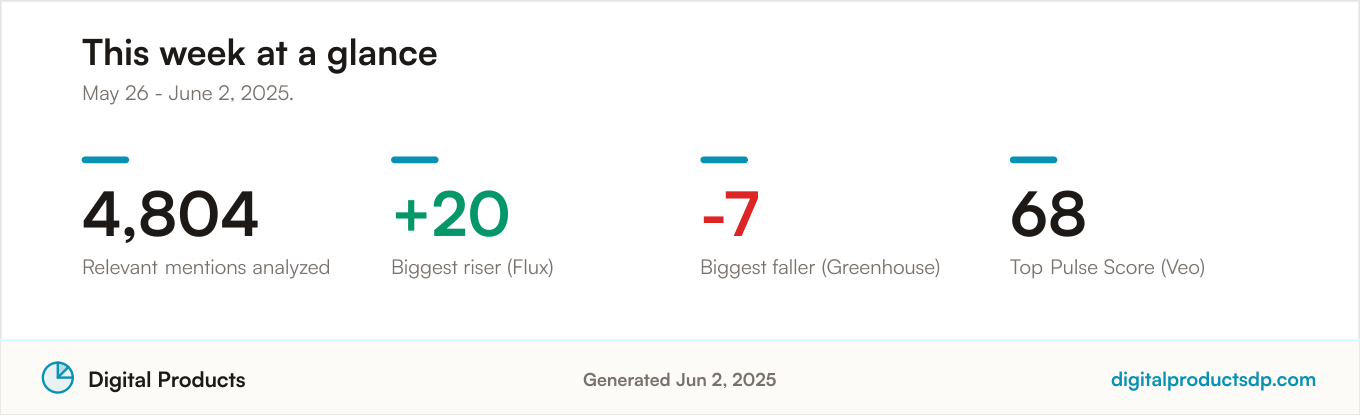
The mentions analyzed for May 26, 2025 through June 2, 2025 cover 4,804 relevant posts and comments. Of 2,246 products tracked, 86 cleared the threshold of at least 10 relevant mentions and qualified for ranking. That leaves a large tail of products with little or no discussion this period, which we treat as insufficient volume rather than a signal about quality.
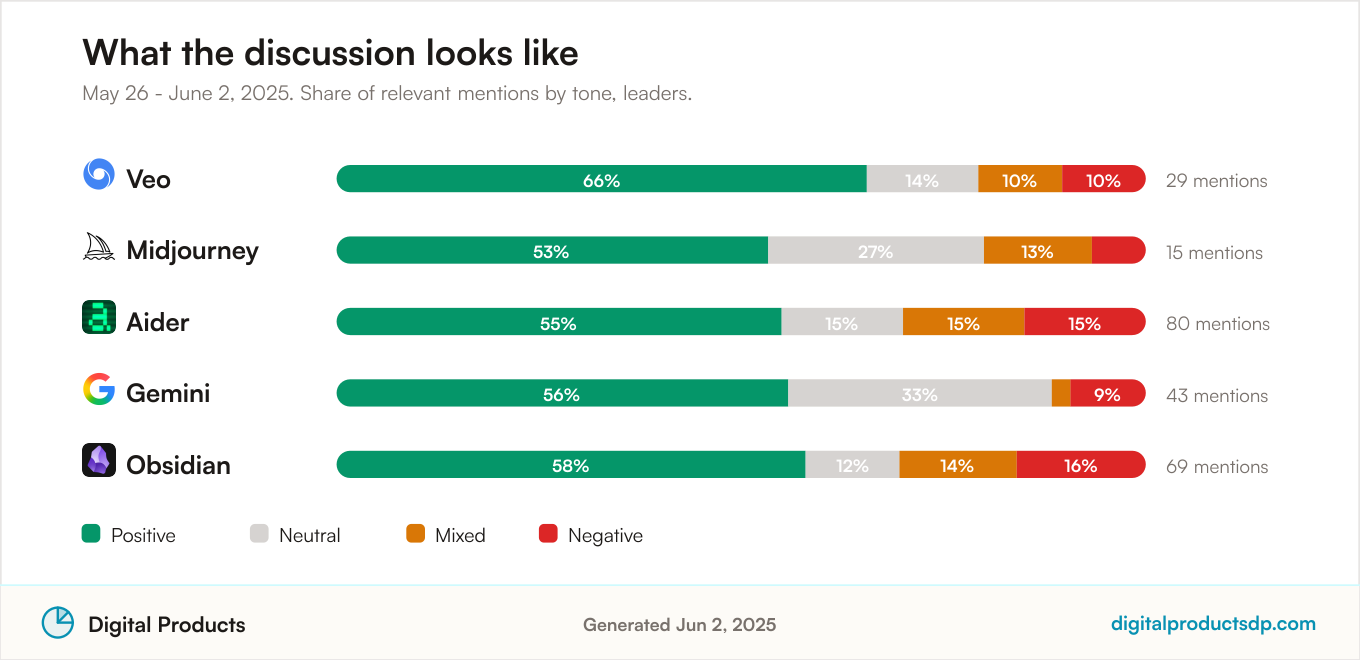
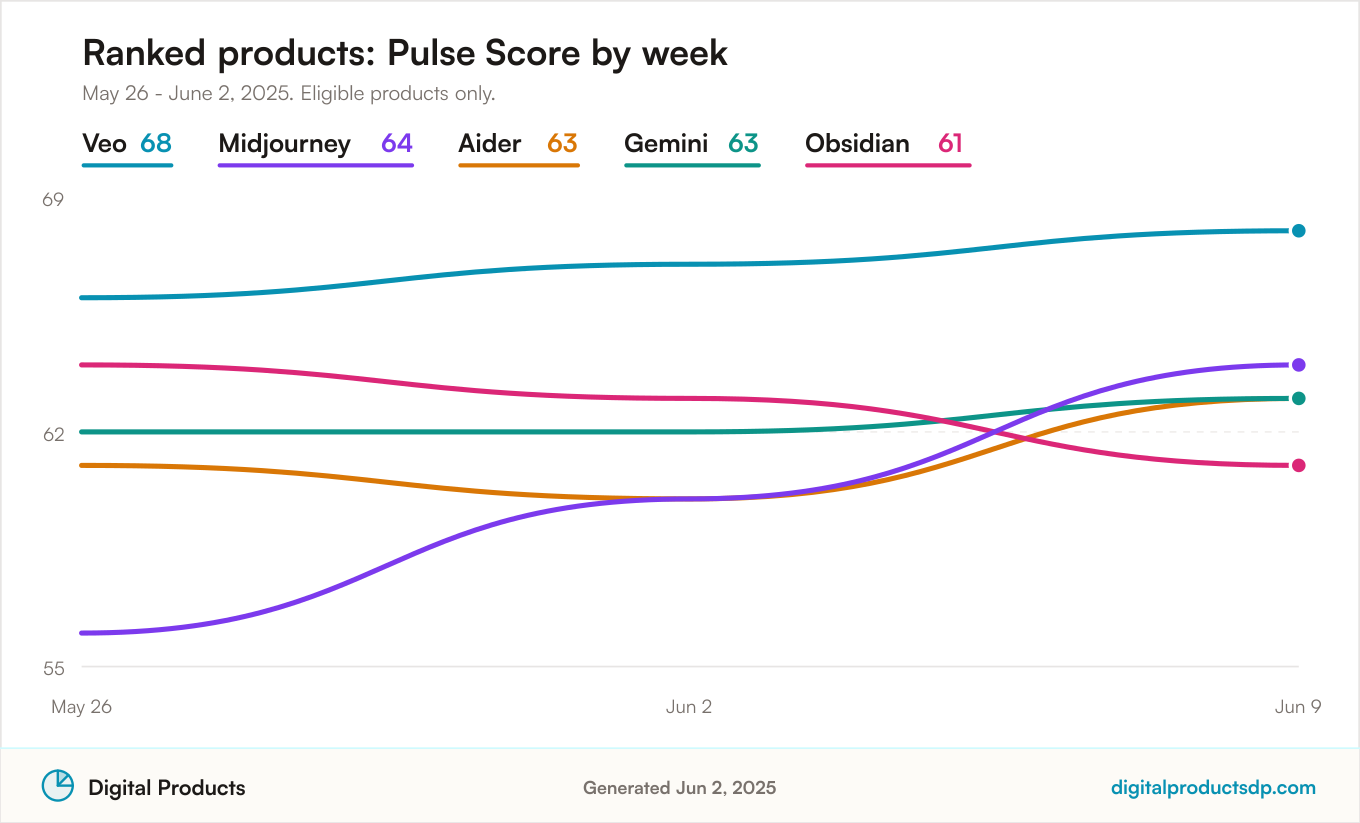
Veo held the top Pulse Score at 68, based on 29 mentions over the period, edging Midjourney at 64 across 15 mentions. Both are AI media products, and they sit above the rest of the ranked field this week. The presence of two generative tools at the top mirrors the category picture we discuss below, where AI image and AI video discussion carried a warmer tone than most software segments.
Below the leaders, the coding tool Aider posted 63 across 80 mentions, the AI chat assistant Gemini also reached 63 across 43 mentions, and the project-management app Obsidian rounded out the top five at 61 across 69 mentions. Aider and Obsidian both drew larger sample sizes than the two products above them, which makes their scores comparatively steadier reads. Gemini's 43 mentions give it more grounding than the two AI media leaders.
Category View
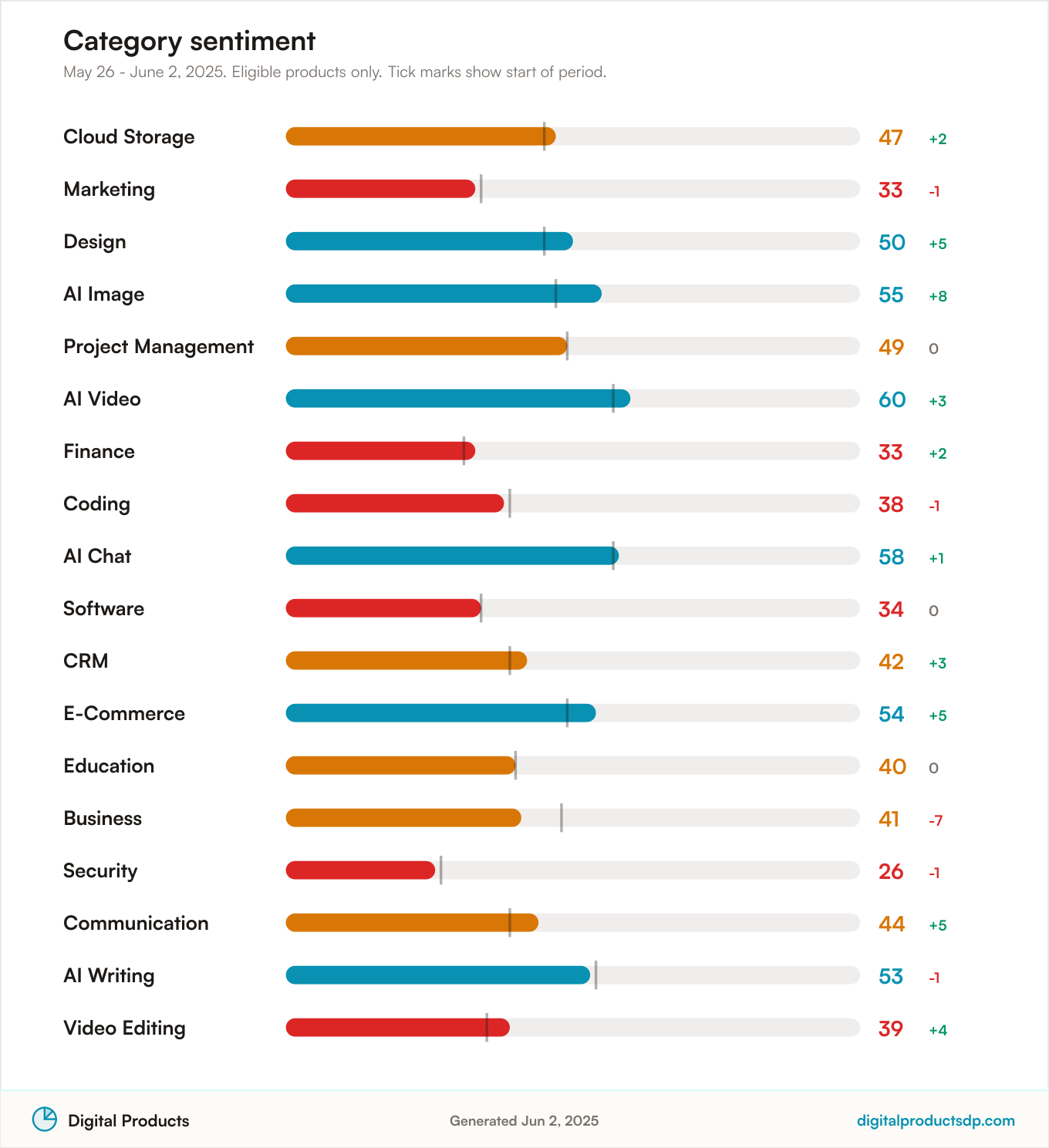
At the category level, the generative segments moved up the most. AI image climbed from 47 to 55 across the period, and e-commerce rose from 49 to 54, while design gained from 45 to 50 and communication moved from 39 to 44. AI video stayed near the top of the table, rising from 57 to 60, and AI chat held steady from 57 to 58. Not every category firmed up: business fell from 48 to 41, security slipped from 27 to 26, and coding eased from 39 to 38. Several categories barely moved, including project-management holding at 49, software flat at 34, and education steady at 40, which suggests a period where sentiment shifts concentrated in a handful of segments rather than spreading evenly.
Biggest Movers
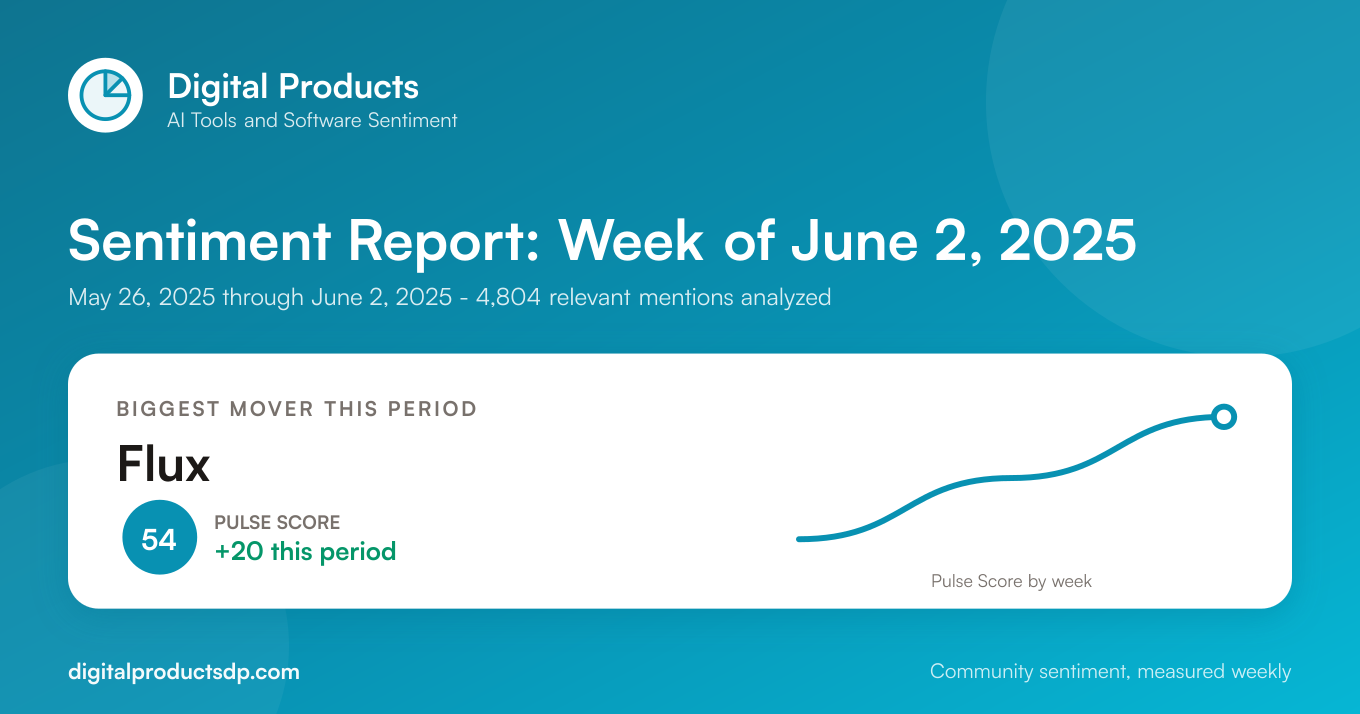
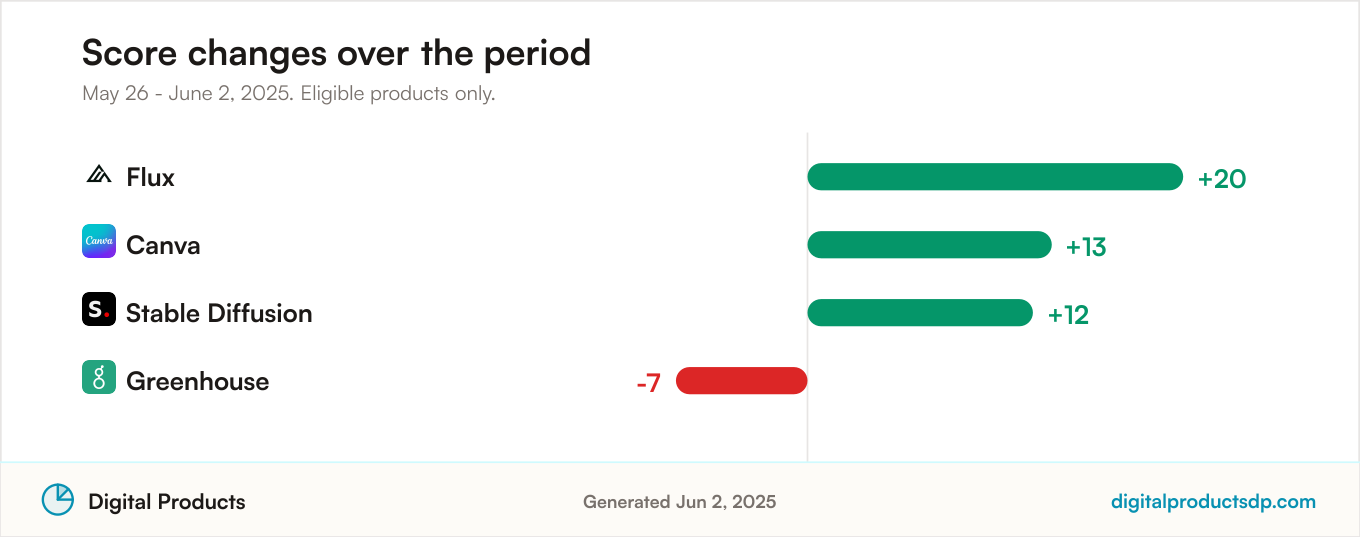
Flux (riser, plus 20, 34 to 54, based on 33 mentions). The image generator posted the largest gain of any ranked product. Its praise themes this week centered on strong features, cited 8 times, and AI quality, cited 7 times, with fair pricing noted twice. The complaint side stayed active, led by bugs at 13 mentions, performance at 13, and reliability at 8, so the rise reflects warmer discussion of output and capability even as reliability grumbles persisted alongside it.
Canva (riser, plus 13, 45 to 58, based on 11 mentions). The design tool's climb was anchored by ease of use, its most-cited praise theme at 99 mentions, followed by strong features at 75 and a polished UI at 34. Those positives outweighed the recurring UI frustrations at 38 mentions, AI quality complaints at 16, and bugs at 12. With only 11 relevant mentions in the period, this score should be read as a thinner sample than the volume of its theme tallies might suggest.
Stable Diffusion (riser, plus 12, 43 to 55, based on 27 mentions). The image model's gain lines up with praise for strong features at 13 mentions, AI quality at 7, and ease of use at 6. Its complaints were more evenly split, with bugs at 10, AI quality also at 10, and performance at 6, so the AI-quality theme appeared on both sides of the ledger, a pattern common to generative tools where opinion on output divides.
Greenhouse (faller, minus 7, 48 to 41, based on 11 mentions). The recruiting software slipped despite praise for strong features at 10 mentions and good integrations at 6. The move tracks a heavier complaint load: bugs at 32 mentions, reliability at 23, and missing features at 9 dominated its discussion, and that weight of reliability chatter is consistent with a downward drift.
Bitbucket (faller, minus 7, 37 to 30, based on 25 mentions). The code-hosting tool fell on thin praise, with strong features cited only twice and single mentions for great collaboration and performance. Its complaints were led by missing features at 4 mentions, comparisons to rivals at 3, and feature requests at 2, so the decline reads as a lack of positive signal rather than a spike in any single grievance.
DALL-E (faller, minus 6, 53 to 47, based on 12 mentions). The image generator's drop sits against a complaint mix led by AI quality at 8 mentions, comparisons to rivals at 3, and reliability at 2, outpacing its praise of AI quality at 4 and new releases at 2. As with other generative tools, AI quality drove both praise and complaints, and here the negative side was heavier.
Spotlight: Veo
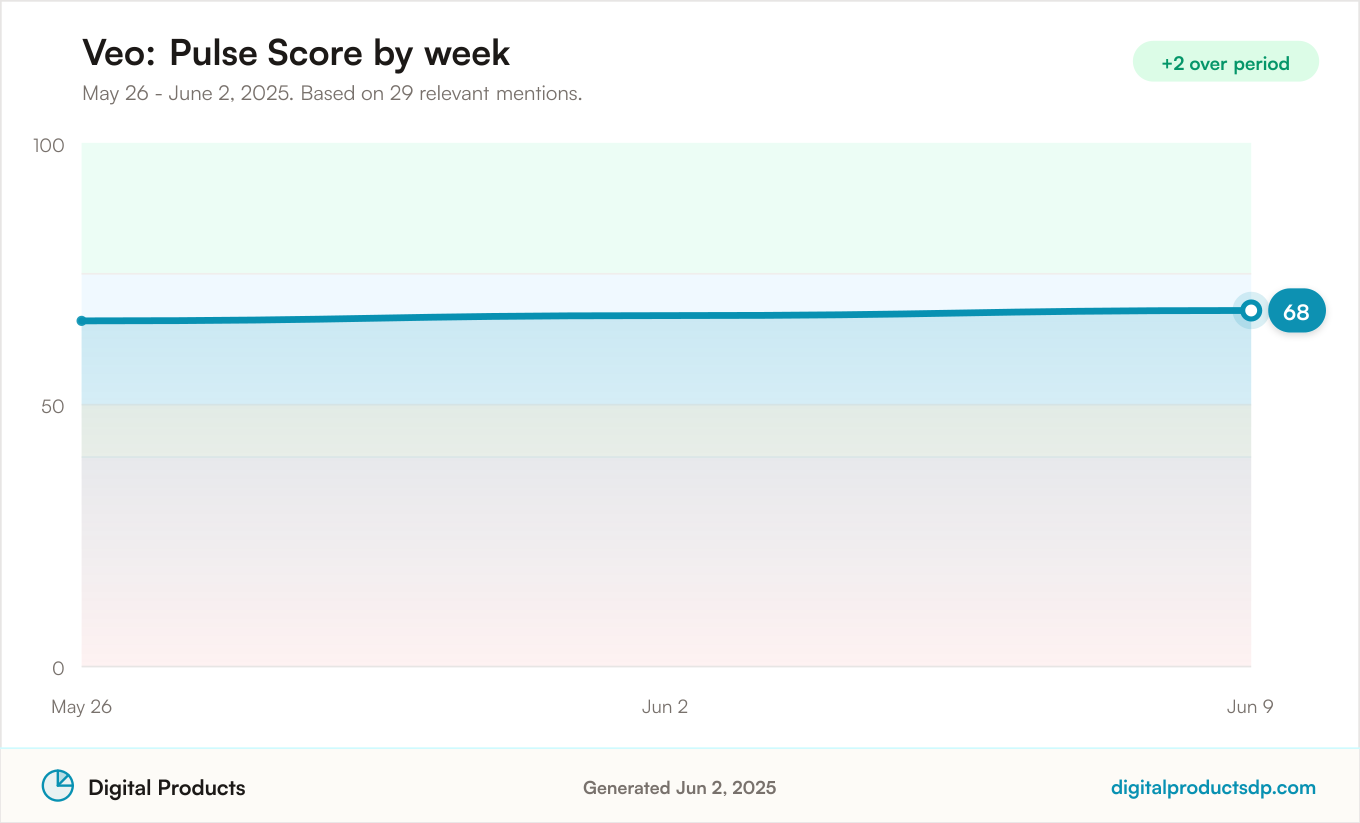
Veo, an AI video product, held the highest Pulse Score in the ranked field at 68, based on 29 mentions over the period. Its weekly trajectory was gently upward across the three weeks tracked, moving from 66 on May 19, 2025 to 67 on May 26, 2025 and then to 68 on June 2, 2025. That is a small but steady climb rather than a jump, which fits a product that stayed near the top throughout.
The praise driving that score leaned on strong features at 13 mentions, new releases at 9, and AI quality at 8. The mix of feature talk and release chatter suggests the conversation was partly about what the tool can do and partly about what is newly available, a combination that tends to keep sentiment warm when both land well.
Veo was not without friction. Its complaint themes were led by bugs at 8 mentions, missing features at 5, and reliability at 4. Those are the same recurring pressures visible across much of the field this week, and the fact that Veo held its top score while carrying them is worth watching. With 29 mentions, the sample is modest, so week-to-week movement here can be noisy and a single burst of discussion could shift the read.
Themes Driving the Conversation
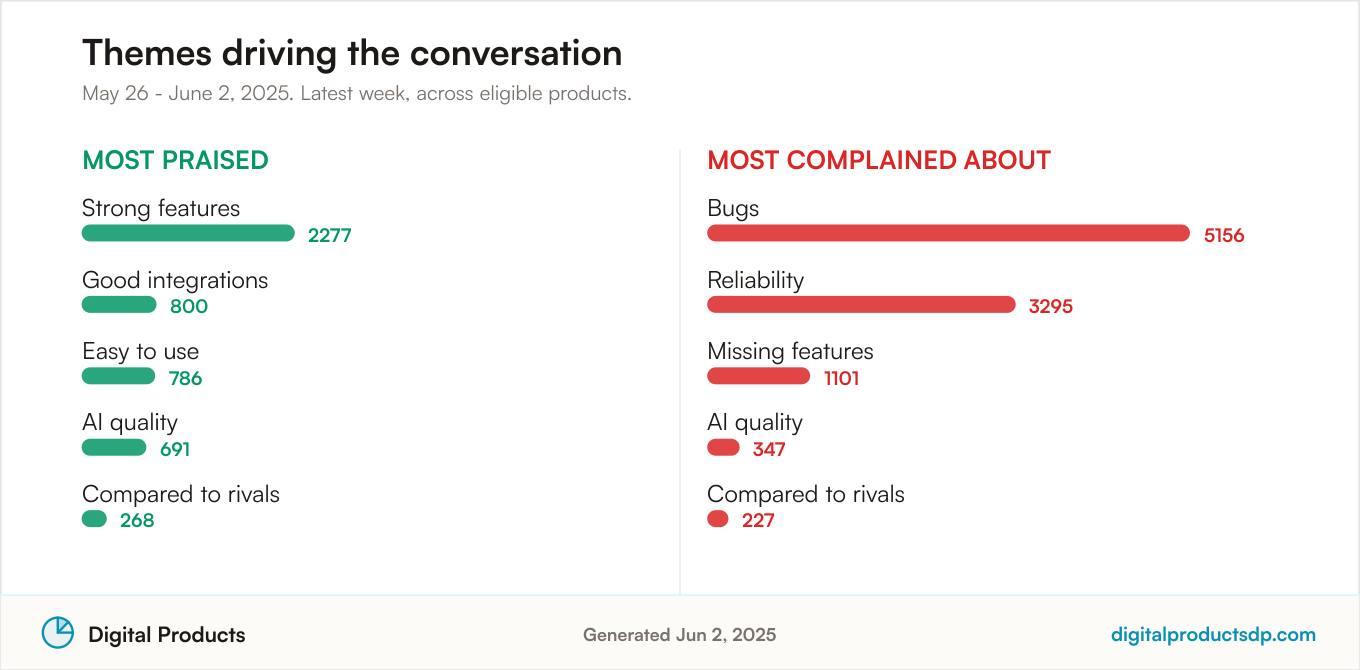
On the praise side, strong features was by far the most-discussed theme at 2,277 mentions, well ahead of good integrations at 800 and easy to use at 786. AI quality followed at 691 mentions, and comparisons to rivals at 268. The feature theme showed up almost everywhere, from Cursor with strong features cited 105 times to Claude at 207 and GitHub Copilot at 104, while ease of use anchored Canva at 99 and Kubernetes at 63. AI quality was concentrated in the chat and image tools, with Claude at 216 praise mentions and Gemini and DeepSeek both drawing heavy AI-quality praise.
The complaint side was dominated by bugs at 5,156 mentions and reliability at 3,295, dwarfing missing features at 1,101, AI quality at 347, and comparisons to rivals at 227. Bugs and reliability were the two loudest grievances across the field, showing up prominently for data and infrastructure products like ClickHouse with 441 bug mentions, dbt at 357, and ArgoCD at 231, as well as for widely used tools like Stripe at 188 and Clerk at 146. That the two negative themes far outweigh every positive theme except strong features tells the clearest story of the period: even products with warm overall scores were carrying steady streams of stability chatter underneath.
Watchlist
A large number of tracked products did not reach the 10-mention threshold this period, and we exclude them from rankings to avoid unstable reads on thin samples. This is a note about discussion volume, not a judgment on quality. Several drew enough attention to be worth monitoring as candidates for future eligibility.
Docker (coding) and Honeycomb (coding) each recorded 9 relevant mentions, just short of the threshold.
Earthly (coding) also landed at 9 relevant mentions.
NordVPN (security), Gumroad (e-commerce), Mailchimp (marketing), Amplitude (marketing), and Devin (coding) all sat in the 7 to 8 mention range.
Sudowrite (ai-writing), Coursera (education), Ahrefs (marketing), LottieFiles (design), InVision (design), Asana (project-management), ClickUp (project-management), HubSpot (crm), and Anyscale (coding) each recorded 5 to 7 relevant mentions.
Widely known products including ChatGPT, Notion, GitHub, Slack, and Zoom recorded zero relevant mentions in this window under our sources and matching, which is a reminder that mention volume varies widely and absence here reflects the sample, not the product's real-world footprint.
What To Watch Next Week
First, watch whether the generative momentum holds. AI image rose from 47 to 55 as a category, and Flux and Stable Diffusion both posted double-digit gains. Whether that warmth carries forward or reverts is the clearest open question, especially since AI quality appeared on both the praise and complaint sides for these tools.
Second, watch the stability themes. Bugs at 5,156 mentions and reliability at 3,295 were the two loudest complaint themes across the field. If those persist for high-volume products like ClickHouse, dbt, and Stripe, they could keep pressure on the coding and software category averages, which were flat to slightly down this period.
Third, watch the fallers for follow-through. Greenhouse and Bitbucket each dropped 7 points on small samples of 11 and 25 mentions, and DALL-E slipped 6. Thin samples can rebound quickly, so it is worth seeing whether next week confirms the direction or simply reflects noise.
Frequently Asked Questions
Which tool had the highest Pulse Score this period?
Veo, an AI video product, had the highest Pulse Score at 68, based on 29 mentions over the period. Midjourney was next at 64 across 15 mentions.
Which product moved the most this period?
Flux posted the biggest rise, climbing from 34 to 54, a gain of 20 points across 33 mentions. On the downside, Greenhouse and Bitbucket each fell 7 points.
What was the overall mood across categories?
The warmest movement was in generative segments, with AI image rising from 47 to 55 and AI video from 57 to 60, while business fell from 48 to 41 and security eased from 27 to 26. Bugs at 5,156 mentions and reliability at 3,295 were the dominant complaint themes.
How many mentions were analyzed?
A total of 4,804 relevant mentions were analyzed for the period. Of 2,246 tracked products, 86 cleared the 10-mention threshold to qualify for ranking.
About This Data
Pulse Scores summarize the tone of public online discussion on a 0-100 scale and reflect community sentiment, not a verdict on a product's quality or a recommendation. We report on complete calendar weeks only, and products with fewer than 10 relevant mentions in the period are excluded from rankings to avoid unstable reads on thin samples.
Public discussion is collected from Hacker News, Stack Exchange, GitHub, Bluesky, the Apple App Store, and YouTube. Automated sentiment analysis can misread sarcasm, jokes, or niche context, mention volumes vary widely between products, and scores can move from week to week. Any company that wants to respond is welcome to reach out. For how scores are calculated, see our methodology.