AI Tools and Software Sentiment Report: Week of June 29, 2026
June 29, 2026
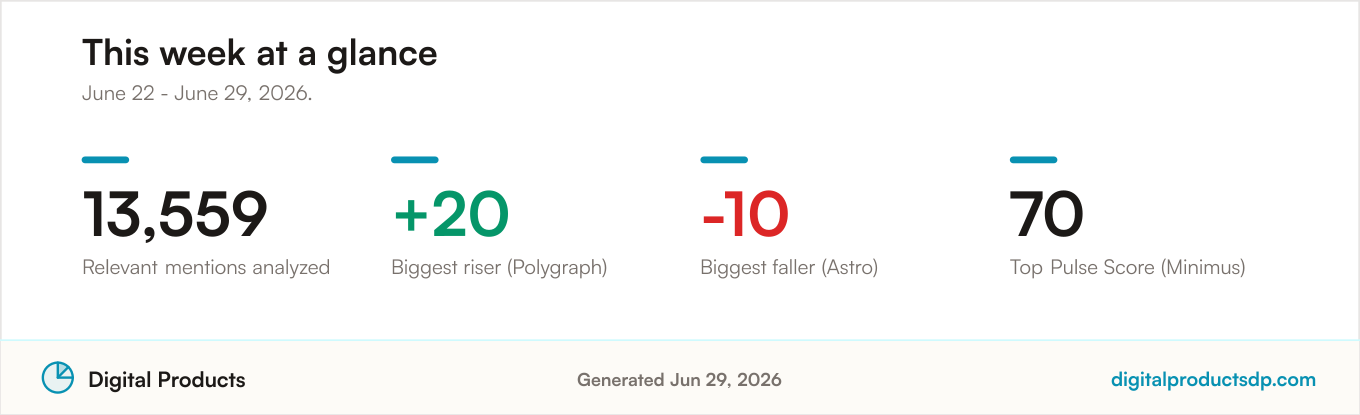
This edition of our sentiment report covers aggregated public online discussion for tools and software tracked across the week. The figures here summarize community sentiment drawn from public conversations, and they are a read on tone rather than a verdict on any product's quality. Across the period running from June 22, 2026 through June 29, 2026, we analyzed 13,559 relevant mentions spread across the products that cleared our minimum discussion threshold.
Of the 2,235 products tracked, 153 gathered enough discussion to be eligible for rankings during the mentions analyzed for June 22, 2026 through June 29, 2026. The picture this period is defined less by the leaders, several of which sit on thin samples, and more by the shared complaint themes running through nearly every product's conversation. Bugs and reliability dominate the negative side of the ledger, while strong features and integrations carry the praise. What follows reads the numbers we have without stretching them.
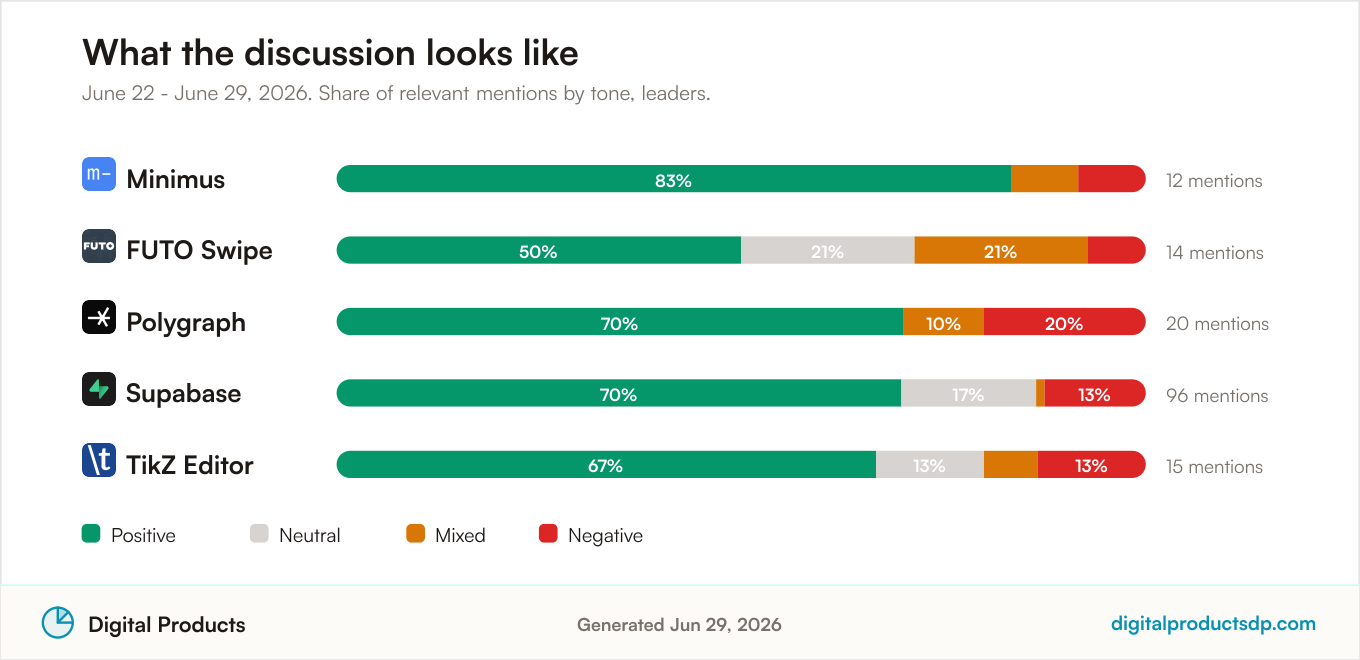
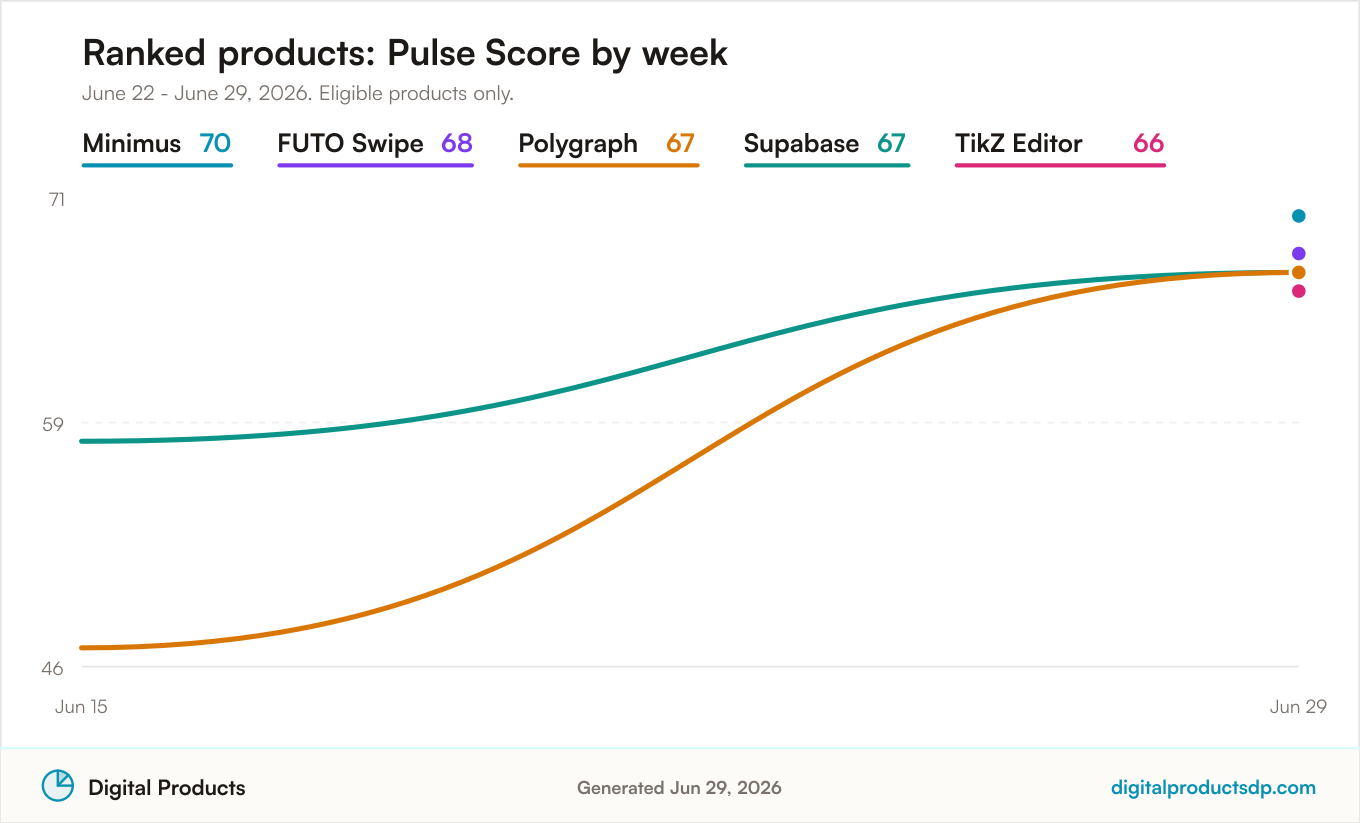
Minimus tops the Pulse Score table at 70, based on 12 mentions, with FUTO Swipe close behind at 68 based on 14 mentions. Polygraph and Supabase are tied at 67, but the sample sizes tell different stories: Polygraph's score rests on 20 mentions while Supabase's rests on 96, making Supabase the sturdiest read near the top. TikZ Editor rounds out the leaders at 66 based on 15 mentions.
The gap in sample sizes matters here. Four of the five leaders sit on fewer than 21 mentions, which means a small number of positive conversations can lift a score quickly. Supabase is the exception, and its position at 67 on nearly a hundred mentions is the most stable signal at the top of the board this period. Readers should treat the thinner scores as directional rather than settled.
Category View
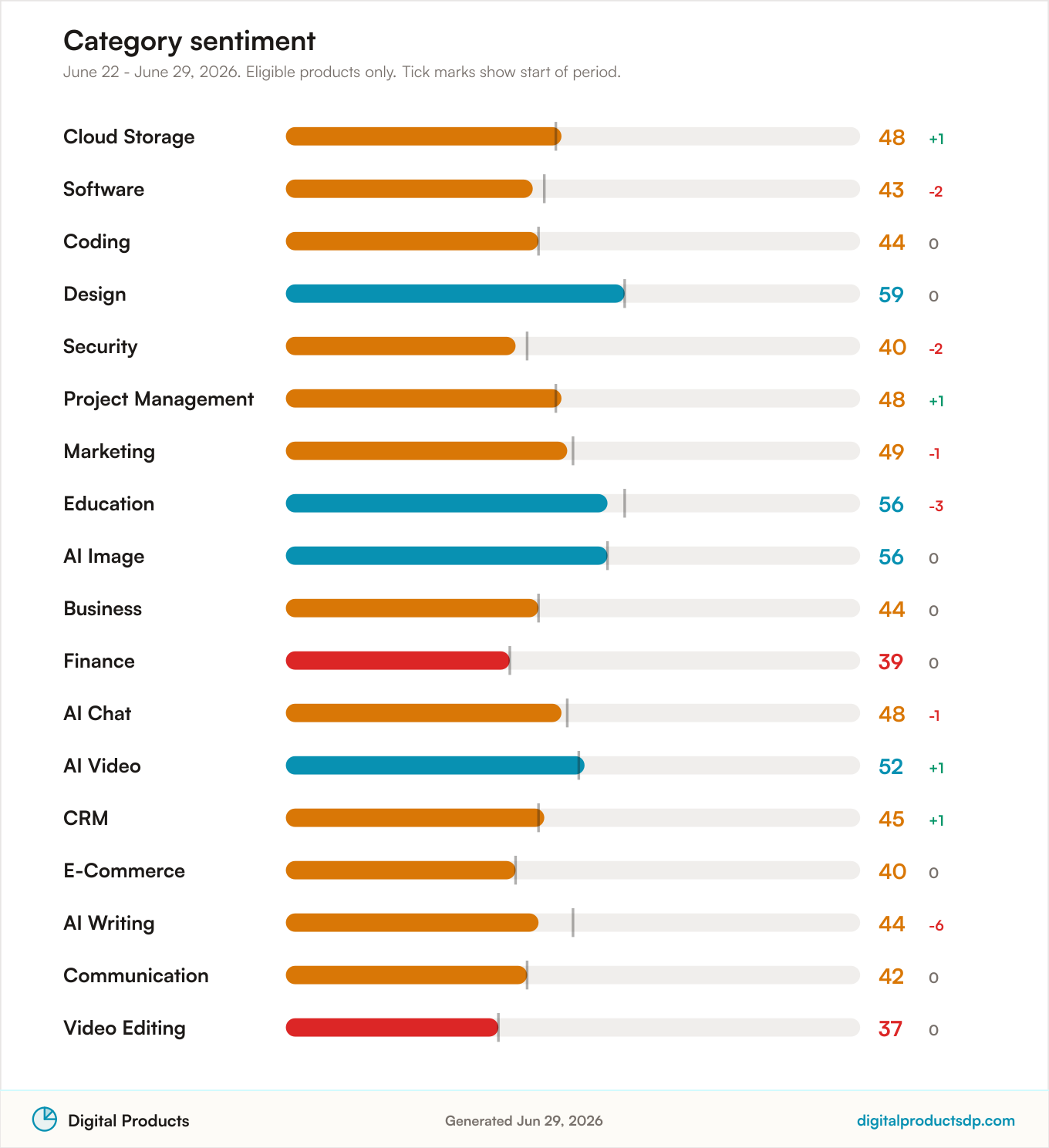
At the category level, movement was modest and mood held fairly steady. Design was the strongest category, flat at 59 from start to end, and education sat highest early but eased from 59 to 56. Cloud-storage nudged up from 47 to 48, project-management from 47 to 48, and crm from 44 to 45, while ai-video edged from 51 to 52. On the softer side, ai-writing fell the most, from 50 to 44, and education, marketing, security, ai-chat, software, and finance all slipped or held. Coding, business, finance, e-commerce, communication, and video-editing were unchanged, with video-editing the lowest at 37. The overall read is a market where most categories moved only a point or two, and ai-writing's drop stands out against that calm backdrop.
Biggest Movers
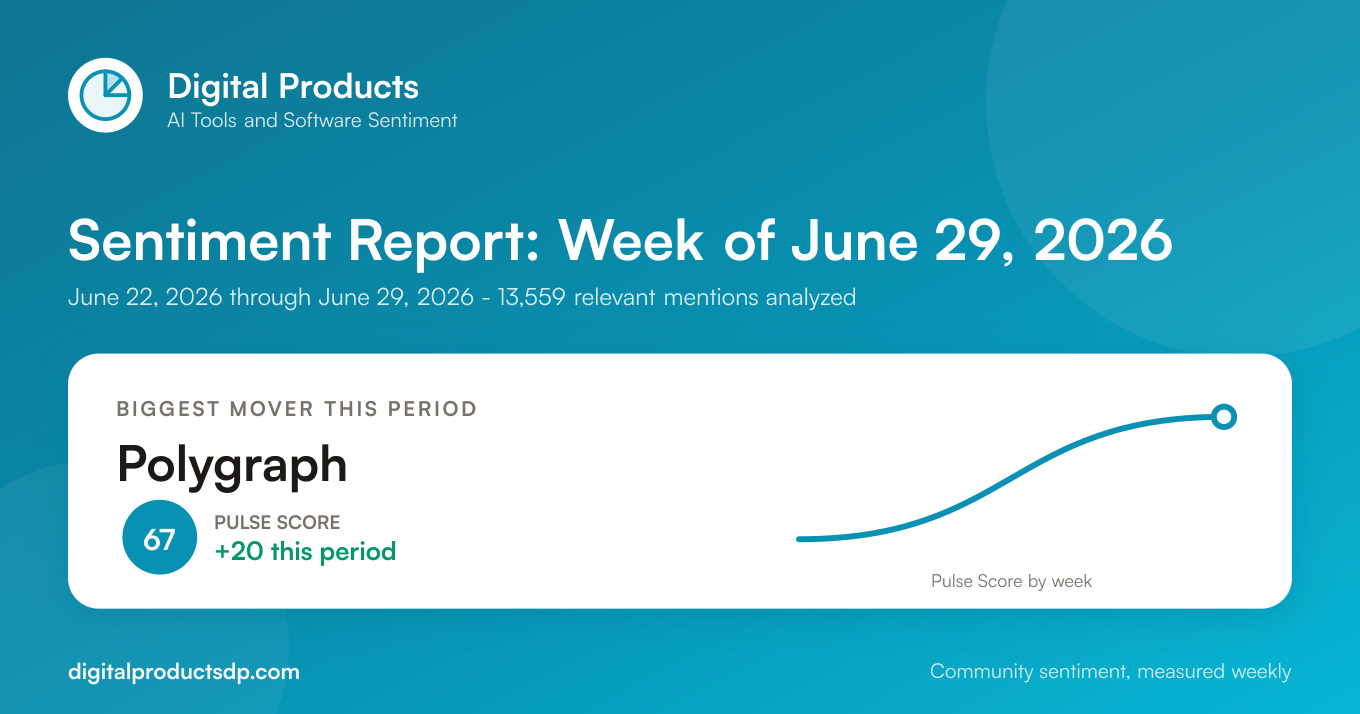
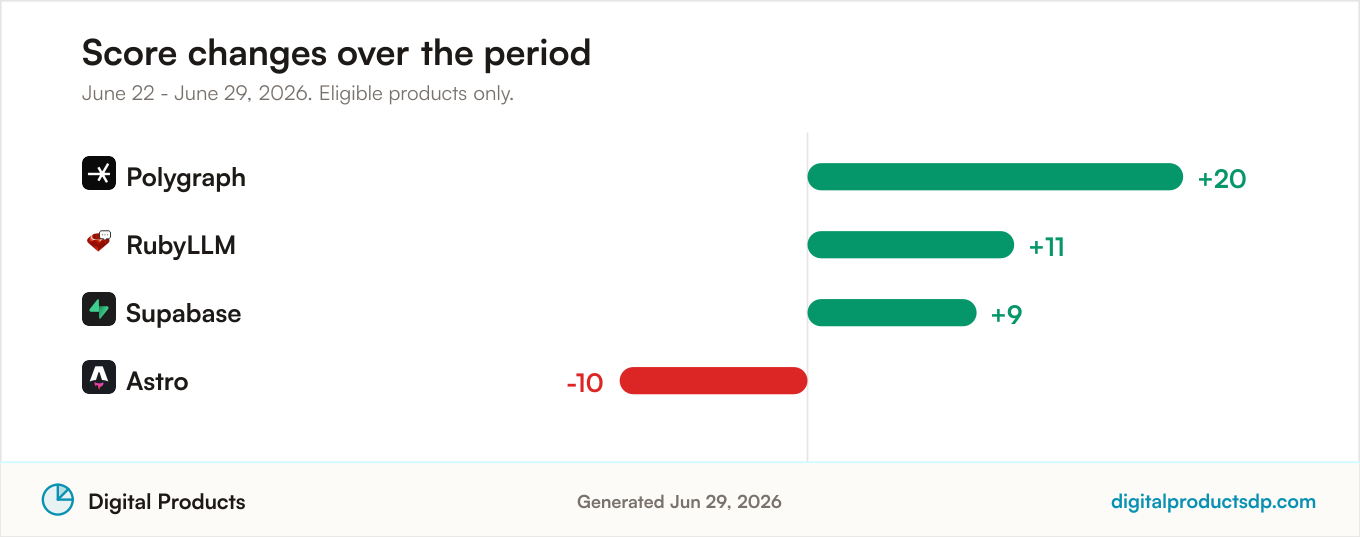
Polygraph was the biggest riser, moving from 47 to 67, a gain of 20 points based on 20 mentions. Its praise conversation leaned on strong features with 12 mentions, new releases with 11, and good integrations with 9, a pairing that suggests recent shipping activity landed well in public discussion. Complaints were lighter and centered on bugs with 4 mentions, missing features with 4, and feature requests with 3, which is a comparatively soft complaint profile for a product this active.
RubyLLM rose from 42 to 53, a gain of 11 points based on 58 mentions. The praise side was led by strong features with 24 mentions, good integrations with 20, and easy to use with 16. The move came despite a real complaint load: bugs drew 27 mentions and reliability 16, so the improvement reflects praise volume climbing alongside, rather than instead of, ongoing friction reports.
Supabase climbed from 58 to 67, a gain of 9 points based on 96 mentions, and it is the most heavily discussed riser. Praise was broad and deep, with strong features at 59 mentions, easy to use at 56, and performance at 41. Complaints were notably thin for its volume, with bugs at 5, downtime at 4, and reliability at 4, which helps explain why a large sample still produced one of the higher scores on the board.
Astro was the biggest faller, sliding from 59 to 49, a drop of 10 points based on 79 mentions. Its praise still featured strong features at 27 mentions, easy to use at 21, and performance at 13, but the complaint side outweighed that: bugs drew 36 mentions and reliability 18, the kind of pairing that tends to pull a score down when it dominates the conversation.
GitGuardian fell from 55 to 46, a drop of 9 points based on 10 mentions. This is the thinnest of the fallers, so the move should be read cautiously. Praise was limited to strong features at 5 mentions, while complaints centered on bugs at 7 and reliability at 6, and on so few total mentions those complaint counts carried disproportionate weight.
JFrog declined from 62 to 54, a drop of 8 points based on 24 mentions. Its praise leaned into security praise at 18 mentions, strong features at 11, and good integrations at 11, but complaints about bugs at 11, reliability at 8, and missing features at 5 offset that goodwill. The result is a product still praised for its security posture whose reliability chatter weighed on tone this period.
Spotlight: Minimus
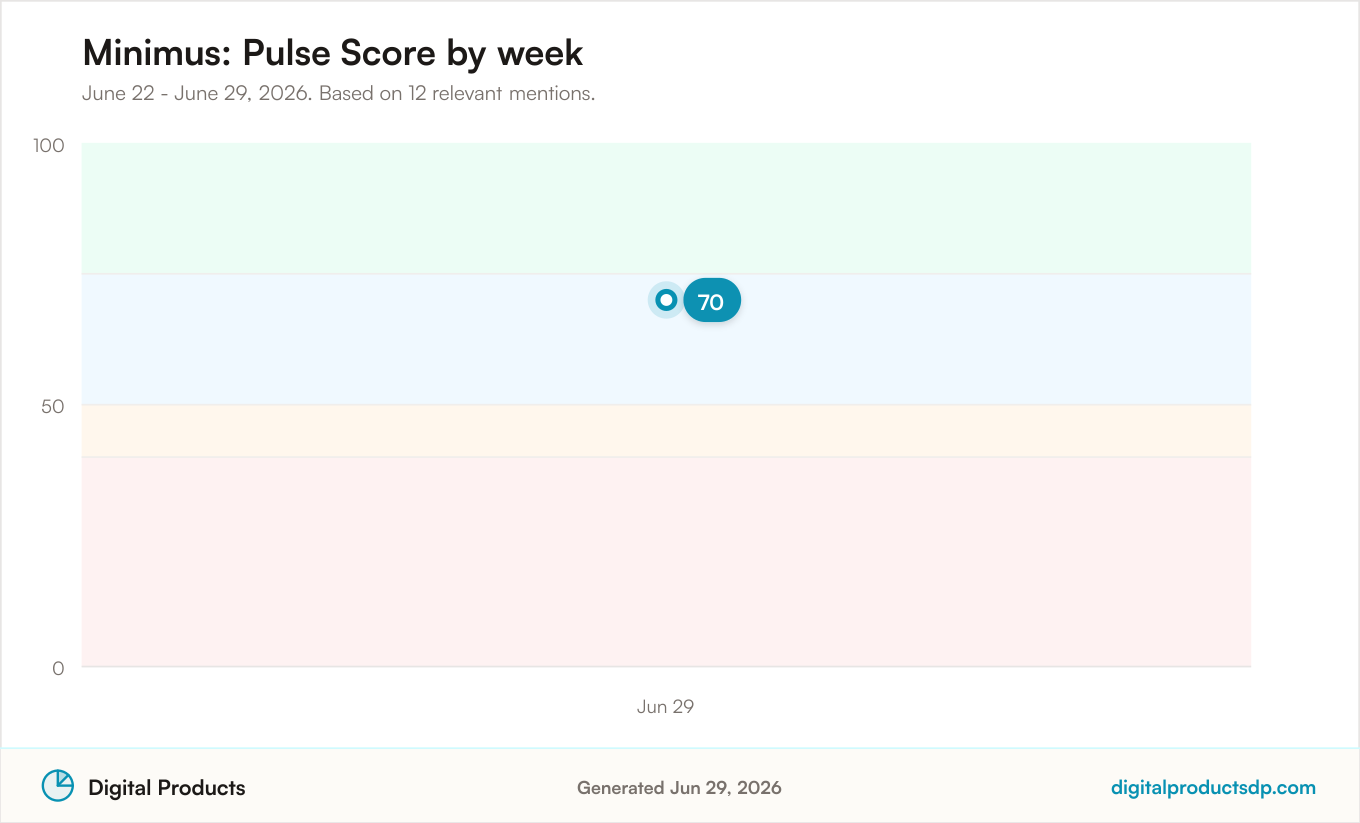
Minimus, a cloud-storage product, held the highest Pulse Score of the period at 70, based on 12 mentions in the week of June 22, 2026. It is a thin sample, and that is worth stating plainly: with only a dozen mentions, the score reflects a small and largely favorable slice of public discussion rather than a broad consensus. The weekly series shows a single data point at 70 for this period, so there is no prior week here to measure a trend against.
What discussion there was skewed positive. Praise was led by strong features at 11 mentions, followed by security praise at 7 and pricing changes at 4. For a storage product, a security praise theme appearing prominently alongside features is a meaningful signal about what the community chose to highlight. The complaint side was minimal, with privacy concerns and poor support drawing 1 mention each.
The takeaway is that Minimus enters the top spot on strong but sparse sentiment. A score built on 12 mentions can move sharply as volume grows, so the more useful thing to watch is whether that features-and-security praise pattern holds if discussion expands in the coming weeks.
Themes Driving the Conversation
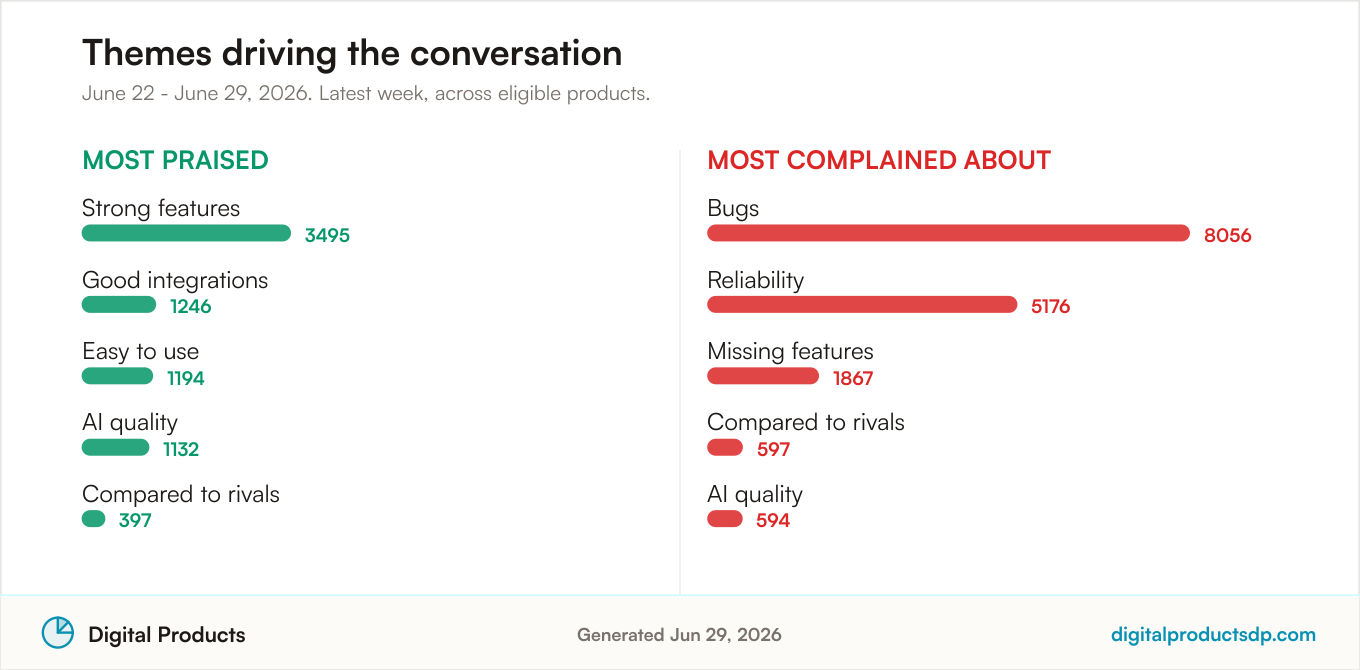
On the praise side, strong features dominated with 3,495 mentions, far ahead of good integrations at 1,246, easy to use at 1,194, AI quality at 1,132, and compared to rivals at 397. Strong features was the leading praise theme for the vast majority of ranked products, including Supabase with 59 mentions, Claude Code with 249, and ChatGPT with 183. AI quality as praise was concentrated in the AI-focused products, with Gemini at 149, Claude at 234, and ChatGPT at 159 driving much of that total, while easy to use anchored praise for products like Canva at 66 and Vercel at 35.
The complaint side was heavier and more concentrated. Bugs led every theme with 8,056 mentions, followed by reliability at 5,176, missing features at 1,867, compared to rivals at 597, and AI quality at 594. These two leading complaints ran through the most-discussed products: Cloudflare logged 203 bug mentions and 177 reliability mentions, Stripe logged 188 and 158, ClickHouse logged 441 and 290, and DuckDB logged 375 and 256. Even highly praised products carried the pattern, with Claude drawing 134 bug mentions and Vercel 170. AI quality appearing on both the praise and complaint lists reflects a split conversation, seen clearly in Gemini's 149 praise mentions against 112 complaint mentions and Grok's 79 against 183.
Watchlist
A large number of tracked products did not clear the 10-mention threshold this period and so were left out of the rankings. This is a statement about discussion volume, not about quality. Products with only a handful of mentions cannot produce a stable read, so we hold them back rather than publish a shaky score.
Several came close. Pika and Aider each drew 9 relevant mentions, as did Wasp, Contentful, and Plesk, leaving them just short of eligibility. LookAway, Framer, CleverCrow, Bluehost, CoreWeave, Bitbucket, Appwrite, and vee each landed at 8 mentions. A cluster including Railway, Better Stack, NordPass, ActiveCampaign, and DocuSign sat at 7, while VEED, DALL-E, Nhost, Braze, Manychat, Writesonic, Tidio, SUSE, and Zilliz gathered 6. If any of these pick up discussion next week, they could enter the rankings, and their theme mixes would become worth reading. For now, the honest position is that we do not have enough signal to score them.
What To Watch Next Week
First, watch whether the thin-sample leaders hold. Minimus at 70 on 12 mentions, FUTO Swipe at 68 on 14, and TikZ Editor at 66 on 15 all sit on small volumes, so the question is whether added discussion confirms or erodes those scores. Supabase at 67 on 96 mentions is the sturdiest top read and the better benchmark to track.
Second, watch the risers for durability. Polygraph gained 20 points to reach 67 but did so on 20 mentions, while RubyLLM's climb to 53 came alongside 27 bug mentions and 16 reliability mentions. Whether those complaint themes grow relative to praise will shape where both land next.
Third, watch the bugs and reliability drumbeat that defined the complaint side, with 8,056 and 5,176 mentions respectively. Products like Astro, which fell 10 points with 36 bug mentions, show how quickly that theme can move a score. The ai-writing category's drop from 50 to 44 is also worth monitoring as the sharpest category shift this period.
Frequently Asked Questions
Which product had the highest Pulse Score this period?
Minimus, a cloud-storage product, had the highest Pulse Score at 70, based on 12 mentions during the week of June 22, 2026.
Which product moved the most this period?
Polygraph rose the most, climbing from 47 to 67 for a gain of 20 points based on 20 mentions. On the downside, Astro fell the most, dropping from 59 to 49, a decline of 10 points based on 79 mentions.
What was the overall category mood this period?
Category sentiment was mostly steady, with small shifts in either direction. Design was strongest and flat at 59, while ai-writing showed the sharpest drop, from 50 to 44, and video-editing sat lowest at 37.
How many mentions were analyzed this period?
We analyzed 13,559 relevant mentions across the products that cleared the minimum threshold, out of 2,235 tracked products, of which 153 were eligible for rankings.
About This Data
Pulse Scores summarize the tone of public online discussion on a 0-100 scale and reflect community sentiment, not a verdict on a product's quality or a recommendation. We report on complete calendar weeks only, and products with fewer than 10 relevant mentions in the period are excluded from rankings to avoid unstable reads on thin samples.
Public discussion is collected from Hacker News, Stack Exchange, GitHub, Bluesky, the Apple App Store, and YouTube. Automated sentiment analysis can misread sarcasm, jokes, or niche context, mention volumes vary widely between products, and scores can move from week to week. Any company that wants to respond to how it is represented here is welcome to reach out. For how the scores are calculated, see our methodology.