AI Tools and Software Sentiment Report: Week of May 26, 2025
May 26, 2025
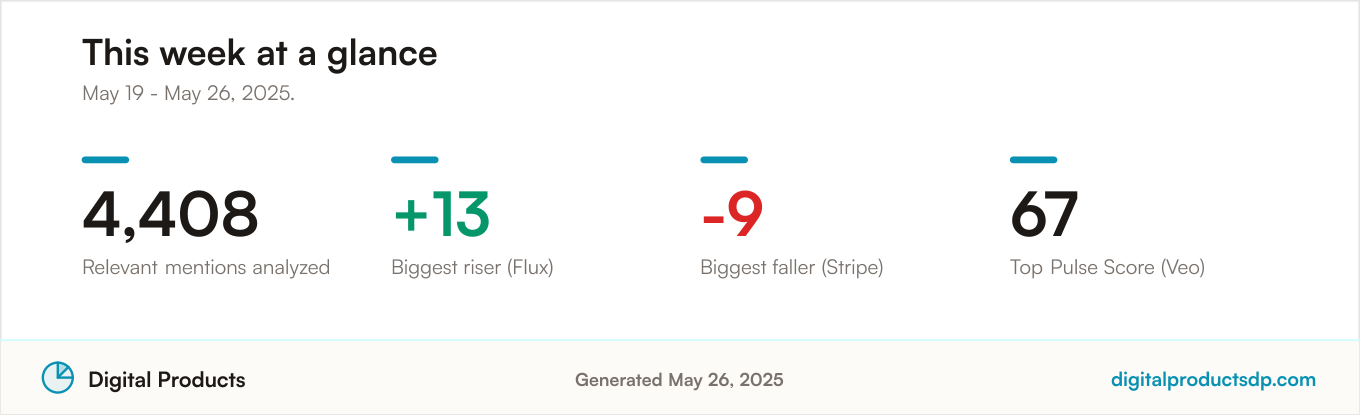
This edition of our sentiment report covers aggregated public online discussion of the AI tools and software products we track, with mentions analyzed for May 19, 2025 through May 26, 2025. Across that window we processed 4,408 relevant mentions spread across 79 products that cleared our minimum volume bar for ranking. The figures below summarize the tone of that public chatter, not any judgment about how well these products actually work.
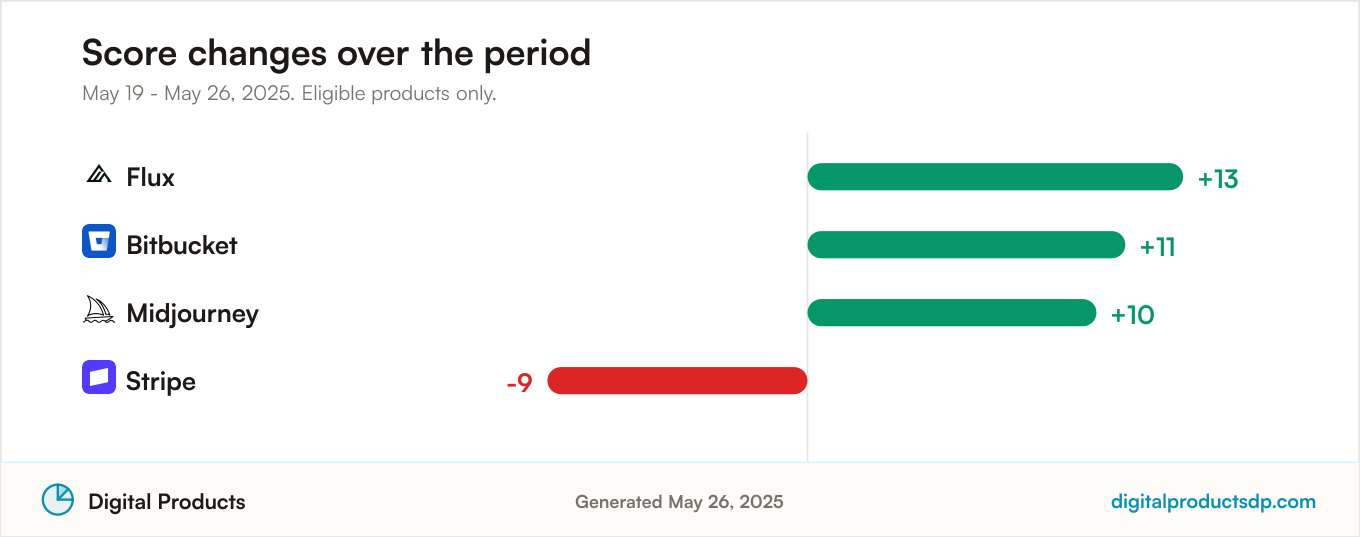
The period running from May 19, 2025 through May 26, 2025 produced a spread of movement worth reading carefully. Veo held the top Pulse Score, Flux posted the largest gain, and Stripe registered the sharpest decline. Because our tracker follows both AI tools and broader software such as CRM, coding, and finance platforms, we name categories directly rather than lumping everything together. What follows connects the scores to the specific praise and complaint themes recorded for each product.
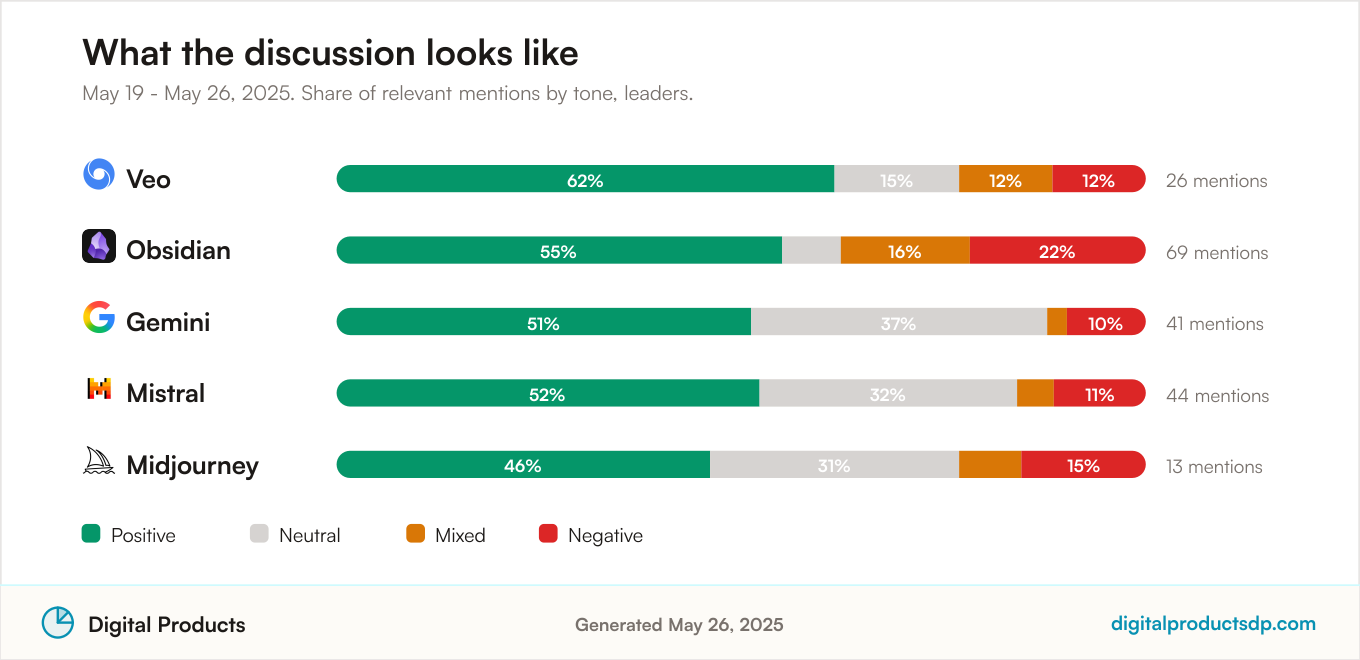
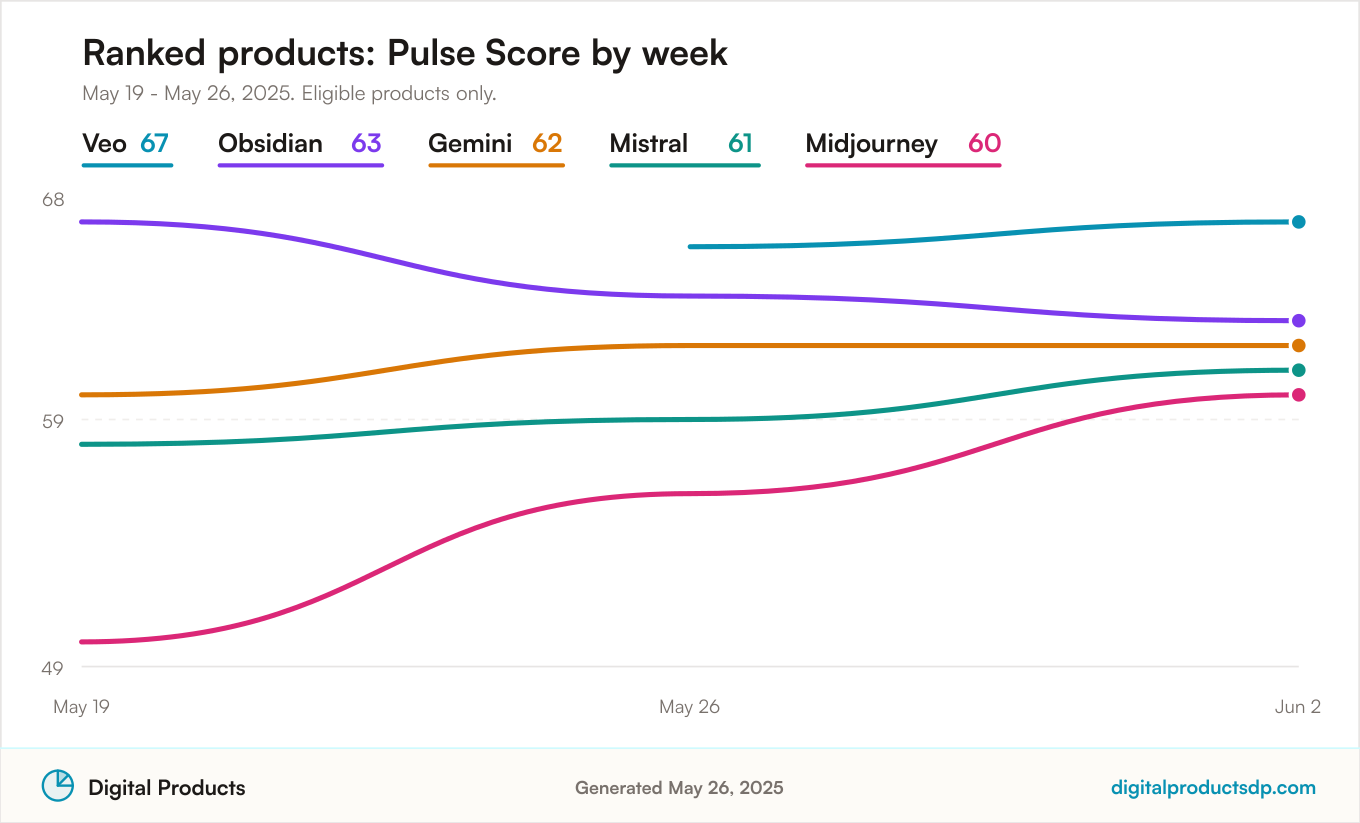
Veo sits at the top with a Pulse Score of 67, based on 26 mentions over the period. Obsidian follows at 63, based on 69 mentions, and it carried the largest mention count of any leader, which makes its read one of the steadier ones in this group. Gemini registered 62 based on 41 mentions, with Mistral just behind at 61 based on 44 mentions.
Midjourney rounds out the leaders at 60, based on 13 mentions. That is the thinnest sample among the five, so its position should be read with more caution than Obsidian's. The cluster from 60 to 67 is tight, meaning small shifts in tone could reshuffle these standings in a future week. Three of the five leaders are AI tools, while Obsidian is a project-management product, a reminder that strong sentiment is not confined to the AI category.
Category View
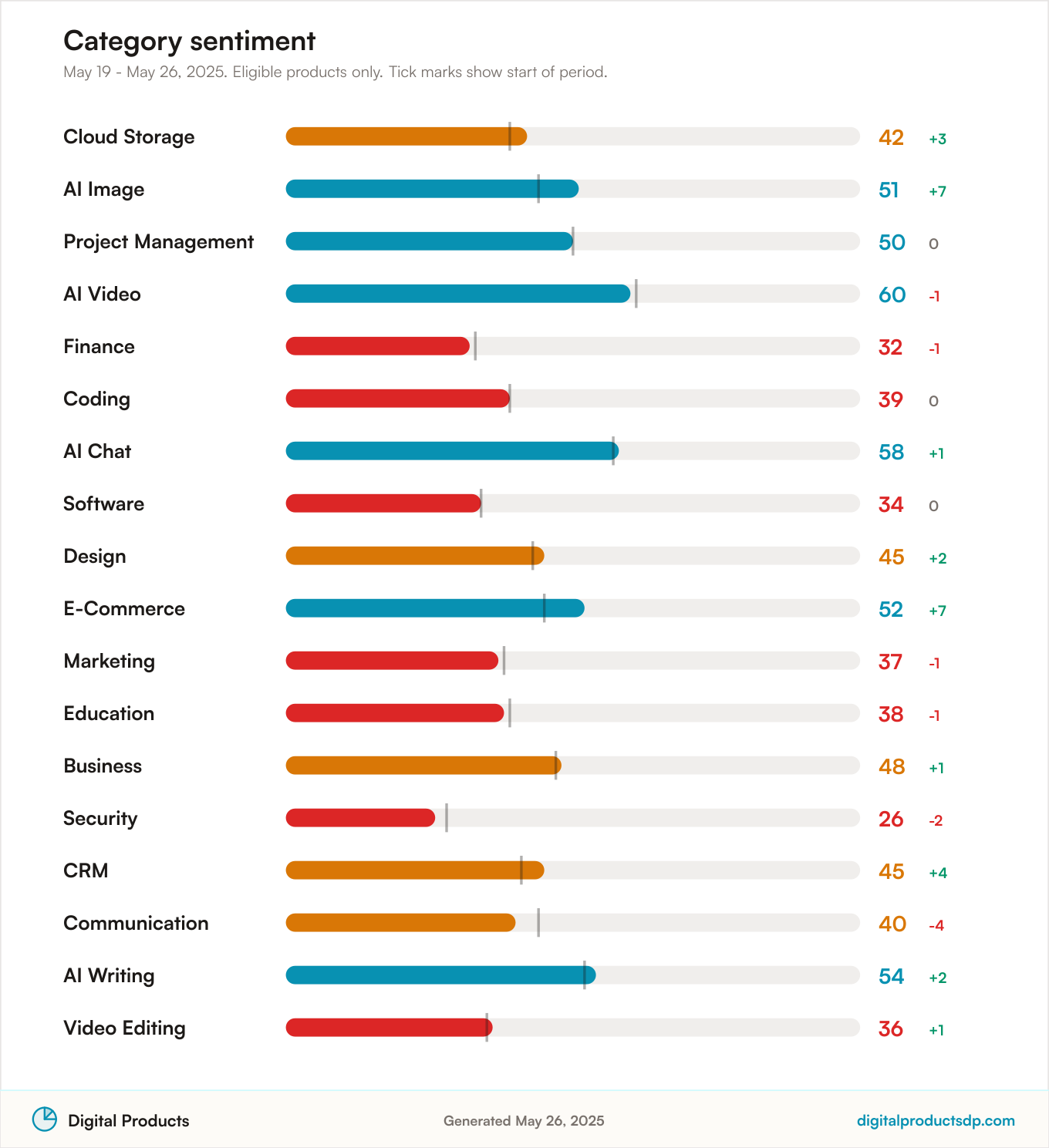
At the category level, the clearest upward moves in public discussion came from e-commerce, which rose from 45 to 52, and ai-image, which climbed from 44 to 51. The crm category moved from 41 to 45, and design edged from 43 to 45. ai-chat held near the top of the range, shifting from 57 to 58, while ai-video stayed high but slipped slightly from 61 to 60. On the softer side, security discussion fell from 28 to 26, the lowest category read here, and communication cooled from 44 to 40. Several categories were essentially flat, including project-management at 50 to 50, coding at 39 to 39, and software at 34 to 34, suggesting steady rather than shifting sentiment in those areas.
Biggest Movers
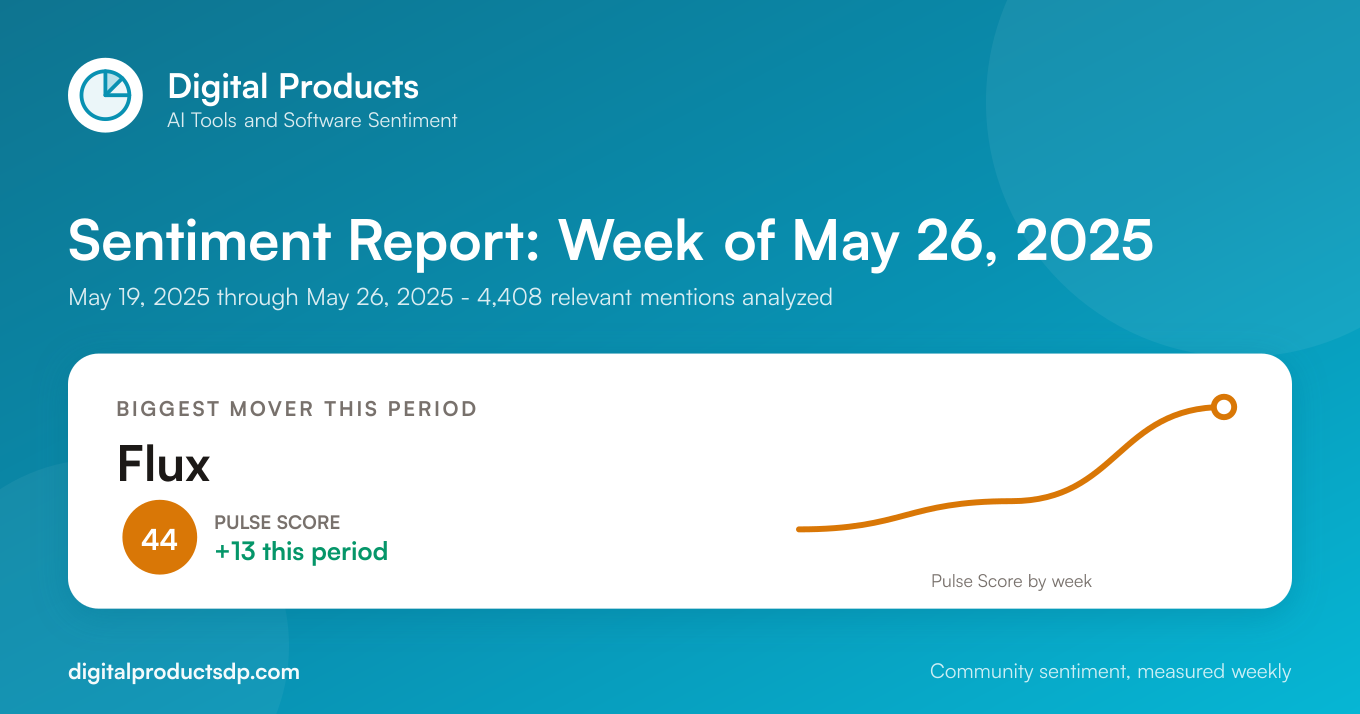
Flux (riser, +13, 31 to 44, based on 24 mentions). Flux posted the largest gain in the period. Its praise themes centered on strong features (8 mentions) and AI quality (7 mentions), with a smaller nod to fair pricing (2 mentions). That said, the complaint side was still active, led by bugs (13 mentions), performance (13 mentions), and reliability (8 mentions). The rise in tone suggests the feature and quality conversation carried more weight this week even as reliability gripes persisted.
Bitbucket (riser, +11, 28 to 39, based on 10 mentions). Bitbucket, a coding product, climbed the second most, though on the smallest sample among the risers at exactly the ten-mention threshold. Its recorded praise was sparse, with strong features (2 mentions) and single mentions of great collaboration and performance. Complaints leaned toward missing features (4 mentions) and comparison to rivals (3 mentions). With so few mentions, this read is best treated as an early signal rather than a settled trend.
Midjourney (riser, +10, 50 to 60, based on 13 mentions). Midjourney's climb pushed it into the top-five leaders. AI quality was the dominant praise theme at 47 mentions, well ahead of strong features (38 mentions) and feels fast (15 mentions). The complaints were narrower, with AI quality also appearing as a criticism (14 mentions), comparison to rivals (9 mentions), and reliability (6 mentions). The same theme showing up in both praise and complaint columns points to a split audience reaction rather than a single view.
Stripe (faller, -9, 51 to 42, based on 56 mentions). Stripe recorded the steepest decline, and it did so on a healthy 56-mention sample, which makes the move one of the more grounded reads among the fallers. Its praise remained substantial, led by strong features (84 mentions), good integrations (50 mentions), and easy to use (35 mentions). But the complaint volume was heavier still, with bugs (188 mentions), reliability (158 mentions), and lacking integrations (61 mentions). When reliability and bug chatter outweigh a solid feature story, the tone tends to slide, and that is what the numbers show here.
Bun (faller, -8, 43 to 35, based on 27 mentions). Bun, a coding product, fell nearly as far. Its praise skewed toward performance (9 mentions), easy to use (8 mentions), and strong features (7 mentions). The complaint side was larger, with bugs (32 mentions), reliability (24 mentions), and lacking integrations (6 mentions). The pattern mirrors Stripe on a smaller scale, with reliability and bug reports dominating the conversation.
Contentful (faller, -6, 46 to 40, based on 16 mentions). Contentful's decline came on a lighter 16-mention sample. Praise was modest, with strong features (6 mentions), good integrations (5 mentions), and new releases (3 mentions). Complaints outnumbered praise, led by bugs (9 mentions), missing features (9 mentions), and reliability (7 mentions). With the complaint themes running even with or ahead of praise, the softer tone follows.
Spotlight: Veo
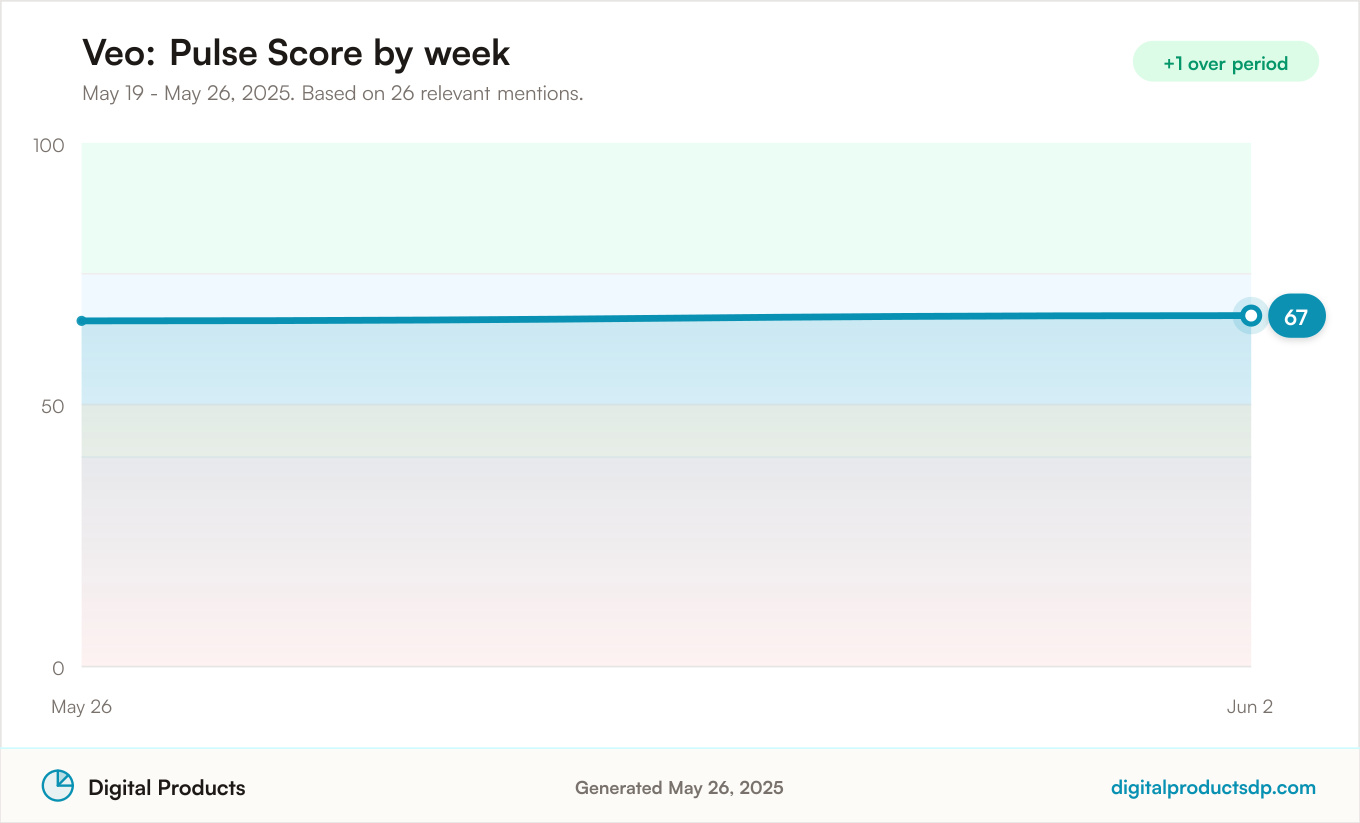
Veo, an AI video product, holds the top Pulse Score for the period at 67, based on 26 mentions. Its weekly series is short, appearing on May 19, 2025 at 66 and on May 26, 2025 at 67. That single-point move upward is small, but it kept Veo ahead of a tightly packed leader group. Because Veo entered the series later than most tracked products, its history here is limited and its position rests on a relatively modest sample.
The theme breakdown helps explain the standing. Veo's praise was led by strong features (13 mentions), new releases (9 mentions), and AI quality (8 mentions). The new-releases signal is notable, since it suggests discussion was partly driven by fresh developments rather than steady-state usage. That kind of attention can lift tone quickly but can also fade once novelty passes.
On the complaint side, Veo drew bugs (8 mentions), missing features (5 mentions), and reliability (4 mentions). These are the same recurring themes that pressure many products in this report, and they are worth watching against the praise volume. For now, the praise themes outweigh the complaints in Veo's mix, which is consistent with its position at the top of the leaderboard. Given the thin sample, though, a handful of additional critical mentions could move the read meaningfully in either direction.
Themes Driving the Conversation
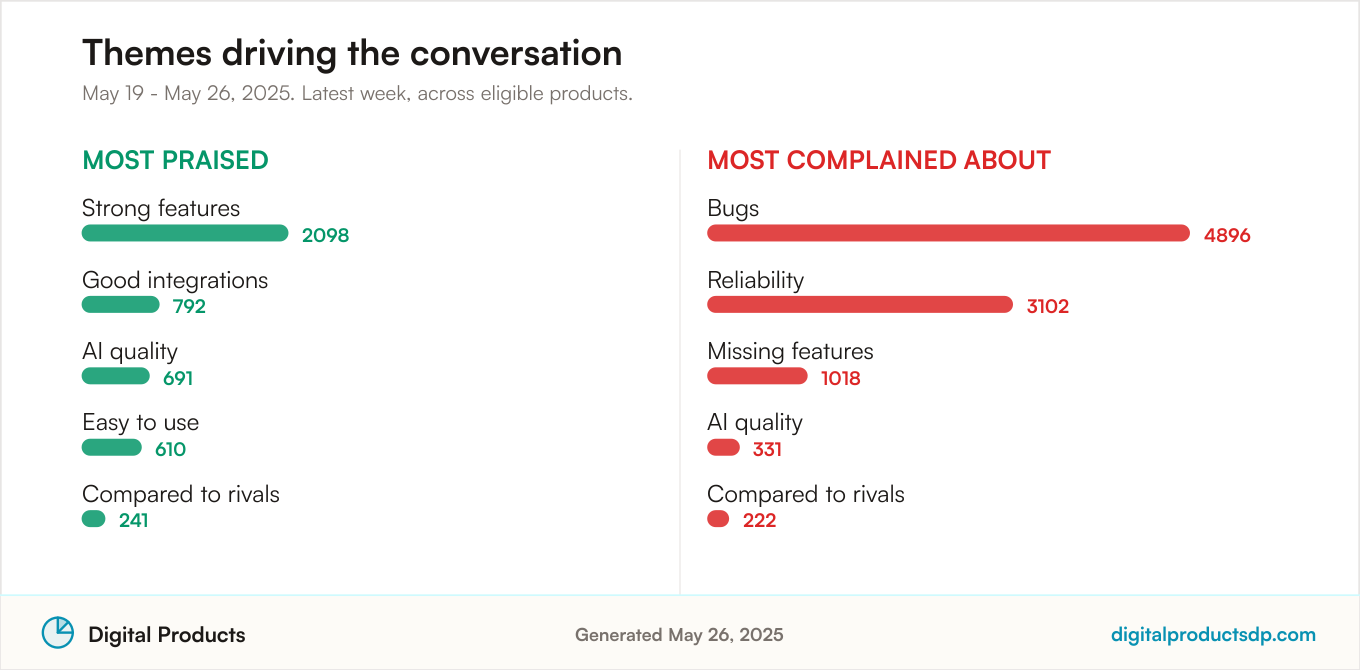
On the praise side, strong features was the dominant theme with 2,098 mentions, far ahead of anything else. Good integrations followed at 792 mentions, then AI quality at 691 mentions, easy to use at 610 mentions, and compared to rivals at 241 mentions. The strong-features theme showed up across many leaders and risers, including Obsidian with 68 mentions, Cursor with 105 mentions, and Stripe with 84 mentions even amid its decline. AI quality was the standout praise driver for Midjourney at 47 mentions and for the ai-chat products Claude and Gemini, which recorded 216 and 121 AI-quality praise mentions respectively.
On the complaint side, bugs led decisively with 4,896 mentions, followed by reliability at 3,102 mentions, missing features at 1,018 mentions, AI quality at 331 mentions, and compared to rivals at 222 mentions. Bugs and reliability were the recurring pressure points behind the fallers, appearing prominently for Stripe (188 bug mentions, 158 reliability) and Bun (32 bug mentions, 24 reliability). Reliability was also heavy for products deep in the rankings such as ClickHouse (290 reliability mentions) and CockroachDB (225 reliability mentions). The presence of AI quality on both the praise and complaint lists underscores that the same attribute can split opinion sharply depending on the product and the user.
Watchlist
Many tracked products did not reach the ten-mention threshold this period and are therefore excluded from the rankings. This is a matter of discussion volume, not a judgment about quality. Several are well-known names that simply drew thin chatter in this window, including Coursera and Asana with 9 relevant mentions each, DigitalOcean and Pipedrive also at 9 mentions each, and Earthly and Hasura at 9 mentions apiece.
Others sat lower still, such as Semrush and HubSpot with 8 relevant mentions each, Helicone at 8, and Gumroad, Mailchimp, Braze, and Fastly at 7 each. A cluster of products registered exactly 6 relevant mentions, including LegalShield, Canva, Hotjar, LottieFiles, InVision, Kinde, and Cloudflare. Because the tracker follows 2,246 products in total, a large number recorded very few or zero relevant mentions in the period. When a product's sample is this small, a single post can swing its apparent tone, which is exactly why we hold the ten-mention line before publishing a score. If discussion volume rises in a future complete week, any of these could enter the ranked view.
What To Watch Next Week
First, watch whether Flux can hold its gain. Its move from 31 to 44 came alongside persistent complaint themes in bugs (13 mentions) and performance (13 mentions), so the question is whether the feature and quality praise that lifted it this week carries forward or gives way to those recurring gripes.
Second, watch the fallers for stabilization. Stripe slid to 42 on a substantial 56-mention sample dominated by bugs and reliability chatter, and Bun landed at 35 with a similar complaint mix. Whether those reliability conversations cool or deepen will shape their next reads.
Third, watch the tight leader cluster. Veo at 67, Obsidian at 63, Gemini at 62, and Mistral at 61 sit within a narrow band, and Obsidian's larger 69-mention base gives it a steadier footing than Veo's 26-mention read. Small tone shifts could rearrange the top of the table in the next complete week.
Frequently Asked Questions
Which tool had the highest Pulse Score this period?
Veo, an AI video product, held the highest Pulse Score at 67, based on 26 mentions over the period.
Which product moved the most this period?
Flux posted the largest gain, rising from 31 to 44, a change of +13, based on 24 mentions. On the downside, Stripe fell the most, from 51 to 42, a change of -9, based on 56 mentions.
What was the overall mood across categories?
It was mixed. E-commerce rose from 45 to 52 and ai-image climbed from 44 to 51, while security slipped from 28 to 26 and communication cooled from 44 to 40. Several categories, including project-management and coding, were flat.
How many mentions were analyzed this period?
We analyzed 4,408 relevant mentions across 79 products that met the ten-mention threshold for ranking during the period.
About This Data
Pulse Scores summarize the tone of public online discussion on a 0-100 scale and reflect community sentiment, not a verdict on a product's quality or a recommendation. We report on complete calendar weeks only, and products with fewer than 10 relevant mentions in the period are excluded from rankings to avoid unstable reads on thin samples.
Public discussion is collected from Hacker News, Stack Exchange, GitHub, Bluesky, the Apple App Store, and YouTube. Automated sentiment analysis can misread sarcasm, jokes, or niche context, mention volumes vary widely between products, and scores can move week to week. Any company that wants to respond is welcome to reach out. For how scores are calculated, see our methodology.