AI Tools and Software Sentiment Report: Week of June 15, 2026
June 16, 2026
This report tracks aggregated public online discussion about AI tools and software, turning the tone of that chatter into Pulse Scores on a 0-100 scale. The figures here reflect community sentiment, not a verdict on any product's quality. For this edition we focus on mentions analyzed for June 8, 2026 through June 15, 2026, the most recent complete calendar week in our window.
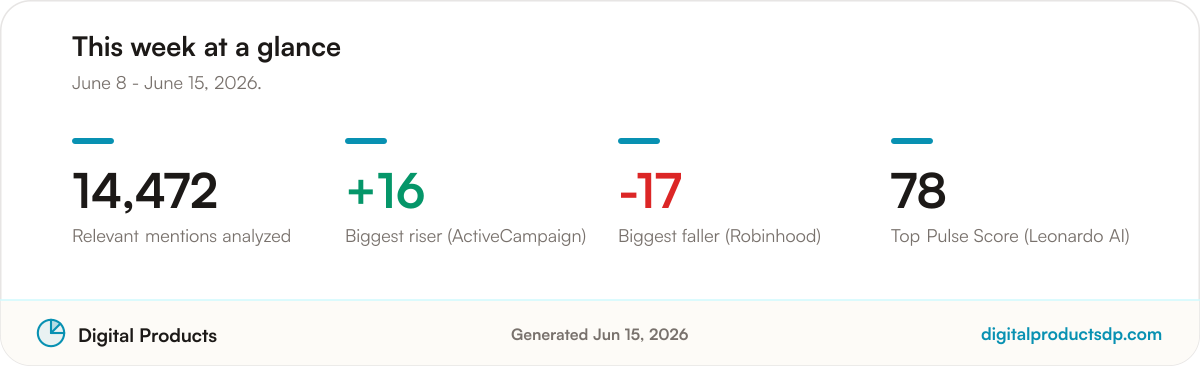
Across the wider digest period running from June 1, 2026 through June 15, 2026, we processed 14,472 relevant mentions. Of the 2,218 products tracked, 143 cleared the threshold of at least 10 relevant mentions to be eligible for ranking. The result is a mixed picture: strong scores at the top, a heavy weight of bug and reliability complaints across the field, and a handful of sharp movers worth watching.
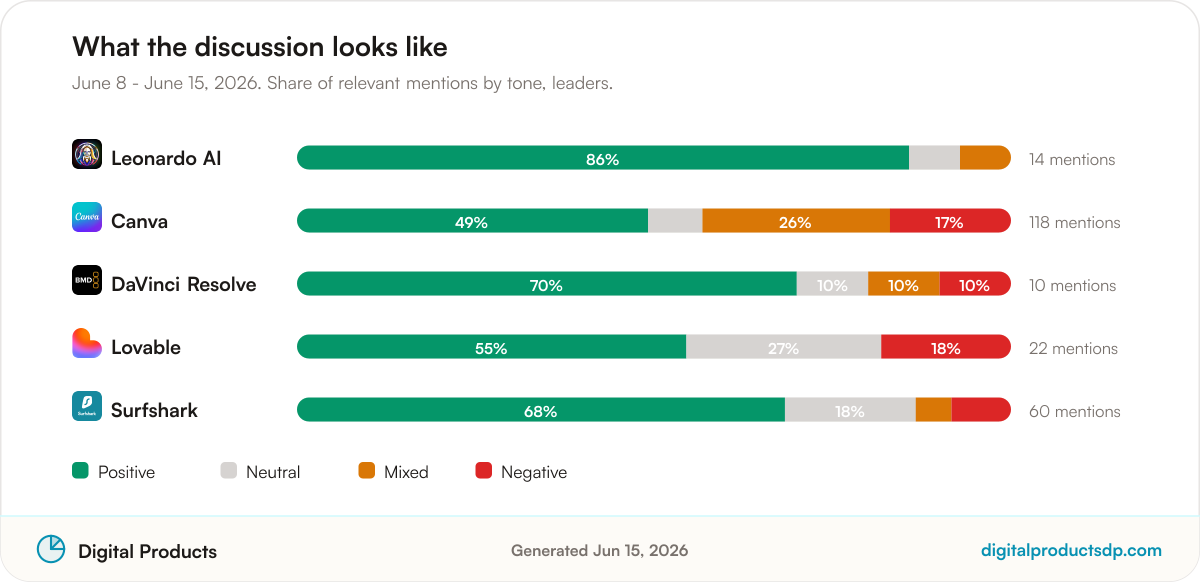
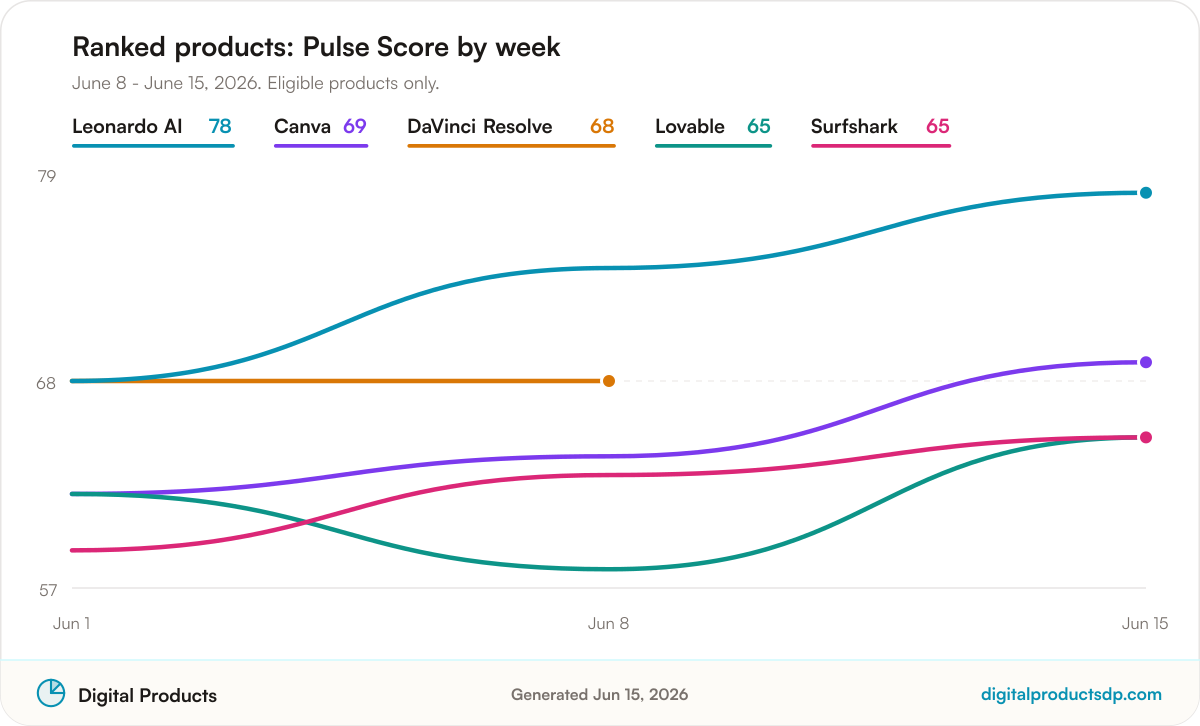
Leonardo AI, an AI image tool, holds the top Pulse Score at 78, though that read rests on a thin sample of just 14 mentions over the period. Canva follows at 69, and its score carries far more weight at 118 mentions analyzed, the largest sample among the leaders. DaVinci Resolve, a video editing tool, sits at 68 based on only 10 mentions, right at the eligibility line.
Lovable, a coding tool, and Surfshark, a security product, are tied at 65, drawn from 22 and 60 mentions respectively. The spread here is worth noting: the very top score comes from one of the smallest eligible samples, while Canva and Surfshark anchor their positions on broader discussion. When sample sizes differ this much, a high score on few mentions should be read with more caution than a slightly lower score on many.
Category View
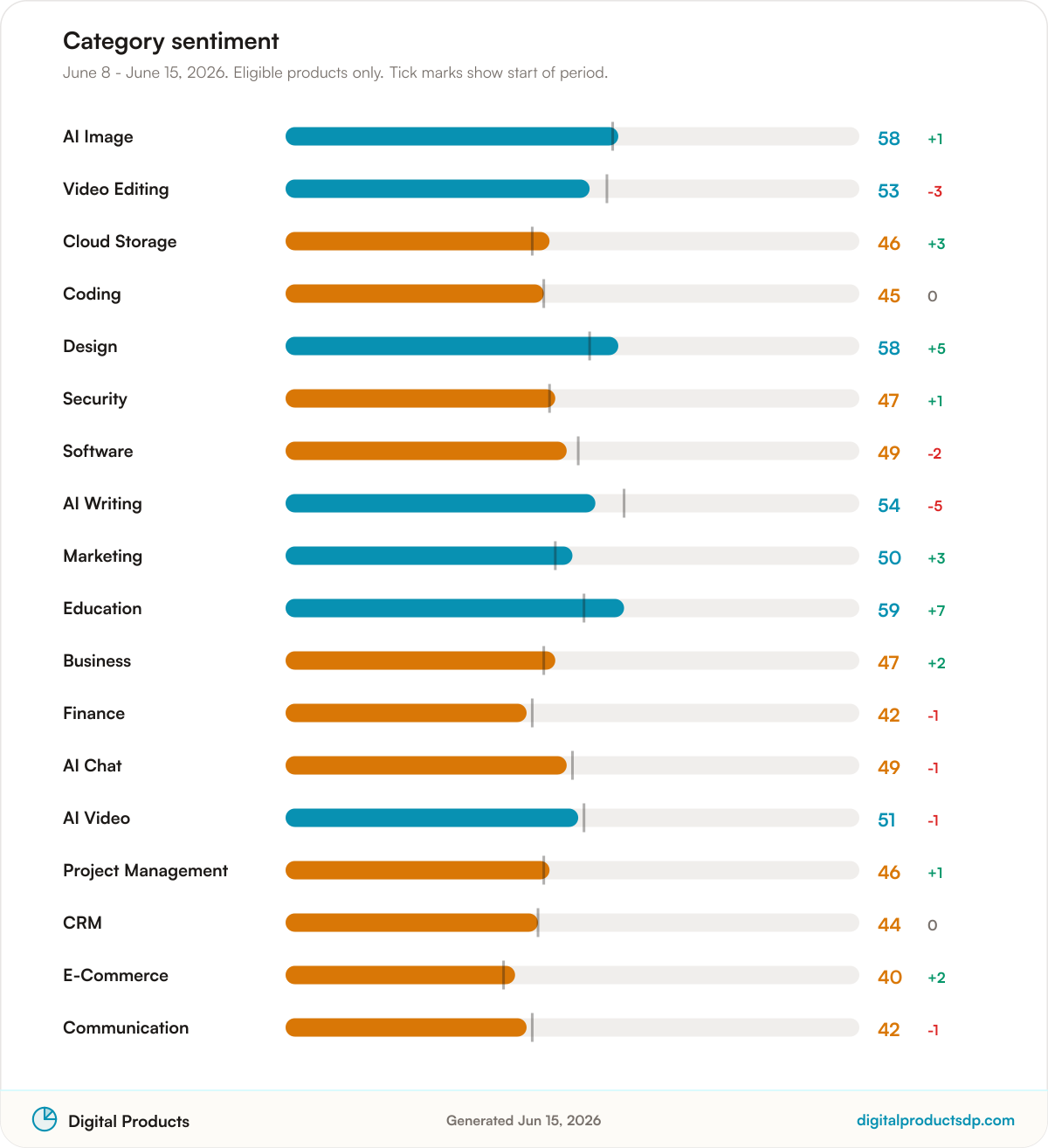
At the category level, the largest gains in average Pulse Score came from education, which moved from 52 to 59, and design, which rose from 53 to 58. Marketing edged up from 47 to 50, and cloud storage from 43 to 46. Moving the other way, ai-writing slipped from 59 to 54, video editing fell from 56 to 53, and software dipped from 51 to 49. Several categories held essentially flat, including coding at 45, crm at 44, and ai-chat near 50 to 49. The overall impression is one of small shifts rather than wholesale mood swings, with education and design the clearest bright spots in community discussion.
Biggest Movers
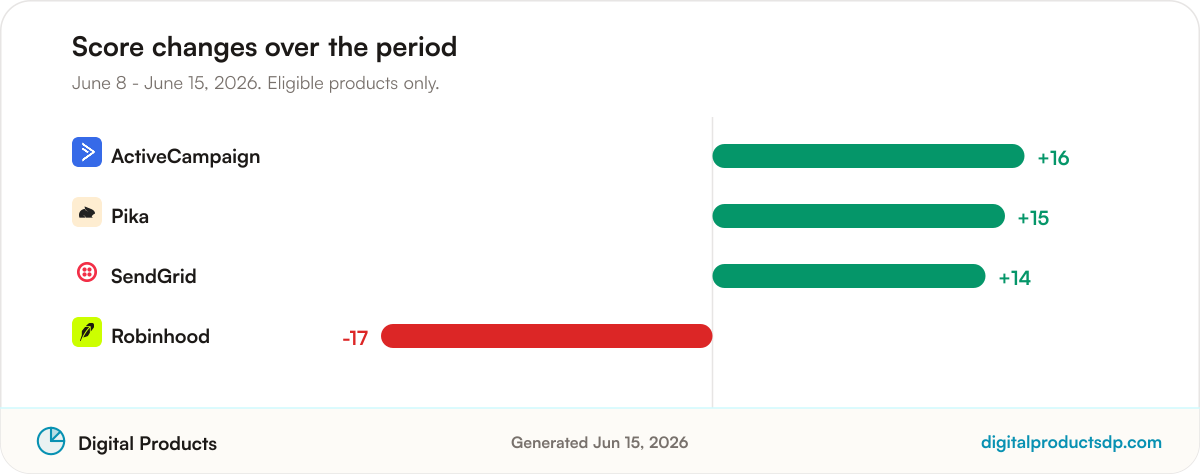
ActiveCampaign (riser, plus 16, from 44 to 60, based on 32 mentions). This marketing tool posted the period's largest gain. Its praise themes leaned heavily on new releases, with 17 mentions, alongside AI quality and strong features at 18 each. That mix suggests the warmer discussion tracked product updates and feature talk. Complaints stayed comparatively light, led by bugs at 6 mentions and reliability at 4, which is a smaller drag than many products in the field carry.
Pika (riser, plus 15, from 31 to 46, based on 29 mentions). The AI video tool climbed steadily from a low base, moving 31 to 38 to 46 across the three weeks. Its praise centered on a polished UI, with 6 mentions, the most of any praise theme for the product. Complaints were dominated by bugs at 4 mentions and reliability at 3, so the rise reflects improving tone rather than a complaint-free read.
SendGrid (riser, plus 14, from 34 to 48, based on 34 mentions). This product recovered from a weak start, jumping 34 to 46 between the first two weeks before settling at 48. Praise was modest and spread across strong features, easy to use, and good integrations, each at 4 to 5 mentions. The complaint side was the louder voice, with bugs at 14 mentions and reliability at 10, so the score improved even as reliability talk remained the central concern in discussion.
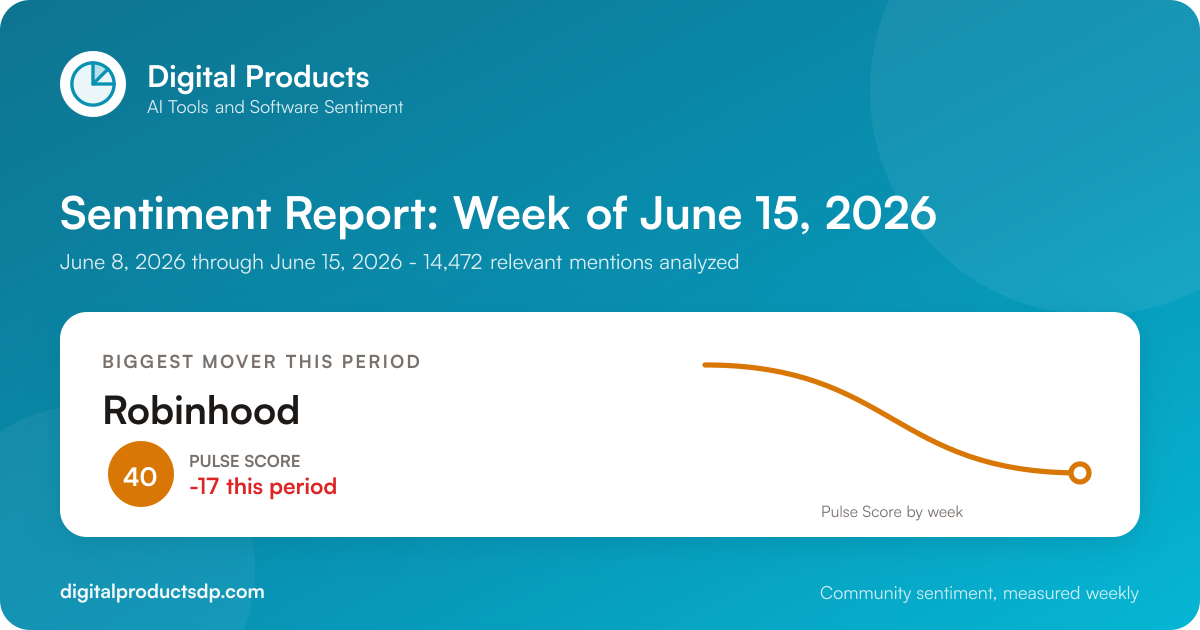
Robinhood (faller, minus 17, from 57 to 40, based on 12 mentions). The finance product saw the steepest drop, and on a thin sample of 12 mentions a swing like this is exactly the kind of move that small volume can amplify. Its complaints were led by bugs at 11 mentions and reliability at 7, with lacking integrations at 3. Praise was sparse, spread across strong features, good integrations, and new releases. The weight of bug talk against limited praise lines up with the fall.
PgDog (faller, minus 13, from 76 to 63, based on 41 mentions). This product began the period as one of the highest-scored names at 76 before settling to 63. Notably, reliability appears on both sides of its ledger, cited 7 times in praise and 5 times in complaints, a sign of split community experiences. Strong features led praise at 16 mentions, while missing features and comparisons to rivals, at 4 each, weighed on the complaint side.
Apollo.io (faller, minus 13, from 55 to 42, based on 11 mentions). The marketing tool fell on a thin 11-mention sample. It recorded no praise themes this period, while its complaints centered on privacy concerns at 4 mentions, followed by lacking integrations and a security mention. With no praise to counterbalance privacy-focused chatter, the downward move is consistent with what discussion captured.
Spotlight: Leonardo AI
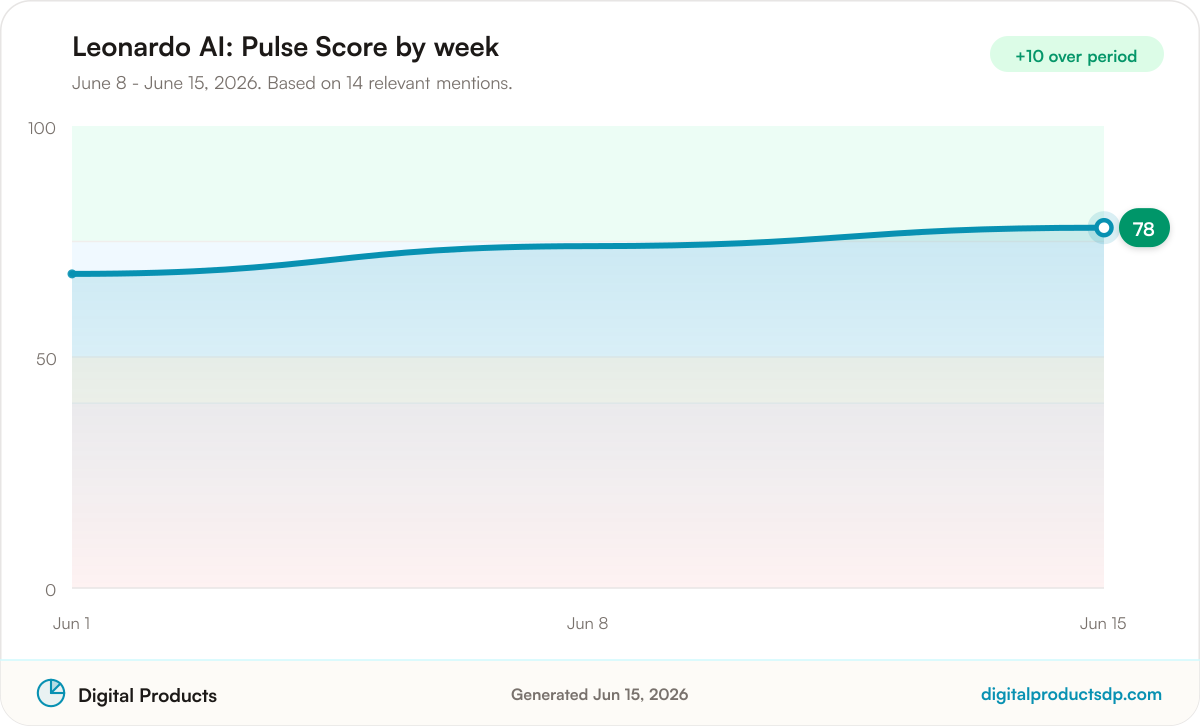
Leonardo AI took the top Pulse Score of the period at 78, based on 14 mentions. Its weekly trajectory was a clean upward climb, moving from 68 on June 1, 2026, to 74 on June 8, 2026, and then to 78 on June 15, 2026. A rising line across all three weeks is the most encouraging pattern a product can show in this data, even when the sample is small.
The themes behind that score are unusually one-sided. Strong features led praise with 10 mentions, followed by AI quality at 3 and good integrations at 2. On the complaint side, the product recorded none this period. That absence of logged complaints is rare across the eligible field and helps explain why Leonardo AI sits above products with far larger samples.
The caution is the same one that applies anywhere on a thin read: 14 mentions is a narrow base, and a clean sheet can shift quickly if discussion volume grows. For now, the available data points to consistently positive community discussion, and the spotlight here reflects what those mentions captured rather than a broad endorsement.
Themes Driving the Conversation
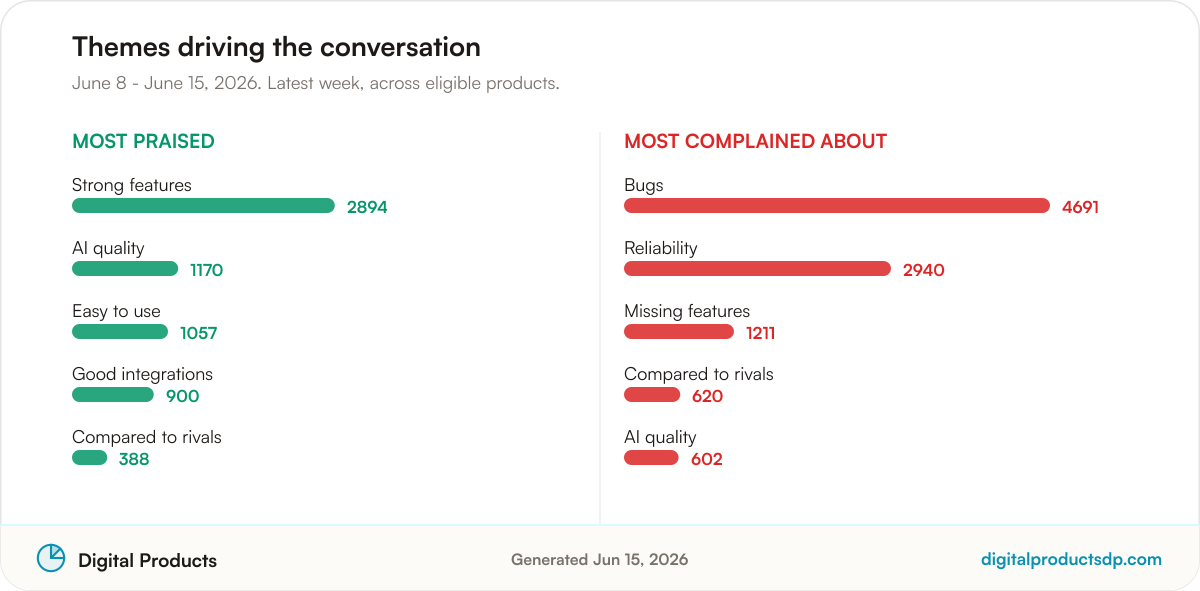
On the praise side, strong features dominated with 2,894 mentions, far ahead of the field. AI quality followed at 1,170 mentions, easy to use at 1,057, and good integrations at 900, with comparisons to rivals trailing at 388. These themes show up across the most-discussed products: Claude Code's praise was led by strong features at 249 mentions, ChatGPT's by strong features at 183, and Claude's by AI quality at 234. Easy-to-use praise also powered names like Canva, where it led at 66 mentions, and Postman at 29. The takeaway is that when discussion turns positive, it most often centers on depth of features and capability.
The complaint side carried more weight overall. Bugs led every theme with 4,691 mentions, followed by reliability at 2,940, missing features at 1,211, comparisons to rivals at 620, and AI quality at 602. Those two top complaint themes track directly to the highest-volume products: Vercel logged bugs at 170 mentions and reliability at 151, Stripe bugs at 188 and reliability at 158, Loom bugs at 211 and reliability at 135, and WooCommerce bugs at 330 and reliability at 175. Even strong performers were not immune, with Canva recording bugs at 12 mentions. The pattern is consistent: bugs and reliability are the central friction points in public discussion across the field this period.
Watchlist
A large number of tracked products fell below the 10-mention threshold this period and are not ranked. This is a measure of discussion volume, not a judgment on quality. Several names sat just under the line, including Sudowrite, Railway, Stability AI, and Storyblok, each at 9 relevant mentions, along with Superhuman and Bitwarden, also at 9. Just behind them were Notepad++ at 8, SaneBox at 8, and Heroku at 7.
Other recognizable products drew only light chatter in our sources this period, such as Google Meet at 7 mentions, CrowdStrike at 7, Vanta at 7, Evernote at 7, and Audacity at 6. A small move in raw mentions would push some of these into eligibility next period. Because our two sources for this digest are Hacker News and YouTube review-video comments, products that simply were not the subject of much posting or commentary in that window naturally land here. Their absence from the leaderboard should be read as thin sampling, nothing more.
What To Watch Next Week
First, watch whether the risers hold. ActiveCampaign climbed to 60 but already ticked down from 62 at the midpoint, and Pika and SendGrid both rose from low bases while still carrying meaningful bug and reliability complaints. Whether those gains stick or fade is the clearest open question in this period's data.
Second, watch the thin-sample leaders. Leonardo AI at 78 on 14 mentions and DaVinci Resolve at 68 on 10 mentions are both eligible but lightly sampled. If discussion volume grows, their scores could move in either direction, and a larger base would make those reads more stable.
Third, watch the bug and reliability load on high-volume products. Vercel, Stripe, Loom, and WooCommerce all carried heavy complaint counts on those two themes. Since bugs and reliability led the entire field at 4,691 and 2,940 mentions, any shift in how those products are discussed would move the broader complaint picture noticeably.
Frequently Asked Questions
Which tool had the highest Pulse Score this period?
Leonardo AI, an AI image tool, had the highest Pulse Score at 78, based on 14 mentions over the period.
Which product moved the most this period?
ActiveCampaign was the biggest riser, climbing from 44 to 60, a gain of 16 points based on 32 mentions. Robinhood was the biggest faller, dropping from 57 to 40, a fall of 17 points based on 12 mentions.
What was the overall mood across categories?
Shifts were small. Education led the gains, moving from 52 to 59, and design rose from 53 to 58, while ai-writing slipped from 59 to 54 and video editing fell from 56 to 53.
How many mentions were analyzed?
We analyzed 14,472 relevant mentions across the digest period. Of 2,218 products tracked, 143 met the threshold of at least 10 relevant mentions to be eligible for ranking.
About This Data
Pulse Scores summarize the tone of public online discussion on a 0-100 scale. They reflect community sentiment, not a verdict on a product's quality and not a recommendation. We report on complete calendar weeks only, and products with fewer than 10 relevant mentions in the period are excluded from rankings to avoid unstable reads on thin samples.
Public discussion is collected from Hacker News, Stack Exchange, GitHub, Bluesky, the Apple App Store, and YouTube. Automated sentiment analysis can misread sarcasm, jokes, or niche context. Mention volumes vary widely between products, and scores can move from week to week, so a small sample can swing more sharply than a large one. Any company that wants to respond to its coverage is welcome to reach out.