AI Tools and Software Sentiment Report: Week of April 13, 2026
April 14, 2026
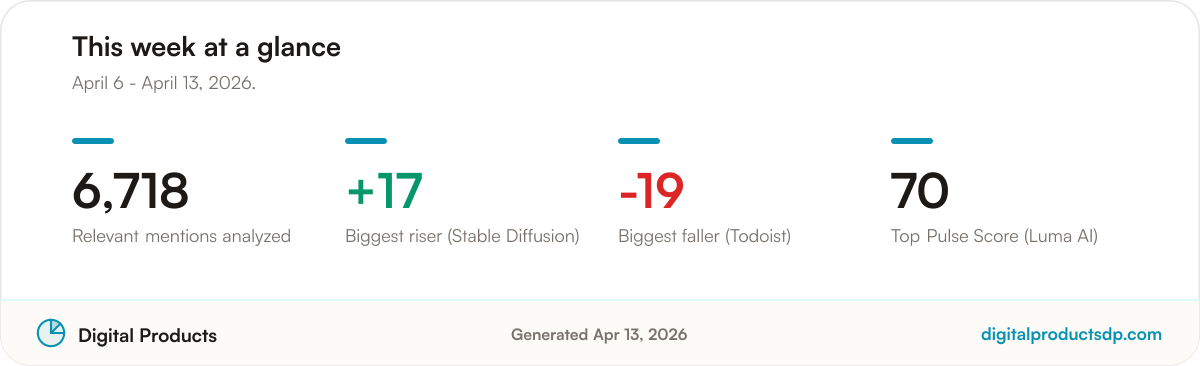
This report summarizes aggregated community sentiment from public online discussion about AI tools and broader software products, drawn from mentions analyzed for April 6, 2026 through April 13, 2026. The figures here reflect the tone of what people said in public, not a verdict on any product's quality. Across this period we processed 6,718 relevant mentions spanning 2,218 tracked products, of which 114 cleared the threshold of at least 10 relevant mentions needed to earn a ranked Pulse Score.
The headline read this week is steady at the top and choppy in the middle. Luma AI posted the highest latest-week Pulse Score among ranked products, while Stable Diffusion logged the largest climb and Todoist the largest decline. Below we break down the leaderboard, category mood, the products that moved most, and the praise and complaint themes driving the conversation. Every number cited traces back to the underlying data for this window.
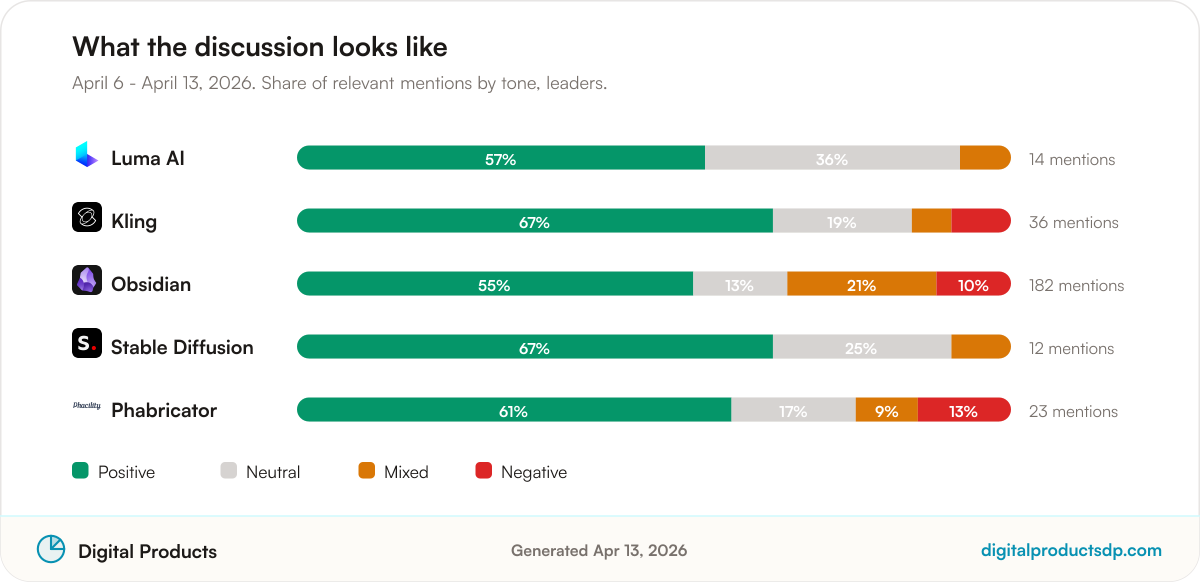
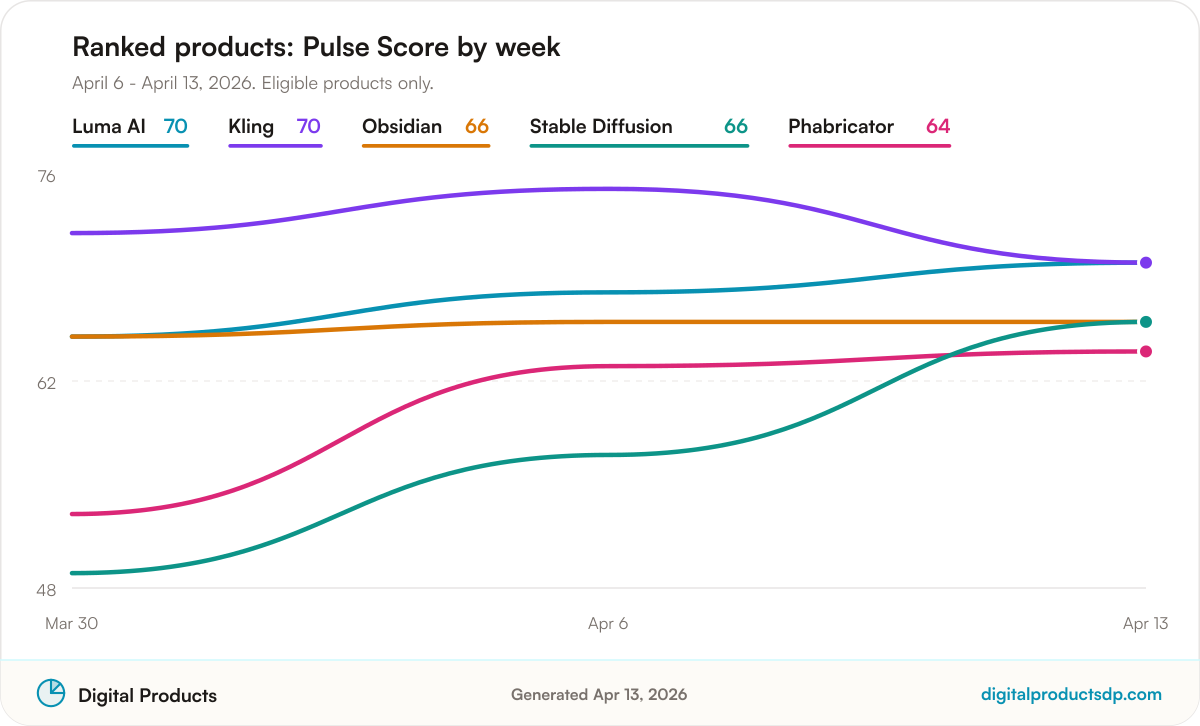
The top of the table is tightly grouped. Luma AI and Kling, both AI video tools, share the leading latest-week Pulse Score of 70, though they sit on very different sample sizes: Luma AI's score rests on 14 mentions over the period while Kling's draws on 36. Obsidian, a project-management and notes tool, holds 66 on a comparatively deep 182 mentions, the largest sample among the leaders. Stable Diffusion, an AI image tool, also reaches 66 but on just 12 mentions, and the coding tool Phabricator rounds out the group at 64 on 23 mentions.
The contrast in sample sizes matters when reading this list. Obsidian's 66 is supported by a far wider base of discussion than the thinner reads on Luma AI and Stable Diffusion, so it represents the most stable signal near the top. The AI video presence at the very top, with both Luma AI and Kling tied, reflects sustained positive chatter in that category this week even on modest mention counts.
Category View
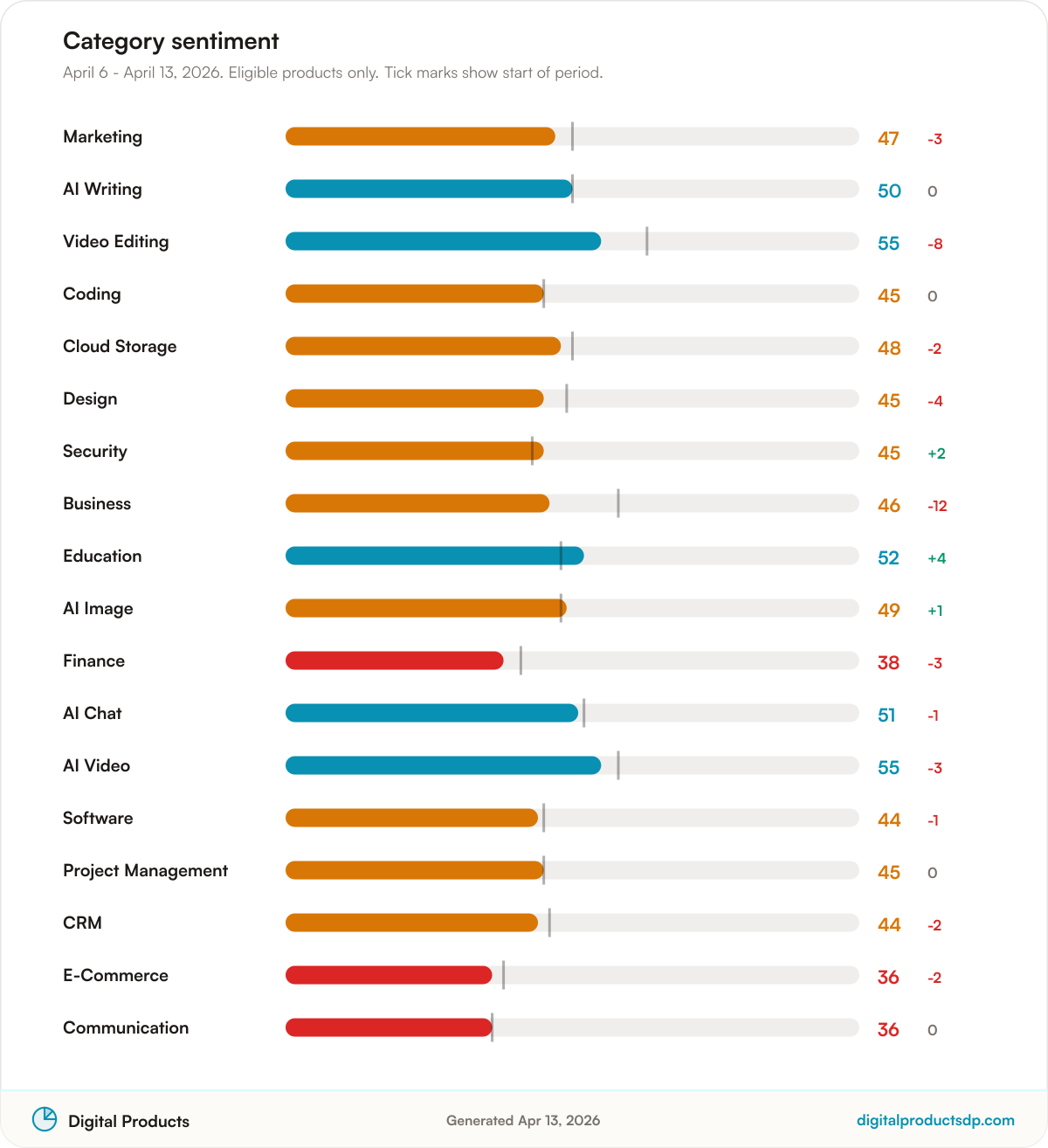
At the category level, the most pronounced move was business, which fell from an average of 58 to 46 across the period, the widest swing of any tracked category. Video-editing also softened, sliding from 63 to 55, and design eased from 49 to 45. On the steadier side, ai-writing held flat at 50, coding stayed at 45, and project-management held at 45. A handful of categories edged up, including education from 48 to 52 and security from 43 to 45, while ai-image ticked from 48 to 49. Communication remained the lowest mood category, unchanged at 36 to 36, and e-commerce stayed soft at 38 to 36. The ai-video category, home to both leaders, averaged 58 to 55, a small step down even as its top names held the highest scores.
Biggest Movers
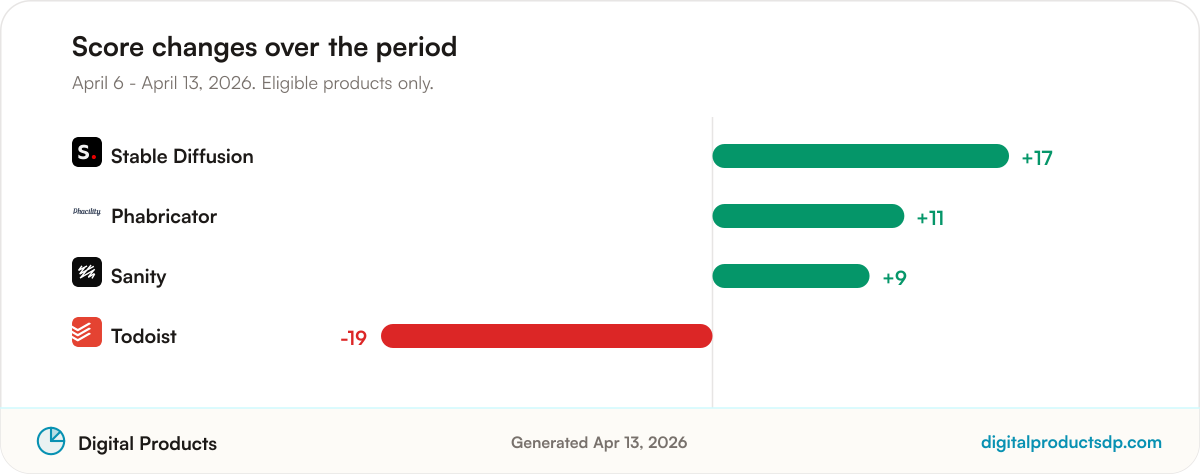
Stable Diffusion (riser, 49 to 66, +17, based on 12 mentions). The AI image tool posted the period's largest gain. Its latest-week praise leaned on Strong features (16 mentions) and AI quality (11 mentions), with Easy to use also noted (5 mentions). Complaints centered on Bugs (12 mentions), Reliability (6 mentions), and Performance (6 mentions). The praise volume on features and output quality appears to have outweighed the persistent technical gripes in this small sample, lifting the tone sharply.
Phabricator (riser, 53 to 64, +11, based on 23 mentions). The coding tool climbed steadily across the period. Praise was spread across Polished UI (3 mentions), Strong features (2 mentions), and Compared to rivals (2 mentions), while complaints were light, limited to Compared to rivals (1 mention) and Missing features (1 mention). The thin complaint load relative to praise is consistent with the upward move.
Sanity (riser, 43 to 52, +9, based on 13 mentions). The content platform improved through the period. Its praise themes were Easy to use (3 mentions), Strong features (3 mentions), and Good integrations (2 mentions), set against complaints of Bugs (3 mentions), Poor support (2 mentions), and Reliability (1 mention). The balance tipped modestly positive in a small sample.
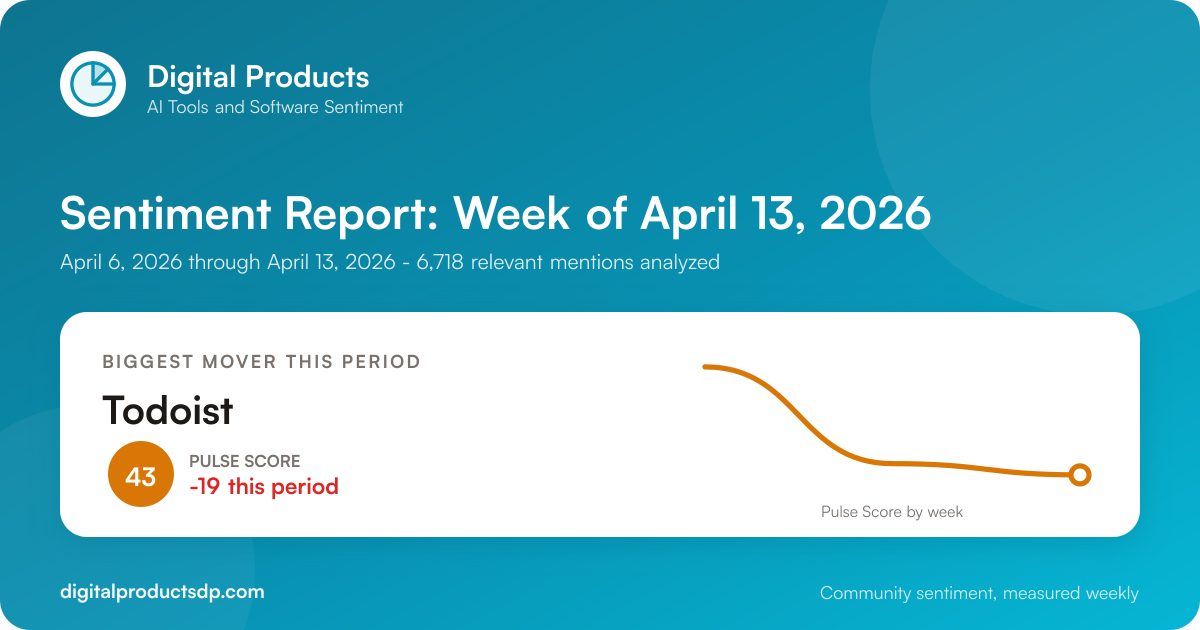
Todoist (faller, 62 to 43, -19, based on 36 mentions). The task manager logged the period's steepest decline. While praise still featured Easy to use (9 mentions) and Strong features (6 mentions), complaints gathered around Bugs (8 mentions), Reliability (6 mentions), and Missing features (4 mentions). The combination of reliability and bug chatter appears to have pulled the tone down from a strong starting point.
Klarna (faller, 38 to 20, -18, based on 10 mentions). The finance product dropped to the lowest latest-week figure among the movers. Praise was limited to Strong features (5 mentions), New releases (2 mentions), and Fair pricing (2 mentions), while complaints were dominated by Reliability (13 mentions), Bugs (8 mentions), and AI quality (5 mentions). With Reliability mentions outnumbering all praise combined, the slide is unsurprising on a 10-mention base.
HeyGen (faller, 59 to 43, -16, based on 20 mentions). The AI video tool gave back ground across the period. Praise included Strong features (14 mentions), New releases (7 mentions), and AI quality (7 mentions), but complaints stacked up around Bugs (11 mentions), Reliability (8 mentions), and Missing features (8 mentions). The heavy bug and reliability discussion sat opposite a respectable feature narrative, and the net tone moved lower.
Spotlight: Luma AI
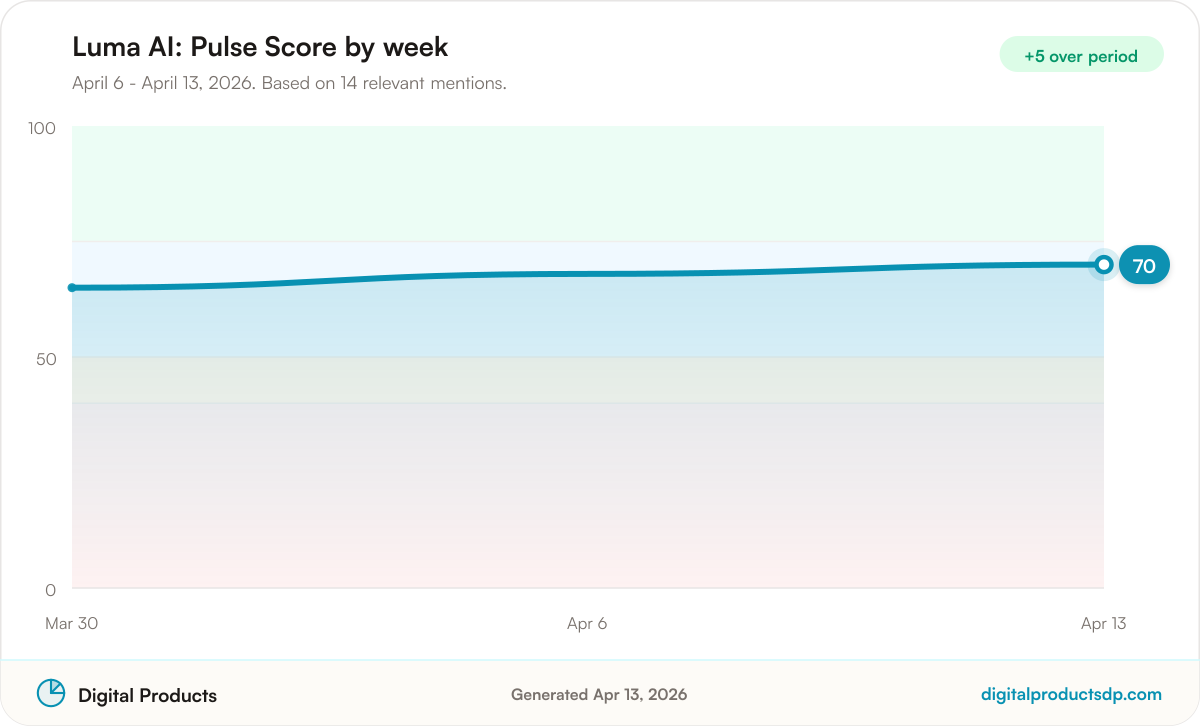
Luma AI, an AI video tool, holds the top latest-week Pulse Score at 70, based on 14 mentions over the period. Its weekly path shows a consistent climb across the three complete weeks tracked, moving from 65 on March 30, 2026 to 68 on April 6, 2026, and then to 70 on April 13, 2026. That steady gradient, while built on a modest sample, is the kind of unbroken upward movement that few products in this dataset displayed.
The theme detail for the latest week is sparse, which is consistent with the small mention count. Its leading praise theme was New releases (5 mentions), followed by AI quality (1 mention) and Strong features (1 mention). The complaint side was led by Bugs (3 mentions), Reliability (2 mentions), and Performance (2 mentions). The praise narrative appears anchored to product news and release activity rather than a deep volume of feature discussion, which is worth keeping in mind when reading the high score.
Because Luma AI sits right at the 14-mention level, its 70 should be treated as a positive but thin signal. The score is the highest on the board, but it rests on far fewer data points than Obsidian's 66, which draws on 182 mentions. Read together, the two illustrate the difference between a strong narrow read and a broadly supported one. Luma AI's complaint themes around bugs and reliability echo a pattern seen across many AI video and AI tools this week, so the upward trend will be most convincing if it holds as mention volume grows.
Themes Driving the Conversation
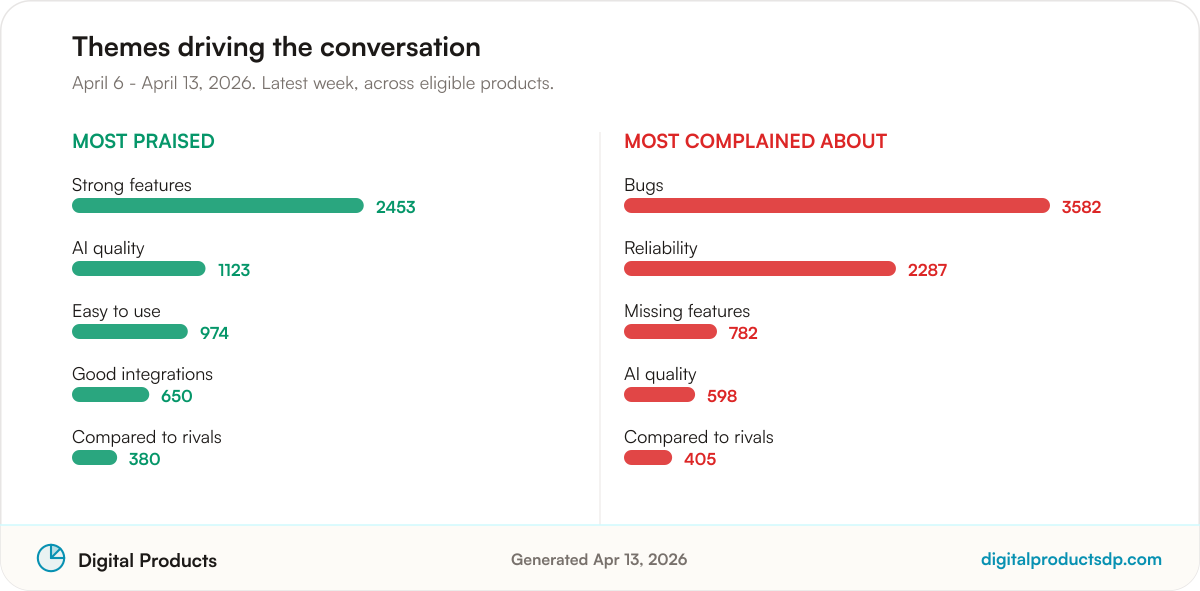
On the praise side, Strong features was by far the most-discussed theme with 2,453 mentions, followed by AI quality with 1,123 mentions, Easy to use with 974 mentions, Good integrations with 650 mentions, and Compared to rivals with 380 mentions. The features narrative was broad based, surfacing prominently for tools like Claude Code (249 feature mentions), Claude (229), ChatGPT (183), and Gemini (140). AI quality praise was driven heavily by the large AI chat tools, with Claude (234 AI quality mentions), ChatGPT (159), and Gemini (149) leading that theme.
On the complaint side, Bugs dominated the conversation with 3,582 mentions, ahead of Reliability at 2,287 mentions, Missing features at 782 mentions, AI quality at 598 mentions, and Compared to rivals at 405 mentions. The bug and reliability themes were widespread among high-volume products: WooCommerce drew 330 bug mentions and 175 reliability mentions, Loom logged 211 and 135, Stripe 188 and 158, and Vercel 170 and 151. The same two themes also weighed on the period's fallers, appearing as the top complaints for Todoist, Klarna, and HeyGen. The recurrence of bugs and reliability as the leading negative themes across so many products is the clearest cross-cutting signal this week.
Watchlist
A large share of tracked products did not reach the 10-mention threshold this period and were excluded from the rankings. This is a measure of discussion volume only and carries no judgment about quality. Several names sat just below the line, including Sublime Text with 9 relevant mentions, AWeber with 9, Microsoft Copilot with 9, HubSpot with 9, Revolut with 9, Google Meet with 9, and WP Engine with 9. Each of these would need only a small uptick in chatter to qualify in a future week.
A little further down, products like Synthesia with 8 relevant mentions, Thinkific with 8, Spocket with 8, NordPass with 8, and Square with 8 also drew limited but real discussion. Many widely used products registered zero relevant mentions in this window, which reflects the specific sources sampled and the short reporting period rather than any absence of users. With 114 of 2,218 tracked products qualifying, the ranked set is a minority of the catalog, so the Watchlist is best read as a queue of candidates whose signal is currently too thin to score reliably.
What To Watch Next Week
First, watch whether the AI video leaders hold their position. Luma AI reached 70 on just 14 mentions and Kling sits at 70 on 36 mentions, while the broader ai-video category eased from 58 to 55. Whether the top names sustain their scores as more discussion accumulates is the key question for that category.
Second, watch the bug and reliability theme. With Bugs at 3,582 mentions and Reliability at 2,287 mentions leading all complaints, and with both themes topping the complaint lists for this week's fallers, any shift in that volume would be the most meaningful change to monitor across the board.
Third, watch the business category and its sharp slide from 58 to 46, the widest category move this period. It is worth tracking whether that softening continues or reverses, and whether the products inside it stabilize once more mentions come in.
Frequently Asked Questions
Which product had the highest Pulse Score this period?
Luma AI and Kling tied for the highest latest-week Pulse Score at 70. Luma AI's score is based on 14 mentions over the period, while Kling's is based on 36 mentions.
Which product moved the most this period?
Stable Diffusion was the biggest riser, climbing from 49 to 66 (+17) on 12 mentions, while Todoist was the biggest faller, dropping from 62 to 43 (-19) on 36 mentions.
What was the overall category mood?
Moods were mixed. Business saw the widest decline, from 58 to 46, and video-editing slipped from 63 to 55, while education rose from 48 to 52 and ai-writing, coding, and project-management held flat.
How many mentions were analyzed this period?
We analyzed 6,718 relevant mentions across 2,218 tracked products, of which 114 cleared the 10-mention threshold needed to be ranked.
About This Data
Pulse Scores summarize the tone of public online discussion on a 0 to 100 scale and reflect community sentiment, not a verdict on a product's quality or a recommendation. We report on complete calendar weeks only, and products with fewer than 10 relevant mentions in the period are excluded from rankings to avoid unstable reads on thin samples.
Public discussion is collected from Hacker News, Stack Exchange, GitHub, Bluesky, the Apple App Store, and YouTube. Automated sentiment analysis can misread sarcasm, jokes, or niche context. Mention volumes vary widely between products, and scores can move week to week. Any company that wants to respond is welcome to reach out. For how scores are calculated, see our methodology.