AI Tools and Software Sentiment Report: Week of December 22, 2025
December 23, 2025
Welcome to this week's read on aggregated public online discussion about the AI tools and broader software products we track. This report summarizes community sentiment drawn from public sources, turning the tone of online chatter into Pulse Scores on a 0-100 scale. Everything here describes how people are talking, not a verdict on how any product actually performs.
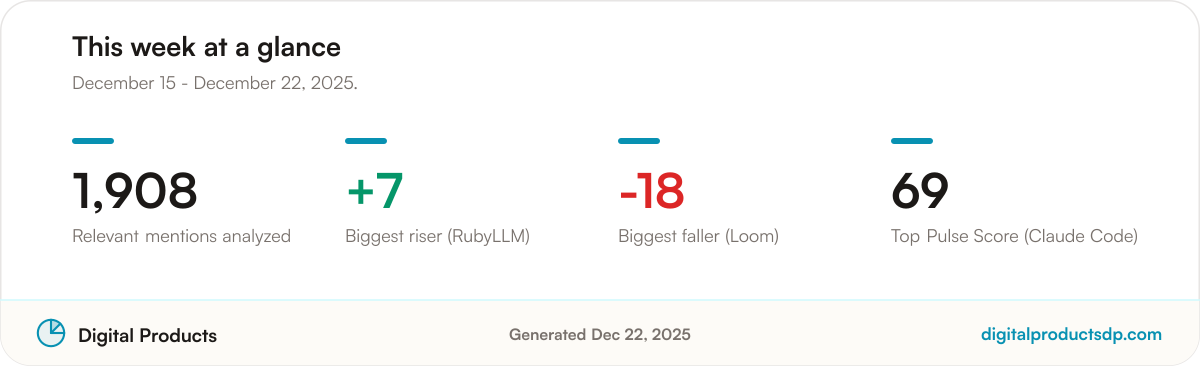
The mentions analyzed for December 15, 2025 through December 22, 2025 totaled 1,908 across the products that cleared our minimum threshold. Of the 2,218 products tracked, 48 drew enough discussion to be ranked this period. That gap between what is tracked and what is rankable is worth keeping in mind as you read: most of the catalog simply did not generate enough public conversation to support a stable read.
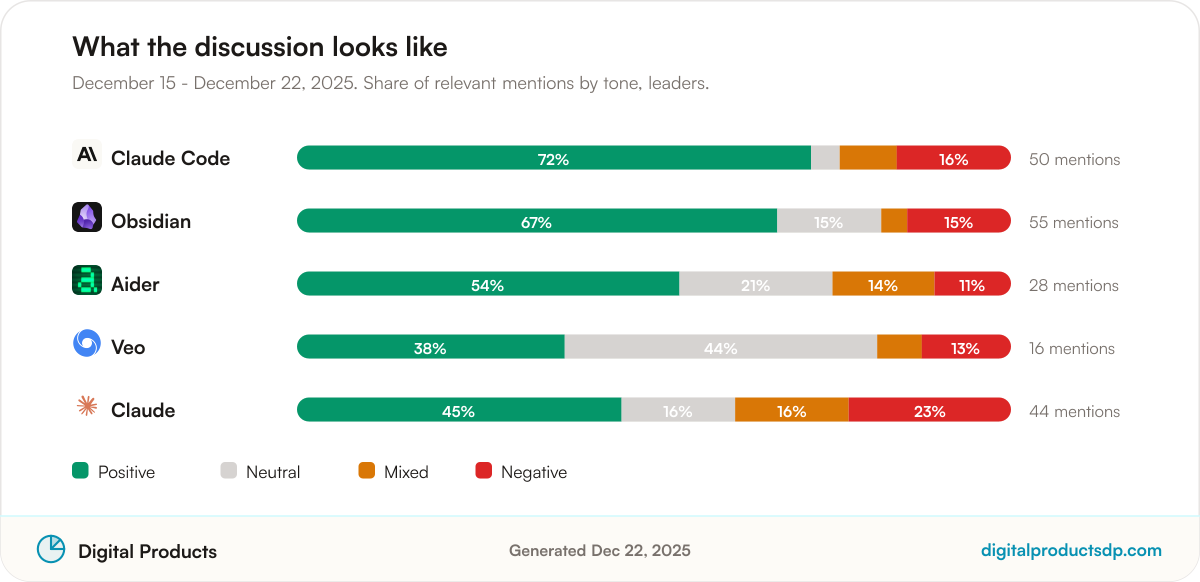
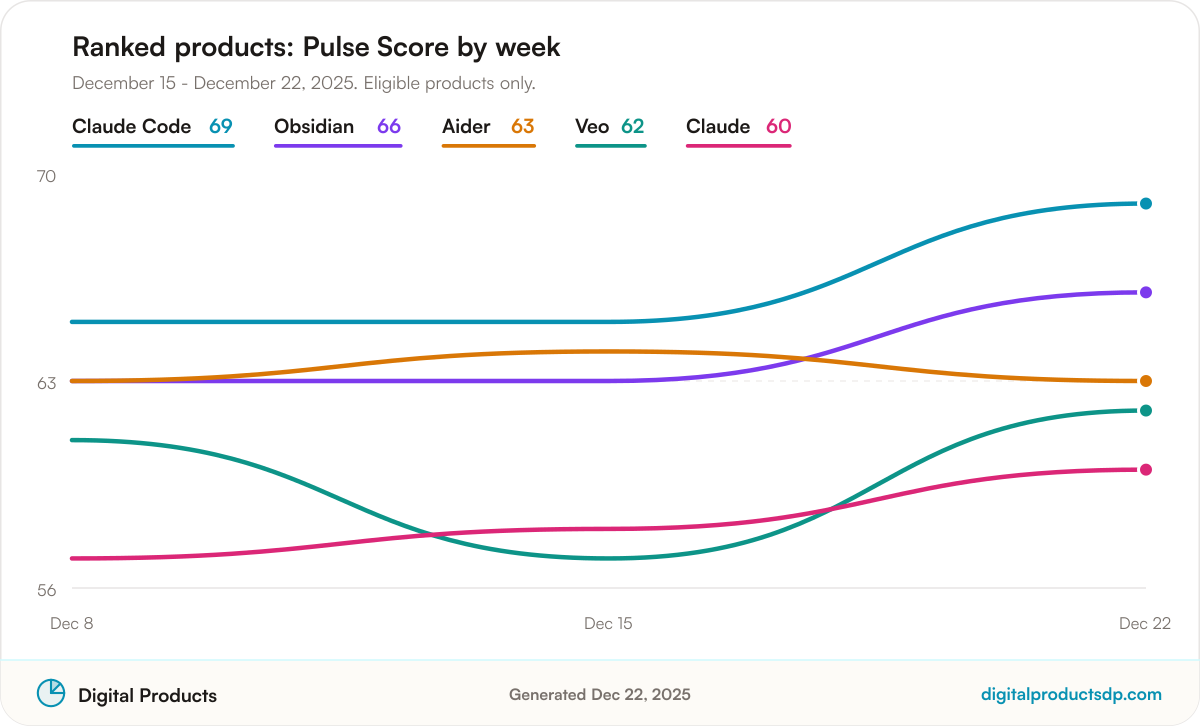
Claude Code, a coding tool, sits at the top of the leaderboard with a Pulse Score of 69, based on 50 mentions over the period. Behind it, the project-management app Obsidian scored 66 based on 55 mentions, and the coding assistant Aider scored 63 based on 28 mentions. The AI video product Veo scored 62 based on 16 mentions, and the AI chat assistant Claude rounded out the top five at 60 based on 44 mentions.
The leaders span several categories rather than clustering in one. Coding tools take two of the five spots, but the presence of an AI video product, an AI chat assistant, and a project-management app shows that high scores this period were not confined to a single use case. The mention counts behind these scores are modest, so each leader's read rests on a relatively thin sample and should be treated as directional.
Category View
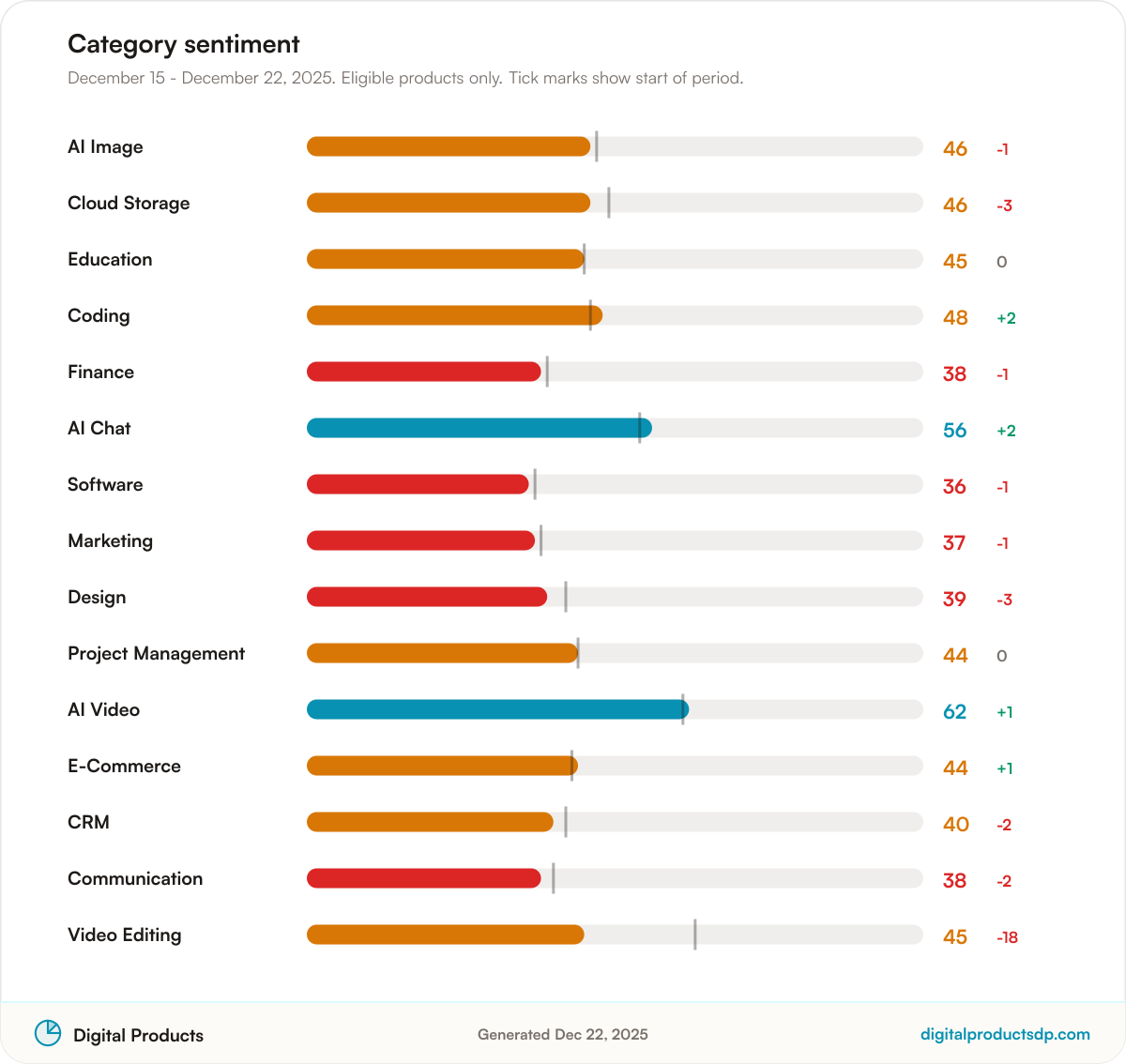
At the category level, most shifts over the period were small. The ai-video category sat highest among those tracked, moving from 61 to 62, while ai-chat rose from 54 to 56 and coding ticked up from 46 to 48. The sharpest category-level move belonged to video-editing, which fell from 63 to 45, a swing heavily shaped by Loom's drop within that group. Several categories barely moved: education held flat at 45, project-management held at 44, and Adyen's category context aside, software eased from 37 to 36. Lower-scoring categories this period included finance, moving from 39 to 38, and software at 36, while design slipped from 42 to 39 and crm eased from 42 to 40. The overall picture is one of stability with a few pronounced exceptions rather than a broad swing in either direction.
Biggest Movers
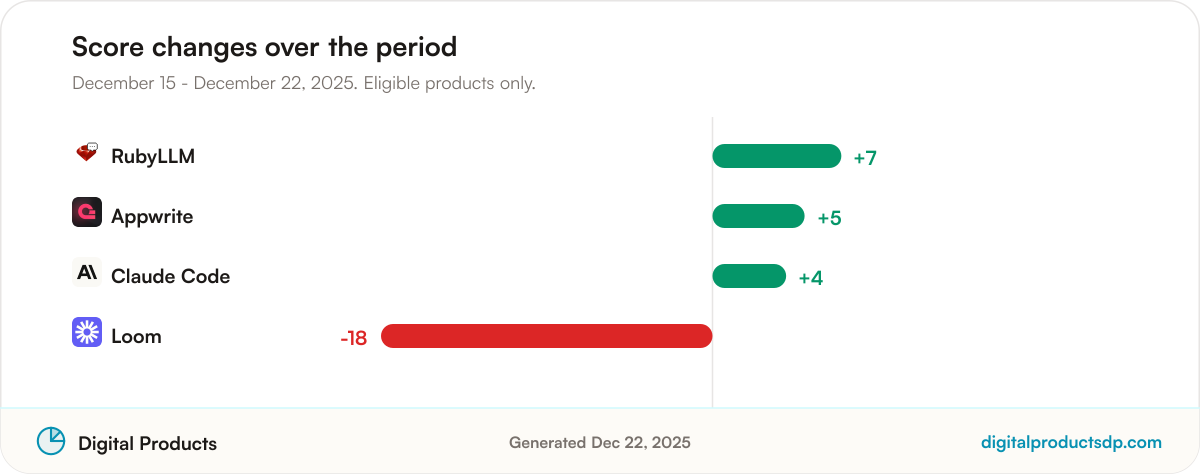
RubyLLM (riser, plus 7). RubyLLM, a coding tool, climbed from 36 to 43, based on 16 mentions. Its latest-week praise leaned on Strong features with 24 mentions, Good integrations with 20, and Easy to use with 16, suggesting that conversation about how it fits into existing workflows helped lift the tone. The improvement is notable given that its complaint side was also active, led by Bugs at 27 mentions and Reliability at 16, so the rise reflects praise gaining ground rather than complaints disappearing.
Appwrite (riser, plus 5). Appwrite moved from 23 to 28, based on 33 mentions. This is a rise from a low base, and the latest-week themes show why the score remains modest: no praise themes were recorded, while complaints were led by Bugs at 18 mentions, Reliability at 13, and UI frustrations at 3. The upward move here is best read as discussion becoming less negative rather than turning positive.
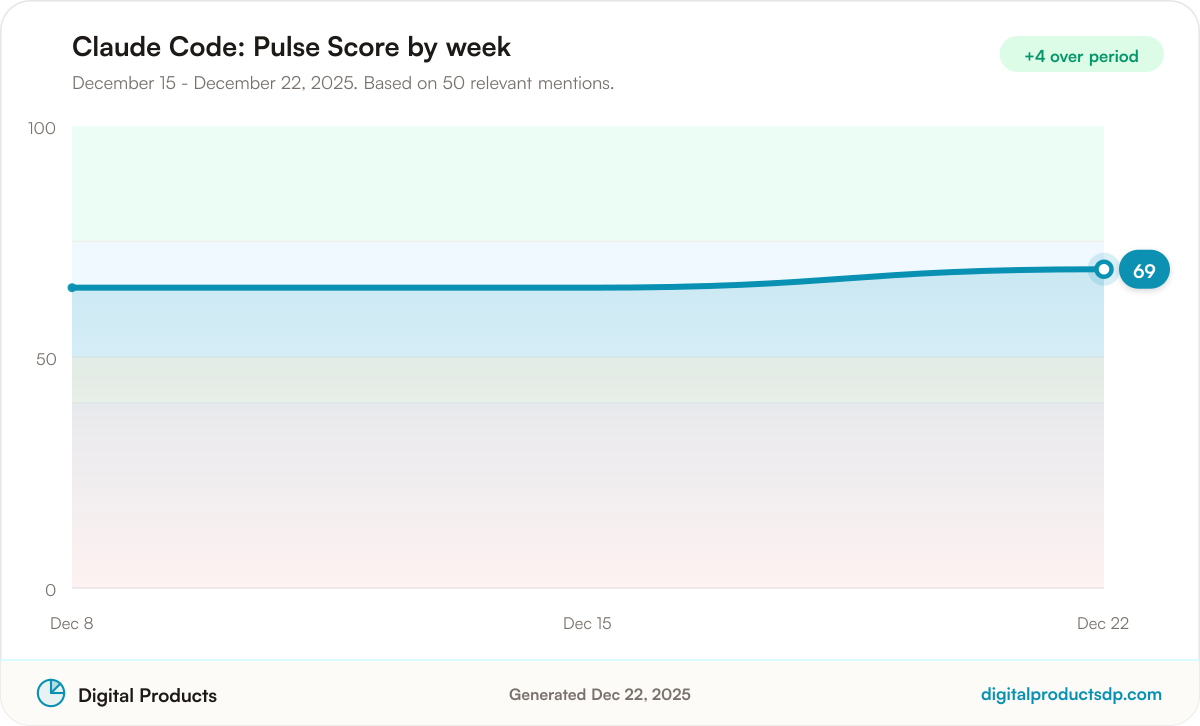
Claude Code (riser, plus 4). Claude Code rose from 65 to 69, based on 50 mentions, finishing as the period's top scorer. Its praise was dominated by Strong features at 249 mentions, AI quality at 124, and Easy to use at 113. Those volumes far outweigh its complaint themes of Bugs at 72, Reliability at 39, and Missing features at 34, which is consistent with a score that climbed while staying at the high end of the board.
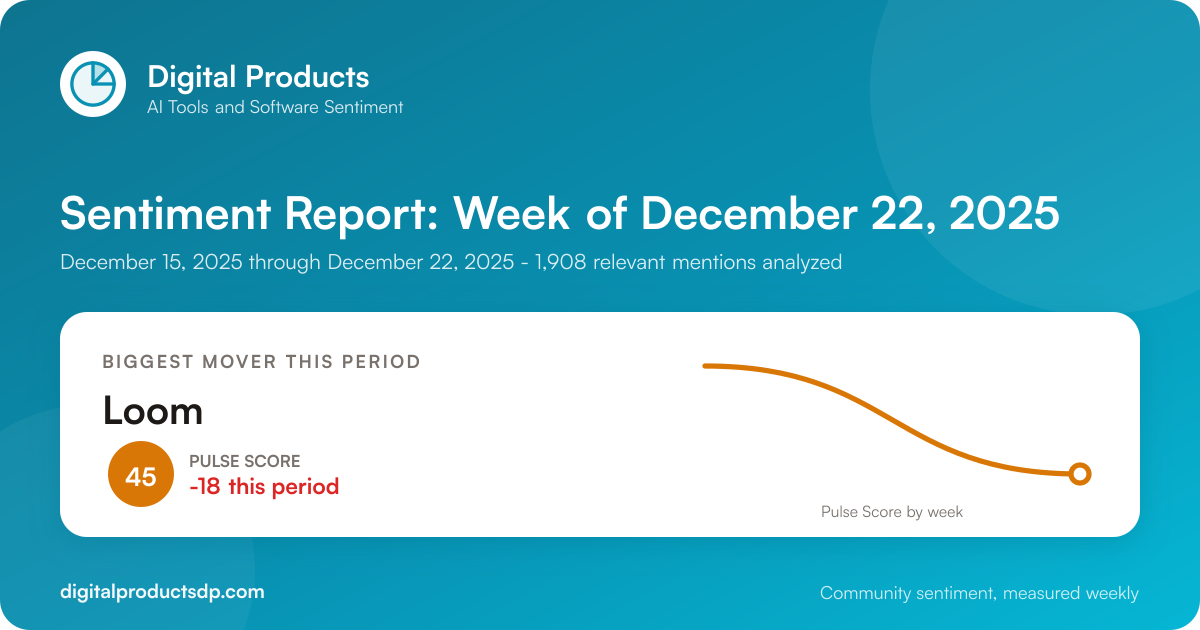
Loom (faller, minus 18). Loom recorded the steepest drop, falling from 63 to 45, based on 10 mentions. Its complaint themes were heavily weighted toward Bugs at 211 mentions and Reliability at 135, with Missing features at 71, and that volume of reliability and bug chatter overwhelmed its praise themes of Strong features at 14 and Feature requests at 7. With only 10 mentions clearing the threshold, the move is dramatic on a thin sample and should be read cautiously.
Carta (faller, minus 6). Carta, a finance product, slipped from 45 to 39, based on 10 mentions. Its latest-week praise was sparse, led by Feature requests at 4 and Strong features at 3, while complaints centered on Bugs at 3 and Reliability at 3. With such small theme counts on both sides, the decline reflects a quiet but negatively tilted week of discussion.
Vercel (faller, minus 5). Vercel eased from 51 to 46, based on 121 mentions, the largest sample among the movers. Its complaint themes were the loudest signal here, with Bugs at 170 mentions, Reliability at 151, and Downtime at 37, dwarfing its praise of Easy to use at 35, Strong features at 26, and Good integrations at 24. Because Vercel's mention count is high, this drop rests on a sturdier base than the other fallers.
Spotlight: Claude Code
Claude Code is this period's top-scoring product, finishing at 69 based on 50 mentions. Its weekly series shows a steady, unhurried climb: 65 on December 8, 2025, holding at 65 on December 15, 2025, then rising to 69 on December 22, 2025. That pattern is one of consolidation at the top rather than a sudden jump, which tends to be a more durable signal than a single sharp move.
The theme breakdown explains the tone. Praise was led decisively by Strong features at 249 mentions, the single largest praise count for any eligible product this period, followed by AI quality at 124 and Easy to use at 113. For a coding tool, that combination points to discussion focused on capability and day-to-day usability rather than novelty alone.
The complaint side is not silent. Bugs drew 72 mentions, Reliability 39, and Missing features 34. Those are real friction points in the public conversation, but they are outweighed by the praise volume, which is consistent with a score that sits at the head of the board. The takeaway is that sentiment around Claude Code is strongly positive while still carrying the kind of bug and reliability chatter that runs through nearly every product we track this week.
Themes Driving the Conversation
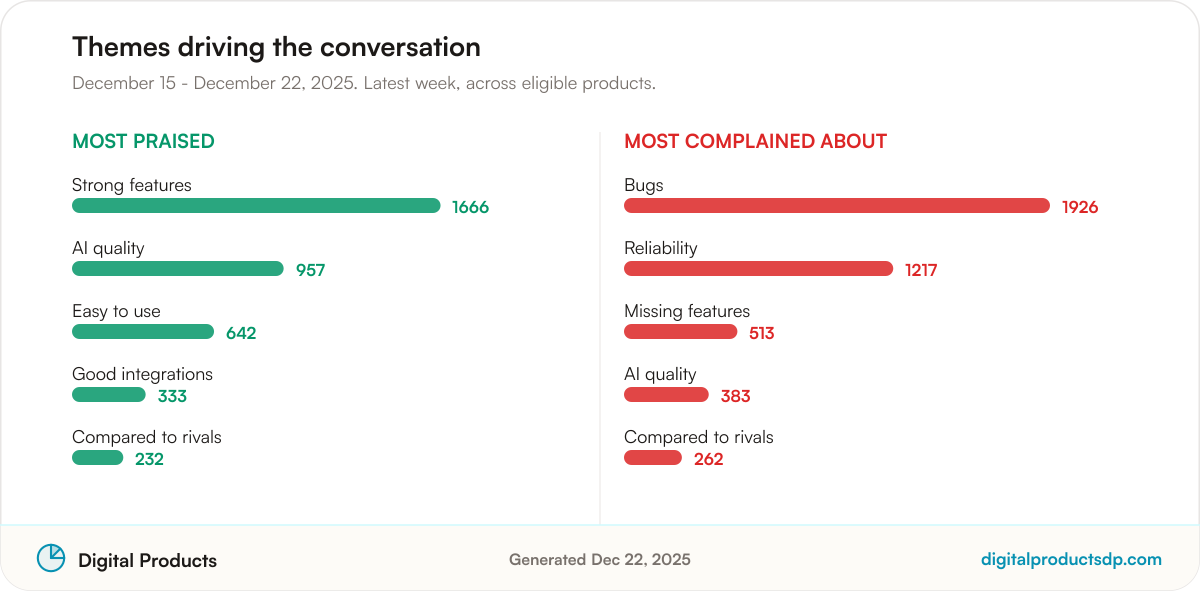
On the praise side, Strong features dominated with 1,666 mentions in the latest week, far ahead of AI quality at 957, Easy to use at 642, Good integrations at 333, and Compared to rivals at 232. Strong features showed up across the leaders, including Claude Code with 249 mentions and Claude with 229, while AI quality was a major driver for Claude at 234 mentions, ChatGPT at 159, and Gemini at 149. Good integrations stood out for products like Stripe at 50 mentions and RubyLLM at 20, underlining that fit with existing tooling was a recurring source of positive chatter.
On the complaint side, Bugs led overwhelmingly with 1,926 mentions, followed by Reliability at 1,217, Missing features at 513, AI quality at 383, and Compared to rivals at 262. These complaints were concentrated in a handful of high-volume products: Loom carried 211 bug mentions and 135 reliability mentions, Stripe drew 188 bug and 158 reliability mentions, and Vercel logged 170 bug and 151 reliability mentions. The recurrence of bugs and reliability as the top two complaint themes across so many products is the defining pattern of the week, and it cut across both AI tools and broader software alike.
Watchlist
A large share of tracked products did not reach the 10-mention threshold this period, so they are not ranked. This is a statement about discussion volume, not about quality. Several came close enough to be worth monitoring as conversation builds. Among them, Canva (design), Surfshark (security), NordVPN (security), HubSpot (crm), and HeyGen (ai-video) each recorded 9 relevant mentions, just short of the cutoff. Flux (ai-image), Pika (ai-video), and NordPass (security) each landed at 8 mentions, while Asana (project-management), Grammarly (ai-writing), Bitcoin-adjacent names aside, Foxit (business), and Kling (ai-video) sat at 7 each.
A little further down, products such as Trello (project-management), Luma AI (ai-video), Sudowrite (ai-writing), WooCommerce (e-commerce), Xata (cloud-storage), and Airwallex (finance) each registered 6 mentions. These near-threshold readings are the most likely to cross into ranked territory if even a modest amount of additional discussion appears next period. For now, treating any of them as a sentiment signal would mean reading too much into too few data points, which is exactly what the threshold exists to prevent.
What To Watch Next Week
First, watch whether bugs and reliability stay locked in as the top two complaint themes. This period they led at 1,926 and 1,217 mentions respectively, and that pattern shaped the steepest fallers, including Vercel and Loom. If those theme counts ease, several mid-table scores could stabilize.
Second, watch Claude Code's position at the top. It rose across the period from 65 to 69 and finished first based on 50 mentions, with the largest Strong features praise count of any eligible product at 249. Whether that praise volume holds is the clearest test of how durable its lead is.
Third, watch the near-threshold names. Several products, including Canva, Surfshark, NordVPN, HubSpot, and HeyGen, finished one mention short at 9 each. A small increase in discussion would move them into the ranked set, where their sentiment could be read with more confidence.
Frequently Asked Questions
Which product had the highest Pulse Score this period?
Claude Code, a coding tool, had the highest Pulse Score at 69, based on 50 mentions over the period.
Which product moved the most this period?
Loom moved the most, falling 18 points from 63 to 45, based on 10 mentions. The biggest riser was RubyLLM, which gained 7 points from 36 to 43, based on 16 mentions.
What was the overall category mood this period?
Most categories were stable, with ai-video highest as it moved from 61 to 62 and ai-chat rising from 54 to 56. The sharpest category drop was video-editing, which fell from 63 to 45.
How many mentions were analyzed this period?
A total of 1,908 relevant mentions were analyzed across 48 eligible products, out of 2,218 products tracked.
About This Data
Pulse Scores summarize the tone of public online discussion on a 0-100 scale and reflect community sentiment. They are not a verdict on a product's quality and not a recommendation. We report on complete calendar weeks only, and products with fewer than 10 relevant mentions in the period are excluded from rankings to avoid unstable reads on thin samples.
Public discussion is collected from Hacker News, Stack Exchange, GitHub, Bluesky, the Apple App Store, and YouTube. Automated sentiment analysis can misread sarcasm, jokes, or niche context. Mention volumes vary widely between products, and scores can move from week to week. Any company that wants to respond to its read is welcome to reach out.
For more on how these scores are calculated, see our methodology.