AI Tools and Software Sentiment Report: Week of November 24, 2025
November 24, 2025
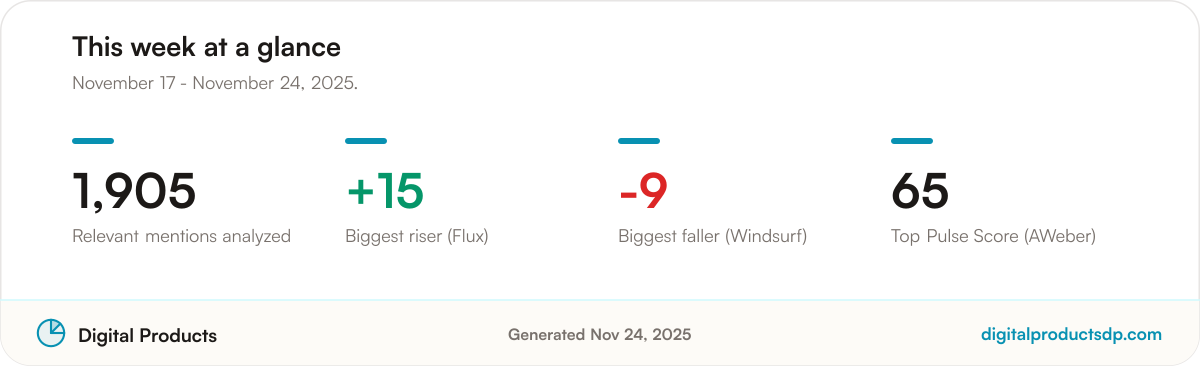
This edition of our weekly sentiment report covers aggregated public online discussion analyzed for November 17, 2025 through November 24, 2025. Across this stretch we logged 1,905 relevant mentions spread across 50 products that cleared our minimum threshold for inclusion. The figures here summarize the tone of public chatter, not the quality of any product, and they reflect what people happened to be saying in the sources we track rather than any controlled test.
The week running from November 17, 2025 through November 24, 2025 produced a familiar mix of marketing, coding, and AI products near the top, alongside payments, security, and project management tools that drew heavier criticism. We track 2,235 products in total, but only the 50 with at least 10 relevant mentions are ranked, which keeps thin samples from producing unstable reads. Below we walk through the leaderboard, category movement, the biggest movers, a spotlight on the leader, and the themes driving conversation.
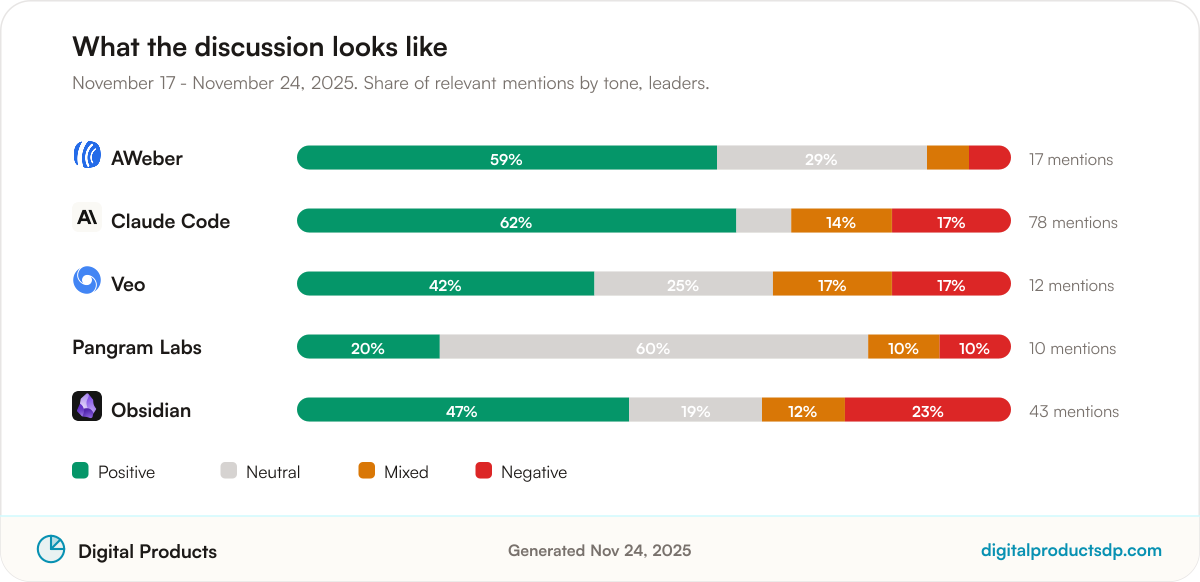
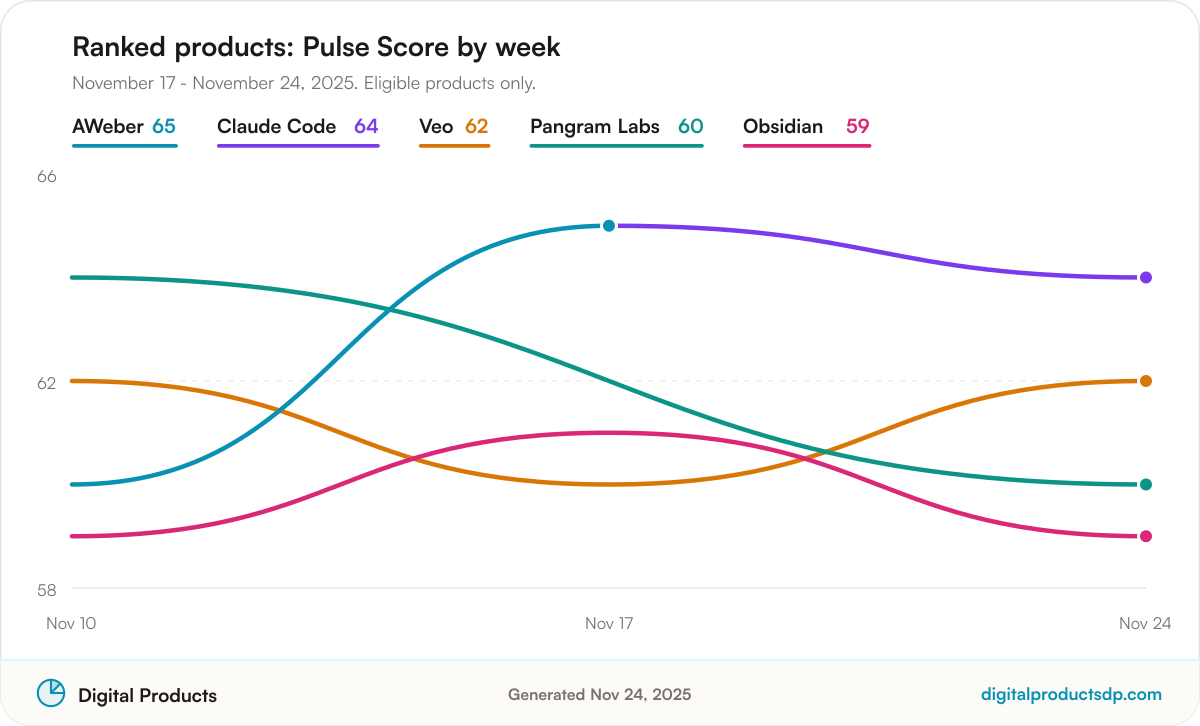
AWeber, a marketing product, sat at the top of the leaderboard with a Pulse Score of 65 based on 17 mentions over the period. Claude Code, a coding tool, followed closely at 64 based on 78 mentions, which makes it the most heavily discussed product among the leaders by a wide margin. Veo, an AI video tool, scored 62 based on 12 mentions, while Pangram Labs, an AI writing tool, posted 60 based on 10 mentions, the thinnest sample among the five leaders.
Obsidian, a project management tool, rounded out the leading group with a score of 59 based on 43 mentions. The spread among these five products is narrow, running from 59 to 65, so small swings in tone could reorder them in future weeks. Sample sizes vary sharply here, and the gap between Claude Code's 78 mentions and Pangram Labs' 10 is worth keeping in mind when reading scores side by side, since thinner samples move more easily.
Category View
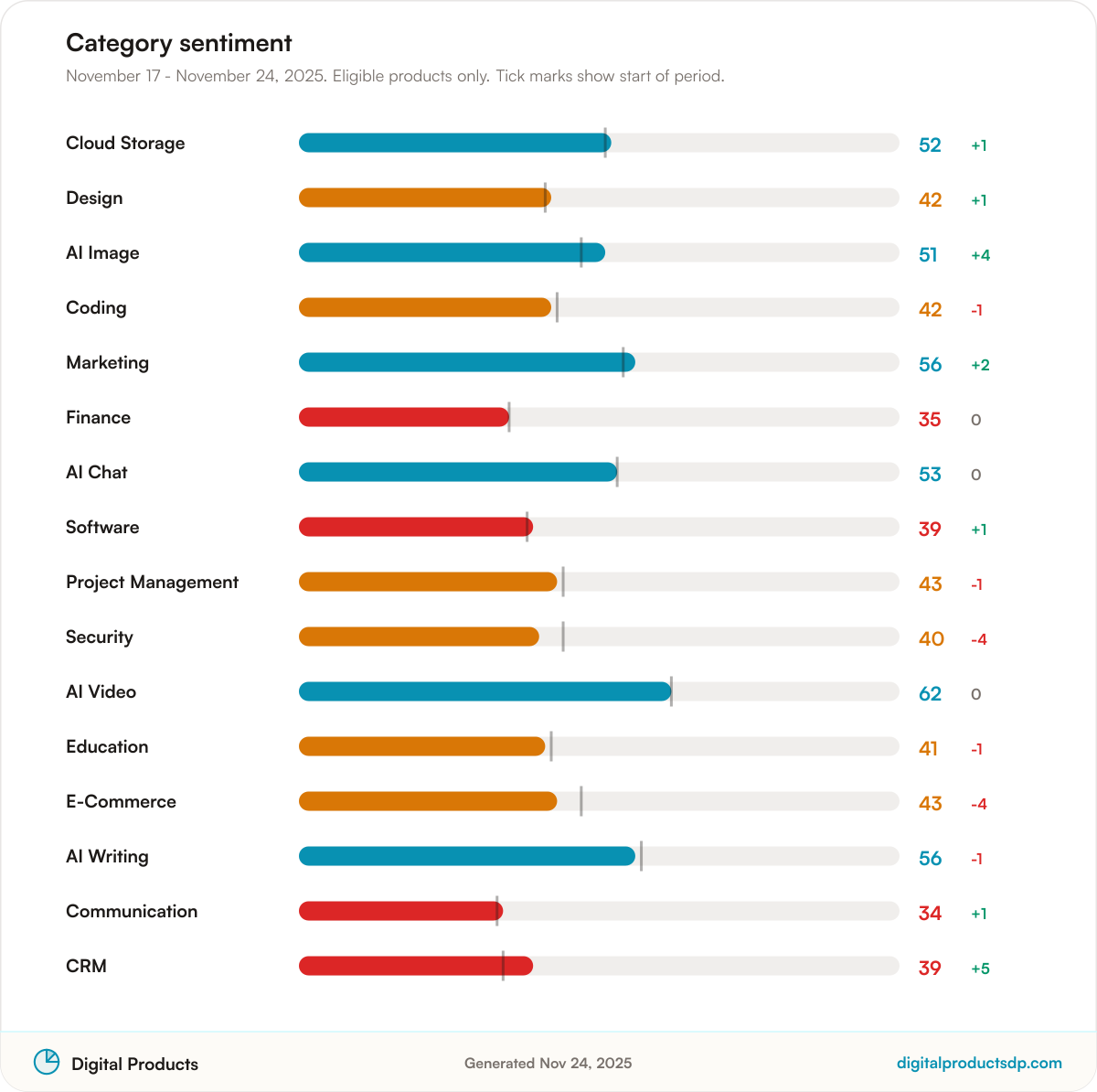
At the category level, AI video held the highest average among eligible products, steady at 62 from the start to the end of the period. Marketing rose from 54 to 56 and AI writing eased from 57 to 56, keeping both near the top. AI image was the standout climber, moving from 47 to 51, while CRM rose from 34 to 39 off a low base. On the softer side, security slipped from 44 to 40 and e-commerce fell from 47 to 43, the two clearest declines. Several categories barely moved, including finance flat at 35, AI chat flat at 53, and cloud storage edging from 51 to 52. Coding and project management each drifted down a single point, to 42 and 43 respectively, while communication remained the lowest-scoring category, inching from 33 to 34.
Biggest Movers
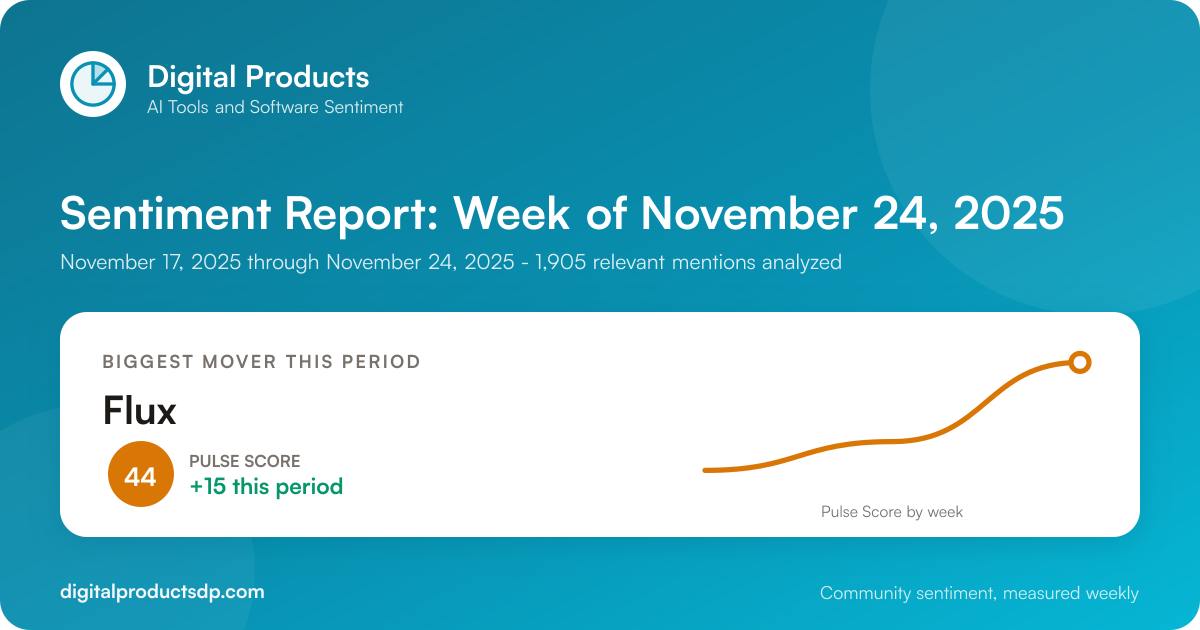
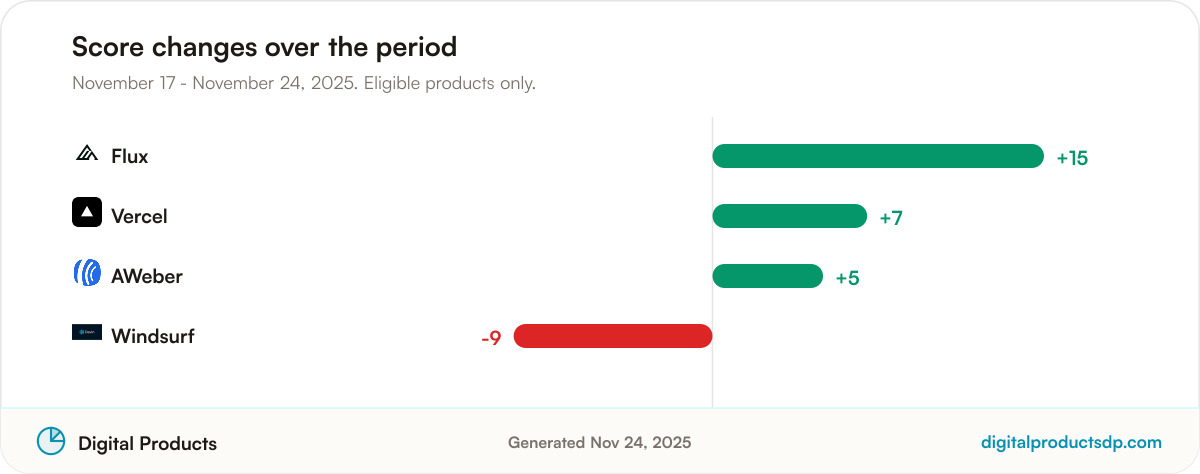
Flux (riser, +15, from 29 to 44, based on 14 mentions): Flux posted the largest jump of the period. Its praise themes in the latest week leaned on AI quality, mentioned 33 times, alongside strong features at 22 and new releases at 13, which suggests discussion warmed as people responded to fresh output and capability. The improvement is notable given lingering complaints around bugs at 19, performance at 17, and reliability at 11, so the rise reflects positive chatter gaining ground rather than complaints disappearing.
Vercel (riser, +7, from 46 to 53, based on 67 mentions): Vercel climbed seven points on a relatively heavy sample. Its praise centered on ease of use at 35, strong features at 26, and good integrations at 24. That said, this is a product carrying a large volume of criticism, with bugs cited 170 times, reliability 151 times, and downtime 37 times in the latest week, so the upward move reflects sentiment improving despite a persistent backdrop of reliability complaints.
AWeber (riser, +5, from 60 to 65, based on 17 mentions): AWeber rose five points to lead the board. Its praise was thin in raw counts, with good integrations and strong features each at 3 and new releases at 1, while complaints were equally sparse, with missing features, pricing too high, and lacking integrations each at 1. On a small sample like this, a handful of favorable mentions can move the score meaningfully, which is the cleanest read on this rise.
Windsurf (faller, -9, from 62 to 53, based on 27 mentions): Windsurf saw the steepest decline. Its praise themes were modest at strong features 7, good integrations 5, and new releases 3, while complaints clustered around bugs at 8, lacking integrations at 7, and reliability at 5. The drop tracks with integration gaps and bug reports outweighing the smaller pool of positive notes this period.
Midjourney (faller, -6, from 57 to 51, based on 23 mentions): Midjourney slid six points across the period. Praise rested on AI quality at 34, strong features at 33, and feels fast at 15, but complaints included AI quality at 11, compared to rivals at 8, and reliability at 6. The presence of AI quality on both the praise and complaint side points to a split conversation, where some discussion praised output while other chatter pushed back, and the comparison to rivals theme suggests competitive framing weighed on tone.
Gemini (faller, -4, from 58 to 54, based on 59 mentions): Gemini eased four points on a sizable sample. It drew heavy praise for AI quality at 149, strong features at 140, and comparison to rivals at 75, but it also carried substantial complaints, with AI quality cited 112 times, compared to rivals 86 times, and missing features 55 times. As with Midjourney, AI quality and rival comparisons appear on both sides of the ledger, which fits a slight cooling rather than a sharp reversal.
Spotlight: AWeber
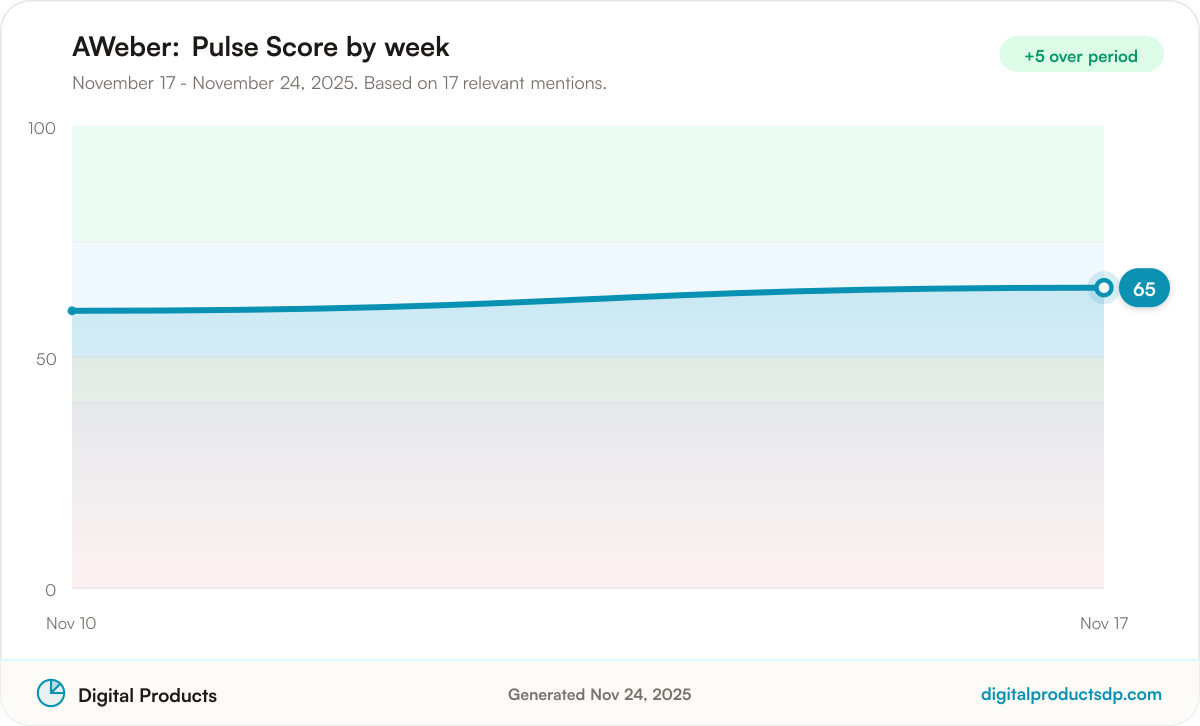
AWeber, a marketing product, took the top Pulse Score this period at 65 based on 17 mentions over the period. Its weekly series shows a move from 60 on November 10, 2025 to 65 on November 17, 2025, a five-point gain that placed it ahead of the larger and more heavily discussed products below it. Because the latest available reading in its series is the November 17, 2025 mark, the leaderboard position rests on a modest and recent base of discussion.
The theme breakdown for AWeber is light in absolute terms. Praise mentions were limited to good integrations at 3, strong features at 3, and new releases at 1, while complaints were equally thin, with missing features, pricing too high, and lacking integrations each registering a single mention. That balance, leaning slightly favorable, is what lifts the score on a small sample.
The takeaway is that AWeber's lead should be read with its sample size in mind. With only 17 mentions over the period, the score reflects a small but positively tilted slice of public discussion rather than a broad consensus. A handful of additional mentions in either direction could shift its standing quickly, which is the nature of reading sentiment on lighter volume.
Themes Driving the Conversation
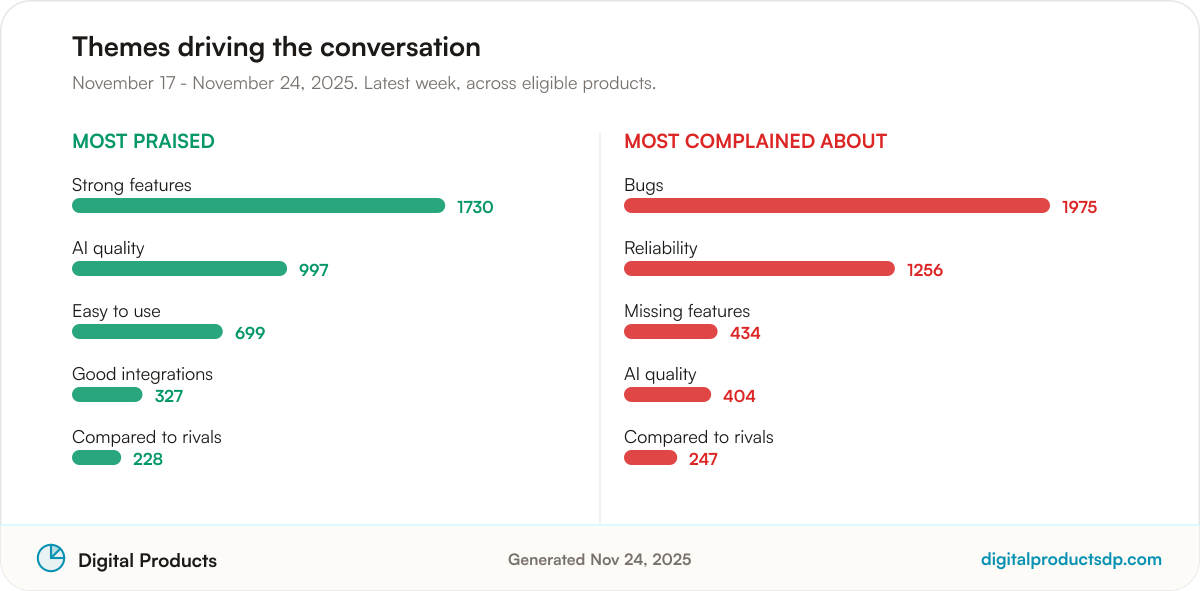
On the praise side, strong features dominated with 1,730 mentions in the latest week, well ahead of AI quality at 997 and easy to use at 699. Good integrations followed at 327 and comparison to rivals at 228. The strong features theme shows up across many leaders, including Claude Code at 249, Claude at 229, and ChatGPT at 183, while AI quality praise was driven by products like Gemini at 149, ChatGPT at 159, and Claude at 234. Ease of use praise was prominent for Claude Code at 113 and Canva at 66, underscoring that capability and approachability were the most common reasons discussion turned positive.
On the complaint side, bugs led decisively with 1,975 mentions, followed by reliability at 1,256, missing features at 434, AI quality at 404, and comparison to rivals at 247. The bugs and reliability themes were concentrated in specific products carrying heavy criticism, including ArgoCD with 215 bug mentions and 146 reliability mentions, Stripe with 188 bug and 158 reliability mentions, and Vercel with 170 bug and 151 reliability mentions. Notably, AI quality appears on both the praise and complaint lists, reflecting a divided conversation around model output for products like Gemini, which logged 112 AI quality complaints, and ChatGPT, with 109.
Watchlist
A large number of tracked products did not reach the 10-mention threshold this period and so were left out of the rankings. This is a matter of discussion volume, not a judgment on quality. Among the closest to the line were Trainual at 9 relevant mentions, Coursera at 7, Pika at 7, Anyscale at 7, and Pipedrive at 7. Others sat just below, including Leonardo AI at 6, HeyGen at 6, Klaviyo at 6, Trello at 6, and Airwallex at 6.
A second tier registered a handful of mentions each, such as Ahrefs at 5, Semrush at 4, Carta at 5, Thinkific at 5, NordPass at 5, and Amplitude at 5. Many widely known names recorded zero relevant mentions in our tracked sources this period, including Slack, Zoom, GitHub, GitLab, Dropbox, and Notion. The absence of these products simply means they did not surface in the public discussion we collected during this window, and they may reappear in future weeks as conversation shifts. We will keep watching whether any of these products cross the threshold next week.
What To Watch Next Week
First, watch whether Flux can hold its gain. It rose from 29 to 44 based on 14 mentions, the largest move of the period, but it carries active complaints around bugs at 19, performance at 17, and reliability at 11. Whether its AI quality praise continues to outpace those complaints is the question to monitor on what remains a thin sample.
Second, keep an eye on the leaders that sit close together. AWeber at 65, Claude Code at 64, Veo at 62, Pangram Labs at 60, and Obsidian at 59 are separated by only six points, and several of those scores rest on small samples, so the order at the top could change with modest swings in tone. Claude Code's far larger base of 78 mentions makes its 64 a steadier read than the scores around it.
Third, monitor the security and e-commerce categories, which showed the clearest declines, with security falling from 44 to 40 and e-commerce from 47 to 43. It is worth watching whether those slides continue or stabilize, and whether the bug and reliability complaints that dominate the overall conversation keep weighing on the products inside them.
Frequently Asked Questions
Which tool had the highest Pulse Score this period?
AWeber, a marketing product, had the highest Pulse Score at 65, based on 17 mentions over the period. Claude Code followed closely at 64, based on 78 mentions.
Which product moved the most this period?
Flux moved the most, rising 15 points from 29 to 44 based on 14 mentions. On the downside, Windsurf fell the most, dropping 9 points from 62 to 53 based on 27 mentions.
How many mentions were analyzed in this report?
We analyzed 1,905 relevant mentions across 50 products that met the minimum threshold of 10 relevant mentions during November 17, 2025 through November 24, 2025.
What was the overall category mood this period?
AI video held the highest category average at 62, steady across the period, while communication remained the lowest, moving from 33 to 34. AI image rose most, from 47 to 51, and security slipped most, from 44 to 40.
About This Data
Pulse Scores summarize the tone of public online discussion on a 0-100 scale and reflect community sentiment. They are not a verdict on a product's quality and not a recommendation. We report on complete calendar weeks only, and products with fewer than 10 relevant mentions in the period are excluded from rankings to avoid unstable reads on thin samples.
Public discussion is collected from Hacker News, Stack Exchange, GitHub, Bluesky, the Apple App Store, and YouTube. Automated sentiment analysis can misread sarcasm, jokes, or niche context, mention volumes vary widely between products, and scores can move from week to week. Any company that wants to respond to its coverage is welcome to reach out. For more on how scores are calculated, see our methodology.