AI Tools and Software Sentiment Report: Week of October 13, 2025
October 14, 2025
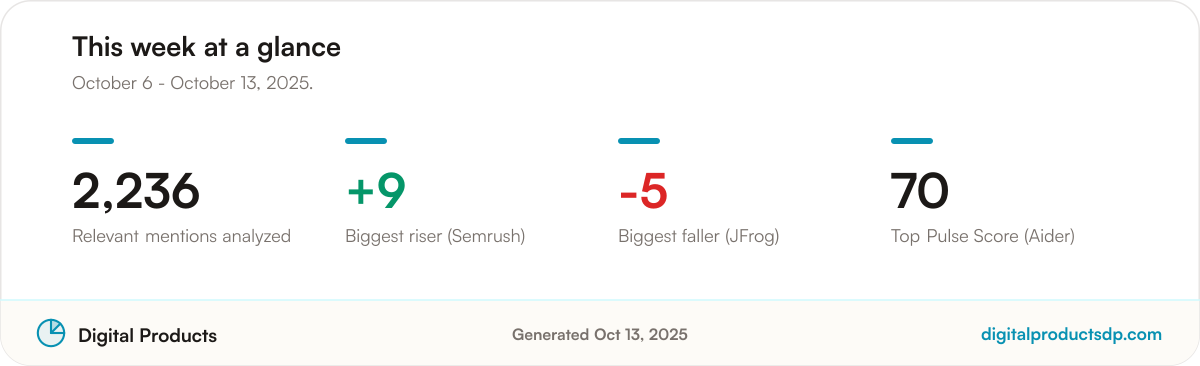
This report summarizes aggregated public online discussion of the AI tools and software we track, drawn from mentions analyzed for October 6, 2025 through October 13, 2025. Across that window, 2,236 relevant mentions were collected, and 49 products cleared the minimum volume needed to be ranked. Everything below reflects the tone of community chatter, not a verdict on any product's quality.
The digest covers complete calendar weeks running from September 29, 2025 through October 13, 2025, and the headline picture for the latest week is a coding assistant on top, a marketing platform climbing fastest, and complaint volume heavily concentrated on bugs and reliability. We walk through the leaderboard, category shifts, the biggest movers, a spotlight on the leader, and the themes that shaped the conversation.
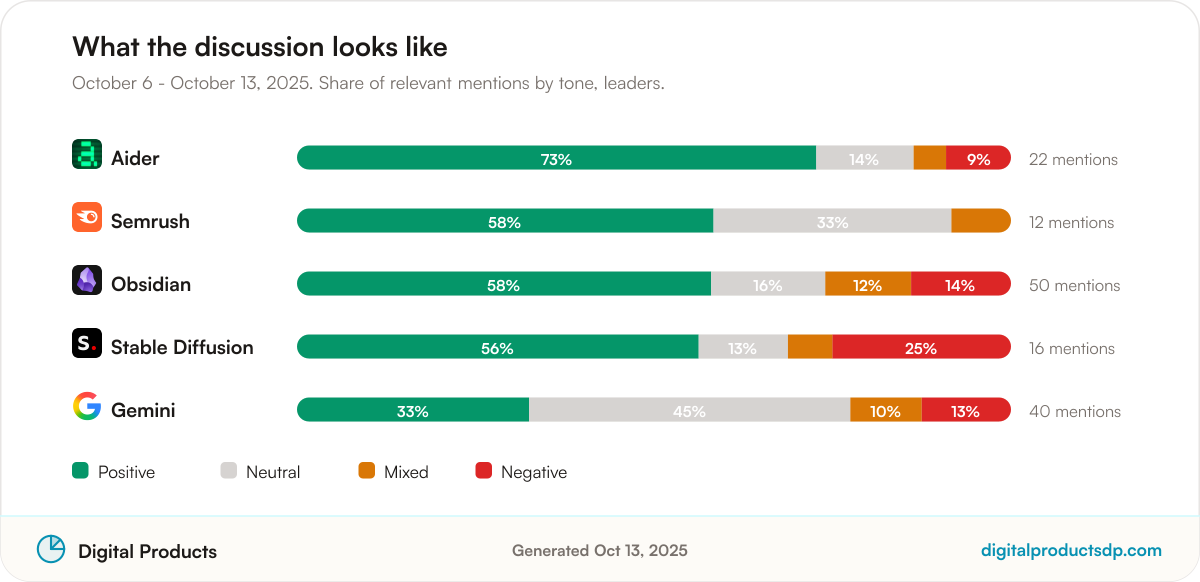
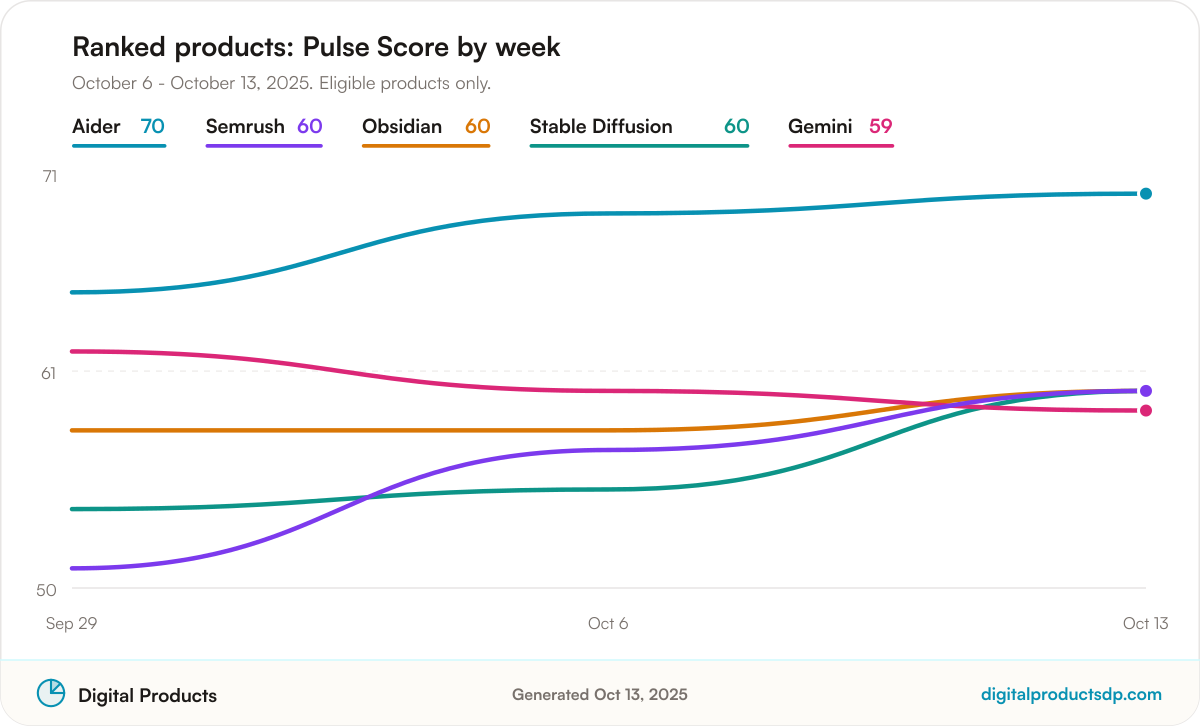
Aider sits at the top of the latest-week ranking with a Pulse Score of 70, based on 22 mentions over the period. Behind it, a tight cluster shares a score of 60: Semrush, based on 12 mentions, Obsidian, based on 50 mentions, and Stable Diffusion, based on 16 mentions. Gemini rounds out the leaders at 59, based on 40 mentions.
What stands out is how close the chasing pack is. Three products land on exactly 60 while drawing very different volumes of discussion, from Semrush's 12 mentions to Obsidian's 50. That gap matters when reading these scores, because a score built on a larger sample tends to be steadier than one built on a thin one. The leaders span four different categories, which suggests the strongest sentiment this week was not concentrated in any single corner of the market.
Category View
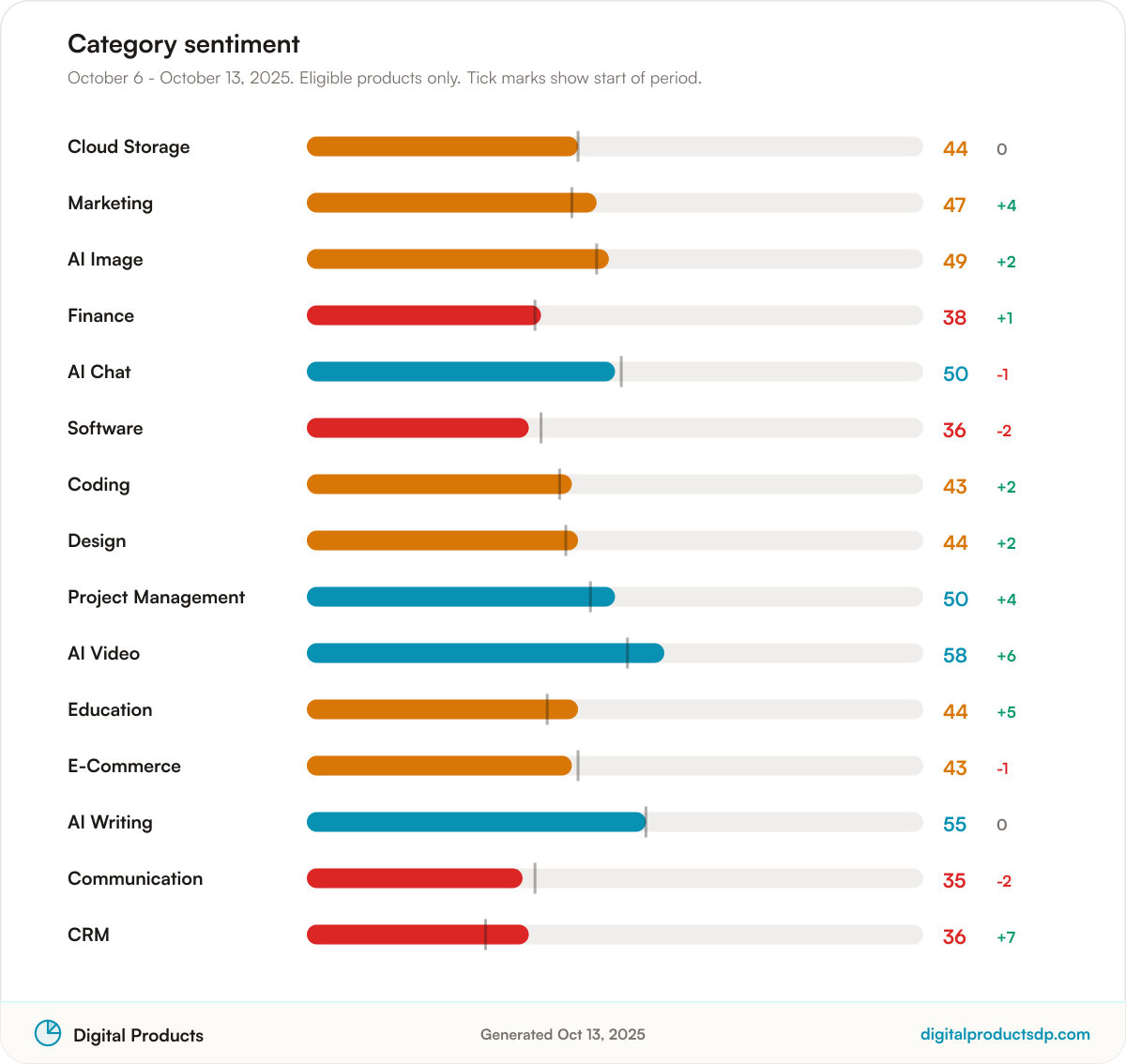
At the category level, several groups moved up over the period while a few drifted lower. CRM saw the largest rise in average score, from 29 to 36, though it remains the lowest-scoring category on the board even after that gain. AI video climbed from 52 to 58, project management moved from 46 to 50, education rose from 39 to 44, and marketing improved from 43 to 47. On the softer side, software slipped from 38 to 36, communication eased from 37 to 35, and ai-chat edged down from 51 to 50. Cloud storage was flat at 44, and ai-writing held steady at 55. The pattern points to a generally constructive week for project tools and AI video discussion, while the broad software and communication categories carried more negative tone.
Biggest Movers
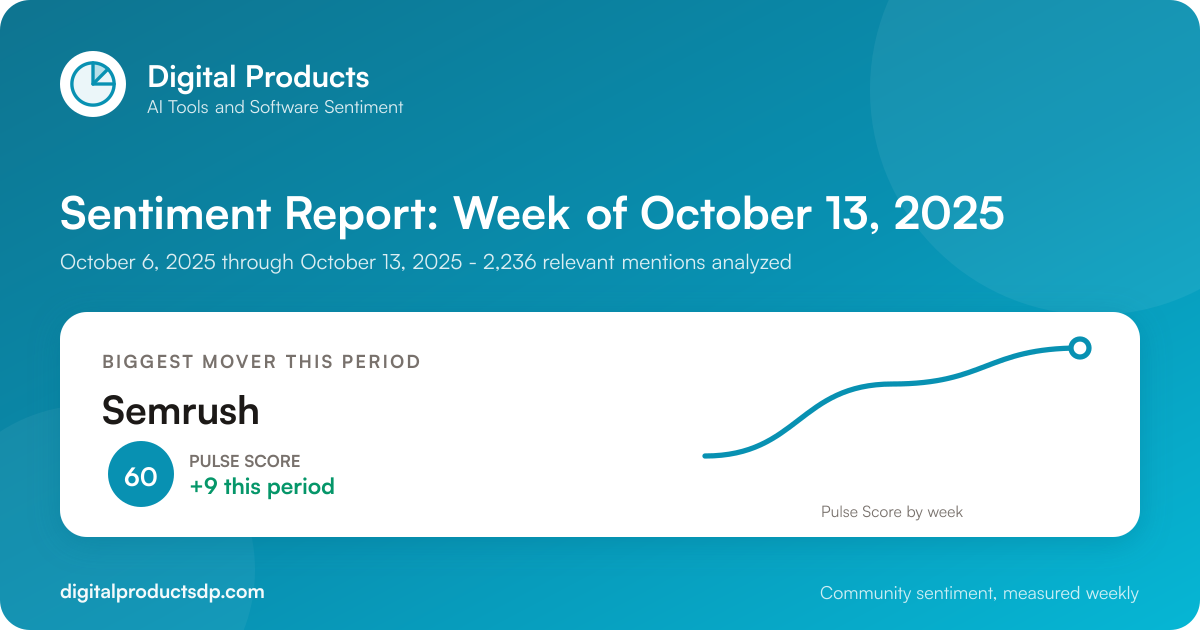
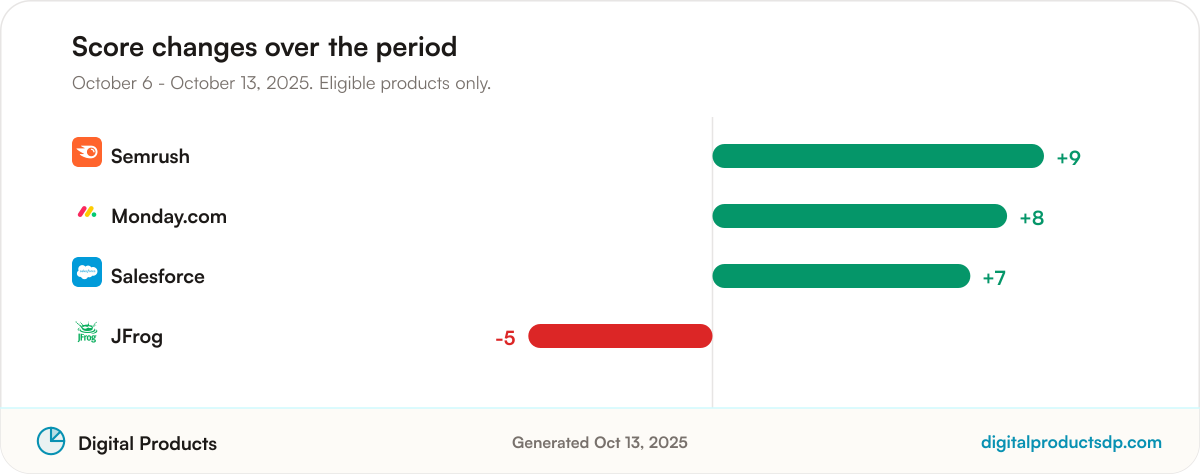
Semrush (riser, +9): The marketing platform climbed from 51 to 60 over the period, based on 12 mentions. Its latest-week praise themes were led by strong features with 22 mentions and easy to use with 11, alongside seven mentions tied to AI quality. The complaint side was lighter and centered on how it compares to rivals with five mentions and pricing too high with four. With praise volume clearly outweighing complaints in the latest week, the upward move tracks with a discussion that leaned favorably on capability and usability.
Monday.com (riser, +8): The project management tool rose from 38 to 46, based on 24 mentions. Its praise themes were modest in count, led by strong features with four mentions and good integrations with three. Complaints were close behind, with bugs at seven, comparisons to rivals at six, and pricing too high at four. The gain came off a low starting point, and the relatively even praise-to-complaint balance suggests sentiment improved without the conversation turning uniformly positive.
Salesforce (riser, +7): The CRM platform moved from 29 to 36, based on 27 mentions. Its praise mix featured new releases with nine mentions, good integrations with eight, and strong features with eight. Complaints were heavier in raw count, led by bugs with 56 mentions, reliability with 30, and missing features with 22. The score still rose, which indicates the tone of discussion lifted even as bug chatter remained the dominant complaint, and it helped pull the wider CRM category average up from 29 to 36.
JFrog (faller, -5): The biggest decliner slid from 30 to 25, based on 21 mentions. Praise centered on security with 18 mentions, strong features with 11, and good integrations with 11. But complaints clustered on bugs with 11 mentions, reliability with eight, and missing features with five. With reliability and bug concerns running alongside its praise, the softening score lines up with a conversation that grew more critical week to week.
Gemini (faller, -3): The ai-chat product eased from 62 to 59, based on 40 mentions, while still finishing among the leaders. Its praise was substantial, led by AI quality with 149 mentions and strong features with 140. The complaint side was also heavy, with AI quality cited 112 times, comparisons to rivals 86 times, and missing features 55 times. The appearance of AI quality on both the praise and complaint lists points to a divided conversation, which fits a small downward drift from a high base.
DigitalOcean (faller, -3): The cloud product moved from 45 to 42, based on 12 mentions. Praise was thin, with strong features at nine mentions, good integrations at six, and reliability at five. Complaints matched or outweighed that, led by bugs with 12 mentions and reliability with 12. With reliability appearing as both a praise and a complaint theme and bug chatter prominent, the modest decline reflects a discussion where the negatives slightly outpaced the positives.
Spotlight: Aider
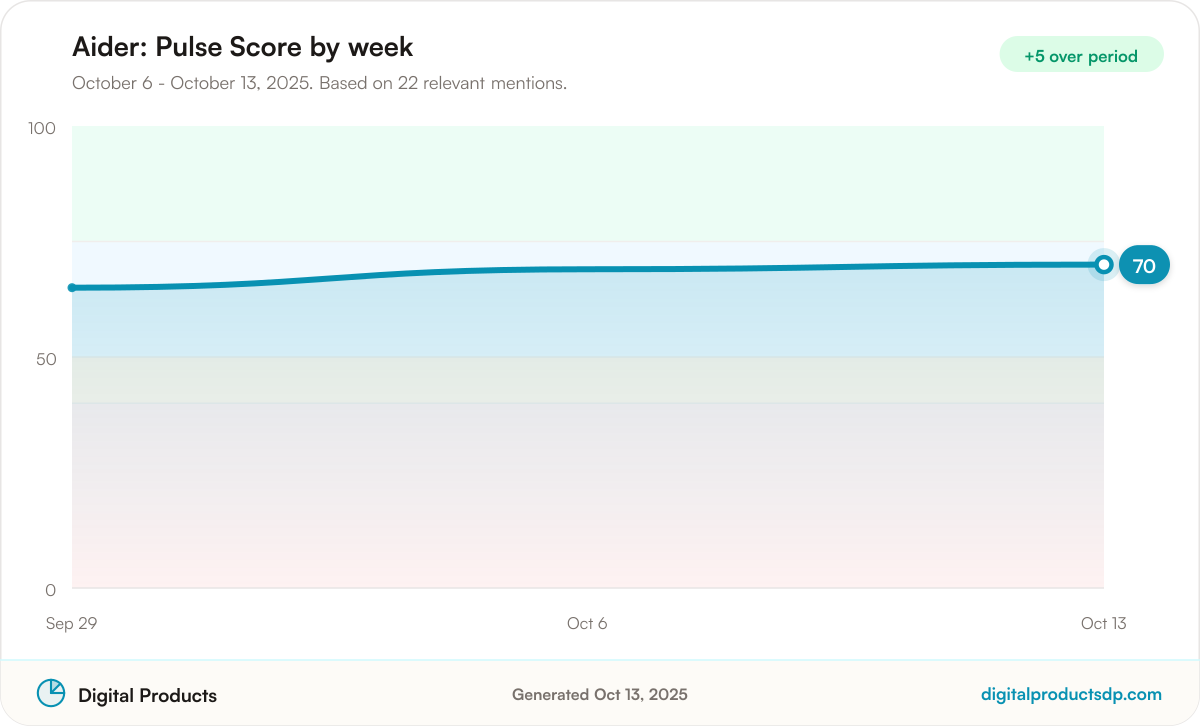
Aider, a coding assistant, led the latest-week board with a Pulse Score of 70, based on 22 mentions over the period. Its weekly series shows a steady climb: 65 on September 29, 2025, 69 on October 6, 2025, and 70 on October 13, 2025. That is a consistent upward path across all three weeks of the digest, which makes it one of the more stable positive stories on the board rather than a one-week spike.
The praise themes behind that score were led by strong features with seven mentions, easy to use with four, and good integrations with three. These are modest counts, which is worth flagging given the 22-mention sample. A high score on a smaller volume can be more sensitive to a handful of comments than a score built on hundreds of mentions, so the read here is best treated as a favorable but lightly sampled signal.
On the complaint side, the most-cited themes were bugs with nine mentions, missing features with five, and feature requests with four. The presence of feature requests alongside missing features suggests an engaged community that wants the tool to do more, which is a different flavor of criticism than reliability or downtime complaints. Taken together, Aider's latest-week picture is one of broadly positive sentiment with the usual coding-tool appetite for additional capability.
Themes Driving the Conversation
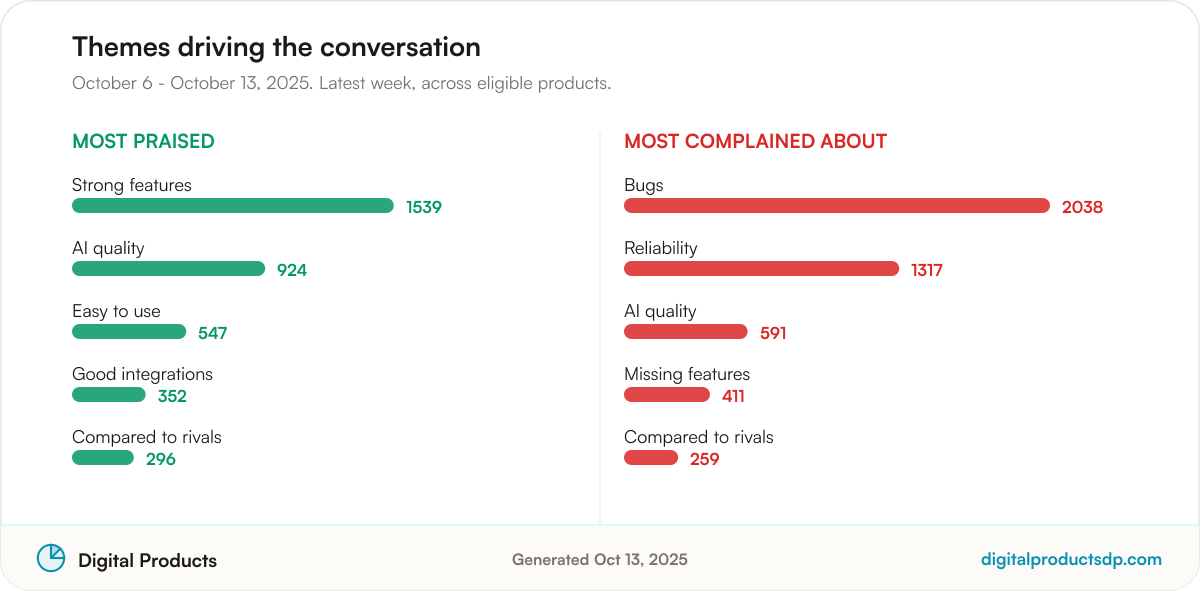
On the praise side, strong features dominated with 1,539 mentions across eligible products, well ahead of AI quality at 924, easy to use at 547, good integrations at 352, and comparisons to rivals at 296. Strong features showed up as the leading praise theme for many of the most-discussed products, including ChatGPT with 183 mentions, Claude with 229, and Stripe with 84, while AI quality drove favorable chatter for Gemini with 149 mentions and Claude with 234. This points to a community that, when positive, talks first about capability and the quality of AI output.
The complaint side was heavier and more concentrated. Bugs led by a wide margin with 2,038 mentions, followed by reliability at 1,317, AI quality at 591, missing features at 411, and comparisons to rivals at 259. The bug and reliability themes traced directly to high-volume products such as Stripe, with 188 bug mentions and 158 reliability mentions, ArgoCD with 183 and 135, Grok with 177 bug mentions, and Vercel with 170 bug mentions and 151 reliability mentions. The fact that AI quality appears on both lists, as praise for some products and a complaint for others such as Grok with 183 mentions and Gemini with 112, underlines that sentiment around model output is genuinely split depending on the product.
Watchlist
A large number of tracked products did not reach the 10-mention minimum this period and so were excluded from the rankings. This is a reflection of discussion volume, not quality. Among those with the most chatter while still below the line were Klaviyo with nine relevant mentions, Coursera with eight, WooCommerce with eight, and a cluster of products at seven mentions including Canva, Foxit, Flux, HeyGen, Apollo.io, Oak, and Namecheap. Several others landed at six, including Leonardo AI, Lovable, Kling, and ClickUp.
These products are close to the threshold and could enter the rankings in a future week if discussion picks up even slightly. Many widely known names sat at zero relevant mentions for the period, which is common in any single window and simply means the public sources we monitor did not surface qualifying chatter about them this time. We will keep watching the near-threshold group, since small swings in volume can move them in or out of the ranked set without any change in the underlying product.
What To Watch Next Week
First, watch whether the leaders holding at 60 can separate. Semrush reached that mark on a rising trajectory but only 12 mentions, while Obsidian reached it on 50, so their next moves may diverge as more discussion accumulates. Second, watch the CRM category, which posted the largest average gain from 29 to 36 on the back of Salesforce's climb, even though bugs remained its dominant complaint with 56 mentions; whether that improvement holds is an open question. Third, watch JFrog, the period's steepest faller, whose three-week path of 30, 28, then 25 shows a consistent downward direction tied to bug and reliability chatter. None of these are predictions, only data points worth monitoring.
Frequently Asked Questions
Which tool had the highest Pulse Score this period?
Aider, a coding assistant, had the highest latest-week Pulse Score at 70, based on 22 mentions over the period.
Which product moved the most this period?
Semrush was the biggest riser, climbing from 51 to 60 over the period for a gain of nine points, based on 12 mentions. JFrog was the biggest faller, sliding from 30 to 25, based on 21 mentions.
What was the overall category mood this period?
It was mixed but leaned positive in several areas. CRM rose from 29 to 36 and AI video climbed from 52 to 58, while software slipped from 38 to 36 and communication eased from 37 to 35.
How many mentions were analyzed this period?
A total of 2,236 relevant mentions were analyzed, and 49 products met the minimum volume to be ranked out of 2,235 tracked products.
About This Data
Pulse Scores summarize the tone of public online discussion on a 0-100 scale and reflect community sentiment, not a verdict on a product's quality or a recommendation. We report on complete calendar weeks only, and products with fewer than 10 relevant mentions in the period are excluded from rankings to avoid unstable reads on thin samples.
Public discussion is collected from Hacker News, Stack Exchange, GitHub, Bluesky, the Apple App Store, and YouTube. Automated sentiment analysis can misread sarcasm, jokes, or niche context, mention volumes vary widely between products, and scores can move from week to week. Any company that would like to respond is welcome to reach out. For how scores are calculated, see our methodology.