AI Tools and Software Sentiment Report: Week of September 22, 2025
September 22, 2025
This edition of our weekly sentiment report looks at aggregated public online discussion of tools and software, drawn from complete calendar weeks. The mentions analyzed for September 15, 2025 through September 22, 2025 sit inside a broader digest covering three complete weeks, and they give us a clear read on where community chatter leaned across chat assistants, coding tools, cloud platforms, CRM systems, and more.
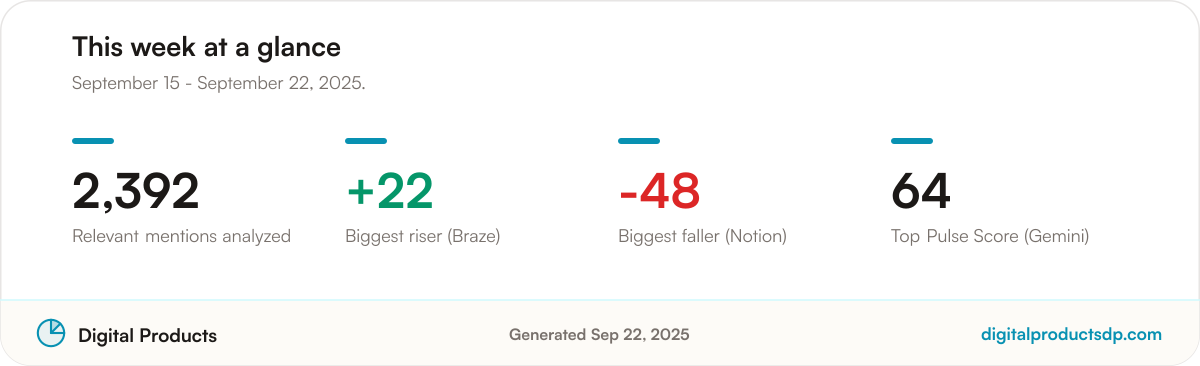
Across the period running from September 15, 2025 through September 22, 2025, we tracked 2,235 products in total. Of those, 47 cleared our threshold of at least 10 relevant mentions and qualified for rankings. In total, 2,392 relevant mentions were analyzed. Everything below reflects the tone of public discussion, not a verdict on product quality. Where we cite a score or a ranking, we include the sample size so you can weigh how thin or thick the underlying discussion was.
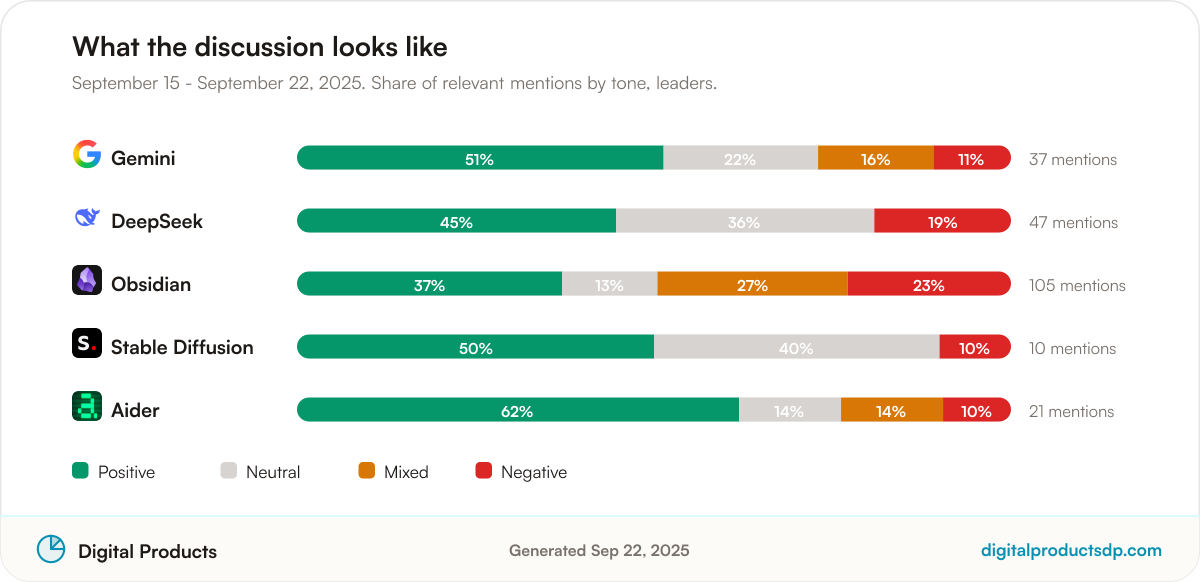
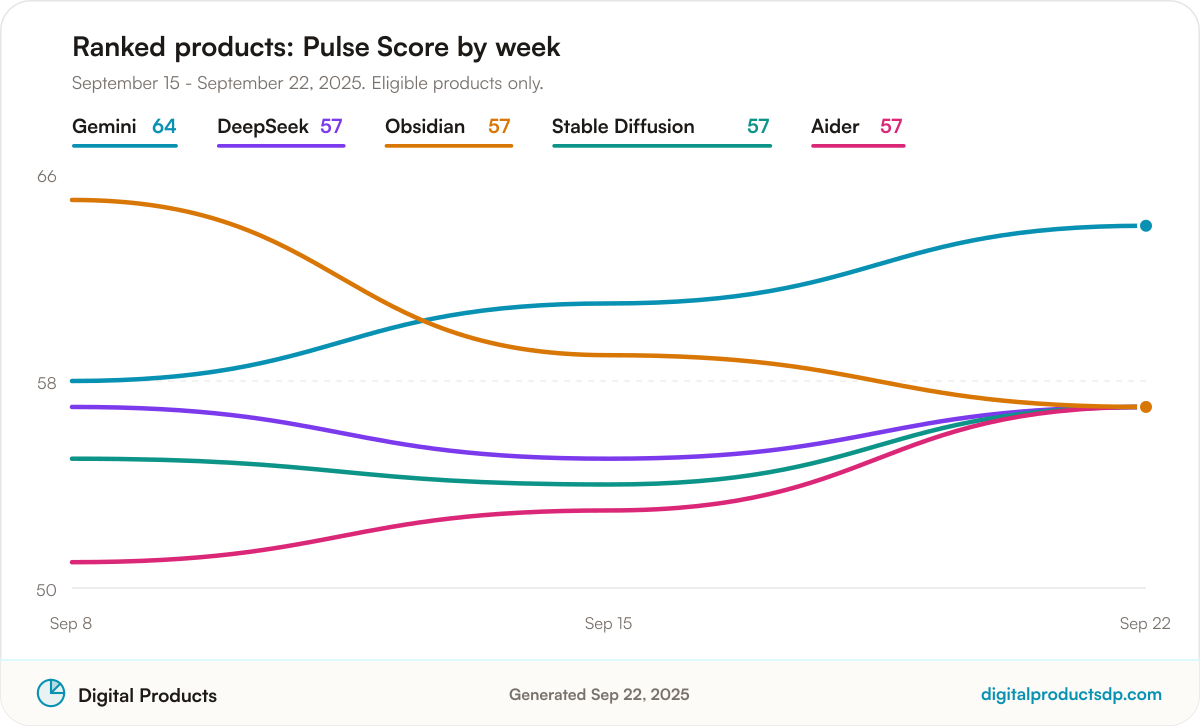
Gemini sits at the top of the board with a Pulse Score of 64, based on 37 mentions over the period. Behind it, a tight cluster forms at 57: DeepSeek based on 47 mentions, Obsidian based on 105 mentions, Stable Diffusion based on 10 mentions, and Aider based on 21 mentions all landed on the same score. That grouping is worth noting because it spans very different categories, from an AI chat assistant to a note-taking and project tool to an image generator to a coding assistant. Similar tone, very different products.
The spread in sample sizes also matters. Obsidian's 57 rests on 105 mentions, a relatively thick sample, while Stable Diffusion's identical 57 rests on just 10 mentions, the minimum to qualify. Both are reported honestly as equal scores, but the Obsidian read is steadier simply because more discussion fed into it. Gemini's lead, at 37 mentions, sits in between and reflects a moderately discussed product rather than a thinly sampled one.
Category View
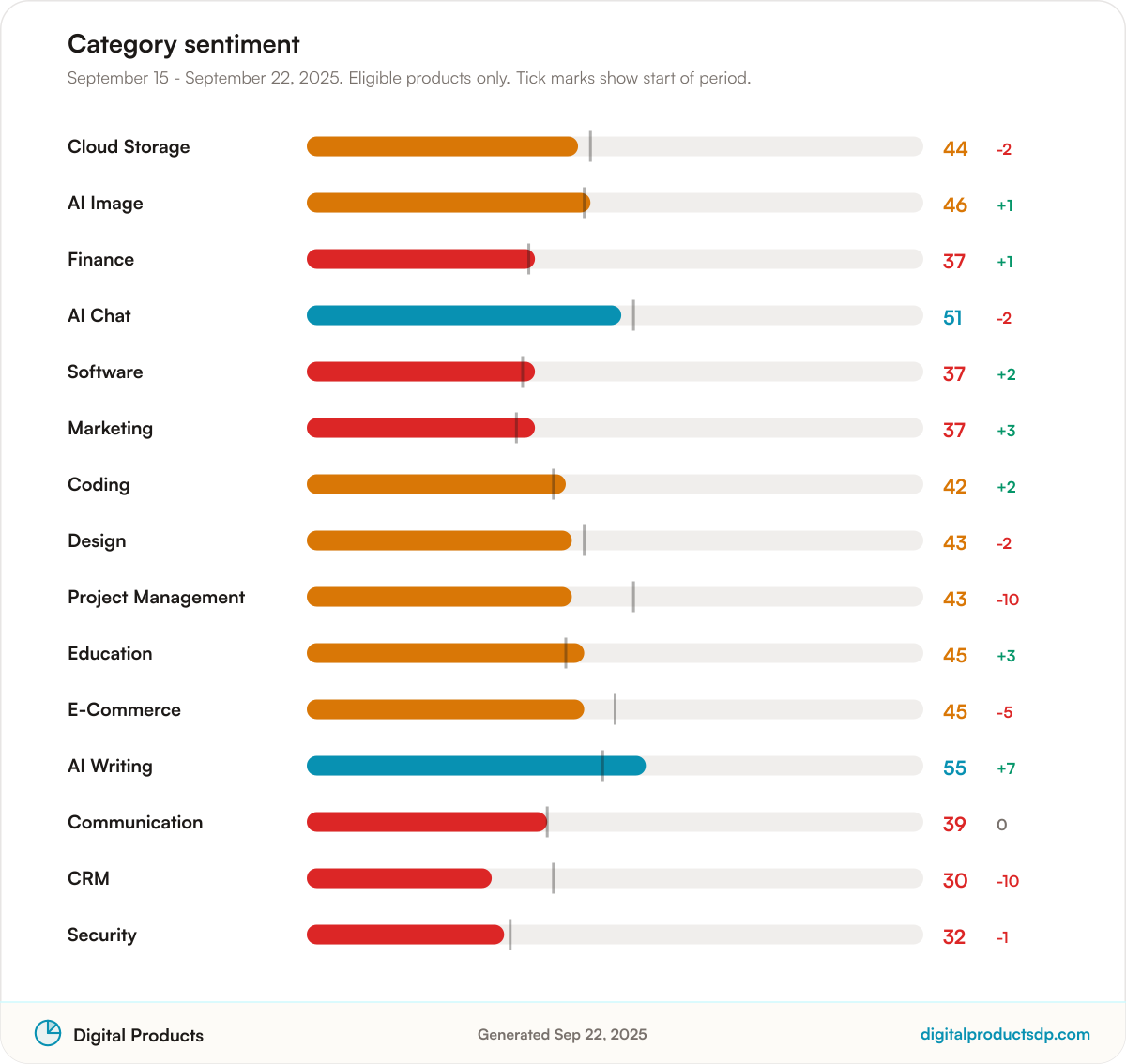
At the category level, the sharpest move belonged to project-management, which slid from 53 to 43 across the period, and crm, which dropped from 40 to 30. Both declines are heavily shaped by single products moving hard, as the movers section shows. On the other side, ai-writing rose from 48 to 55, the strongest positive shift, and marketing edged up from 34 to 37. Several categories barely budged: communication held flat at 39, ai-image nudged from 45 to 46, and finance moved from 36 to 37. The ai-chat category, home to the period's top scorer, softened slightly from 53 to 51, a reminder that a leading product and a leading category are not the same thing.
Biggest Movers
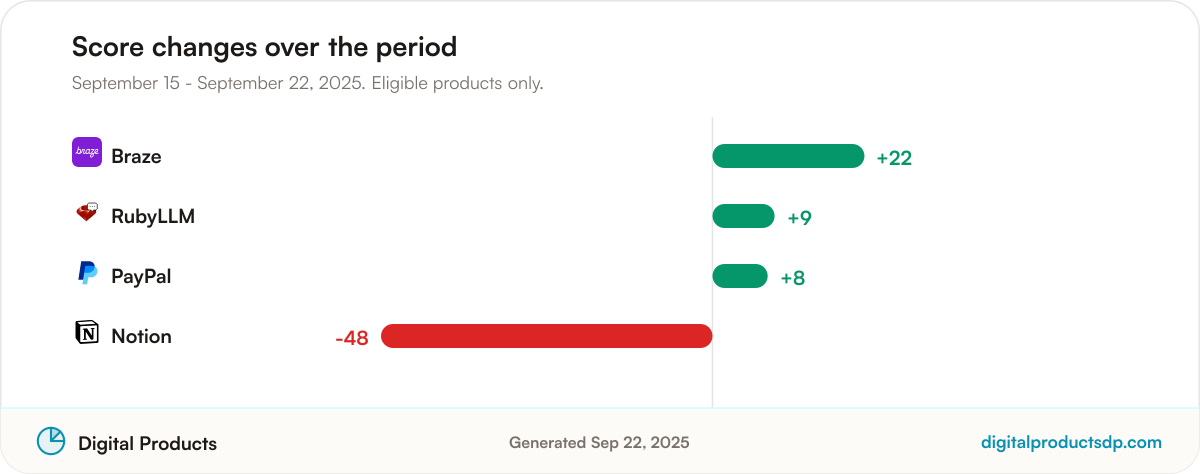
Braze (riser, +22, based on 43 mentions). The marketing platform climbed from 24 to 46 over the period, the largest gain on the board. That said, its recorded themes lean cautionary rather than celebratory: no praise themes were logged in the latest week, while complaints centered on Bugs (8 mentions), Reliability (5 mentions), and Feature requests (4 mentions). The jump in tone therefore looks like a move off a low base rather than a wave of enthusiasm, and the thin praise picture is worth watching in future weeks.
RubyLLM (riser, +9, based on 28 mentions). RubyLLM rose from 29 to 38, with a weekly path of 29, then 33, then 38, a steady climb. Its praise themes were led by Strong features (24 mentions), Good integrations (20 mentions), and Easy to use (16 mentions), which points to developers appreciating what it ships and how it connects. The offsetting complaints were Bugs (27 mentions), Reliability (16 mentions), and Missing features (8 mentions), so the improvement in sentiment coexists with real friction being voiced.
PayPal (riser, +8, based on 110 mentions). PayPal improved from 32 to 40 on the heaviest sample among the risers, moving 32, then 37, then 40 across the weeks. Its praise was modest and practical, led by Easy to use (4 mentions) and Strong features (3 mentions). Complaints were larger in volume, with Reliability (20 mentions), Bugs (18 mentions), and Compared to rivals (13 mentions) leading the conversation. The rise in Pulse Score against a complaint-heavy theme mix suggests tone warmed even as reliability remained the sticking point in discussion.
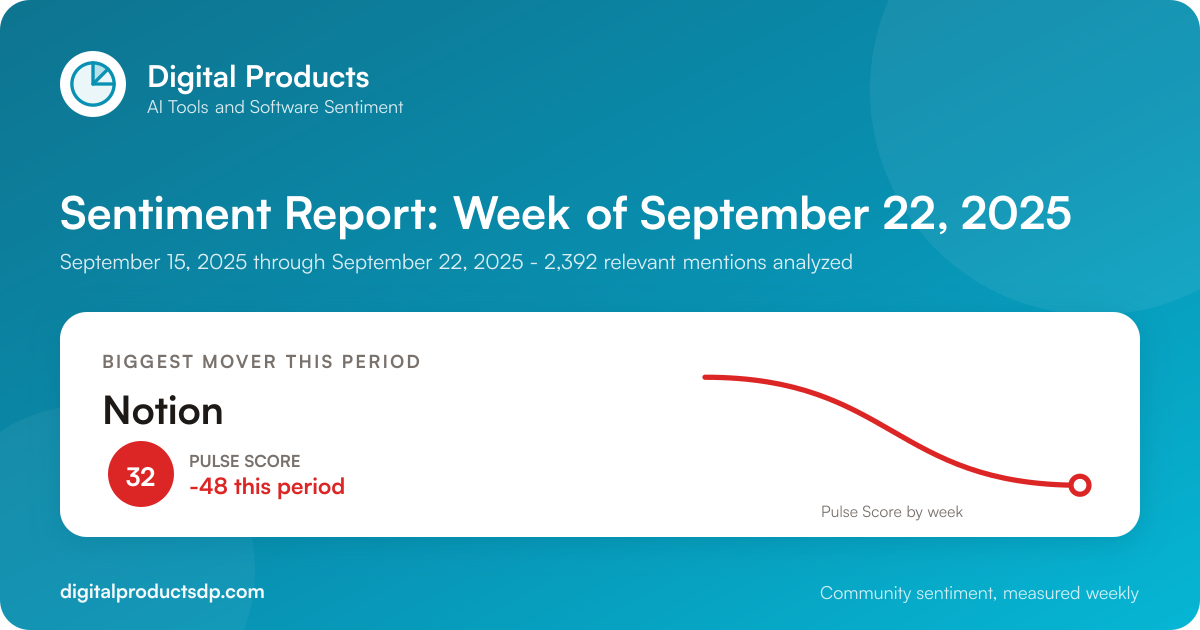
Notion (faller, -48, based on 29 mentions). The steepest drop of the period belonged to Notion, which fell from 80 to 32. Its latest-week praise themes were sparse, with Good integrations (3 mentions), Strong features (2 mentions), and Easy to use (2 mentions). Complaints clearly dominated the read, led by Bugs (19 mentions), Reliability (8 mentions), and Lacking integrations (8 mentions). A move of this size on 29 mentions should be read with the sample size in mind, but the theme mix explains the direction: bug and reliability chatter overwhelmed a thin set of positives.
DigitalOcean (faller, -12, based on 12 mentions). The cloud platform slipped from 57 to 45, tracing 57, then 52, then 45 across the weeks. Its praise themes were Strong features (9 mentions), Good integrations (6 mentions), and Reliability (5 mentions), but the complaint side carried equal reliability weight, with Bugs (12 mentions) and Reliability (12 mentions) tied at the top, followed by Performance (4 mentions). When reliability appears prominently on both sides of the ledger, the tone tends to hinge on which experiences dominate, and here the negative read won out.
Salesforce (faller, -10, based on 32 mentions). The CRM platform declined from 40 to 30, moving 40, then 32, then 30. Its praise was spread thin across New releases (9 mentions), Good integrations (8 mentions), and Strong features (8 mentions). Complaints were far heavier, led by Bugs (56 mentions), Reliability (30 mentions), and Missing features (22 mentions). That complaint volume, well above the praise counts, aligns with both the product's own slide and the broader crm category drop from 40 to 30.
Spotlight: Gemini
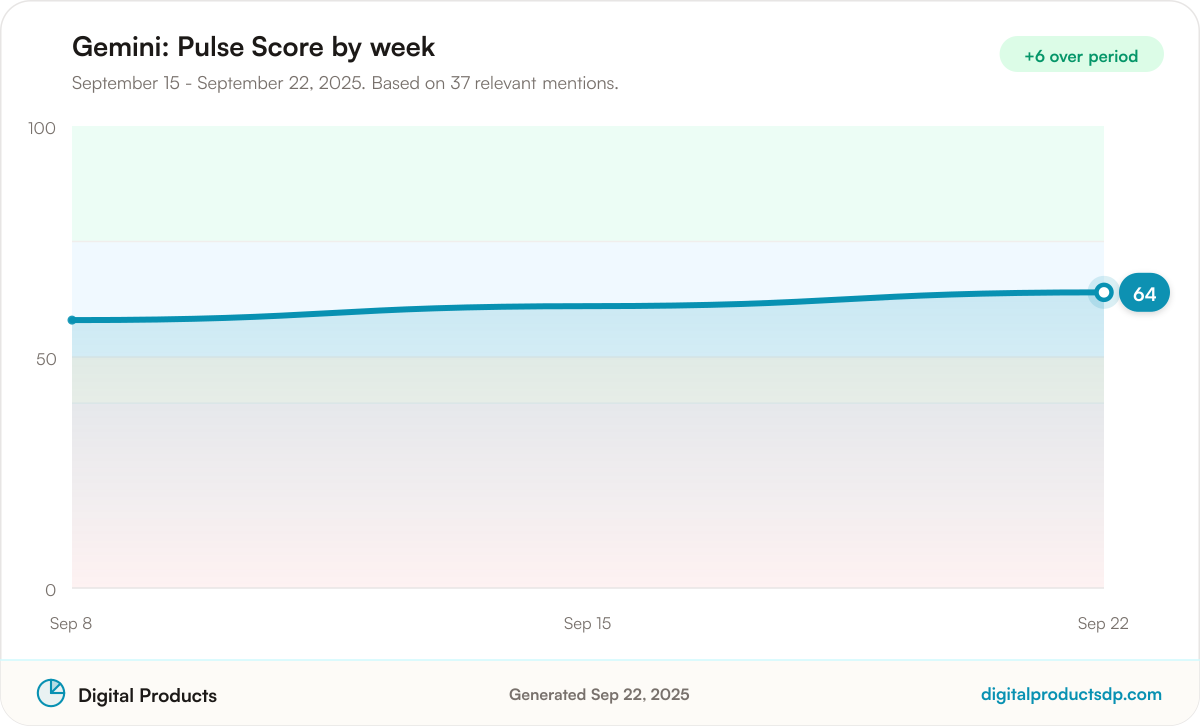
Gemini took the top Pulse Score of the period at 64, based on 37 mentions. Its weekly path moved steadily upward, from 58 on September 8, 2025, to 61 on September 15, 2025, and then to 64 on September 22, 2025. Among the eligible ai-chat products, that upward trend stands out, since the category average softened slightly over the same window.
The theme picture behind Gemini is genuinely two-sided, which is part of what makes the read interesting. On the praise side, the conversation was led by AI quality (149 mentions), Strong features (140 mentions), and Compared to rivals (75 mentions). On the complaint side, many of the same buckets appear, with AI quality (112 mentions), Compared to rivals (86 mentions), and Missing features (55 mentions). In other words, the same dimensions that drew praise also drew criticism, which is common for a heavily discussed assistant where expectations run high.
The net tone leaned positive enough to keep Gemini on top, with AI quality praise outweighing AI quality complaints and Strong features carrying real volume. Because Compared to rivals shows up prominently on both sides, the discussion clearly framed Gemini against alternatives rather than in isolation. That is a sentiment read worth revisiting next period to see whether the upward weekly trend holds or the criticism catches up.
Themes Driving the Conversation
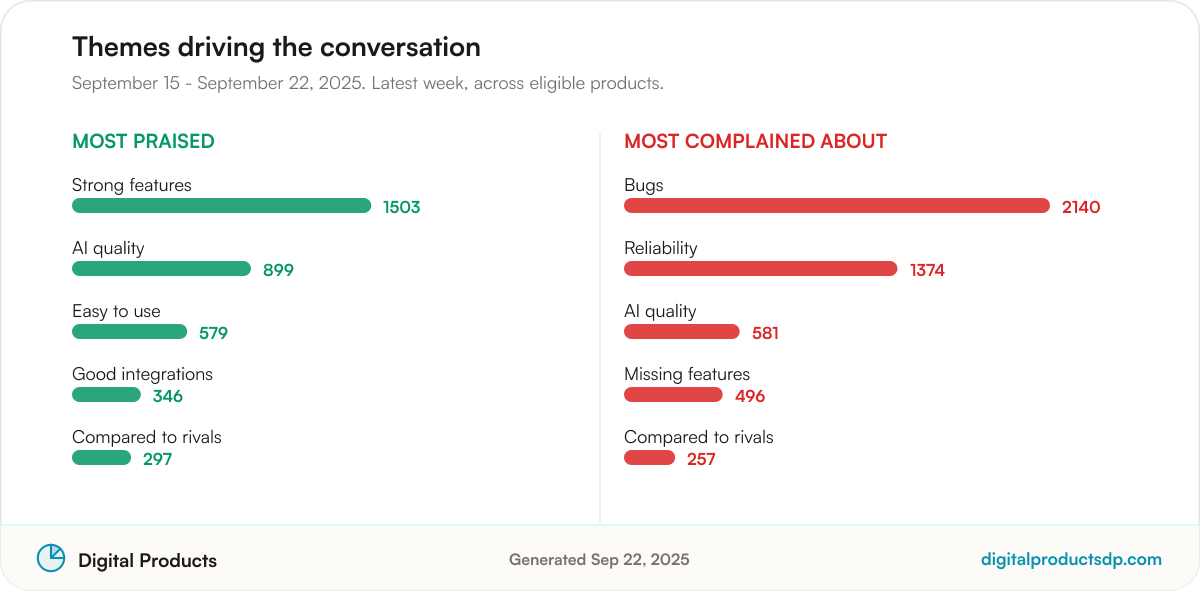
On the praise side, Strong features led by a wide margin at 1,503 mentions, followed by AI quality (899 mentions), Easy to use (579 mentions), Good integrations (346 mentions), and Compared to rivals (297 mentions). Strong features shows up across the leaderboard, driving conversation for products like Obsidian (40 mentions), Cursor (100 mentions), and ChatGPT (183 mentions), while AI quality praise concentrated around the chat assistants, with Gemini (149 mentions), ChatGPT (159 mentions), and Claude (234 mentions) among the loudest contributors.
On the complaint side, the picture was blunt: Bugs dominated at 2,140 mentions, ahead of Reliability (1,374 mentions), AI quality (581 mentions), Missing features (496 mentions), and Compared to rivals (257 mentions). Bugs and Reliability were the recurring pressure points across categories, showing up prominently for Salesforce (Bugs 56, Reliability 30), Vercel (Bugs 170, Reliability 151), Stripe (Bugs 188, Reliability 158), and ArgoCD (Bugs 231, Reliability 172). The pattern is clear: features and AI quality earn the praise, while bugs and reliability drive the friction, and the two often attach to the very same products.
Watchlist
A large number of tracked products did not clear the 10-mention threshold this period and are therefore not ranked. This is a statement about discussion volume, not about quality. Several are widely used tools that simply did not generate enough eligible mentions in this window to produce a stable read.
Among the closest to the line were DALL-E (ai-image) with 9 relevant mentions and Namecheap (software) with 9 relevant mentions, each just short of qualifying. HubSpot (crm) landed at 8 relevant mentions, while ClickUp (project-management), Canva (design), and Veo (ai-video) each recorded 7. A little further back, Klarna (finance), Semrush (marketing), Foxit (business), Lovable (coding), Braintrust (coding), Carta (finance), Gamma (coding), and Bitbucket (coding) each drew 6. Products like Jasper (ai-writing) at 5, and Coursera (education), ActiveCampaign (marketing), NordVPN (security), Synthesia (ai-video), WooCommerce (e-commerce), Anyscale (coding), Leonardo AI (ai-image), Monday.com (project-management), Pipedrive (crm), and Gumroad (e-commerce) at 4, sat below that. If discussion picks up around any of these next period, they could enter the rankings quickly.
What To Watch Next Week
First, watch whether Gemini's steady weekly climb holds. It rose 58, 61, 64 across the three weeks and finished as the top scorer based on 37 mentions, but its praise and complaint themes both center on AI quality and comparisons to rivals. That balance can tip either way, so the direction of the next reading is worth monitoring rather than assuming.
Second, keep an eye on the crm and project-management categories, which fell to 30 and 43 respectively over the period. Salesforce dropped to 30 on heavy complaint volume led by Bugs (56 mentions), and Notion's fall to 32 pulled hard on project-management. Whether those declines were single-week swings or the start of a sustained softer tone is the open question.
Third, the risers deserve follow-up. Braze jumped 22 points to 46 but logged no praise themes and complaints led by Bugs (8 mentions), so its improvement rests on a thin base. PayPal rose to 40 on the heaviest riser sample, 110 mentions, yet reliability complaints (20 mentions) remained the loudest note. Watching whether these gains stick or fade is more useful than predicting an outcome.
Frequently Asked Questions
Which tool had the highest Pulse Score this period?
Gemini had the highest Pulse Score at 64, based on 37 mentions over the period. It was followed by a cluster at 57 that included DeepSeek, Obsidian, Stable Diffusion, and Aider.
Which product moved the most this period?
Notion moved the most, falling from 80 to 32, a 48-point drop based on 29 mentions. Among risers, Braze gained the most, climbing from 24 to 46, a 22-point move based on 43 mentions.
How many mentions were analyzed for this report?
A total of 2,392 relevant mentions were analyzed across the period. Of 2,235 tracked products, 47 cleared the threshold of at least 10 relevant mentions to qualify for rankings.
What was the overall mood across categories?
It was mixed. Ai-writing rose from 48 to 55, while crm fell from 40 to 30 and project-management slid from 53 to 43. Across all products, Bugs (2,140 mentions) and Reliability (1,374 mentions) were the most-discussed complaint themes.
About This Data
Pulse Scores summarize the tone of public online discussion on a 0-100 scale and reflect community sentiment, not a verdict on a product's quality or a recommendation. We report on complete calendar weeks only, and products with fewer than 10 relevant mentions in the period are excluded from rankings to avoid unstable reads on thin samples.
Public discussion is collected from Hacker News, Stack Exchange, GitHub, Bluesky, the Apple App Store, and YouTube. Automated sentiment analysis can misread sarcasm, jokes, or niche context. Mention volumes vary widely between products, and scores can move week to week, so a single reading is best treated as a snapshot rather than a trend on its own.
Any company that would like to respond to its coverage is welcome to reach out. For more on how these scores are calculated, see our methodology.