AI Tools and Software Sentiment Report: Week of August 4, 2025
August 4, 2025
This edition of our sentiment report covers aggregated public online discussion about tracked AI tools and software, drawing on mentions analyzed for July 28, 2025 through August 4, 2025. Everything here reflects the tone of community chatter, not a verdict on any product's quality. Our aim is to show where the conversation moved, which themes drove it, and how those themes tie back to specific products.
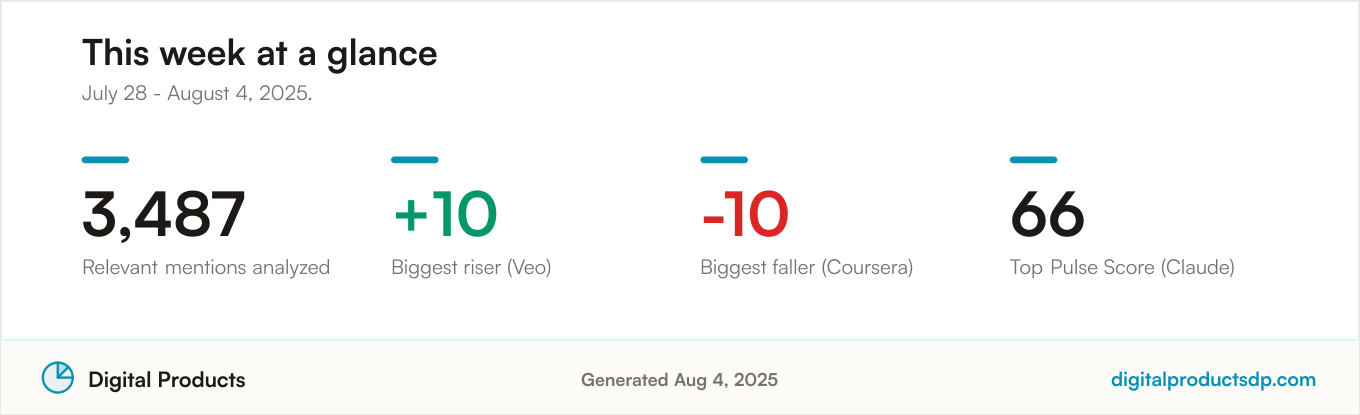
Across the period running from July 28, 2025 through August 4, 2025, we analyzed 3,487 relevant mentions. Of the 2,246 products tracked, 80 cleared the threshold of at least 10 relevant mentions and were eligible for rankings. The result is a snapshot dominated by a handful of familiar names in AI chat, coding, and creative categories, with a long tail of software products showing thinner but still telling signals.
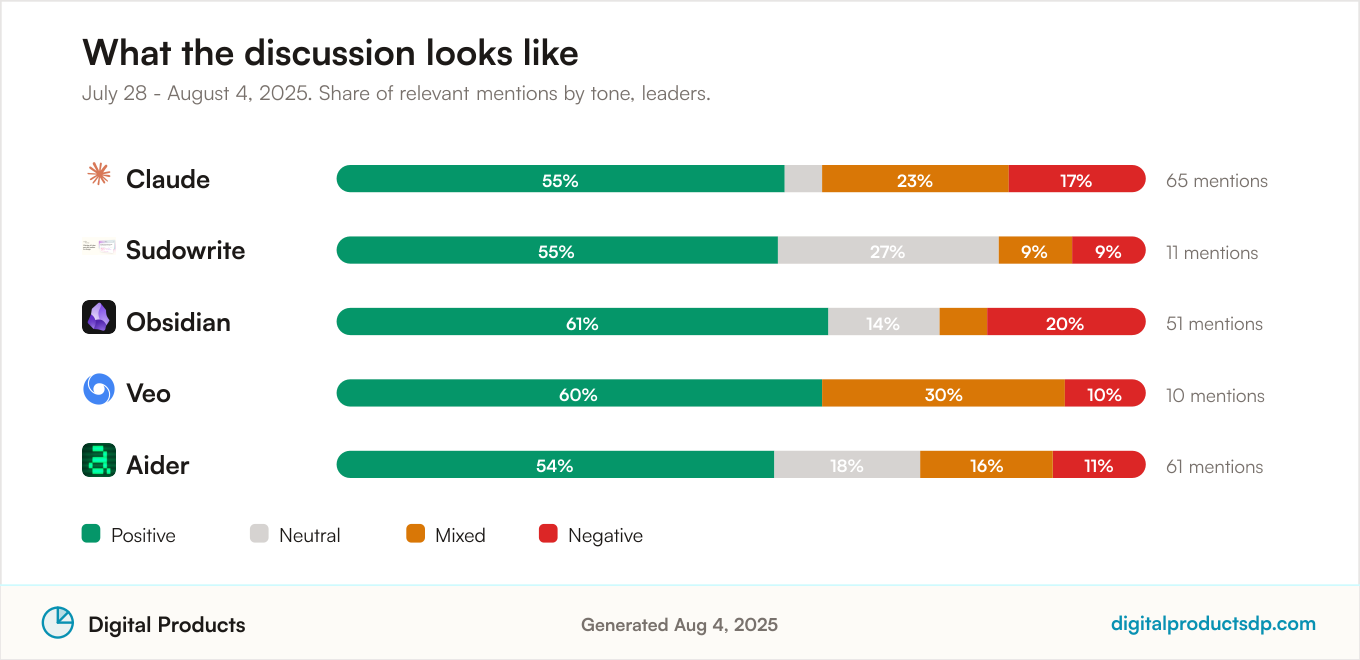
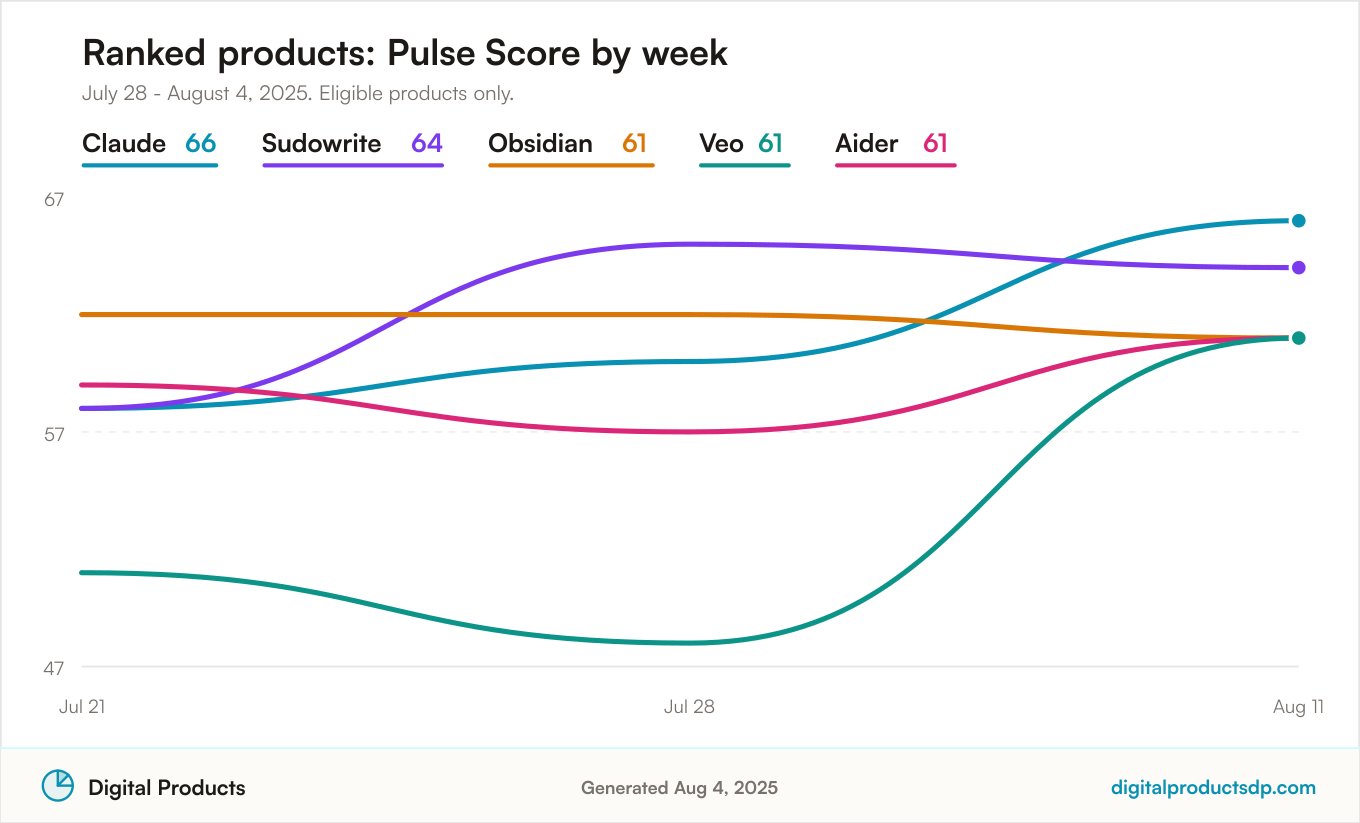
Claude sits at the top of the ranked products with a Pulse Score of 66, based on 65 mentions over the period. Sudowrite follows at 64, based on 11 mentions, though that thin sample means its read is more fragile than the leaders with heavier volume. Obsidian holds 61 based on 51 mentions, Veo reaches 61 based on 10 mentions, and Aider rounds out the top group at 61 based on 61 mentions.
The spread among the leaders is narrow, with only five points separating the top five scores. What separates them is confidence: Claude, Obsidian, and Aider carry mention counts in the dozens, while Sudowrite and Veo cleared the threshold by only a mention or two. When reading these positions, weight the higher-volume names more heavily, since a single strongly worded comment moves a thin sample far more than a busy one.
Category View
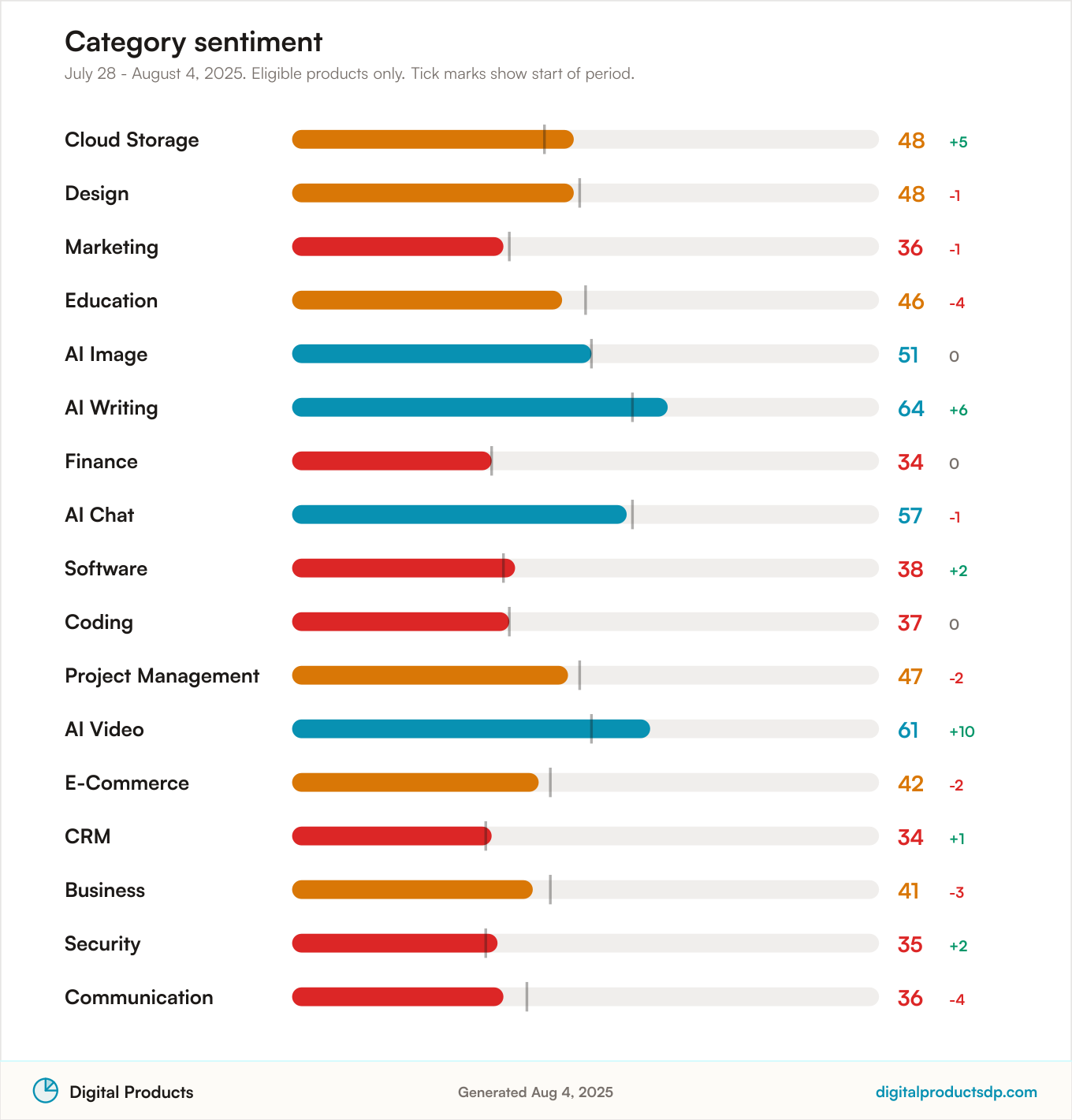
At the category level, the clearest positive movers were ai-video, which rose from 51 to 61, and ai-writing, which climbed from 58 to 64. Cloud-storage also improved, moving from 43 to 48, and software edged up from 36 to 38. Several categories drifted lower, including education from 50 to 46, communication from 40 to 36, business from 44 to 41, and project-management from 49 to 47. A large group barely moved: ai-image held flat at 51, coding stayed at 37, finance held at 34, and crm ticked from 33 to 34. The overall picture is a market where a few creative and writing categories gained ground while operational and communication categories softened slightly.
Biggest Movers
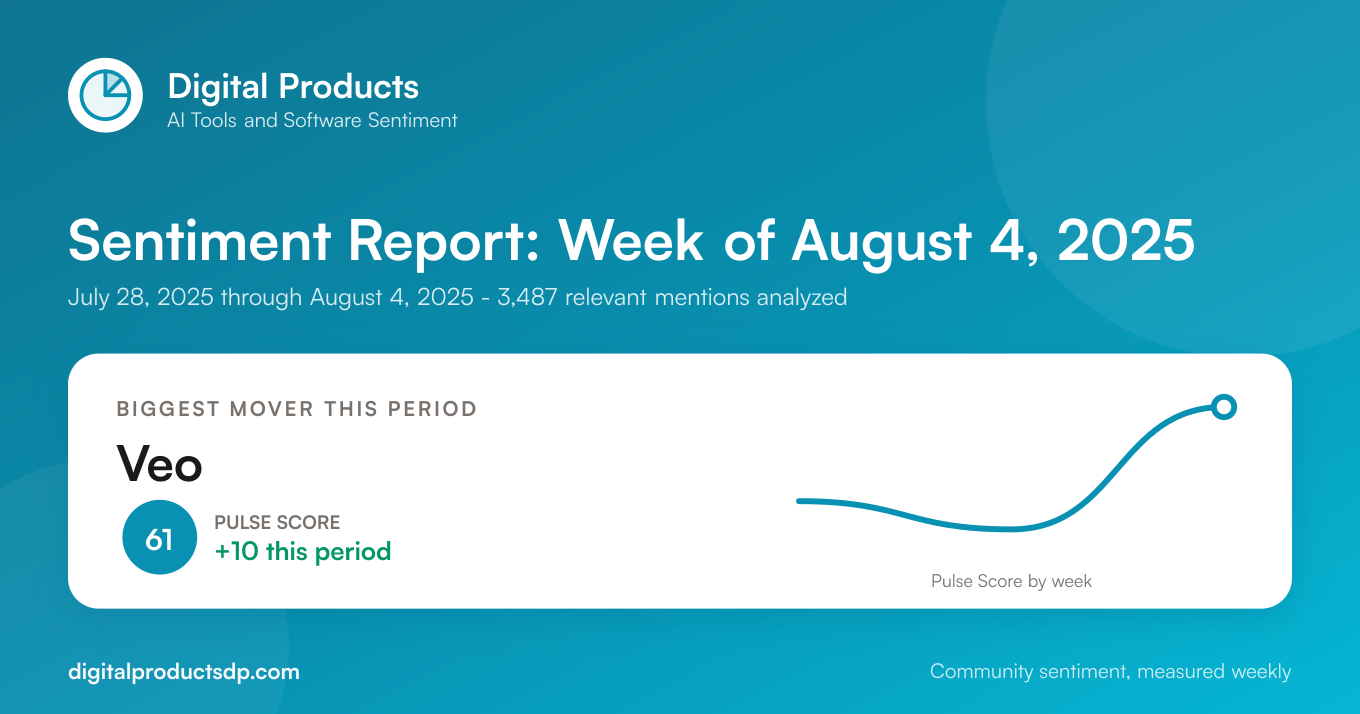
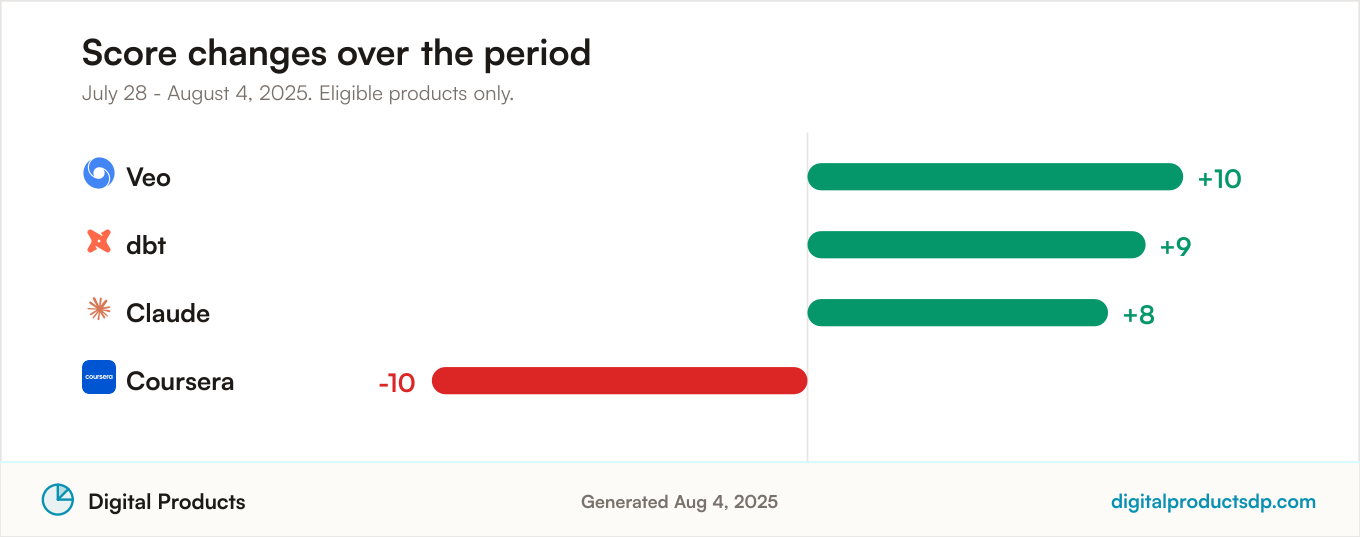
Veo (riser, plus 10): Veo moved from 51 to 61 based on 10 mentions. Its praise themes centered on strong features (12 mentions), new releases (8 mentions), and AI quality (7 mentions), which fits a product being discussed for what it can newly do. The countervailing chatter came from bugs (10 mentions), reliability (5 mentions), and missing features (5 mentions), so the gain sits on top of an active complaint layer. With only 10 mentions clearing the bar, this move should be read cautiously.
dbt (riser, plus 9): dbt rose from 26 to 35 based on 300 mentions, the heaviest sample among the movers. Its praise leaned on strong features (49 mentions), feature requests (41 mentions), and good integrations (32 mentions), a pattern typical of an engaged user base pushing for more. That engagement runs alongside a very large complaint load: bugs (357 mentions), reliability (208 mentions), and missing features (105 mentions). The score improved even as complaint volume stayed high, suggesting the tone of discussion warmed rather than the problems disappearing.
Claude (riser, plus 8): Claude climbed from 58 to 66 based on 65 mentions. Its praise was led by AI quality (234 mentions) and strong features (229 mentions), with easy to use adding 99 mentions. The complaints were meaningful too, with bugs at 134 mentions, AI quality appearing on the negative side at 110 mentions, and reliability at 80 mentions. The split on AI quality, showing up heavily in both praise and complaints, is the defining tension in Claude's discussion this period.
Coursera (faller, minus 10): Coursera dropped from 61 to 51 based on 23 mentions. Its praise came from strong features (14 mentions), easy to use (9 mentions), and fair pricing (6 mentions), but the complaint themes of AI quality (4 mentions), pricing too high (4 mentions), and missing features (4 mentions) point to a mixed read. With praise and pricing sentiment pulling in opposite directions, the softer score reflects a discussion that lost its earlier warmth.
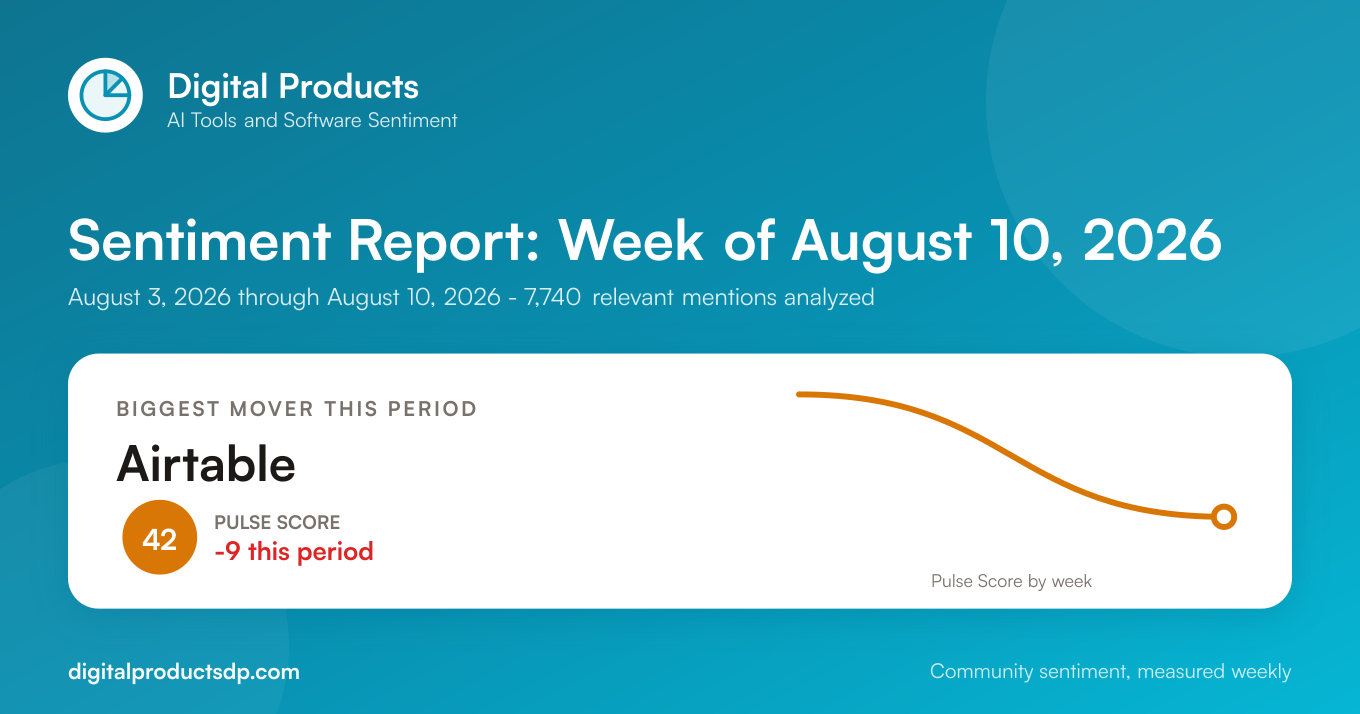
Trello (faller, minus 8): Trello fell from 50 to 42 based on 12 mentions. Praise centered on easy to use (13 mentions) and strong features (8 mentions), with great collaboration adding 4 mentions. Complaints focused on missing features (6 mentions), comparisons to rivals (4 mentions), and UI frustrations (4 mentions). On a small sample, the comparison and missing-features themes appear to have weighed the tone down.
Docker (faller, minus 8): Docker slid from 26 to 18 based on 24 mentions. Its praise came from easy to use (21 mentions), feature requests (17 mentions), and strong features (16 mentions), but the complaint side dominated with bugs (196 mentions), reliability (133 mentions), and missing features (48 mentions). The gap between modest praise and heavy bug and reliability chatter explains the downward move.
Spotlight: Claude
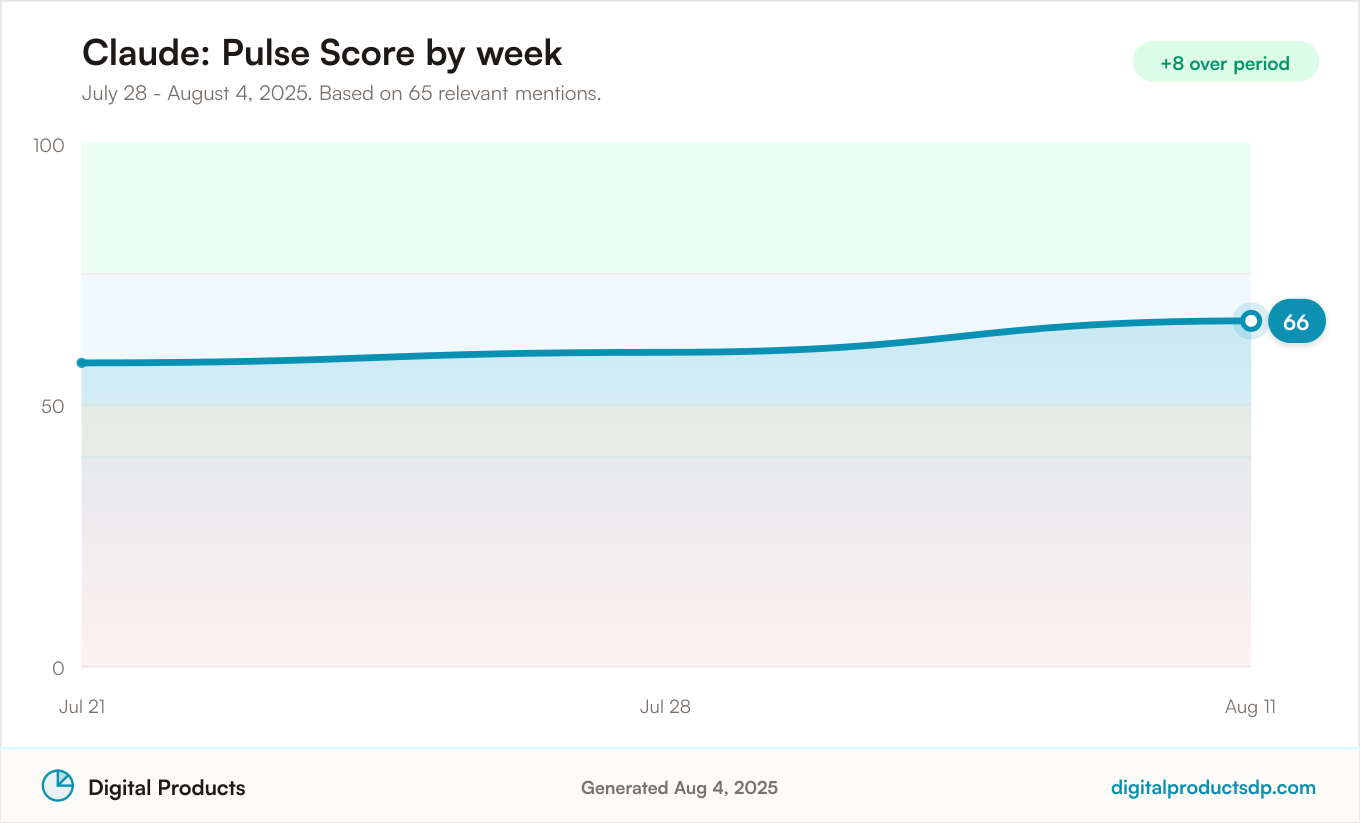
Claude leads this period with a Pulse Score of 66, based on 65 mentions. Its weekly path shows steady improvement across the three tracked weeks, moving from 58 on July 21, 2025, to 60 on July 28, 2025, and up to 66 on August 4, 2025. That is an eight-point gain from the first week to the last, and it is the kind of gradual climb that reads as more durable than a single-week spike.
The theme breakdown explains both the strength and the caveat. Praise for AI quality reached 234 mentions and strong features reached 229 mentions, the two largest praise counts for any single product this period. Easy to use added 99 mentions. These are the drivers pushing the score toward the top of the leaderboard.
At the same time, Claude's discussion carried real friction. Bugs appeared 134 times, AI quality showed up on the complaint side 110 times, and reliability was cited 80 times. The presence of AI quality in both the praise and complaint columns is worth watching, because it signals a community that is split on output rather than uniformly satisfied. For now the positive tone outweighs the negative, but the reliability and bug chatter are the themes most likely to pressure the score if they grow.
Themes Driving the Conversation
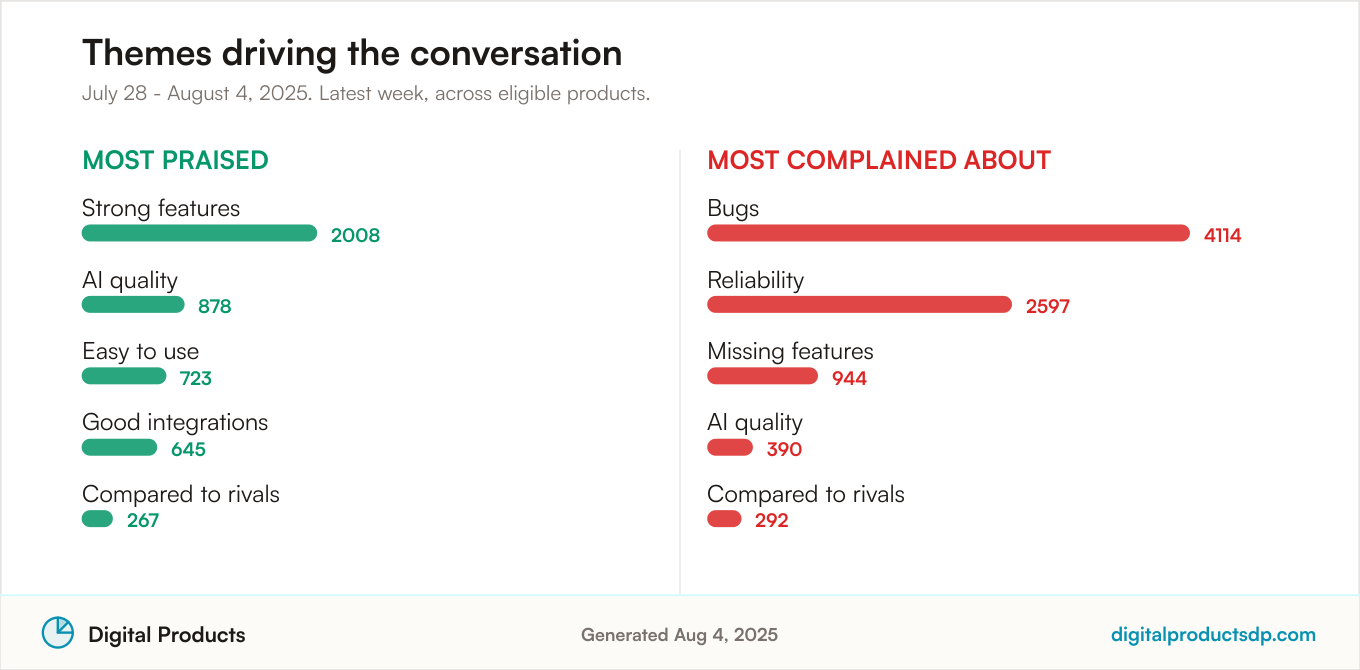
On the praise side, strong features dominated with 2,008 mentions, well ahead of AI quality at 878 mentions and easy to use at 723 mentions. Good integrations followed at 645 mentions, and comparisons to rivals accounted for 267 mentions. Strong features was the connective thread across the leaders, appearing prominently for Claude (229 mentions), Cursor (100 mentions), and Obsidian (40 mentions), while AI quality anchored the discussion for Claude, Gemini (149 mentions), and ChatGPT (159 mentions). The integrations theme was central for products like Clerk (32 mentions) and Grafana (95 mentions on good integrations), showing that ecosystem fit remains a recurring reason people speak positively.
The complaint side was heavier still. Bugs led every theme with 4,114 mentions, and reliability followed at 2,597 mentions, the two largest counts in the entire report. Missing features drew 944 mentions, AI quality appeared as a complaint 390 times, and comparisons to rivals accounted for 292 mentions. These themes were concentrated in the data and infrastructure products: ClickHouse carried 441 bug mentions and 290 reliability mentions, dbt logged 357 bug mentions and 208 reliability mentions, and ArgoCD showed 231 bug mentions and 172 reliability mentions. Stripe, Aspire, and Docker also contributed large bug and reliability totals. The pattern is clear, that stability concerns drive the bulk of negative discussion far more than feature gaps or head-to-head comparisons.
Watchlist
A large number of tracked products did not clear the threshold of 10 relevant mentions this period, so they are not ranked. This is a signal about discussion volume only, never about quality. Among the closest to the line were Lovable and Asana, each with 9 relevant mentions, Anyscale and Honeycomb with 9 relevant mentions, and Astro, Checkly, IPFS, Kinde, and Kinde-adjacent tools with 8 relevant mentions each. Others with modest but sub-threshold volume included Ahrefs and Bubble at 6 relevant mentions, Devin and Bitbucket at 6 relevant mentions, and Jina AI and Earthly at 6 relevant mentions.
Further down, products like Hotjar, Ideogram, LottieFiles, NordVPN, Thinkific, Foxit, Jasper, and DuckDB registered around 5 relevant mentions, while many well-known names such as HubSpot, ClickUp, and Grammarly saw only a handful. A long list of tracked products recorded zero relevant mentions in the period. When a product is quiet, it usually means the sampled sources simply did not surface enough discussion to produce a stable read, and a single busy week could bring it back into the ranked set. We would rather exclude a thin sample than publish a score that could swing wildly on one or two comments.
What To Watch Next Week
First, watch whether Claude holds its climb. It has risen in each of the three tracked weeks to reach 66, but its discussion carries AI quality on both the praise and complaint sides, so the balance between those could shift the score in either direction. Second, watch dbt, which improved nine points to 35 while still carrying 357 bug mentions and 208 reliability mentions across 300 mentions; whether the warmer tone continues alongside that complaint load is the open question. Third, watch the ai-video category, which rose from 51 to 61 largely on Veo's movement from a thin 10-mention sample. If more products in that category clear the threshold, we will get a firmer read on whether the category strength is broad or concentrated in one name.
Frequently Asked Questions
Which tool had the highest Pulse Score this period?
Claude had the highest Pulse Score among ranked products at 66, based on 65 mentions over the period.
Which product moved the most this period?
Veo and Coursera tied for the largest absolute move at 10 points. Veo rose from 51 to 61 based on 10 mentions, while Coursera fell from 61 to 51 based on 23 mentions.
What was the overall mood across categories?
Mixed. Ai-writing rose from 58 to 64 and ai-video rose from 51 to 61, while education slipped from 50 to 46 and communication fell from 40 to 36. Complaint themes were led by bugs at 4,114 mentions and reliability at 2,597 mentions.
How many mentions were analyzed this period?
We analyzed 3,487 relevant mentions across 80 eligible products, drawn from 2,246 products tracked in total.
About This Data
Pulse Scores summarize the tone of public online discussion on a 0-100 scale and reflect community sentiment, not a verdict on a product's quality or a recommendation. We report on complete calendar weeks only, and products with fewer than 10 relevant mentions in the period are excluded from rankings to avoid unstable reads on thin samples.
Public discussion is collected from Hacker News, Stack Exchange, GitHub, Bluesky, the Apple App Store, and YouTube. Automated sentiment analysis can misread sarcasm, jokes, or niche context, mention volumes vary widely between products, and scores can move week to week. Any company that wants to respond is welcome to reach out. For how scores are calculated, see our methodology.