AI Tools and Software Sentiment Report: Week of June 16, 2025
June 16, 2025
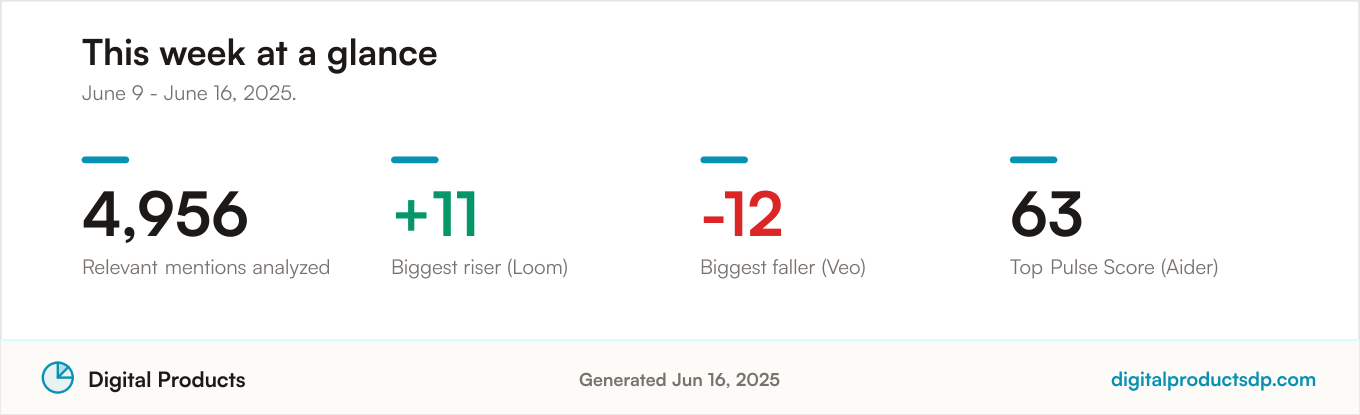
This week's read of aggregated public online discussion covers the mentions analyzed for June 9, 2025 through June 16, 2025, the latest of three complete calendar weeks in the current digest. Across the tracked set, we logged 4,956 relevant mentions spread over 81 products that cleared our minimum volume bar for ranking. The figures below summarize the tone of that public chatter, not any verdict on product quality.
The headline picture for June 9, 2025 through June 16, 2025 is one of a tight leaderboard and a few sharp individual moves. Coding assistant Aider held the highest Pulse Score, several AI chat tools clustered just behind it, and the largest declines landed on video generation and image tools. Below we walk the leaderboard, the category averages, the biggest movers, and the praise and complaint themes doing the most work in the data.
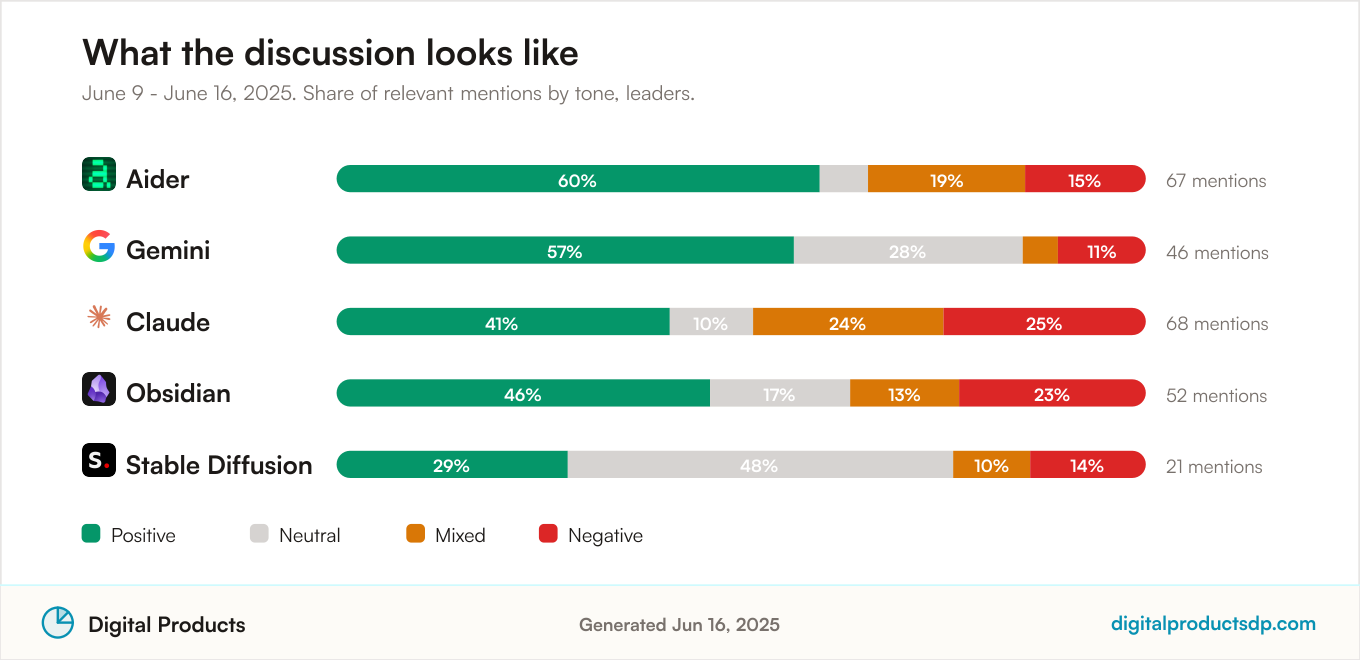
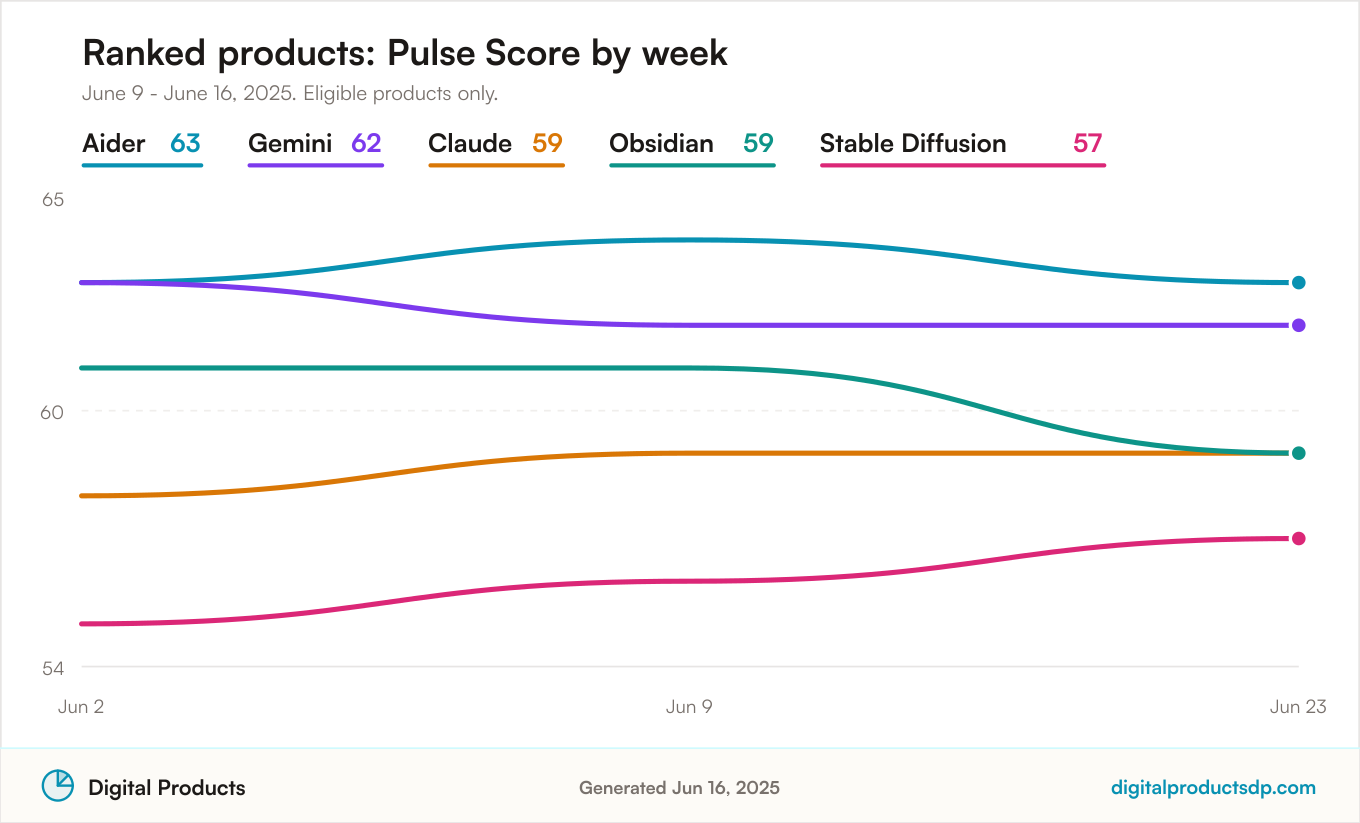
Aider led the ranked field with a Pulse Score of 63, based on 67 mentions over the period. Gemini followed at 62, based on 46 mentions, with Claude at 59, based on 68 mentions, and Obsidian also at 59, based on 52 mentions. Stable Diffusion rounded out the top five at 57, based on 21 mentions. The spread between first and fifth is only six points, which underscores how closely bunched the leaders were in this period's public discussion.
It is worth reading these scores alongside their sample sizes. Claude and Aider drew the largest mention counts among the leaders, at 68 and 67 respectively, so their scores rest on comparatively richer discussion. Stable Diffusion's 57 sits on a thinner base of 21 mentions, so smaller shifts in tone can move it more easily week to week. The leaders span three different categories, coding, ai-chat, and ai-image, which suggests positive sentiment was not concentrated in a single corner of the market.
Category View
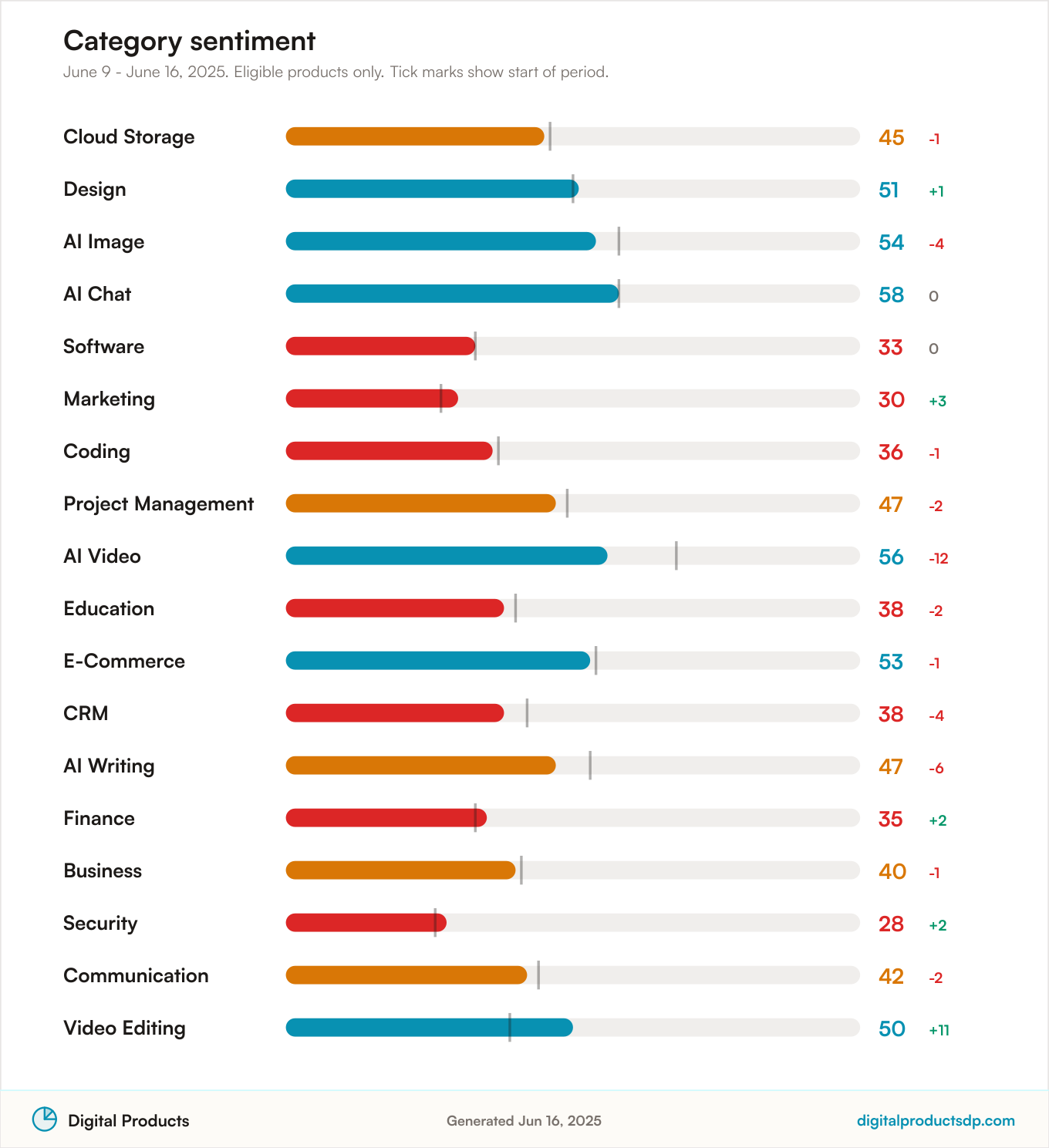
At the category level, the sharpest swing came in ai-video, which fell from 68 to 56 over the period, while video-editing moved the other way, climbing from 39 to 50. Marketing edged up from 27 to 30, security from 26 to 28, and finance from 33 to 35, while ai-writing slipped from 53 to 47, ai-image from 58 to 54, and crm from 42 to 38. Several larger categories held steady, with ai-chat flat at 58, software unchanged at 33, and coding barely moving from 37 to 36. The overall impression is of a mood that shifted meaningfully in a handful of categories and stayed close to flat across the broader tracked set.
Biggest Movers
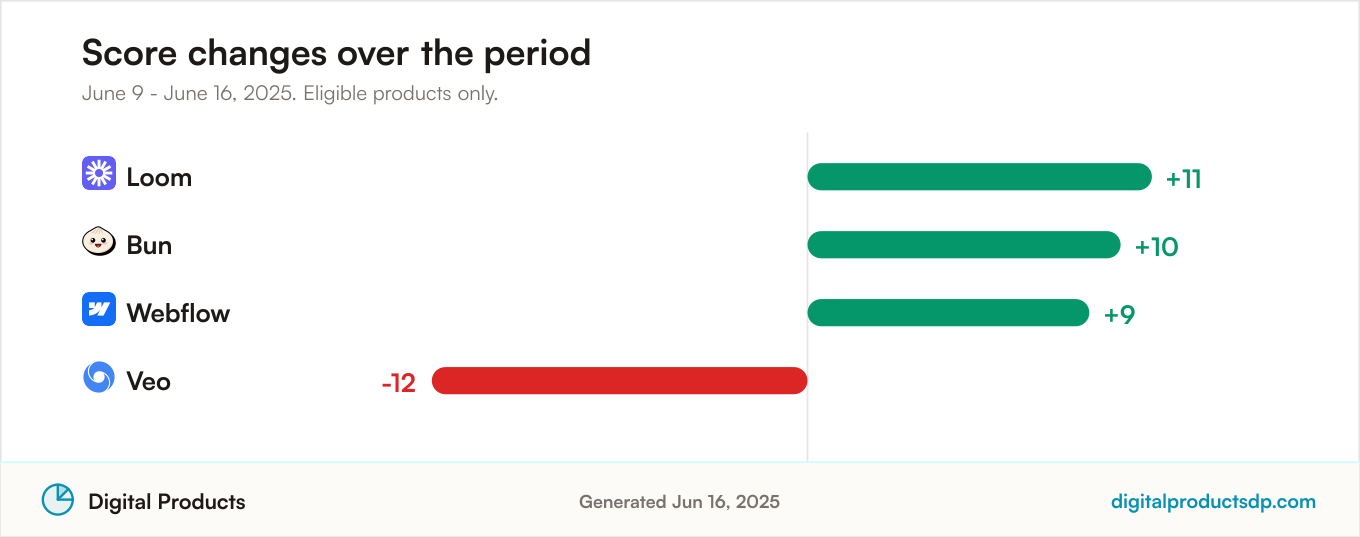
Loom (riser, up 11, from 39 to 50, based on 27 mentions). Loom posted the largest gain in the ranked field, moving from 39 to 50. Its praise themes leaned on strong features, cited 14 times, along with feature requests at 7 and comparisons to rivals at 3. The complaint side remained heavy, with bugs mentioned 211 times and reliability 135 times, so the improved score reflects a warmer balance of discussion rather than an absence of criticism.
Bun (riser, up 10, from 39 to 49, based on 27 mentions). Bun climbed from 39 to 49. Public discussion praised its performance, noted 9 times, along with ease of use at 8 and strong features at 7. Complaints still centered on bugs at 32 and reliability at 24, with lacking integrations at 6, which suggests the runtime's speed story carried the positive tone even as stability questions persisted.
Webflow (riser, up 9, from 41 to 50, based on 17 mentions). Webflow rose from 41 to 50 on a thinner base of 17 mentions. Its praise themes were modest in volume, with strong features at 6, ease of use at 5, and polished UI at 3. The complaint side was led by learning curve at 10, comparisons to rivals at 8, and UI frustrations at 6, a pattern consistent with a design tool where onboarding friction is the recurring theme even as sentiment warmed.
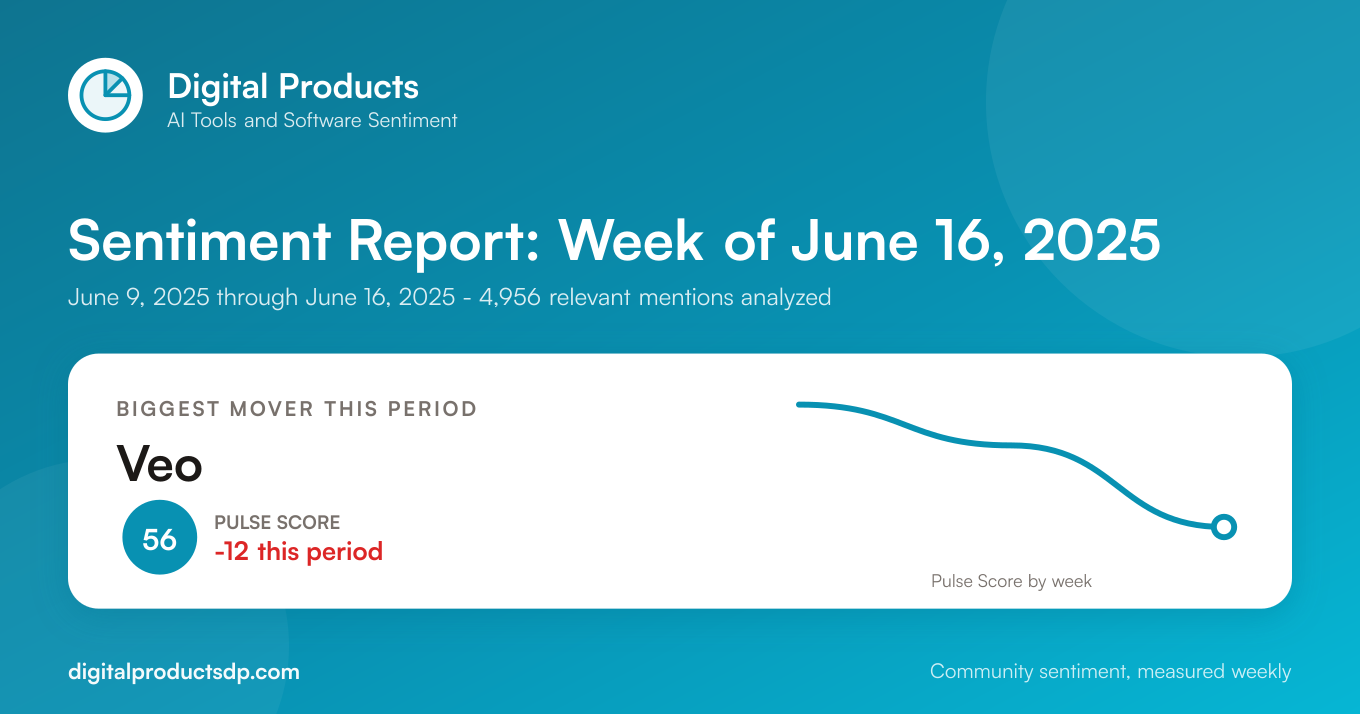
Veo (faller, down 12, from 68 to 56, based on 10 mentions). Veo recorded the steepest drop, sliding from 68 to 56 on just 10 mentions, the minimum for eligibility. Praise pointed to strong features at 12, new releases at 8, and AI quality at 7, while complaints flagged bugs at 10, reliability at 5, and missing features at 5. With so small a sample, the swing should be read cautiously, but the complaint mix suggests stability and gaps weighed on the tone.
Midjourney (faller, down 11, from 64 to 53, based on 14 mentions). Midjourney fell from 64 to 53. Its praise themes centered on AI quality at 34 and strong features at 33, with feels fast at 15. On the complaint side, AI quality itself appeared 11 times, alongside comparisons to rivals at 8 and reliability at 6, a sign that output quality was a point of both praise and contention in the same period.
RubyLLM (faller, down 10, from 45 to 35, based on 19 mentions). RubyLLM dropped from 45 to 35. Public discussion praised strong features at 24, good integrations at 20, and ease of use at 16, but complaints were led by bugs at 27, reliability at 16, and missing features at 8. The score movement lines up with a conversation where the volume of bug and reliability mentions outpaced the praise.
Spotlight: Aider
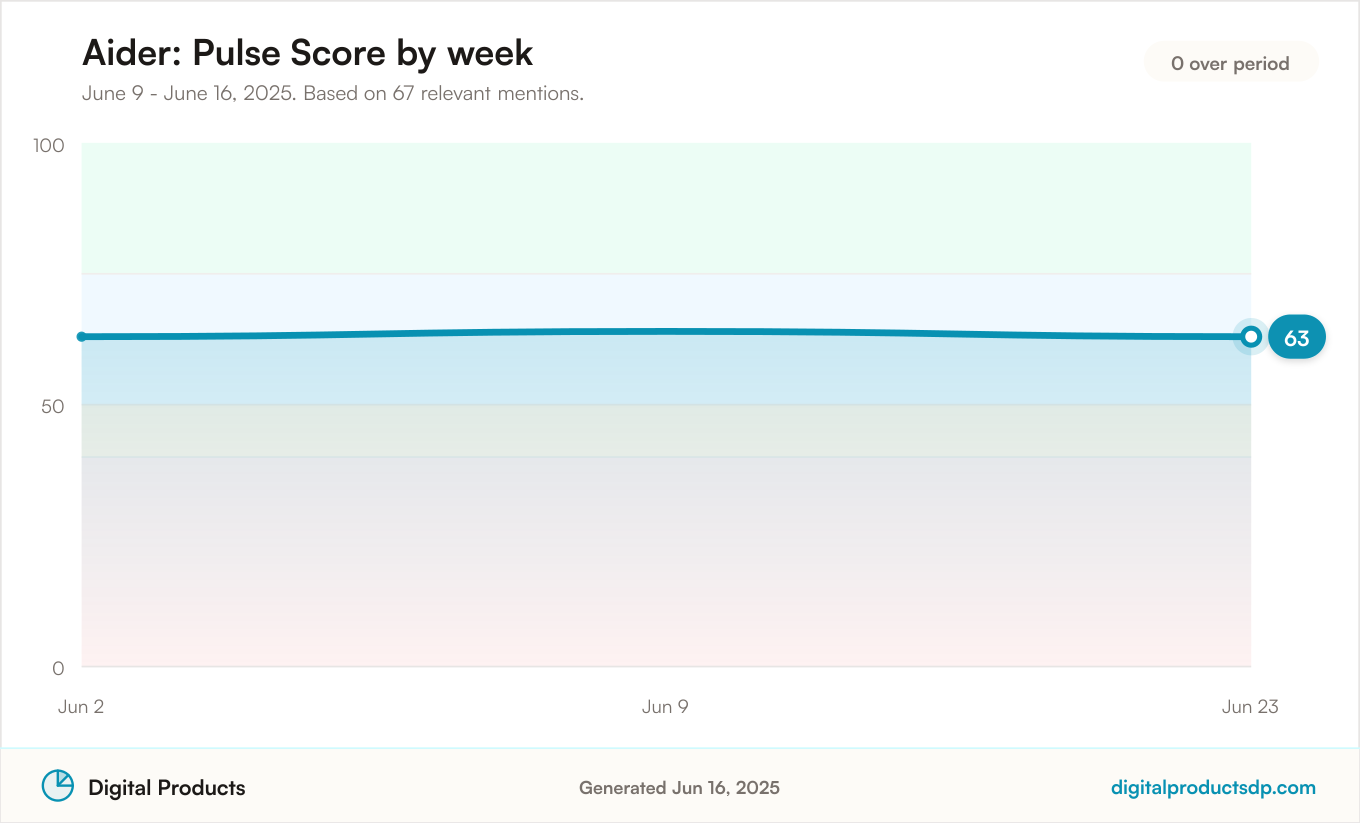
Aider took the top spot this period with a Pulse Score of 63, based on 67 mentions. Its weekly series shows notable stability: 63 on June 2, 2025, then 64 on June 9, 2025, and back to 63 on June 16, 2025. That is a one-point band across three complete weeks, which points to a settled and consistent tone in public discussion rather than a sudden surge.
The theme breakdown for the latest week is modest in raw counts, which fits a coding tool with a focused audience. Praise centered on strong features at 7, ease of use at 4, and good integrations at 3. Complaints were led by bugs at 9, missing features at 5, and feature requests at 4. The presence of feature requests alongside missing features suggests a community that is engaged enough to ask for more, which often accompanies steady rather than declining sentiment.
Read together, the flat weekly line and the balanced theme mix explain why Aider sits at the front of a tightly packed leaderboard. It did not spike, and it did not slide. In a period where the top five were separated by six points, consistency was enough to lead.
Themes Driving the Conversation
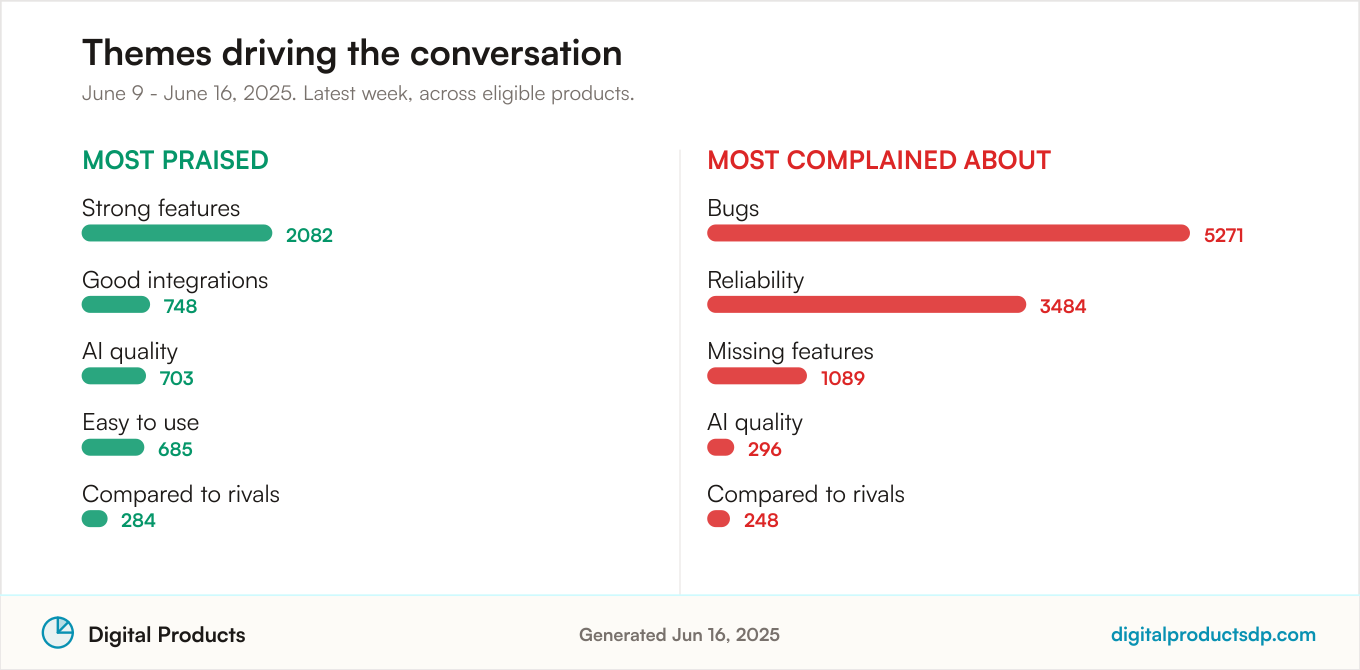
On the praise side, strong features dominated with 2,082 mentions, far ahead of good integrations at 748, AI quality at 703, easy to use at 685, and compared to rivals at 284. Strong features surfaced repeatedly across the leaders, driving praise for Claude at 229 and Gemini at 140, and it also anchored positive discussion for products further down the field such as DuckDB at 157 and Grafana at 82. AI quality was concentrated in the chat and image tools, with Claude at 234 and Gemini at 149 leading that theme.
The complaint side was heavier still. Bugs led with 5,271 mentions, followed by reliability at 3,484, missing features at 1,089, AI quality at 296, and compared to rivals at 248. These two dominant complaint themes were spread widely: bugs and reliability drove the negative conversation for high-volume products including ClickHouse, with 441 bug mentions and 290 reliability mentions, dbt at 357 and 208, ArgoCD at 231 and 172, and Stripe at 188 and 158. The pattern is consistent across categories, with stability and defect reports forming the backbone of critical discussion even for otherwise well-regarded products.
Watchlist
A large number of tracked products did not clear the 10-mention threshold this period and are therefore excluded from the rankings. This is a statement about discussion volume only, not about quality. Several names sat just under the bar, including Lovable and DigitalOcean at 9 relevant mentions each, Dynatrace at 9, Sudowrite at 8, NordVPN at 8, Honeycomb at 8, Calendly at 8, DALL-E at 8, Atlassian at 8, and Jina AI at 8. A small nudge in chatter next week could bring any of these into the ranked set.
Further down, products like Anyscale at 7, Cloudflare at 7, Klaviyo at 7, Dremio at 7, Carta at 6, Gamma at 6, Devin at 6, HubSpot at 5, Semrush at 5, Ahrefs at 5, and Great Expectations at 5 registered on the tracker but remained too thin to score reliably. Many others recorded zero relevant mentions in the period. For thin samples, a handful of posts can swing sentiment sharply, which is exactly why we hold these products out of the leaderboard until discussion volume is sufficient to support a stable read.
What To Watch Next Week
First, watch whether ai-video stabilizes or keeps sliding. The category fell from 68 to 56 over the period, driven by Veo's move from 68 to 56 and Midjourney's from 64 to 53, both on small samples of 10 and 14 mentions. Thin volume means these scores can rebound as easily as they fell, so the direction of the next reading is worth monitoring rather than predicting.
Second, watch the risers for follow-through. Loom, Bun, and Webflow gained 11, 10, and 9 points respectively, but each still carried meaningful complaint volume, with Loom in particular showing 211 bug mentions and 135 reliability mentions. Whether those complaint themes ease or reassert themselves will shape whether the gains hold.
Third, watch the below-threshold cluster sitting at 8 and 9 mentions. Products like Lovable, DigitalOcean, Dynatrace, and several others are one quiet week away from qualifying. If their discussion volume ticks up, the ranked field could look broader next period.
Frequently Asked Questions
Which tool had the highest Pulse Score this period?
Aider led with a Pulse Score of 63, based on 67 mentions over the period, narrowly ahead of Gemini at 62, based on 46 mentions.
Which product moved the most this period?
Veo posted the largest single move, falling 12 points from 68 to 56, based on 10 mentions. The biggest riser was Loom, up 11 points from 39 to 50, based on 27 mentions.
What was the overall category mood?
Mixed. Video-editing rose from 39 to 50 and ai-video fell from 68 to 56, while several large categories held steady, including ai-chat at 58 and software at 33.
How many mentions were analyzed?
We analyzed 4,956 relevant mentions across 81 products that met the minimum volume threshold for ranking during the period.
About This Data
Pulse Scores summarize the tone of public online discussion on a 0 to 100 scale and reflect community sentiment, not a verdict on a product's quality or a recommendation. We report on complete calendar weeks only, and products with fewer than 10 relevant mentions in the period are excluded from rankings to avoid unstable reads on thin samples.
Public discussion is collected from Hacker News, Stack Exchange, GitHub, Bluesky, the Apple App Store, and YouTube. Automated sentiment analysis can misread sarcasm, jokes, or niche context, mention volumes vary widely between products, and scores can move from week to week. Any company that wants to respond is welcome to reach out. For how scores are calculated, see our methodology.