AI Tools and Software Sentiment Report: Week of June 9, 2025
June 10, 2025
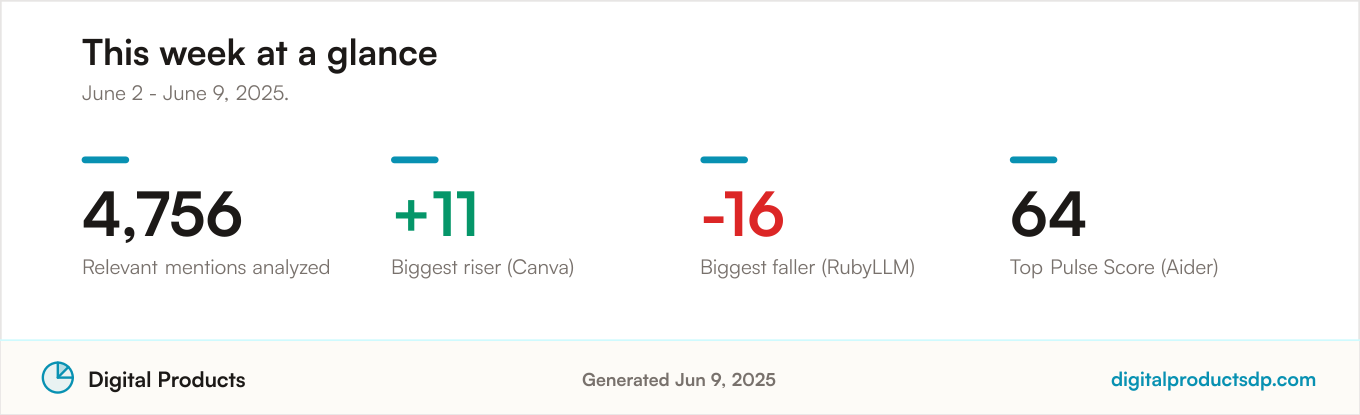
This edition of our weekly sentiment report covers aggregated public online discussion of AI tools and software, drawing on mentions analyzed for June 2, 2025 through June 9, 2025. Across this period we processed 4,756 relevant mentions spanning a broad mix of products, from AI chat assistants and coding helpers to design tools, CRM platforms, and developer infrastructure. Of the 2,246 products we track, 82 cleared the threshold of at least 10 relevant mentions and qualified for ranking this period.
Everything below reflects the tone of community sentiment in public online chatter, not our own assessment of product quality. Pulse Scores summarize how discussion sounded, and they can move week to week. With that framing in place, here is how the week running from June 2, 2025 through June 9, 2025 looked across the tools and software we monitor.
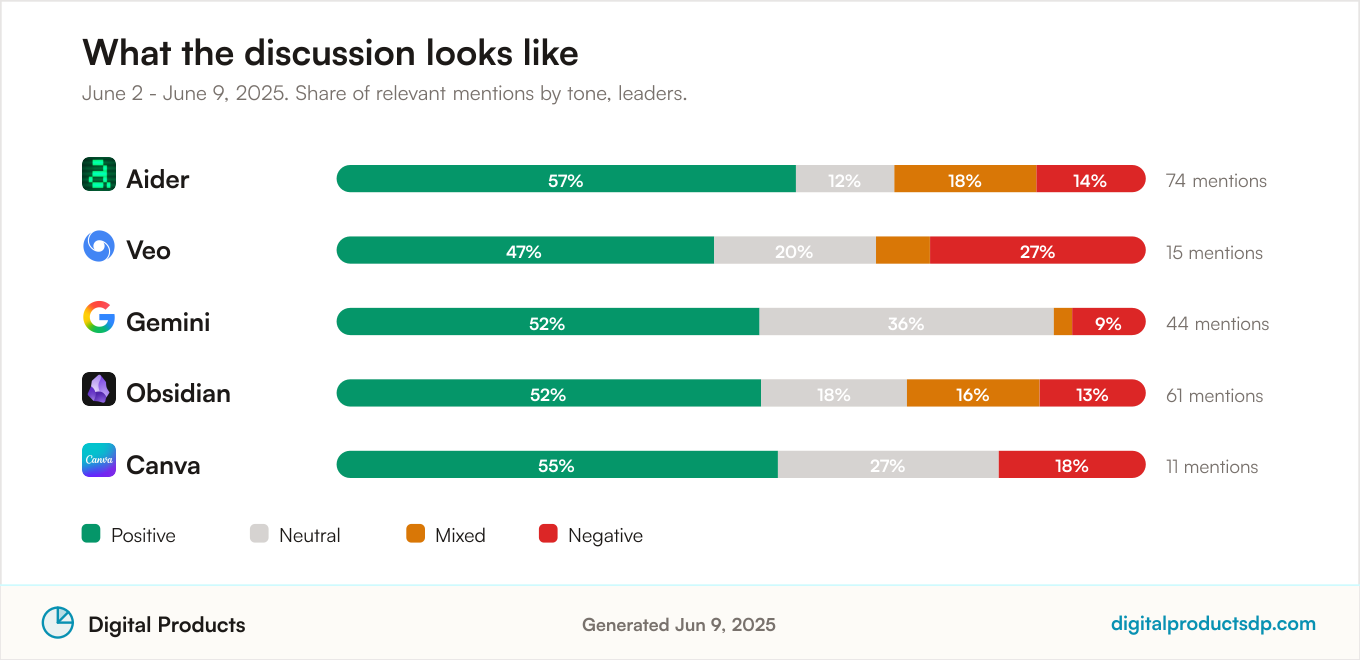
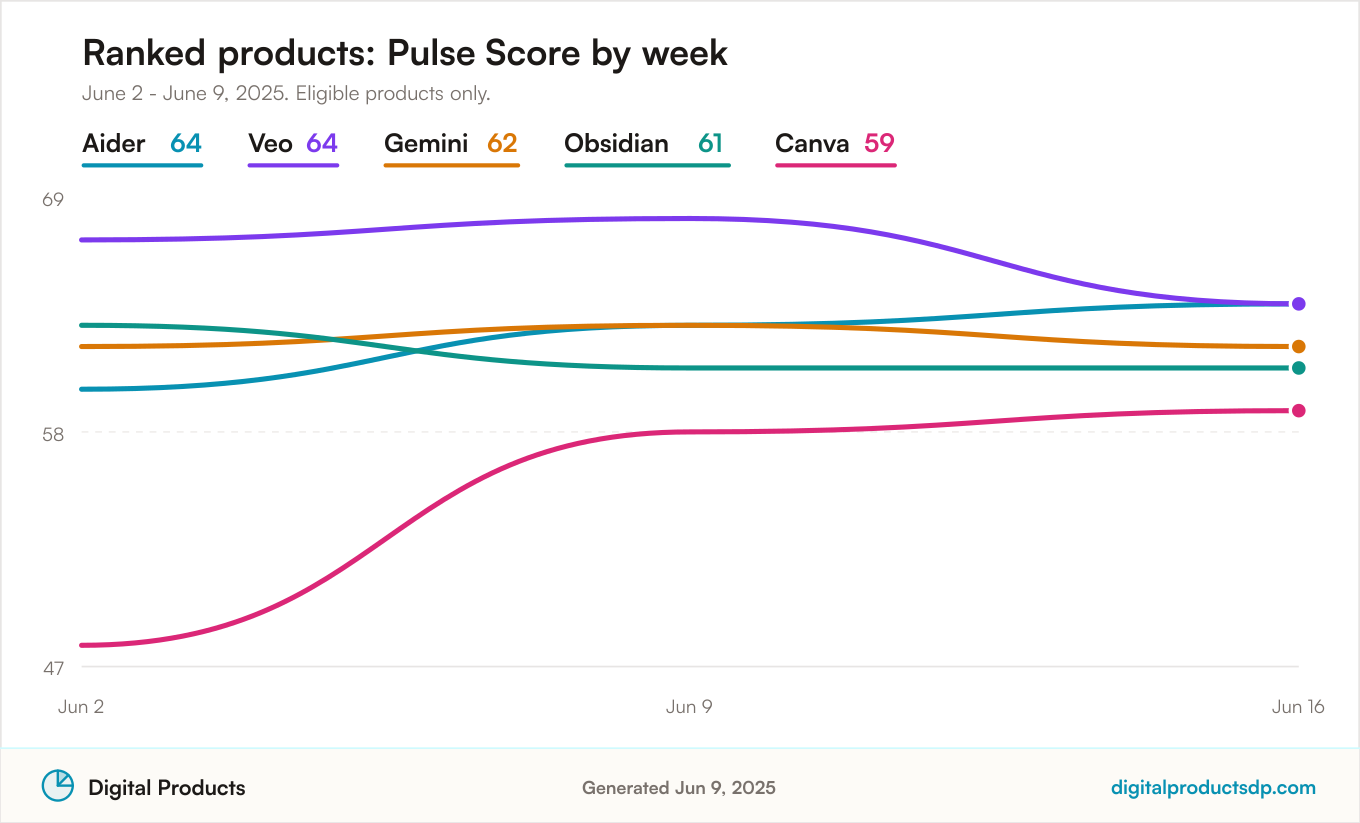
The top of the board is tight this period. Aider, a coding tool, and Veo, an AI video product, both closed the week at a Pulse Score of 64. Aider carried that score on a heavier discussion base of 74 mentions, while Veo's 64 rested on just 15 mentions. Gemini, an AI chat product, followed at 62 based on 44 mentions, with Obsidian, a project management and notes tool, at 61 based on 61 mentions, and the design platform Canva at 59 based on 11 mentions.
Sample sizes matter when reading these placements. Aider and Obsidian sit on the sturdiest discussion volumes among the leaders, so their scores reflect broader chatter. Veo and Canva, by contrast, cleared the threshold but rest on thinner samples of 15 and 11 mentions, which means a small shift in tone can move them more than it would a heavily discussed product. Treat the leaderboard as a snapshot of mood, not a durable ranking.
Category View
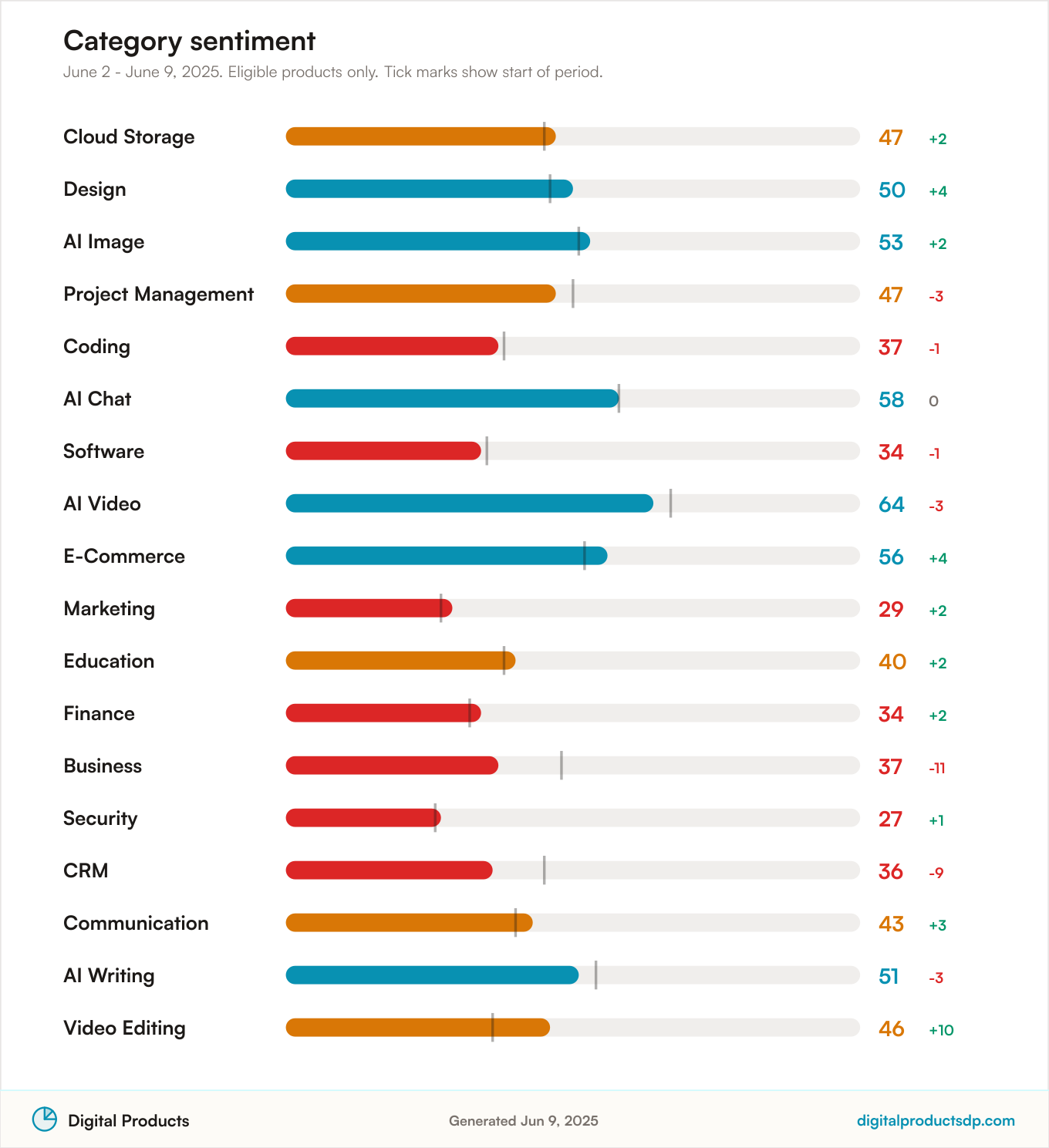
At the category level, ai-video held the highest average even as it eased from 67 to 64, and ai-chat sat steady at 58 across the period. Design moved up from 46 to 50, e-commerce climbed from 52 to 56, and video-editing rose notably from 36 to 46. On the softer side, business fell from 48 to 37 and crm dropped from 45 to 36, the two sharpest category declines in the set. Coding barely moved, slipping from 38 to 37, while software eased from 35 to 34 and security held near the bottom, moving from 26 to 27. These are averages across eligible products only, so a single sharp mover can pull a smaller category with it.
Biggest Movers
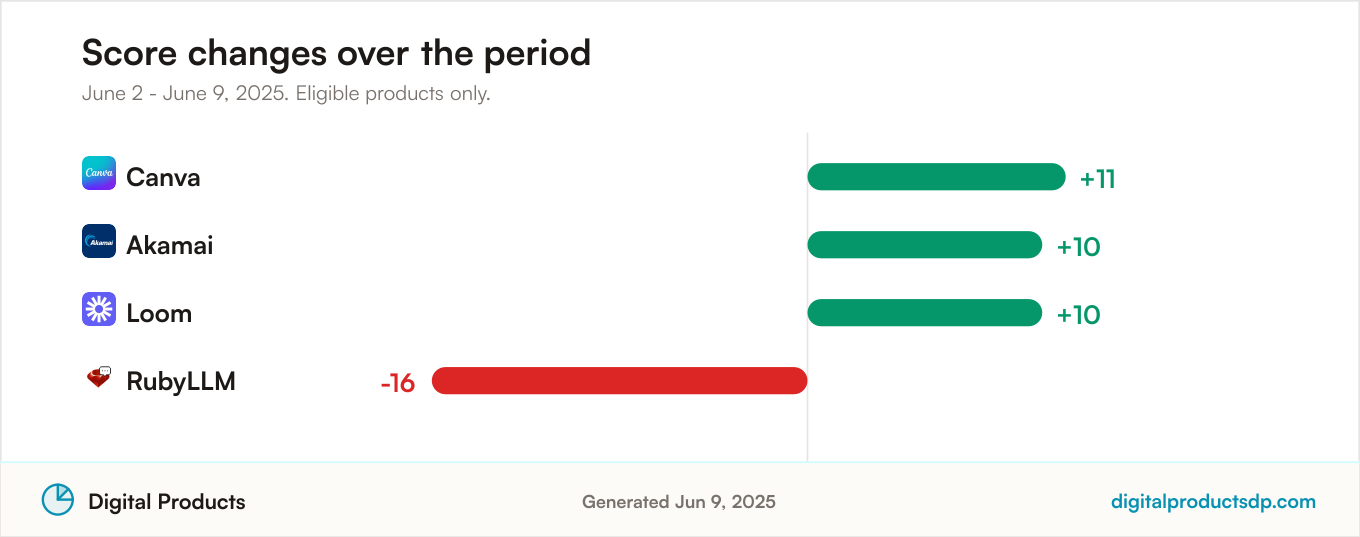
Canva (up 11, from 48 to 59, based on 11 mentions). Canva was the biggest riser of the period. Its praise themes leaned heavily on ease of use, which drew 99 mentions, along with strong features at 75 and a polished UI at 34. The main drag on the conversation was UI frustrations at 38, with AI quality at 16 and bugs at 12 following. The gap between a large ease-of-use signal and a smaller cluster of UI complaints tracks with the upward move, though the thin 11-mention sample warrants caution.
Akamai (up 10, from 36 to 46, based on 15 mentions). Akamai, a cloud and delivery product, posted one of the largest gains. Praise centered on strong features at 10, new releases at 7, and performance at 5. Complaints were still present and material, with bugs at 38 and reliability at 37, plus lacking integrations at 12. The rise suggests the positive notes carried more weight in tone this week even as reliability chatter persisted.
Loom (up 10, from 36 to 46, based on 19 mentions). Loom, a video messaging tool, matched Akamai's climb. Its praise was concentrated in strong features at 14, followed by feature requests at 7 and comparisons to rivals at 3. The complaint side was substantial, led by bugs at 211 and reliability at 135, with missing features at 71. That the score rose despite a heavy bug volume points to how the tone of the week's discussion, rather than raw complaint counts alone, shapes the Pulse Score.
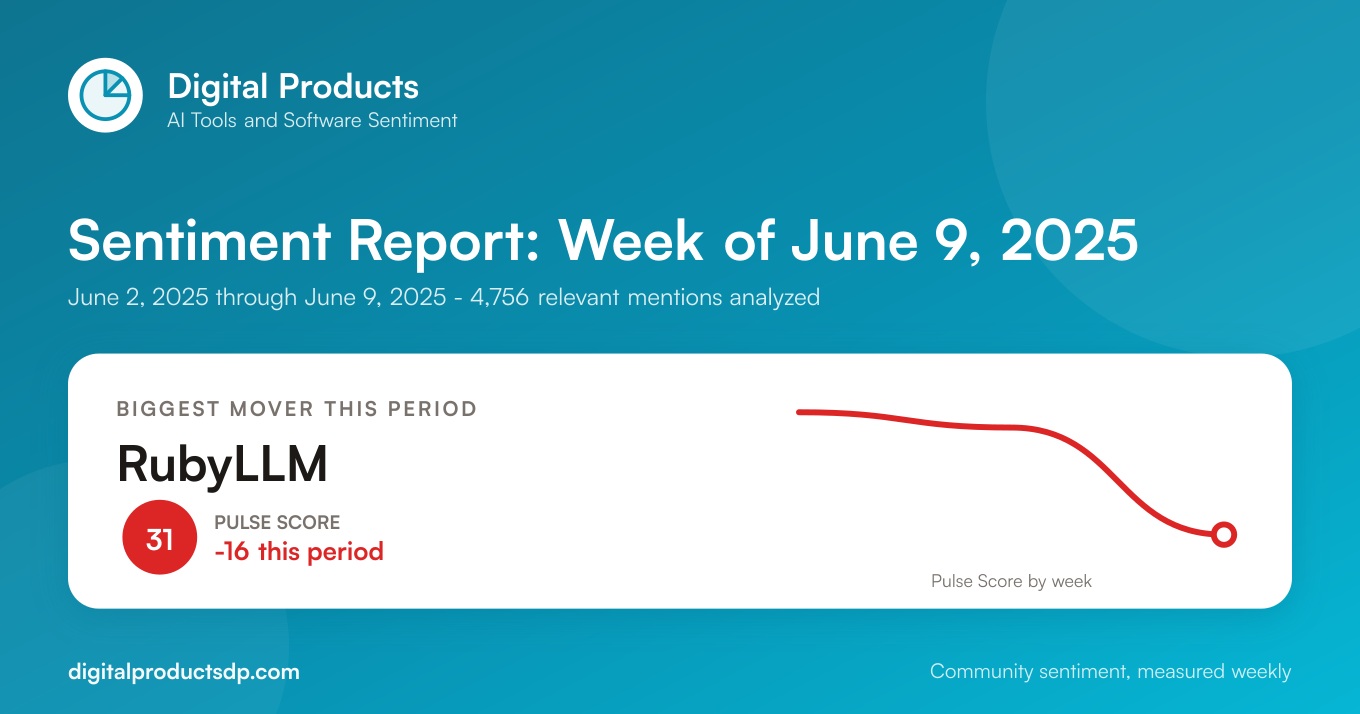
RubyLLM (down 16, from 47 to 31, based on 15 mentions). RubyLLM was the sharpest faller. Its praise themes were respectable, with strong features at 24, good integrations at 20, and ease of use at 16. But the complaint side outweighed them in tone, led by bugs at 27, reliability at 16, and missing features at 8. When bug and reliability chatter sits close to or above the praise volume on a thin sample, scores can swing hard, which is what happened here.
Greenhouse (down 11, from 48 to 37, based on 14 mentions). Greenhouse, a business and hiring tool, gave back a double-digit drop. Praise was modest, with strong features at 10, good integrations at 6, and comparisons to rivals at 3. Complaints dominated, led by bugs at 32, reliability at 23, and missing features at 9. The lopsided ratio of complaint to praise volume aligns with the decline.
Docker (down 10, from 26 to 16, based on 20 mentions). Docker fell to the lowest score among the movers. Its praise leaned on ease of use at 35, strong features at 22, and feature requests at 17. The complaint side was heavy, with bugs at 192, reliability at 128, and missing features at 48. The scale of bug and reliability chatter relative to praise is consistent with a week of soured tone, though the 20-mention sample keeps this a cautious read.
Spotlight: Aider
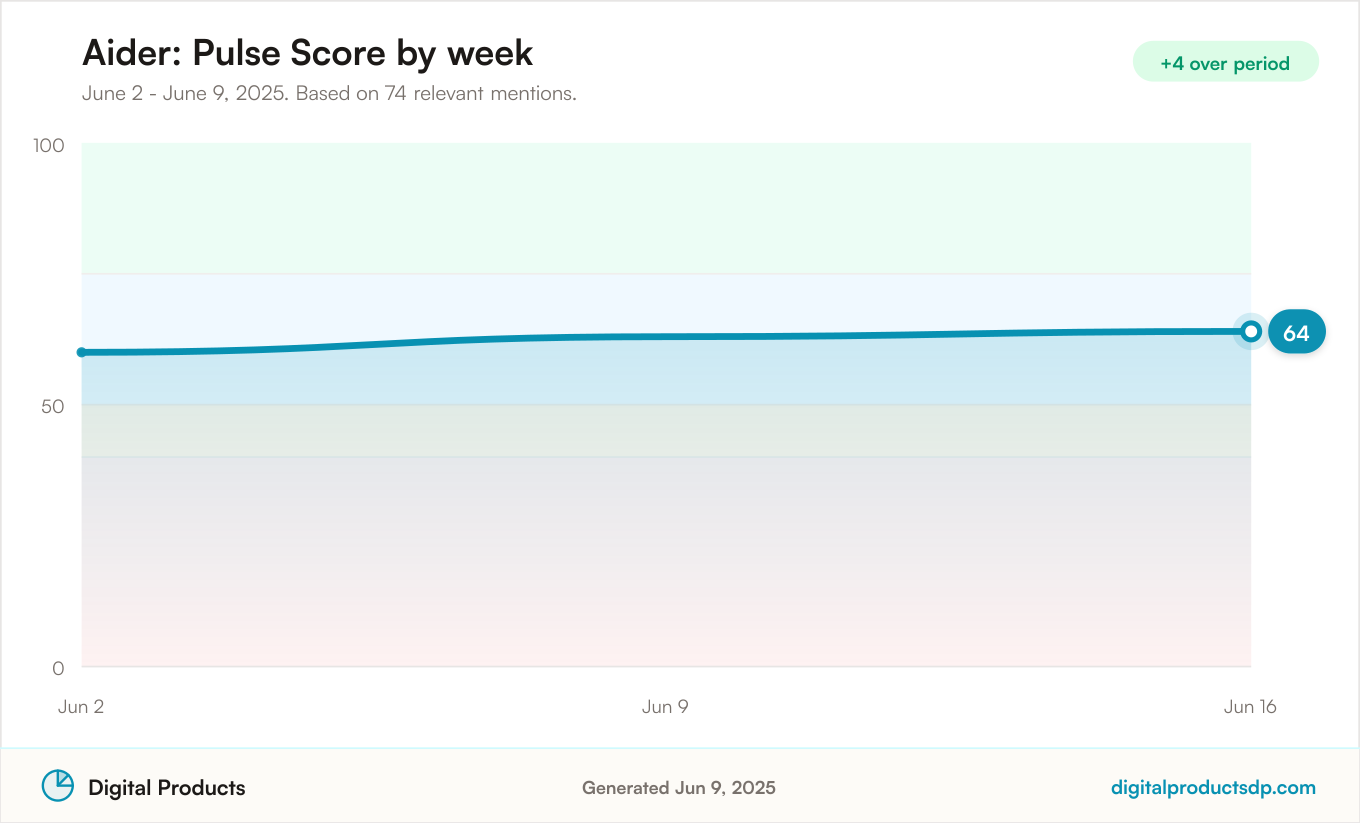
Aider, a coding tool, took the top spot on the leaderboard with a Pulse Score of 64 based on 74 mentions over the period. Its weekly series shows a steady, quiet climb: 60 on May 26, 2025, then 63 on June 2, 2025, and 64 on June 9, 2025. That is a rare pattern in this dataset, where many products in the coding category drifted sideways or down. The consistency, combined with one of the larger discussion volumes among the leaders, makes Aider's read one of the more grounded on the board this week.
The theme mix behind that score is modest in absolute counts but balanced in shape. On the praise side, strong features drew 7 mentions, good integrations 5, and ease of use 4. Complaints were close behind, with bugs at 5, missing features at 4, and reliability at 3. Unlike several heavily discussed coding tools, Aider did not show a runaway bug or reliability signal this period, and the relatively even praise-to-complaint spread is consistent with a score that held near the top rather than swinging.
It is worth restating that a 64 here reflects the tone of public discussion, not a verdict on the tool itself. Aider sitting level with Veo at 64, while resting on a far larger sample, simply means the community conversation about it skewed favorable and stable over these three tracked weeks. As always, a shift in discussion volume or topic could move that read in either direction next period.
Themes Driving the Conversation
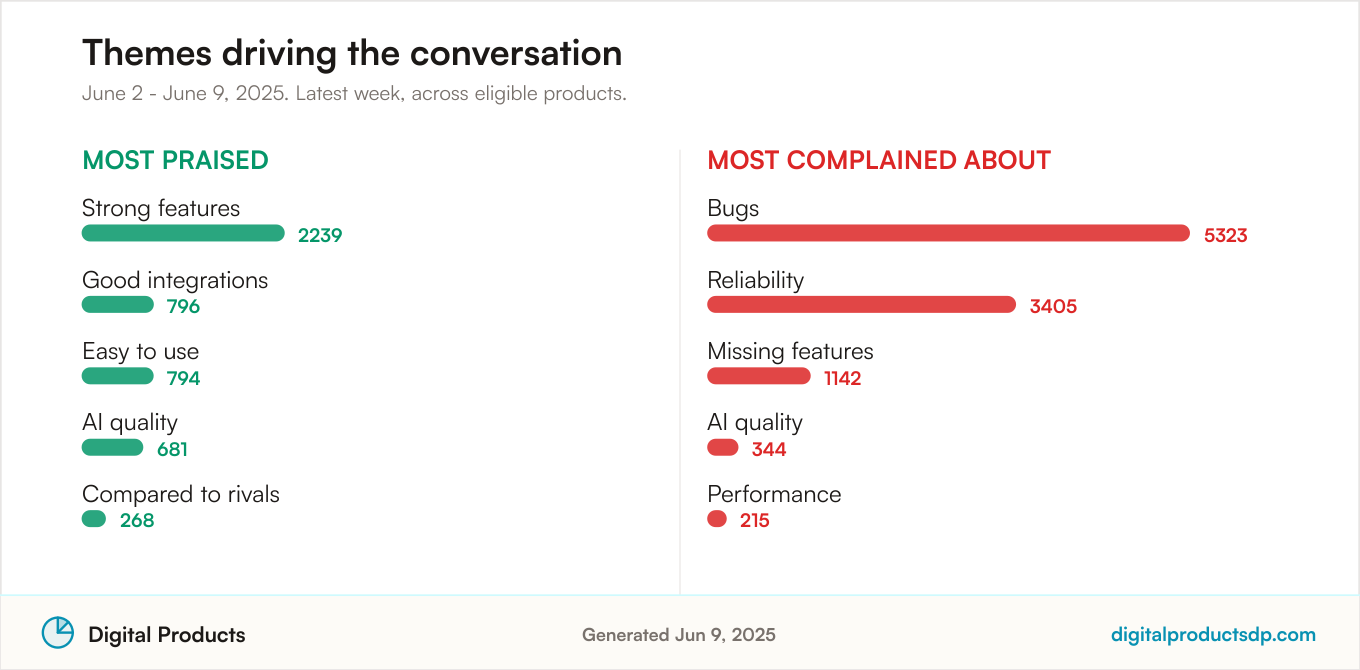
On the praise side, strong features dominated with 2,239 mentions, well ahead of good integrations at 796 and easy to use at 794. AI quality followed at 681, and comparisons to rivals at 268. The strong-features signal shows up across many leaders, including Claude with 207 feature praise mentions, Gemini with 101, and Cursor with 105, suggesting that when discussion turned positive this week it most often centered on what a product could do rather than on price or polish. Ease of use was a particular driver for Canva at 99 and Kubernetes at 63.
The complaint side was heavier in raw volume, and it was led decisively by bugs at 5,323 mentions and reliability at 3,405. Missing features followed at 1,142, with AI quality at 344 and performance at 215. These two lead themes concentrate in developer infrastructure and data tools: ClickHouse showed 441 bug mentions, dbt 357, ArgoCD 231, Loom 211, and Docker 192, while reliability chatter clustered similarly around ClickHouse at 290, CockroachDB at 225, and dbt at 208. The pattern helps explain why the coding, software, and security categories sat low on average, and why several of this week's fallers were dragged by bug and reliability discussion.
Watchlist
A large share of tracked products did not reach the 10-mention threshold this period and are not ranked. This is a statement about discussion volume, not quality. Several products landed just below the line, including Pipedrive with 9 mentions, Namecheap with 9, Sudowrite with 8, NordVPN with 8, Klaviyo with 8, Lovable with 7, Asana with 7, Materialize with 7, Great Expectations with 7, and Dremio with 7. A modest uptick in chatter next week could bring any of these into ranked territory.
Further down, a cluster of products drew a handful of mentions, such as Coinbase, Semrush, Coursera, Ahrefs, Mailchimp, Gumroad, Carta, Devin, Honeycomb, Jina AI, Earthly, and Bright Data, each in the 6-mention range. Many others logged only a few mentions or none at all this period. Thin samples are excluded precisely because a single loud thread can distort a score, so we hold these back rather than publish an unstable read. If your product appears here, it means the public conversation we sampled was simply too quiet this week to score responsibly.
What To Watch Next Week
First, watch whether the video-editing category holds its gain. It rose from 36 to 46 over the period, one of the largest category moves, and Loom's climb from 36 to 46 was part of that story. Whether that reflects a durable shift in tone or a short-lived bump will be clearer with another week of data.
Second, keep an eye on the business and crm categories, which fell to 37 and 36 respectively, with Salesforce sliding from 45 to 36 and Greenhouse from 48 to 37. If bug and reliability chatter, the two dominant complaint themes this week, keeps concentrating there, those averages could stay under pressure.
Third, watch the thin-sample leaders. Veo at 64 on 15 mentions and Canva at 59 on 11 mentions both sit near the top on light volume, so their scores are the most likely to move if discussion picks up or fades. Aider's steadier 74-mention base gives it a firmer footing at the top for now.
Frequently Asked Questions
Which tool had the highest Pulse Score this period?
Aider and Veo tied for the highest Pulse Score at 64. Aider's score was based on 74 mentions and Veo's on 15 mentions over the period.
Which product moved the most this week?
Canva was the biggest riser, up 11 points from 48 to 59 based on 11 mentions. RubyLLM was the biggest faller, down 16 points from 47 to 31 based on 15 mentions.
What was the overall category mood?
ai-video held the highest average despite easing from 67 to 64, and ai-chat stayed steady at 58. Business fell from 48 to 37 and crm from 45 to 36, the sharpest category declines, while video-editing rose from 36 to 46.
How many mentions were analyzed this period?
We analyzed 4,756 relevant mentions for June 2, 2025 through June 9, 2025. Of the 2,246 products tracked, 82 met the 10-mention threshold to be ranked.
About This Data
Pulse Scores summarize the tone of public online discussion on a 0-100 scale and reflect community sentiment, not a verdict on a product's quality or a recommendation. We report on complete calendar weeks only, and products with fewer than 10 relevant mentions in the period are excluded from rankings to avoid unstable reads on thin samples.
Public discussion is collected from Hacker News, Stack Exchange, GitHub, Bluesky, the Apple App Store, and YouTube. Automated sentiment analysis can misread sarcasm, jokes, or niche context, mention volumes vary widely between products, and scores can move from week to week. Any company that wants to respond to what appears here is welcome to reach out. For more on how scores are calculated, see our methodology.