Back to blog
Best Of

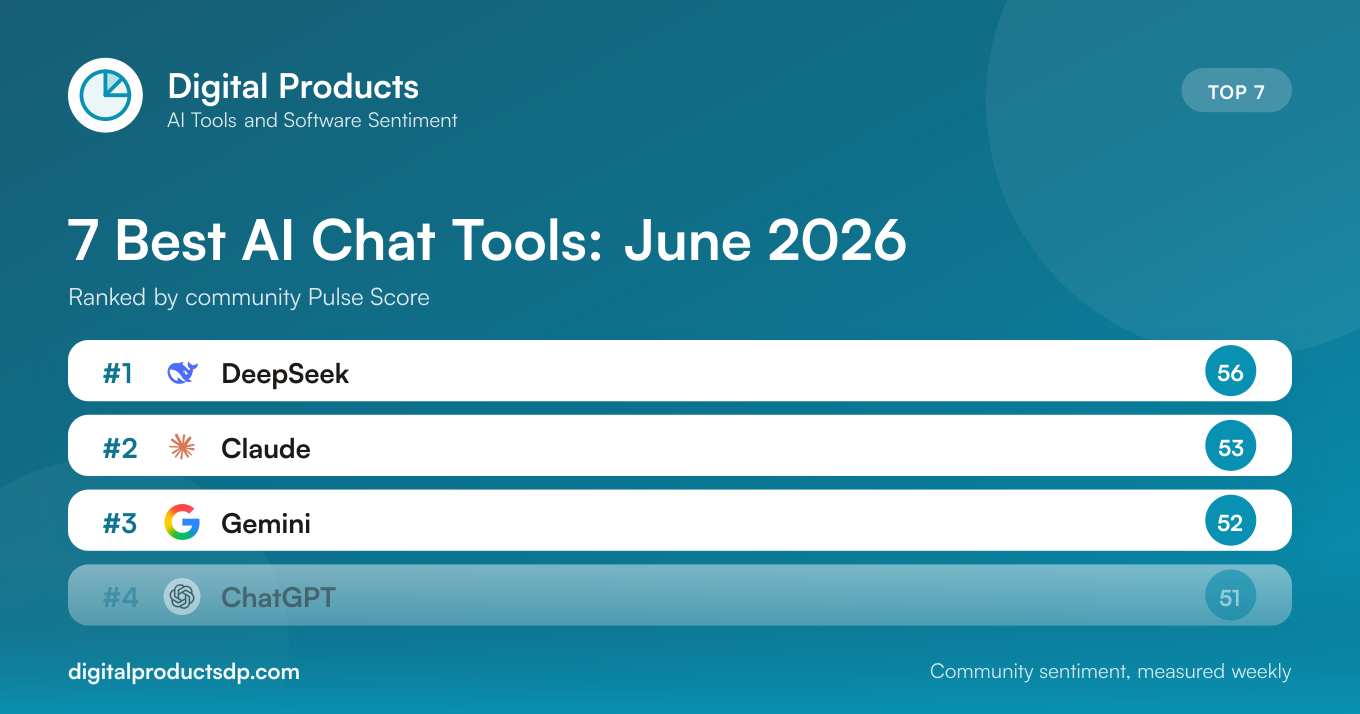
7 Best AI Chat Tools: June 2026

July 3, 2026
7 Best AI Chat Tools: June 2026

The AI chat category moves fast, and the loudest opinions about it live in public: on developer forums, in app store reviews, across social posts, and inside code repositories. This ranking gathers that discussion and turns it into something you can scan quickly. It covers the period of June 1 through June 30, 2026, and orders seven of the most talked-about AI chat tools by their Pulse Score, a 0-100 summary of how positive or negative the surrounding conversation was during that window.

To be clear about what this is and is not: this is a best-of ranking based on sentiment, not a lab benchmark or a feature-by-feature shootout. A high Pulse Score means the public conversation about a tool skewed favorable over the month. It does not certify that a product is the best fit for your specific workflow, budget, or team. Treat these numbers as a read on community mood, and use the praise and complaint patterns underneath each score to decide what deserves your own testing.

Across the seven tools below, scores clustered tightly between 41 and 56, which tells its own story. No single AI chat assistant ran away with universal approval in June 2026. Even the highest-ranked tools carried meaningful negative discussion, and the gaps between neighbors often came down to a few points. Here is how the month shook out.

RankProductCategoryPulse ScoreRelevant MentionsVisit
1DeepSeekAI Chat56548Visit ↗
2ClaudeAI Chat53880Visit ↗
3GeminiAI Chat52670Visit ↗
4ChatGPTAI Chat51718Visit ↗
5Microsoft CopilotAI Chat50131Visit ↗
6MistralAI Chat50178Visit ↗
7xAIAI Chat41218Visit ↗

1. DeepSeek

DeepSeek Pulse Score trend from aggregated public discussion

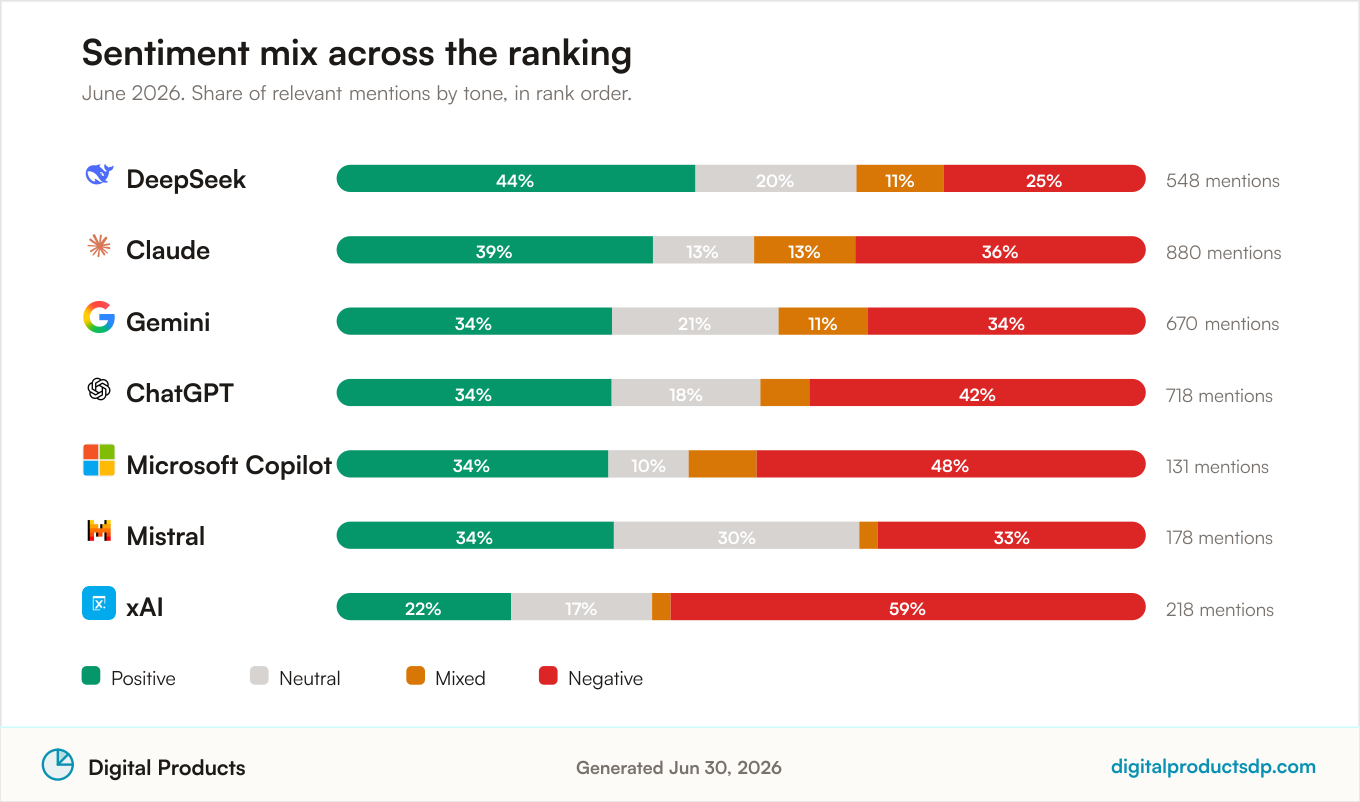
DeepSeek finished June at the top of the list with a Pulse Score of 56, drawn from 548 total mentions. That score edged out the rest of the field, and the sentiment mix helps explain why: 44% of discussion was positive, 20% neutral, 11% mixed, and 25% negative. Among the tools ranked here, DeepSeek carried the highest share of clearly favorable conversation, and its negative slice stayed relatively contained.

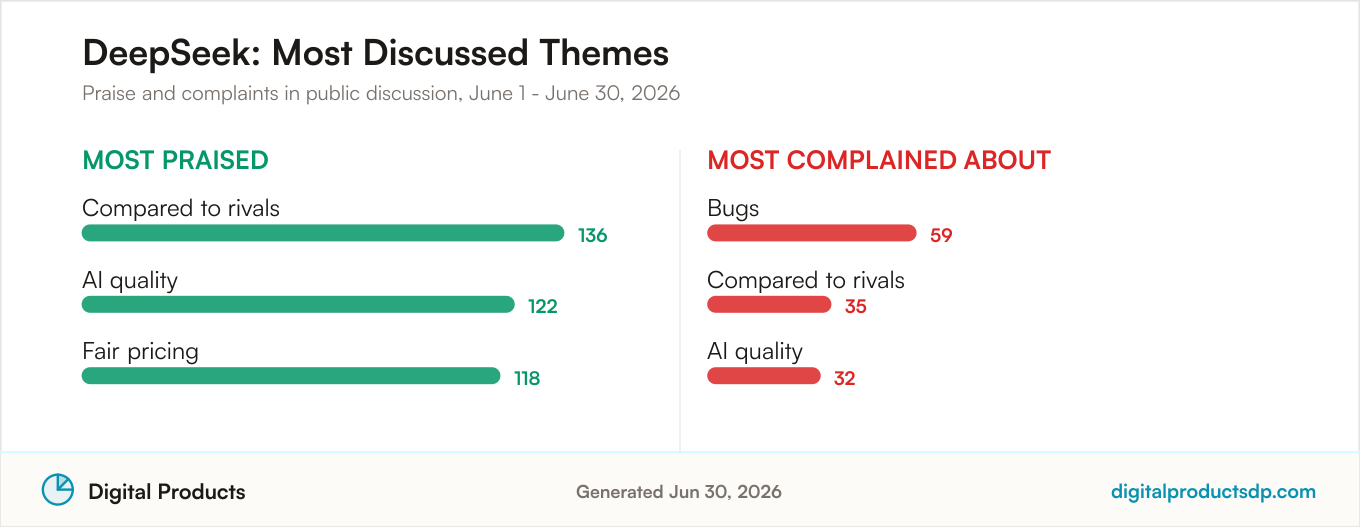
What people liked most was how it stacked up against alternatives. The single largest praise theme was comparisons to rivals, with 136 mentions leaning positive, followed closely by AI quality at 122 and fair pricing at 118. That combination is notable. The conversation suggests a tool people feel gives them strong output without the cost sting they associate with some competitors, and the value angle came through repeatedly in the discussion we tracked.

The criticism was more concentrated. Bugs led the complaints with 59 mentions, and interestingly, comparisons to rivals (35) and AI quality (32) showed up as both strengths and sore points depending on who was talking. That split is common for a widely discussed tool: the same features that impress one group frustrate another. Still, with the most positive overall mix in the category, DeepSeek's community sentiment sat at the front of the pack for June.

Most praised and most complained about themes for DeepSeek from aggregated public discussion

Visit DeepSeek

2. Claude

Claude Pulse Score trend from aggregated public discussion

Second place goes to Claude, which posted a Pulse Score of 53 on the largest discussion volume in this ranking: 880 total mentions. That is a heavy sample, and it makes the score meaningful even with a divided sentiment picture. The breakdown came in at 39% positive, 13% neutral, 13% mixed, and 36% negative, so roughly as many people spoke favorably as unfavorably over the month.

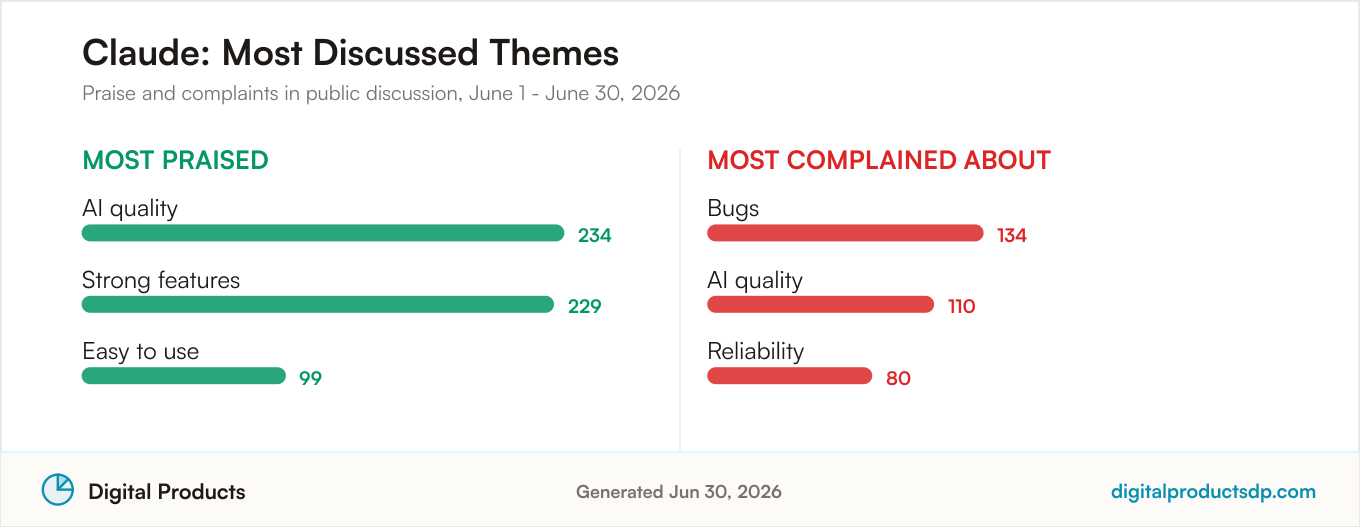
The praise was substantial and clearly focused. AI quality dominated with 234 mentions, strong features followed at 229, and ease of use added 99. Read together, these themes describe a tool that a large group of people trust for the actual writing and reasoning work they throw at it. When Claude comes up positively, it tends to be about output people consider high-caliber, not just novelty.

The other side of the ledger is why it did not finish first. Bugs drew 134 complaints, AI quality appeared again on the negative side with 110 mentions, and reliability concerns reached 80. The AI quality theme cutting both ways, and doing so at high volume, points to inconsistency in how people experienced it: some sessions delighted, others disappointed. With a 36% negative share on a large base, Claude carried real friction alongside genuine enthusiasm, which is what kept it just behind the leader.

Most praised and most complained about themes for Claude from aggregated public discussion

Visit Claude

3. Gemini

Gemini Pulse Score trend from aggregated public discussion

Gemini lands in third with a Pulse Score of 52 across 670 mentions. Its sentiment mix leaned toward the neutral middle more than most: 34% positive, a comparatively high 21% neutral, 11% mixed, and 34% negative. That balance between positive and negative, with a large fact-stating neutral band, suggests a tool people discuss often but with measured rather than fiery opinions.

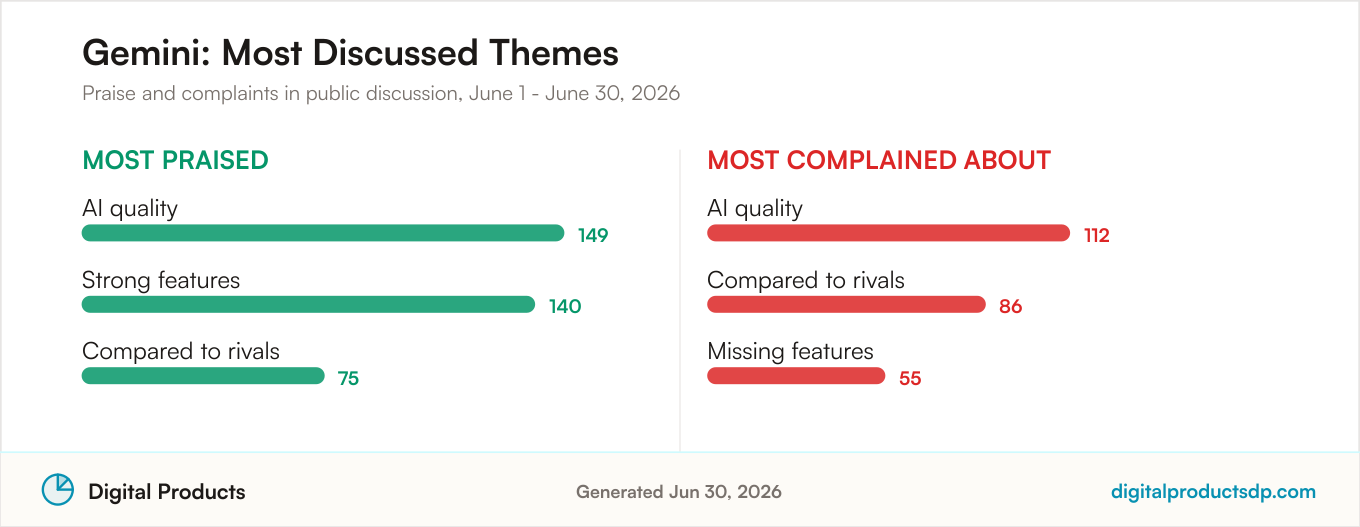
On the praise side, AI quality led with 149 mentions and strong features followed at 140, with comparisons to rivals contributing 75. People clearly engage with what Gemini can do and where it sits relative to the competition, and that comparison chatter reflects its position as a default option many users have on hand through Google's ecosystem.

The complaints mirror the praise in an interesting way. AI quality was also the top gripe at 112 mentions, comparisons to rivals appeared negatively 86 times, and missing features rounded things out at 55. The recurring pattern here is that Gemini gets measured against expectations and against other tools constantly, and it does not always come out ahead in those side-by-side judgments. When output impressed, people said so; when it fell short of what they expected from a major player, they said that too.

Most praised and most complained about themes for Gemini from aggregated public discussion

Visit Gemini

4. ChatGPT

ChatGPT Pulse Score trend from aggregated public discussion

The most famous name in the category sits fourth this month. ChatGPT earned a Pulse Score of 51 from 718 mentions, a large sample second only to Claude. Its sentiment split was 34% positive, 18% neutral, 6% mixed, and 42% negative, giving it the highest negative share among the top four. That does not mean the tool is unpopular; it means the volume of discussion includes a heavy load of criticism alongside steady praise.

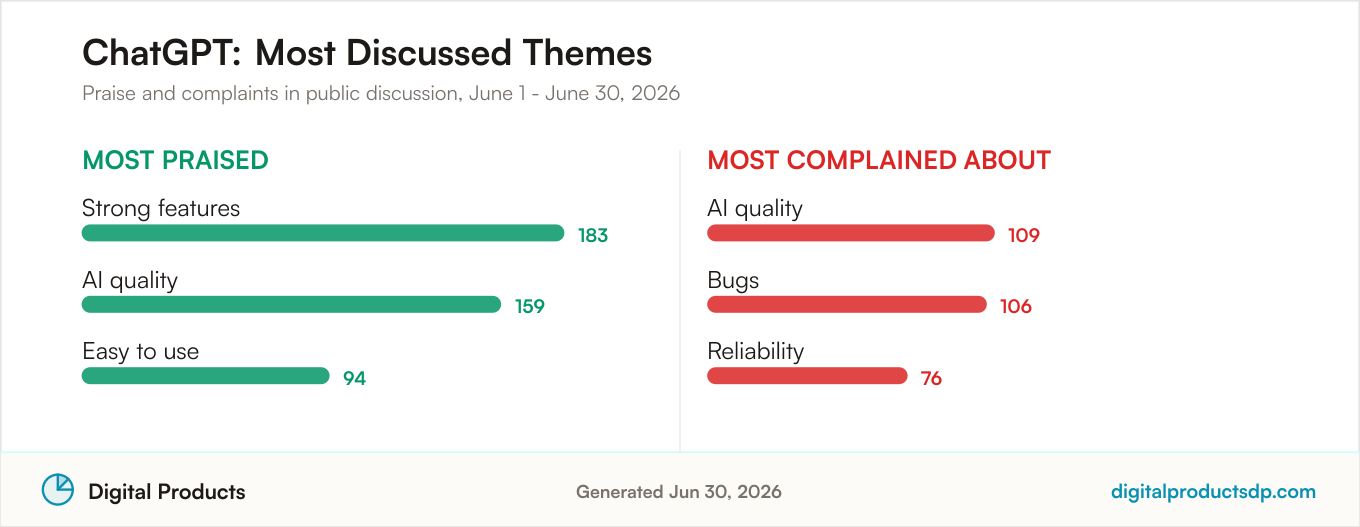
What people applauded was breadth. Strong features drew 183 mentions, AI quality reached 159, and ease of use added 94. This is the profile of a mainstream tool that a huge audience relies on for everyday tasks and finds approachable. The ease-of-use praise in particular reflects how many first-time and casual users pass through ChatGPT compared with more specialist options.

The frustrations were pointed. AI quality showed up as the top complaint at 109 mentions, bugs followed at 106, and reliability drew 76. When a tool this widely used has an off day, a lot of people notice and post about it, and the size of the negative slice reflects that scale. The gap between ChatGPT's positive discussion and its criticism is what placed it in the middle of the pack for June rather than higher, despite its enormous visibility.

Most praised and most complained about themes for ChatGPT from aggregated public discussion

Visit ChatGPT

5. Microsoft Copilot

Microsoft Copilot Pulse Score trend from aggregated public discussion

Microsoft Copilot takes fifth with a Pulse Score of 50, based on a much smaller sample of 131 mentions. The lighter volume is worth keeping in mind: with fewer data points, individual conversations carry more weight, so this read is thinner than the tools above it. The sentiment mix was 34% positive, 10% neutral, 8% mixed, and 48% negative, the largest negative share so far in the list.

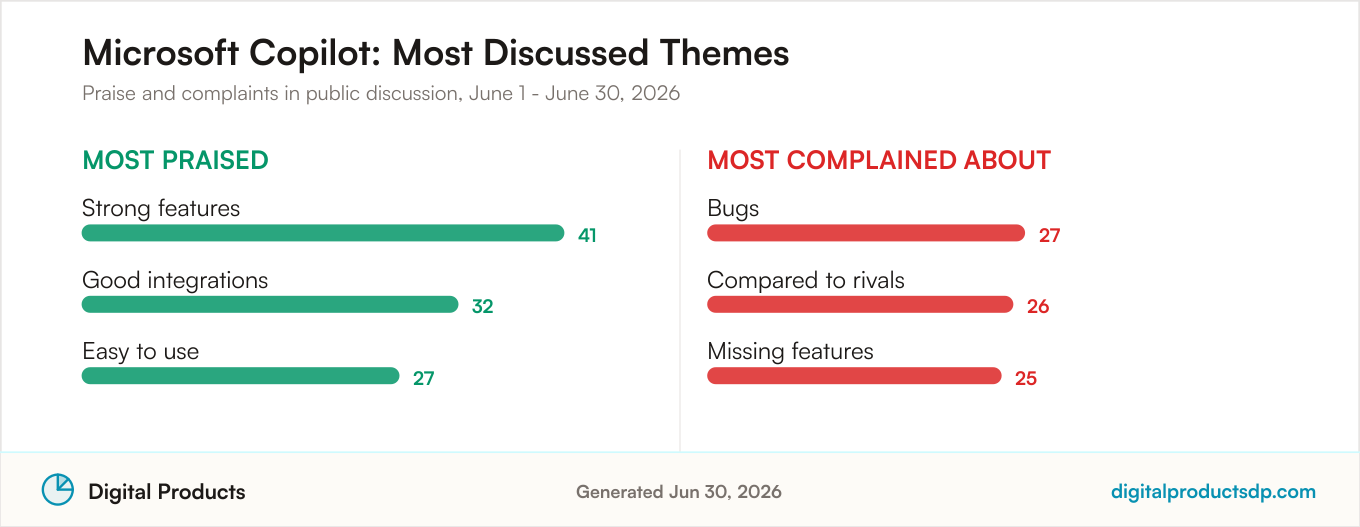
The positives centered on capability and connection. Strong features led with 41 mentions, good integrations followed at 32, and ease of use contributed 27. That integration praise is very much on brand for a tool built to live inside Microsoft's productivity suite, and the people who value it tend to value how it fits into the software they already use daily.

The complaints spread across a few areas without one dominating. Bugs drew 27 mentions, comparisons to rivals 26, and missing features 25. Taken together, these suggest a tool that some users feel trails competitors on certain fronts and still has rough edges to smooth. On a smaller mention base, that near-even split of a tight praise cluster against a broad set of gripes was enough to hold Copilot at a Pulse Score of 50 for the month.

Most praised and most complained about themes for Microsoft Copilot from aggregated public discussion

Visit Microsoft Copilot

6. Mistral

Mistral Pulse Score trend from aggregated public discussion

Sixth place belongs to Mistral, which matched Copilot's Pulse Score of 50 but got there differently, across 178 mentions. Its standout characteristic was calm: a sentiment mix of 34% positive, an unusually high 30% neutral, just 2% mixed, and 33% negative. That large neutral band means a big chunk of the conversation was informational rather than emotional, with positive and negative discussion roughly balancing each other out.

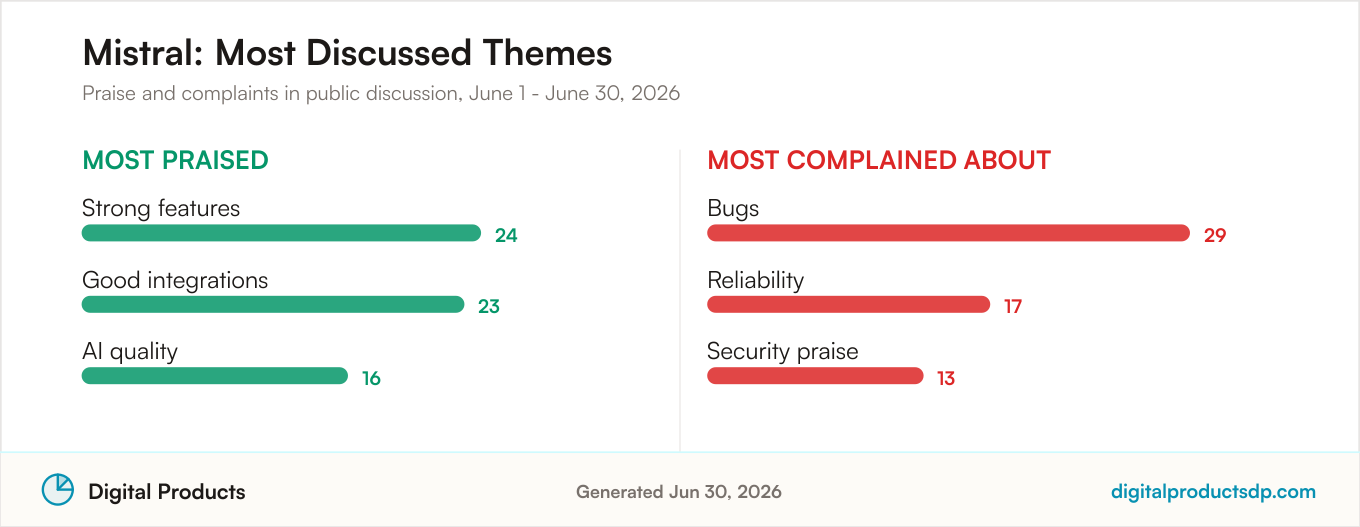
On what people praised, strong features led with 24 mentions, good integrations followed at 23, and AI quality added 16. This is the discussion profile of a tool that a technically minded audience appreciates for its capabilities and how it plugs into their setups, even if it does not generate the mass enthusiasm of the biggest consumer names.

The criticism was led by bugs at 29 mentions, followed by reliability at 17. One quirk in the data: security appeared as a praise-adjacent theme with 13 mentions, showing that some of the conversation touched on trust and safety in a favorable light. With a large steady-state neutral share and balanced sentiment, Mistral's Pulse Score reflects a tool discussed thoughtfully rather than passionately during June.

Most praised and most complained about themes for Mistral from aggregated public discussion

Visit Mistral

7. xAI

xAI Pulse Score trend from aggregated public discussion

Rounding out the ranking is xAI, which posted a Pulse Score of 41 from 218 mentions. That is the widest gap in the list, sitting nine points below the tool just above it, and the sentiment mix explains the distance clearly: 22% positive, 17% neutral, 2% mixed, and a heavy 59% negative. Nearly three in five tracked comments leaned unfavorable during June, the most lopsided profile of any tool here.

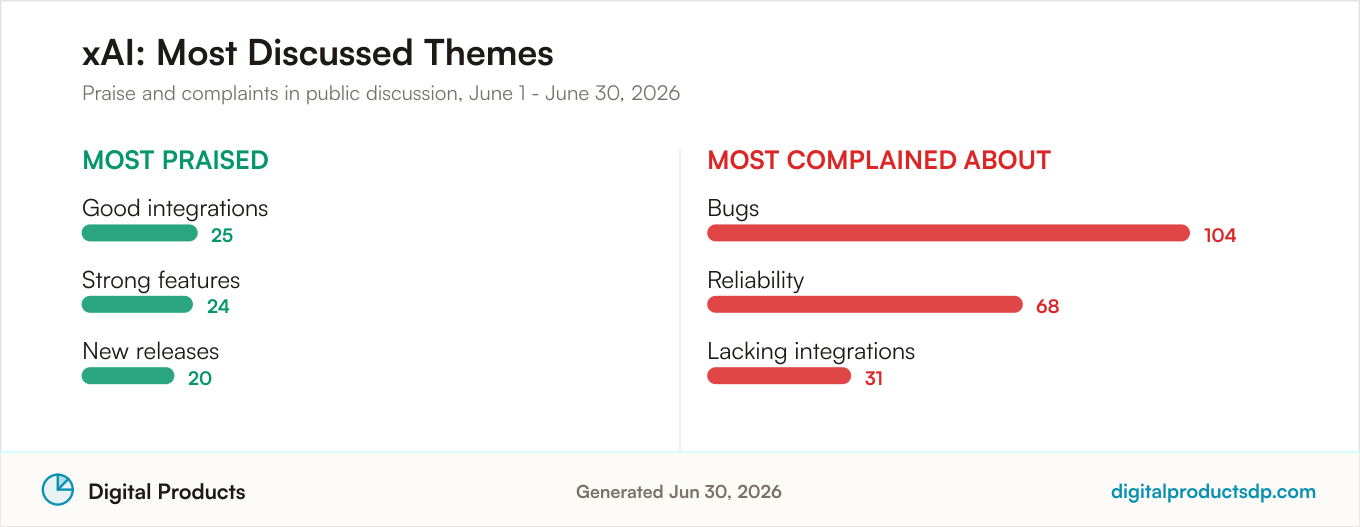
There were bright spots. Good integrations drew 25 positive mentions, strong features 24, and new releases 20, the last of which points to an audience paying attention to its update cadence and shipping activity. A dedicated group clearly follows what the product is building.

The complaints, however, were both loud and concentrated. Bugs dominated with 104 mentions, reliability drew 68, and lacking integrations added 31. That combination of stability and dependability concerns is a tough one for community sentiment, because it touches the day-to-day experience of actually using the tool. The praise for new releases and integrations was not enough to offset a negative share that large, which is what placed xAI at the bottom of the June ranking. As always, this reflects the tone of public conversation over one month, not a fixed judgment of the product.

Most praised and most complained about themes for xAI from aggregated public discussion

Visit xAI

How This Ranking Works

Every position in this list is determined by Pulse Score across the June 1 to June 30, 2026 period. The Pulse Score is a single 0-100 number that summarizes the tone of public online discussion about a tool during the window. Higher scores mean the aggregated conversation skewed more positive; lower scores mean it skewed more negative or carried more unresolved friction.

The ordering here is straightforward: DeepSeek led at 56, followed by Claude at 53, Gemini at 52, ChatGPT at 51, Microsoft Copilot and Mistral tied at 50, and xAI at 41. When scores land close together, as several did this month, small shifts in sentiment can change neighbors, so treat tight gaps as roughly comparable rather than decisive.

Underneath each score sits the sentiment breakdown (positive, neutral, mixed, and negative shares) and the specific themes people praised or criticized most. Those themes are where the real value lives. A score tells you the overall mood; the theme counts tell you why. When you see AI quality praised heavily by one tool and criticized heavily by another, or bugs recurring across several products, you are looking at the practical signals worth weighing before you commit your own time to testing.

Mention volume matters too. Claude's 880 mentions and ChatGPT's 718 make their scores more robust than reads built on smaller samples like Microsoft Copilot's 131. More discussion generally means a steadier signal, so give extra scrutiny to any conclusion drawn from a thin base.

About This Data

Pulse Scores summarize the tone of public online discussion on a 0-100 scale. They reflect community sentiment during a given period, not a verdict on a product's quality and not a recommendation to buy or avoid anything. A tool can do excellent work and still carry a middling score if the conversation around it ran hot with complaints, and the reverse is equally possible.

We report on complete calendar weeks only, and we exclude any product with fewer than 10 relevant mentions in the period to avoid unstable reads on thin samples. Public discussion is collected from a range of sources, including Hacker News, Stack Exchange, GitHub, Bluesky, the Apple App Store, and YouTube. Bringing several sources together helps balance out the quirks of any single community, though it cannot remove them entirely.

A few honest caveats. Automated sentiment analysis can misread sarcasm, jokes, or niche context, so individual classifications are not perfect. Mention volumes vary widely between products, which means some scores rest on far more data than others. And scores can move week to week as new releases, outages, or viral posts shift the conversation. If you represent a company featured here and want to respond, we welcome you to reach out.

Some Visit links on this page may be affiliate links, and the site may earn a commission if you use them. That never influences Pulse Scores or rankings, which are calculated the same way regardless of any commercial relationship. For a fuller explanation of how the numbers come together, see our methodology.

Frequently Asked Questions

Which AI chat tool ranked first in June 2026 and why?

DeepSeek ranked first with a Pulse Score of 56 across 548 mentions. It earned the top spot by carrying the most favorable sentiment mix in the category, at 44% positive, and by drawing strong praise for how it compared to rivals (136 mentions), its AI quality (122), and its fair pricing (118). Its negative share of 25% was also lower than most competitors, which helped lift its overall score.

How is the ranking calculated?

The ranking orders tools by their Pulse Score for the June 1 to June 30, 2026 period. The Pulse Score is a 0-100 summary of the tone of public discussion collected from sources like Hacker News, Stack Exchange, GitHub, Bluesky, the Apple App Store, and YouTube. Each product's sentiment breakdown and its most praised and criticized themes sit beneath the score to show what drove it. Products with fewer than 10 relevant mentions are excluded.

How often does this ranking update?

Pulse Scores are tracked over complete calendar weeks and this best-of ranking reflects the full June 2026 period. Because scores respond to new releases, outages, and shifts in public conversation, they can change from week to week, and a future period may reorder the list. This snapshot captures where community sentiment landed during June specifically.

Does a high Pulse Score mean the tool is right for me?

Not necessarily. A high Pulse Score means the public conversation about a tool skewed positive during the period, not that it fits your particular needs, budget, or workflow. The theme details matter more for your decision: for example, Claude drew heavy praise for AI quality but also frequent bug complaints, while Mistral had a large neutral discussion band. Use the scores as a starting signal and test any shortlisted tool yourself before committing.