This ranking looks at how the finance software community talked about the tools it uses across a single month, from June 1 to June 30, 2026. Instead of scoring features in a lab or weighing our own opinions, we tracked what real people said in public online discussion and distilled that conversation into a Pulse Score, a 0-100 measure that summarizes the overall tone of the chatter. The five products below are ordered by that score, from the highest to the lowest, so what you are reading is a snapshot of sentiment rather than a technical audit or a buying verdict.
Each product here cleared our minimum thresholds for inclusion, meaning it drew enough mentions across enough of the month to produce a stable read. For every entry we report the exact Pulse Score, the total number of mentions collected, and the breakdown of positive, neutral, mixed, and negative discussion. We also surface the themes people praised most and the ones they complained about most, so you can see not just how loud the conversation was but what actually drove it. Keep in mind throughout that sentiment reflects public discussion, not established fact about any product.
Read as a whole, this month's finance leaderboard is a study in how volume and tone diverge. Coinbase leads with a Pulse Score of 56 on the back of a relatively balanced sentiment mix, while Stripe commands by far the largest conversation at 499 mentions yet lands third because nearly half of that discussion skewed negative. The middle and lower ranks, filled by Square, Carta, and Klarna, cluster tightly in the high 30s to mid 40s, and each carries a majority-negative sentiment profile. In other words, no product in this group escaped criticism, and the ranking is less about who is beloved than about who managed the healthiest balance of praise against complaint.
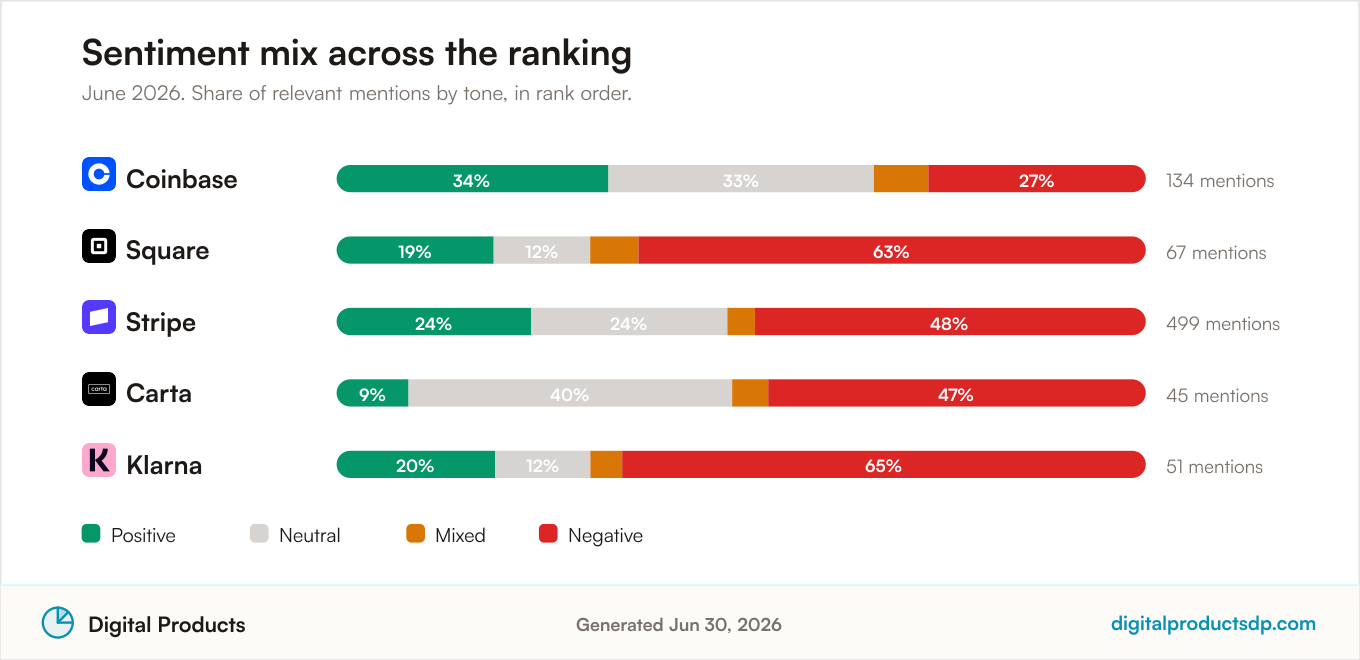
Coinbase takes the top spot with a Pulse Score of 56, the highest in this group, drawn from 134 total mentions over the month. What sets it apart is not the sheer size of the conversation but the shape of it. The sentiment mix reads 34 percent positive, 33 percent neutral, 7 percent mixed, and 27 percent negative, which makes it the only product in the ranking where positive discussion outweighs negative. That balance is what earned the lead.
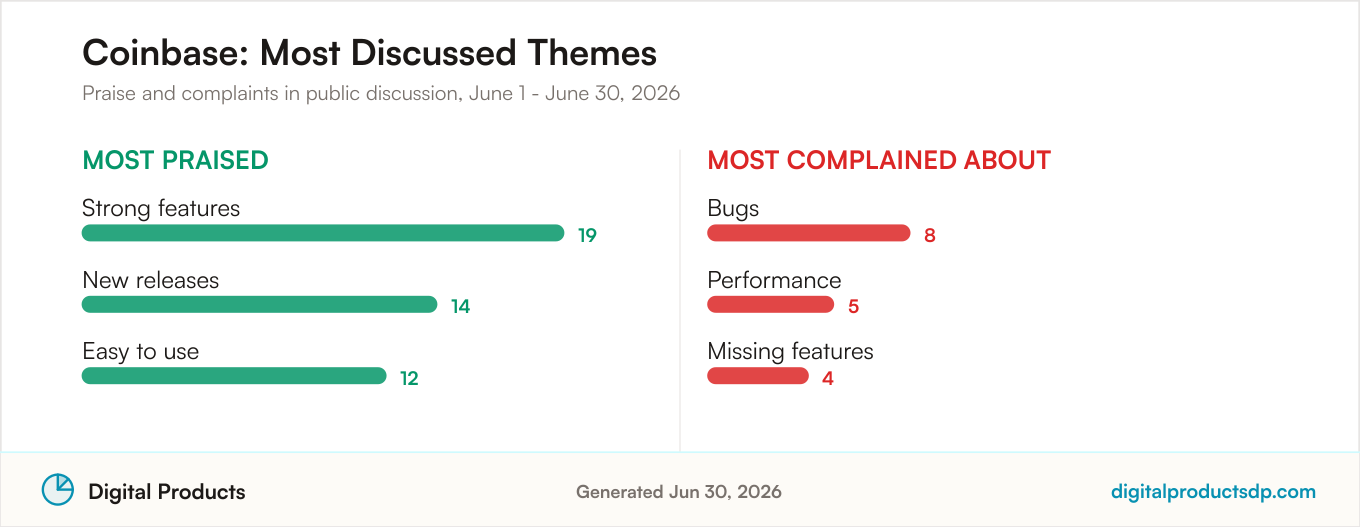
On the praise side, the community leaned heavily into strong features, which came up 19 times, followed by new releases with 14 mentions and easy to use with 12. That combination suggests people were both noticing the platform shipping things and finding it approachable once they got in. The pattern points to a tool that generated genuine enthusiasm rather than just passive attention.
The complaints were real but comparatively contained. Bugs led the negative themes with 8 mentions, performance followed with 5, and missing features accounted for 4. None of these dominated the conversation the way negative themes did for lower-ranked products, and that restraint is a big reason Coinbase held its position. Public discussion suggests a product people were largely willing to recommend, tempered by the usual friction points around stability and speed.
Square lands in second place with a Pulse Score of 45, built on a modest 67 mentions. The interesting thing about this position is that it sits above two products despite carrying one of the most negative sentiment mixes in the entire ranking. The breakdown reads 19 percent positive, 12 percent neutral, 6 percent mixed, and a heavy 63 percent negative. That the score still clears 45 tells you the positive discussion, though smaller in share, carried real weight.
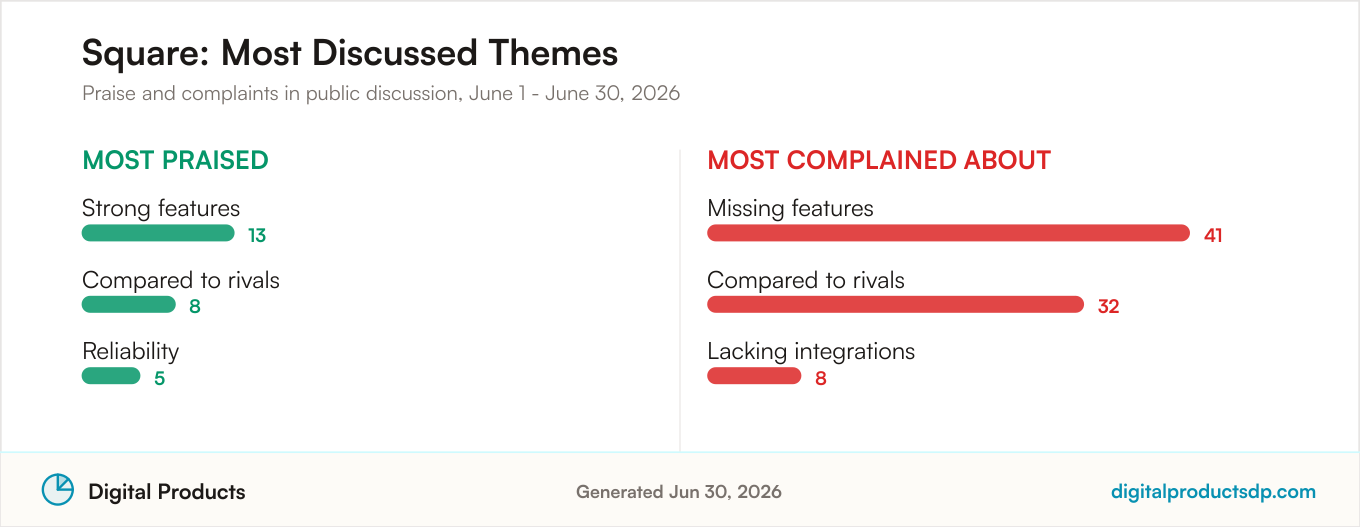
Where people spoke well of Square, they focused on strong features with 13 mentions, followed by compared to rivals at 8 and reliability at 5. The presence of comparison talk on both the praise and complaint sides is notable, because it signals a community actively weighing Square against alternatives rather than simply reacting to it in isolation.
The criticism was pointed and largely functional. Missing features was by far the loudest complaint at 41 mentions, an unusually concentrated theme, with compared to rivals at 32 and lacking integrations at 8 rounding out the top grievances. Read together, the public conversation suggests a product people respect for what it already does well but repeatedly wish did more, especially when they hold it up against competitors. That tension is exactly what a mid-table score reflects.
Stripe is the giant of this list by conversation volume, drawing 499 total mentions, more than the other four products combined. Yet its Pulse Score of 44 places it third, a reminder that being talked about a lot is not the same as being talked about well. The sentiment mix breaks down to 24 percent positive, 24 percent neutral, 3 percent mixed, and 48 percent negative, so nearly half of a very large conversation carried a critical tone.
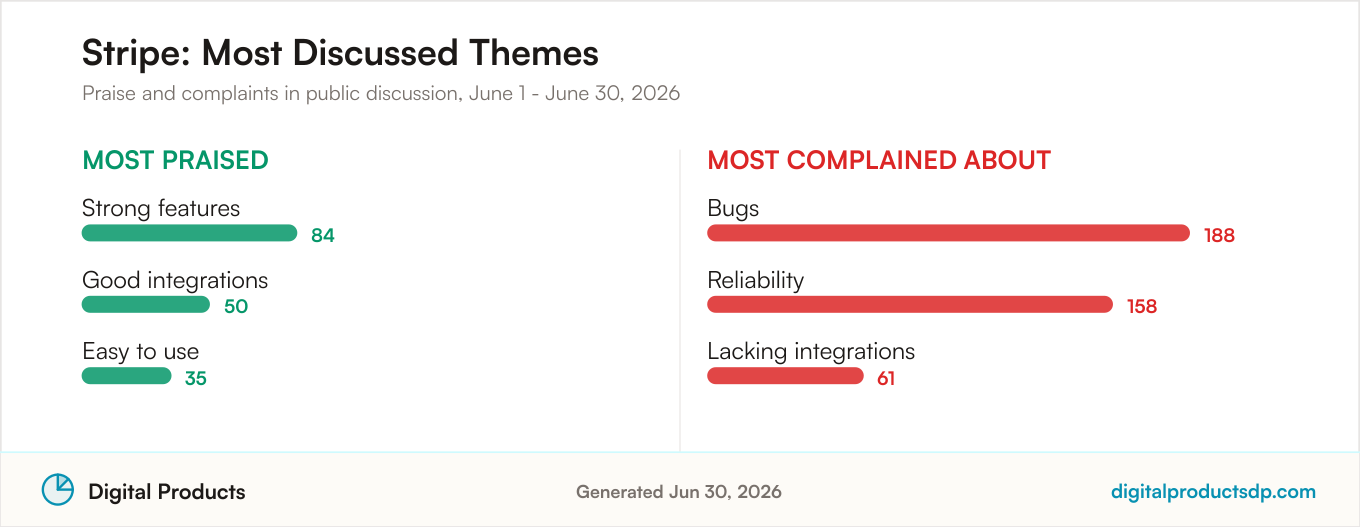
The praise was substantial in absolute terms. Strong features drew 84 mentions, good integrations earned 50, and easy to use picked up 35. For many developers and finance teams, Stripe's breadth and its ecosystem of integrations remain a genuine draw, and those numbers reflect a large base of users who find real value in the platform.
The problem is that the complaints were even louder. Bugs dominated with 188 mentions, reliability followed at 158, and lacking integrations reached 61, which is a striking counterpoint to the integration praise on the other side. What this suggests is a platform operating at enormous scale where even a minority of frustrated users produces a very large volume of critical discussion. The public conversation points to a tool that is deeply relied upon and, precisely because of that reliance, held to an exacting standard on stability. High volume plus a negative tilt is what kept its score in the mid 40s despite all the positive mentions.
Carta comes in fourth with a Pulse Score of 40, drawn from a smaller sample of 45 mentions. Its sentiment profile is distinct from the rest of the field because neutral discussion leads the mix at 40 percent, followed by 47 percent negative, 9 percent positive, and just 4 percent mixed. That heavy neutral share suggests a lot of the conversation was matter-of-fact rather than emotionally charged, with people describing or referencing the product more than celebrating or condemning it.
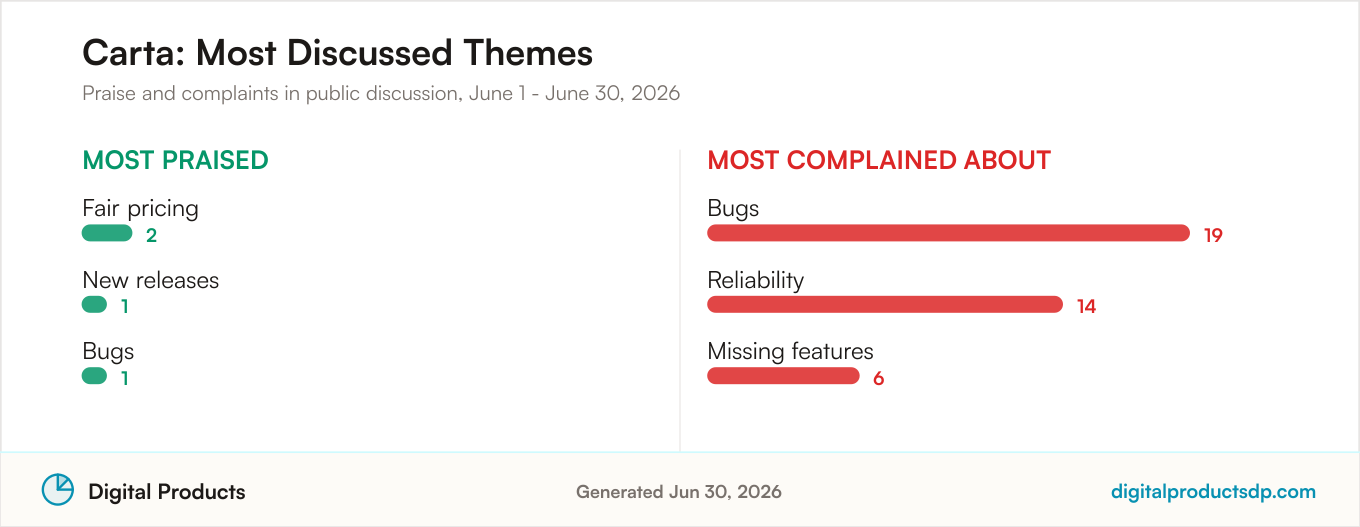
Positive themes were thin on the ground. Fair pricing was the most cited compliment with 2 mentions, while new releases and, curiously, bugs each appeared once on the praise side, likely reflecting fixes people were glad to see. With so few positive data points, it is hard to read a strong endorsement into the conversation.
The complaints were more clearly defined. Bugs topped the list at 19 mentions, reliability followed at 14, and missing features came in at 6. For a product with only 45 total mentions, that concentration of stability-related criticism carries real weight in the read. The public discussion suggests users who are engaging with Carta primarily in practical terms and running into technical friction often enough to color the overall tone. Its rank reflects a quiet but critical conversation more than either enthusiasm or outrage.
Klarna rounds out the ranking in fifth with a Pulse Score of 39, based on 51 mentions. It carries the most negative sentiment mix of any product here, at 65 percent negative, alongside 20 percent positive, 12 percent neutral, and 4 percent mixed. That the score still sits at 39 rather than lower speaks to the fact that one in five mentions was positive, but the overall tone of the conversation was clearly critical this month.
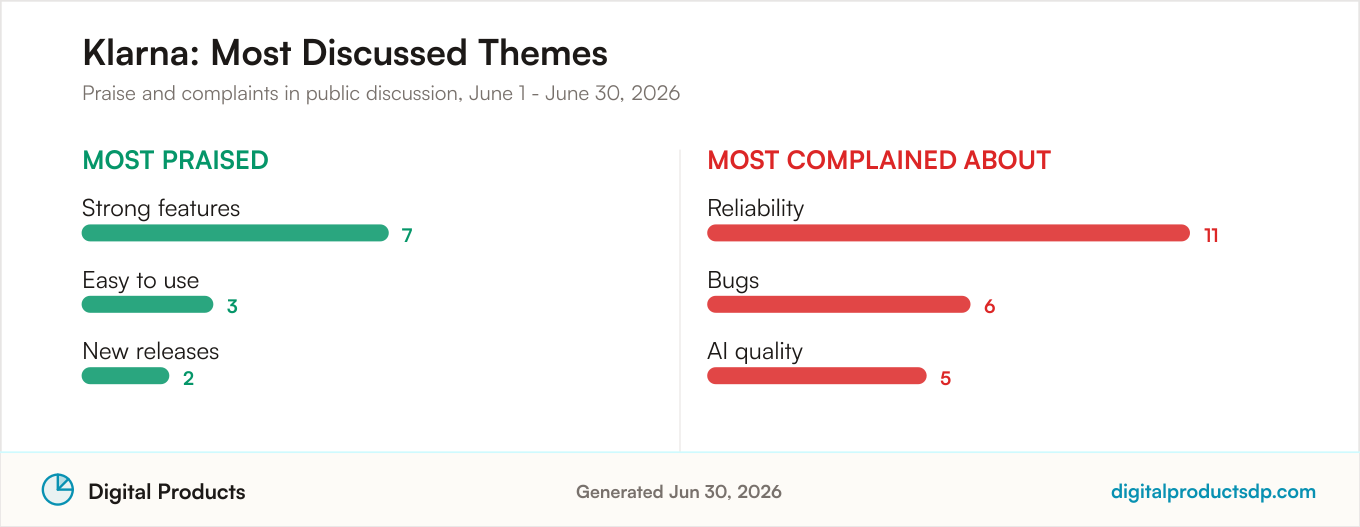
The praise that did surface centered on strong features with 7 mentions, easy to use with 3, and new releases with 2. Those are familiar signals for a consumer-facing finance product, pointing to a slice of users who found the experience smooth and appreciated ongoing updates. The volume, though, was modest compared with the criticism.
On the negative side, reliability led with 11 mentions, bugs followed at 6, and AI quality appeared 5 times, the only product in this ranking where AI-related complaints cracked the top three themes. That last point is worth noting given how many finance tools are folding AI into their workflows, and the public conversation suggests Klarna's users were not universally sold on how that played out. Taken together, the discussion paints a picture of a product with pockets of genuine enthusiasm but a dominant undercurrent of frustration around stability and newer AI-driven features. That balance is what placed it at the foot of this month's list.
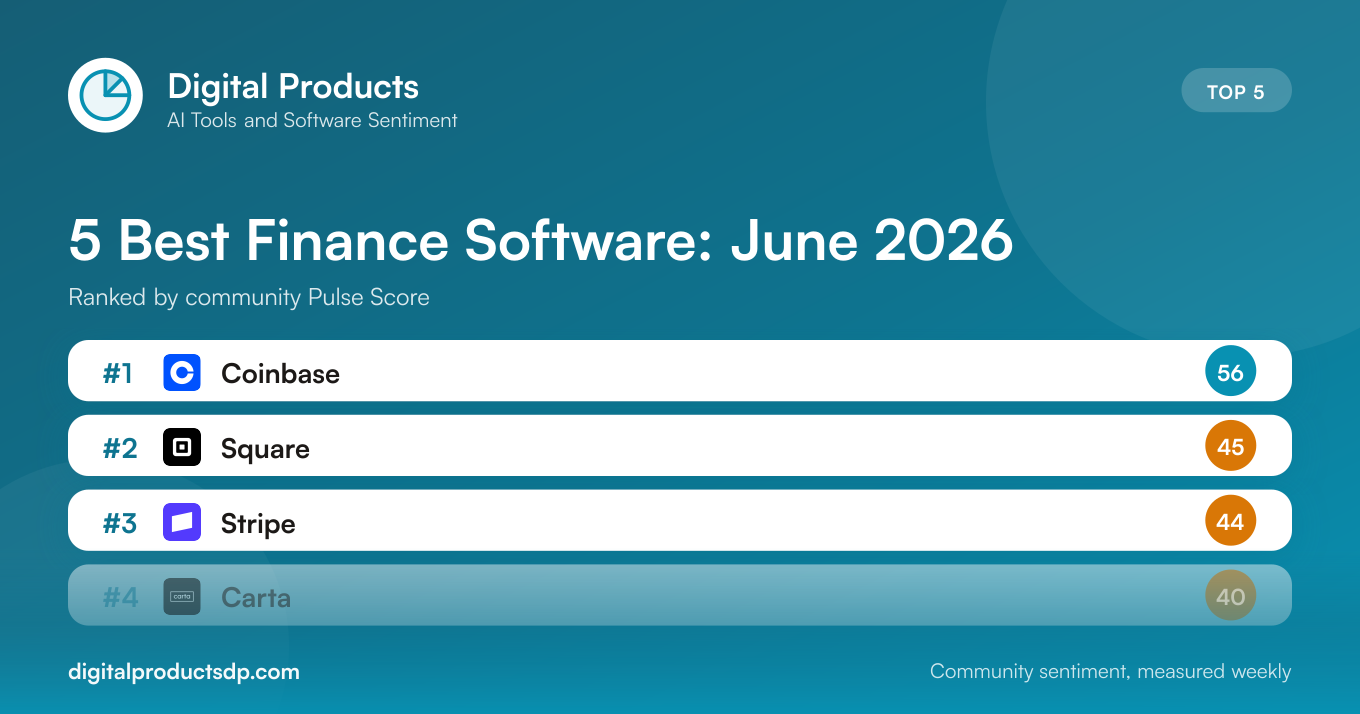
The order of this list comes directly from each product's Pulse Score across the June 1 to June 30, 2026 window. The Pulse Score is a single number on a 0-100 scale that captures the overall tone of public online discussion during the period, and we simply rank products from highest to lowest. Coinbase leads at 56, Square follows at 45, Stripe sits at 44, Carta at 40, and Klarna at 39.
Because the score reflects tone rather than volume, a product can be discussed far more than its peers and still rank below them, as Stripe's 499 mentions and third-place finish demonstrate. Likewise, a smaller but more positively skewed conversation, like Coinbase's, can rise to the top. We report the raw mention counts and sentiment breakdowns alongside each score so you can see the reasoning rather than take the ranking on faith. Nothing here declares one product better than another in absolute terms. It is a reading of how the community talked during one specific month, and it can shift as that conversation evolves.
About This Data
Pulse Scores summarize the tone of public online discussion on a 0-100 scale. They reflect community sentiment, not a verdict on a product's quality and not a recommendation to buy or avoid anything. A high score means the conversation skewed favorable during the period, and a low score means it skewed critical, nothing more.
We report on complete calendar weeks only. To avoid unstable reads on thin samples, products with fewer than 10 relevant mentions in the period are excluded. Ranked products also need at least 2 complete weeks of discussion data within the period, so a single-week spike cannot push a product into the ranking on its own. Public discussion is collected from Hacker News, Stack Exchange, GitHub, Bluesky, the Apple App Store, and YouTube.
A few honest caveats. Automated sentiment analysis can misread sarcasm, jokes, or niche context, so individual mentions are not always classified perfectly. Mention volumes vary widely between products, which is why a tool with hundreds of mentions and one with a few dozen can sit near each other in the ranking. Scores can also move from week to week as new discussion comes in. If you represent one of these companies and want to respond, we welcome you to reach out. Note too that some Visit links may be affiliate links, meaning the site may earn a commission, and this never influences Pulse Scores or rankings. For the full details on how scores are calculated, see our methodology.
Frequently Asked Questions
Which finance software ranks first in June 2026 and why?
Coinbase ranks first with a Pulse Score of 56, the highest in this group. It earned the top position because it was the only product where positive discussion outweighed negative, with a mix of 34 percent positive against 27 percent negative across 134 total mentions. The community praised its strong features, new releases, and ease of use, while complaints about bugs and performance stayed comparatively contained.
How is the Pulse Score ranking calculated?
Each product receives a Pulse Score from 0 to 100 that summarizes the tone of public online discussion during the period, in this case June 1 to June 30, 2026. We rank products from highest score to lowest. The score reflects sentiment rather than how much a product is discussed, which is why Stripe's 499 mentions still placed third behind products with far smaller conversations. Mention counts and sentiment breakdowns are reported alongside every entry.
How often does this ranking update?
The ranking is built from complete calendar weeks within the reporting period, and scores can move week to week as new public discussion comes in. This particular list covers the full month of June 2026. Products need at least 2 complete weeks of data and a minimum of 10 relevant mentions to be included, so the picture reflects sustained conversation rather than a single-week spike.
Does a high Pulse Score mean the product is right for everyone?
No. A high Pulse Score only means public discussion during the period leaned favorable. It is not a verdict on quality or a recommendation for your specific needs. Square, for example, ranks second despite a 63 percent negative sentiment mix, and Stripe carries strong feature praise alongside heavy complaints about bugs and reliability. Use the theme breakdowns to judge whether the things people praised or criticized actually matter for your use case.

 Coinbase
 Square
 Stripe
 Carta
Carta Klarna