Back to blog
Best Of

13 Best Coding Tools in June 2026

July 5, 2026
13 Best Coding Tools in June 2026

This ranking looks at the coding tools that generated the most talked-about, most positively received discussion across public online communities between June 1 and June 30, 2026. Rather than relying on editorial opinion or vendor marketing, it reads what developers actually said in the open, then distills that conversation into a single comparable figure called a Pulse Score. Every product below cleared our minimum thresholds for mention volume and coverage across the period, so each entry reflects a real body of discussion rather than a single loud thread.

The Pulse Score runs on a 0 to 100 scale and summarizes the overall tone of public conversation, blending how positive or negative the discussion was with how consistent it stayed. Below you will find the full leaderboard, a reading of the field as a whole, a breakdown of the sentiment mix, and then a section for each tool explaining exactly what earned its position. Throughout, remember that these figures describe sentiment in public discussion, not verified facts about product quality, so treat everything here as a signal to investigate rather than a verdict to trust blindly.

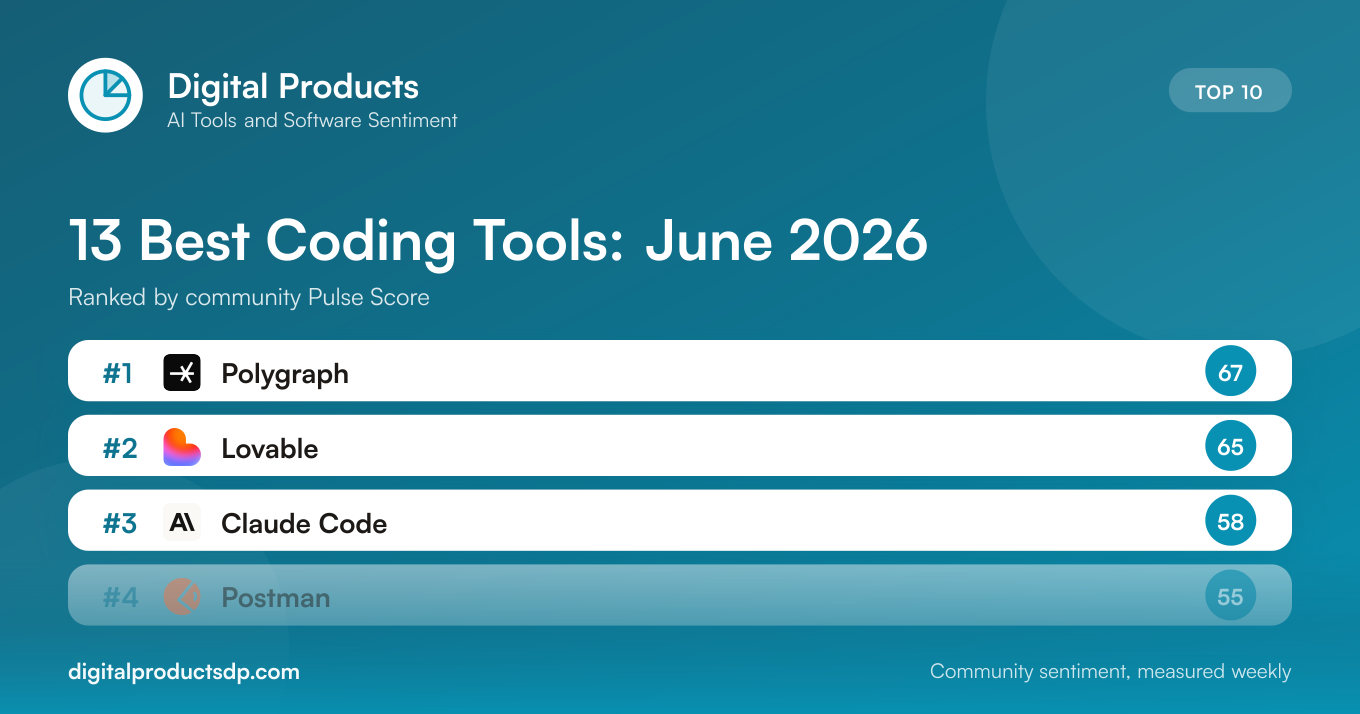
RankProductCategoryPulse ScoreRelevant MentionsVisit
1PolygraphCoding6721Visit ↗
2LovableCoding6522Visit ↗
3Claude CodeCoding58612Visit ↗
4PostmanCoding55102Visit ↗
5TurborepoCoding54192Visit ↗
6CursorCoding53336Visit ↗
7RubyLLMCoding53100Visit ↗
8Better StackCoding5222Visit ↗
9DevinCoding5072Visit ↗
10ReplitCoding5075Visit ↗
11WindsurfCoding5059Visit ↗
1210WebCoding4961Visit ↗
13AiderCoding4939Visit ↗

Taken as a whole, this month's field shows how much position can hinge on discussion mix rather than raw volume. The two leaders, Polygraph and Lovable, both drew relatively small mention counts but very favorable sentiment, while Claude Code sat third despite commanding by far the largest conversation at 612 mentions. That contrast runs through the entire list: high-volume tools like Cursor and Turborepo carried heavier negative shares, and lower-ranked entries such as 10Web and Aider leaned heavily neutral, which tends to hold a Pulse Score down. The spread from 67 at the top to 49 at the bottom is narrow, so small shifts in praise or complaint moved products meaningfully.
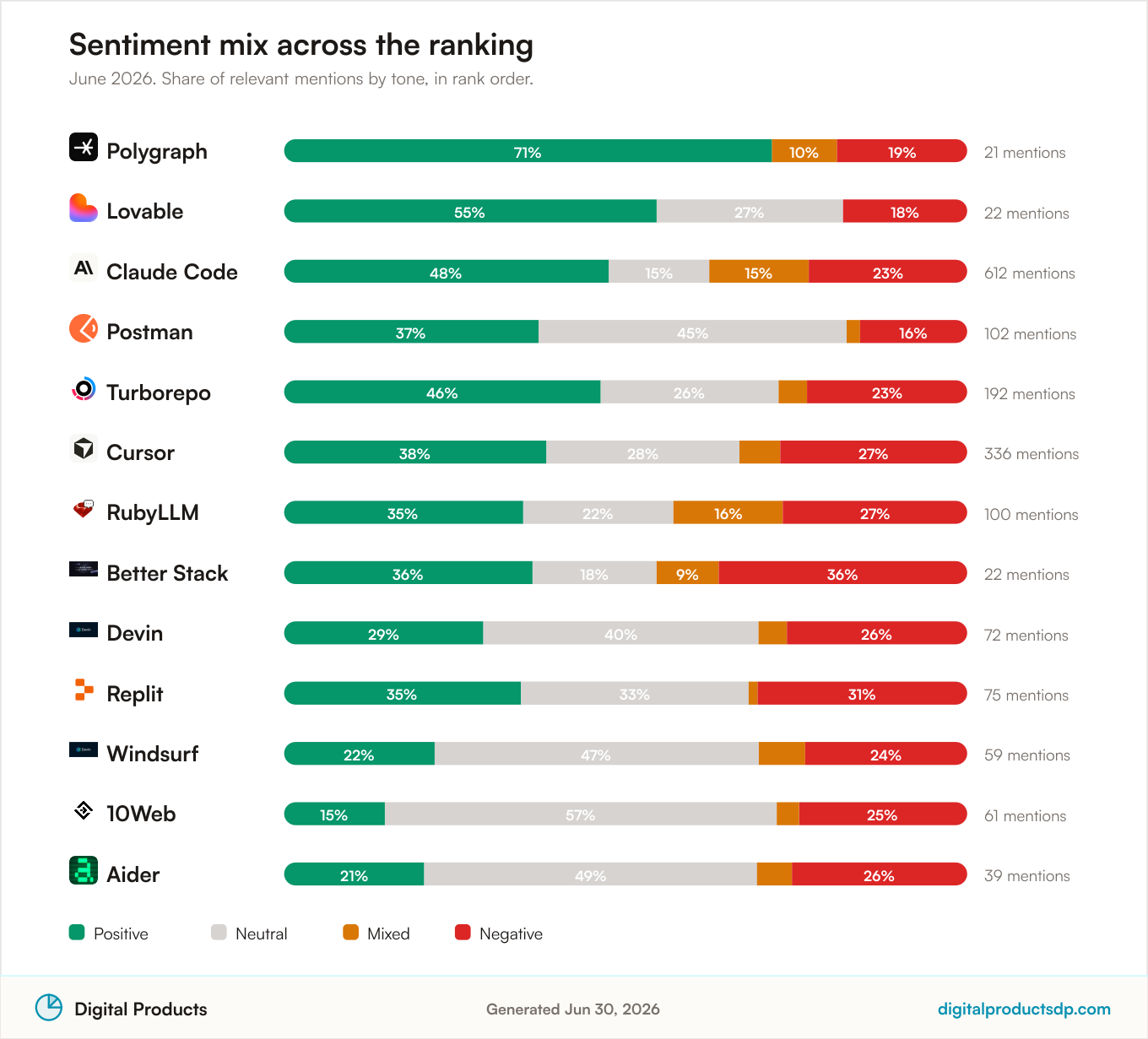
Positive, neutral, mixed, and negative discussion share for the 13 ranked Coding Tools, June 2026

1. Polygraph

Polygraph Pulse Score trend from aggregated public discussion

Polygraph takes the top spot with a Pulse Score of 67, the highest in this month's field. It reached that position on the strength of its discussion mix rather than sheer volume: across 21 total mentions, 71 percent of the conversation registered as positive, with no neutral share, 10 percent mixed, and 19 percent negative. For a smaller-volume tool, that is an unusually clean profile, and it is what let Polygraph edge ahead of tools with far larger conversations.

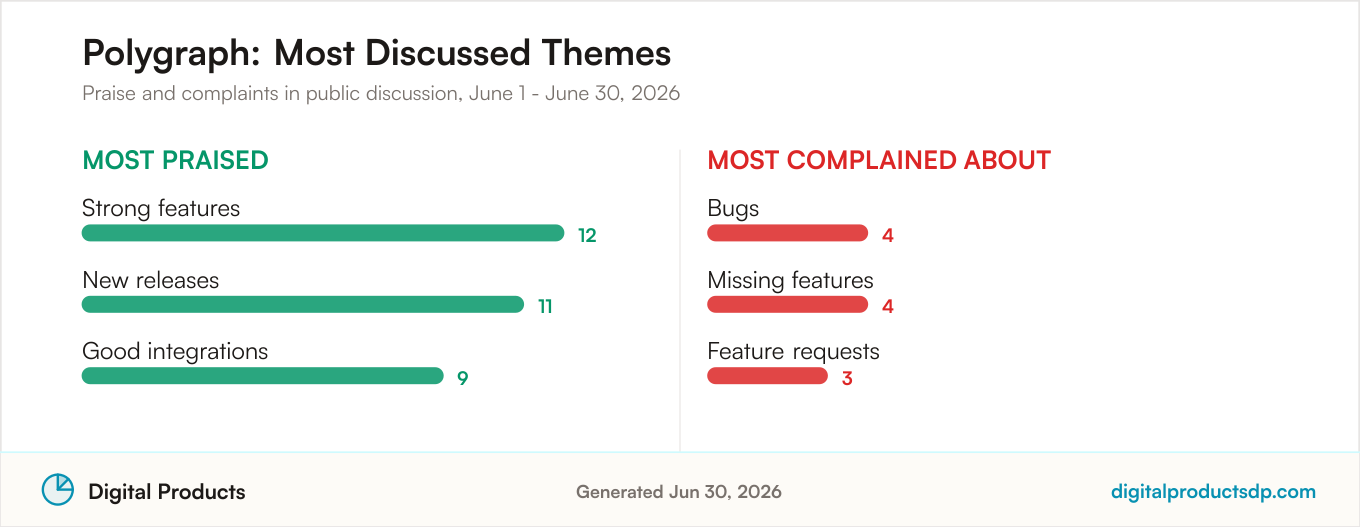
What drove the praise was consistent. Strong features led the way with 12 mentions, closely followed by new releases at 11 and good integrations at 9, suggesting the community responded well both to what the tool ships and to how it fits alongside existing workflows. That combination of steady feature momentum and integration goodwill is exactly the pattern that tends to produce a high Pulse Score.

The criticism was real but modest in scale. Bugs and missing features each drew 4 mentions, and feature requests added 3 more, which points to a tool people are actively using and want more from rather than one being written off. On the evidence of public discussion, Polygraph earned its lead by keeping its negative share contained while its praise stayed specific.

Most praised and most complained about themes for Polygraph from aggregated public discussion

Visit Polygraph

2. Lovable

Lovable Pulse Score trend from aggregated public discussion

Just behind the leader sits Lovable, which landed a Pulse Score of 65 from a similar-sized sample of 22 mentions. Its sentiment mix reads differently from Polygraph's, though: 55 percent positive, a substantial 27 percent neutral, no mixed, and 18 percent negative. The heavier neutral share is what kept it a couple of points shy of first place, since neutral discussion neither lifts nor sinks a score the way clear positive or negative sentiment does.

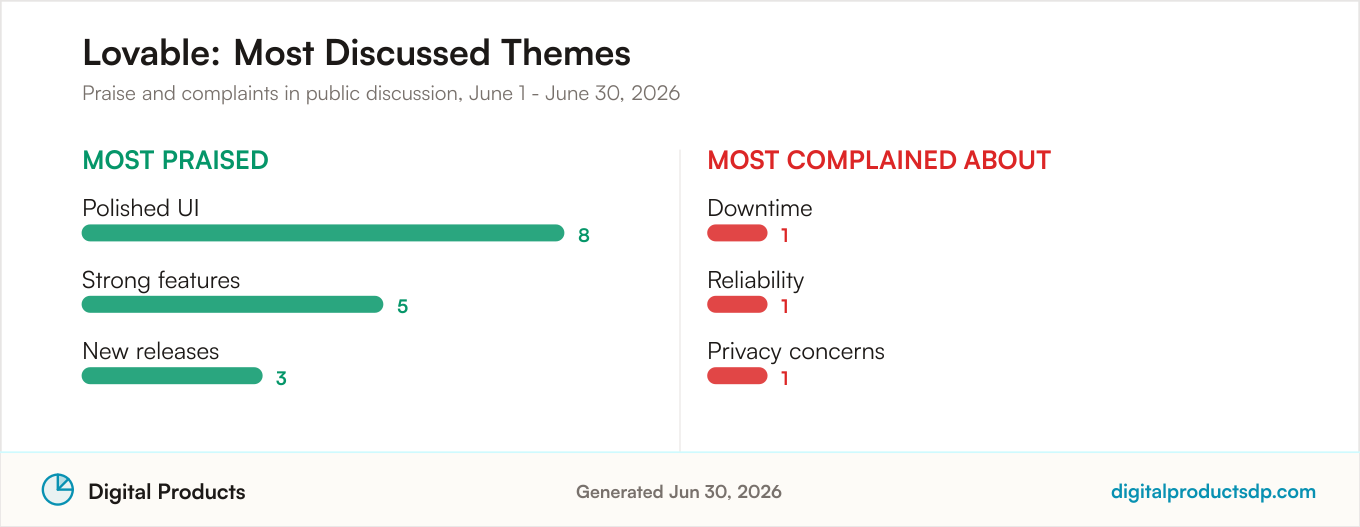
The praise here centered on presentation. Polished UI was the single most cited strength at 8 mentions, ahead of strong features at 5 and new releases at 3. That ordering suggests the community sees Lovable first as a pleasant, well-designed experience and second as a capable one, which is a meaningful signal for anyone weighing tools where the surface matters as much as the engine.

Complaints were sparse and spread thin, each appearing just once: downtime, reliability, and privacy concerns. No single issue dominated, which is generally a healthier sign than one loud recurring gripe. Read through the lens of public discussion, Lovable earned its runner-up spot on a strong positive base and a notably light complaint load.

Most praised and most complained about themes for Lovable from aggregated public discussion

Visit Lovable

3. Claude Code

Claude Code Pulse Score trend from aggregated public discussion

Claude Code is the heavyweight of this ranking. Its 612 total mentions dwarf every other entry, and holding a Pulse Score of 58 across that volume is arguably more impressive than a higher score on a thin sample. Its sentiment broke down to 48 percent positive, 15 percent neutral, 15 percent mixed, and 23 percent negative, a spread that reflects the reality of being the most-discussed tool on the list: more eyes bring more scrutiny.

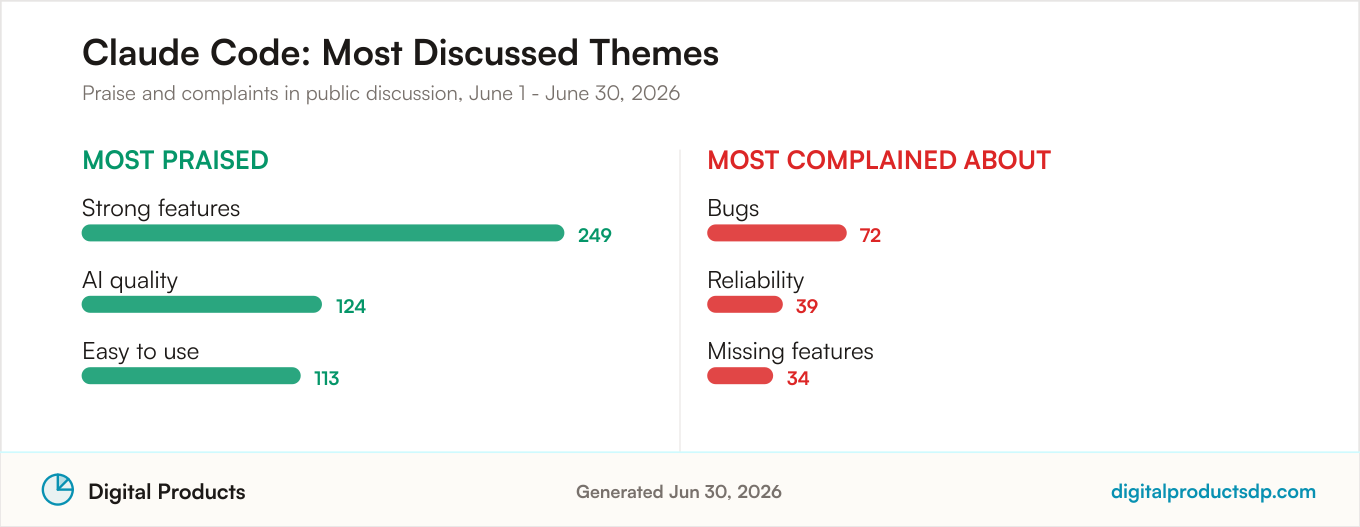
The praise was both broad and deep. Strong features led with 249 mentions, AI quality followed at 124, and ease of use added 113. Those are large absolute numbers, and the fact that they cluster around capability and usability suggests the community sees Claude Code as a genuinely productive tool rather than a novelty. Few products can point to hundreds of positive references to their core features in a single month.

The flip side is that a large conversation also surfaces a large volume of complaints. Bugs drew 72 mentions, reliability 39, and missing features 34. None of these dominated the positive picture, but together they explain why Claude Code sits third rather than first: its negative share, in absolute terms, is heavier than any smaller-volume rival could accumulate. What public discussion suggests is a widely relied-upon tool that people push hard and expect a lot from.

Most praised and most complained about themes for Claude Code from aggregated public discussion

Visit Claude Code

4. Postman

Postman Pulse Score trend from aggregated public discussion

The API workhorse Postman lands fourth with a Pulse Score of 55 across 102 mentions. Its defining trait this month was neutrality: 45 percent of its discussion was neutral, the highest neutral share among the top tools, alongside 37 percent positive, just 2 percent mixed, and 16 percent negative. That heavy neutral center is typical of an established, familiar tool that people mention matter-of-factly in the course of describing their workflow.

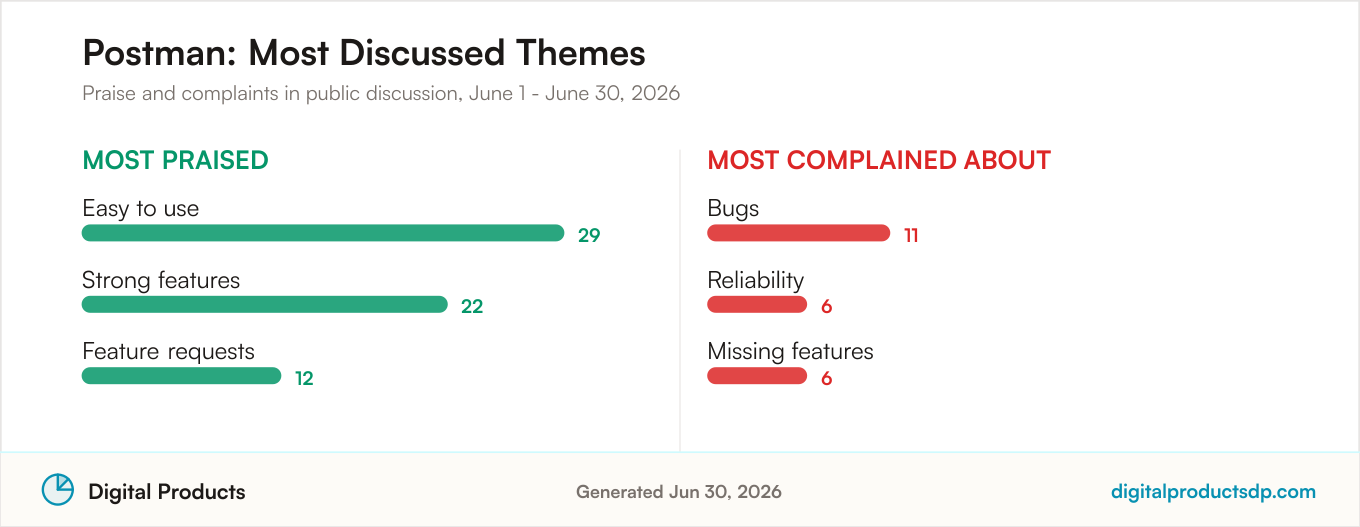
Where sentiment did tip positive, ease of use led at 29 mentions, ahead of strong features at 22 and feature requests at 12. The prominence of ease of use fits a product that has been a default in its category for years, the kind of tool people reach for without much friction. The feature-request volume also signals an engaged base that wants the product to keep evolving.

Its complaints were moderate and predictable for mature software: bugs at 11, reliability at 6, and missing features at 6. Nothing there suggests a crisis, and nothing suggests standout enthusiasm either. On the balance of public discussion, Postman occupies the position of a dependable, widely-used tool that generates steady rather than passionate conversation.

Most praised and most complained about themes for Postman from aggregated public discussion

Visit Postman

5. Turborepo

Turborepo Pulse Score trend from aggregated public discussion

Monorepo build tool Turborepo holds fifth with a Pulse Score of 54 on a healthy 192 mentions. Its sentiment split ran 46 percent positive, 26 percent neutral, 4 percent mixed, and 23 percent negative, a profile that mixes genuine enthusiasm with a nontrivial layer of frustration. That balance is what places it in the middle of the pack despite a well-above-average positive share.

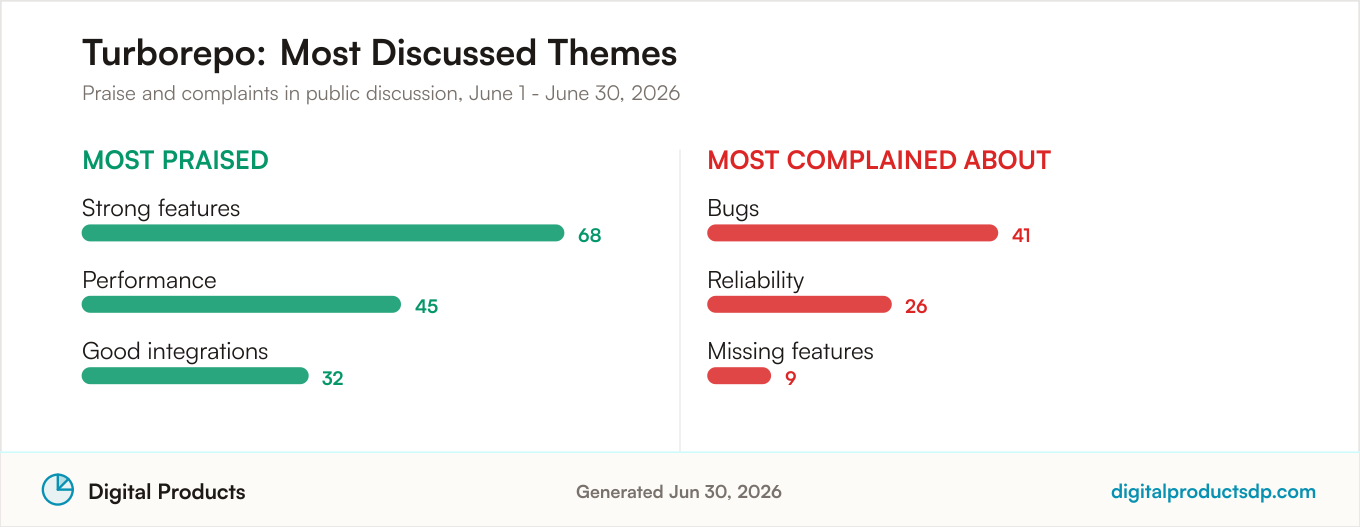
Performance is the standout theme here, and appropriately so for a build tool. Strong features led praise at 68 mentions, but performance came in a strong second at 45, followed by good integrations at 32. When a tool exists to make things faster, seeing performance cited so prominently is a meaningful endorsement from the people actually running it at scale.

The complaints, though, are worth taking seriously. Bugs drew 41 mentions and reliability 26, both high enough to weigh on the score, with missing features adding 9. Those figures suggest a tool whose speed wins fans but whose stability occasionally tests them. Read through public discussion, Turborepo comes across as powerful and fast, with rough edges that a meaningful slice of users encountered this month.

Most praised and most complained about themes for Turborepo from aggregated public discussion

Visit Turborepo

6. Cursor

Cursor Pulse Score trend from aggregated public discussion

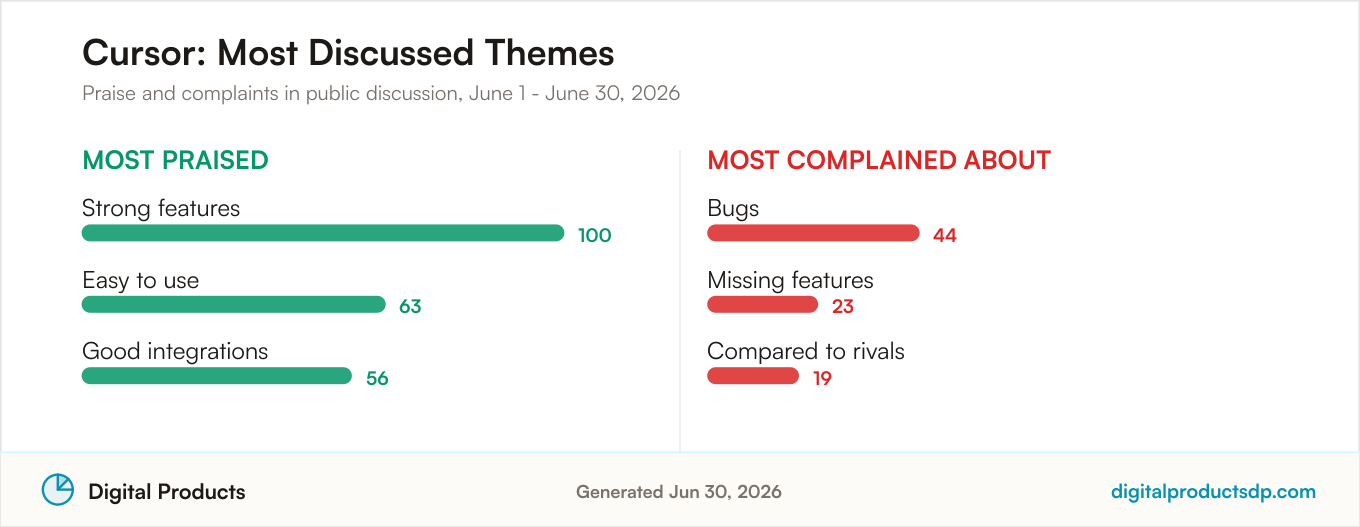
The AI-native editor Cursor sits sixth with a Pulse Score of 53 across a large 336 mentions. Its sentiment came in at 38 percent positive, 28 percent neutral, 6 percent mixed, and 27 percent negative, the highest negative share so far among the tools above it in absolute prominence. As with Claude Code, a big conversation cuts both ways.

On the positive side, the numbers are substantial. Strong features led at 100 mentions, ease of use followed at 63, and good integrations at 56. Those are the kinds of totals only a heavily used tool accumulates, and they point to a product that a lot of developers have folded into their daily work and appreciate for its capability and fit.

The friction is equally visible. Bugs drew 44 mentions, missing features 23, and comparisons to rivals 19, the last of which is notable because it shows the community actively weighing Cursor against alternatives. That competitive scrutiny, combined with a 27 percent negative share, is what holds it to a mid-table Pulse Score. What public discussion suggests is a popular, capable editor operating in a crowded, closely-compared space.

Most praised and most complained about themes for Cursor from aggregated public discussion

Visit Cursor

7. RubyLLM

RubyLLM Pulse Score trend from aggregated public discussion

RubyLLM shares a Pulse Score of 53 with Cursor but lands seventh on a smaller sample of 100 mentions. Its sentiment mix was 35 percent positive, 22 percent neutral, 16 percent mixed, and 27 percent negative. The relatively high mixed share, at 16 percent, is distinctive here and signals a lot of conversation that lands somewhere between praise and criticism rather than firmly on either side.

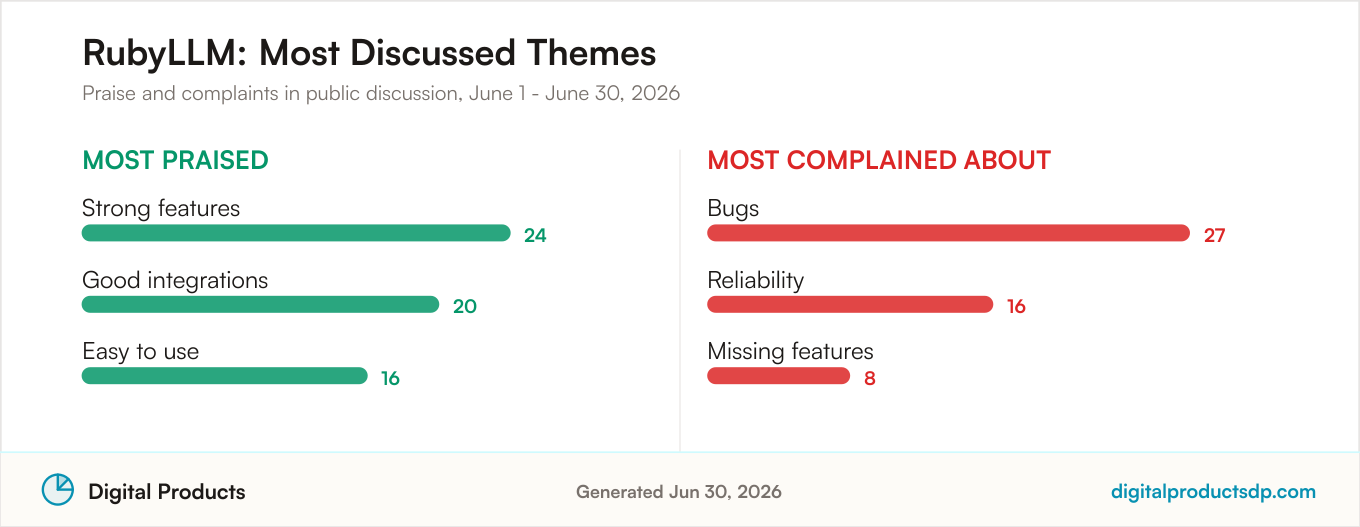
Its strengths clustered around integration and usability. Strong features led at 24 mentions, good integrations followed closely at 20, and ease of use added 16. For a library-style tool, that integration prominence is exactly what you would hope to see, since fitting cleanly into existing Ruby projects is much of the value proposition.

The complaint side is where RubyLLM was held back. Bugs drew 27 mentions, actually outnumbering its top praised theme, with reliability at 16 and missing features at 8. That is a heavy stability-related complaint load relative to its total volume. On the evidence of public discussion, RubyLLM is a useful and well-integrated tool that a meaningful share of users found rough around the edges this month.

Most praised and most complained about themes for RubyLLM from aggregated public discussion

Visit RubyLLM

8. Better Stack

Better Stack Pulse Score trend from aggregated public discussion

Observability and monitoring platform Better Stack takes eighth with a Pulse Score of 52 on 22 mentions. Its sentiment was the most polarized in the upper half of this ranking: 36 percent positive, 18 percent neutral, 9 percent mixed, and a matching 36 percent negative. When positive and negative shares are evenly balanced like this, the Pulse Score reflects a genuinely divided conversation.

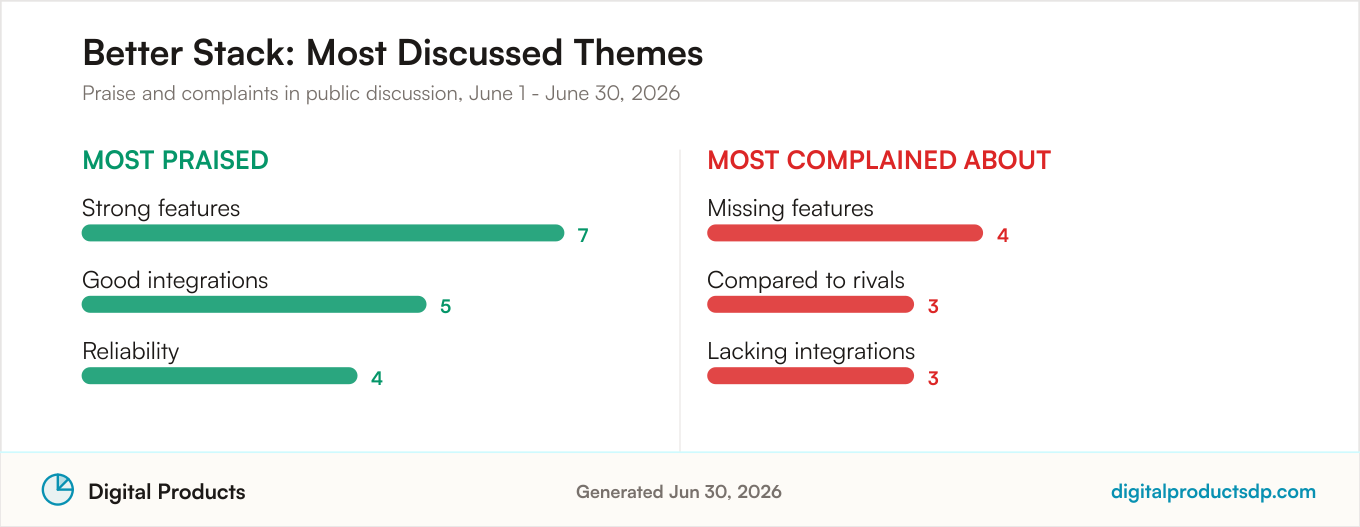
The praise focused on substance. Strong features led at 7 mentions, good integrations followed at 5, and reliability at 4, the last being especially relevant for a monitoring tool where dependability is the whole point. That its fans specifically call out reliability is a positive signal for the use case it serves.

The criticism, though, tells a competitive and gap-focused story. Missing features drew 4 mentions, comparisons to rivals 3, and lacking integrations another 3. The mix of feature gaps, integration gaps, and rival comparisons suggests a tool that some users feel does not yet cover everything they need. Read through public discussion, Better Stack is a capable platform with a divided audience and clear areas people want expanded.

Most praised and most complained about themes for Better Stack from aggregated public discussion

Visit Better Stack

9. Devin

Devin Pulse Score trend from aggregated public discussion

The autonomous coding agent Devin lands ninth with a Pulse Score of 50 across 72 mentions. Its discussion leaned heavily neutral at 40 percent, with 29 percent positive, 4 percent mixed, and 26 percent negative. That large neutral middle, paired with roughly matched positive and negative wings, describes a tool people are still figuring out and describing more than fervently endorsing or rejecting.

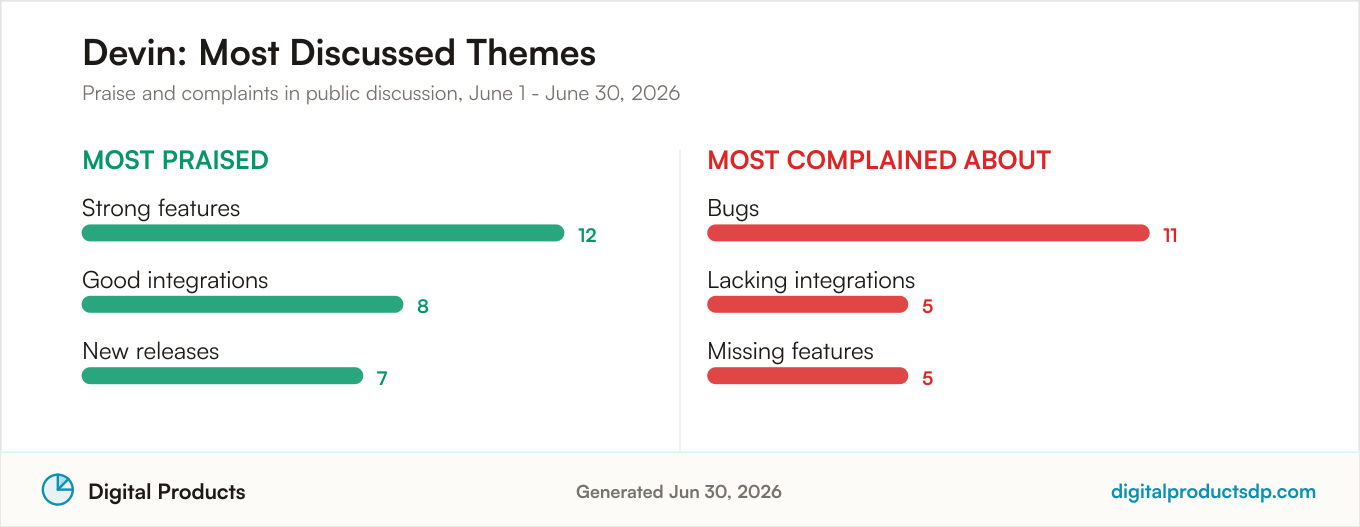
On the praise side, strong features led at 12 mentions, good integrations followed at 8, and new releases at 7. The presence of new releases near the top suggests active development that the community noticed, which is a healthy sign for a product still establishing itself in the agentic coding space.

The complaints centered on completeness and stability. Bugs drew 11 mentions, while lacking integrations and missing features each drew 5. For an ambitious autonomous tool, that pattern of bugs plus coverage gaps is fairly expected, and it explains a middle-of-the-pack score. What public discussion suggests is a promising but still-maturing agent that people are watching closely.

Most praised and most complained about themes for Devin from aggregated public discussion

Visit Devin

10. Replit

Replit Pulse Score trend from aggregated public discussion

Browser-based development platform Replit holds tenth with a Pulse Score of 50 on 75 mentions. It shares that score with Devin but carries a different shape: 35 percent positive, 33 percent neutral, just 1 percent mixed, and a notably high 31 percent negative. The near-even split between positive and negative, with very little mixed, points to a community that tends to land firmly on one side or the other.

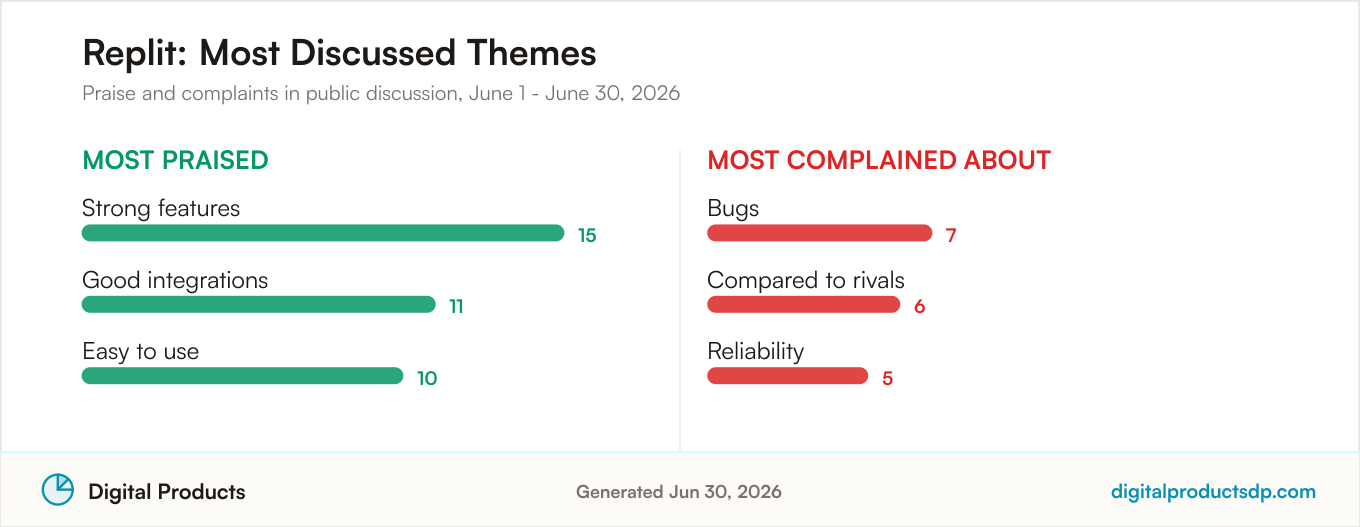
Its strengths spread across three familiar themes. Strong features led at 15 mentions, good integrations followed at 11, and ease of use at 10. That trio reflects Replit's long-standing appeal as an accessible, all-in-one environment where people can build without heavy setup, which continues to draw genuine appreciation.

The 31 percent negative share is what pulls it down. Bugs led complaints at 7 mentions, comparisons to rivals at 6, and reliability at 5. The rival comparisons in particular echo a competitive market where users are actively weighing alternatives. Read through public discussion, Replit remains an approachable and well-integrated platform contending with a sizable pocket of dissatisfaction this month.

Most praised and most complained about themes for Replit from aggregated public discussion

Visit Replit

11. Windsurf

Windsurf Pulse Score trend from aggregated public discussion

AI editor Windsurf takes eleventh with a Pulse Score of 50 across 59 mentions. Its discussion was the most neutral-leaning near the bottom of the list, at 47 percent, with 22 percent positive, 7 percent mixed, and 24 percent negative. When neutral discussion this heavily outweighs positive, a middle-of-the-road score follows almost by definition.

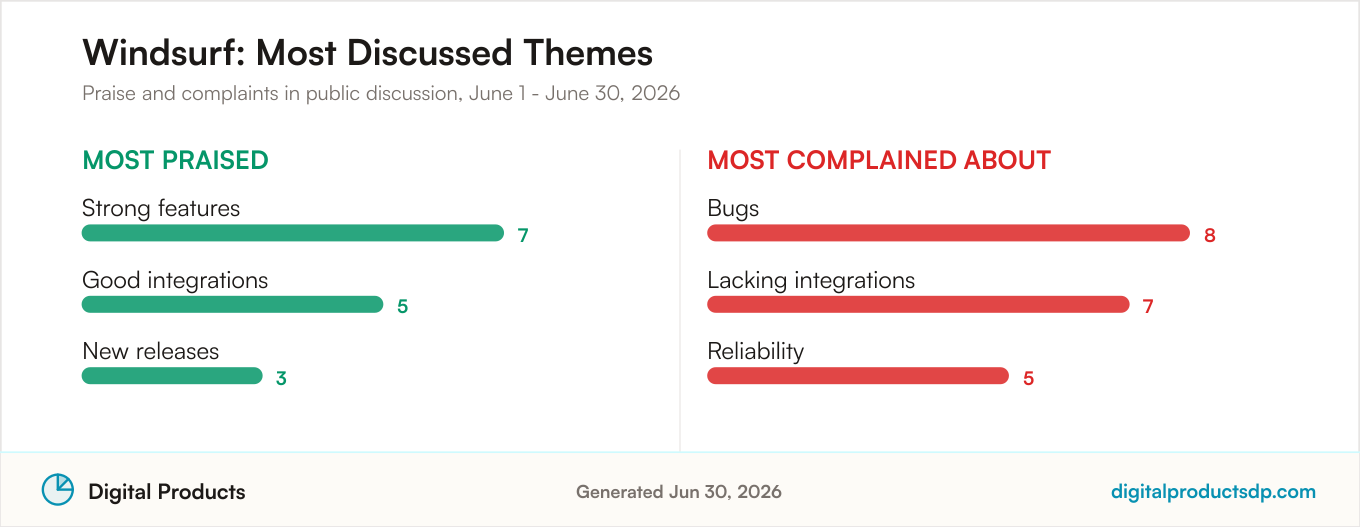
Its praise mirrored the pattern seen across the AI editor category. Strong features led at 7 mentions, good integrations followed at 5, and new releases at 3, indicating a product that people notice for its capabilities and its ongoing development. The modest absolute totals reflect its smaller conversation this month.

The complaints, however, edged out the praise in volume. Bugs led at 8 mentions, lacking integrations at 7, and reliability at 5. That the negative share exceeded the positive share is the core reason Windsurf sits where it does. Read through public discussion, Windsurf is a capable editor whose integration and stability gaps drew more attention than its wins during June.

Most praised and most complained about themes for Windsurf from aggregated public discussion

Visit Windsurf

12. 10Web

10Web Pulse Score trend from aggregated public discussion

AI website builder 10Web lands twelfth with a Pulse Score of 49 on 61 mentions. Its sentiment was the most neutral of the entire ranking, at 57 percent, with only 15 percent positive, 3 percent mixed, and 25 percent negative. A conversation that overwhelmingly neutral, with negative outweighing positive, produces one of the lower scores in the field.

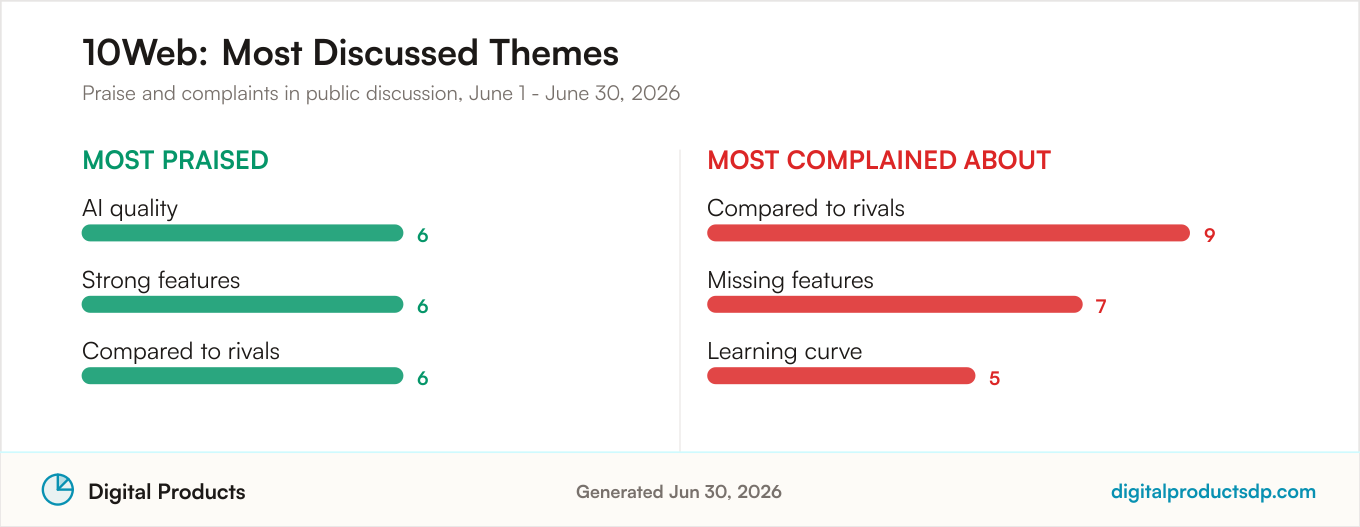
Interestingly, 10Web's praise and criticism collided on the same theme. Its top praised items were AI quality, strong features, and comparisons to rivals, each at 6 mentions, meaning some users cited it favorably against competitors. But comparisons to rivals also topped its complaints at 9 mentions, so the same competitive framing that helped it in some conversations hurt it in more.

Beyond those comparisons, missing features drew 7 complaint mentions and learning curve added 5. The learning-curve mentions are worth noting for a tool that markets itself on accessibility. Read through public discussion, 10Web is a tool that a lot of people mentioned in passing, that some rated well against rivals, and that others felt fell short on features and ease of onboarding.

Most praised and most complained about themes for 10Web from aggregated public discussion

Visit 10Web

13. Aider

Aider Pulse Score trend from aggregated public discussion

Rounding out the ranking, the command-line AI pair programmer Aider holds thirteenth with a Pulse Score of 49 on 39 mentions, the smallest sample among products that cleared our thresholds. Its sentiment ran 21 percent positive, a large 49 percent neutral, 5 percent mixed, and 26 percent negative. As with several tools near the bottom, a dominant neutral share paired with negative outweighing positive kept the score modest.

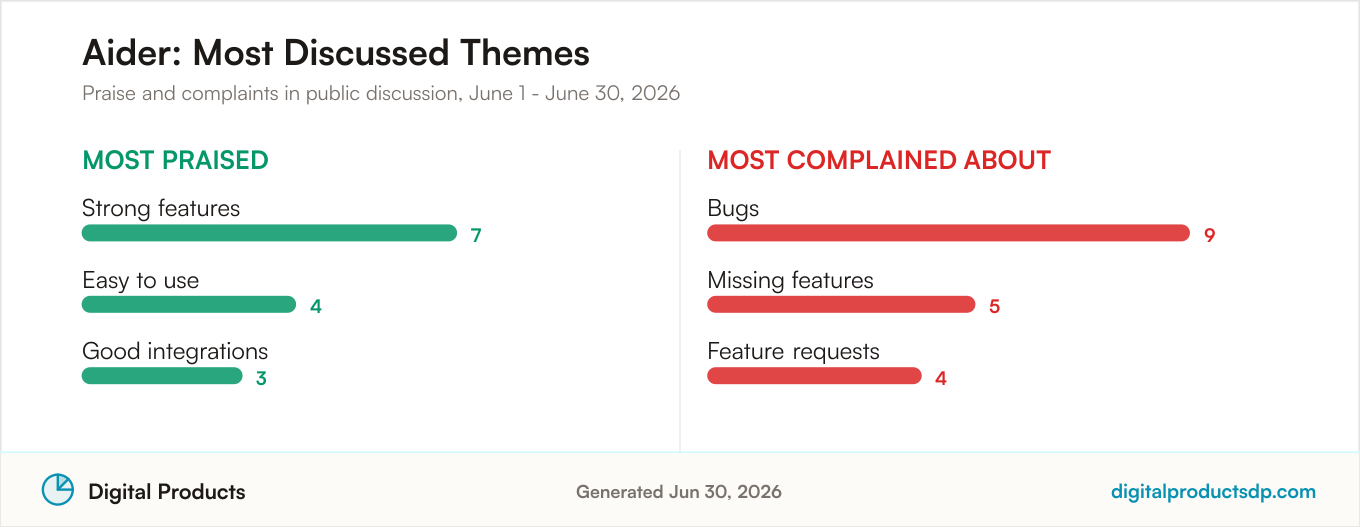
The praise it did attract was concentrated in familiar territory. Strong features led at 7 mentions, ease of use followed at 4, and good integrations at 3. For a terminal-first tool with a devoted following, those are the strengths you would expect its fans to highlight, even if the overall volume of enthusiasm was limited this month.

The complaint side was led firmly by bugs at 9 mentions, ahead of missing features at 5 and feature requests at 4. That bugs outnumbered every praised theme is the clearest reason Aider sits at the foot of the ranking. The feature-request mentions, though, show an engaged base that wants the tool to grow. Read through public discussion, Aider remains a well-liked tool among its core users that ran into a heavier-than-usual round of bug reports during June.

Most praised and most complained about themes for Aider from aggregated public discussion

Visit Aider

How This Ranking Works

Every position in this list comes from Pulse Scores measured across the full June 2026 period, from June 1 to June 30. The Pulse Score is a single 0 to 100 number that captures the overall tone of public online discussion about a tool, weighing how positive or negative that discussion was and how steady it stayed across the weeks in the window. Products are ranked strictly by that score, which is why a tool with only 21 mentions like Polygraph can finish ahead of one with 612 mentions like Claude Code: the ranking rewards the quality of sentiment, not the quantity of noise.

Because the scores are built from sentiment rather than benchmarks, the leaderboard tells you where the conversation was warmest and most consistent during the period, not which tool is technically superior. A high score means public discussion skewed favorable and stable; a lower score often reflects a heavy neutral share, a meaningful negative share, or both. Reading the theme breakdowns alongside the score is the best way to understand what actually drove each position, since two tools with the same score can get there for very different reasons, as Devin and Replit did this month.

About This Data

Pulse Scores summarize the tone of public online discussion on a 0 to 100 scale. They reflect community sentiment, not a verdict on a product's quality and not a recommendation to buy or avoid anything. A score is a snapshot of how people were talking about a tool during a specific window, and it should be treated as a starting point for your own research rather than a conclusion.

We report on complete calendar weeks only. Products with fewer than 10 relevant mentions in the period are excluded to avoid unstable reads on thin samples, and ranked products also need at least 2 complete weeks of discussion data in the period, so a single-week spike cannot carry a tool into the ranking. Public discussion is collected from Hacker News, Stack Exchange, GitHub, Bluesky, the Apple App Store, and YouTube.

Automated sentiment analysis is not perfect. It can misread sarcasm, jokes, or niche technical context, mention volumes vary widely between products, and scores can move from week to week as conversations shift. We share these figures to describe trends in discussion, not to make definitive claims about any product. Any company that wants to respond to how its tool is represented here is welcome to reach out. Note also that some Visit links may be affiliate links, and the site may earn a commission if you use them, but this never influences Pulse Scores or rankings. For a fuller explanation of how scores are calculated, see our methodology.

Frequently Asked Questions

Which coding tool ranks first in June 2026 and why?

Polygraph ranks first with a Pulse Score of 67. It led not because it was the most discussed tool, since it drew only 21 mentions, but because its discussion mix was exceptionally favorable at 71 percent positive with no neutral share and a contained 19 percent negative share. Praise centered on strong features, new releases, and good integrations, which together produced the cleanest sentiment profile in the field.

How is the Pulse Score ranking calculated?

Each tool is ranked by its Pulse Score, a 0 to 100 measure of the tone of public online discussion across the full June 2026 period. The score blends how positive or negative the conversation was with how consistent it stayed across complete weeks. Because it measures sentiment rather than volume or technical benchmarks, a tool with fewer but warmer mentions can outrank a tool with far more discussion but a heavier negative or neutral share.

How often does this ranking update?

The ranking reflects a specific period, in this case June 1 to June 30, 2026, and is rebuilt for each new reporting window using complete calendar weeks only. Scores can shift from one period to the next as discussion volume and tone change, so a tool's position here is a snapshot of that month rather than a permanent standing. Single-week spikes are excluded because ranked products need at least 2 complete weeks of data.

Does a high Pulse Score mean the tool is right for me?

Not necessarily. A high Pulse Score means public discussion about a tool was largely positive and steady during the period, but it does not account for your specific stack, budget, team size, or requirements. Claude Code, for example, drew hundreds of positive mentions yet also accumulated 72 bug complaints, while a smaller tool like Polygraph scored higher on lighter volume. Use the scores and theme breakdowns to guide your research, then test any tool against your own needs before committing.