Back to blog
Best Of

4 Best CRM Software in June 2026

July 7, 2026
4 Best CRM Software in June 2026

This ranking looks at how the CRM software community talked about its favorite (and least favorite) tools during June 2026. Rather than scoring features on a spec sheet or running a hands-on lab test, we measured the tone of real public discussion across a set of open sources, then translated that discussion into a single number we call a Pulse Score. The result is a snapshot of sentiment, not a laboratory verdict. It tells you what people were saying, how positive or negative that conversation leaned, and which themes came up again and again.

The window here is the complete calendar weeks that fall within June 1 to June 30, 2026. Every product below cleared our minimum thresholds for mention volume and weeks of coverage, which means each one had enough discussion to produce a reasonably stable read. Keep in mind that sentiment reflects the mood of online conversation, which can be shaped by outages, pricing changes, viral complaints, or a single well-shared thread. Treat the numbers as a directional signal about community perception, and read the theme breakdowns to understand what is actually driving each score.

RankProductCategoryPulse ScoreRelevant MentionsVisit
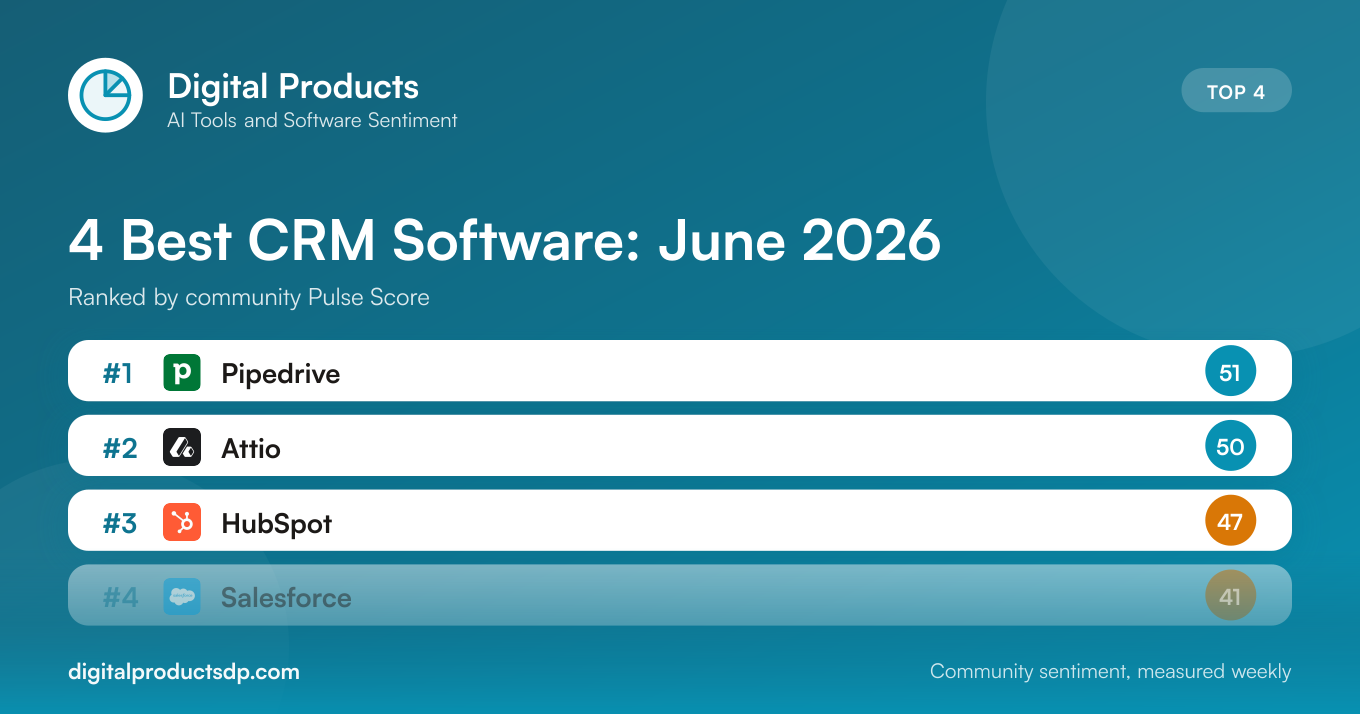
1PipedriveCRM5155Visit ↗
2AttioCRM5028Visit ↗
3HubSpotCRM47155Visit ↗
4SalesforceCRM41241Visit ↗

Taken as a whole, this is a tight ranking at the top and a wider gap at the bottom. Pipedrive and Attio finished within a single point of each other, at Pulse Scores of 51 and 50, even though their discussion mixes look nothing alike. HubSpot sits a few points back at 47 despite carrying by far the busiest conversation among the smaller players, with 155 mentions. Salesforce anchors the list at 41, weighed down by a heavily negative discussion mix across the largest sample in the group, 241 mentions. In other words, the highest Pulse Score here did not come from the most-discussed product, and the most-discussed product did not finish first. That contrast is worth holding in mind as you read each section.
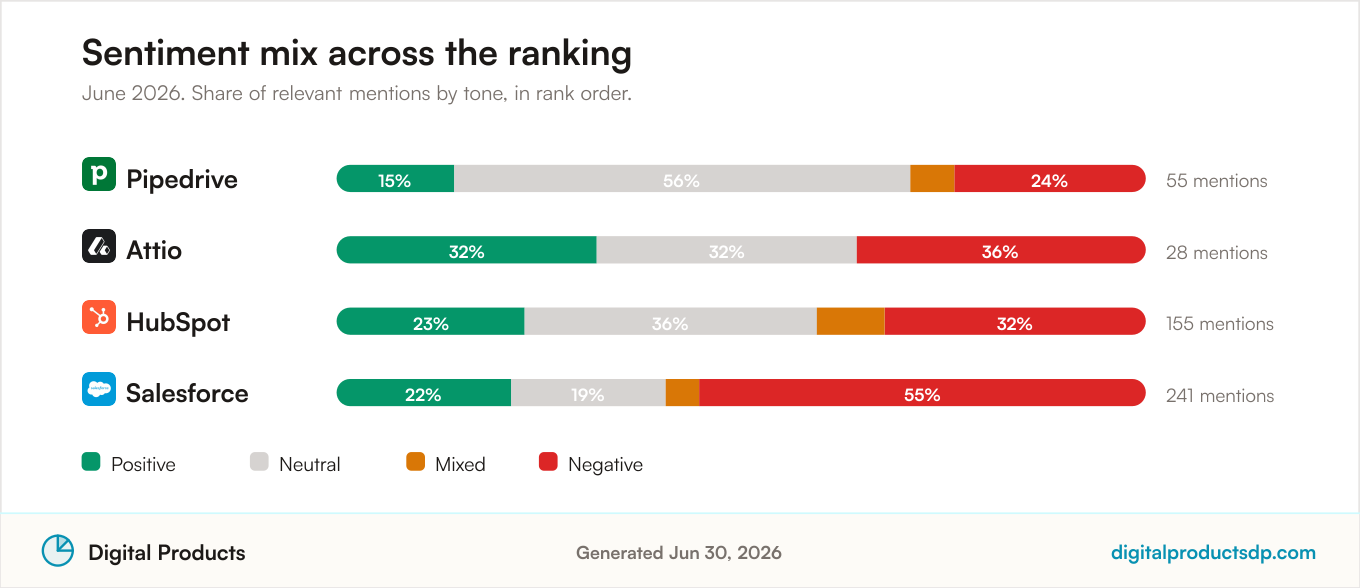
Positive, neutral, mixed, and negative discussion share for the 4 ranked CRM Software, June 2026

1. Pipedrive

Pipedrive Pulse Score trend from aggregated public discussion

Pipedrive takes the top spot in June 2026 with a Pulse Score of 51, drawn from 55 total mentions. What is interesting about that first-place finish is that it did not come from a wave of glowing praise. The discussion mix was actually dominated by neutral chatter, at 56 percent, with only 15 percent of mentions reading as clearly positive and 24 percent as negative. The remaining 5 percent landed as mixed. In a period where several rivals attracted sharply polarized conversation, Pipedrive's relatively steady, low-drama profile was enough to edge out the field.

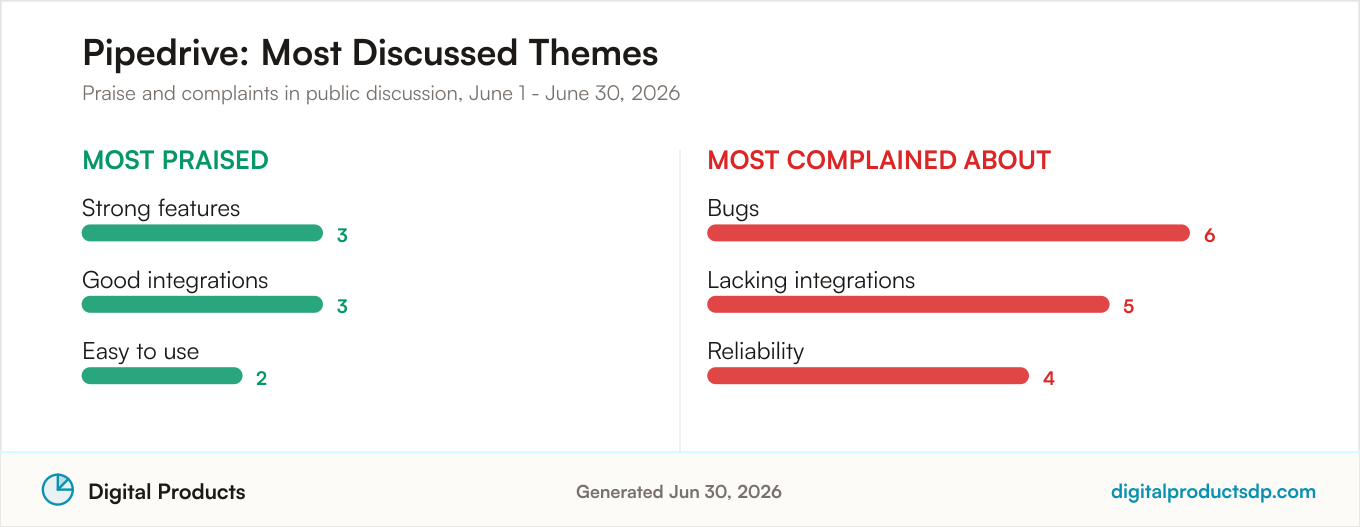
When people did praise Pipedrive, they tended to point at the same handful of things. Strong features came up three times, good integrations came up three times, and ease of use was mentioned twice. That combination paints a picture of a tool people find approachable and capable rather than flashy. The community read here suggests a product that does the core CRM job without demanding a steep learning curve, which is a recurring theme in how sales teams talk about it.

The criticism side is where the picture gets more cautious. Bugs were the single most common complaint, showing up in six mentions, followed by lacking integrations at five and reliability at four. Notice that integrations appear on both the praised and criticized lists. That tension is common in CRM discussion: the connectors people rely on get celebrated when they work and called out loudly when a needed one is missing or breaks. Because this is aggregated public sentiment rather than a support ticket audit, the honest read is that some users found the integration coverage solid while others hit gaps, and the bug reports suggest a segment of users ran into stability friction during the period.

Most praised and most complained about themes for Pipedrive from aggregated public discussion

Visit Pipedrive

2. Attio

Attio Pulse Score trend from aggregated public discussion

Attio lands in second place with a Pulse Score of 50, just one point behind Pipedrive, on a smaller sample of 28 mentions. The discussion mix tells a very different story than the leader, though. Attio's conversation was far more polarized: 32 percent positive, 32 percent neutral, zero percent mixed, and 36 percent negative. There was almost no fence-sitting here. People either liked what they saw or they did not, which is a pattern you often see with newer, opinionated products that ask users to work a certain way.

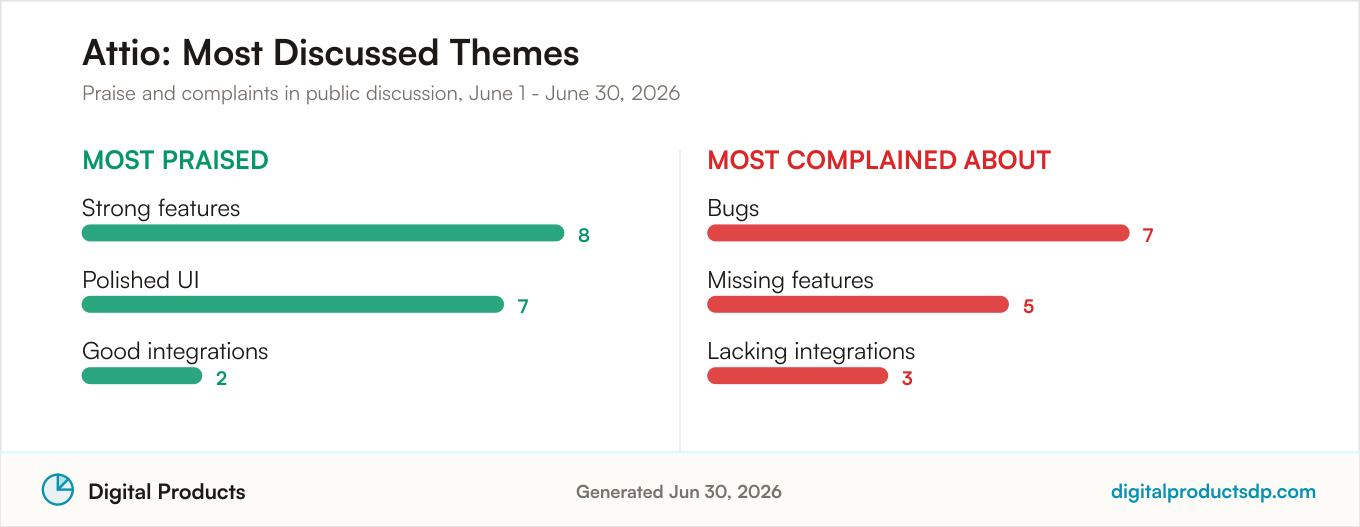
The praise for Attio was both loud and specific. Strong features led the way with eight mentions, polished UI followed closely with seven, and good integrations added two. That is an unusually high concentration of design-and-capability praise for a sample this size. The community sentiment suggests Attio has built a reputation for feeling modern and well-crafted, and the repeated mentions of a polished UI indicate that its interface is a genuine differentiator in how people talk about it.

On the other side, the complaints cluster around maturity. Bugs topped the list with seven mentions, missing features came up five times, and lacking integrations three times. Read together, these themes describe a product that impresses on first contact but where some users bump into rough edges or gaps once they push it into real workflows. Because 36 percent of the discussion was negative, the score held below Pipedrive's despite a much higher positive share. The takeaway from public discussion is that Attio generates enthusiasm and frustration in roughly equal measure, and where you land may depend on how many of those missing features and integrations matter to your team.

Most praised and most complained about themes for Attio from aggregated public discussion

Visit Attio

3. HubSpot

HubSpot Pulse Score trend from aggregated public discussion

Third place goes to HubSpot, which posted a Pulse Score of 47 on 155 mentions. That is a substantial volume of discussion, more than five times what Attio generated, and it gives this read more stability than the smaller samples above it. The mix leaned neutral overall, at 36 percent, with 23 percent positive, 8 percent mixed, and 32 percent negative. A product this widely used naturally attracts a broad spectrum of opinion, and HubSpot's sentiment reflects exactly that breadth.

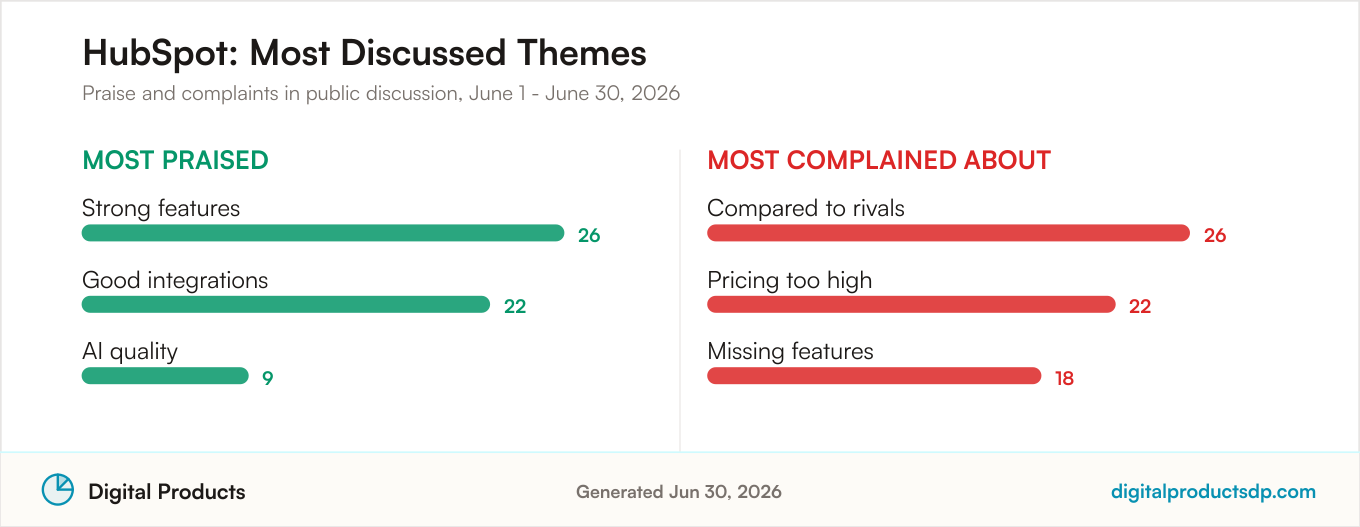
The praise was heavy and consistent. Strong features drew 26 mentions, good integrations pulled 22, and AI quality was cited nine times. That AI theme is worth flagging, because it shows up as a genuine positive rather than a complaint, which is not something every tool in this category can claim. Between the feature depth, the integration ecosystem, and favorable notes on its AI capabilities, the community discussion positions HubSpot as a mature, capable platform that people generally trust to do a lot.

What held it to third was the shape of the criticism. The most common complaint, appearing in 26 mentions, was HubSpot being compared unfavorably to rivals. Pricing too high followed with 22 mentions, and missing features accounted for 18. Those are not stability complaints so much as value-and-positioning complaints. People seem to like what HubSpot does but wrestle with what it costs and how it stacks up against alternatives. When a third of your discussion is negative and a large chunk of that centers on price and competitive comparison, it pulls the Pulse Score down even when the feature praise is strong. The public read is of a well-regarded platform whose main friction point is cost justification rather than core capability.

Most praised and most complained about themes for HubSpot from aggregated public discussion

Visit HubSpot

4. Salesforce

Salesforce Pulse Score trend from aggregated public discussion

Salesforce rounds out the ranking at number four with a Pulse Score of 41, and it did so while generating the largest conversation in the entire group by a wide margin: 241 mentions. High volume cuts both ways. It makes the read more statistically stable, but it also means a heavily negative mix carries real weight. Salesforce's mix was 22 percent positive, 19 percent neutral, 4 percent mixed, and a striking 55 percent negative. More than half of the discussion leaned negative, which is what separated it from the pack and set its score notably lower than the others.

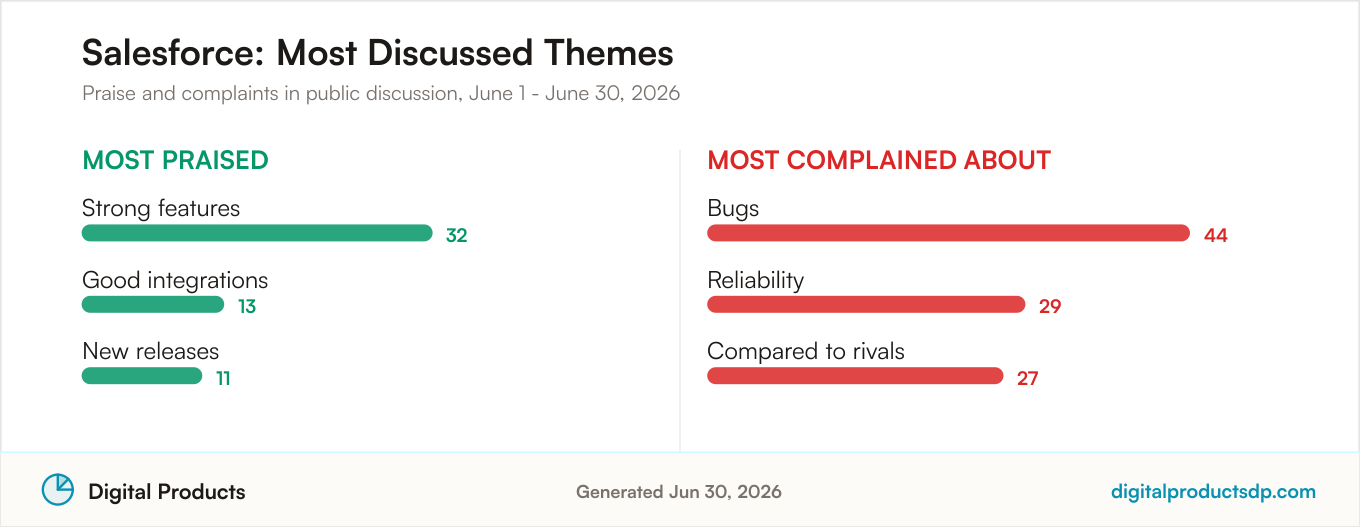
Despite that, there was plenty of praise to be found. Strong features led with 32 mentions, good integrations followed with 13, and new releases were cited 11 times. Those numbers reflect the reality of a deeply entrenched enterprise platform: people acknowledge its power, its breadth, and its steady release cadence. The community clearly recognizes what Salesforce can do, and the feature praise here is the highest raw count of any single positive theme across all four products.

The problem was on the complaint side, where the volume was overwhelming. Bugs dominated with 44 mentions, reliability concerns added 29, and unfavorable comparisons to rivals came up 27 times. That is a lot of frustration concentrated on stability and dependability. When the two loudest themes are bugs and reliability, the picture that emerges from public discussion is of a powerful system that a meaningful share of users found frustrating to depend on during the period. It is important not to overstate this: 241 mentions on a platform this large will always surface a big pool of complaints, and heavy usage tends to generate heavy criticism. But sentiment scoring reads the mix as it stands, and a 55 percent negative share is what placed Salesforce fourth this month.

Most praised and most complained about themes for Salesforce from aggregated public discussion

Visit Salesforce

How This Ranking Works

The order of this list comes directly from Pulse Scores measured over the June 2026 period, not from our own opinions about which CRM is best. Each product's Pulse Score is a 0 to 100 number that summarizes the tone of public online discussion during the complete calendar weeks inside the window. Pipedrive led at 51, Attio followed at 50, HubSpot came in at 47, and Salesforce closed the list at 41. When two products finish close together, as Pipedrive and Attio did with just one point between them, that gap should be read as narrow rather than decisive.

Notice that the ranking does not track mention volume. Salesforce had by far the most discussion at 241 mentions and finished last, while Attio had the fewest ranked mentions at 28 and finished second. That is by design. The score reflects the balance of positive, neutral, mixed, and negative sentiment in the conversation, so a smaller but more favorable discussion can outrank a much larger but more negative one. Volume tells you how much attention a product is getting; the Pulse Score tells you how that attention leaned. Reading both together, along with the praised and criticized themes, gives you a fuller picture than any single number can on its own.

About This Data

Pulse Scores summarize the tone of public online discussion on a 0 to 100 scale. They reflect community sentiment during a specific period, not a verdict on a product's quality and not a recommendation to buy or avoid anything. A higher score means the conversation leaned more favorably during the window; it does not mean the product is objectively better for your particular needs.

We report on complete calendar weeks only, so partial weeks at the edges of a month do not distort the read. Products with fewer than 10 relevant mentions in the period are excluded, because thin samples produce unstable scores that can swing wildly on a single post. Ranked products also need at least 2 complete weeks of discussion data within the period, which keeps one-off single-week spikes from entering the ranking and inflating a score that would not hold up over time.

Public discussion is collected from Hacker News, Stack Exchange, GitHub, Bluesky, the Apple App Store, and YouTube. We want to be honest about the limits of this approach. Automated sentiment analysis can misread sarcasm, jokes, and niche context, so an ironic comment might be scored as genuine praise or a technical aside might be flagged as a complaint. Mention volumes vary widely between products, as this month's range from 28 to 241 shows, and scores can move from week to week as conversation shifts. If you represent a company covered here and want to respond or add context, we welcome you to reach out.

Finally, some of the Visit links in this article may be affiliate links, which means the site may earn a commission if you sign up through them. That never influences Pulse Scores or rankings, which are calculated from discussion data alone before any commercial consideration enters the picture. For a fuller explanation of how the numbers come together, see our methodology.

Frequently Asked Questions

Which CRM ranks first in June 2026 and why?

Pipedrive ranks first with a Pulse Score of 51 across 55 mentions. It did not win on the strength of overwhelming praise; its discussion was actually 56 percent neutral with only 15 percent positive. Instead, its relatively low-drama profile and lighter negative share of 24 percent edged out Attio at 50 in a very tight finish. Community praise centered on strong features, good integrations, and ease of use, while the main complaints were bugs and integration gaps.

How is this ranking calculated?

The ranking is ordered by Pulse Score, a 0 to 100 measure of the tone of public online discussion during the complete calendar weeks in June 2026. We pull mentions from Hacker News, Stack Exchange, GitHub, Bluesky, the Apple App Store, and YouTube, then score the balance of positive, neutral, mixed, and negative sentiment. Products need at least 10 mentions and 2 complete weeks of data to qualify, and mention volume does not factor into the position itself.

How often does this ranking update?

Scores are built from complete calendar weeks, and this particular list covers June 1 to June 30, 2026. Because sentiment shifts as new discussion accumulates week to week, the standings can change in future periods. A product that finished high one month can slip if bug reports or pricing complaints pile up, just as a lower-ranked tool can climb if its conversation turns more favorable. Treat each edition as a snapshot of its own window.

Does a high Pulse Score mean a CRM is right for everyone?

No. A high Pulse Score only means public discussion leaned favorably during the period; it is not a promise that the tool fits your team, budget, or workflow. HubSpot, for example, drew heavy praise for features and AI quality yet also faced 22 mentions about pricing being too high. The right choice depends on what you need, so use the theme breakdowns and your own trials alongside these scores rather than treating any number as a final answer.