Back to blog
Best Of

6 Best AI Image Tools in June 2026

July 3, 2026
6 Best AI Image Tools in June 2026

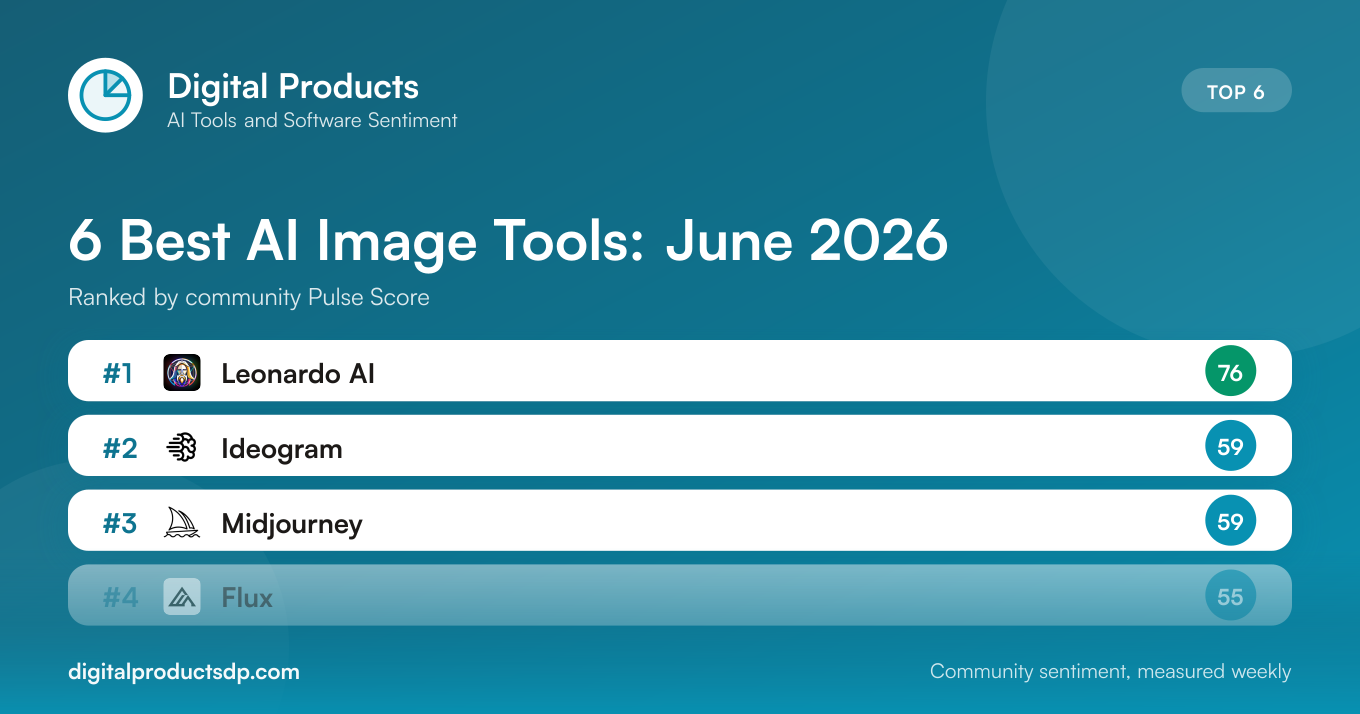
Choosing an AI image tool has become less about which one exists and more about which one people actually trust once the novelty wears off. This ranking looks at the six AI image tools that generated the most measurable public discussion between June 1 and June 30, 2026, and orders them by Pulse Score, a 0-100 measure that summarizes the overall tone of that discussion. The goal is not to crown a technical winner but to show what the community mood looked like over a full month, and to make that mood legible with numbers rather than vibes.

Every figure here comes from aggregated public conversation collected across several platforms, then scored for sentiment. We track how positive, neutral, mixed, or negative the discussion skewed, how many total mentions each tool drew, and which themes people praised or complained about most. Because sentiment analysis reads language rather than facts, treat these scores as a snapshot of reputation and chatter, not as a verdict on image quality or a personal recommendation. With that framing in mind, here is how the six ranked tools stacked up for June 2026.

RankProductCategoryPulse ScoreRelevant MentionsVisit
1Leonardo AIAI Image7615Visit ↗
2IdeogramAI Image5991Visit ↗
3MidjourneyAI Image59133Visit ↗
4FluxAI Image55102Visit ↗
5Stability AIAI Image5518Visit ↗
6Stable DiffusionAI Image5054Visit ↗

Read as a group, the June rankings show a field where high mention volume and high positivity rarely arrive together. Leonardo AI tops the list with a Pulse Score of 76 built on a small but overwhelmingly positive sample, while the tools that dominated raw conversation, such as Midjourney at 133 mentions and Flux at 102, landed in the middle of the pack because their discussion carried a heavier load of criticism. Ideogram and Midjourney tied on 59, Flux and Stability AI tied on 55, and Stable Diffusion closed out the ranking at 50 with the most negative mix of any tool here. In short, public discussion suggests that a quieter, happier conversation can outrank a louder, more divided one.
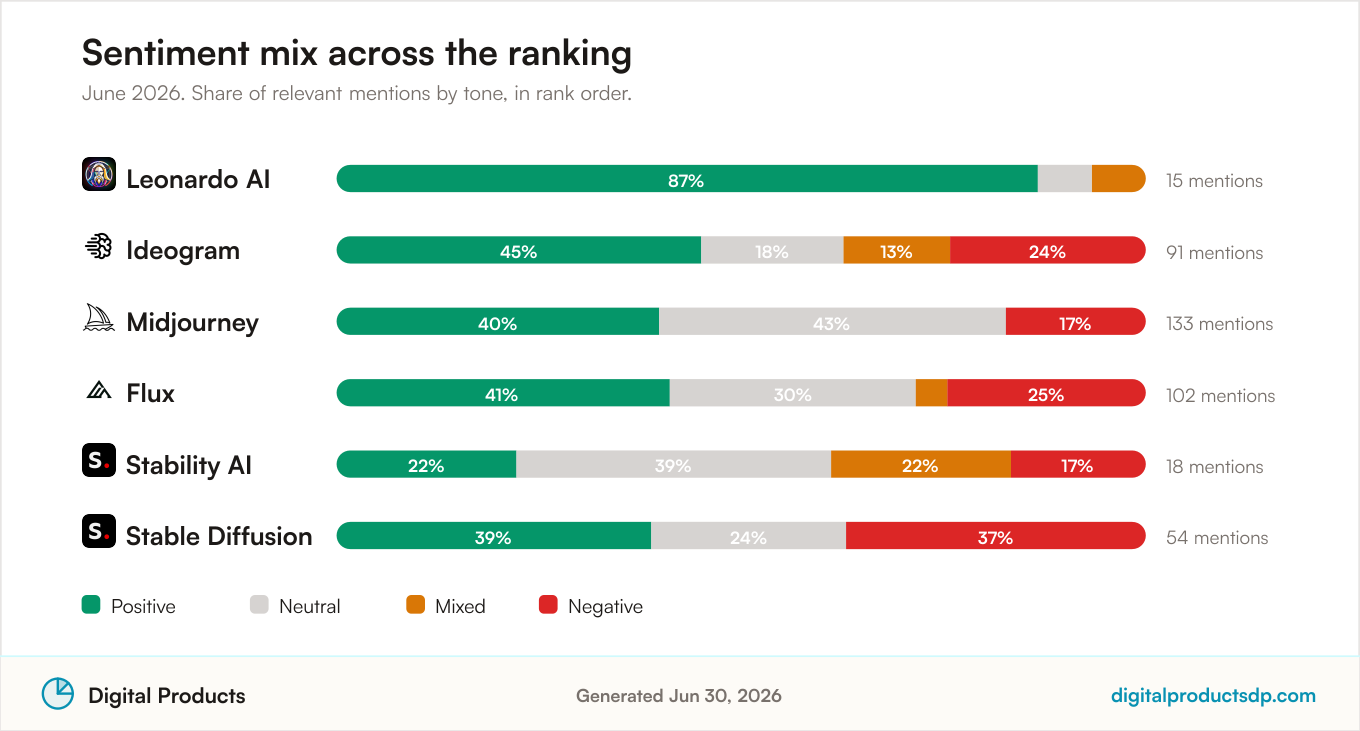
Positive, neutral, mixed, and negative discussion share for the 6 ranked AI Image Tools, June 2026

1. Leonardo AI

Leonardo AI Pulse Score trend from aggregated public discussion

Leonardo AI leads the June ranking with a Pulse Score of 76, the highest of any tool in this group. What makes that number stand out is the sentiment mix behind it: across 15 total mentions, discussion ran 87% positive, 7% neutral, and 7% mixed, with no negative mentions recorded at all. That is an unusually clean profile, and it is the main reason a tool with a modest mention count sits at the top.

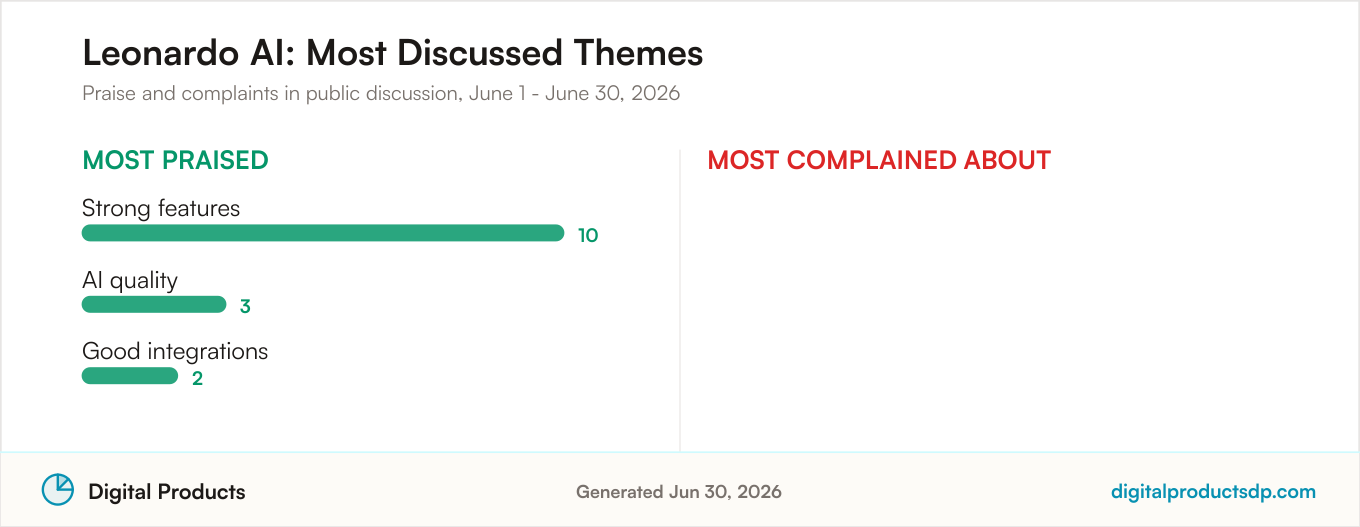
The praise clustered around a few clear themes. Strong features drew the most attention with 10 mentions, followed by AI quality with 3 and good integrations with 2. Taken together, the conversation suggests people who used Leonardo AI in June came away describing a capable, well-connected toolset rather than a single standout trick. The absence of any recurring complaint is worth noting, though it comes with a caveat.

That caveat is sample size. Fifteen mentions is enough to qualify for the ranking but small enough that a handful of new posts could shift the tone quickly. A Pulse Score of 76 built on a quiet, happy conversation is a genuine signal, but it is a narrower base than the triple-digit volumes further down the list. Public discussion here points to a tool people are pleased with, not necessarily one that has been stress-tested by a large and vocal crowd.

Most praised and most complained about themes for Leonardo AI from aggregated public discussion

Visit Leonardo AI

2. Ideogram

Ideogram Pulse Score trend from aggregated public discussion

Second place goes to Ideogram, which earned a Pulse Score of 59 across a much busier conversation of 91 total mentions. The sentiment split shows why it sits below Leonardo AI despite the larger sample: 45% of discussion was positive, 18% neutral, 13% mixed, and 24% negative. That is a meaningful chunk of criticism, and it pulls the score down from what the positive share alone might suggest.

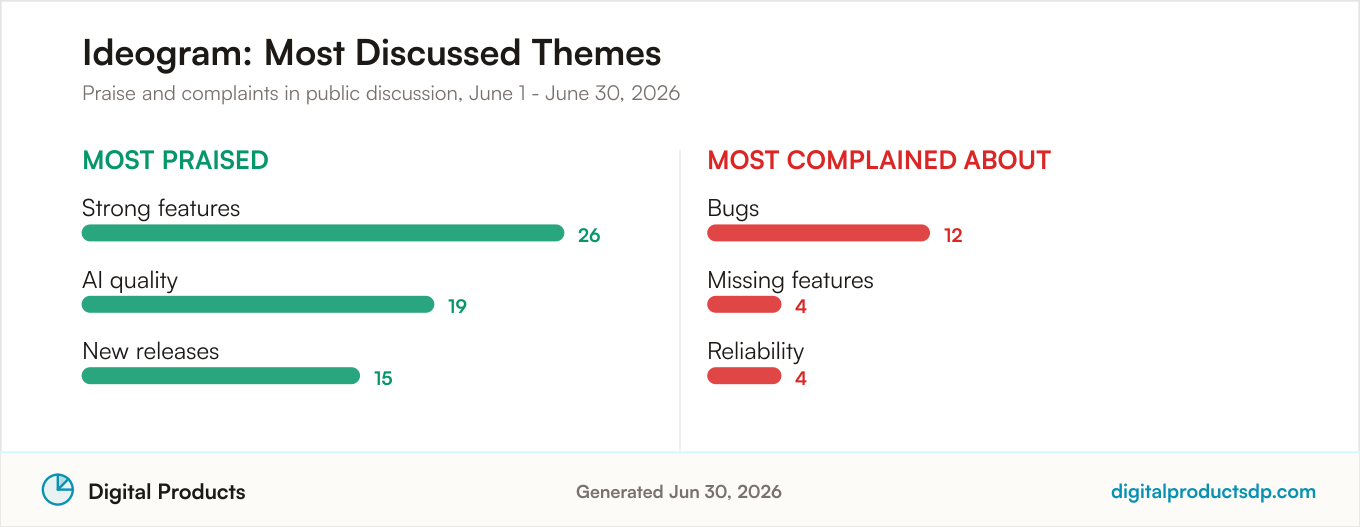
On the positive side, people talked most about strong features, which appeared 26 times, followed by AI quality at 19 and new releases at 15. The volume of new-release chatter hints at a tool that shipped actively during the period and kept people talking about what it could do. That momentum is part of what kept Ideogram near the top of the pack.

The complaints, though, were specific and recurring. Bugs led the negative themes with 12 mentions, while missing features and reliability each drew 4. In practical terms, the community discussion suggests a tool that many users like for its output but that some found rough around the edges in June. If you are weighing Ideogram, the takeaway from public sentiment is a capable, fast-moving product with a nontrivial bug conversation attached.

Most praised and most complained about themes for Ideogram from aggregated public discussion

Visit Ideogram

3. Midjourney

Midjourney Pulse Score trend from aggregated public discussion

Midjourney drew the most discussion of any tool in this ranking, with 133 total mentions, and it matched Ideogram's Pulse Score of 59. The sentiment profile here is distinctive: 40% positive, 43% neutral, 0% mixed, and 17% negative. That large neutral block is telling. A lot of the Midjourney conversation in June was descriptive or matter-of-fact rather than emotionally charged in either direction.

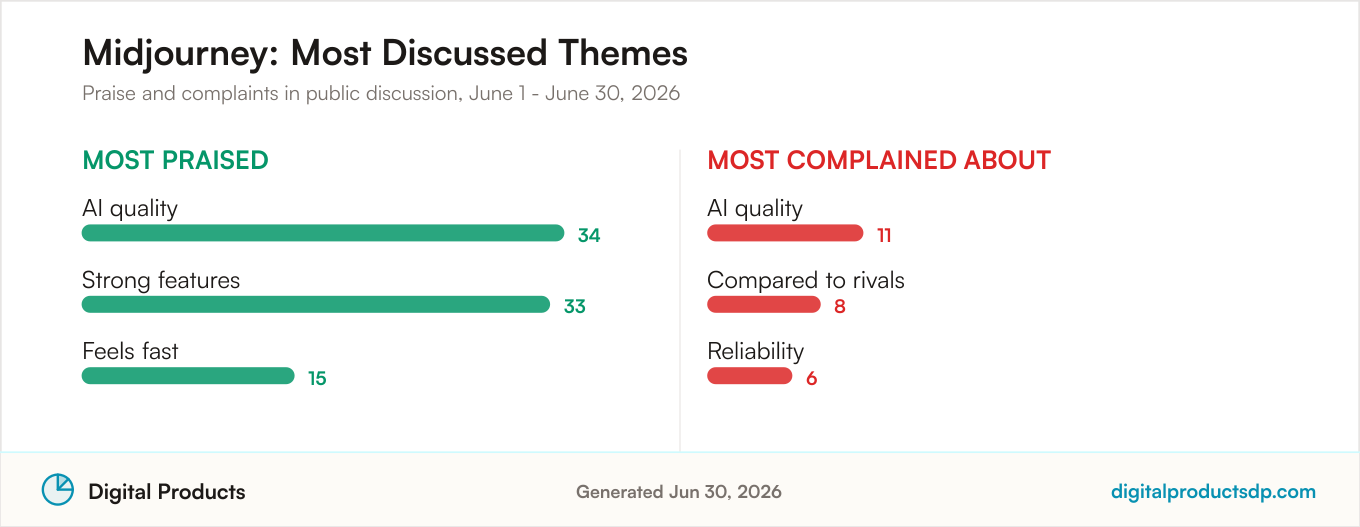
Where people did express enthusiasm, they focused on AI quality, which led all praise themes at 34 mentions, closely followed by strong features at 33 and a sense that the tool feels fast at 15. That combination points to a product with a reputation for output quality and responsiveness that remains firmly intact in public conversation.

Interestingly, AI quality also showed up as a complaint, with 11 mentions on the negative side, alongside comparisons to rivals at 8 and reliability at 6. The presence of quality on both lists suggests a community with high expectations that Midjourney does not always meet uniformly. Read as a whole, the discussion describes a heavily used, widely benchmarked tool that inspires steady confidence and steady scrutiny in roughly equal measure.

Most praised and most complained about themes for Midjourney from aggregated public discussion

Visit Midjourney

4. Flux

Flux Pulse Score trend from aggregated public discussion

Fourth place belongs to Flux, which posted a Pulse Score of 55 on the strength of 102 total mentions. Its sentiment breakdown reads 41% positive, 30% neutral, 4% mixed, and 25% negative. The positive share is competitive with the tools ranked above it, but the negative quarter of the conversation is what holds the score at 55 rather than higher.

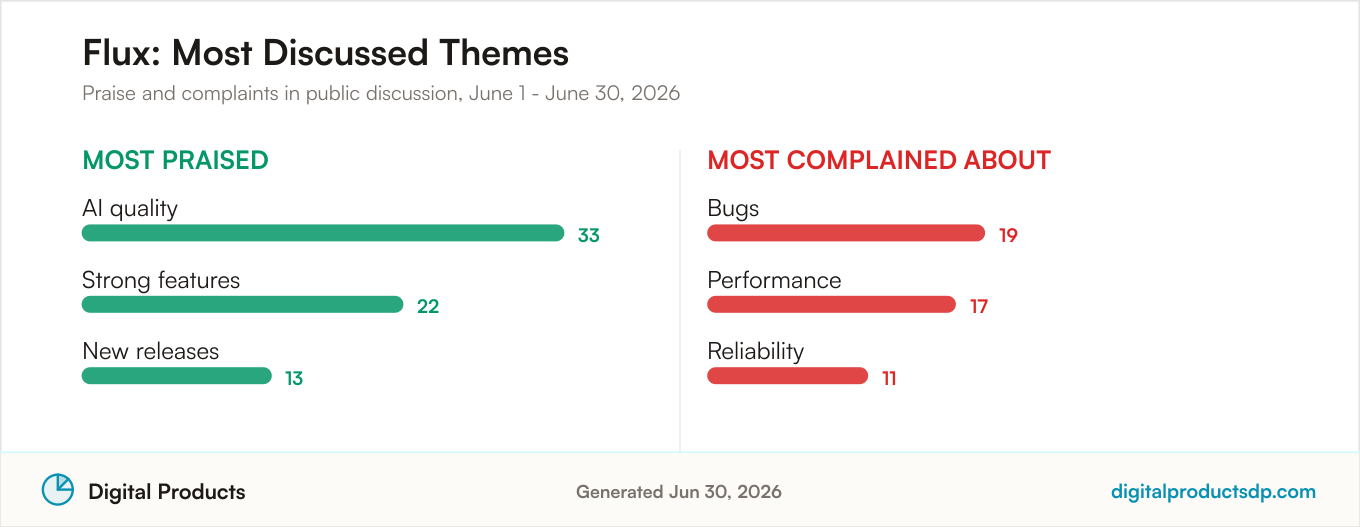
The praise themes look familiar and encouraging. AI quality led at 33 mentions, strong features followed at 22, and new releases drew 13. This is the profile of a tool that people rate highly for output and that shipped visible updates during the month, keeping it in active conversation.

The friction, however, was concentrated and technical. Bugs topped the complaints at 19 mentions, performance followed at 17, and reliability at 11. That is a substantial cluster of stability and speed concerns, and it is the clearest reason Flux trails the leaders despite strong quality praise. Public discussion suggests a tool many people admire for its results but that a meaningful group found inconsistent to run in June.

Most praised and most complained about themes for Flux from aggregated public discussion

Visit Flux

5. Stability AI

Stability AI Pulse Score trend from aggregated public discussion

Stability AI ties Flux on a Pulse Score of 55, but it gets there from a very different place. Its conversation was one of the smallest in the ranking at 18 total mentions, and the sentiment was notably split: 22% positive, 39% neutral, 22% mixed, and 17% negative. The dominant note here is neutrality, with a large share of discussion that neither praised nor criticized strongly.

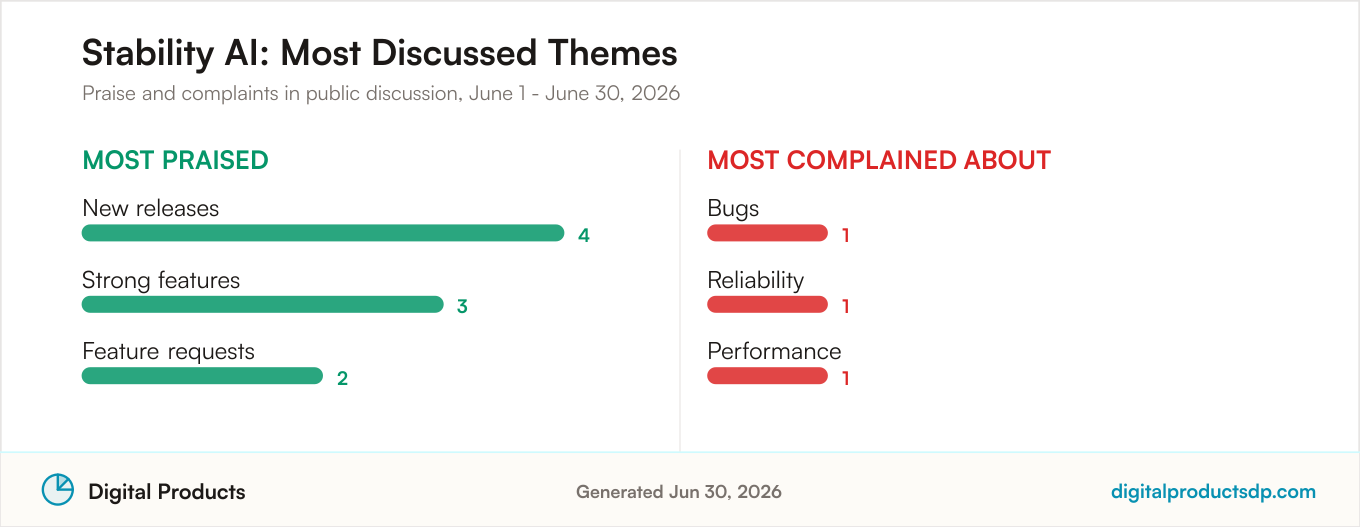
The positive themes centered on new releases, which appeared 4 times, followed by strong features at 3 and feature requests at 2. That mix of releases and requests paints a picture of an engaged audience watching what the company ships and asking for more, rather than a crowd expressing loud satisfaction.

On the negative side, the complaints were light and evenly spread: bugs, reliability, and performance each drew a single mention. With so few data points, none of these themes should be read as a dominant narrative. The honest interpretation is that June discussion around Stability AI was thin and measured, which keeps its score respectable but its signal cautious. Small samples like this can move quickly in either direction.

Most praised and most complained about themes for Stability AI from aggregated public discussion

Visit Stability AI

6. Stable Diffusion

Stable Diffusion Pulse Score trend from aggregated public discussion

Closing out the ranking is Stable Diffusion with a Pulse Score of 50, drawn from 54 total mentions. Its sentiment mix is the most polarized of the group: 39% positive, 24% neutral, 0% mixed, and 37% negative. That near-even split between clearly positive and clearly negative discussion is the defining feature of its June conversation, and it explains why it sits at the bottom of the list despite a healthy positive share.

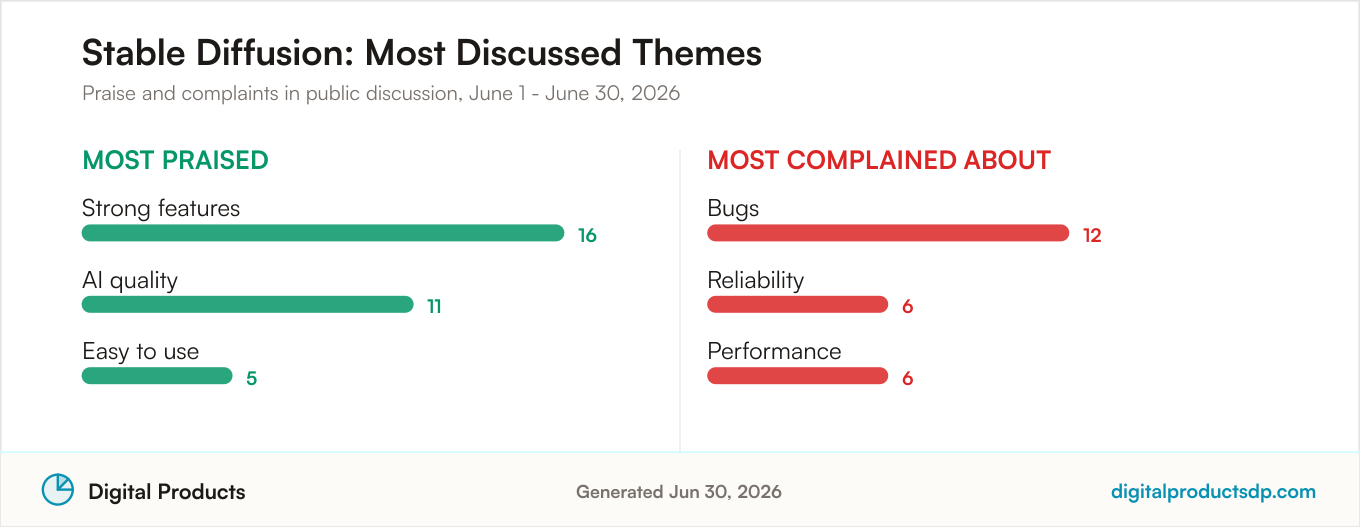
The praise was substantial where it appeared. Strong features led at 16 mentions, AI quality followed at 11, and ease of use drew 5. For a tool with a large open ecosystem, that combination reflects the flexibility and accessibility people have long associated with it.

The complaints, however, were heavier than for most tools here. Bugs led the negative side with 12 mentions, while reliability and performance each drew 6. That is a consistent trio of stability concerns, and it dragged the overall tone toward the negative end. Public discussion suggests a tool that continues to earn genuine appreciation for capability while frustrating a comparable number of people on the operational side. The result is a divided conversation and the lowest Pulse Score in this June ranking.

Most praised and most complained about themes for Stable Diffusion from aggregated public discussion

Visit Stable Diffusion

How This Ranking Works

This list is ordered entirely by Pulse Score across the period from June 1 to June 30, 2026. A Pulse Score is a single number on a 0-100 scale that condenses the overall tone of public discussion about a tool into one value. The higher the score, the more favorable the aggregated conversation skewed during the month. It is not an editorial rating, a benchmark result, or a measure of technical performance.

Because the ranking is sentiment-driven, the order does not always follow mention volume. Leonardo AI took the top spot with just 15 mentions because 87% of that discussion was positive and none was negative, while Midjourney generated 133 mentions but landed third on a more mixed and heavily neutral tone. Ideogram and Midjourney both scored 59, and Flux and Stability AI both scored 55, which is why their relative order reflects the finer details of their sentiment mixes and theme breakdowns rather than a wide gap in score.

When you read each section, the useful signals are the same three things: the Pulse Score itself, the positive-to-negative sentiment ratio, and the specific themes people raised. A tool praised for AI quality but flagged for bugs tells a different story than one praised for features with no complaints at all. Reading those patterns together gives a fuller sense of what the community actually experienced than any single number can.

About This Data

Pulse Scores summarize the tone of public online discussion on a 0-100 scale. They reflect community sentiment during a given period, not a verdict on a product's quality and not a recommendation to buy or avoid anything. A high score means people were talking positively; a low score means the conversation carried more criticism or neutrality. Neither should be mistaken for an objective measure of how good a tool is.

We report on complete calendar weeks only, and we exclude any product with fewer than 10 relevant mentions in the period to avoid unstable reads on thin samples. Ranked products also need at least 2 complete weeks of discussion data within the period, so a single-week spike cannot push a tool into the ranking on its own. These rules keep the list grounded in sustained conversation rather than momentary noise.

Public discussion is collected from Hacker News, Stack Exchange, GitHub, Bluesky, the Apple App Store, and YouTube. Automated sentiment analysis is not perfect: it can misread sarcasm, jokes, or niche context, mention volumes vary widely between products, and scores can move week to week as conversations shift. We share these numbers as a snapshot of mood, not as the final word. Any company that wants to respond to how its tool appears here is welcome to reach out. Some Visit links may be affiliate links, and the site may earn a commission, but this never influences Pulse Scores or rankings. For a fuller explanation of how scores are calculated, see our methodology.

Frequently Asked Questions

Which AI image tool ranks first in June 2026 and why?

Leonardo AI ranks first with a Pulse Score of 76, the highest in this group. It earned that position not through the largest conversation but through the most favorable one. Across 15 mentions, discussion ran 87% positive with no negative mentions, and praise focused on strong features, AI quality, and good integrations. Public discussion suggests a tool people were consistently pleased with, though its sample is smaller than the busier tools further down the list.

How is this ranking calculated?

The ranking is ordered by Pulse Score, a 0-100 measure that summarizes the tone of aggregated public discussion during the period from June 1 to June 30, 2026. We factor in the positive, neutral, mixed, and negative share of conversation, the number of mentions, and the themes people raised. Higher positivity and lower criticism lift the score. Because it is sentiment-based, a tool with fewer mentions can outrank a heavily discussed one if its conversation is clearly more favorable.

How often does this ranking update?

We report on complete calendar weeks only and build these rankings from full periods rather than partial ones. Scores can move from week to week as new discussion comes in, so a tool's position reflects its standing during the specific window covered, in this case June 2026. A ranked tool needs at least 2 complete weeks of data and at least 10 relevant mentions to appear, which keeps short-lived spikes from distorting the results.

Does a high Pulse Score mean the tool is right for everyone?

No. A high Pulse Score means public discussion skewed positive during the period, not that a tool will suit your particular workflow, budget, or output needs. Midjourney, for example, drew strong quality praise but also had AI quality show up as a complaint, which shows how the same tool can satisfy some users and frustrate others. Use the scores and theme breakdowns as one input alongside your own testing, and remember that sentiment reflects mood, not a personal recommendation.