AI Tools and Software Sentiment Report: Week of June 22, 2026
June 22, 2026
This week's report tracks aggregated public online discussion about AI tools and broader software, drawing on chatter pulled from Hacker News and YouTube review-video comments. The figures below summarize the tone of that conversation for the complete calendar week running from June 15, 2026 through June 22, 2026, set against the prior weeks in the digest window. Nothing here is a verdict on product quality. It is a snapshot of how people were talking.
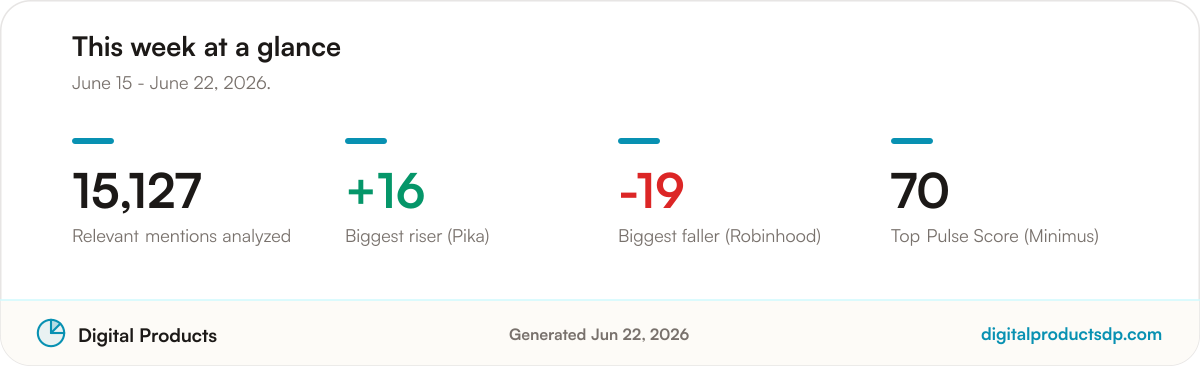
For the mentions analyzed for June 15, 2026 through June 22, 2026, we logged 15,127 relevant mentions across the digest. Of the 2,218 products tracked, 137 cleared the threshold of at least 10 relevant mentions and qualified for ranking. That leaves a wide field of products with too little discussion to score reliably, which we cover in the Watchlist. The sections that follow read the leaderboard, the category averages, the biggest movers, and the themes that shaped the week.
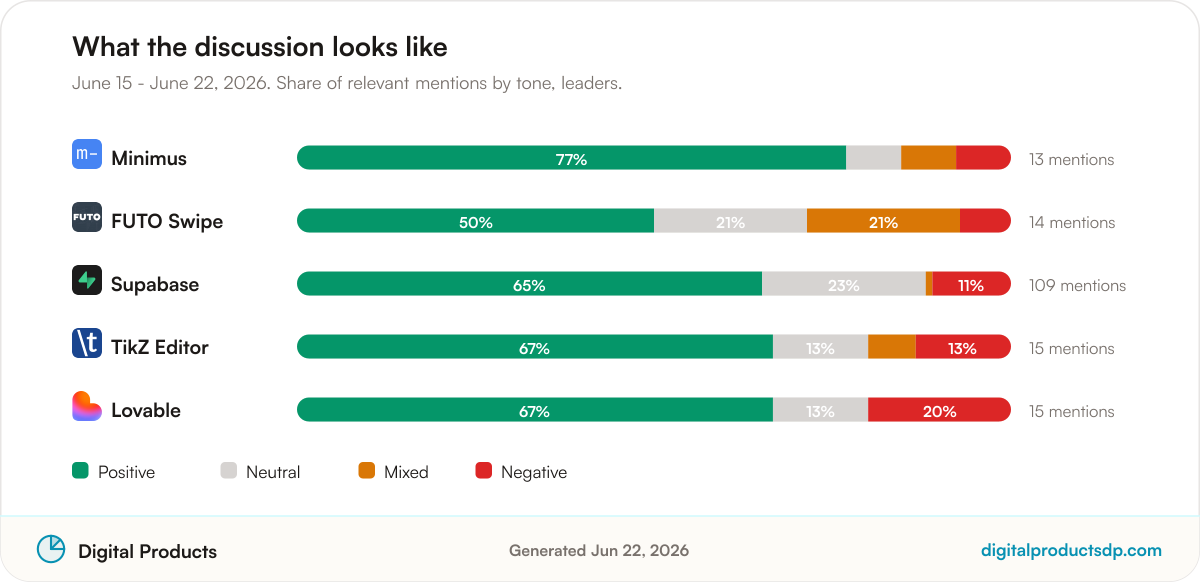
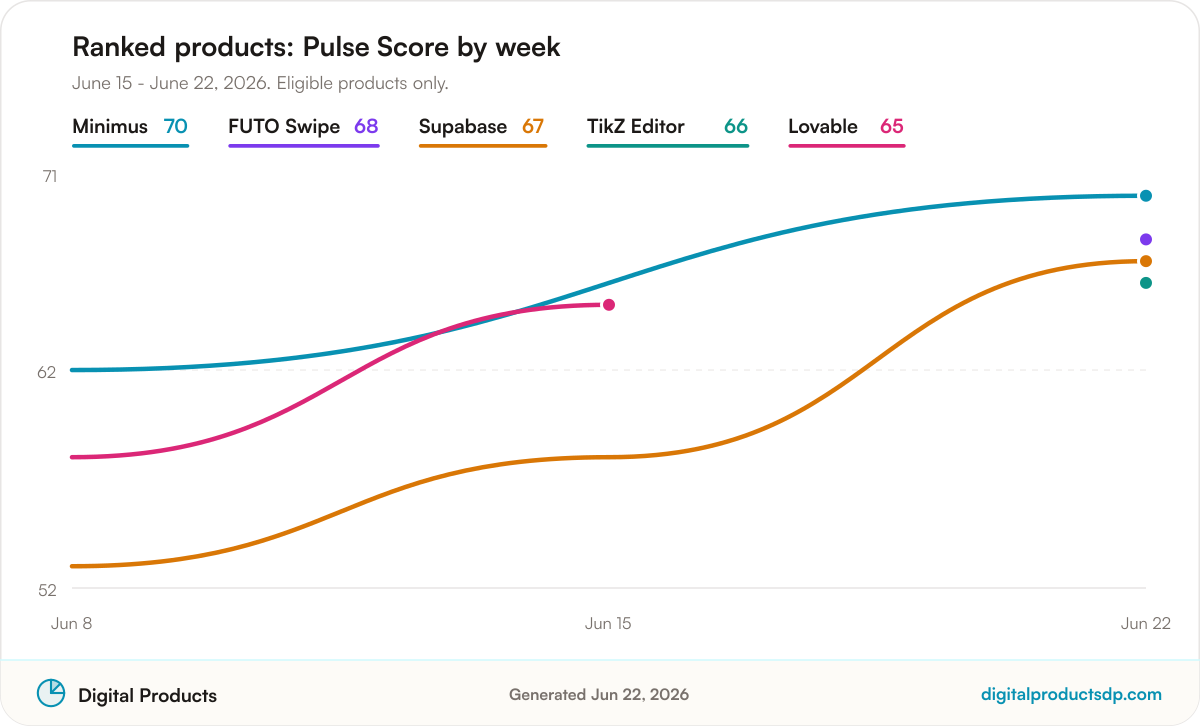
The top of the table is tight and built on thin samples. Minimus, a cloud-storage product, led with a Pulse Score of 70 based on 13 mentions over the period. FUTO Swipe followed at 68 based on 14 mentions, and TikZ Editor, a design tool, sat at 66 based on 15 mentions. Lovable, a coding product, rounded out the leaders at 65 based on 15 mentions. Each of these reads rests on small mention counts, so they should be treated as early signals rather than settled positions.
The exception is Supabase, the cloud-storage product that scored 67 based on 109 mentions over the period. That is a far larger sample than its neighbors at the top, which makes its placement the most stable read in the leading group. Supabase praise concentrated on strong features, with 59 mentions, easy to use with 56, and performance with 41, while its complaints stayed comparatively light at bugs with 5, downtime with 4, and reliability with 4.
Category View
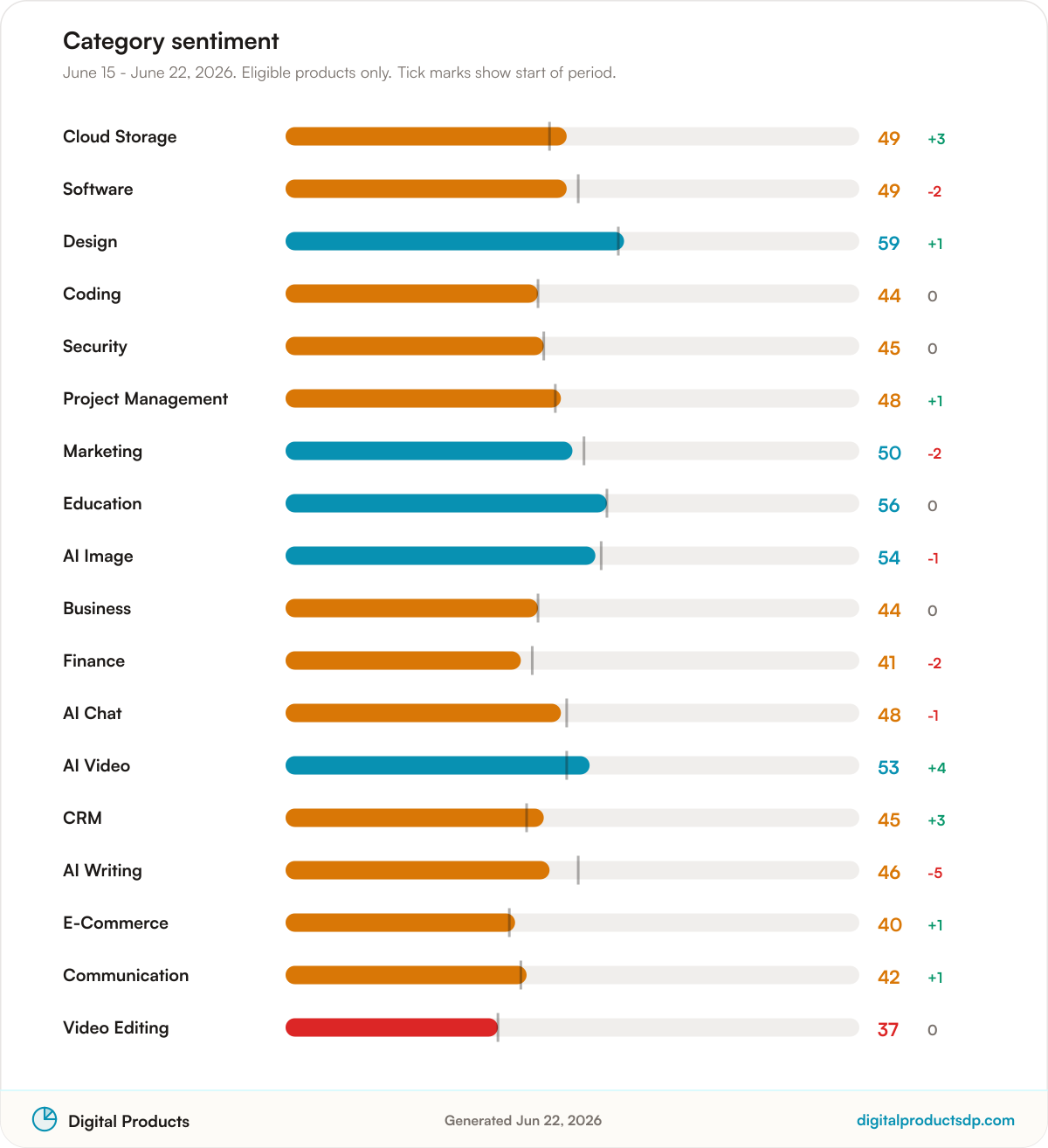
Category averages moved only modestly across the period. Design held the highest mood, edging from 58 to 59, with education steady at 56 and ai-image easing from 55 to 54. At the lower end, video-editing was flat at 37 and e-commerce inched from 39 to 40. The clearest upward drift came in ai-video, which rose from 49 to 53, and crm, which climbed from 42 to 45. On the softer side, ai-writing slipped from 51 to 46 and marketing eased from 52 to 50. Cloud-storage, home to leaders Minimus and Supabase, rose from 46 to 49, while coding, security, and business all held flat at 44, 45, and 44 respectively. These are aggregate moods across eligible products only, and the small shifts suggest a period without a single dominant story pulling whole categories in one direction.
Biggest Movers
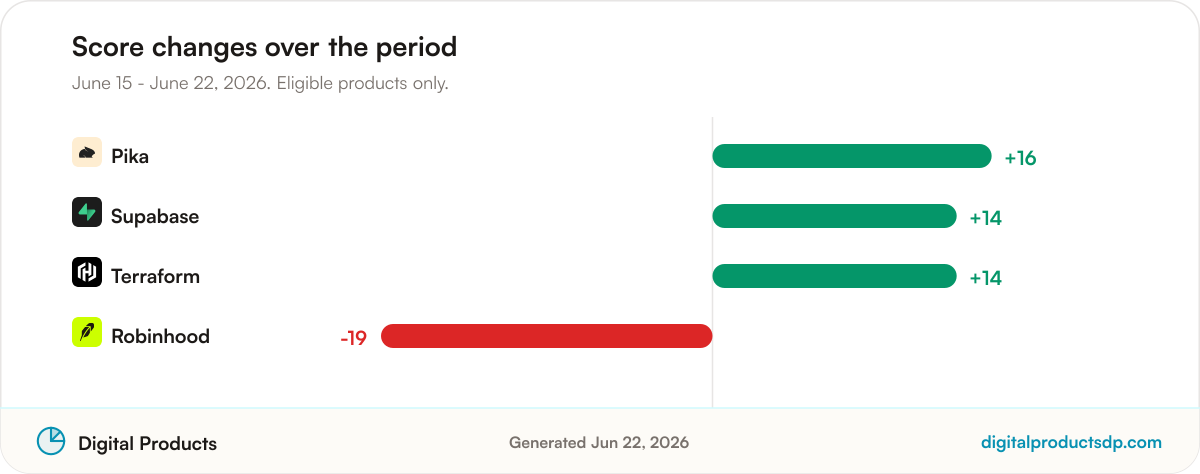
Pika rose the most, climbing from 38 to 54 for a gain of 16 points based on 25 mentions. Its latest-week praise leaned on polished UI with 6 mentions and strong features with 2, while complaints stayed limited to bugs with 4 and reliability with 3. The shift suggests discussion warmed toward its interface even as a thin stream of stability gripes persisted.
Supabase rose from 53 to 67, a gain of 14 points based on 109 mentions, the largest sample among the risers. Its weekly series moved steadily from 53 to 58 to 67. The praise mix of strong features, easy to use, and performance, set against modest bug and reliability complaints, lines up with a conversation that grew more favorable each week rather than spiking once.
Terraform also rose 14 points, from 20 to 34 based on 290 mentions. That remains a low absolute score, and its complaint load was heavy: bugs with 173 mentions, reliability with 116, and missing features with 74. Praise was comparatively sparse, led by feature requests with 11 and strong features with 8. The improvement reads as discussion lifting off a very low floor rather than turning positive.
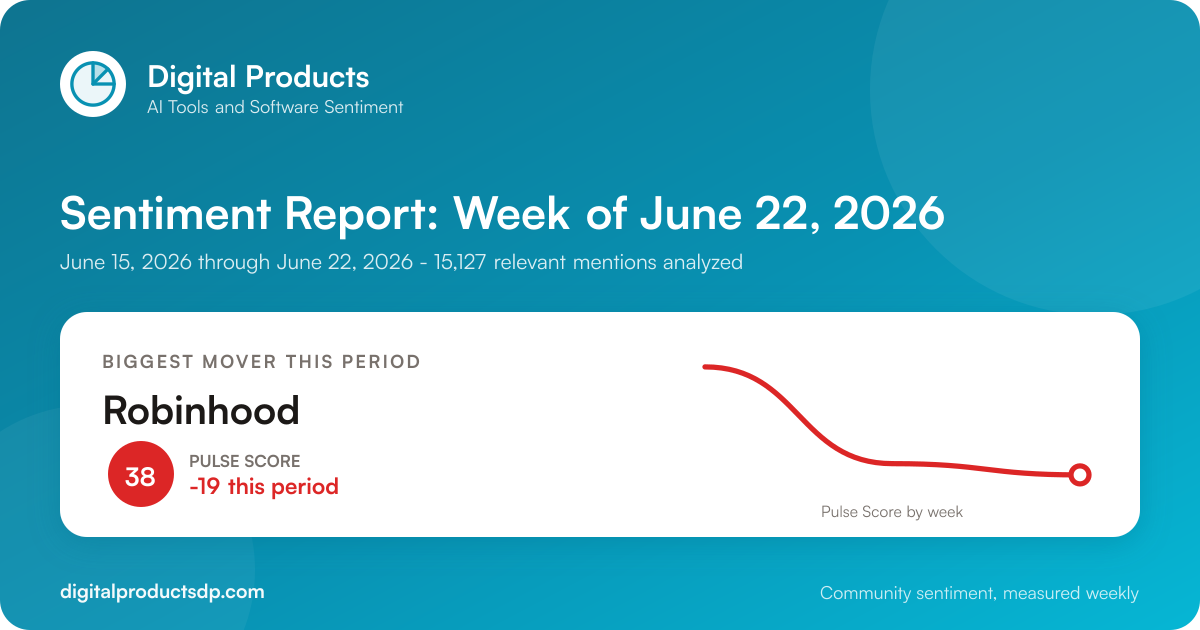
Robinhood fell the hardest, dropping from 57 to 38 for a 19-point decline based on 18 mentions. Its weekly series shows the break landing early, sliding from 57 to 40 by mid-period. Latest-week complaints centered on bugs with 11 mentions, reliability with 7, and lacking integrations with 3, outweighing thin praise for strong features and good integrations at 4 each.
Apollo.io fell from 46 to 35, an 11-point drop based on 10 mentions, the minimum sample for eligibility. It recorded no praise themes this period, while complaints flagged privacy concerns with 4 mentions and lacking integrations with 2. With praise absent entirely, the read here is fragile and worth revisiting as volume grows.
Grammarly fell from 54 to 44, a 10-point decline based on 63 mentions. Notably, its most-cited complaint was AI quality with 24 mentions, ahead of bugs with 15 and UI frustrations with 15. Praise still registered for strong features with 17 and easy to use with 14, but the concentration of AI-quality criticism is the clearest driver of the softer mood.
Spotlight: Minimus
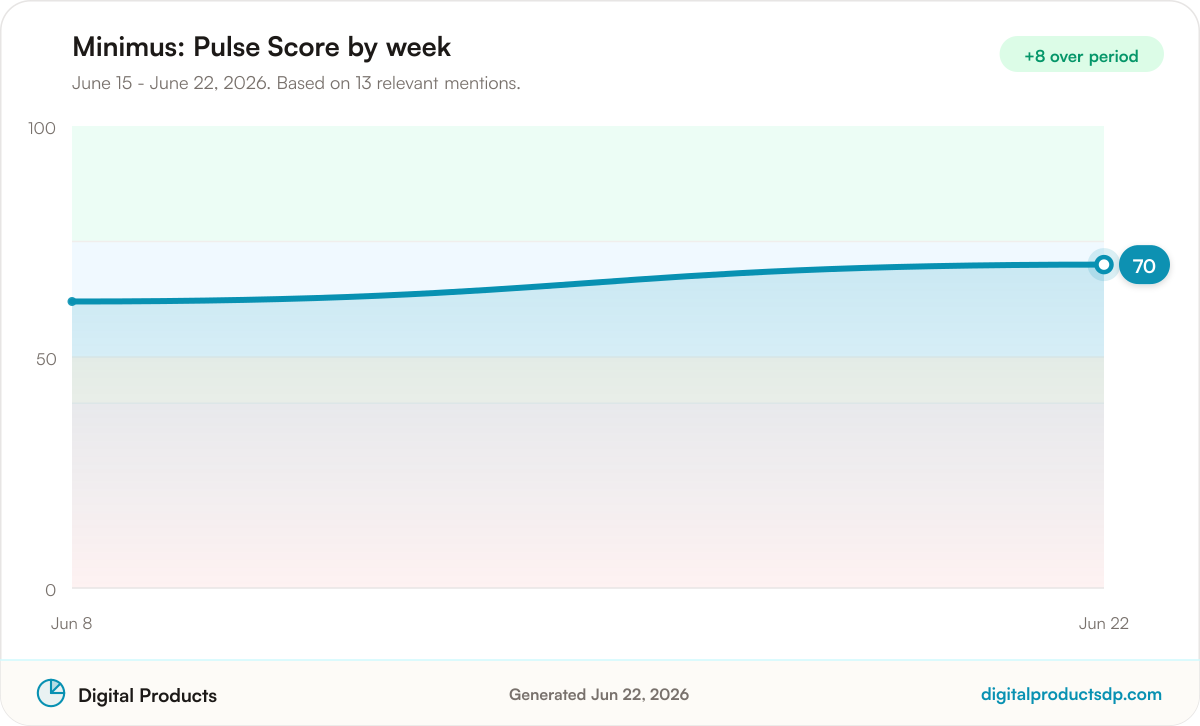
Minimus, a cloud-storage product, took the top Pulse Score this period at 70 based on 13 mentions over the period. Its weekly series shows movement from 62 on June 8, 2026 to 70 on June 22, 2026, an upward path even if the underlying sample is small. With only 13 mentions behind the latest read, the score should be read as a favorable but lightly-supported signal rather than a firmly established lead.
The theme detail helps explain the tone. Minimus praise centered on strong features with 11 mentions and security praise with 7, with pricing changes noted 4 times. Complaints were minimal, registering privacy concerns and poor support at just 1 mention each. A profile where praise heavily outnumbers complaints is consistent with the high score, though the thin volume means a handful of new comments could move the number meaningfully next week.
Because Minimus sits in cloud-storage alongside the far more discussed Supabase, the two together carried the category's improvement from 46 to 49. The contrast between them is instructive: Minimus shows what a high score looks like on a small sample, while Supabase shows a similar score holding up under far more scrutiny. Both are worth watching, but for different reasons.
Themes Driving the Conversation
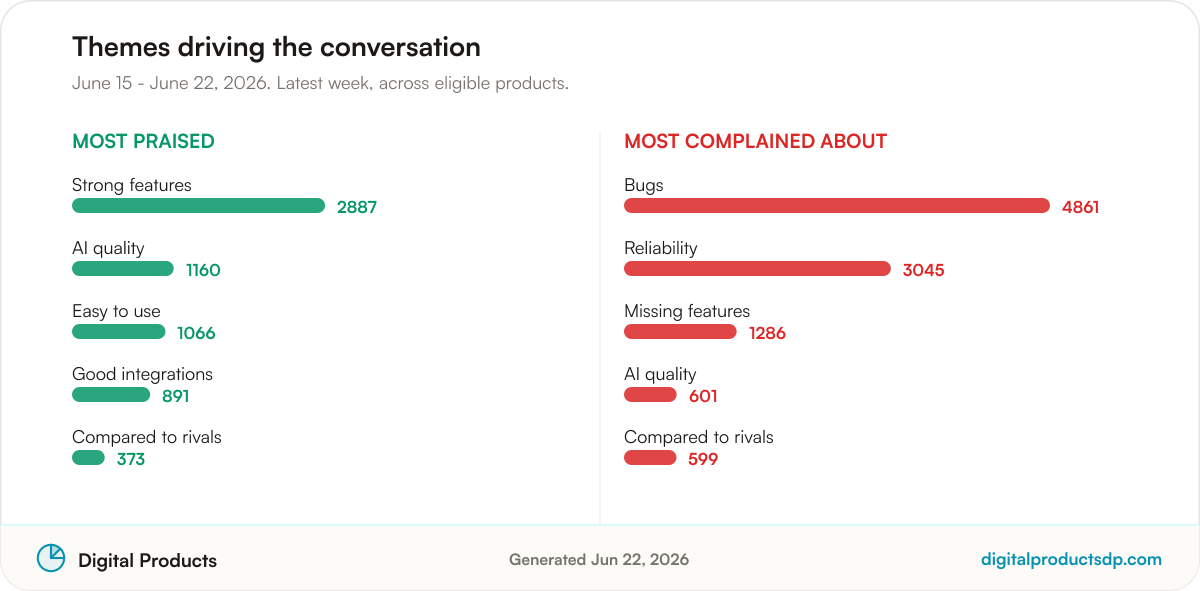
On the praise side, strong features dominated with 2,887 mentions, far ahead of AI quality with 1,160, easy to use with 1,066, good integrations with 891, and compared to rivals with 373. Strong features showed up across the board, from Claude Code with 249 mentions and Claude with 229 to ChatGPT with 183 and Stripe with 84. AI quality praise leaned on the large language and image conversations, including Claude with 234 mentions and ChatGPT with 159, while good integrations gathered around infrastructure and platform tools such as Tailscale with 77 and Prometheus with 69.
The complaint picture was led, decisively, by bugs at 4,861 mentions, ahead of reliability with 3,045, missing features with 1,286, AI quality with 601, and compared to rivals with 599. Bugs and reliability were the dominant strain for high-volume products: WooCommerce logged 330 bug mentions and 175 reliability mentions, Rancher 243 and 159, Loom 211 and 135, Stripe 188 and 158, and Terraform 173 and 116. The recurrence of these two themes across very different categories is the period's most consistent pattern, and it sits behind several of the lower category averages even as feature praise remains strong elsewhere.
Watchlist
A large number of tracked products did not clear the 10-mention threshold this period and are excluded from ranking. This reflects discussion volume, not quality. Among those closest to eligibility were Framer and Bitbucket, each with 9 relevant mentions, and a cluster at 8 mentions including LookAway, Shippo, Writesonic, Lusha, Vanta, and SentinelOne. Slightly behind them, several products logged 7 mentions, among them VEED, Tidio, Luma AI, Storyblok, SingleStore, Autopilot, ZoomInfo, ThorData, Evernote, Nhost, and SaneBox.
Many widely-known names registered little or no discussion in this window, including Dropbox, Slack, Zoom, GitHub, GitLab, and Cloudflare, each with 0 relevant mentions. That is a function of where this period's chatter was collected, namely Hacker News and YouTube review-video comments, and of the simple fact that mention volume varies enormously between products from one week to the next. A quiet week does not mean a product is doing poorly. It means there was not enough conversation to produce a stable read, so we hold off rather than publish a number we cannot stand behind.
What To Watch Next Week
First, watch whether the leaders built on thin samples hold their scores as volume changes. Minimus at 70 on 13 mentions, FUTO Swipe at 68 on 14, TikZ Editor at 66 on 15, and Lovable at 65 on 15 all rest on small counts, so even modest swings in new comments could reshape the top of the table. Supabase, at 67 on 109 mentions, is the read most likely to persist.
Second, watch the movers for follow-through. Pika gained 16 points to reach 54 and Terraform gained 14 to reach 34, but Terraform's score remains low against a heavy load of bug and reliability complaints. Whether those gains continue or fade will say more than a single week can.
Third, watch the bugs and reliability themes, which led complaints at 4,861 and 3,045 mentions respectively. They surfaced across products as varied as WooCommerce, Rancher, Loom, Stripe, and Terraform. If that pattern eases, several lower category averages could lift with it.
Frequently Asked Questions
Which tool had the highest Pulse Score this period?
Minimus, a cloud-storage product, had the highest Pulse Score at 70, based on 13 mentions over the period. Because the sample is small, the read is an early signal rather than a settled position.
Which product moved the most this period?
Pika rose the most, climbing from 38 to 54 for a 16-point gain based on 25 mentions, while Robinhood posted the steepest decline, dropping from 57 to 38, a 19-point fall based on 18 mentions.
What was the overall category mood?
Category averages shifted only slightly. Design was highest, moving from 58 to 59, while video-editing was lowest and flat at 37. The clearest gains came in ai-video, up from 49 to 53, and crm, up from 42 to 45.
How many mentions were analyzed this period?
A total of 15,127 relevant mentions were analyzed. Of 2,218 tracked products, 137 cleared the 10-mention threshold and qualified for ranking.
About This Data
Pulse Scores summarize the tone of public online discussion on a 0-100 scale and reflect community sentiment. They are not a verdict on a product's quality and not a recommendation. We report on complete calendar weeks only, and products with fewer than 10 relevant mentions in the period are excluded from rankings to avoid unstable reads on thin samples.
Public discussion is collected from Hacker News, Stack Exchange, GitHub, Bluesky, the Apple App Store, and YouTube. Automated sentiment analysis can misread sarcasm, jokes, or niche context, mention volumes vary widely between products, and scores can move week to week. Any company that wants to respond is welcome to reach out. For how scores are calculated, see our methodology.