AI Tools and Software Sentiment Report: Week of May 25, 2026
May 25, 2026
This report tracks aggregated public online discussion of AI tools and broader software, turning community chatter into Pulse Scores that summarize the tone of that conversation. The figures here reflect mentions analyzed for May 18, 2026 through May 25, 2026, the most recent complete calendar week in our window, read alongside the surrounding weeks to give movement context.
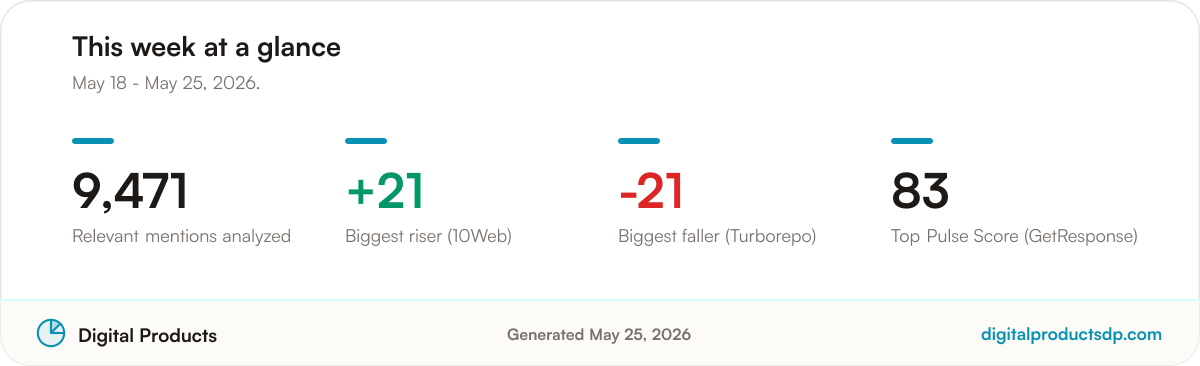
Across the period running from May 18, 2026 through May 25, 2026, we processed 9,471 relevant mentions spread across 134 products that cleared our minimum threshold for ranking. The products span many categories, from marketing platforms and CRMs to coding tools, AI image generators, and cloud infrastructure, so the language below names categories specifically rather than lumping everything together as AI tools. What follows is a read of where sentiment sat and how it moved, never a verdict on product quality.
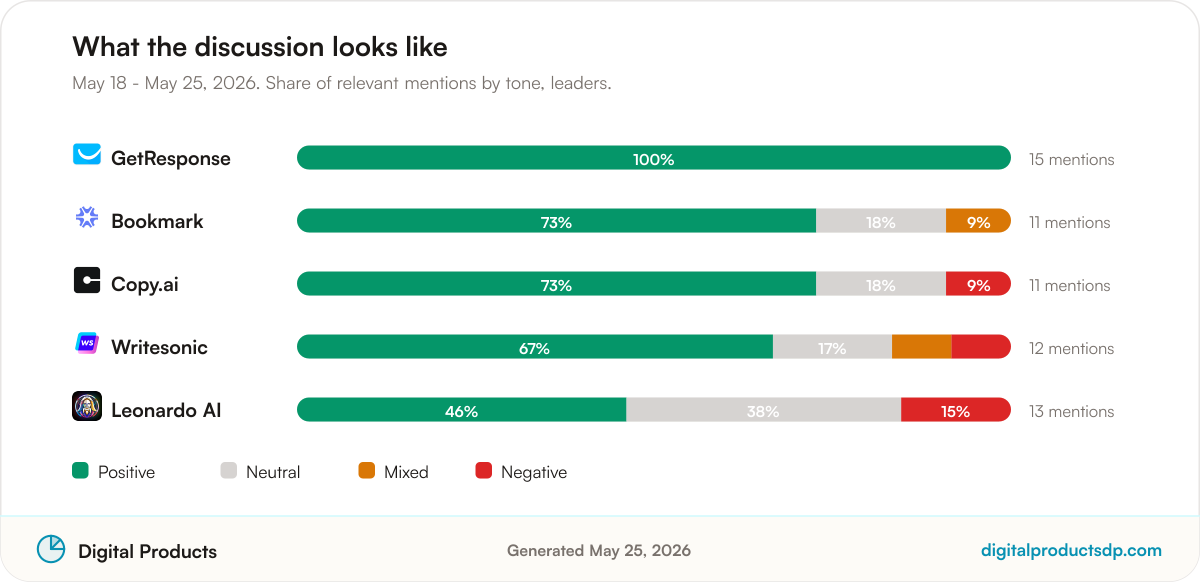
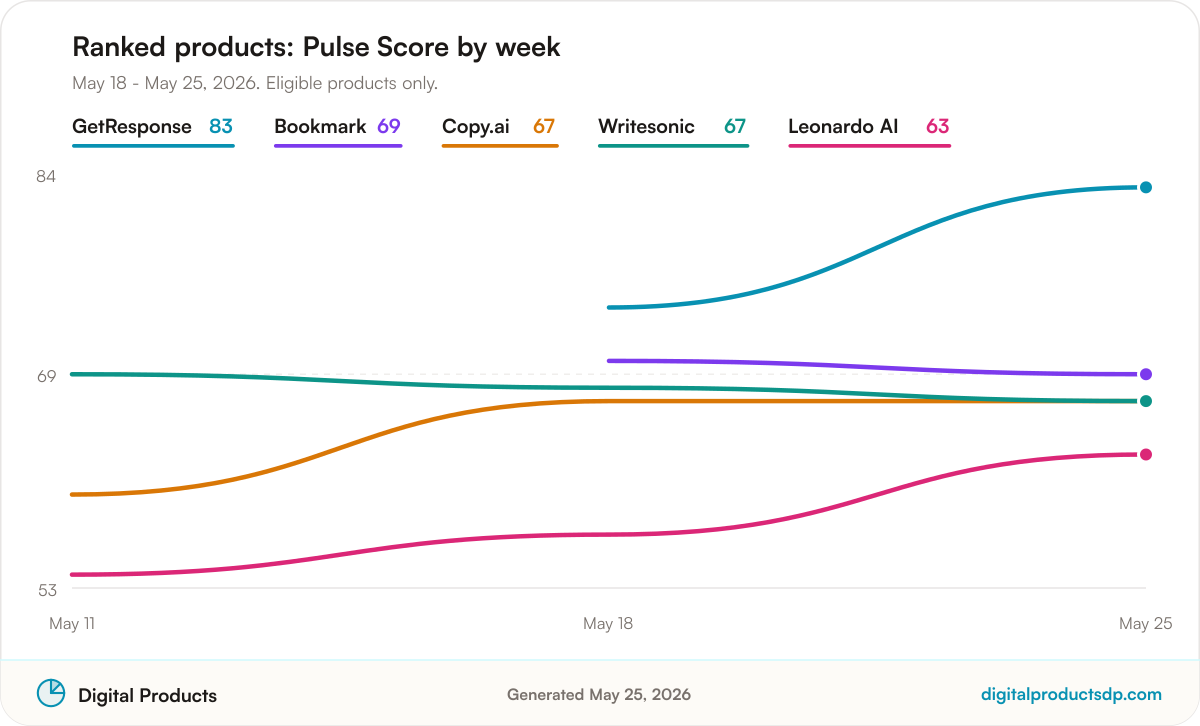
GetResponse, a marketing platform, sits at the top of the leaderboard with a Pulse Score of 83, based on 15 mentions over the period. Behind it, Bookmark, a coding tool, scored 69 based on 11 mentions, while the AI-writing assistants Copy.ai and Writesonic both landed at 67, based on 11 mentions and 12 mentions respectively. Leonardo AI, an AI image tool, rounds out the top five at 63 based on 13 mentions.
The notable feature of this leaderboard is how thin each sample is. Every ranked leader cleared the threshold but did so on a modest number of mentions, which means single conversations carry real weight in these scores. That is worth keeping in mind: a score of 83 built on 15 mentions describes a small, mostly favorable pocket of discussion, not a broad consensus. The leaders cluster in different categories, which suggests no single product type owned the positive end of the conversation this week.
Category View
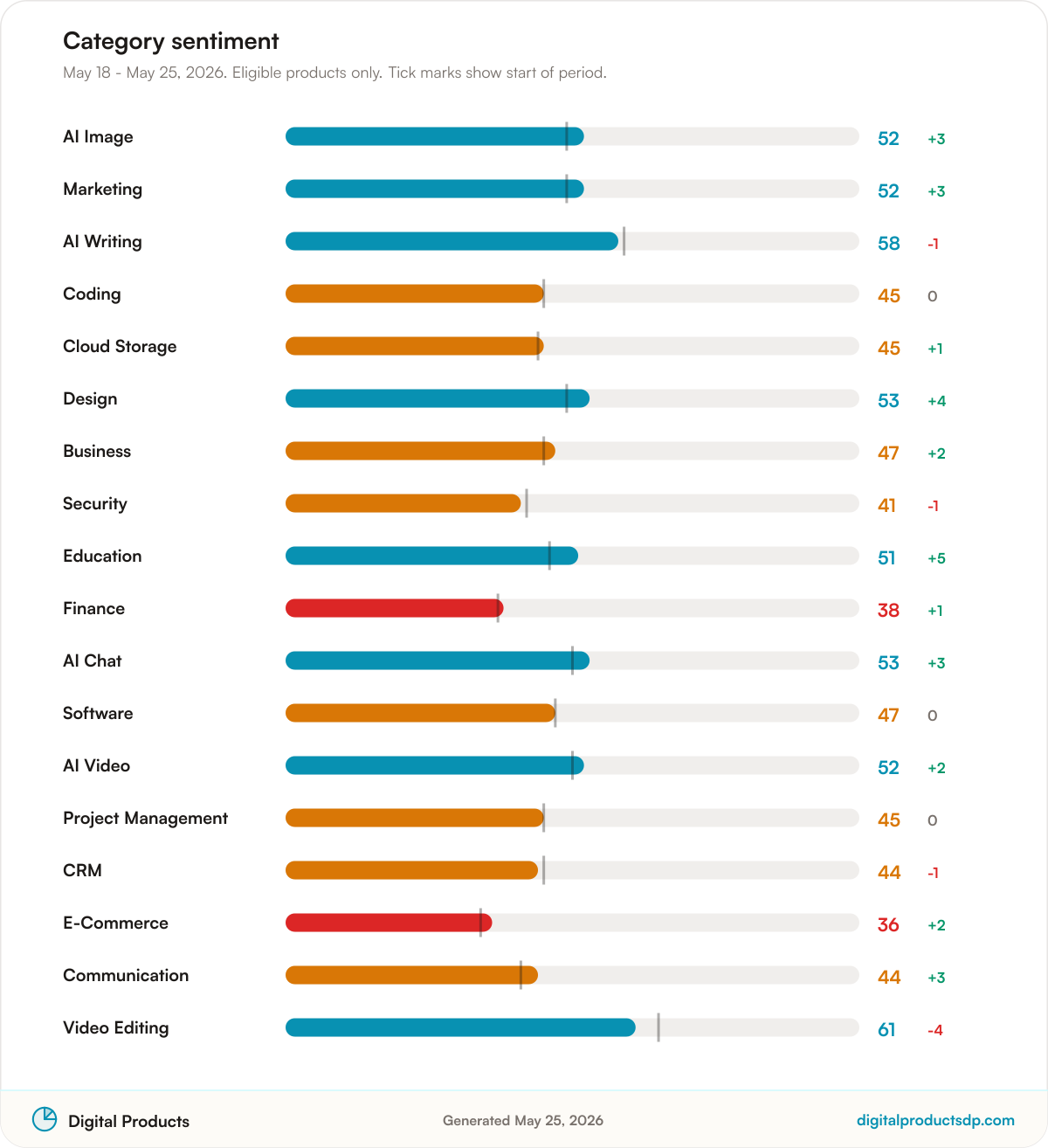
At the category level, most movements were small and upward. Design rose from 49 to 53, ai-chat from 50 to 53, education from 46 to 51, and ai-image from 49 to 52, while marketing and ai-video each moved from their start points to 52. A few categories held flat, including coding at 45, software at 47, and project-management at 45. The clearest decline came in video-editing, which slipped from 65 to 61 yet still ended as the highest-scoring category in the set. Finance and e-commerce remained the lowest-scoring categories, ending at 38 and 36 respectively, while security edged down from 42 to 41. The overall picture is one of mild positive drift in creative and AI-adjacent categories, with infrastructure and commerce categories anchored lower.
Biggest Movers
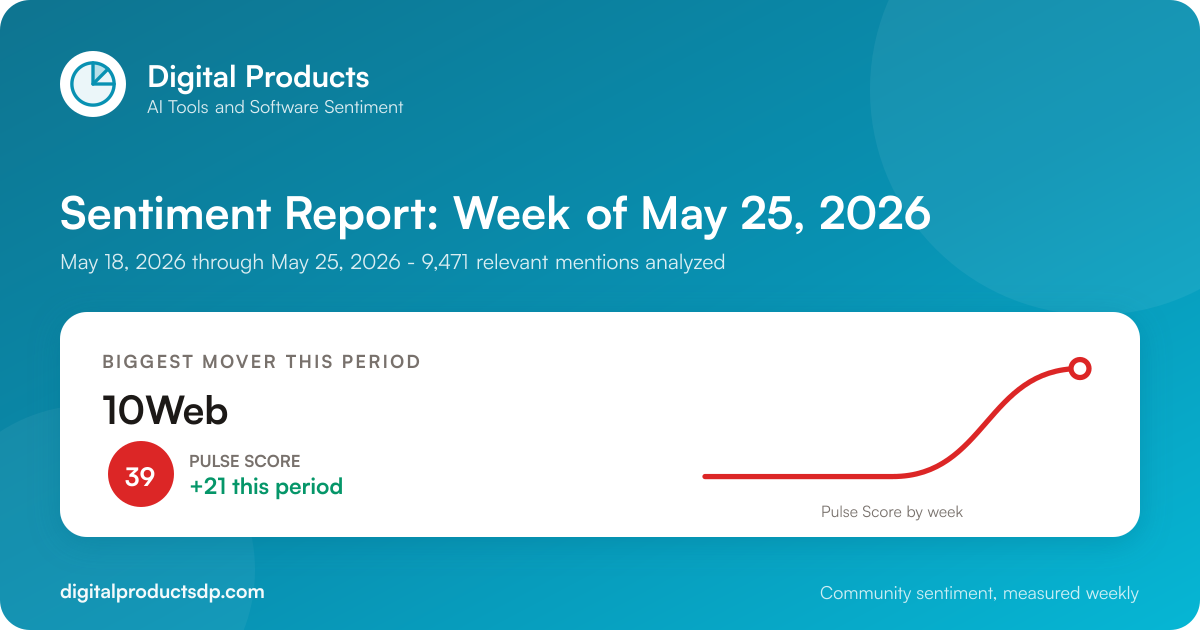
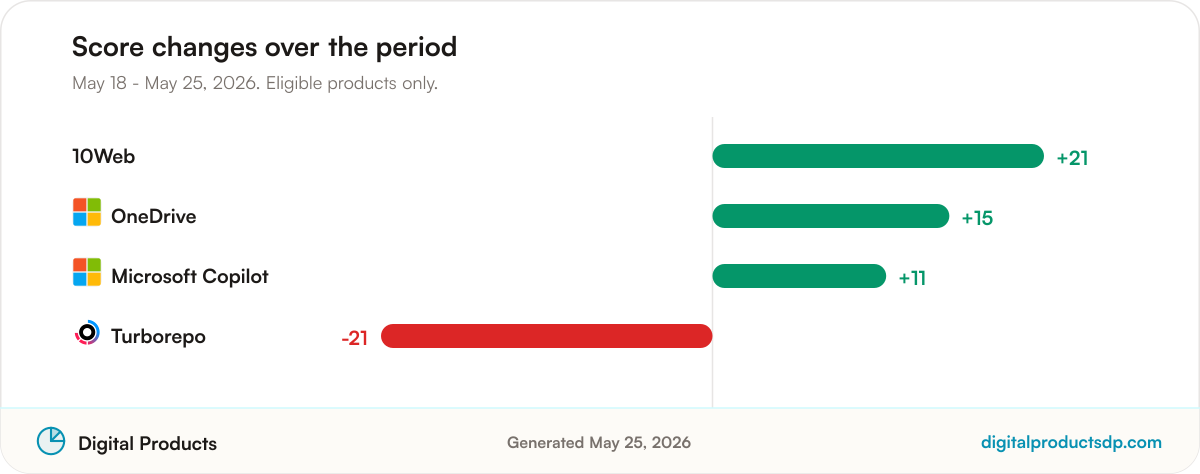
10Web (riser, +21, 18 to 39, based on 11 mentions): The website-building tool posted the largest gain of the period, though it climbed off a very low base and still ended below the midpoint. Its latest-week praise centered on AI quality, strong features, and how it compares to rivals, each noted six times. That said, the same comparison-to-rivals theme also led its complaints with nine mentions, alongside missing features at seven and learning curve at five, so the improvement reads as a partial recovery in a conversation that remains mixed.
OneDrive (riser, +15, 25 to 40, based on 32 mentions): The cloud-storage product rose meaningfully on a larger sample than most movers. Its praise themes were good integrations at nine, comparisons to rivals at eight, and strong features at seven. The complaints remained heavy, however, with reliability at 37, UI frustrations at 29, and bugs at 28, which explains why even a 15-point gain left it sitting at 40.
Microsoft Copilot (riser, +11, 42 to 53, based on 67 mentions): The AI assistant gained on the largest sample in the riser group. Praise leaned on strong features at 41, good integrations at 32, and easy to use at 27. Its complaints were led by bugs at 27, comparisons to rivals at 26, and missing features at 25, a relatively balanced split that fits a product moving from below the midpoint to just above it.
Turborepo (faller, -21, 74 to 53, based on 75 mentions): The coding tool recorded the steepest drop of the period. Even as praise stayed strong, with strong features at 68, performance at 45, and good integrations at 32, the complaint side was led by bugs at 41 and reliability at 26. When a developer-facing tool draws that volume of bug and reliability chatter, sentiment tends to compress quickly, and that is the pattern here.
PhpStorm (faller, -17, 74 to 57, based on 10 mentions): The IDE fell sharply on a thin sample of just 10 mentions, where each conversation moves the needle hard. Its latest-week praise was strong features at six and easy to use at three, while complaints clustered around speed and interface, with feels slow, UI frustrations, and performance each noted twice. On a small sample, that mix of speed complaints is enough to pull a score down materially.
ActiveCampaign (faller, -12, 54 to 42, based on 14 mentions): The marketing platform declined despite a notably positive praise profile, with AI quality, strong features, and new releases each cited 17 or 18 times. The drag came from bugs at six, reliability at four, and lacking integrations at two. The coexistence of heavy feature praise and reliability complaints is the kind of tension that can leave a score lower than the praise alone would suggest.
Spotlight: GetResponse
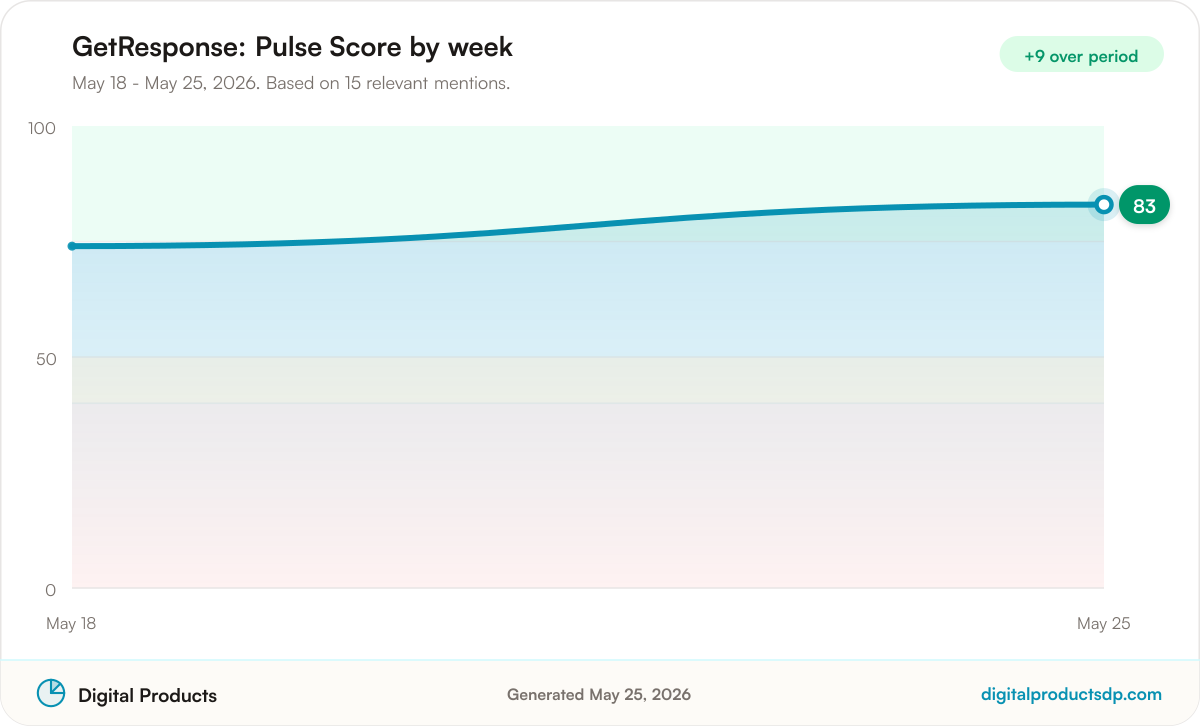
GetResponse led the period with a Pulse Score of 83, based on 15 mentions. Its weekly series shows the score moving from 74 on May 18, 2026 to 83 on May 25, 2026, a single-week climb that put it clear of the rest of the leaderboard. As with every leader this week, that number rests on a small sample, so it should be read as a snapshot of a favorable but narrow conversation rather than a settled reputation.
The theme breakdown helps explain the warmth. In the latest week, GetResponse drew praise for strong features at 11 mentions and fair pricing at 11 mentions, with easy to use noted once. That pairing of features and pricing is a constructive combination, because it suggests the discussion valued both capability and cost. On the complaint side, the only recorded theme was poor support at a single mention, an unusually light negative footprint for a ranked product.
The takeaway is that GetResponse occupied a clean corner of the marketing-category conversation this week, with praise concentrated and complaints almost absent. The marketing category as a whole moved from 49 to 52 over the period, so GetResponse sat well above its category average. Whether that gap persists is a question for the coming weeks, especially given how few mentions underpin the current read.
Themes Driving the Conversation
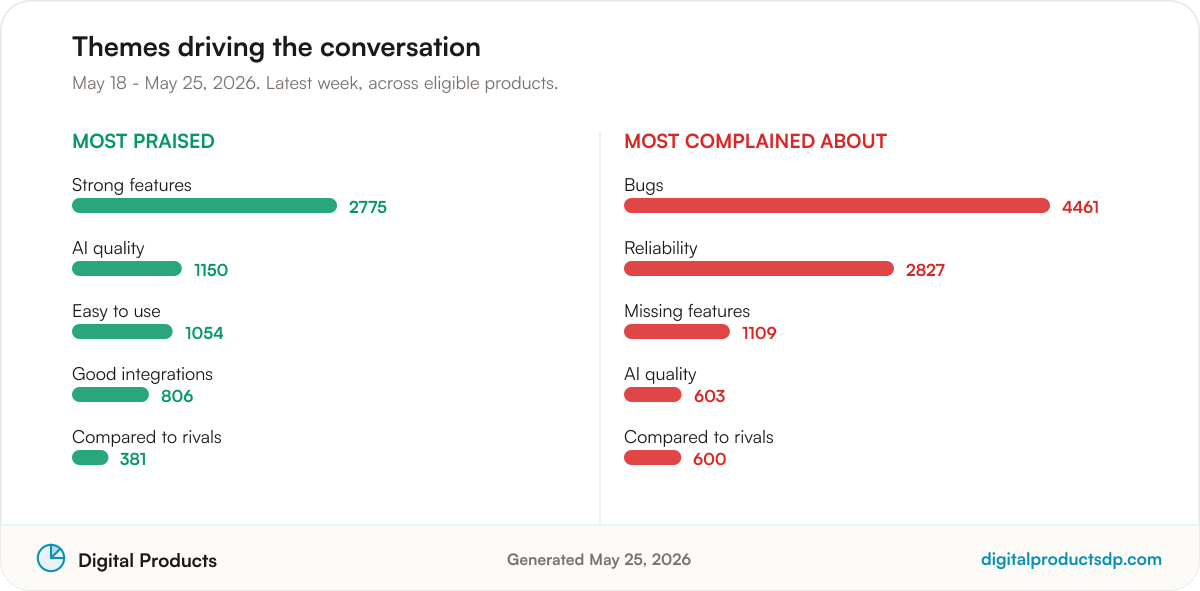
On the praise side, strong features dominated with 2,775 mentions, far ahead of AI quality at 1,150, easy to use at 1,054, good integrations at 806, and comparisons to rivals at 381. The feature theme showed up across nearly every leading product, from Claude Code at 249 and Claude at 229 to ChatGPT at 183 and Cursor at 100. AI quality, the second-ranked praise theme, was driven by the large language model conversations, including Claude at 234, Gemini at 149, and ChatGPT at 159, alongside image and writing tools where output quality is central.
The complaint side was heavier and more concentrated. Bugs led with 4,461 mentions, well ahead of reliability at 2,827, missing features at 1,109, AI quality at 603, and comparisons to rivals at 600. Bugs and reliability complaints clustered most visibly around high-volume infrastructure and developer products, including Stripe with bugs at 188 and reliability at 158, WooCommerce with bugs at 330, Vercel with bugs at 170 and reliability at 151, and Tailscale with bugs at 174. Notably, AI quality appears on both the praise and complaint lists, a reminder that the same capability can split opinion depending on the conversation, as seen with Gemini drawing 149 AI-quality praises and 112 AI-quality complaints, and Grok drawing 79 praises against 183 complaints on the same theme.
Watchlist
A large number of tracked products did not clear the 10-mention threshold this period and are excluded from rankings. This is a measure of discussion volume only and says nothing about quality. Several products landed just short, including Sublime Text, Affinity, Databricks, Stability AI, and Basecamp, each at nine relevant mentions, and VEED, Shippo, Gusto, Turbopuffer, CrowdStrike, Superhuman, Turso, Visual Studio Code, and Zypper, each at eight relevant mentions.
Others sat in a middle band that may cross the line with a small uptick in chatter, such as Codemirror, Haystack, Nx, Sanity, Spacelift, Hygraph, SourceForge, and SentinelOne at seven, and DaVinci Resolve and Audacity also at seven. Products like Koala AI, Tidio, NordPass, AVG, Heroku, Ideogram, and Unstructured registered six relevant mentions. Because thin samples produce unstable reads, we hold these back rather than publish a score that one or two conversations could swing. If interest picks up around any of them, they could appear in a future ranked leaderboard.
What To Watch Next Week
First, watch whether GetResponse holds its lead. Its 83 came on 15 mentions after a jump from 74 the prior week, and scores built on small samples can move quickly in either direction. A wider base of discussion would tell us whether the current warmth is durable.
Second, watch the developer-tool fallers. Turborepo gave back 21 points to land at 53 and PhpStorm shed 17 to reach 57, both with bug, reliability, or speed complaints prominent in their latest-week themes. Whether those complaint threads cool or continue will shape the coding category, which sat flat at 45 across the period.
Third, watch the recovering low-base risers. 10Web jumped to 39 and OneDrive to 40, but both still carried heavy complaint volume, OneDrive with reliability at 37 and UI frustrations at 29. Whether those gains extend or stall is the question, especially since both products remain below the midpoint despite their improvements.
Frequently Asked Questions
Which product had the highest Pulse Score this period?
GetResponse, a marketing platform, had the highest Pulse Score at 83, based on 15 mentions over the period.
Which product moved the most this period?
Two products tied for the largest single move at 21 points. 10Web rose from 18 to 39 across 11 mentions, while Turborepo fell from 74 to 53 across 75 mentions.
What was the overall mood across categories?
Sentiment drifted mildly upward in creative and AI-adjacent categories, with design rising from 49 to 53 and ai-chat from 50 to 53, while video-editing slipped from 65 to 61 yet stayed the highest-scoring category, and finance and e-commerce remained lowest at 38 and 36.
How many mentions were analyzed this period?
We analyzed 9,471 relevant mentions across 134 products that cleared the minimum threshold for ranking, out of 2,218 products tracked.
About This Data
Pulse Scores summarize the tone of public online discussion on a 0-100 scale. They reflect community sentiment, not a verdict on a product's quality and not a recommendation. We report on complete calendar weeks only, and products with fewer than 10 relevant mentions in the period are excluded from rankings to avoid unstable reads on thin samples.
Public discussion is collected from Hacker News, Stack Exchange, GitHub, Bluesky, the Apple App Store, and YouTube. Automated sentiment analysis can misread sarcasm, jokes, or niche context. Mention volumes vary widely between products, and scores can move from week to week, so a single week's figure is best read as a snapshot rather than a settled judgment. Any company that wants to respond to its coverage is welcome to reach out. For more on how scores are calculated, see our methodology.