AI Tools and Software Sentiment Report: Week of April 20, 2026
April 21, 2026
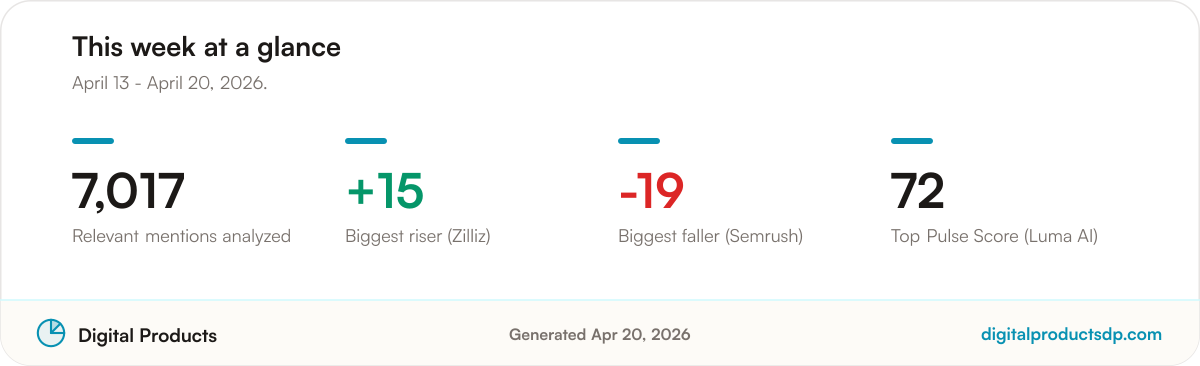
This report covers aggregated public online discussion of tracked AI tools and software, summarizing the tone of community chatter rather than any verdict on product quality. The window here is a single complete calendar week, with mentions analyzed for April 13, 2026 through April 20, 2026. Across that span we counted 7,017 relevant mentions, drawn from public conversation on sources including Hacker News and YouTube review-video comments.
Of the 2,218 products we track, 111 cleared the threshold of at least 10 relevant mentions and qualified for rankings this period. The rest sat below that line and are listed later in the Watchlist, framed strictly as a matter of discussion volume. Everything below reflects community sentiment, expressed as 0-100 Pulse Scores, and should be read as a snapshot of online mood, not a measure of how well any product works.
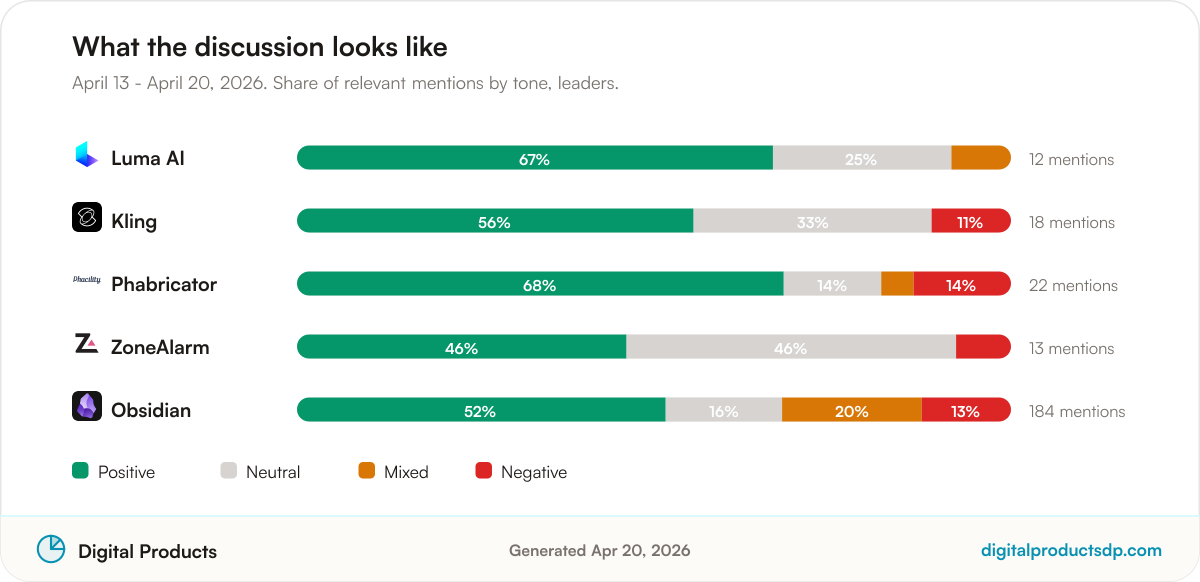
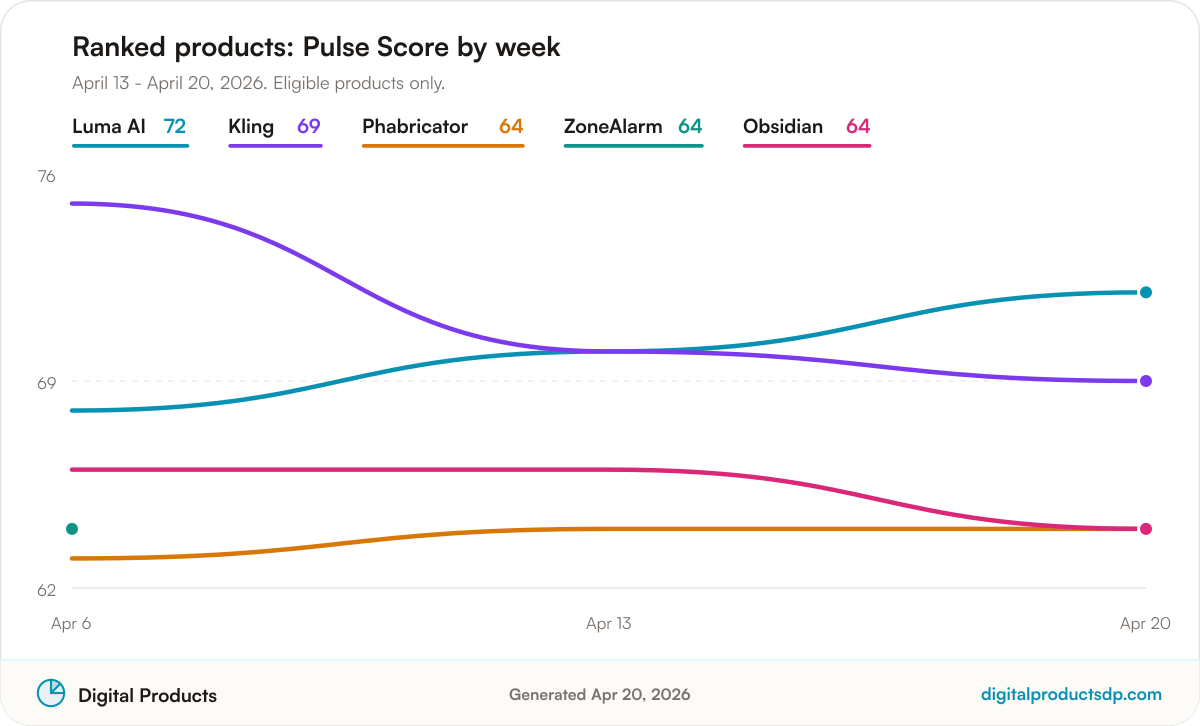
Luma AI sits at the top of the latest-week rankings with a Pulse Score of 72, based on 12 mentions over the period. It is followed by Kling at 69, based on 18 mentions, giving the AI video category two of the leading slots. Phabricator and ZoneAlarm are tied at 64, based on 22 mentions and 13 mentions respectively, with Obsidian rounding out the group at 64 on a much larger base of 184 mentions.
The spread here is worth noting. The leaders cluster tightly between 64 and 72, and several of them rest on thin samples. Luma AI and Kling each drew fewer than 20 mentions, so their scores reflect a small slice of public discussion. Obsidian's 64, by contrast, is built on 184 mentions, making it the most heavily discussed product among the leaders and arguably the steadiest read on this list.
Category View
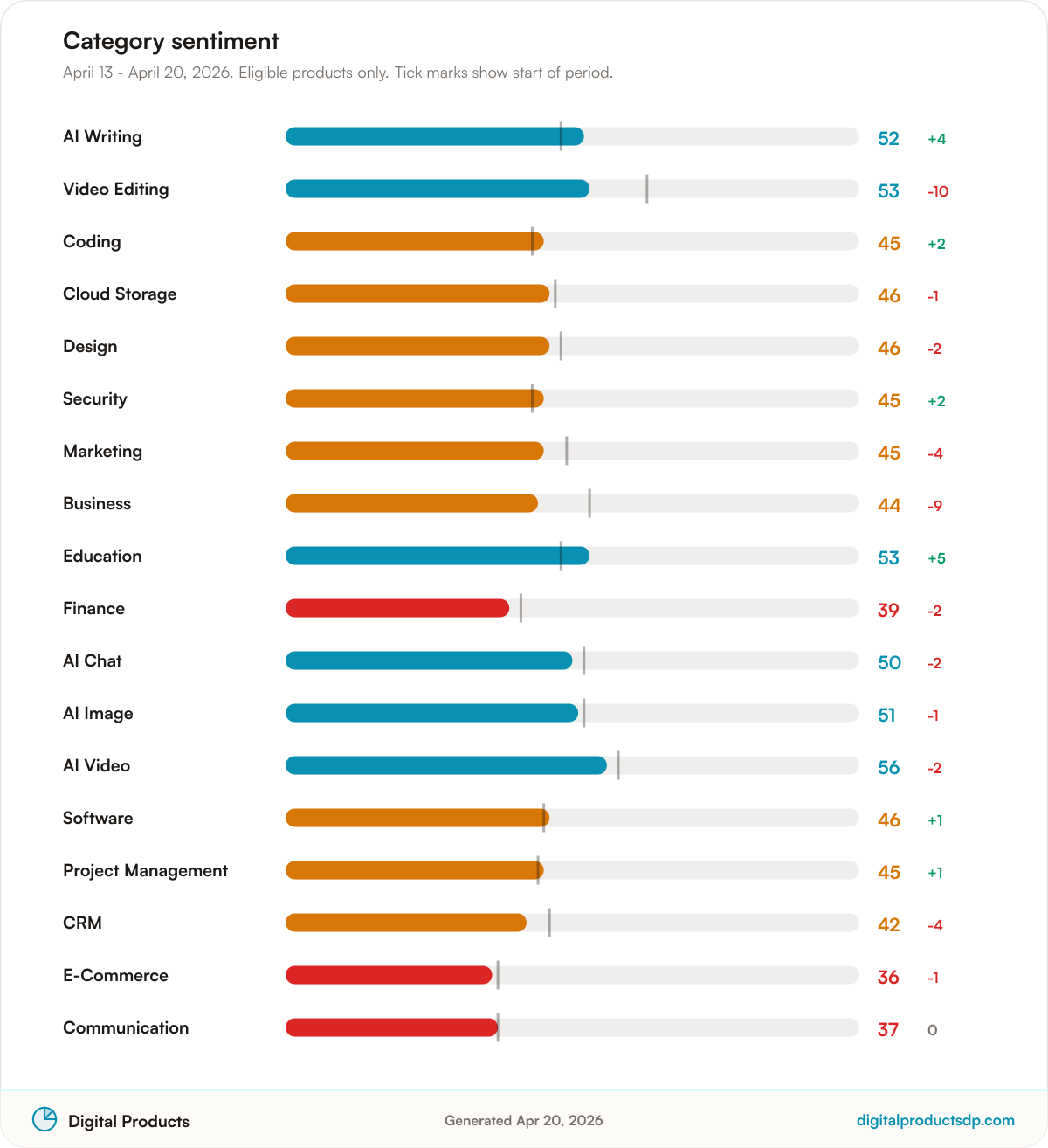
At the category level, the sharpest declines in community sentiment came in business, which fell from 53 to 44, and video-editing, which dropped from 63 to 53. Marketing eased from 49 to 45 and crm slipped from 46 to 42. On the other side, education rose from 48 to 53 and ai-writing improved from 48 to 52. The AI-centric categories held relatively steady, with ai-chat moving from 52 to 50, ai-image from 52 to 51, and ai-video from 58 to 56. Communication was flat at 37, the lowest category mood among the eligible set, while e-commerce sat at 36 by the end of the period.
Biggest Movers
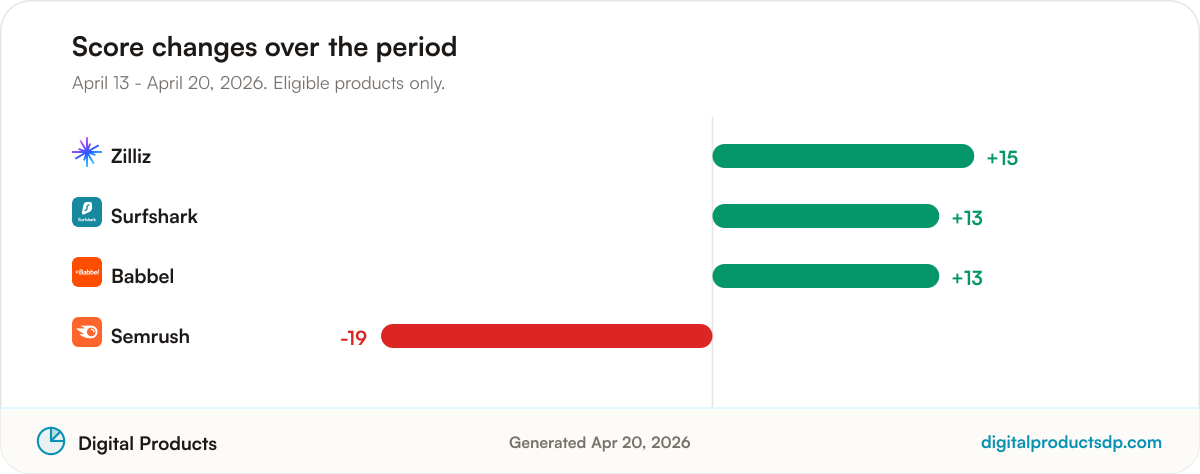
Zilliz (riser, 25 to 40, based on 10 mentions). Zilliz posted the largest gain of the period, climbing 15 points. Even so, the underlying discussion remained heavily complaint-weighted, with Bugs (15 mentions), Reliability (13 mentions) and Missing features (4 mentions) leading its theme breakdown, against modest praise for Strong features (2 mentions). The improvement in tone came off a very low starting point of 25, so the move reads as sentiment climbing out of a deep trough rather than a wave of enthusiasm.
Surfshark (riser, 39 to 52, based on 24 mentions). Surfshark gained 13 points and did so on a healthier base of discussion than most movers. Its leading praise theme was Fair pricing (29 mentions), followed by Strong features (11 mentions) and Easy to use (7 mentions). Complaints were comparatively light, led by Compared to rivals (3 mentions) and Missing features (2 mentions). The pricing-driven praise lines up cleanly with the upward move in community mood.
Babbel (riser, 49 to 62, based on 14 mentions). Babbel rose 13 points and helped lift the education category. Its praise centered on Easy to use (11 mentions) and Strong features (8 mentions), with Fair pricing (3 mentions) also recorded. Complaints were present but smaller, led by UI frustrations (4 mentions) and Pricing too high (3 mentions), suggesting a split read on cost even as the overall tone improved.
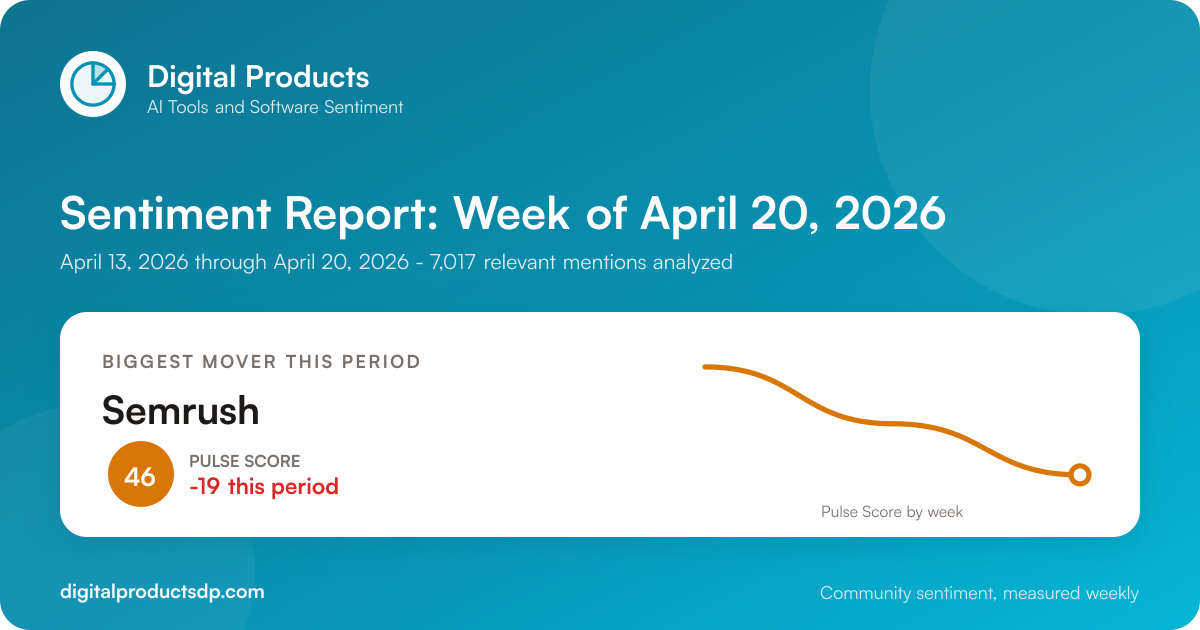
Semrush (faller, 65 to 46, based on 11 mentions). Semrush recorded the steepest decline of the period at 19 points. Its praise themes were actually solid, led by Strong features (22 mentions) and Easy to use (11 mentions), but the complaint side leaned on Compared to rivals (5 mentions), Pricing too high (4 mentions) and Missing features (3 mentions). On a thin base of 11 mentions, a cluster of comparison and pricing gripes can move the score sharply.
Affinity (faller, 68 to 52, based on 21 mentions). Affinity fell 16 points. Its theme breakdown shows a tug of war, with Compared to rivals appearing as both a praise theme (4 mentions) and a complaint theme (4 mentions), alongside UI frustrations (2 mentions). When the same comparison topic cuts both ways, sentiment can swing quickly, and here it tilted downward.
Bluehost (faller, 49 to 37, based on 19 mentions). Bluehost dropped 12 points. The product drew praise for Fair pricing (9 mentions) and Easy to use (8 mentions), but complaints clustered around Reliability (6 mentions), Poor support (4 mentions) and Feels slow (2 mentions). The reliability and support themes are the kind that tend to weigh heavily on hosting sentiment, and they outpaced the pricing goodwill this period.
Spotlight: Luma AI
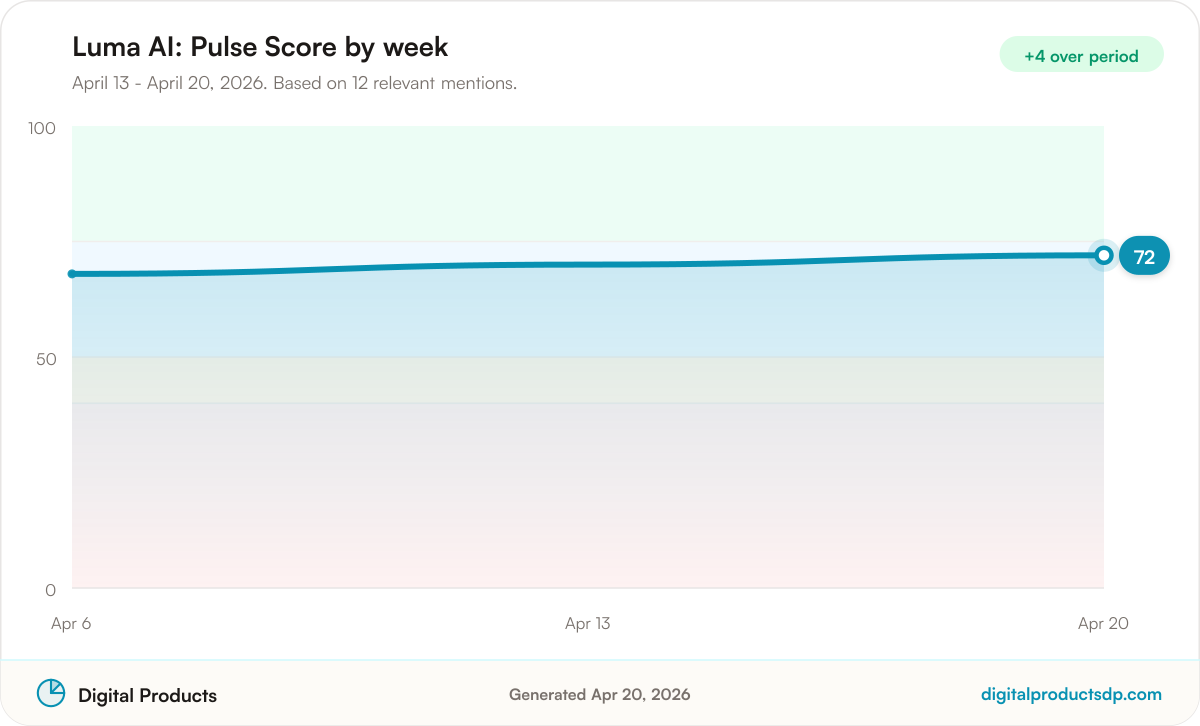
Luma AI, an AI video tool, holds the top Pulse Score of the latest week at 72, based on 12 mentions over the period. Its weekly trajectory has been steadily positive, moving from 68 on April 6, 2026 to 70 on April 13, 2026 and then to 72 on April 20, 2026. That is a quiet, consistent climb rather than a single spike, which is notable given how thin the mention volume is.
What stands out about Luma AI's spotlight is the mismatch between its high score and its recorded themes. Its praise themes were led by New releases (5 mentions), with AI quality (1 mention) and Strong features (1 mention) also noted. Its complaints, meanwhile, were Bugs (3 mentions), Reliability (2 mentions) and Performance (2 mentions). On a base this small, the New releases discussion appears to be doing much of the work in lifting the tone, even as a handful of bug and reliability mentions sit alongside it.
The takeaway is to treat the number with care. A 72 on 12 mentions is the highest mood reading among eligible products this week, but it rests on a narrow slice of public discussion, and the same theme mix that lifted it could shift just as easily next period. The steady three-week climb is the more durable signal here.
Themes Driving the Conversation
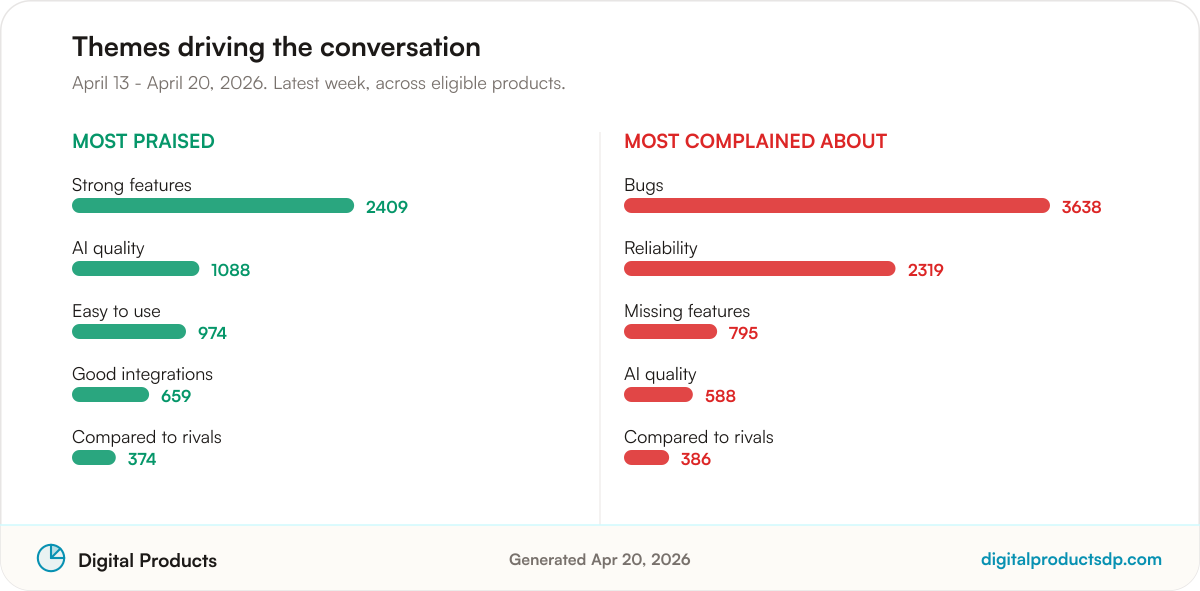
On the praise side, Strong features dominated with 2,409 mentions, far ahead of any other positive theme. AI quality followed at 1,088 mentions, then Easy to use at 974 mentions, Good integrations at 659 mentions, and Compared to rivals at 374 mentions. The feature-focused praise shows up across many of the most-discussed products, including Claude Code, where Strong features drew 249 mentions, ChatGPT at 183 mentions, and Stripe at 84 mentions. AI quality praise was concentrated in the large language model tools, led by Claude at 234 mentions and Gemini at 149 mentions.
The complaint side was heavier still. Bugs led all themes outright at 3,638 mentions, ahead of Reliability at 2,319 mentions, Missing features at 795 mentions, AI quality at 588 mentions, and Compared to rivals at 386 mentions. The bug and reliability complaints turned up at scale across infrastructure and developer-facing products, including WooCommerce with 330 Bugs mentions, Loom with 211, Stripe with 188, Vercel with 170, and Tailscale with 174. The fact that Bugs and Reliability together outweigh the entire top praise list helps explain why so many category averages drifted sideways or down this period.
Watchlist
A large number of tracked products did not reach the 10-mention threshold this period and are therefore excluded from rankings. This is purely a reflection of discussion volume in the sources we monitor, not a judgment on quality. Several came close to qualifying, including Midjourney and Apple Notes at 9 relevant mentions each, Microsoft Copilot, Xata, Plesk and ZoomInfo also at 9 mentions, and Lovable, AWeber, Affirm, Notepad++, Spacelift, Medusa and Hygraph at 8 mentions each.
Others sat further down, such as Copy.ai, LearnWorlds, Audacity, NordPass and Railway at 6 to 7 mentions, with many more registering only a handful or none at all this week. Because thin samples produce unstable reads, we hold these back rather than publish a score that could swing wildly on a single comment. If discussion volume picks up in a future complete week, any of these could enter the rankings.
What To Watch Next Week
First, watch whether Luma AI can sustain its climb. It has risen each week from 68 to 70 to 72, but on only 12 mentions this period, so the question is whether discussion volume grows enough to confirm the trend or whether the score proves fragile.
Second, keep an eye on the business and video-editing categories, which posted the largest category declines this period, falling from 53 to 44 and from 63 to 53 respectively. Whether those moves stabilize or continue downward is worth monitoring.
Third, the dominance of Bugs at 3,638 mentions and Reliability at 2,319 mentions across eligible products is the defining theme of the week. Watching whether those complaint volumes ease or stay elevated will say a lot about overall community mood in the next report.
Frequently Asked Questions
Which product had the highest Pulse Score this period?
Luma AI had the highest latest-week Pulse Score at 72, based on 12 mentions over the period, narrowly ahead of Kling at 69.
Which product moved the most this period?
Among risers, Zilliz gained the most, climbing from 25 to 40, a 15-point move based on 10 mentions. Among fallers, Semrush dropped the most, from 65 to 46, a 19-point decline based on 11 mentions.
What was the overall mood across categories?
Mood was mixed and tilted slightly down in several areas. Business fell from 53 to 44 and video-editing from 63 to 53, while education rose from 48 to 53 and ai-writing from 48 to 52. Communication remained the lowest at 37.
How many mentions were analyzed this period?
We analyzed 7,017 relevant mentions across the week, with 111 of 2,218 tracked products clearing the 10-mention threshold to qualify for rankings.
About This Data
Pulse Scores summarize the tone of public online discussion on a 0-100 scale and reflect community sentiment, not a verdict on a product's quality or a recommendation. We report on complete calendar weeks only, and products with fewer than 10 relevant mentions in the period are excluded from rankings to avoid unstable reads on thin samples.
Public discussion is collected from Hacker News, Stack Exchange, GitHub, Bluesky, the Apple App Store, and YouTube. Automated sentiment analysis can misread sarcasm, jokes, or niche context, mention volumes vary widely between products, and scores can move week to week. Any company that wants to respond is welcome to reach out. For how scores are calculated, see our methodology.