AI Tools and Software Sentiment Report: Week of April 6, 2026
April 6, 2026
This edition of our weekly sentiment tracker covers aggregated public online discussion about the tools and software we monitor, drawn from open conversation across the web. The mentions analyzed for the period running from March 30, 2026 through April 6, 2026 give us a window into how the community is talking about everything from AI video generators to CRM platforms, password managers, and developer tooling. As always, the numbers here describe the tone of public chatter, not a verdict on any product's quality.
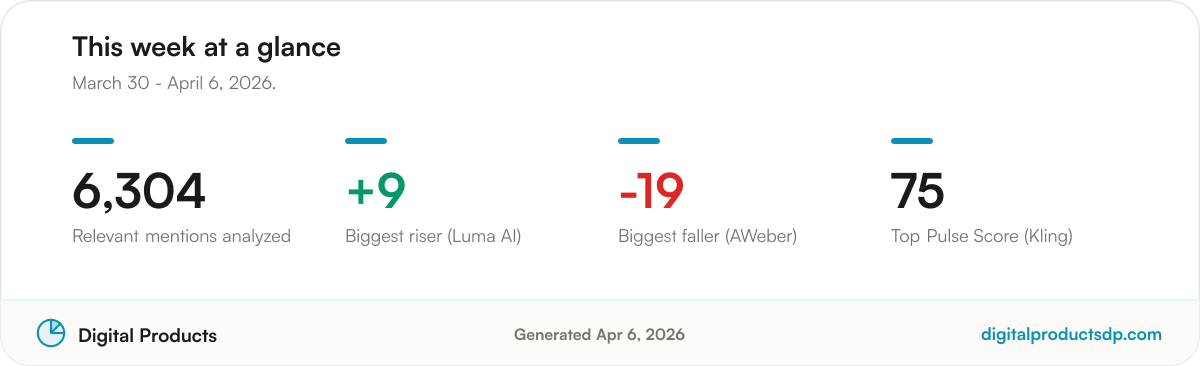
Across the period running from March 30, 2026 through April 6, 2026, we logged 6,304 relevant mentions. Of the 2,218 products tracked, 101 cleared our threshold of at least 10 relevant mentions and qualified for ranking. The figures below summarize the leaders, the movers, and the recurring themes that shaped the week's discussion.
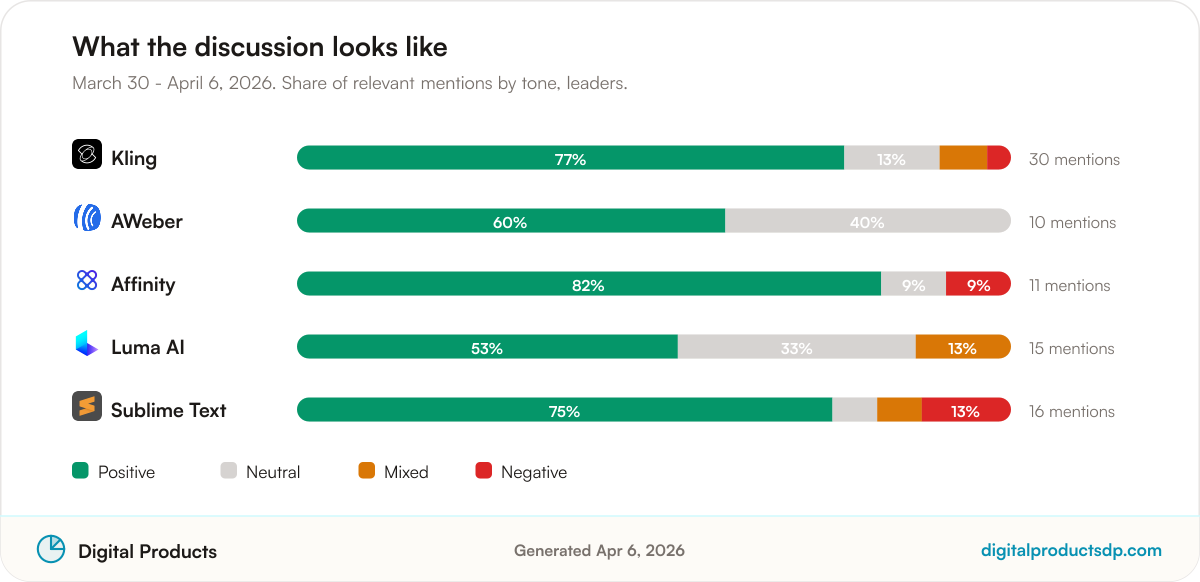
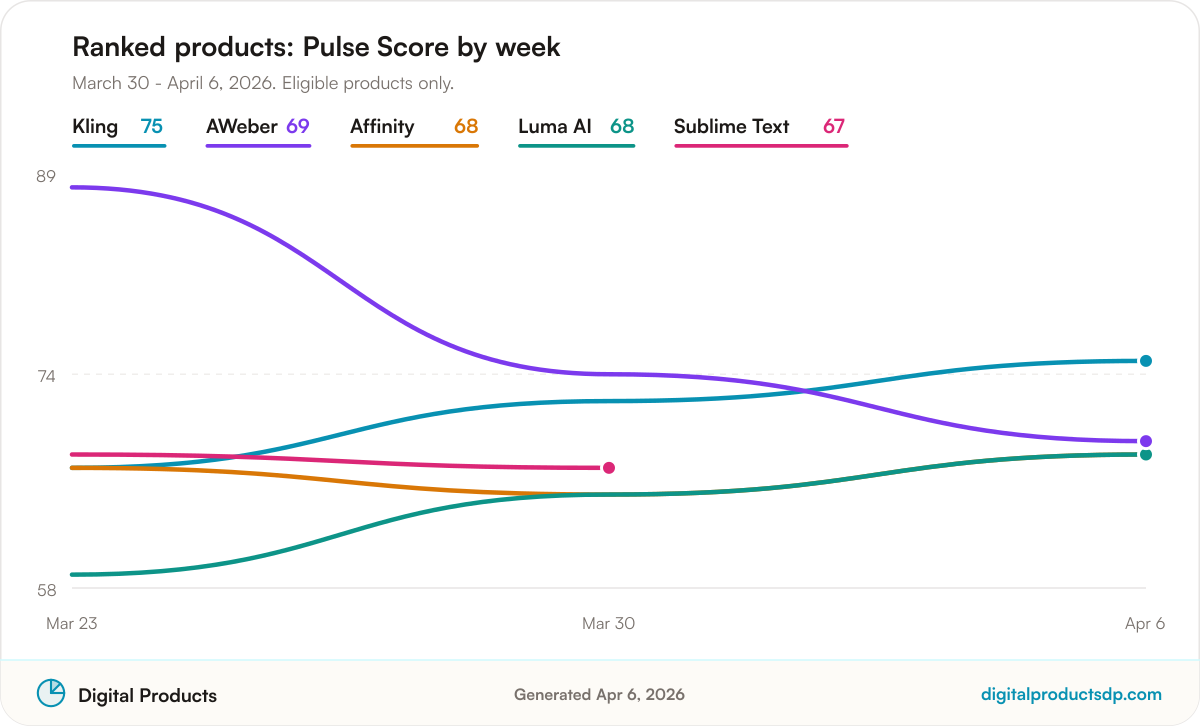
Kling sat at the top of the board with a Pulse Score of 75, based on 30 mentions over the period, the highest read of any eligible product this week. Behind it, the spread tightened quickly: AWeber landed at 69 based on 10 mentions, Affinity at 68 based on 11 mentions, Luma AI at 68 based on 15 mentions, and Sublime Text at 67 based on 16 mentions. The two AI video products in this group, Kling and Luma AI, give the top five a noticeable lean toward generative video sentiment this week.
It is worth reading these scores alongside their sample sizes. Kling's 30 mentions make it the most-discussed of the leaders, while AWeber, Affinity, and Luma AI each rest on smaller bases of 10 to 15 mentions. Smaller samples can swing more sharply from week to week, so a tight cluster like this one is best read as a group of products sharing a generally positive tone rather than a strict ranking with meaningful gaps between neighbors.
Category View
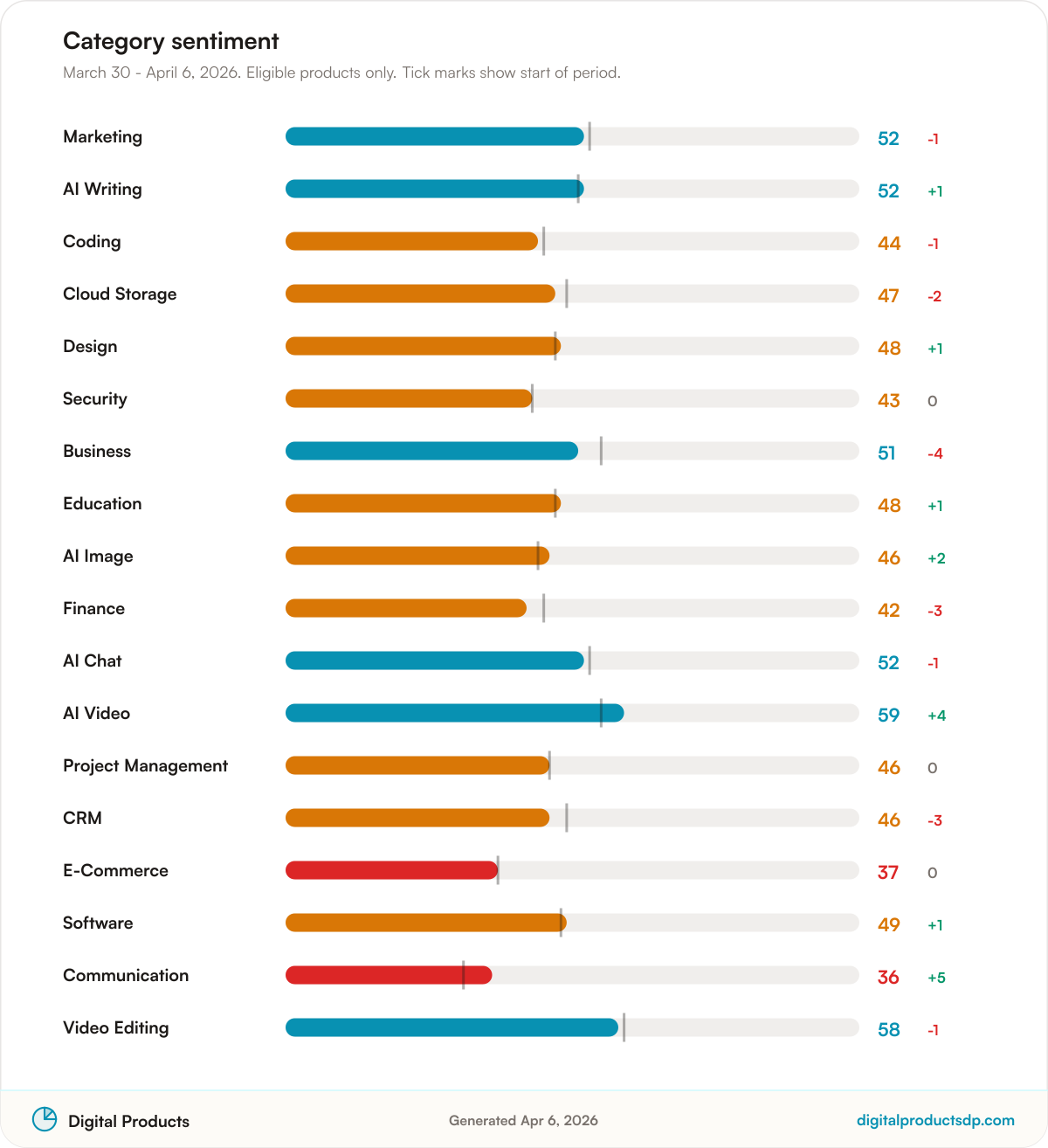
At the category level, the shifts were mostly modest. AI video was the standout, moving from 55 to 59 over the period, the strongest upward swing of any category and consistent with the leaderboard presence of Kling and Luma AI. Communication also climbed, from 31 to 36, though it started from the lowest base of any tracked group. On the other side, business slipped from 55 to 51 and CRM eased from 49 to 46, while finance softened from 45 to 42. Several categories barely moved at all: security held flat at 43, e-commerce held at 37, project-management stayed at 46, and ai-chat drifted from 53 to 52. The overall picture is one of small adjustments rather than broad sentiment swings, with AI video the clearest area of improving tone.
Biggest Movers
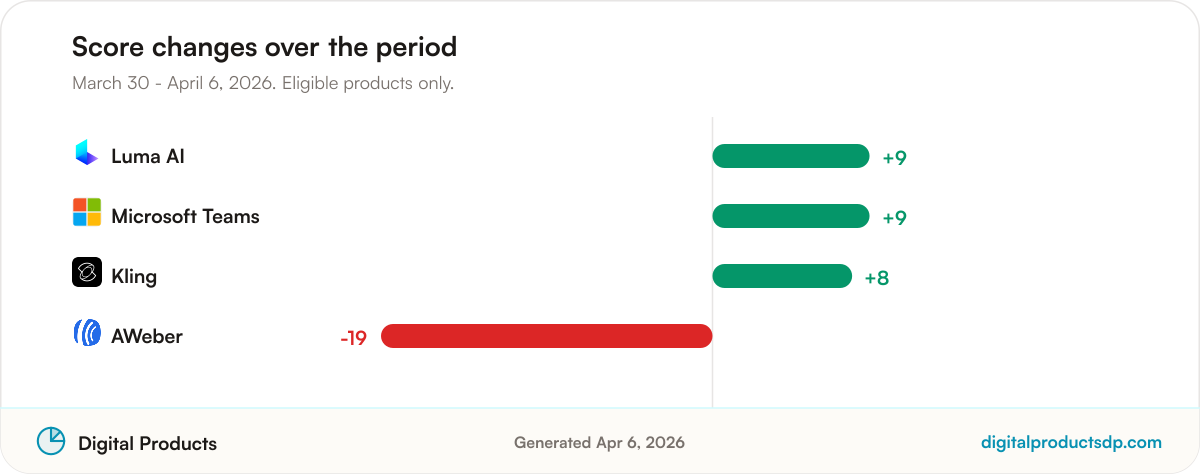
Luma AI (riser, plus 9). Luma AI moved from 59 to 68 over the period, based on 15 mentions. Its praise discussion leaned on New releases, its most-cited positive theme, alongside smaller notes on AI quality and Strong features. The release-driven attention helps explain the upward tone, though the same week also carried complaints around Bugs, Reliability, and Performance. With a sample of 15 mentions, the move is real but sits on a thin base, so the New releases momentum is the cleanest signal here.
Microsoft Teams (riser, plus 9). Microsoft Teams climbed from 26 to 35, based on 16 mentions, one of the larger percentage swings on the board even though it remains among the lower-scored products tracked. Notably, no praise themes were recorded for it this week, while its complaints clustered around Bugs, UI frustrations, and Compared to rivals. A rise without recorded praise themes suggests the improvement came from a reduction in negative tone rather than a surge of positive sentiment, which is worth watching given the small sample.
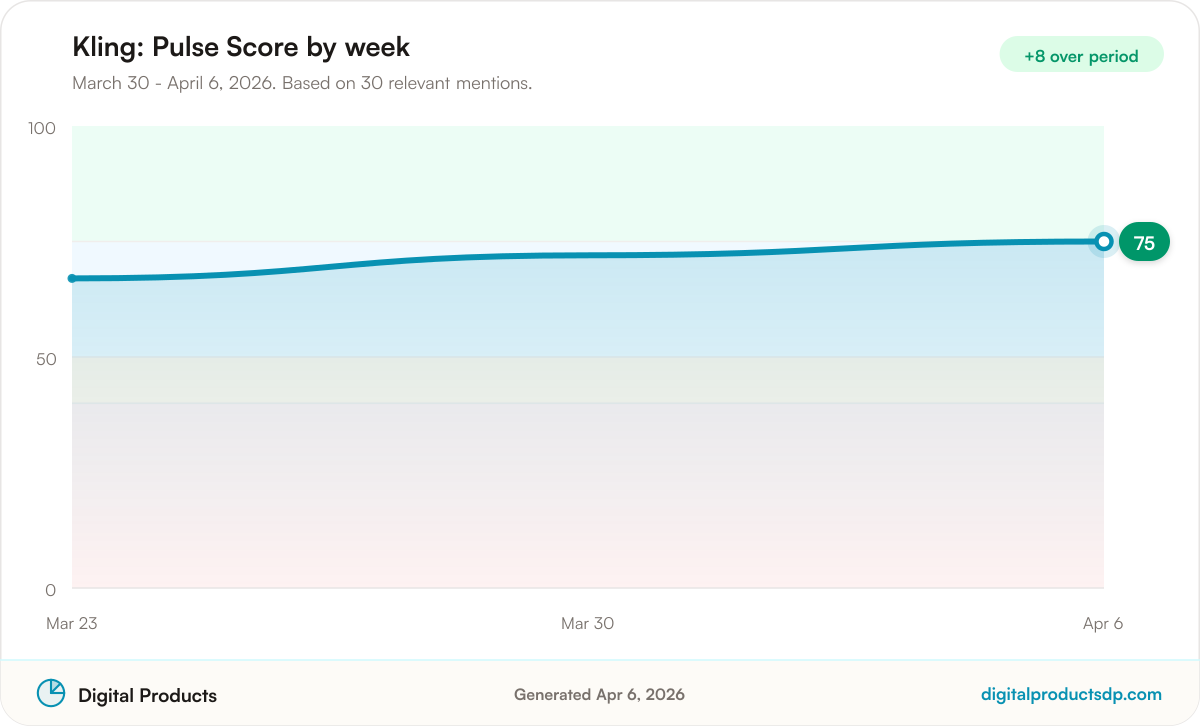
Kling (riser, plus 8). Kling rose from 67 to 75, based on 30 mentions, and ended the period as the top-scored product overall. Its praise themes were led by AI quality, Strong features, and New releases, a combination that fits a generative video tool drawing attention to fresh capabilities. The same week recorded complaints around Bugs, AI quality, and Performance, showing that the conversation was not uniformly positive even as the score climbed.
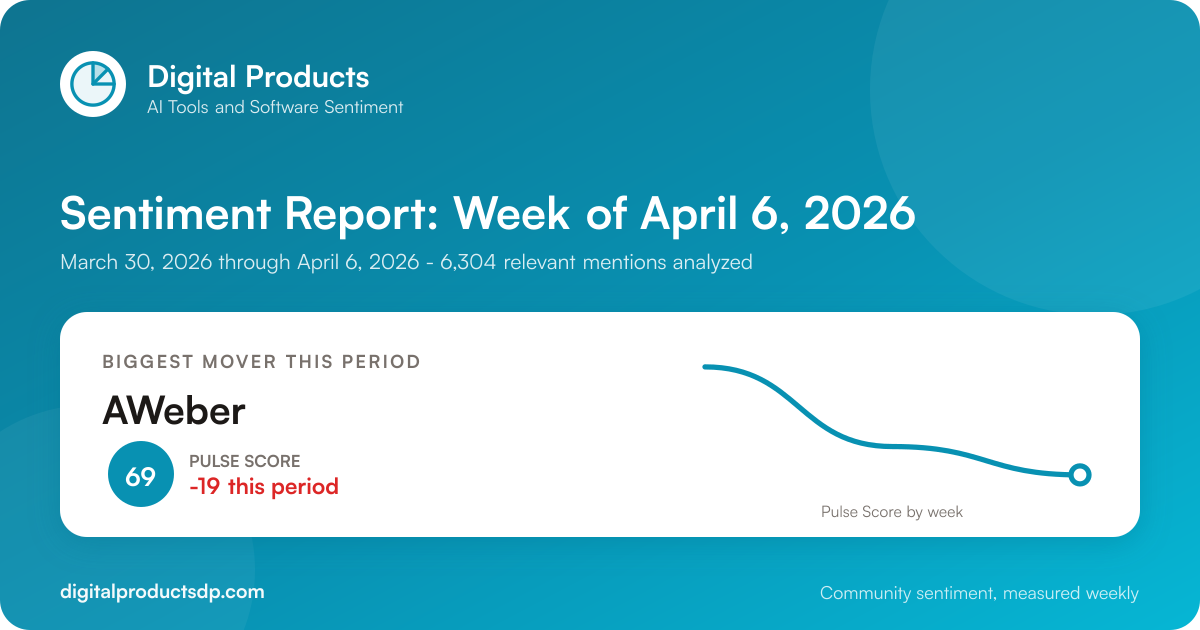
AWeber (faller, minus 19). AWeber posted the steepest drop of the week, sliding from 88 to 69 based on 10 mentions. Its weekly series shows the descent in stages, from 88 to 74 to 69. The praise it did attract centered on Good integrations, Strong features, and New releases, while complaints touched Missing features, Pricing too high, and Lacking integrations. With only 10 mentions, the marketing tool's score is highly sensitive to a handful of conversations, so the size of the drop should be read against that thin base rather than as a broad shift in standing.
Todoist (faller, minus 16). Todoist fell from 61 to 45 over the period, based on 25 mentions, with the weekly series showing a stable 61 to 62 before a sharp drop to 45. Praise leaned on Easy to use and Strong features, but complaints around Bugs, Reliability, and Missing features dominated the negative side. The combination of a meaningful sample and a late-period slide makes this one of the more notable moves on the board.
Coinbase (faller, minus 13). Coinbase declined from 48 to 35, based on 12 mentions. Its praise themes included Strong features, Easy to use, and New releases, but the complaint side was heavy with Bugs, Poor support, and Missing features. Poor support appearing prominently among complaints is the kind of theme that can pull tone down quickly, and the move fits the broader softening seen in the finance category over the period.
Spotlight: Kling
Kling, an AI video product, led this period with a Pulse Score of 75 based on 30 mentions. Its weekly series shows a steady climb across the three weeks we have on hand: 67 on March 23, 2026, then 72 on March 30, 2026, and 75 on April 6, 2026. That is a consistent upward path rather than a single spike, which lends a little more weight to the read despite the modest sample.
The themes behind the score tell a balanced story. On the praise side, AI quality, Strong features, and New releases led the conversation, the kind of mix that points to interest in what the tool can produce and in its recent updates. The complaint side was not empty, with Bugs, AI quality, and Performance all appearing. AI quality showing up in both columns is a reminder that public discussion rarely moves in one direction at once, and that the same capability can draw admiration and criticism from different corners of the conversation.
For readers tracking the AI video space, Kling's position alongside Luma AI in the top five reflects the category's strong period, with AI video moving from 55 to 59 overall. As with every product on a smaller sample, the score is best treated as a snapshot of tone rather than a durable ranking, and the coming weeks will show whether the upward trend holds.
Themes Driving the Conversation
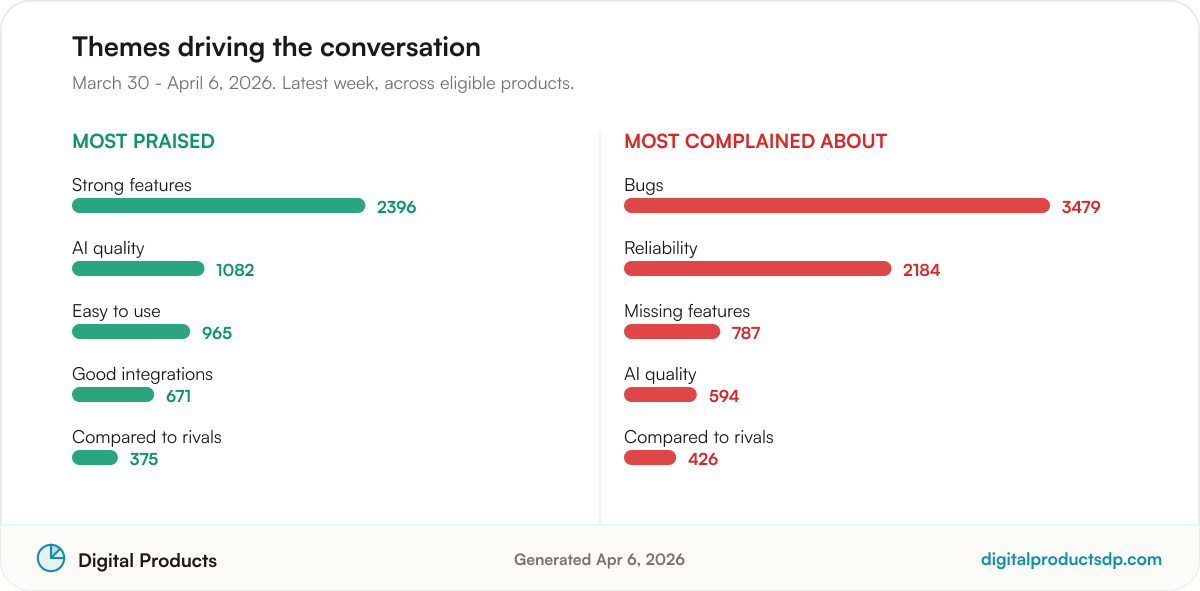
On the praise side, Strong features dominated with 2,396 mentions, far ahead of any other positive theme. AI quality followed at 1,082 mentions, then Easy to use at 965, Good integrations at 671, and Compared to rivals at 375. The weight of Strong features shows up across many high-volume products, with Claude Code, Claude, ChatGPT, and Stripe all leaning heavily on it in their per-product themes. AI quality as the second-ranked praise theme reflects the heavy presence of AI chat and assistant tools in the dataset, where Gemini, ChatGPT, Claude, and Grok all drew sizable AI quality praise counts.
The complaint side was led, by a wide margin, by Bugs at 3,479 mentions, followed by Reliability at 2,184, Missing features at 787, AI quality at 594, and Compared to rivals at 426. The scale of the Bugs and Reliability totals is striking and traces to several very high-volume products: WooCommerce recorded 330 Bugs mentions and 175 Reliability mentions, Loom logged 211 Bugs and 135 Reliability, Stripe carried 188 Bugs and 158 Reliability, and Vercel showed 170 Bugs and 151 Reliability. AI quality appearing among the top complaints as well as the top praise themes underlines how divided the conversation around AI output can be, with Grok alone contributing 183 AI quality complaints against 79 AI quality praises.
Watchlist
A large number of tracked products did not reach the 10-mention threshold this period and are not ranked. This reflects insufficient discussion volume, not any judgment about quality. Several were close to the line and worth keeping an eye on: Flux logged 9 relevant mentions, Databricks 9, Thinkific 9, Bluehost 9, Fly.io 9, ZoomInfo 9, Google Meet 9, and Superhuman 9. Each of these sat just one mention short of qualifying.
A second tier came in slightly lower, including Wrike at 8, Turborepo at 8, Spocket at 8, HeyGen at 8, and WP Engine at 8, followed by Sudowrite, Railway, Sanity, Devin, Nhost, NordPass, and Foxit at 7 each. Well-known names such as HubSpot, Basecamp, Handbrake, VirusTotal, Ideogram, and Carta also landed below the bar with 6 or 7 mentions. A number of products tracked registered zero relevant mentions this period, which simply means the public conversation we collect did not surface them in this window. Thin samples produce unstable reads, so we hold these back rather than publish a score that could mislead.
What To Watch Next Week
First, watch whether AI video sustains its lead. The category climbed from 55 to 59 over the period, and both Kling and Luma AI carried upward weekly trends, with Kling rising across all three weeks to 75. If those trajectories continue, the top of the leaderboard could stay video-heavy, but the smaller samples behind these products mean a few conversations could shift the picture.
Second, monitor whether the steep fallers stabilize. AWeber dropped 19 points to 69, Todoist fell 16 to 45, and Coinbase declined 13 to 35. Todoist's slide in particular came late in the period after a stable start, and its complaint mix of Bugs, Reliability, and Missing features will be worth tracking to see if the tone recovers or settles lower.
Third, keep an eye on the Bugs and Reliability themes that dominated complaints, totaling 3,479 and 2,184 mentions respectively. These were concentrated in a handful of high-volume products including WooCommerce, Loom, Stripe, and Vercel. Whether those reliability conversations ease or persist will shape the overall complaint picture in the weeks ahead.
Frequently Asked Questions
Which product had the highest Pulse Score this period?
Kling led with a Pulse Score of 75, based on 30 mentions over the period, the highest read among the 101 eligible products.
Which product moved the most this period?
AWeber posted the largest move, falling 19 points from 88 to 69 based on 10 mentions. Among risers, Luma AI and Microsoft Teams each gained 9 points.
What was the overall category mood this period?
Shifts were mostly small. AI video improved the most, moving from 55 to 59, and communication rose from 31 to 36, while business fell from 55 to 51 and finance eased from 45 to 42.
How many mentions were analyzed this period?
We analyzed 6,304 relevant mentions across 101 eligible products, drawn from 2,218 products tracked in total.
About This Data
Pulse Scores summarize the tone of public online discussion on a 0-100 scale and reflect community sentiment, not a verdict on a product's quality or a recommendation. We report on complete calendar weeks only, and products with fewer than 10 relevant mentions in the period are excluded from rankings to avoid unstable reads on thin samples.
Public discussion is collected from Hacker News, Stack Exchange, GitHub, Bluesky, the Apple App Store, and YouTube. Automated sentiment analysis can misread sarcasm, jokes, or niche context, mention volumes vary widely between products, and scores can move from week to week. Any company that wants to respond is welcome to reach out. For more on how scores are calculated, see our methodology.