AI Tools and Software Sentiment Report: Week of March 16, 2026
March 16, 2026
This edition of our community sentiment report covers aggregated public online discussion about tracked AI tools and software, drawn from open conversations rather than any verdict on product quality. The mentions analyzed for March 9, 2026 through March 16, 2026 form the basis for every score, ranking, and theme below. Across the broader digest window, we tracked 2,218 products, of which 87 cleared the bar for ranking with at least 10 relevant mentions in the period.
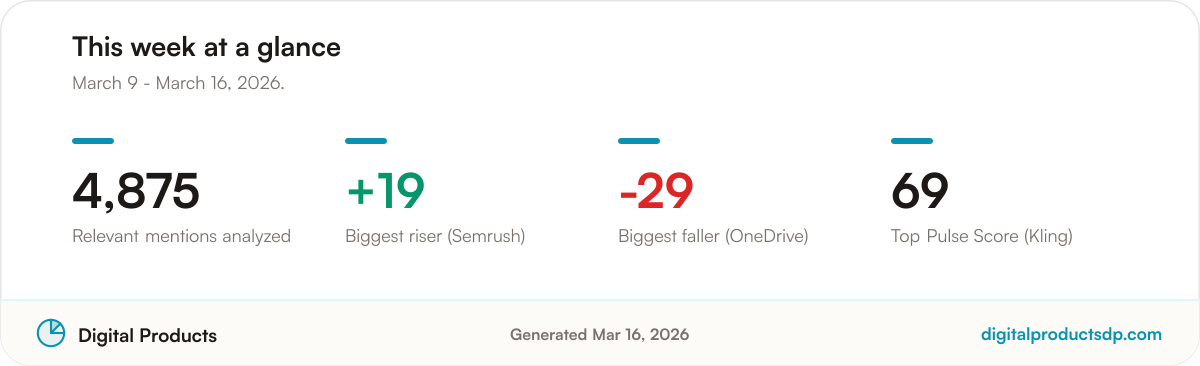
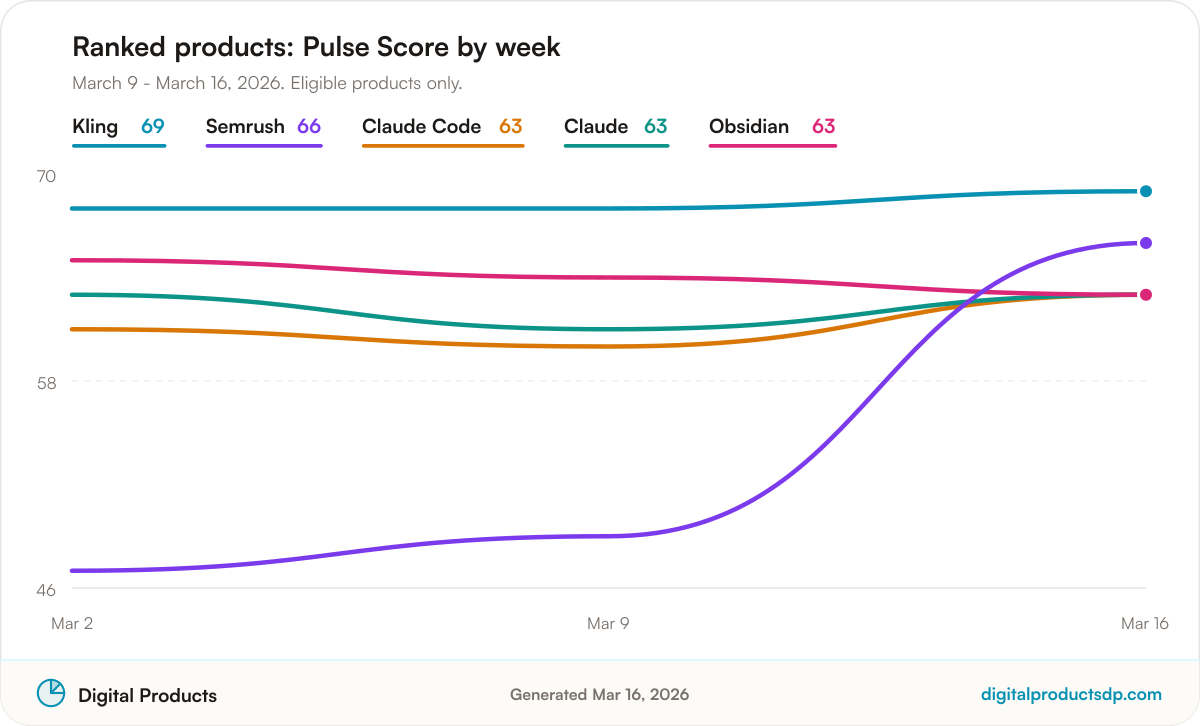
In total, 4,875 relevant mentions were analyzed for the period running from March 9, 2026 through March 16, 2026. The headline picture is steady at the top and turbulent in the middle. Kling held the highest Pulse Score, Semrush surged, and a handful of products gave back ground they had earlier in the window. Everything that follows reflects the tone of public chatter, not a recommendation.
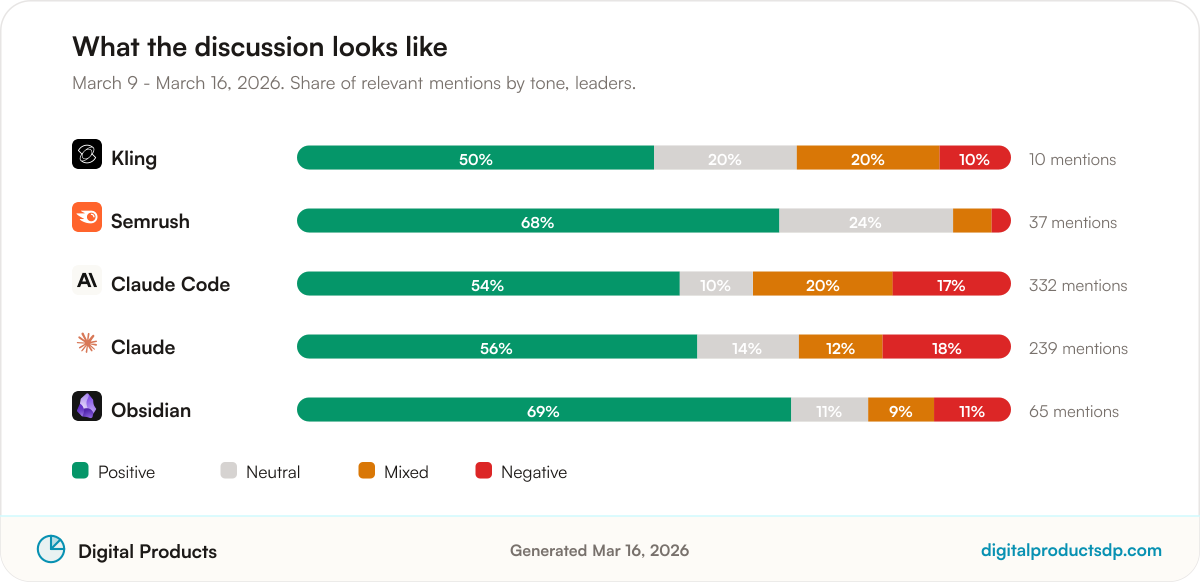
Kling sits at the top with a Pulse Score of 69, based on 10 mentions over the period. That is the thinnest sample among the five leaders, so the read is more sensitive to individual posts. Semrush follows at 66, based on 37 mentions, then a tight cluster at 63: Claude Code, based on 332 mentions, Claude, based on 239 mentions, and Obsidian, based on 65 mentions.
The spread between first and fifth here is only six points, which signals that the top of the board reflects broadly positive but not euphoric discussion. The volume gap is the more striking detail. Claude Code and Claude carry hundreds of mentions each, so their scores rest on far steadier ground than the leaders sitting on double-digit samples.
Category View
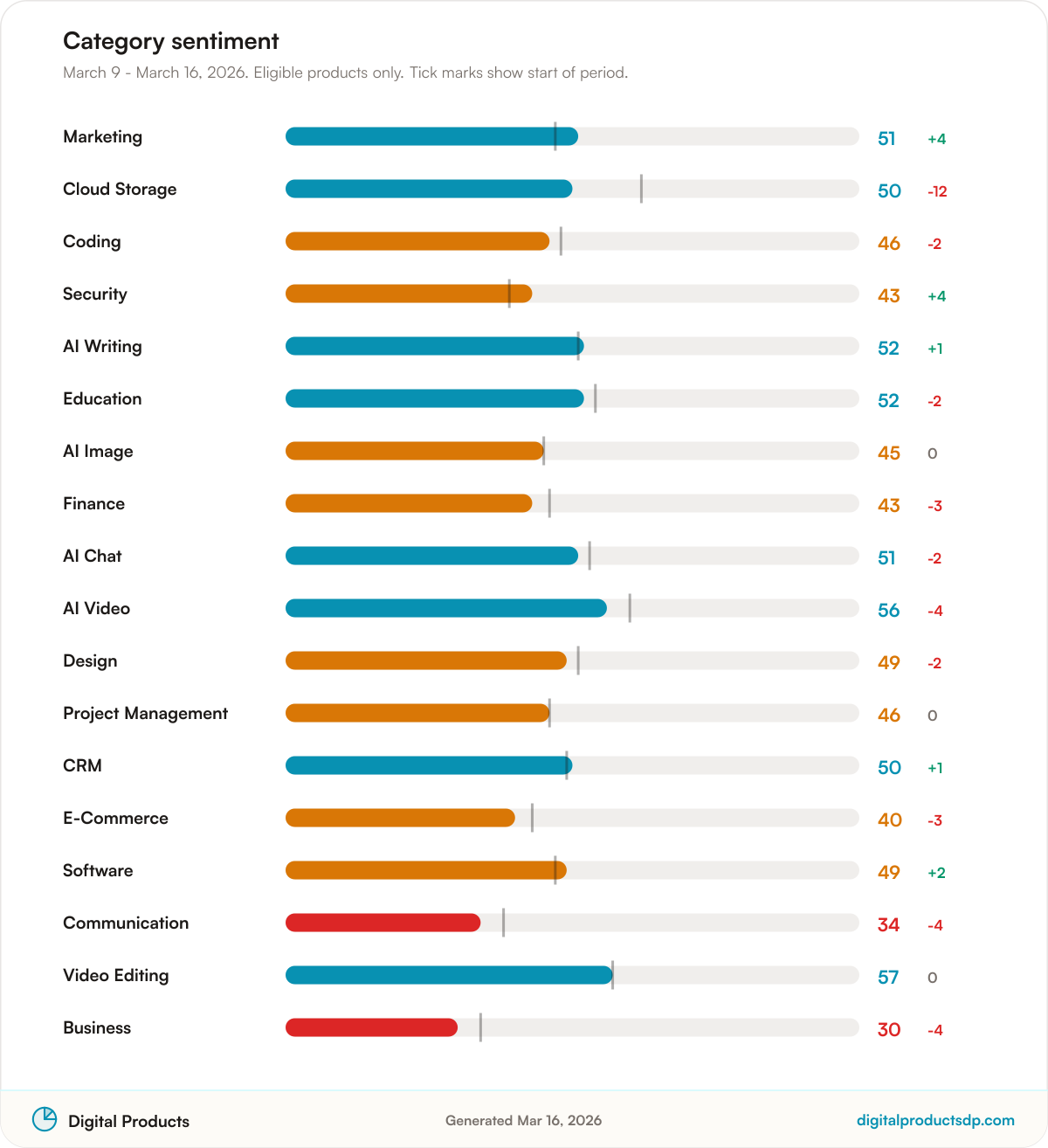
At the category level, the sharpest move was cloud-storage, which slid from 62 to 50 across the period, a drop heavily shaped by OneDrive's fall. Marketing edged up from 47 to 51, security firmed from 39 to 43, and software rose from 47 to 49. On the softer side, communication eased from 38 to 34 and business slipped from 34 to 30, leaving both near the bottom of the category table. Several categories barely moved at all: ai-image held flat at 45, project-management held at 46, and video-editing held at 57, suggesting stable public sentiment in those corners rather than any shift in mood.
Biggest Movers
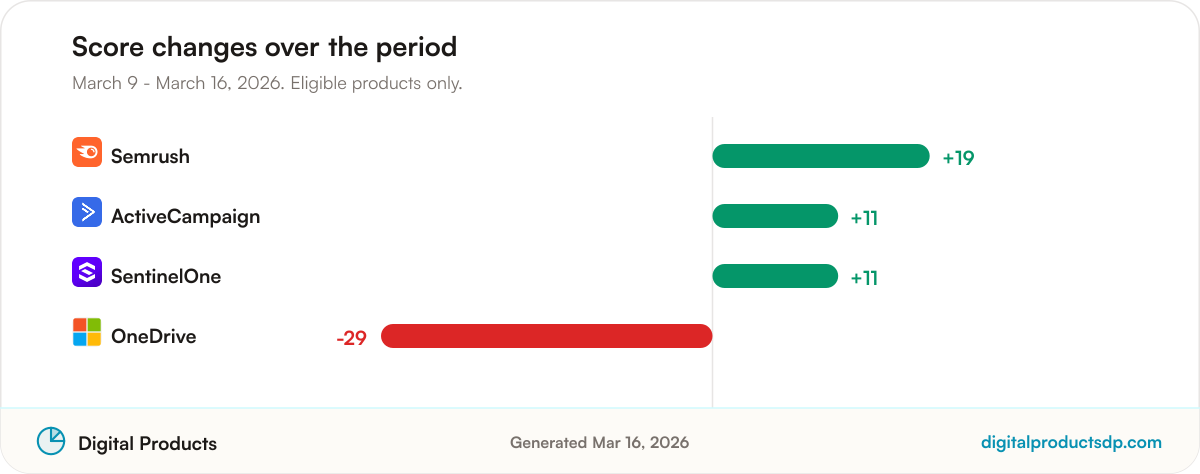
Semrush (up 19, from 47 to 66, based on 37 mentions). This marketing platform posted the largest gain of the period. Its praise discussion leaned on strong features, cited 22 times, with easy to use noted 11 times and AI quality 7 times. The complaints that did surface were comparatively muted, led by compared to rivals at 5 mentions and pricing too high at 4. With praise volume clearly outweighing the gripes, the public conversation tilted positive over the window.
ActiveCampaign (up 11, from 42 to 53, based on 16 mentions). Discussion of this marketing tool was buoyed by an even split of praise across AI quality, strong features, and new releases, each cited 17 to 18 times. Complaints centered on bugs at 6 mentions and reliability at 4. The release-driven praise appears to be what nudged sentiment from below the midpoint to above it.
SentinelOne (up 11, from 28 to 39, based on 13 mentions). This security product climbed from a low base. Its praise themes were thin, with good integrations and strong features each cited once, while complaints still featured bugs at 5 mentions and reliability at 2. The score improved but remains below the midpoint, so the move reads as a partial recovery in tone rather than a wave of enthusiasm.
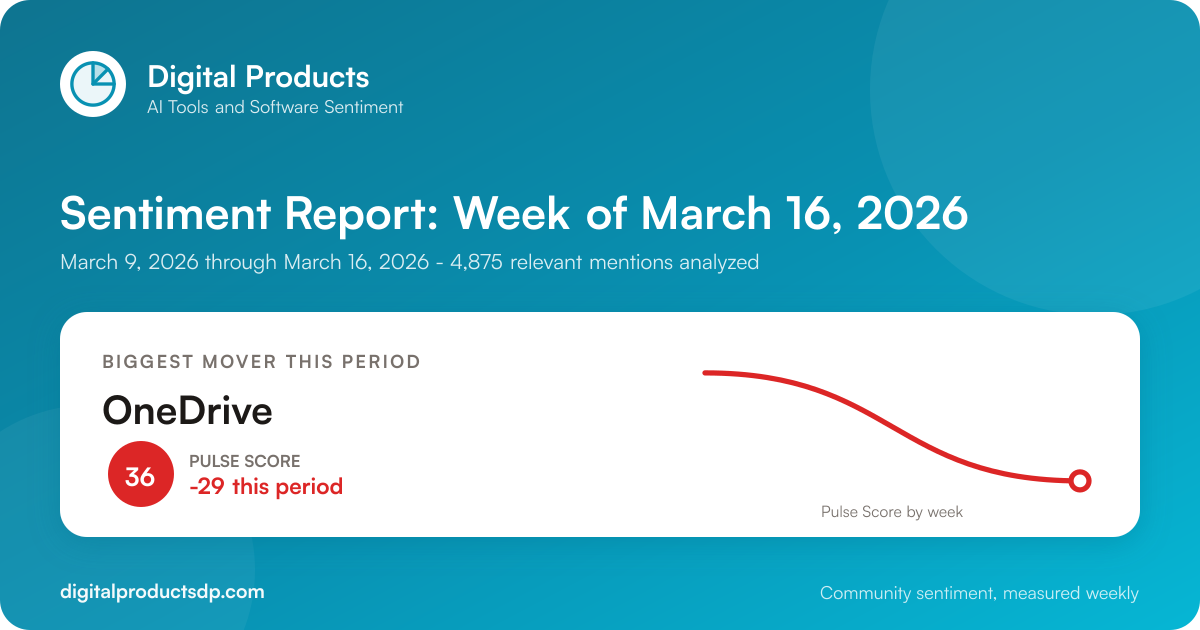
OneDrive (down 29, from 65 to 36, based on 17 mentions). The cloud-storage tool was the period's steepest faller. Reliability complaints dominated at 37 mentions, with UI frustrations at 29 and bugs at 28. Its praise, led by good integrations at 9 and compared to rivals at 8, was not enough to offset that volume of frustration, and the score gave back nearly all of its earlier standing.
Red Hat (down 25, from 75 to 50, based on 11 mentions). Discussion of this software product cooled sharply. Praise and complaints were closely matched and both thin, with strong features cited 3 times against compared to rivals at 4 and bugs and reliability at 3 each. On a small sample, that balance was enough to pull the score back to the midpoint.
HeyGen (down 13, from 71 to 58, based on 10 mentions). The AI video tool slipped while still finishing above the midpoint. Praise rested on strong features at 14 mentions, new releases at 7, and AI quality at 7, but complaints about bugs at 11, reliability at 8, and missing features at 8 weighed the conversation down over the window.
Spotlight: Kling
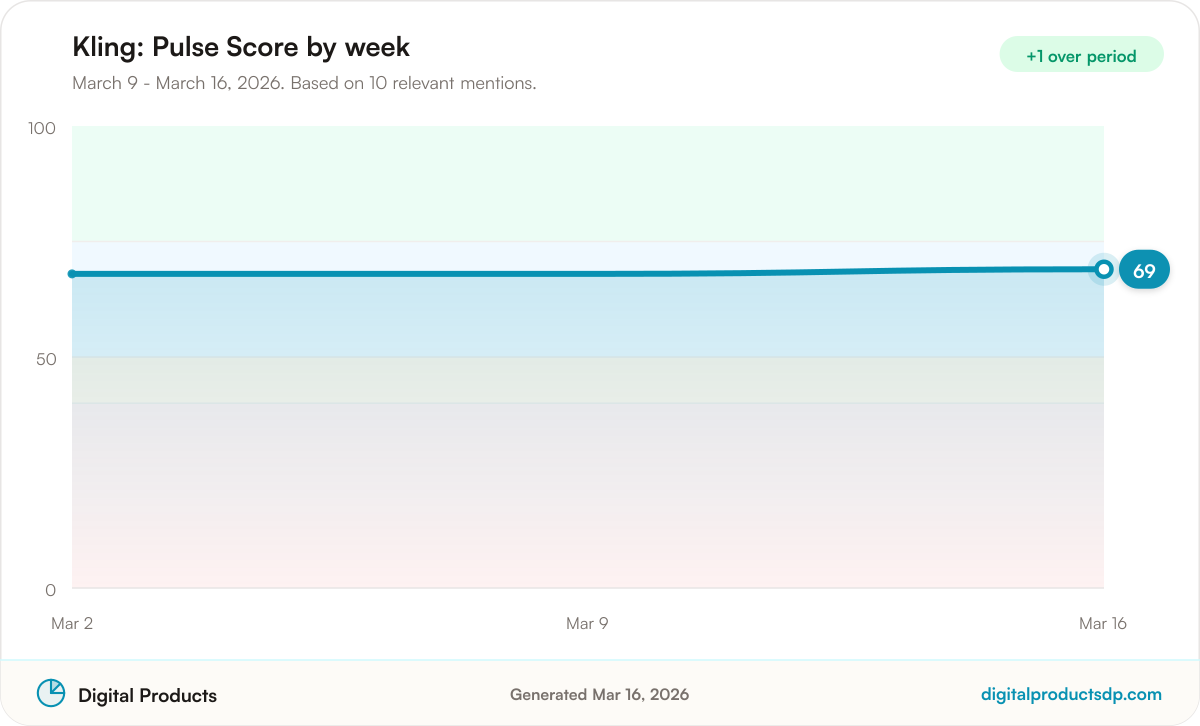
Kling, an AI video tool, finished the period with the top Pulse Score at 69, based on 10 mentions. Its weekly series shows remarkable stability: 68 on March 2, 2026, 68 again on March 9, 2026, and 69 on March 16, 2026. That is a flat, slightly rising line rather than a spike, which suggests a consistently positive tone in the public chatter rather than a single viral moment lifting the read.
The theme breakdown is mixed beneath that calm surface. Praise leaned on AI quality at 7 mentions, strong features at 6, and new releases at 5. Complaints were not absent, with bugs cited 6 times, AI quality 4 times, and performance 3 times. Notably, AI quality appears on both sides of the ledger, a reminder that the same attribute can draw admiration from some commenters and criticism from others within the same week.
The key caveat is sample size. With only 10 mentions, Kling's leaderboard position rests on the thinnest base of any leader this period, so its score should be read as a directional signal rather than a settled consensus. A modest shift in the mix of posts next week could move it noticeably in either direction.
Themes Driving the Conversation
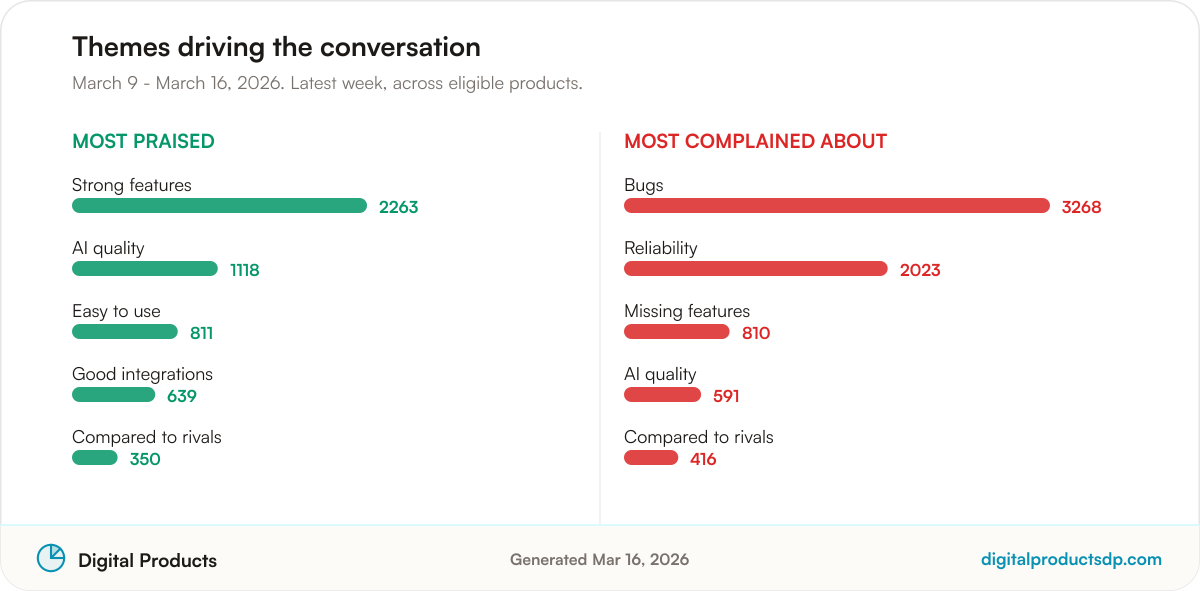
On the praise side, strong features led decisively with 2,263 mentions, followed by AI quality at 1,118, easy to use at 811, good integrations at 639, and compared to rivals at 350. Strong features showed up across the board, anchoring praise for Claude Code at 249 mentions, Claude at 229, ChatGPT at 183, and Gemini at 140. AI quality praise was concentrated in the chat and model tools, with Claude at 234, ChatGPT at 159, and Gemini at 149 leading that theme.
Complaints, however, carried the larger raw totals. Bugs topped the list at 3,268 mentions, with reliability at 2,023, missing features at 810, AI quality at 591, and compared to rivals at 416. Bug and reliability complaints clustered heavily around high-volume infrastructure and developer products: WooCommerce drew 330 bug mentions, Loom 211, Stripe 188, Tailscale 174, and Vercel 170. AI quality also appeared as a complaint theme, most visibly for Grok at 183 mentions and Claude at 110, underscoring how the same models that earn praise for output also draw scrutiny for it. The contrast between feature-led praise and bug-led complaints is the defining tension in this period's public discussion.
Watchlist
A large number of tracked products fell below the 10-mention threshold this period and are not ranked. This reflects insufficient discussion volume to produce a stable read, not any judgment about quality. Several names landed just shy of the cutoff and are worth monitoring: QuillBot, Nx, and Roboflow each drew 9 relevant mentions, while 1Password, Railway, Lusha, Wrike, Synthesia, and Pulumi each registered 8. A small further uptick in chatter could bring any of these into the ranked set next period.
Others were quieter still, including Canva, Ideogram, and LegalShield at 7 mentions, and Ahrefs, Apollo.io, and Spacelift at 6. A long tail of tracked products, including many well-known names across coding, communication, and security, recorded zero relevant mentions in the period. Their absence from the leaderboard is purely a matter of volume in the sampled sources during this window.
What To Watch Next Week
First, watch whether Semrush holds its gain. Its jump from 47 to 66 over the period was the largest of any ranked product, but it rests on 37 mentions and a praise mix led by strong features. Whether that positive tone persists or normalizes is the clearest open question heading into the next window.
Second, watch the cloud-storage category. It fell from 62 to 50, dragged by OneDrive's 29-point drop and its 37 reliability complaints. If OneDrive's reliability chatter eases, the category average could stabilize; if it continues, the category may stay under pressure.
Third, watch the leaders sitting on thin samples. Kling at 69 and Semrush at 66 both carry smaller mention counts than Claude Code and Claude, which sit on 332 and 239 mentions respectively. The high-volume names are the steadier signals to track for any genuine shift in community sentiment.
Frequently Asked Questions
Which tool had the highest Pulse Score this period?
Kling led with a Pulse Score of 69, based on 10 mentions over the period. It was followed by Semrush at 66, based on 37 mentions.
Which product moved the most this period?
Semrush was the biggest riser, climbing from 47 to 66, a gain of 19 points based on 37 mentions. OneDrive was the biggest faller, dropping from 65 to 36, a decline of 29 points based on 17 mentions.
What was the overall mood across categories?
It was mixed. Marketing rose from 47 to 51 and security firmed from 39 to 43, while cloud-storage fell from 62 to 50 and business eased from 34 to 30.
How many mentions were analyzed this period?
A total of 4,875 relevant mentions were analyzed across 87 products that met the 10-mention threshold, out of 2,218 tracked products.
About This Data
Pulse Scores summarize the tone of public online discussion on a 0-100 scale. They reflect community sentiment, not a verdict on a product's quality and not a recommendation. We report on complete calendar weeks only, and products with fewer than 10 relevant mentions in the period are excluded from rankings to avoid unstable reads on thin samples.
Public discussion is collected from Hacker News, Stack Exchange, GitHub, Bluesky, the Apple App Store, and YouTube. Automated sentiment analysis can misread sarcasm, jokes, or niche context. Mention volumes vary widely between products, and scores can move week to week. Any company that wants to respond is welcome to reach out. See our methodology for how scores are calculated.