AI Tools and Software Sentiment Report: Week of March 9, 2026
March 10, 2026
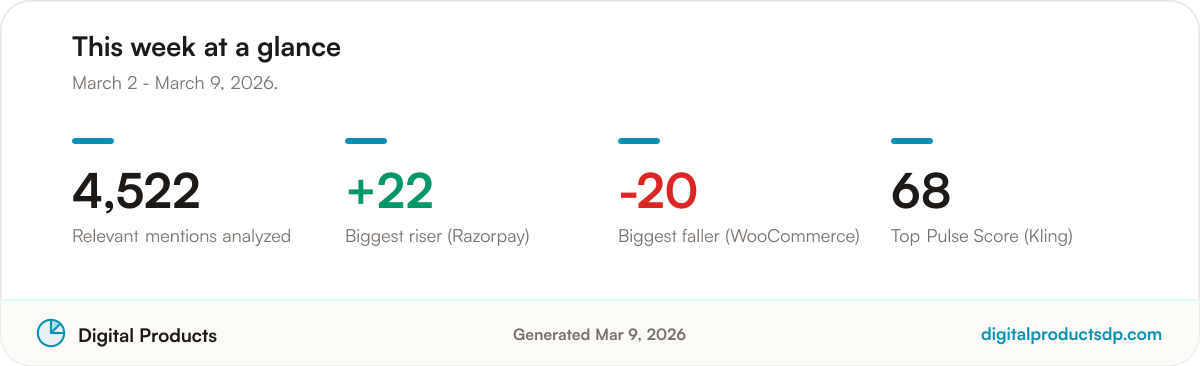
This report covers aggregated public online discussion of tracked tools and software for the complete week running from March 2, 2026 through March 9, 2026. It is a snapshot of community sentiment, not a verdict on any product. Across this period we analyzed 4,522 relevant mentions, drawn from a tracked list of 2,218 products, of which 81 cleared the threshold of at least 10 relevant mentions needed to appear in the rankings.
The mentions analyzed for March 2, 2026 through March 9, 2026 point to a mood that leans cautious. Praise clustered around features and capability, while complaints were dominated by reliability and bug reports. The products that rose and fell tell a consistent story about what the online conversation rewards and punishes this week. Below we walk through the leaderboard, category shifts, the biggest movers, and the themes pulling sentiment in each direction.
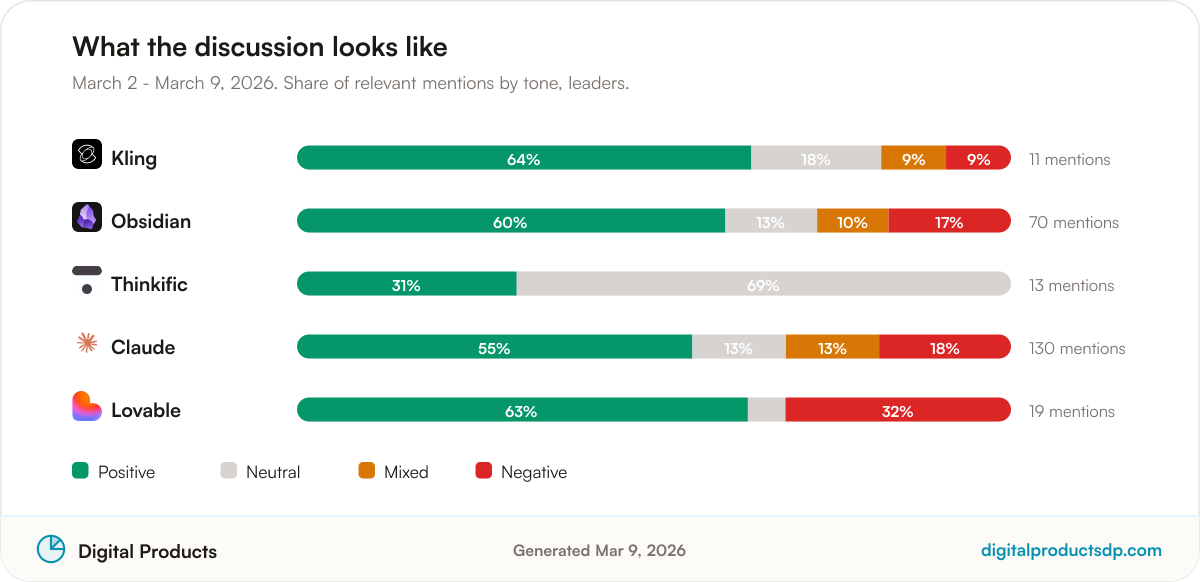
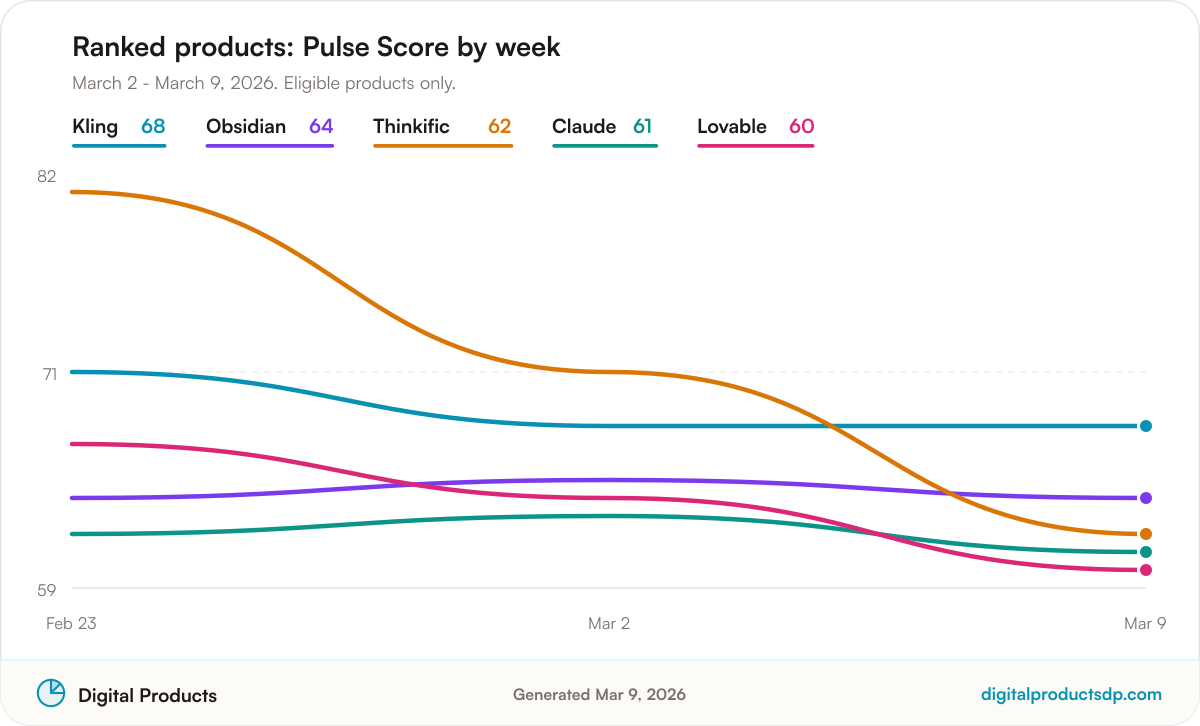
Kling leads the period with a Pulse Score of 68, based on 11 mentions, narrowly ahead of Obsidian at 64 based on a much larger 70 mentions. Thinkific sits at 62 based on 13 mentions, with Claude at 61 based on 130 mentions and Lovable rounding out the top five at 60 based on 19 mentions. The spread here is narrow, and the sample sizes vary widely, from Kling's thin 11 mentions to Claude's far sturdier 130.
That contrast matters. Obsidian and Claude carry their scores on heavier discussion volume, so their reads are steadier. Kling and Thinkific sit on lighter samples, where a handful of mentions can move the number more. Read the leaderboard as a measure of tone among the people talking, weighted by how many were talking.
Category View
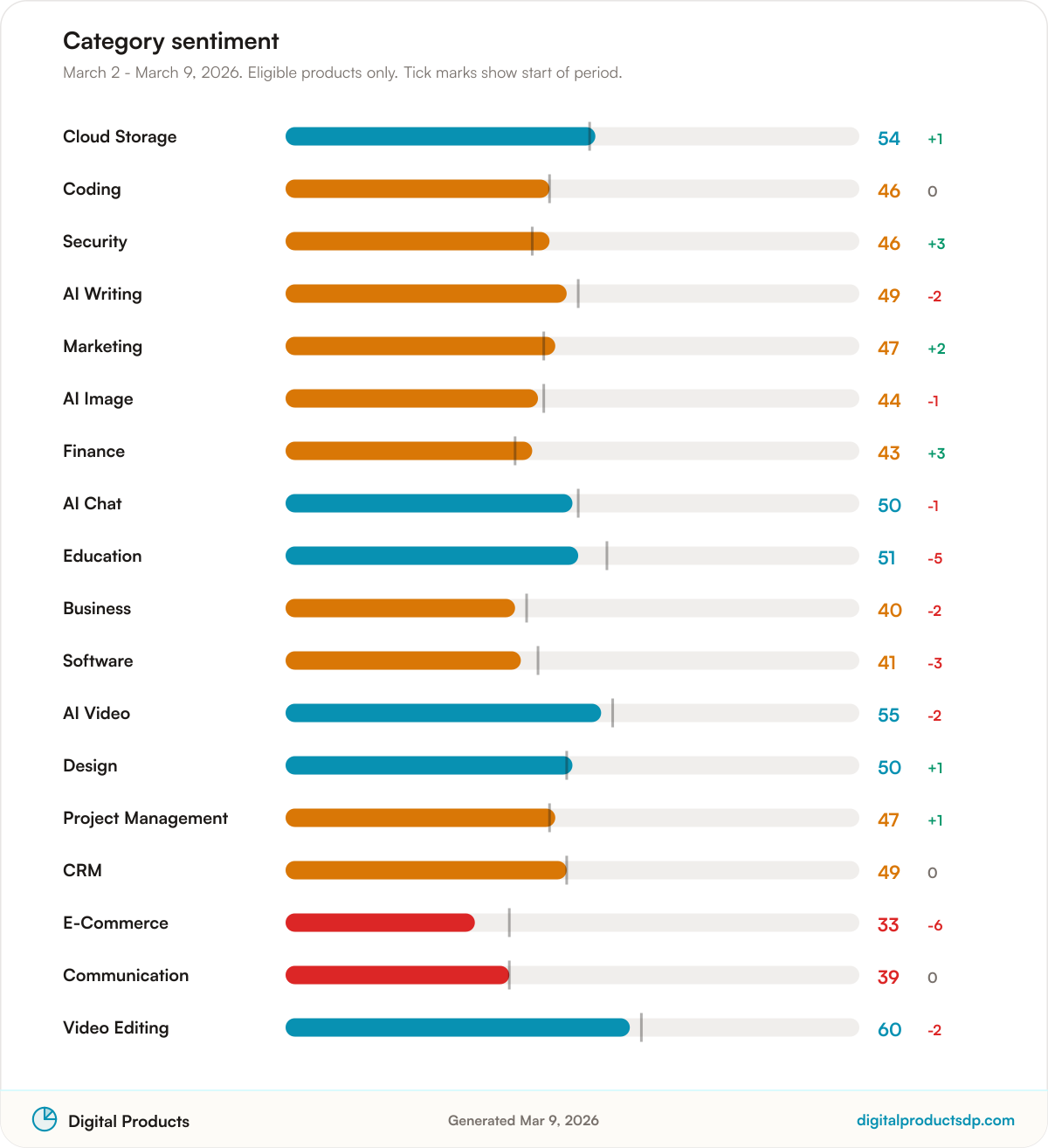
At the category level, most groups moved only slightly. Video-editing held the highest average, easing from 62 to 60, with ai-video close behind at 57 down to 55. The sharpest decline came in e-commerce, sliding from 39 to 33, and education softened from 56 to 51. On the upside, finance climbed from 40 to 43, security rose from 43 to 46, and marketing edged from 45 to 47. Coding, crm, and communication were essentially flat, sitting at 46, 49, and 39 respectively at both ends of the period. The overall picture is one of small shifts rather than wholesale movement, with e-commerce the clearest soft spot in the community conversation.
Biggest Movers
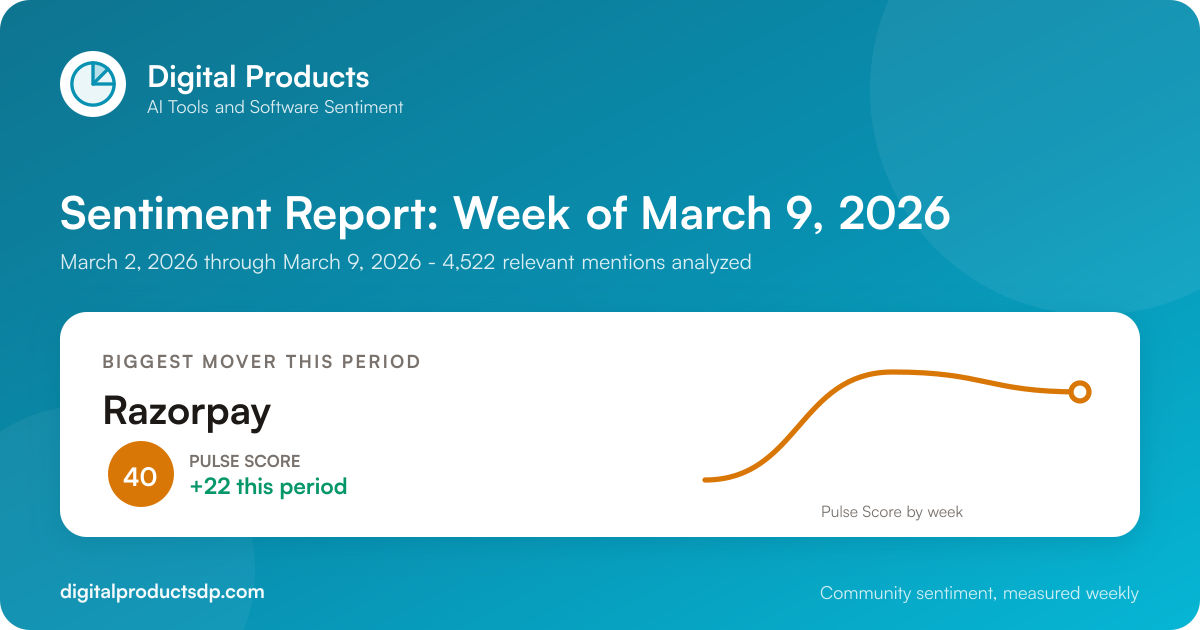
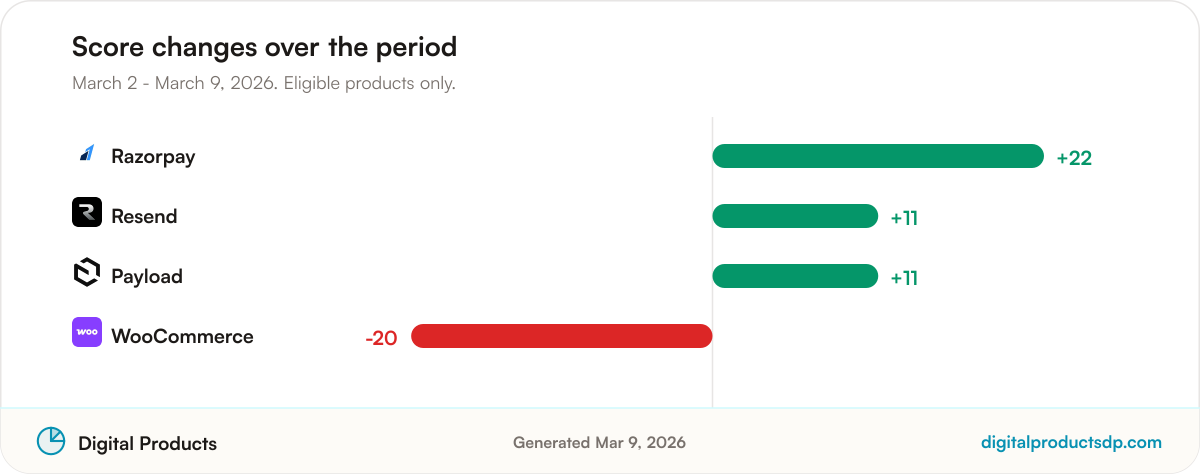
Razorpay (riser, +22, from 18 to 40, based on 15 mentions). Razorpay posted the largest gain of the period. Its praise themes lean on Good integrations, mentioned 17 times, and Strong features, mentioned 9 times. The climb is best read as a recovery from a very low starting point of 18, though complaints remain heavy: Bugs were cited 67 times and Reliability 46 times, which caps how far the recovery has carried.
Resend (riser, +11, from 47 to 58, based on 16 mentions). Resend's gain tracks praise for Strong features, mentioned 28 times, Good integrations, mentioned 24 times, and Fair pricing, mentioned 21 times. The positive notes outline a tool that the community discusses for capability and value, even as Bugs at 36 mentions and Reliability at 29 mentions keep the conversation grounded.
Payload (riser, +11, from 37 to 48, based on 40 mentions). Payload rose on the heaviest sample of the three risers. Its praise is thin, with Strong features and Easy to use each noted once, while complaints are more present: Bugs at 14 mentions, Reliability at 8, and Missing features at 7. The improvement here reflects a move up from a weak base rather than a wave of enthusiasm.
WooCommerce (faller, -20, from 50 to 30, based on 29 mentions). WooCommerce saw the steepest decline. The complaint load is striking: Bugs were mentioned 330 times and Reliability 175 times, with UI frustrations adding another 58. Praise for Strong features at 17 mentions and Good integrations at 10 was nowhere near enough to offset the volume of reliability and bug discussion.
Thinkific (faller, -19, from 81 to 62, based on 13 mentions). Thinkific remains a leaderboard product at 62, but it lost ground from an unusually high 81. On its thin sample, theme signal is sparse, with single-mention notes spread across Good integrations and Strong features on the praise side and Lacking integrations and Missing features on the complaint side. With so few mentions, this kind of swing is exactly the volatility light samples invite.
Roboflow (faller, -12, from 56 to 44, based on 10 mentions). Roboflow fell on the minimum qualifying sample. Bugs led its complaints at 15 mentions, with Missing features and Reliability each at 7. Praise for Strong features at 12 mentions and Easy to use at 7 was present but outweighed by the bug discussion in the latest week.
Spotlight: Kling
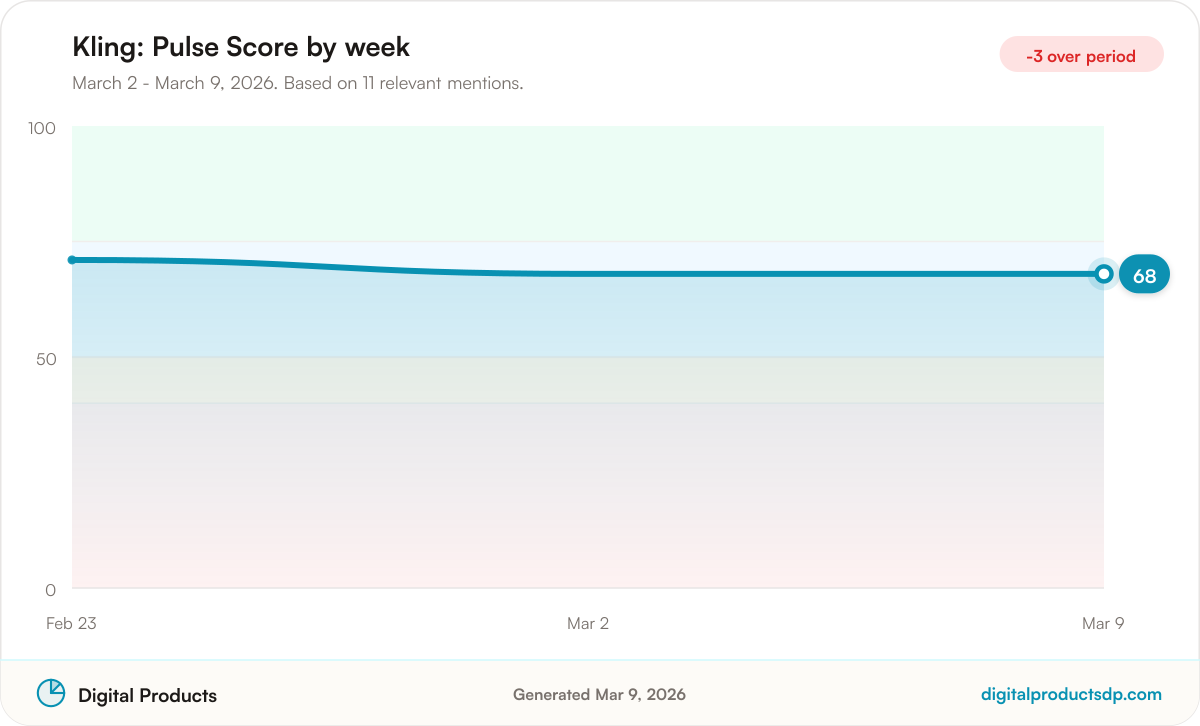
Kling tops the leaderboard this period with a Pulse Score of 68, based on 11 mentions. Its weekly series shows a slight cooling from 71 on February 23, 2026 to 68 on March 2, 2026, holding at 68 on March 9, 2026. The score has drifted down modestly across the three weeks while staying firmly in the upper range of the eligible field.
The theme breakdown is mixed even at the top. On the praise side, Kling drew AI quality at 7 mentions, Strong features at 6, and New releases at 5. On the complaint side, Bugs were noted 6 times, AI quality 4 times, and Performance 3 times. The fact that AI quality appears on both sides is worth noting: the same dimension that some discuss favorably is a point of friction for others, a common pattern in ai-video conversation.
The key caveat is sample size. With only 11 mentions, Kling's lead rests on a thin base, and a small number of new posts could move it meaningfully in either direction. Treat the top spot as a snapshot of a small but currently positive conversation rather than a durable verdict.
Themes Driving the Conversation
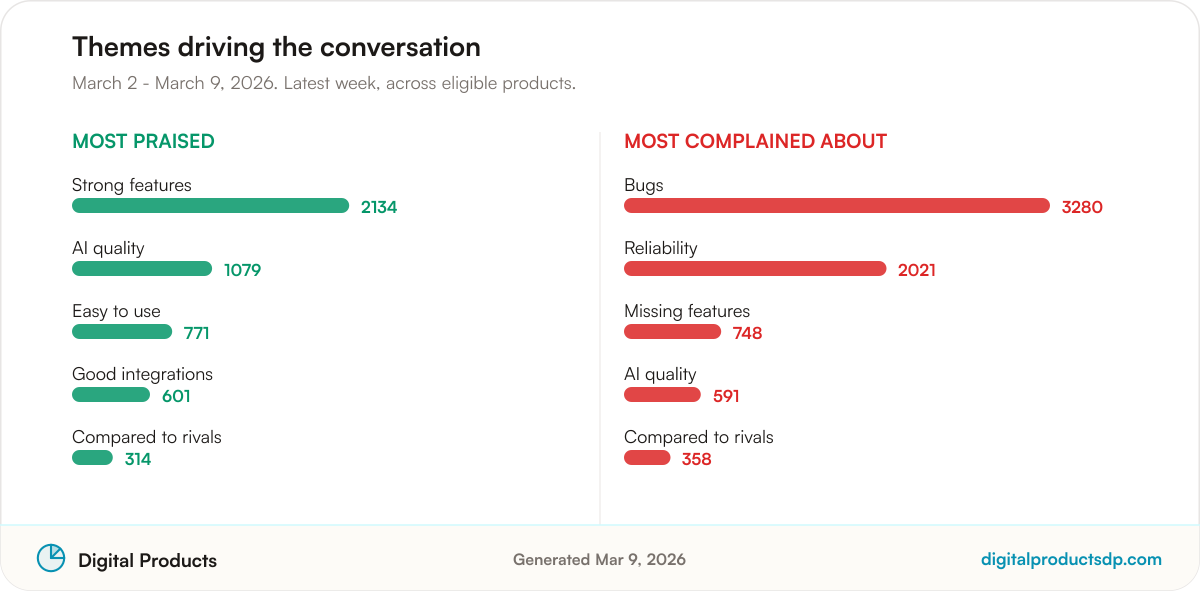
On the praise side, Strong features led by a wide margin with 2,134 mentions, followed by AI quality at 1,079, Easy to use at 771, Good integrations at 601, and Compared to rivals at 314. These themes show up across the most-discussed products. Claude drew 229 Strong features mentions and 234 AI quality mentions, ChatGPT 183 Strong features and 159 AI quality, and Gemini 140 Strong features and 149 AI quality. Good integrations is the standout for infrastructure-style products like Tailscale, with 77 mentions, and Prometheus, with 69.
On the complaint side, the conversation is heavily weighted toward reliability. Bugs led all complaint themes with 3,280 mentions, with Reliability close behind at 2,021. Missing features followed at 748, AI quality at 591, and Compared to rivals at 358. The bug volume is concentrated in a handful of high-traffic products: WooCommerce alone accounts for 330 Bugs mentions, Loom for 211, Stripe for 188, Grok for 177, and Tailscale for 174. Reliability follows a similar shape, led by WooCommerce at 175 and Stripe at 158. The clear message from this week's discussion is that stability complaints, not feature gaps, are the dominant source of negative sentiment.
Watchlist
A large share of tracked products did not clear the 10-mention threshold this period, which means they are excluded from the rankings to avoid unstable reads on thin samples. This is a statement about discussion volume only, never a judgment on quality. Several products sat just below the line: Canva, Ideogram, DALL-E, Semgrep, and Akamai each drew 9 relevant mentions, and Babbel, Flux, HeyGen, Hygraph, Oak, Microsoft Copilot, and Carta each drew 8. Devin also landed at 9 mentions.
A little further down, QuillBot, Leonardo AI, and Tresorit each registered 7 mentions, alongside Asana, Todoist, Zilliz, and Terraform. Products like LegalShield, Shippo, Zypper, Adyre and others in the 4 to 6 range remain too thinly discussed to rank reliably this week. Many well-known names registered zero relevant mentions in the period, including Notion, Slack, Zoom, GitHub, and Dropbox, a reminder that brand size and weekly discussion volume in our sources are not the same thing. Any of these could re-enter the rankings in a future week if community discussion picks up.
What To Watch Next Week
First, watch whether Razorpay's recovery holds. It gained 22 points to reach 40, but its complaint load remains heavy with Bugs at 67 mentions and Reliability at 46, so the climb sits on a fragile base worth monitoring.
Second, watch e-commerce, the weakest category this period at 33 after starting at 39. WooCommerce's fall to 30, driven by 330 Bugs mentions and 175 Reliability mentions, is a large part of that softness, and whether the category stabilizes will depend on how that conversation evolves.
Third, watch the thin-sample leaders. Kling at 68 on 11 mentions and Thinkific at 62 on 13 mentions both sit on light volume, where scores can move quickly week to week. It is worth seeing whether their discussion volume grows enough to firm up those reads.
Frequently Asked Questions
Which product had the highest Pulse Score this period?
Kling led with a Pulse Score of 68, based on 11 mentions, narrowly ahead of Obsidian at 64 based on 70 mentions.
Which product moved the most this period?
Razorpay was the biggest riser, climbing from 18 to 40 for a gain of 22 points based on 15 mentions, while WooCommerce was the biggest faller, dropping from 50 to 30 based on 29 mentions.
What was the overall mood across categories?
The mood was cautious and mostly stable, with video-editing highest at 60 and e-commerce weakest after sliding from 39 to 33. Complaints were dominated by Bugs at 3,280 mentions and Reliability at 2,021 mentions.
How many mentions were analyzed this period?
We analyzed 4,522 relevant mentions across the week, drawn from 2,218 tracked products, of which 81 cleared the 10-mention threshold to be ranked.
About This Data
Pulse Scores summarize the tone of public online discussion on a 0-100 scale and reflect community sentiment. They are not a verdict on a product's quality and not a recommendation. We report on complete calendar weeks only, and products with fewer than 10 relevant mentions in the period are excluded from rankings to avoid unstable reads on thin samples.
Public discussion is collected from Hacker News, Stack Exchange, GitHub, Bluesky, the Apple App Store, and YouTube. Automated sentiment analysis can misread sarcasm, jokes, or niche context, mention volumes vary widely between products, and scores can move from week to week. Any company that wants to respond is welcome to reach out. For more on how scores are calculated, see our methodology.