AI Tools and Software Sentiment Report: Week of March 2, 2026
March 3, 2026
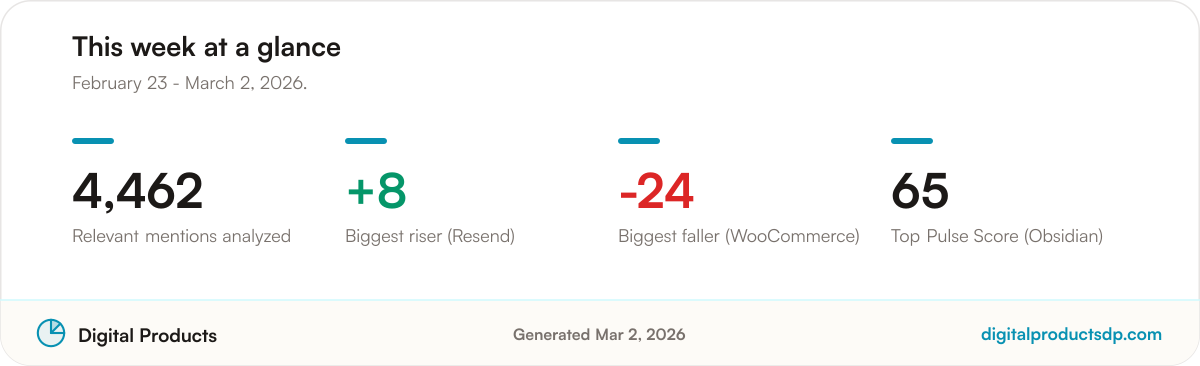
This edition of our weekly sentiment report covers aggregated public online discussion for the period running from February 23, 2026 through March 2, 2026. Across that span we analyzed 4,462 relevant mentions drawn from public sources, tracking how the tone of conversation moved for the tools and software products that drew enough discussion to rank. As always, these figures describe community sentiment, the mood of public chatter, and not any verdict on product quality.
Of the 2,218 products we track, 75 cleared the threshold of at least 10 relevant mentions for the period analyzed for February 23, 2026 through March 2, 2026. The leaderboard this week is tightly packed at the top, the biggest movers tell a story of reliability and bug complaints, and the most-discussed themes lean heavily negative. Below we walk through the numbers and what the available data suggests.
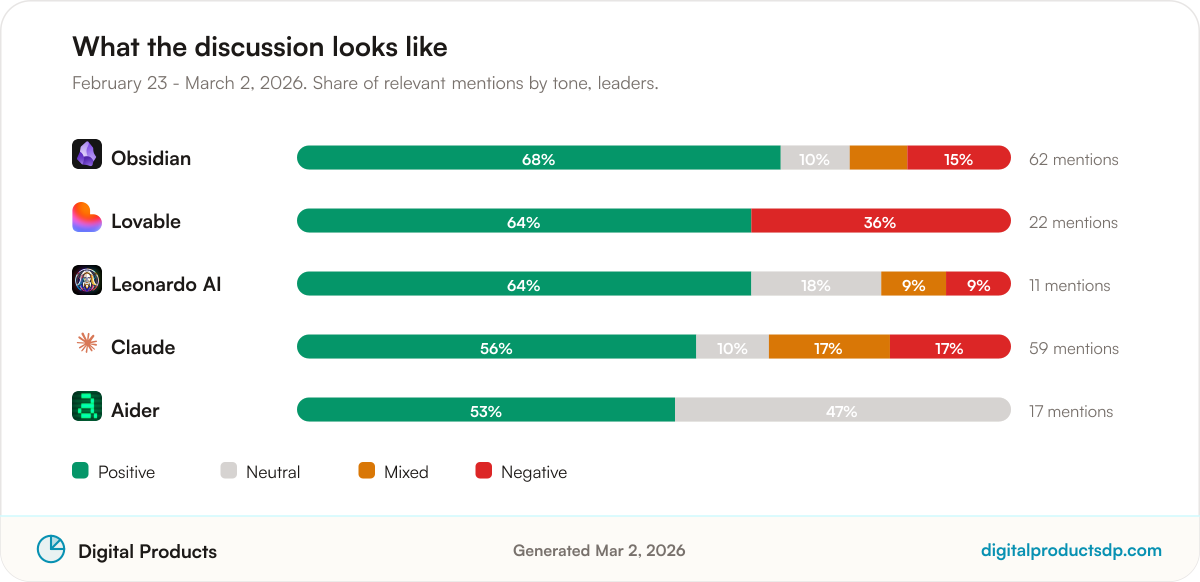
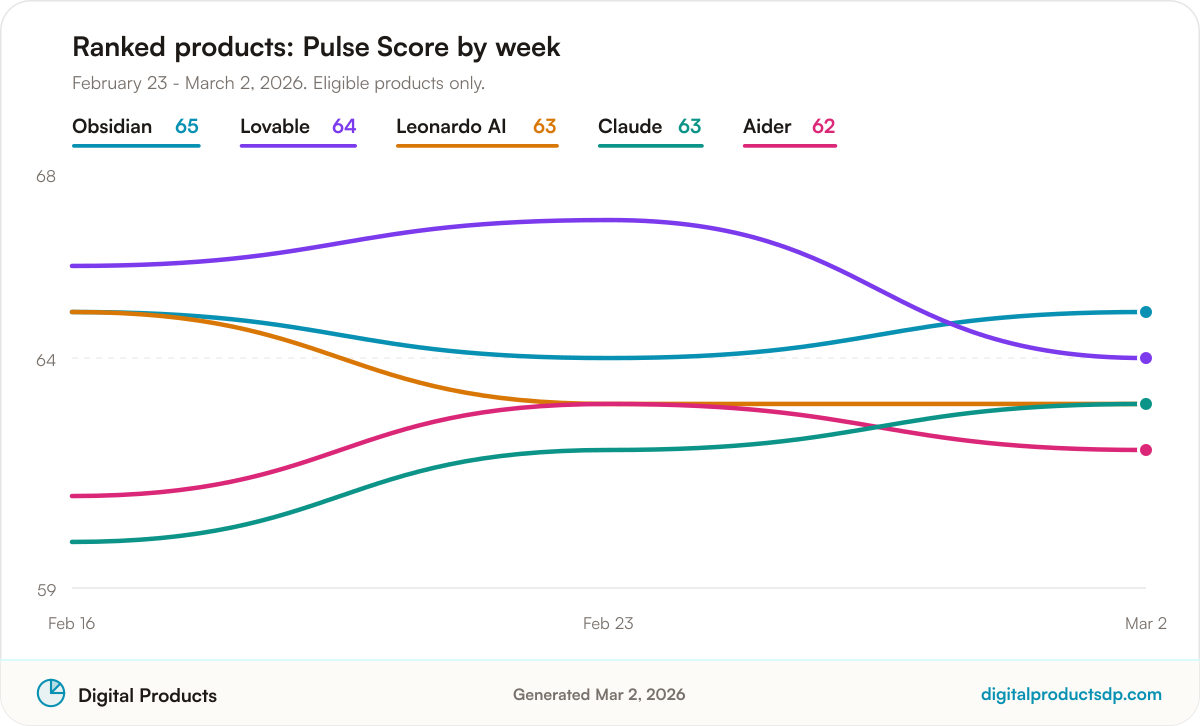
The top of the table is tightly bunched. Obsidian, a project-management tool, leads with a Pulse Score of 65 based on 62 mentions over the period. Lovable, a coding product, follows at 64 based on 22 mentions. Leonardo AI, an AI image tool, scored 63 based on just 11 mentions, while Claude, an AI chat assistant, also landed at 63 but on a far larger base of 59 mentions. Aider, another coding tool, rounds out the leaders at 62 based on 17 mentions.
The spread between first and fifth is only three points, which means small shifts in tone can reorder this group week to week. It is also worth noting how different the sample sizes are. Claude's score of 63 rests on 59 mentions, while Leonardo AI's matching tier sits on 11. Scores built on thinner samples deserve more caution, since a handful of posts can swing them. Claude and Obsidian carry the most discussion volume among the leaders, so their reads are the steadiest of the group.
Category View
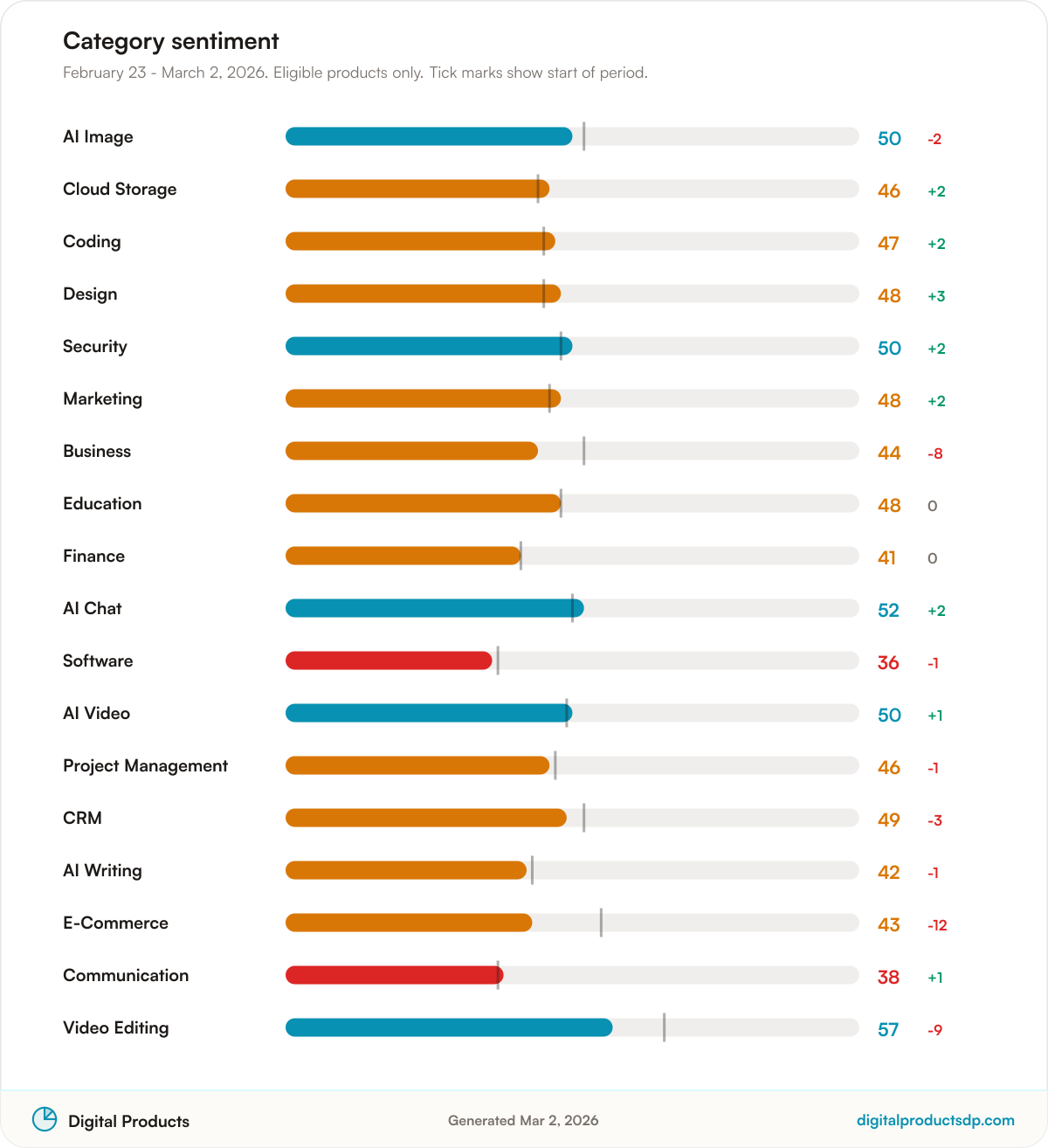
At the category level, the sharpest declines came in e-commerce, which fell from 55 to 43, business, which dropped from 52 to 44, and video-editing, which slid from 66 to 57 even though it remained the highest-scoring category at the end of the period. CRM eased from 52 to 49. Movement on the upside was smaller and steadier: design rose from 45 to 48, ai-chat moved from 50 to 52, and security, marketing, and coding each ticked up by two or three points. Finance and education were essentially flat at 41 and 48 respectively, while software stayed low, moving from 37 to 36. The pattern suggests the period's negative pressure was concentrated in a few categories rather than spread evenly across the board.
Biggest Movers
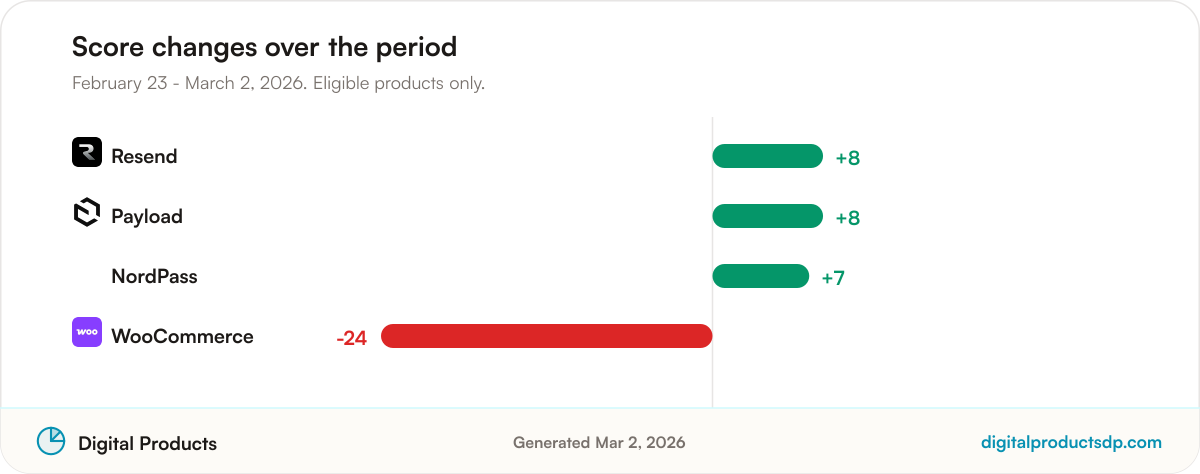
Resend (up 8, from 47 to 55, based on 11 mentions). The email-focused tool's rise tracks with praise themes centered on strong features (28 mentions), good integrations (24), and fair pricing (21). Those positives appear to have outweighed a notable load of complaints, where bugs (36) and reliability (29) were the most-cited grievances, alongside lacking integrations (11). The move shows sentiment improving even while reliability concerns remained part of the conversation.
Payload (up 8, from 37 to 45, based on 23 mentions). The headless CMS climbed despite a complaint-heavy theme mix. Its praise mentions were sparse, with strong features (1) and easy to use (1), while complaints clustered around bugs (14), reliability (8), and missing features (7). A rise off a low starting point of 37 can reflect a relative warming in tone rather than broad enthusiasm, and the thin praise volume here is worth keeping in view.
NordPass (up 7, from 53 to 60, based on 16 mentions). The password manager's gain aligns with praise for strong features (6), being easy to use (4), and pricing changes (3). Complaints were modest by comparison, with bugs (3), reliability (3), and downtime (2). Among the risers, NordPass shows the cleanest balance of positive themes against a light complaint load.
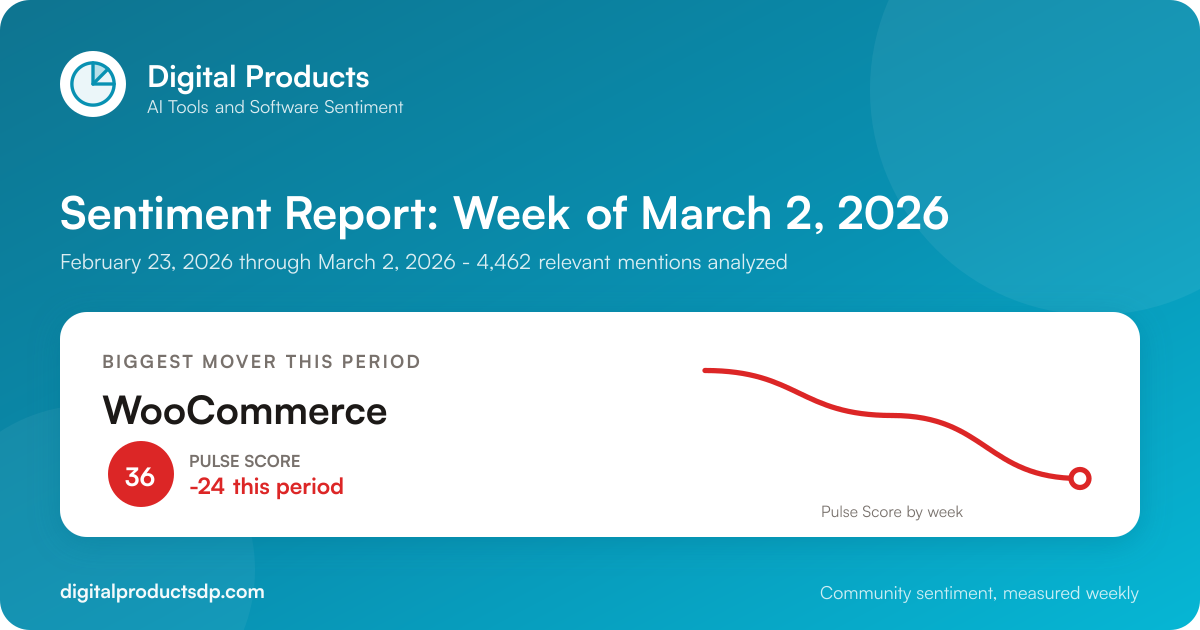
WooCommerce (down 24, from 60 to 36, based on 18 mentions). The e-commerce platform posted the steepest drop of the period. While praise included strong features (17), good integrations (10), and new releases (10), the complaint side was overwhelming: bugs drew 330 mentions, reliability 175, and UI frustrations 58. That heavy volume of bug and reliability chatter is the clearest driver behind the fall and helps explain the e-commerce category's broader slide.
Plesk (down 18, from 52 to 34, based on 11 mentions). The hosting control panel's decline maps to a complaint mix led by bugs (19) and reliability (17), with lacking integrations (4) also present. Praise was light, with easy to use (3), strong features (3), and polished UI (1). The mismatch between sparse positives and concentrated reliability complaints fits the size of the drop.
Attio (down 16, from 68 to 52, based on 10 mentions). The CRM started the period as the highest scorer in its swing range and gave most of that back. Its weekly series shows the bulk of the fall happening early, from 68 to 53, before settling at 52. Praise centered on strong features (8), polished UI (7), and good integrations (2), while complaints included bugs (7), missing features (5), and lacking integrations (3). On just 10 mentions, this read is among the thinnest in the mover set and should be treated with caution.
Spotlight: Obsidian
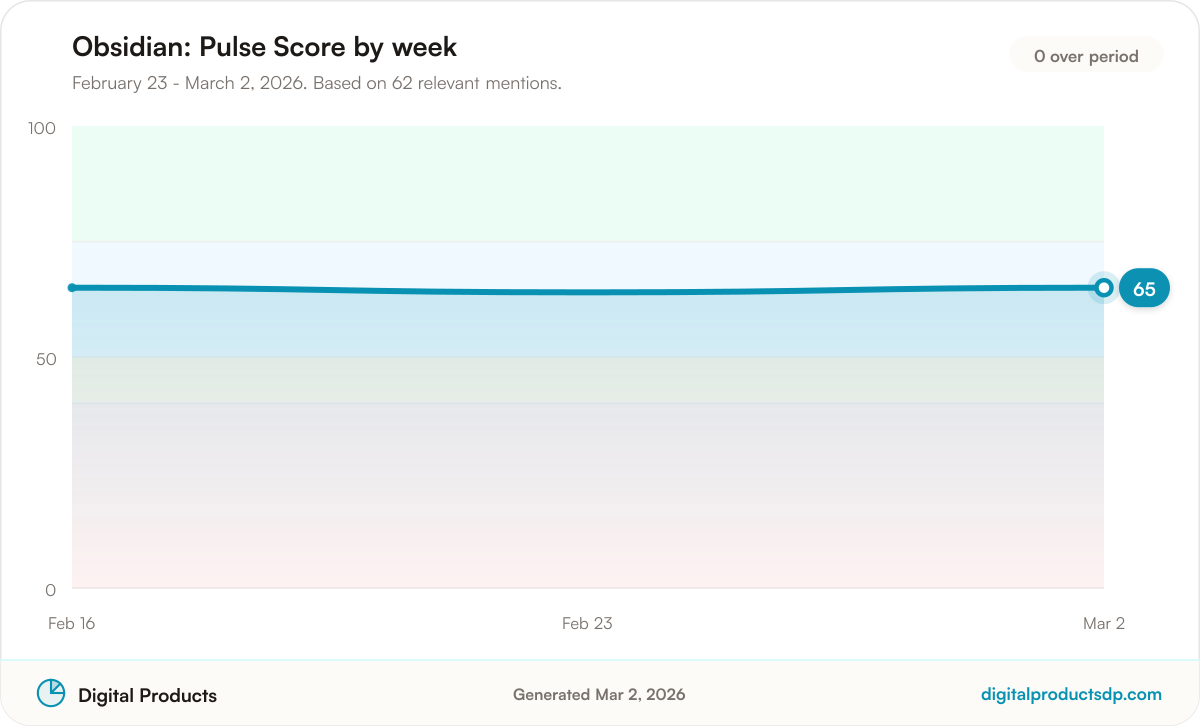
Obsidian holds the top Pulse Score this period at 65, based on 62 mentions. Its weekly series is notably stable: 65 on February 16, 2026, a slight dip to 64 on February 23, 2026, and back to 65 on March 2, 2026. That steadiness, paired with one of the larger sample sizes among the leaders, makes it one of the more reliable reads on the board.
The praise side of Obsidian's discussion was led by strong features (40 mentions), good integrations (25), and easy to use (20). That combination points to a community that values the tool's capability and how it fits into wider workflows. It is the only project-management product among the top five, in a category that otherwise eased slightly from 47 to 46 over the period.
Obsidian's conversation was not free of friction. Complaints included bugs (28), missing features (20), and reliability (13). Those concerns echo the broader themes dominating this period's discussion, yet they did not pull Obsidian's score down, suggesting the positive sentiment around features and integrations carried more weight in the aggregate tone.
Themes Driving the Conversation
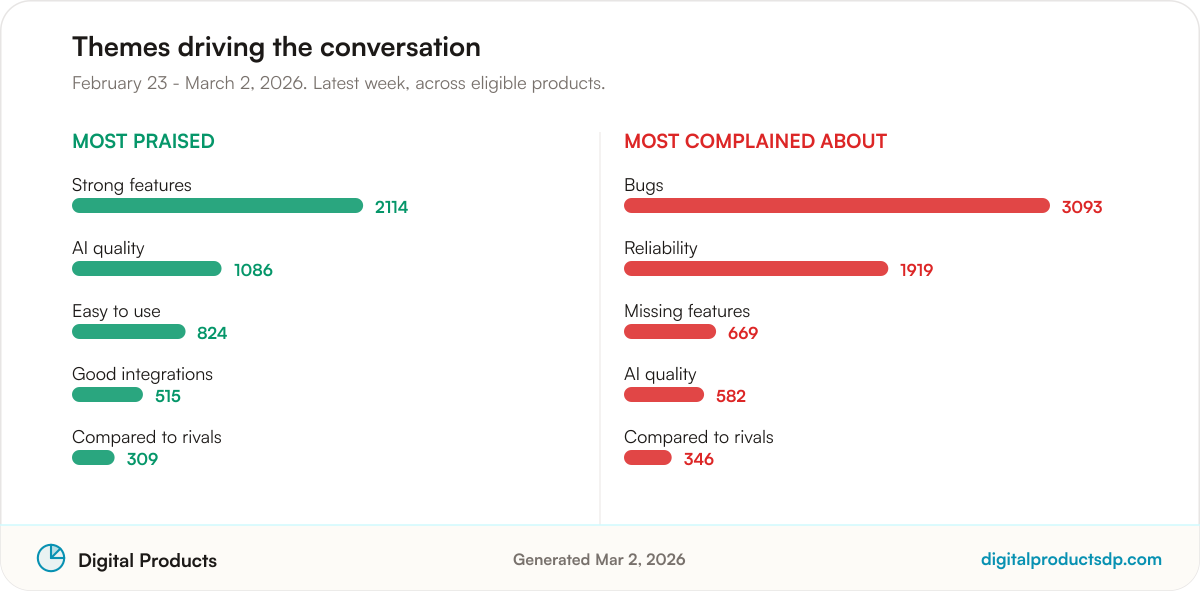
On the praise side, strong features led by a wide margin with 2,114 mentions, followed by AI quality at 1,086, easy to use at 824, good integrations at 515, and compared to rivals at 309. The strong-features theme shows up across the leaderboard, from Obsidian (40) and Claude (229) to Cursor (100) and ChatGPT (183), suggesting capability is the most consistent driver of positive chatter. AI quality praise was concentrated in the AI chat and image products, with Claude (234), ChatGPT (159), and Gemini (149) carrying much of that volume.
The complaint side was heavier still. Bugs topped all themes at 3,093 mentions, with reliability second at 1,919, then missing features at 669, AI quality at 582, and compared to rivals at 346. The bug and reliability complaints were dominated by a handful of high-volume products: WooCommerce alone drew 330 bug mentions and 175 reliability mentions, while Loom (211 bugs, 135 reliability), Stripe (188 bugs, 158 reliability), Vercel (170 bugs, 151 reliability), and Tailscale (174 bugs, 131 reliability) added substantial weight. Notably, AI quality appears on both the praise and complaint lists, reflecting a community that is divided on how well AI outputs are performing, with Grok (183), ChatGPT (109), and Gemini (112) drawing the most AI-quality complaints.
Watchlist
Many tracked products did not reach the 10-mention threshold this period and are therefore excluded from the rankings. This is a statement about discussion volume, not quality. Several came close and are worth watching as candidates to qualify in future weeks: Copy.ai, Ideogram, DALL-E, Wrike, Devin, Oak, Prometheus, Power BI, Semgrep, Razorpay, and Todoist each recorded 9 relevant mentions, just short of the cutoff. A second tier sat at 8 mentions, including Tresorit, Carta, AVG, Asana, Roboflow, Hygraph, Medusa, and Zilliz.
Others drew only a trickle of discussion in the period, such as GetResponse, QuillBot, Foxit, Thinkific, and Klarna at 7 mentions, and Ahrefs and Zscaler at 6. A large number of tracked products recorded zero relevant mentions this period, which simply means public conversation about them did not surface in our sources during the window. None of this should be read as a negative signal. Thin samples produce unstable scores, which is exactly why the threshold exists, and a product can move from the watchlist into the rankings as soon as discussion picks up.
What To Watch Next Week
First, watch whether WooCommerce and Plesk stabilize or continue lower. Both fell sharply on complaint mixes dominated by bugs and reliability, and their weekly series show declines across consecutive weeks. Monitoring whether that bug and reliability chatter eases will indicate whether the drop was a one-period spike or a longer trend.
Second, keep an eye on the tightly packed leaderboard. With only three points separating Obsidian at 65 from Aider at 62, and several of those scores resting on small samples, the ordering could shift easily. Claude and Obsidian carry the heaviest discussion volume among the leaders, so their reads are the ones to track for stability.
Third, watch the AI quality theme, which appeared on both the praise and complaint lists this period. With 1,086 praise mentions against 582 complaint mentions, the conversation around AI output quality is active and split. Whether that balance tips in either direction for products like Grok, Gemini, and ChatGPT is worth following.
Frequently Asked Questions
Which product had the highest Pulse Score this period?
Obsidian led with a Pulse Score of 65, based on 62 mentions over the period running from February 23, 2026 through March 2, 2026.
Which product moved the most this period?
WooCommerce was the biggest faller, dropping 24 points from 60 to 36 based on 18 mentions. On the upside, Resend and Payload each rose 8 points.
What was the overall mood across categories?
It was mixed, with sharp declines in e-commerce (55 to 43) and business (52 to 44), offset by smaller gains in design (45 to 48) and ai-chat (50 to 52). Complaint themes led by bugs (3,093 mentions) outweighed praise volume overall.
How many mentions were analyzed this period?
We analyzed 4,462 relevant mentions across 75 eligible products, out of 2,218 products tracked.
About This Data
Pulse Scores summarize the tone of public online discussion on a 0-100 scale and reflect community sentiment, not a verdict on a product's quality or a recommendation. We report on complete calendar weeks only, and products with fewer than 10 relevant mentions in the period are excluded from rankings to avoid unstable reads on thin samples.
Public discussion is collected from Hacker News, Stack Exchange, GitHub, Bluesky, the Apple App Store, and YouTube. Automated sentiment analysis can misread sarcasm, jokes, or niche context, mention volumes vary widely between products, and scores can move week to week. Any company that wants to respond is welcome to reach out. For more on how scores are calculated, see our methodology.