AI Tools and Software Sentiment Report: Week of February 23, 2026
February 23, 2026
This edition of our weekly sentiment report covers aggregated public online discussion for tracked tools and software across the period running from February 16, 2026 through February 23, 2026. The figures here summarize the tone of community chatter collected from public sources, not a verdict on any product's quality. Every number below traces to one dataset for the period.
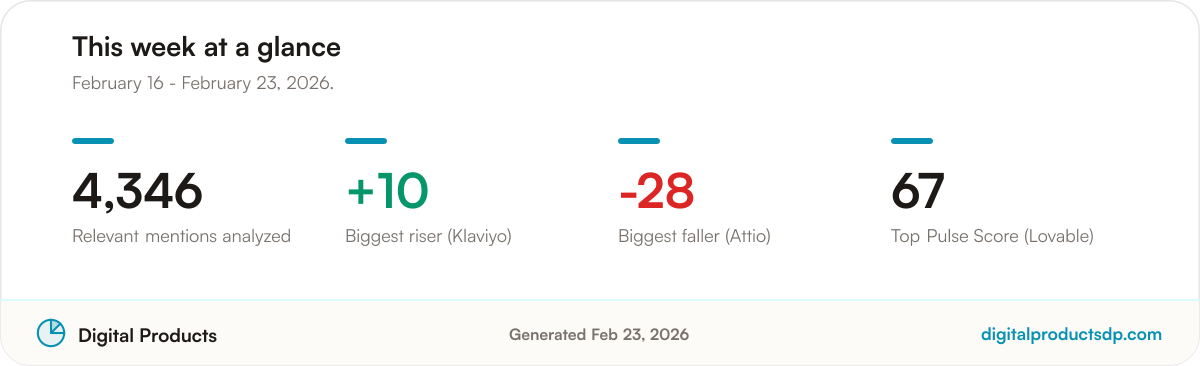
For the mentions analyzed for February 16, 2026 through February 23, 2026, we logged 4,346 relevant mentions. Of the 2,218 products tracked, 66 cleared the threshold of at least 10 relevant mentions and qualified for rankings. The rest are noted in the Watchlist as having insufficient discussion volume to score reliably. What follows reads the leaderboard, the category averages, the biggest movers, and the themes that shaped the conversation.
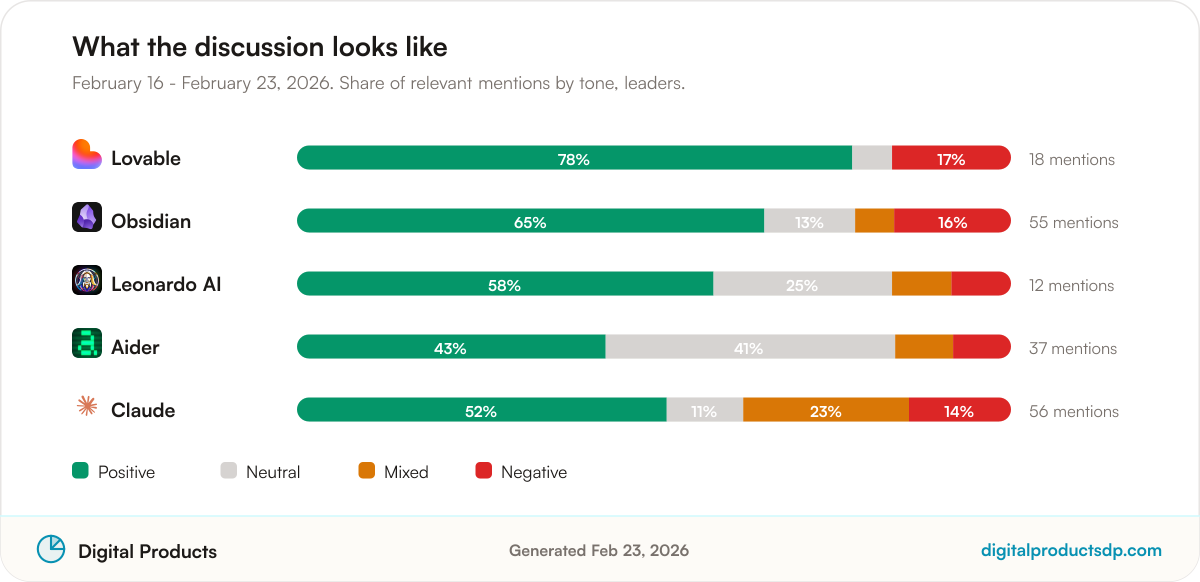
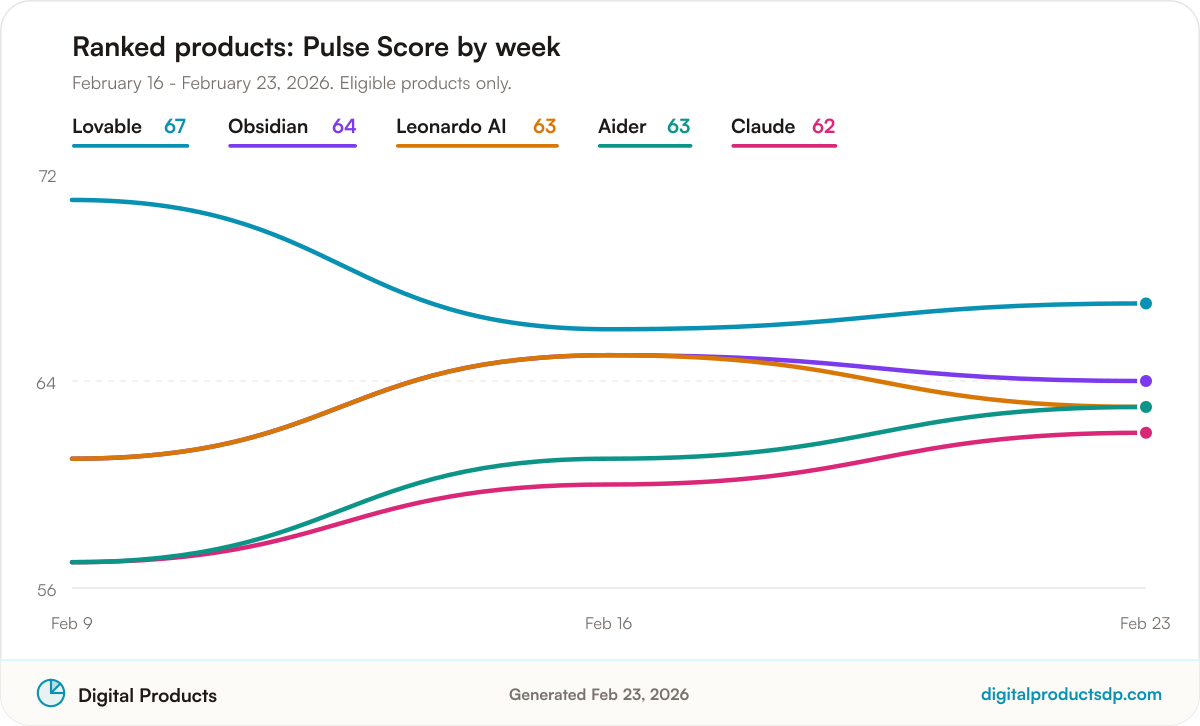
Lovable led the ranked products with a Pulse Score of 67 based on 18 mentions, a coding tool that edged ahead of the project-management app Obsidian at 64 based on 55 mentions. Leonardo AI, an AI image tool, scored 63 based on 12 mentions, tied on score with the coding tool Aider, which drew 63 based on 37 mentions. Claude, an AI chat tool, rounded out the leaders at 62 based on 56 mentions.
The spread among these five is narrow, with only five points separating the top score from the bottom of the group. Worth noting too is how different the sample sizes are: Lovable's lead rests on 18 mentions, while Claude and Obsidian carry heavier samples of 56 and 55 mentions respectively. Smaller samples can move more sharply week to week, so a tight clustering at the top is best read as a band of broadly positive sentiment rather than a clear separation in standing.
Category View
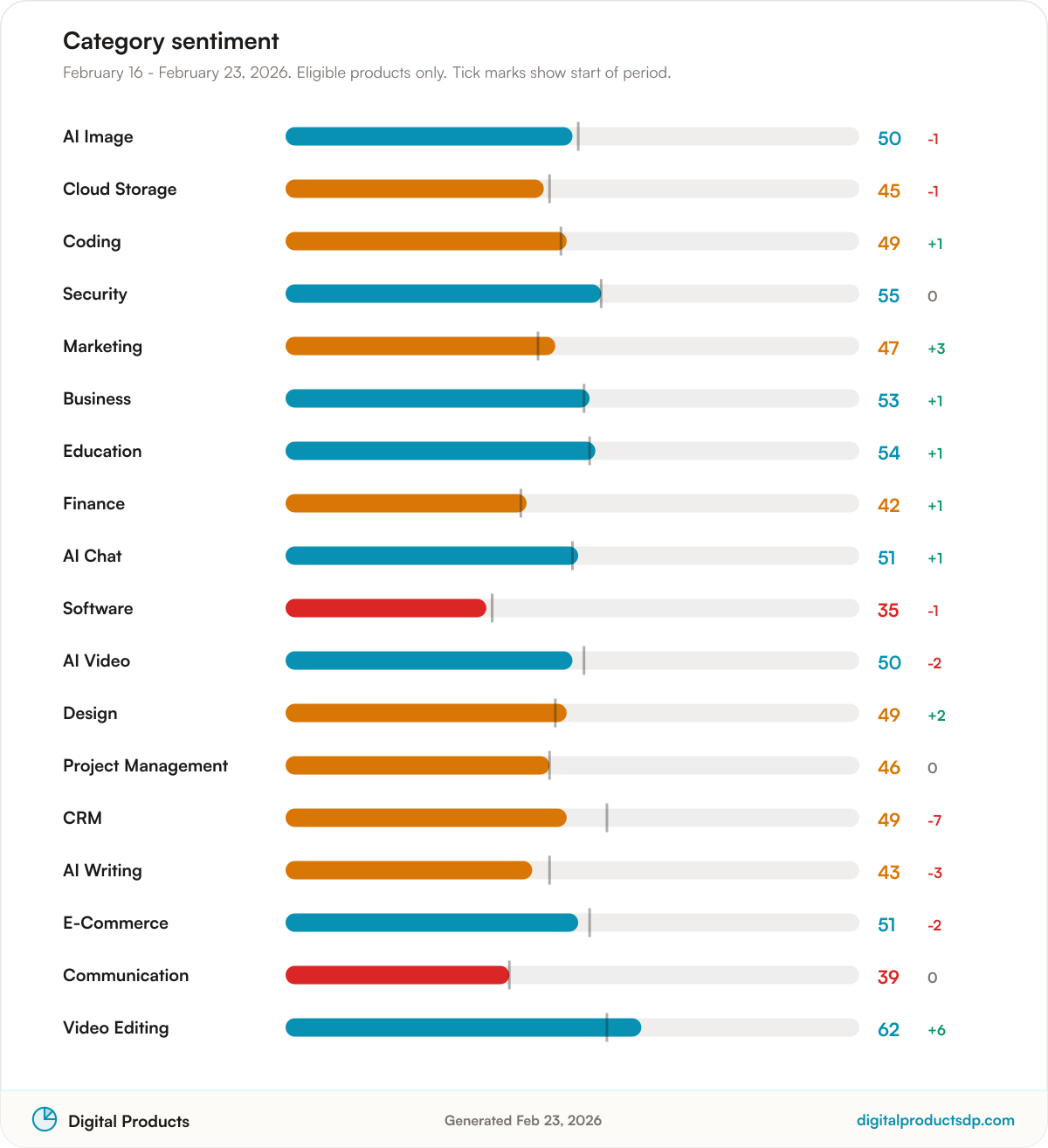
At the category level, most groups moved only slightly across the period. Video-editing showed the largest positive shift, rising from 56 to 62, while crm fell the most, moving from 56 to 49. Marketing edged up from 44 to 47, design from 47 to 49, and coding from 48 to 49. On the softer side, ai-writing slipped from 46 to 43, ai-video from 52 to 50, e-commerce from 53 to 51, and software from 36 to 35. Several categories held flat, including security at 55, communication at 39, and project-management at 46. The broad picture is a set of mostly steady category moods, with crm's seven-point drop standing out as the sharpest negative swing of the group.
Biggest Movers
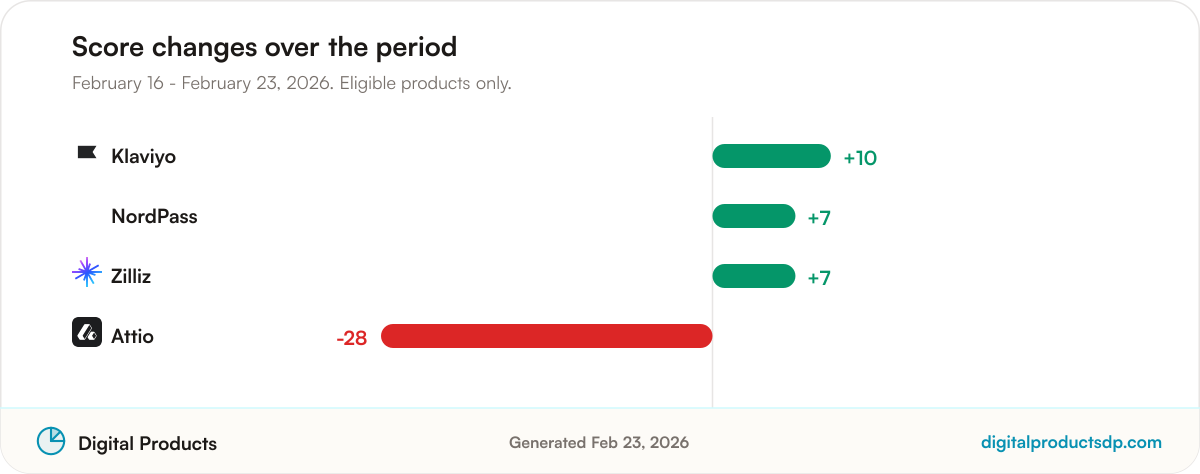
Klaviyo (riser, 31 to 41, based on 15 mentions). The marketing platform posted the largest gain of the period, climbing 10 points. Its complaint themes were still the heavier side of its profile, led by missing features at 12 mentions and compared to rivals at 12 mentions, with bugs at 7 mentions. Praise was thinner, with strong features and good integrations at 2 mentions each. The rise here reflects an improving tone off a low starting point rather than a flood of positive discussion.
NordPass (riser, 48 to 55, based on 13 mentions). The security product gained 7 points. Praise centered on strong features at 6 mentions, easy to use at 4 mentions, and pricing changes at 3 mentions. Complaints were modest, with bugs and reliability at 3 mentions each and downtime at 2 mentions. The balance of light praise against light complaints lines up with the upward move.
Zilliz (riser, 36 to 43, based on 11 mentions). Zilliz rose 7 points despite a complaint-heavy theme mix. Bugs led at 15 mentions, reliability at 13 mentions, and missing features at 4 mentions, while praise was limited to strong features at 2 mentions, good integrations at 1 mention, and performance at 1 mention. The score improvement sits alongside a profile still dominated by reliability and bug discussion, a reminder that a rising score reflects shifting tone, not the resolution of complaints.
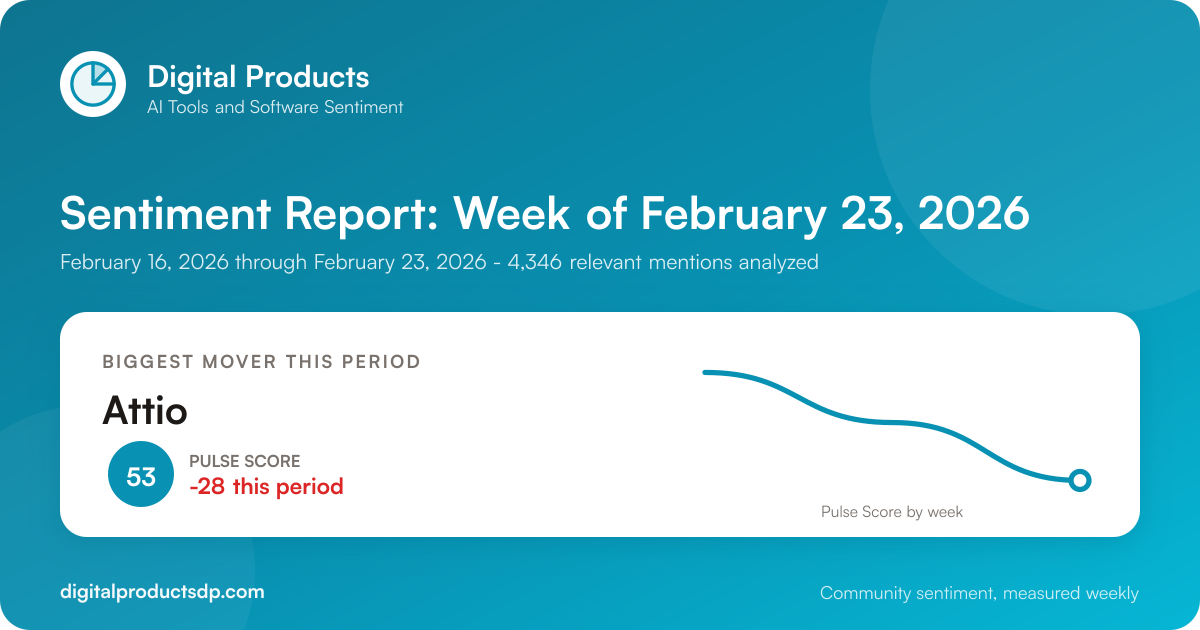
Attio (faller, 81 to 53, based on 10 mentions). The crm tool recorded the steepest drop of the period, falling 28 points across a three-week slide from 81 to 68 to 53. Its complaint themes were led by bugs at 7 mentions, missing features at 5 mentions, and lacking integrations at 3 mentions. Praise focused on strong features at 8 mentions, polished UI at 7 mentions, and good integrations at 2 mentions. With only 10 mentions, this is a thin sample where a handful of negative posts can move the score sharply, and the steep decline should be read with that fragility in mind.
Veo (faller, 57 to 48, based on 14 mentions). The ai-video tool fell 9 points. Complaints were led by bugs at 10 mentions, reliability at 5 mentions, and missing features at 5 mentions. Praise came from strong features at 12 mentions, new releases at 8 mentions, and AI quality at 7 mentions. The mix of substantial feature praise against bug and reliability complaints frames a tool drawing both interest and friction in the same week.
WooCommerce (faller, 50 from 59, based on 11 mentions). The e-commerce platform dropped 9 points. Its complaint volume was heavy in raw terms, with bugs at 330 mentions, reliability at 175 mentions, and UI frustrations at 58 mentions. Praise was led by strong features at 17 mentions, good integrations at 10 mentions, and new releases at 10 mentions. The lopsided ratio of bug and reliability discussion against praise tracks with the downward move.
Spotlight: Lovable
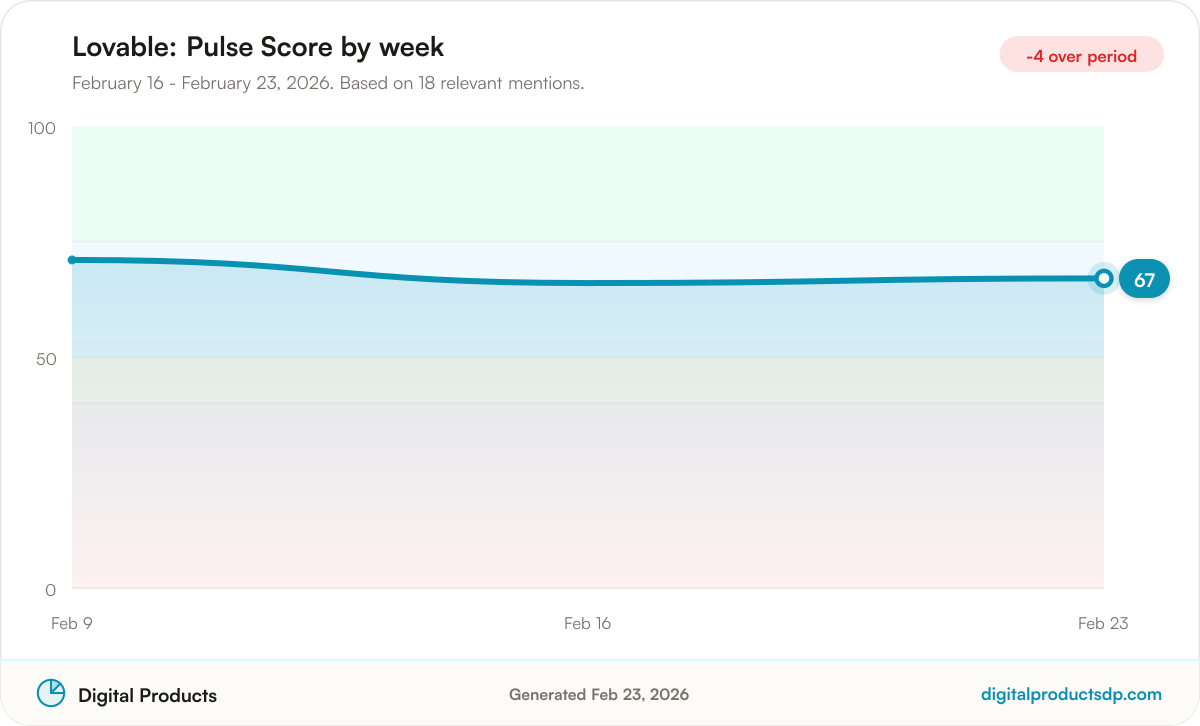
Lovable, a coding tool, took the top Pulse Score of the period at 67 based on 18 mentions. Its weekly series traced a path from 71 on February 9, 2026 to 66 on February 16, 2026 and back up to 67 on February 23, 2026. That means the tool entered the window from a higher point earlier in the digest and settled slightly below it, while still finishing as the leader among ranked products.
The theme mix behind the score leans positive and light on friction. Praise was led by polished UI at 8 mentions, strong features at 5 mentions, and new releases at 3 mentions. Complaints were minimal, with downtime, reliability, and privacy concerns each recorded at 1 mention. For a coding tool, a profile weighted toward UI polish and feature praise with barely any complaint volume is what carried it to the front of the leaderboard.
The caveat is sample size. With 18 mentions, Lovable's lead rests on a thinner base than heavier-discussed leaders such as Claude at 56 mentions or Obsidian at 55 mentions. A small number of posts can move a thin sample quickly, so the standing is best read as a positive but lightly-evidenced tone for the week rather than a settled position.
Themes Driving the Conversation
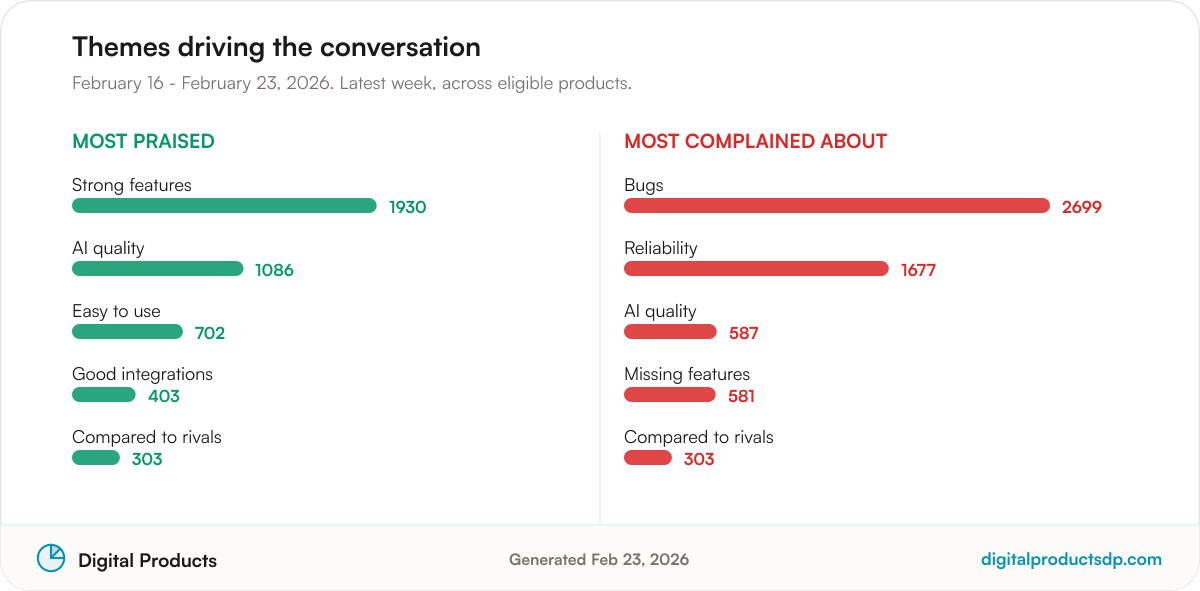
On the praise side, strong features dominated at 1,930 mentions, far ahead of AI quality at 1,086 mentions and easy to use at 702 mentions. Good integrations followed at 403 mentions and compared to rivals at 303 mentions. The feature praise shows up across many leaders, with Claude logging 229 strong-features mentions, ChatGPT 183, and Gemini 140. AI quality praise was concentrated among the chat and image tools, including Claude at 234 mentions and ChatGPT at 159 mentions, while easy to use surfaced strongly for products like ChatGPT at 94 mentions and Cursor at 63 mentions.
On the complaint side, bugs led every other theme by a wide margin at 2,699 mentions, with reliability second at 1,677 mentions. AI quality appeared as a complaint at 587 mentions, missing features at 581 mentions, and compared to rivals at 303 mentions. The bug and reliability totals were driven by several heavily-discussed products: WooCommerce alone logged 330 bug mentions and 175 reliability mentions, Loom 211 bug and 135 reliability mentions, Stripe 188 bug and 158 reliability mentions, and Grok 177 bug and 125 reliability mentions. AI quality cutting both ways, appearing as a top praise theme and a top complaint theme, reflects how the same chat tools that draw quality praise also draw quality criticism in the same week.
Watchlist
A large number of tracked products fell below the 10-mention threshold this period and are not ranked. This is a statement about discussion volume only, not about quality. Several products landed just under the line, including Canva, Tresorit, Todoist, Calendly, DALL-E, and Payload at 9 relevant mentions each. Slightly lower were Devin and Hygraph at 8 mentions, and edX, Nx, Pulumi, and AVG at 7 mentions each.
A cluster sat at 6 relevant mentions, including Ideogram, Wrike, Asana, Apollo.io, Kling, Oak, Medusa, and Plesk. Others such as GetResponse, QuillBot, Foxit, Carta, Power BI, Tailscale, SingleStore, and Vite registered between 4 and 5 mentions. These products may move into the ranked set in future weeks if discussion picks up, but for now their samples are too thin for a stable read. Many widely-used names, including Slack, Zoom, GitHub, GitLab, Dropbox, and Notion, recorded zero relevant mentions in the period under the sources sampled, which underscores how mention volume varies sharply between products and weeks.
What To Watch Next Week
First, watch whether Attio stabilizes. Its 28-point drop from 81 to 53 was the steepest of the period, but it came on just 10 mentions, so a small change in volume could pull the score in either direction next week. Whether bug and missing-feature discussion keeps pace will be the signal to monitor.
Second, watch the risers off low bases. Klaviyo climbed to 41 from 31 while its complaint themes still outweighed praise, and Zilliz rose to 43 even with bugs at 15 mentions and reliability at 13 mentions leading its profile. It is worth monitoring whether those upward tones hold or revert as more discussion accumulates.
Third, watch the crm category mood after its move from 56 to 49. With Attio and HubSpot both showing complaint-heavy weeks, including HubSpot's 26 compared-to-rivals mentions and 17 pricing-too-high mentions, the question is whether the category's drop was concentrated in a few products or broader.
Frequently Asked Questions
Which tool had the highest Pulse Score this period?
Lovable, a coding tool, had the highest Pulse Score at 67 based on 18 mentions, narrowly ahead of Obsidian at 64 based on 55 mentions.
Which product moved the most this period?
Attio moved the most, falling 28 points from 81 to 53 based on 10 mentions. The biggest riser was Klaviyo, up 10 points from 31 to 41 based on 15 mentions.
How many mentions were analyzed this period?
A total of 4,346 relevant mentions were analyzed for February 16, 2026 through February 23, 2026, across the 66 products that cleared the 10-mention threshold out of 2,218 tracked.
What were the most discussed themes?
Strong features led praise at 1,930 mentions, while bugs led complaints at 2,699 mentions, ahead of reliability at 1,677 mentions.
About This Data
Pulse Scores summarize the tone of public online discussion on a 0-100 scale and reflect community sentiment, not a verdict on a product's quality or a recommendation. We report on complete calendar weeks only, and products with fewer than 10 relevant mentions in the period are excluded from rankings to avoid unstable reads on thin samples.
Public discussion is collected from Hacker News, Stack Exchange, GitHub, Bluesky, the Apple App Store, and YouTube. Automated sentiment analysis can misread sarcasm, jokes, or niche context, mention volumes vary widely between products, and scores can move week to week. Any company that wants to respond is welcome to reach out. See our methodology for how scores are calculated.