AI Tools and Software Sentiment Report: Week of February 16, 2026
February 16, 2026
This report tracks aggregated public online discussion about AI tools and broader software products, translating the tone of that chatter into a 0-100 Pulse Score. The figures here summarize community sentiment for mentions analyzed across the period running from February 9, 2026 through February 16, 2026. Every number below traces back to that window of complete-week data.
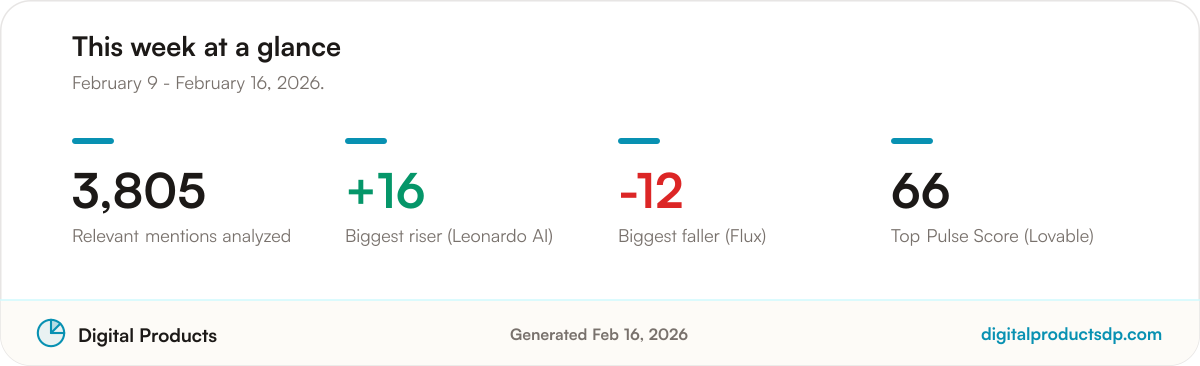
Across the period, 3,805 relevant mentions were analyzed. Of the 2,218 products tracked, 66 cleared the minimum bar of 10 relevant mentions to be ranked. That leaves a wide field of products with too little discussion to read reliably, a point we return to in the Watchlist. What follows is an interpretation of where sentiment clustered, which products moved, and which themes drove the conversation.
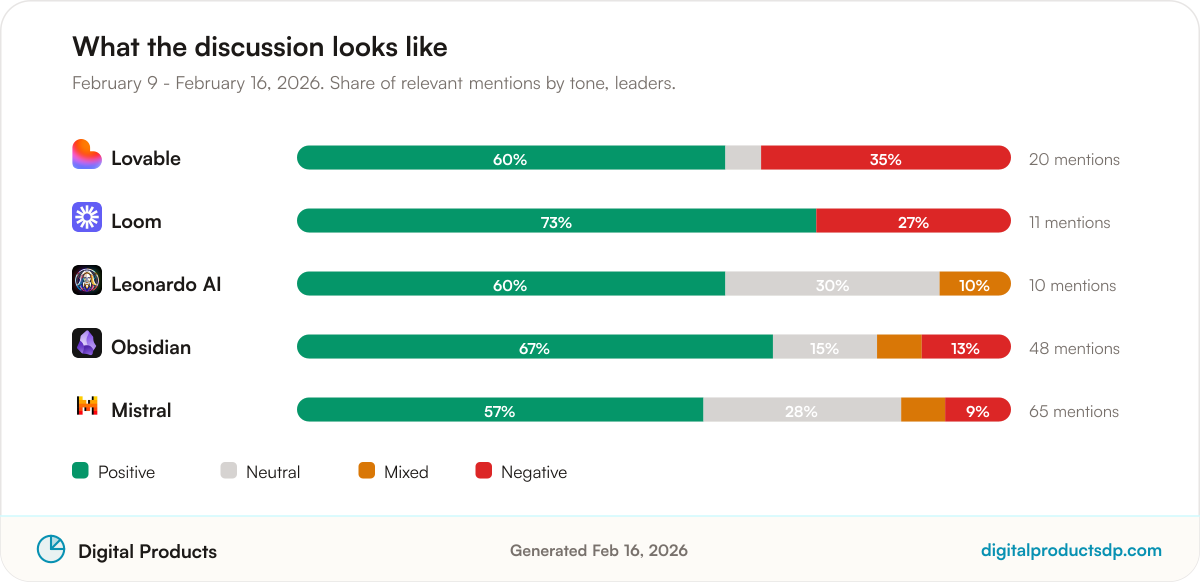
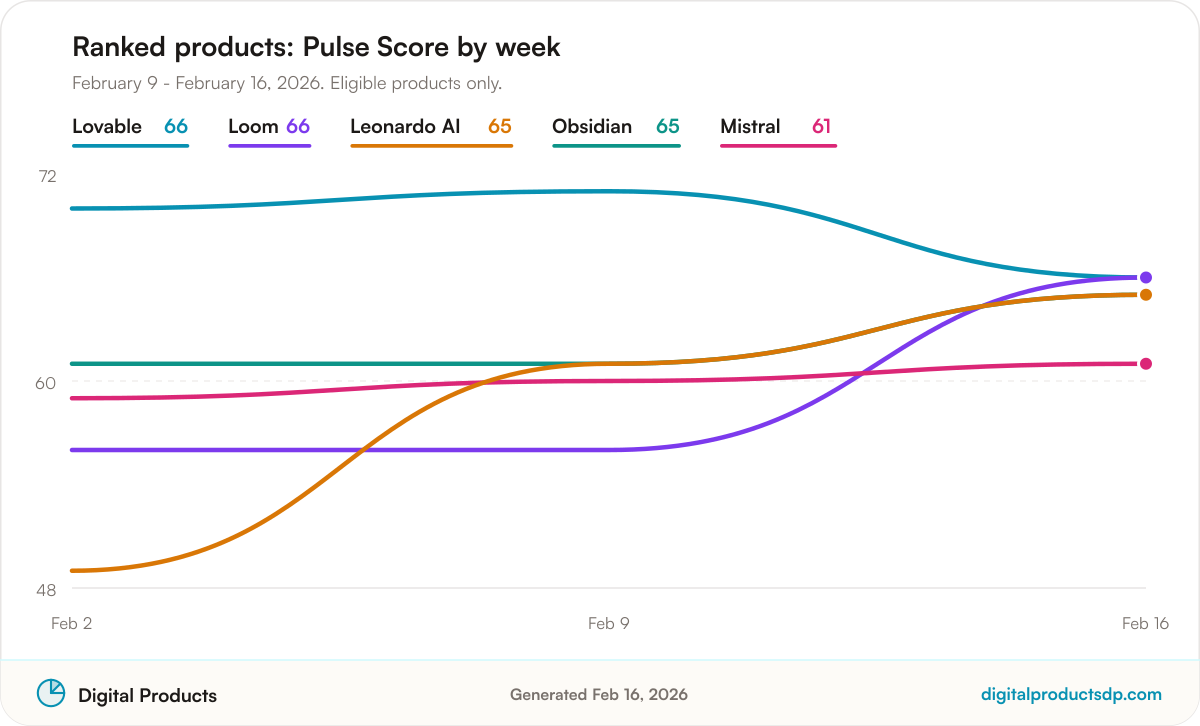
The top of the table is tightly bunched. Lovable, a coding product, and Loom, a video-editing product, both finished the latest week at a Pulse Score of 66, based on 20 and 11 mentions respectively. Leonardo AI, an AI image tool, and Obsidian, a project-management product, each landed at 65, based on 10 and 48 mentions. Mistral, an AI chat product, rounded out the leaders at 61 based on 65 mentions.
The spread between these leaders is narrow, and the sample sizes vary widely. Obsidian's 48 mentions and Mistral's 65 mentions give those reads more ballast than the thinner samples behind Loom and Leonardo AI. A score built on 10 or 11 mentions can swing more easily from week to week, so the leaderboard is best read as a snapshot of tone rather than a durable ranking.
Category View
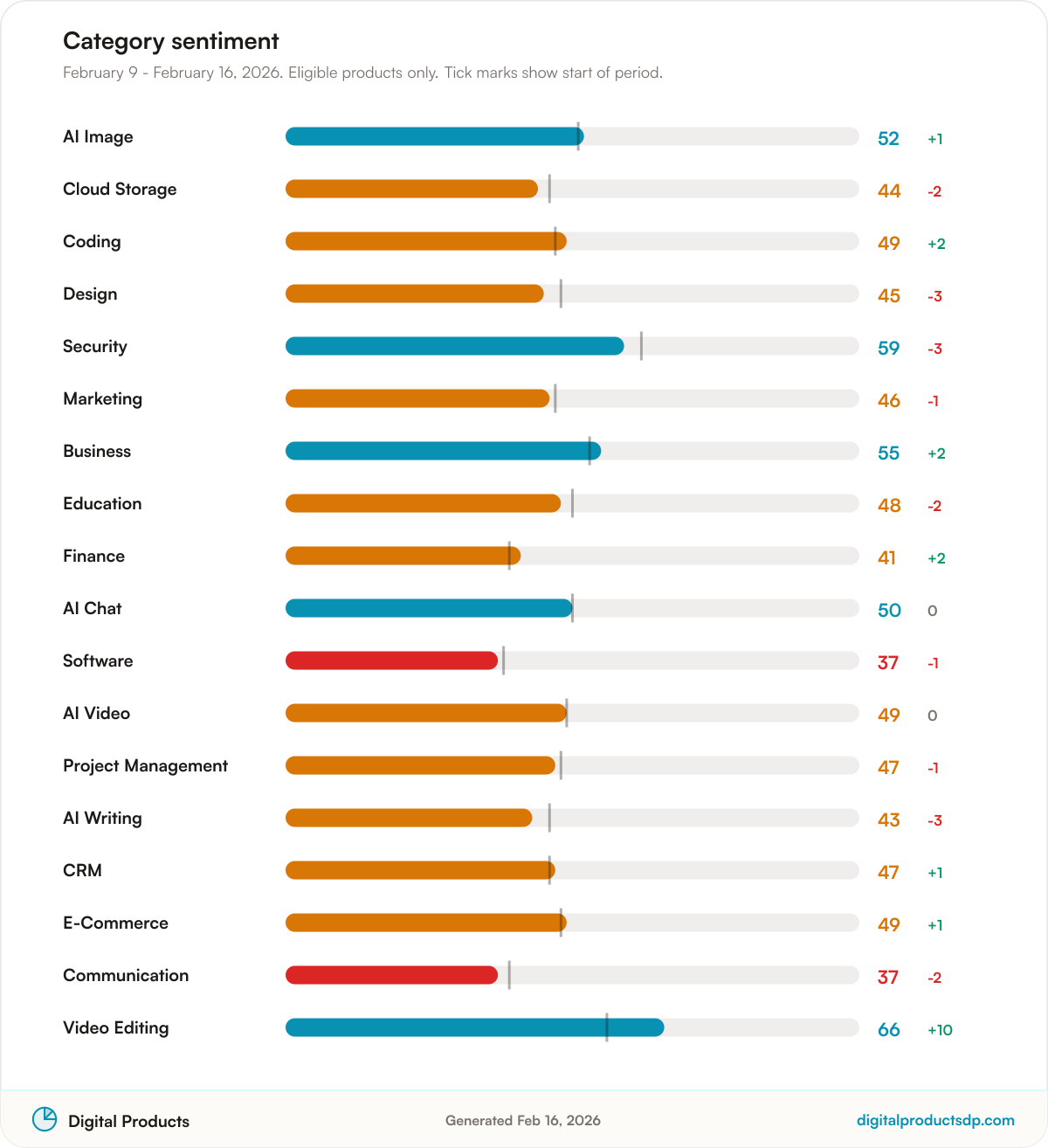
At the category level, the standout move was video-editing, which rose from 56 to 66 over the period. Security held the highest single starting average at 62 but slipped to 59, while business edged up from 53 to 55 and finance ticked from 39 to 41. Several categories barely moved: ai-chat held flat at 50, ai-video held at 49, and coding rose modestly from 47 to 49. On the softer side, design fell from 48 to 45, ai-writing from 46 to 43, communication from 39 to 37, and software from 38 to 37. These are averages across eligible products only, so a single product with heavy discussion can pull a category one way or the other.
Biggest Movers
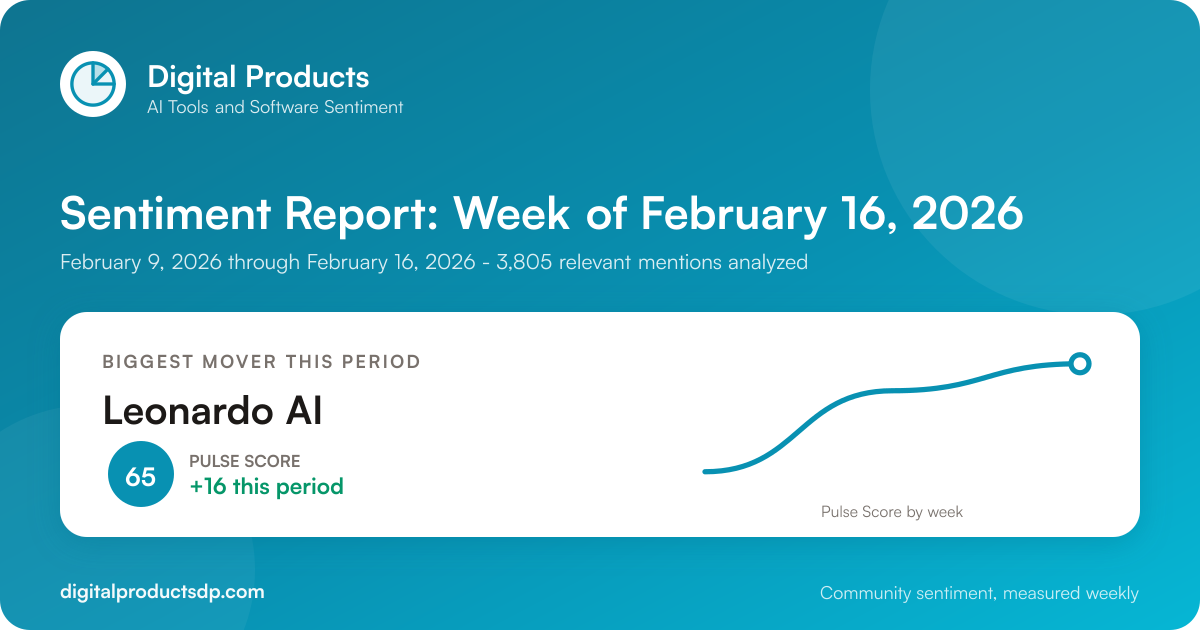
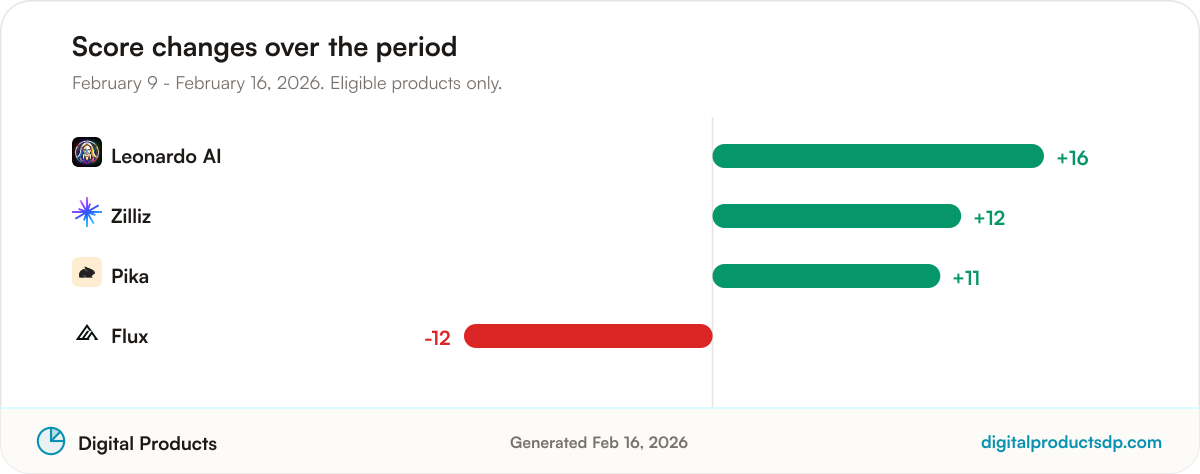
Leonardo AI (riser, 49 to 65, based on 10 mentions). The biggest climb of the period belongs to this AI image tool. Its latest-week themes are entirely on the praise side, led by Strong features with 10 mentions, AI quality with 3, and Good integrations with 2, with no complaint themes recorded. With discussion this thin and tilted toward feature praise, the upward move reads as a small, positive-leaning conversation rather than a broad consensus shift.
Zilliz (riser, 25 to 37, based on 13 mentions). Zilliz gained 12 points but did so from a low base, finishing at 37. Its complaint themes outweigh its praise: Bugs at 15 mentions, Reliability at 13, and Missing features at 4, against Strong features at 2, Good integrations at 1, and Performance at 1. The rise here is best read as a recovery off a weak starting point rather than a strongly positive turn, given how prominent the bug and reliability chatter remained.
Pika (riser, 37 to 48, based on 26 mentions). Pika climbed 11 points on a healthier sample. Praise centered on Polished UI with 6 mentions, plus Strong features and Good integrations, while complaints flagged Bugs at 4, Reliability at 3, and AI quality at 1. The mix suggests interface and feature appreciation pulling sentiment up while reliability questions kept it short of the leaders.
Flux (faller, 58 to 46, based on 19 mentions). The steepest drop of the period. Flux still drew praise for AI quality with 33 mentions, Strong features with 22, and New releases with 13, but the complaint side was heavy: Bugs at 19, Performance at 17, and Reliability at 11. With performance and stability complaints stacking up alongside the praise, the conversation pulled the score down by 12 points.
Veo (faller, 61 to 50, based on 13 mentions). Veo lost 11 points. Its praise themes were Strong features at 12, New releases at 8, and AI quality at 7, while complaints were led by Bugs at 10, Reliability at 5, and Missing features at 5. On a sample of 13 mentions, a cluster of bug and reliability remarks is enough to move the read meaningfully lower.
Canva (faller, 47 to 41, based on 17 mentions). The design product slipped 6 points. Canva drew strong praise volume, with Easy to use at 66 mentions, Strong features at 57, and Polished UI at 31, but complaints around UI frustrations at 16, Bugs at 12, and Reliability at 8 weighed against that. The drop reflects friction themes gaining relative prominence even amid heavy positive discussion.
Spotlight: Lovable
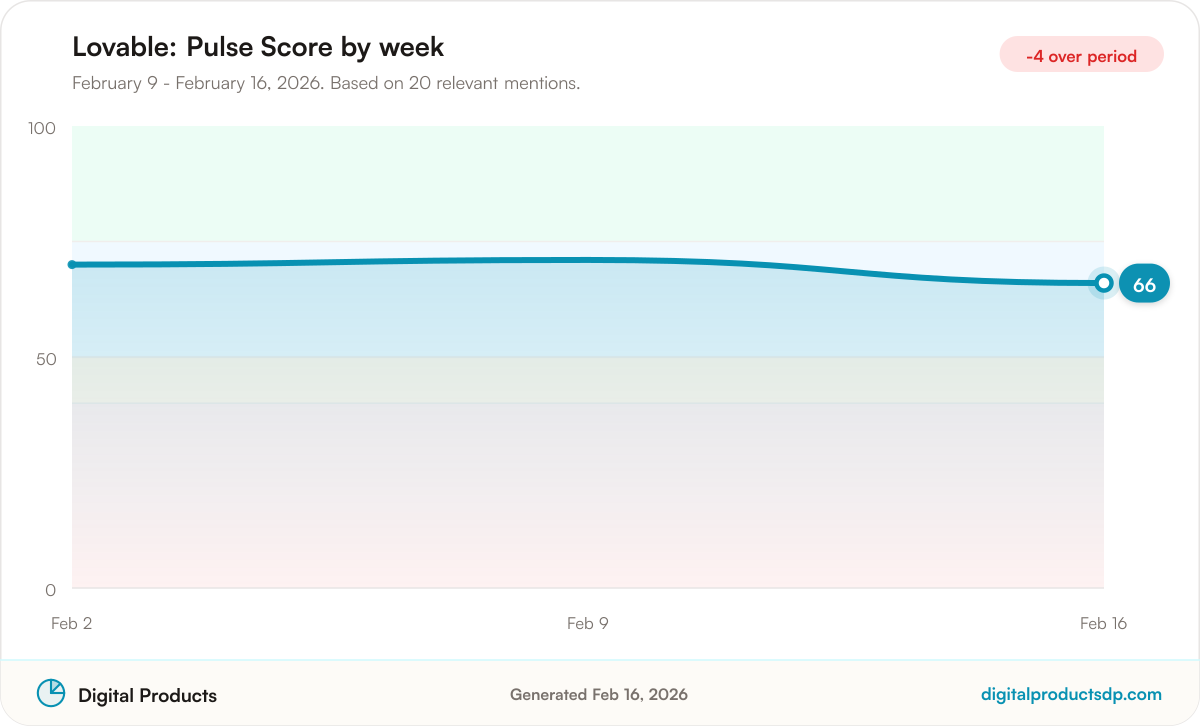
Lovable, a coding product, shares the top Pulse Score this period at 66, based on 20 mentions. Its weekly series tells a story of a high score easing back slightly: 70 on February 2, 2026, then 71 on February 9, 2026, then 66 on February 16, 2026. Even with that softening, it sits at the front of the ranked field.
The theme breakdown helps explain the consistently warm tone. On the praise side, Lovable drew Polished UI with 8 mentions, Strong features with 5, and New releases with 3. The complaints were notably light: Downtime, Reliability, and Privacy concerns each registered just 1 mention. That balance, with praise themes outnumbering complaints and no single complaint dominating, is the kind of profile that supports a score near the top of the table.
The caveat is sample size. Twenty mentions is a modest base, so the move from 71 to 66 should not be over-read as a sharp reversal. It is more useful to note that Lovable's discussion stayed positive in tone across all three weeks of available data, with UI polish as the most-cited strength.
Themes Driving the Conversation
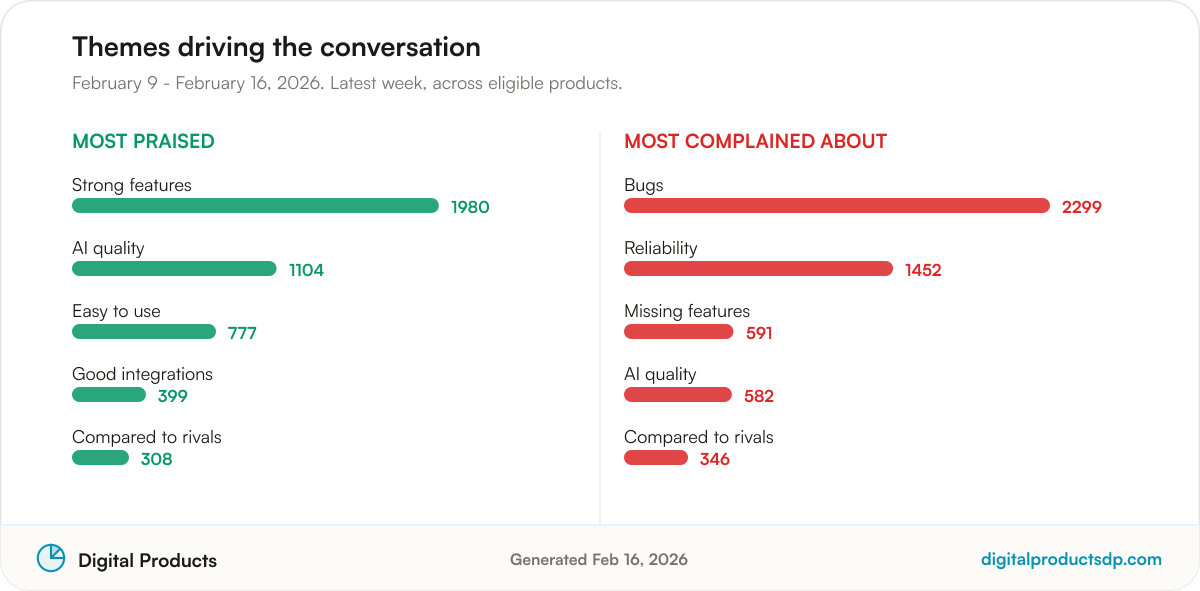
On the praise side, Strong features led decisively with 1,980 mentions, followed by AI quality at 1,104, Easy to use at 777, Good integrations at 399, and Compared to rivals at 308. Strong features showed up across products of every size, from Claude Code's 249 feature mentions and Claude's 229 to Cursor's 100 and Stripe's 84. AI quality praise was concentrated in the chat and assistant products, with Claude at 234, ChatGPT at 159, and Gemini at 149 all contributing heavily.
The complaint side was led by Bugs at 2,299 mentions, the single most-discussed theme of any kind this period, followed by Reliability at 1,452, Missing features at 591, AI quality at 582, and Compared to rivals at 346. Bug and reliability chatter was widespread and often attached to high-volume products: Loom recorded 211 bug mentions and 135 reliability mentions, Stripe logged 188 bugs and 158 reliability, and Vercel showed 170 bugs and 151 reliability. Notably, AI quality appears on both lists, praised in some contexts and criticized in others, with Grok showing 79 AI quality praise mentions against 183 AI quality complaints. That split is a reminder that the same theme can cut both ways depending on the product and the moment.
Watchlist
The vast majority of tracked products did not clear the 10-mention threshold this period, and that is a statement about discussion volume, not about quality. Several names sat just under the line and are worth monitoring in case their chatter picks up: Klarna with 9 mentions, Apollo.io with 9, DALL-E with 9, HeyGen with 8, and NordPass with 8. A small step up in discussion would put any of these into ranking range.
A second tier showed even thinner activity, including Carta and Asana at 7 mentions each, SingleStore at 7, QuillBot and Sudowrite at 6 each, Ahrefs and Foxit at 6 each, and Tresorit, Wrike, and Attio at 5 each. Many widely used products registered zero relevant mentions in the window, such as Slack, Zoom, GitHub, and Dropbox, which underscores that this report reflects where public conversation happened to concentrate during one specific week, not the full footprint of any product. Low volume here should be read as insufficient signal to score, full stop.
What To Watch Next Week
First, watch whether video-editing holds its gain. The category jumped from 56 to 66, and Loom's own series climbed from 56 to 66 with a heavy load of bug mentions at 211 sitting underneath that score. Whether sentiment stays elevated or corrects is worth tracking, especially given the gap between the positive tone and the volume of reliability complaints.
Second, watch the AI image and AI video movers. Leonardo AI rose to 65 with no recorded complaints on 10 mentions, while Flux and Veo both fell on bug, performance, and reliability themes. If those stability complaints persist, the question is whether the fallers stabilize or slide further, and whether Leonardo AI's positive read survives a larger sample.
Third, watch the bug and reliability theme overall. With Bugs at 2,299 mentions and Reliability at 1,452 leading the complaint side, and several high-volume products like Stripe, Vercel, and Loom carrying large counts, these themes are the clearest pressure point in the current data. Any shift in their prominence would likely move multiple category averages at once.
Frequently Asked Questions
Which products had the highest Pulse Score this period?
Lovable and Loom tied for the top Pulse Score at 66, based on 20 and 11 mentions respectively, followed by Leonardo AI and Obsidian at 65 each.
Which product moved the most this period?
Leonardo AI was the biggest riser, climbing from 49 to 65 for a gain of 16 points based on 10 mentions, while Flux was the biggest faller, dropping from 58 to 46 based on 19 mentions.
What was the overall mood across categories?
It was mixed, with video-editing rising sharply from 56 to 66 and business edging up from 53 to 55, while design fell from 48 to 45 and communication slipped from 39 to 37. Several categories, including ai-chat and ai-video, held essentially flat.
How many mentions were analyzed this period?
A total of 3,805 relevant mentions were analyzed across 66 ranked products, out of 2,218 products tracked, for the week of February 16, 2026.
About This Data
Pulse Scores summarize the tone of public online discussion on a 0-100 scale and reflect community sentiment. They are not a verdict on a product's quality and not a recommendation. We report on complete calendar weeks only, and products with fewer than 10 relevant mentions in the period are excluded from rankings to avoid unstable reads on thin samples.
Public discussion is collected from Hacker News, Stack Exchange, GitHub, Bluesky, the Apple App Store, and YouTube. Automated sentiment analysis can misread sarcasm, jokes, or niche context. Mention volumes vary widely between products, and scores can move from week to week. Any company that wants to respond is welcome to reach out. For more on how scores are calculated, see our methodology.