AI Tools and Software Sentiment Report: Week of January 26, 2026
January 26, 2026
This edition tracks aggregated public online discussion about AI tools and broader software products, from coding assistants and cloud storage to CRM platforms and payment systems. The figures here summarize the tone of community chatter, not a verdict on any product's quality. Every score is a Pulse Score on a 0-100 scale that reflects how people talked about a product in public forums and comment threads during the window we cover.
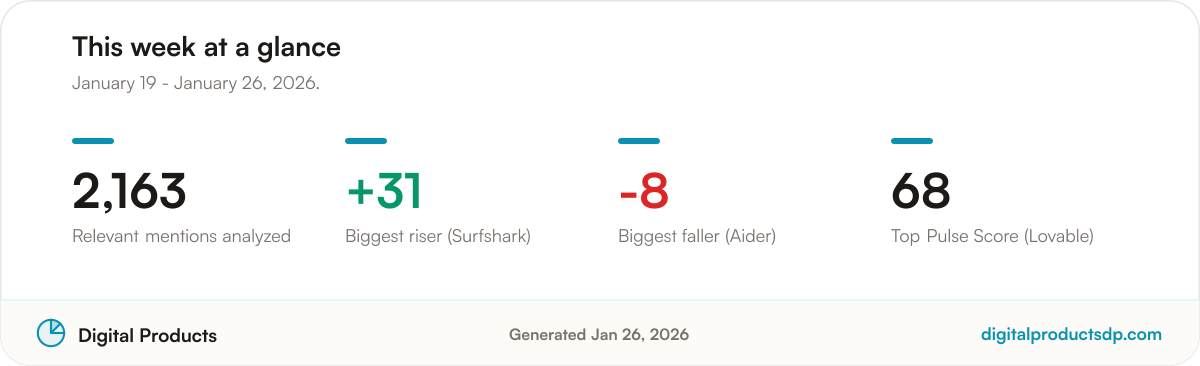
The mentions analyzed for January 19, 2026 through January 26, 2026 add up to 2,163 relevant mentions across the 54 products that cleared our ranking threshold. Out of 2,218 products tracked in total, only those 54 drew enough discussion to rank. That gap is worth keeping in mind as you read: most of the catalog sat quiet this period, and the conversation concentrated around a familiar set of coding tools, chat models, and a handful of infrastructure and payments names.
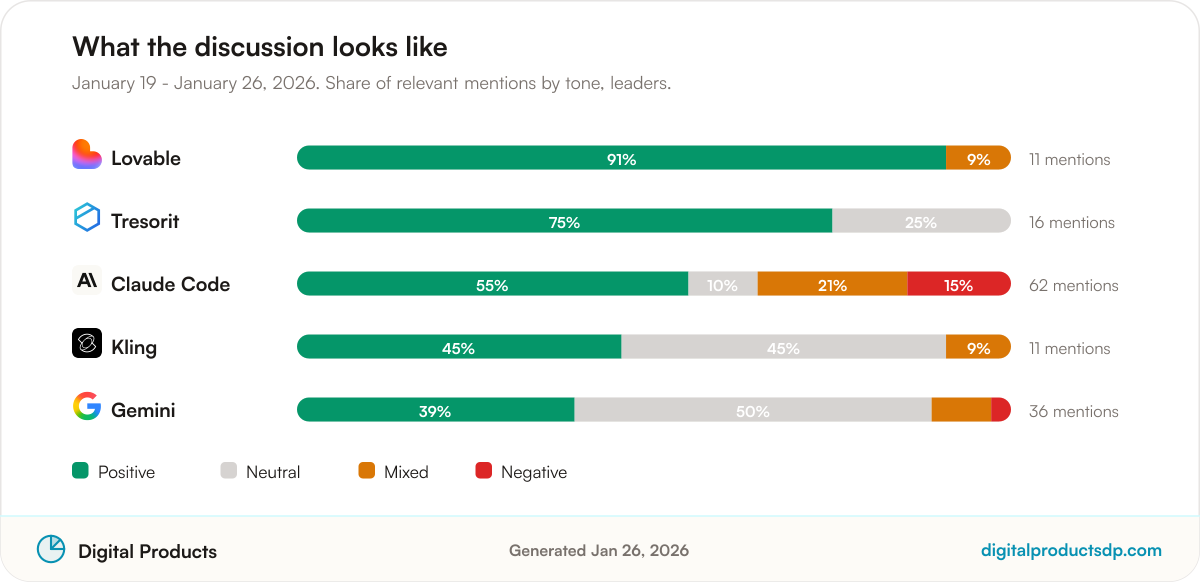
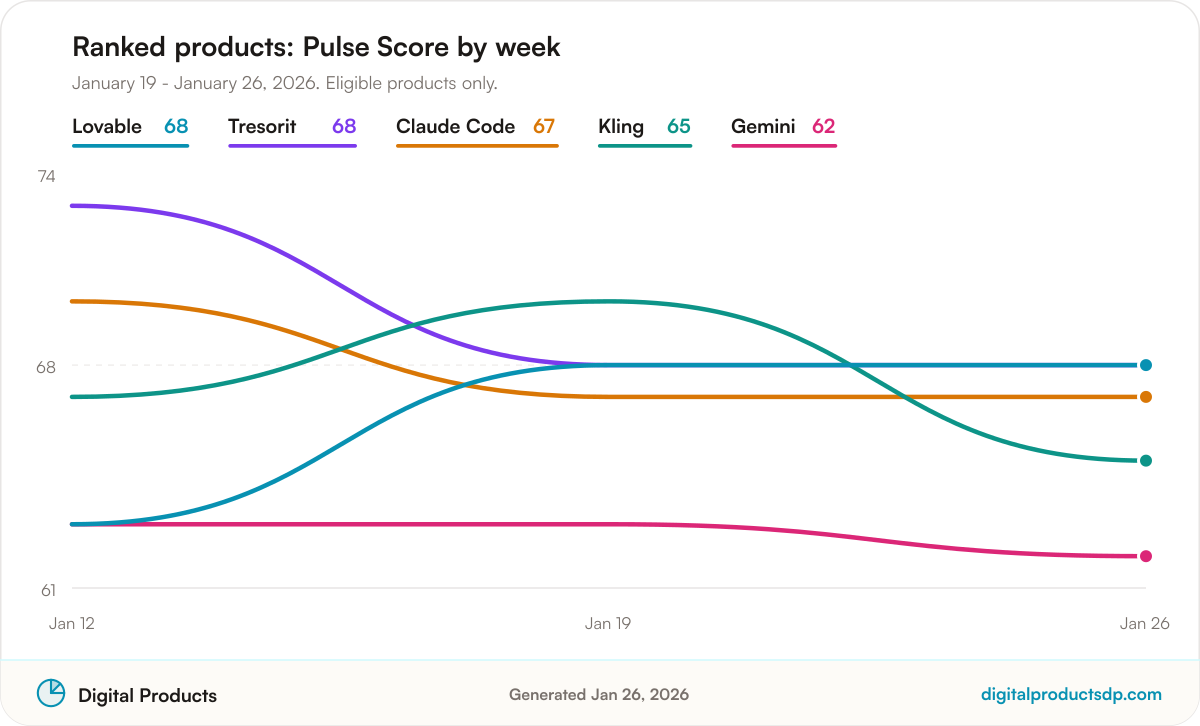
Two products share the top Pulse Score this period. Lovable, a coding tool, sits at 68 based on 11 mentions, and Tresorit, a cloud-storage product, also reads 68 based on 16 mentions. Claude Code follows closely at 67 based on 62 mentions, and notably its sample is far deeper than the two leaders above it, which makes its score a steadier read on community sentiment. Kling, an AI-video tool, lands at 65 based on 11 mentions, and Gemini rounds out the leaders at 62 based on 36 mentions.
The spread among the leaders is narrow, just six points separating the top score from Gemini. What stands out more than the ranking is the difference in sample size. Lovable, Tresorit, and Kling each cleared the bar with small mention counts in the low teens, so their scores rest on thinner evidence. Claude Code and Gemini, with 62 and 36 mentions, give a more grounded picture of where public discussion settled. Read the leaderboard as a snapshot of tone, not a quality ladder.
Category View
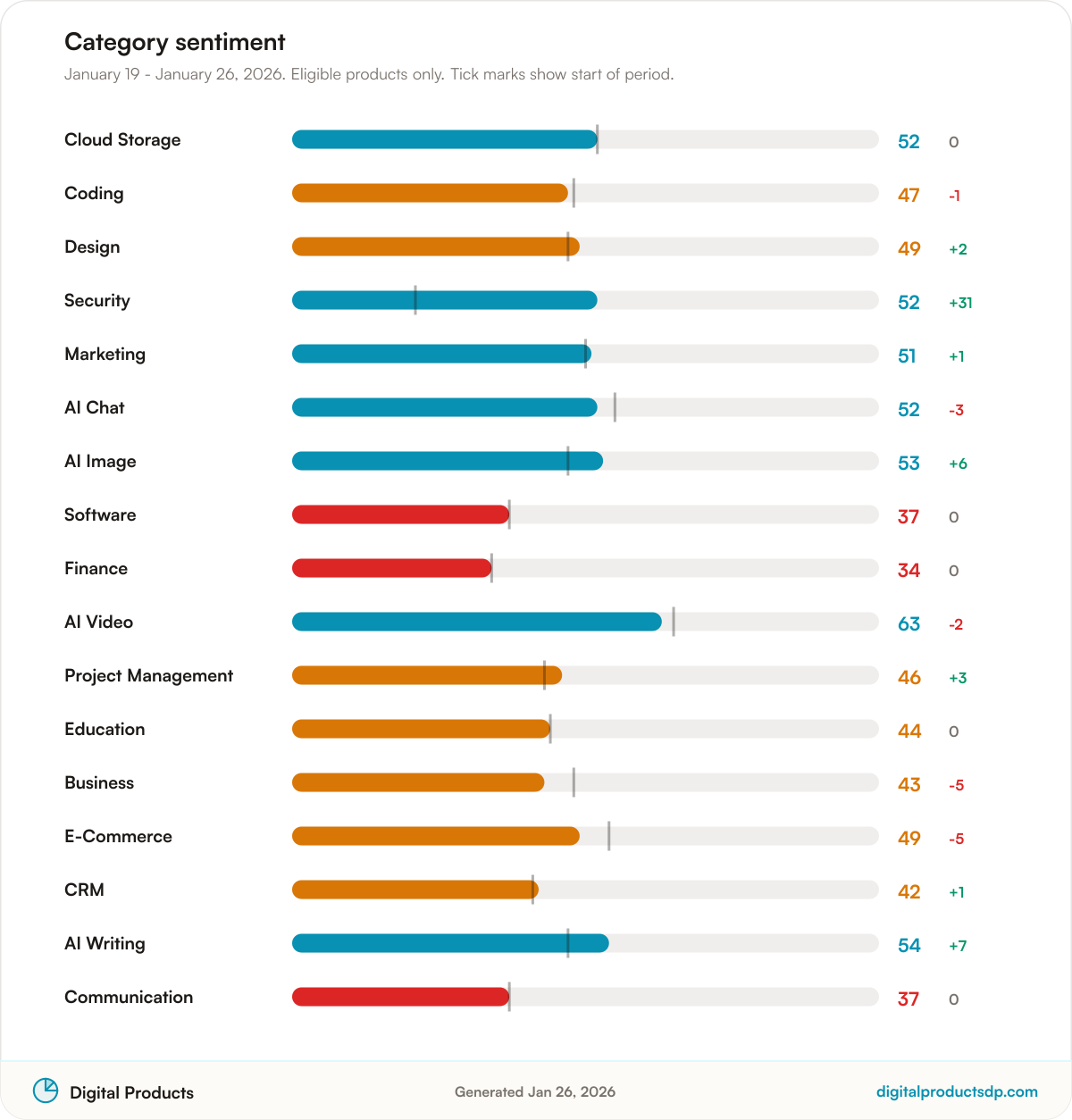
The most dramatic category shift was security, which moved from an average of 21 to 52 across the period. That swing is heavily shaped by Surfshark's recovery, discussed below, and shows how a single product can reshape a thinly populated category. AI-image rose from 47 to 53 and AI-writing from 47 to 54, both pointing to warmer discussion in generative tooling. AI-chat cooled from 55 to 52, and business slipped from 48 to 43, while e-commerce eased from 54 to 49. Several categories barely moved: cloud-storage held at 52, software held at 37, finance held at 34, education held at 44, and communication held at 37. AI-video remained the highest-scoring category, easing only slightly from 65 to 63, while coding edged from 48 to 47 despite hosting some of the most-discussed products in the report.
Biggest Movers
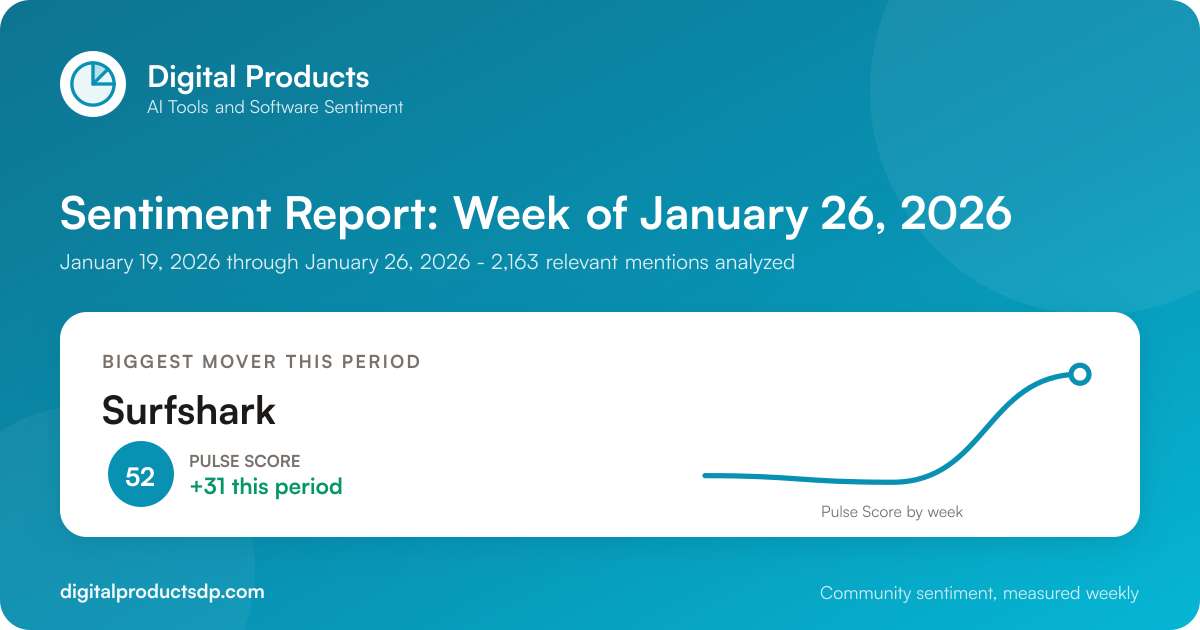
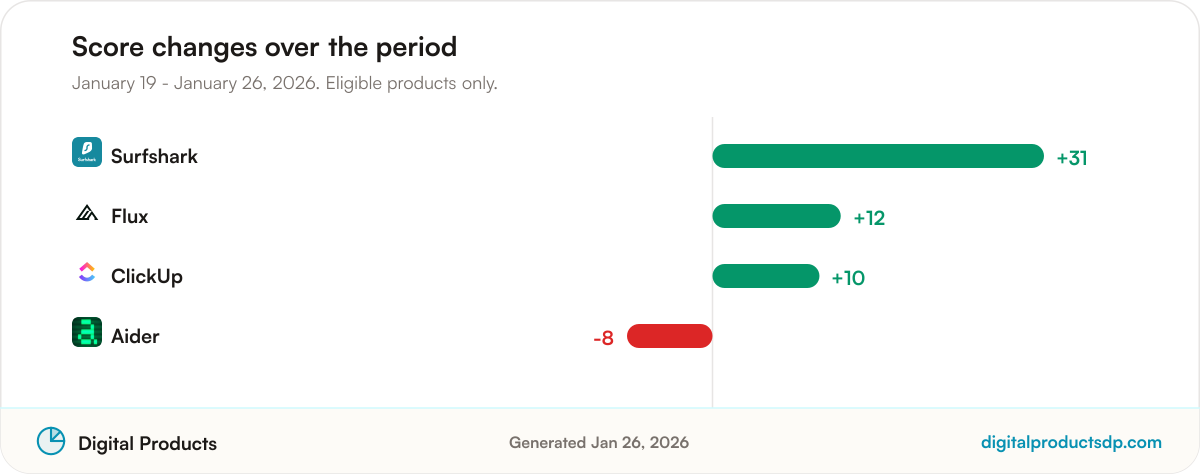
Surfshark (up 31, from 21 to 52, based on 13 mentions). This security product posted the largest move of the period. Its praise themes were led by fair pricing with 29 mentions, well ahead of strong features at 11 and easy to use at 7, so the warmer tone tracks closely with value-for-money discussion. The complaint side was light by comparison, with compared to rivals at 3 mentions and missing features and pricing too high at 2 each. With pricing dominating the positive chatter and few loud complaints, the rebound reads as a value-driven shift in sentiment rather than a feature story.
Flux (up 12, from 38 to 50, based on 10 mentions). Discussion of this AI-image tool leaned on AI quality with 33 mentions, followed by strong features at 22 and new releases at 13, suggesting output quality and fresh capability drove the climb. The complaint themes were not trivial, with bugs at 19, performance at 17, and reliability at 11, so the improving tone came alongside real friction. The praise volume outweighing those complaints helps explain the net upward move.
ClickUp (up 10, from 25 to 35, based on 26 mentions). This project-management product improved from a low base. Praise centered on strong features with 8 mentions, good integrations at 7, and easy to use at 4. The complaints were heavier, led by bugs at 13, lacking integrations at 9, and missing features at 6. The score remains modest at 35, and the theme mix shows a product where users still flag gaps even as overall tone improved across the period.
Aider (down 8, from 63 to 55, based on 29 mentions). This coding tool gave back ground after starting the period strong. Its top complaint was bugs at 9 mentions, ahead of missing features at 5 and feature requests at 4. Praise was thinner, with strong features at 7, easy to use at 4, and good integrations at 3. The complaint themes outweighing the praise volume aligns with the softer tone as the weekly series moved from 63 to 58 to 55.
xAI (down 8, from 42 to 34, based on 29 mentions). This product saw bugs dominate its complaint mix at 104 mentions, with reliability at 68 and lacking integrations at 31 close behind. Its praise themes were comparatively modest, led by good integrations at 25, strong features at 24, and new releases at 20. With reliability and bug discussion so heavily outweighing the positives, the drop to 34 fits the pattern of frustration in the chatter.
RubyLLM (down 7, from 50 to 43, based on 20 mentions). This coding tool's complaints were led by bugs at 27 mentions, reliability at 16, and missing features at 8. Praise leaned on strong features at 24, good integrations at 20, and easy to use at 16. The praise and complaint volumes are close here, but the heavy bug and reliability load helps explain why sentiment slipped over the period, with the weekly series dropping from 50 to 43 and holding there.
Spotlight: Lovable
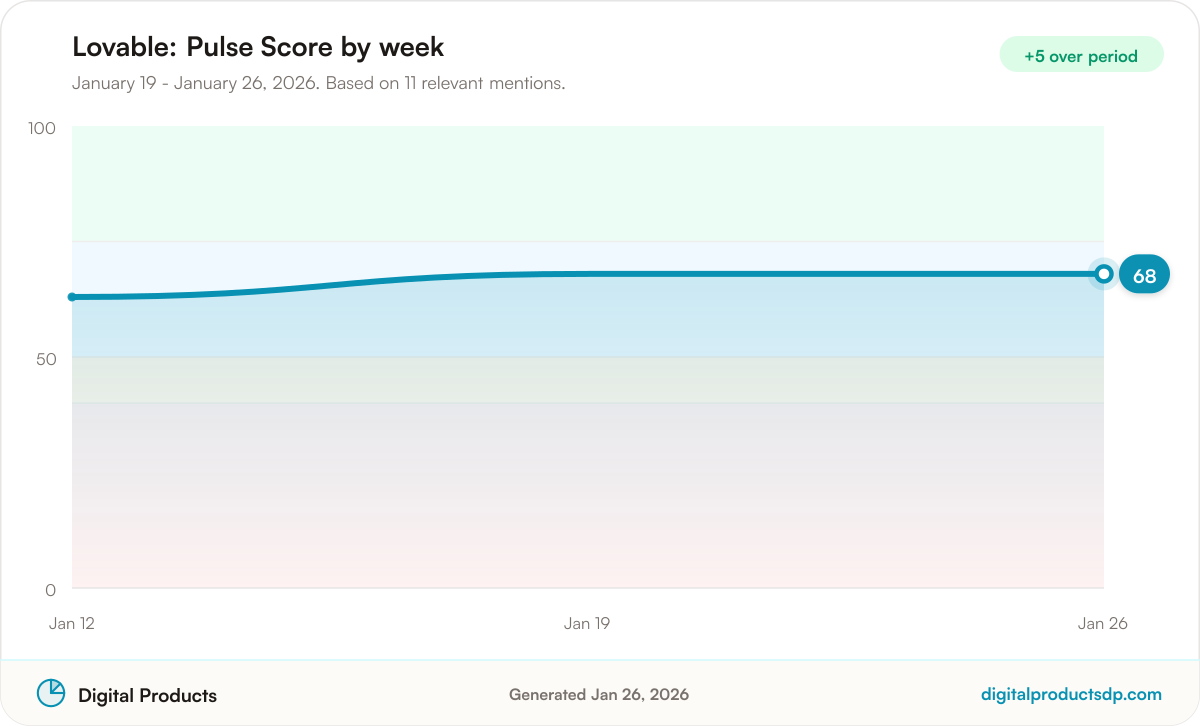
Lovable shares the top Pulse Score this period at 68, based on 11 mentions. Its weekly series shows a climb from 63 on January 12, 2026 to 68 on January 19, 2026, holding at 68 through January 26, 2026. That steadiness over the last two weeks is part of why it tops the table, though the modest sample size means the read sits on a thin base and should be treated with care.
The theme mix behind the score is small but consistently positive. Polished UI led the praise with 8 mentions, followed by strong features at 5 and new releases at 3. On the complaint side, the counts were minimal: downtime, reliability, and privacy concerns each registered just 1 mention. With praise concentrated on interface polish and almost no sustained negative chatter, the public discussion around Lovable was favorable in tone during this window.
The caution here is volume. Eleven mentions is enough to rank but not enough to be confident the tone would hold if discussion volume rose. A leader resting on a small sample can move quickly when a single thread shifts the conversation. For now, the picture is a coding tool whose limited chatter skewed positive around UI and features, with complaint themes too sparse to weigh against it.
Themes Driving the Conversation
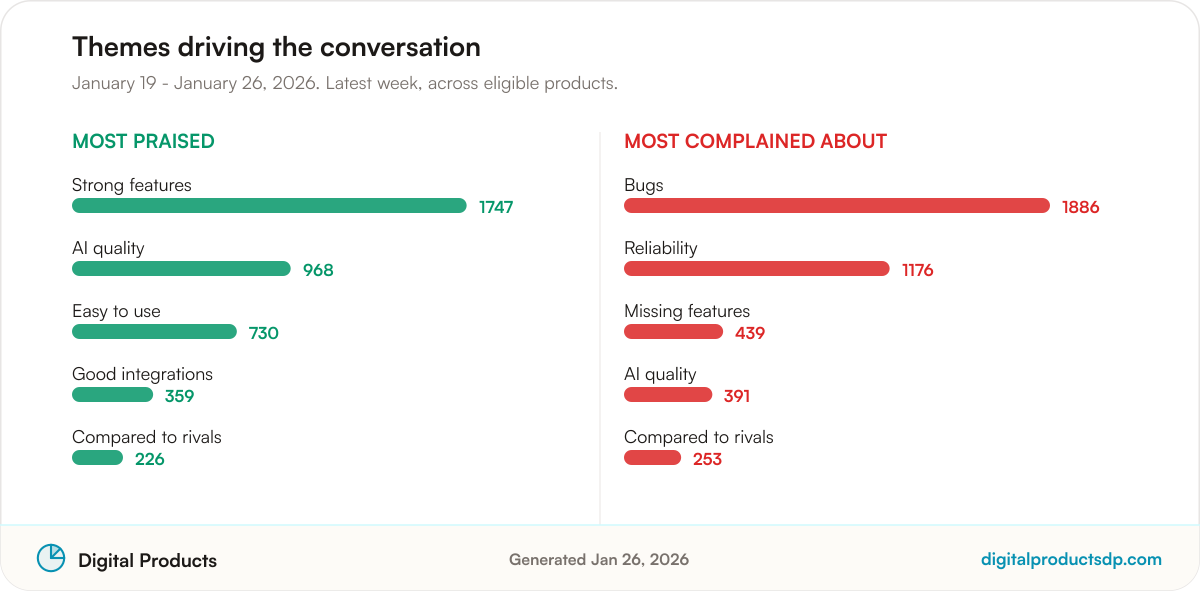
On the praise side, strong features dominated with 1,747 mentions, far ahead of any other positive theme. AI quality followed at 968 mentions, easy to use at 730, good integrations at 359, and compared to rivals at 226. The feature and AI-quality themes were carried by the heavily discussed coding and chat products. Claude Code logged 249 strong-features mentions and Claude logged 229, while ChatGPT carried 183 and Gemini 140. AI quality praise leaned on Claude at 234 mentions, ChatGPT at 159, and Gemini at 149. Easy to use surfaced strongly for Canva at 66 mentions and ChatGPT at 94, showing that approachability still drives positive sentiment outside the model-quality conversation.
Complaints told a sharper story. Bugs led every other theme with 1,886 mentions, and reliability followed at 1,176, together forming the core of negative discussion. Missing features registered 439 mentions, AI quality drew 391 on the complaint side, and compared to rivals reached 253. The bug and reliability themes were concentrated in high-volume infrastructure and payments names: Stripe carried 188 bug mentions and 158 reliability mentions, Vercel logged 170 bugs and 151 reliability, and ElevenLabs registered 118 bugs and 74 reliability. Note that AI quality appears on both lists, a reminder that the same dimension can split opinion, praised by some and faulted by others across products like Claude, ChatGPT, and Gemini.
Watchlist
Many tracked products did not draw enough discussion to rank this period, and that is a statement about mention volume, not quality. Several names came close to the threshold of 10 relevant mentions but fell short. Loom recorded 9 relevant mentions, Wrike 7, and Devin 7. A cluster of generative and AI products landed in the mid-single digits: DALL-E at 7, Midjourney at 6, Leonardo AI at 6, Pika at 6, Synthesia at 6, HeyGen at 5, and QuillBot at 5. Apollo.io also reached 6 mentions.
Others sat lower still. Ahrefs and Anyscale registered a handful of mentions, alongside Coinbase at 4, Klarna at 4, Jasper at 4, Linear at 4, Calendly at 4, ZoomInfo at 4, Thinkific at 4, and SingleStore at 4. A long tail of products, including widely used names like Slack, Zoom, GitHub, Notion, and Dropbox, recorded zero relevant mentions in our sources this period. With discussion collected from Hacker News and YouTube review-video comments for this digest, low counts often reflect where a given week's conversation happened to land rather than any shift in a product's standing. We will keep watching whether the products clustered just below the line cross into ranked territory as chatter accumulates.
What To Watch Next Week
First, watch whether Surfshark holds its rebound. Its rise from 21 to 52 was the period's largest, but it rests on 13 mentions and leaned heavily on fair-pricing discussion. A swing that steep from a thin base is worth confirming before reading it as durable.
Second, watch the bug and reliability load on the high-volume infrastructure and payments names. Stripe, Vercel, and ElevenLabs each carried triple-digit bug counts this period, and that complaint pressure is the kind of theme that tends to keep scores anchored until the underlying chatter changes.
Third, watch Claude Code as the steadiest signal among the leaders. With 62 mentions behind its 67, it carries more evidence than the two products tied above it at 68, and its weekly series easing from 70 to 67 is worth tracking to see whether the top of the table firms up or reshuffles.
Frequently Asked Questions
Which products had the highest Pulse Score this period?
Lovable and Tresorit tied for the top Pulse Score at 68, based on 11 and 16 mentions respectively. Claude Code followed at 67 based on a deeper sample of 62 mentions.
Which product moved the most this period?
Surfshark posted the biggest rise, climbing from 21 to 52 for a gain of 31 points based on 13 mentions. On the downside, Aider and xAI each fell 8 points, based on 29 mentions each.
What was the overall mood across categories?
Mixed, with security jumping from an average of 21 to 52 and AI-writing rising from 47 to 54, while business slipped from 48 to 43 and several categories like cloud-storage, software, and finance held flat. AI-video stayed the highest-scoring category, easing slightly from 65 to 63.
How many mentions were analyzed this period?
A total of 2,163 relevant mentions were analyzed across the 54 products that cleared the ranking threshold, out of 2,218 products tracked overall.
About This Data
Pulse Scores summarize the tone of public online discussion on a 0-100 scale and reflect community sentiment. They are not a verdict on a product's quality and not a recommendation. We report on complete calendar weeks only, and products with fewer than 10 relevant mentions in the period are excluded from rankings to avoid unstable reads on thin samples.
Public discussion is collected from Hacker News, Stack Exchange, GitHub, Bluesky, the Apple App Store, and YouTube. Automated sentiment analysis can misread sarcasm, jokes, or niche context, mention volumes vary widely between products, and scores can move week to week. Any company that wants to respond is welcome to reach out. See our methodology for how scores are calculated.