AI Tools and Software Sentiment Report: Week of January 12, 2026
January 13, 2026
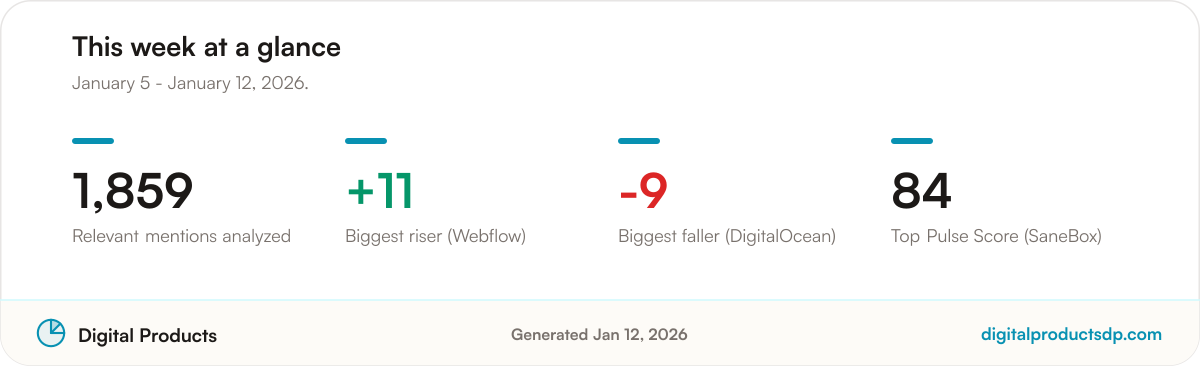
This edition tracks aggregated public online discussion about AI tools and broader software products, drawn from mentions analyzed for January 5, 2026 through January 12, 2026. Across that span, our system reviewed 1,859 relevant mentions and found 47 products with enough discussion volume to qualify for ranking, meaning at least 10 relevant mentions each. Everything below reflects the tone of community chatter, not a verdict on any product's quality.
The headline story for the period running from January 5, 2026 through January 12, 2026 is a quiet one at the top and a busier one in the middle of the table. SaneBox, an email management tool in the business category, held the highest Pulse Score, while the larger movements came from design and infrastructure products. We walk through the leaderboard, the category picture, the biggest movers, and the praise and complaint themes that shaped the conversation.
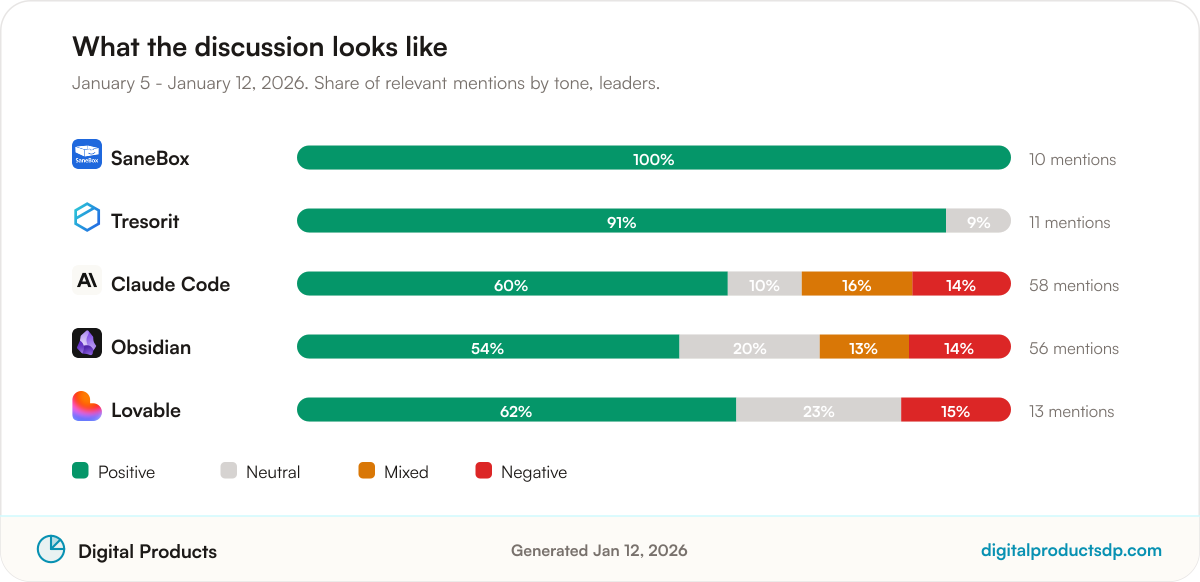
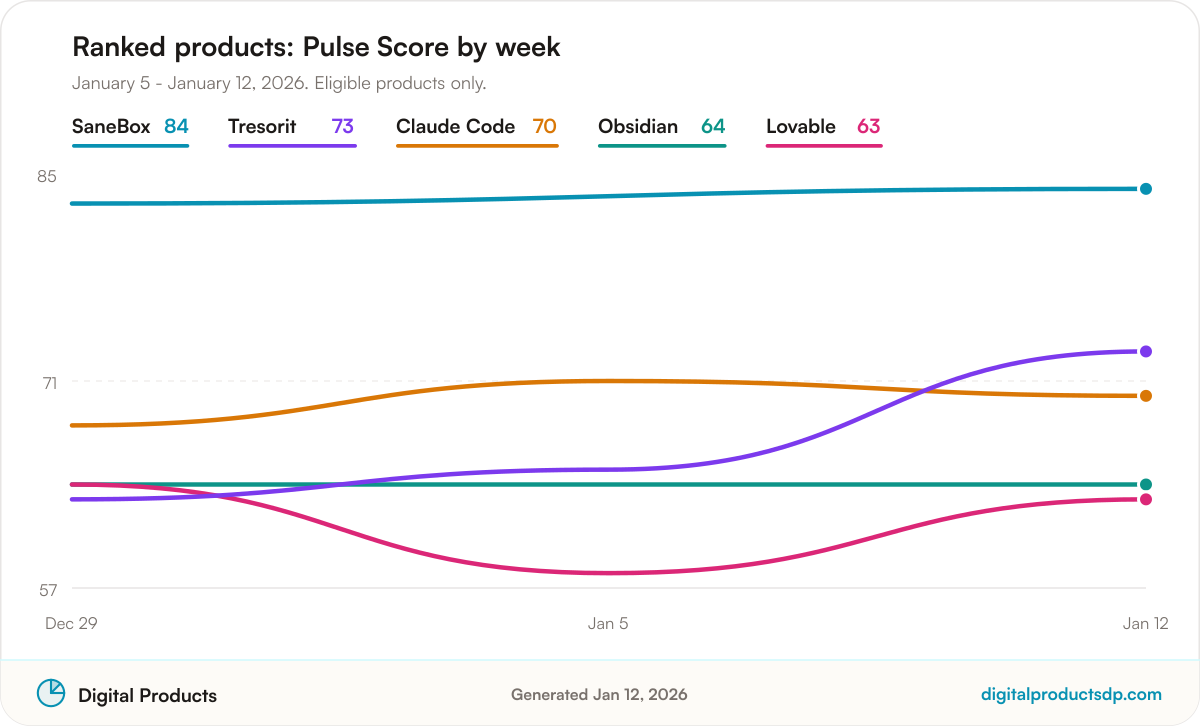
SaneBox topped the latest week with a Pulse Score of 84, based on 10 mentions over the period, just clearing the ranking threshold. Tresorit, a cloud storage product, followed at 73 based on 11 mentions, and Claude Code, a coding tool, sat at 70 based on a much larger 58 mentions. Obsidian, tracked in project management, scored 64 based on 56 mentions, and Lovable, another coding product, rounded out the top five at 63 based on 13 mentions.
The spread here is worth noting. The two highest scores come from small samples of 10 and 11 mentions, which makes them more sensitive to a handful of comments. Claude Code and Obsidian carry their scores on far heavier discussion volume, so their reads rest on broader footing even though they sit lower on the board. Treat the small-sample leaders as a snapshot of a thin but positive conversation rather than a settled consensus.
Category View
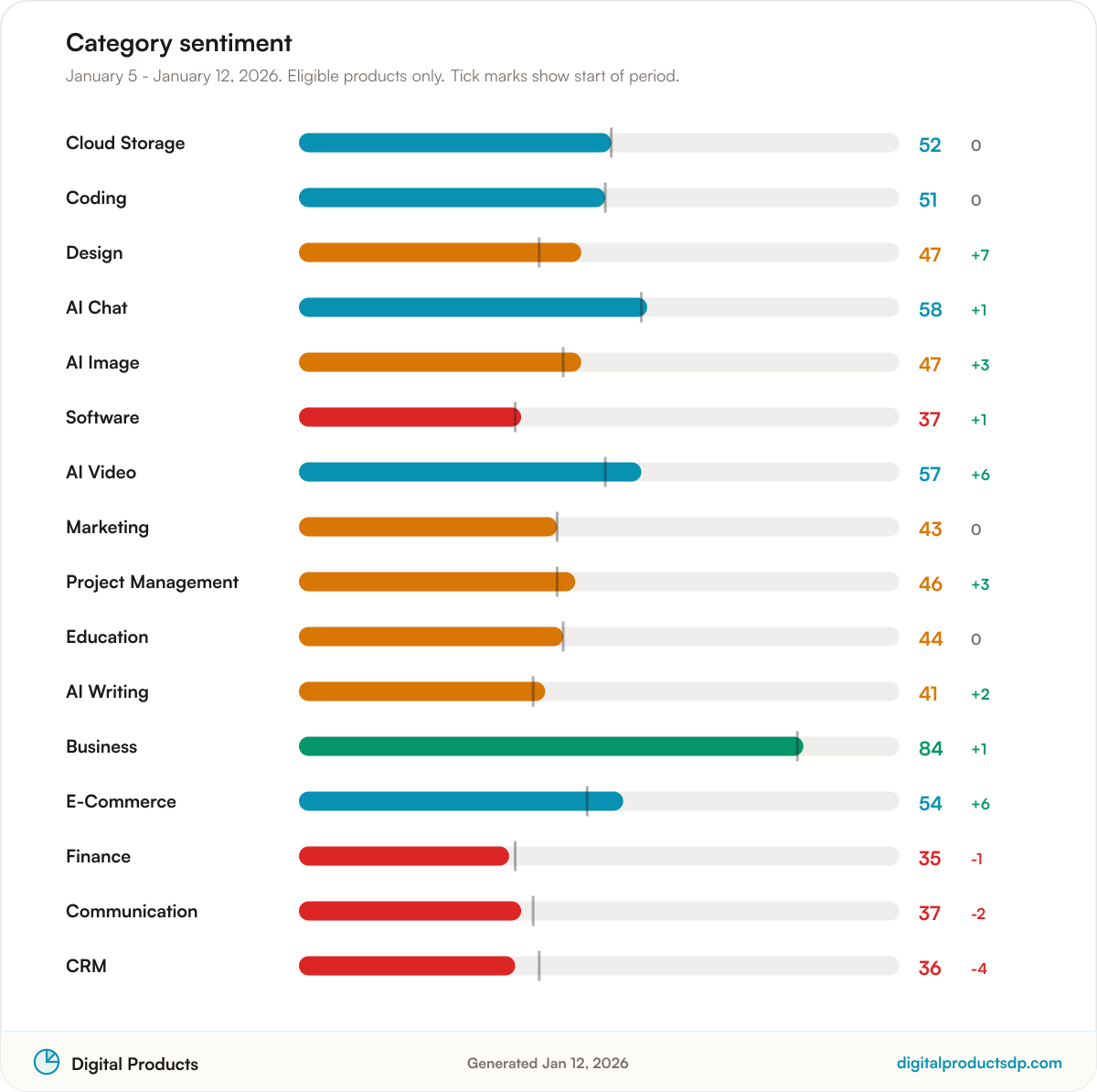
At the category level, business sat highest in average sentiment, moving from 83 to 84 across the period, though that average is anchored by SaneBox's thin sample. The clearest upward shifts came in design, which rose from 40 to 47, ai-video, which moved from 51 to 57, and e-commerce, which climbed from 48 to 54. Project management edged from 43 to 46 and ai-image from 44 to 47. Several categories held essentially flat, including cloud-storage at 52, coding at 51, and marketing at 43. On the softer side, crm slipped from 40 to 36, communication eased from 39 to 37, and finance ticked from 36 to 35. The overall picture is a community that leaned more positive on creative and video tooling while staying cool on crm and communication products.
Biggest Movers
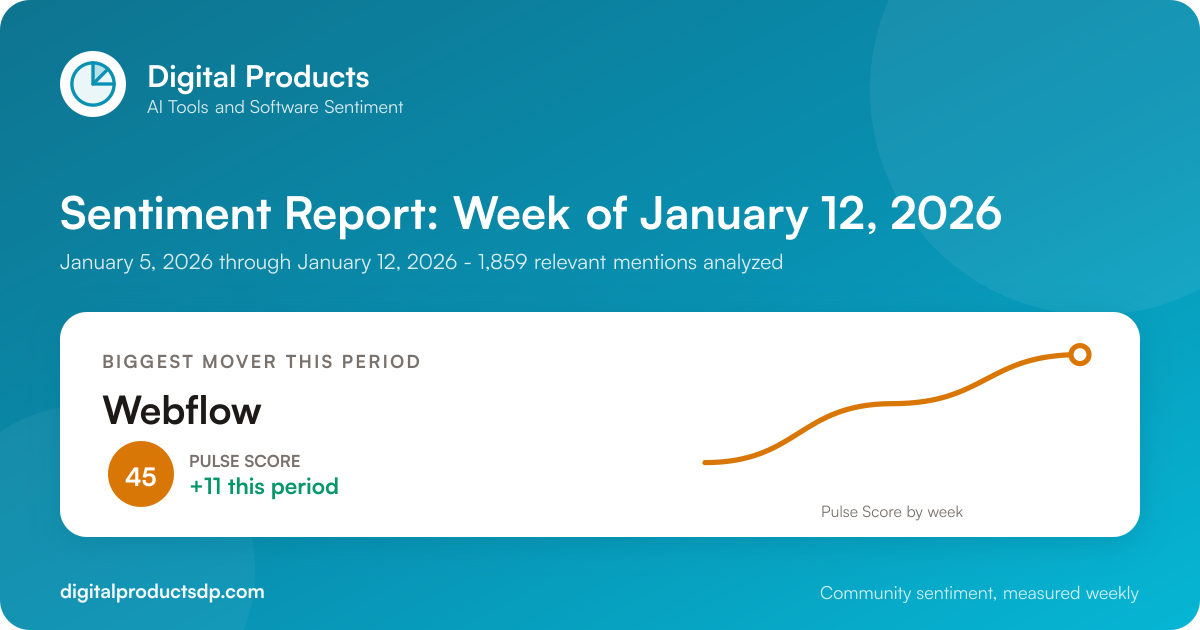
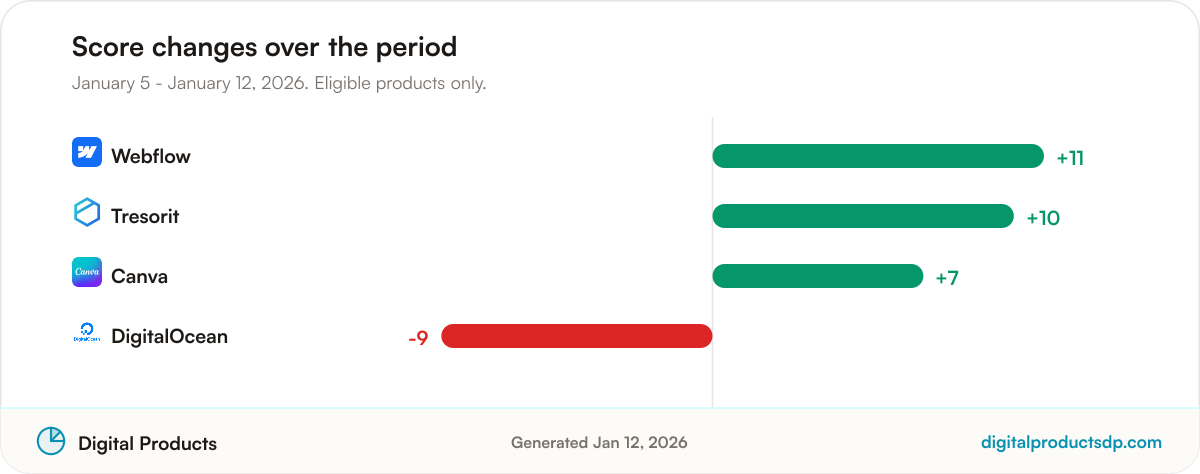
Webflow (+11, 34 to 45, based on 25 mentions). The web design product posted the largest gain of the period. Its praise themes leaned on Strong features (6 mentions), Easy to use (5 mentions), and Polished UI (3 mentions). The complaint side still carried friction, led by Learning curve (10 mentions), Compared to rivals (8 mentions), and UI frustrations (6 mentions). The move suggests community chatter warmed even as the onboarding curve remained the most cited sticking point.
Tresorit (+10, 63 to 73, based on 11 mentions). The cloud storage product saw the second largest rise, on a small sample. Its praise centered on Security praise (2 mentions), with single mentions of Great collaboration and Strong features. Complaints were equally light, with single mentions of Bugs, UI frustrations, and Pricing too high. With so few mentions, the climb reflects a small but favorable cluster of discussion rather than a broad shift.
Canva (+7, 38 to 45, based on 19 mentions). The design product rose alongside its category. Praise was led by Easy to use (66 mentions), Strong features (57 mentions), and Polished UI (31 mentions), a notably feature- and usability-driven conversation. Complaints were lighter, with UI frustrations (16 mentions), Bugs (12 mentions), and Reliability (8 mentions). The volume of praise around ease of use helps explain the upward move.
DigitalOcean (-9, 57 to 48, based on 13 mentions). The infrastructure product posted the steepest fall. Its complaint themes outweighed praise, with Bugs (12 mentions) and Reliability (12 mentions) leading, followed by Performance (4 mentions). Praise was thinner, citing Strong features (9 mentions), Good integrations (6 mentions), and Reliability (5 mentions). The presence of reliability on both the praise and complaint sides points to a divided conversation that tilted negative this period.
Cursor (-5, 60 to 55, based on 59 mentions). The coding tool slipped on heavier volume. Praise stayed substantial, led by Strong features (100 mentions), Easy to use (63 mentions), and Good integrations (56 mentions). Complaints centered on Bugs (44 mentions), Missing features (23 mentions), and Compared to rivals (19 mentions). The dip came despite a still large body of positive discussion, suggesting bug and comparison chatter weighed on tone.
ElevenLabs (-5, 50 to 45, based on 64 mentions). The AI voice product fell on the largest sample of the three fallers. Its complaint themes were heavy, led by Bugs (118 mentions) and Reliability (74 mentions), with Pricing too high (25 mentions) also present. Praise included Strong features (67 mentions), AI quality (35 mentions), and Good integrations (26 mentions). The reliability and bug volume appears to have driven the softer read.
Spotlight: SaneBox
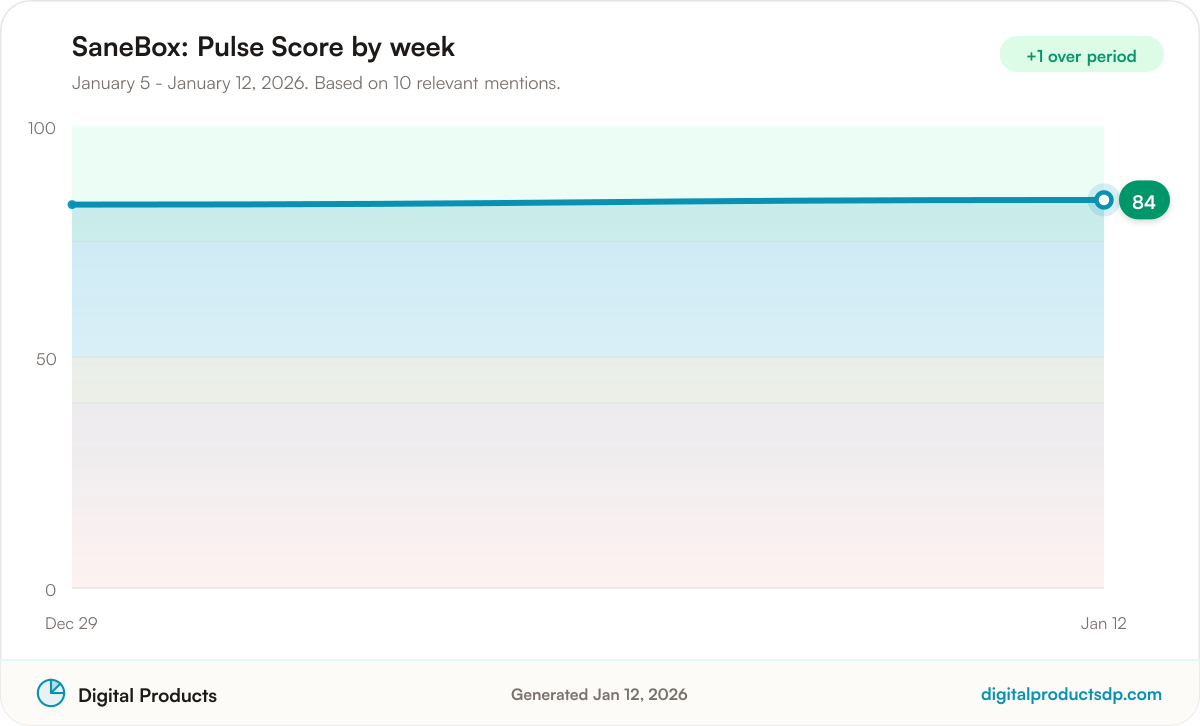
SaneBox led the period with a Pulse Score of 84, based on 10 mentions. Its weekly series shows it sitting at 83 on December 29, 2025 and at 84 on January 12, 2026, a stable and high read across the points we recorded. As an email management tool in the business category, it benefits from a category that itself moved from 83 to 84, though that category average leans heavily on SaneBox's own sample.
The theme breakdown is small but evenly balanced. On the praise side, the conversation cited AI quality (2 mentions) and Strong features (2 mentions). On the complaint side, it cited Bugs (2 mentions), AI quality (2 mentions), and Downtime (1 mention). Notably, AI quality appears on both sides, which signals a conversation where the same capability drew both appreciation and criticism within a thin sample.
The most important caveat is volume. With only 10 mentions clearing the threshold, SaneBox's score should be read as a positive but lightly sampled snapshot. A small number of additional comments in either direction could move it meaningfully next period, so the high placement is best treated as a signal to watch rather than a durable lead.
Themes Driving the Conversation
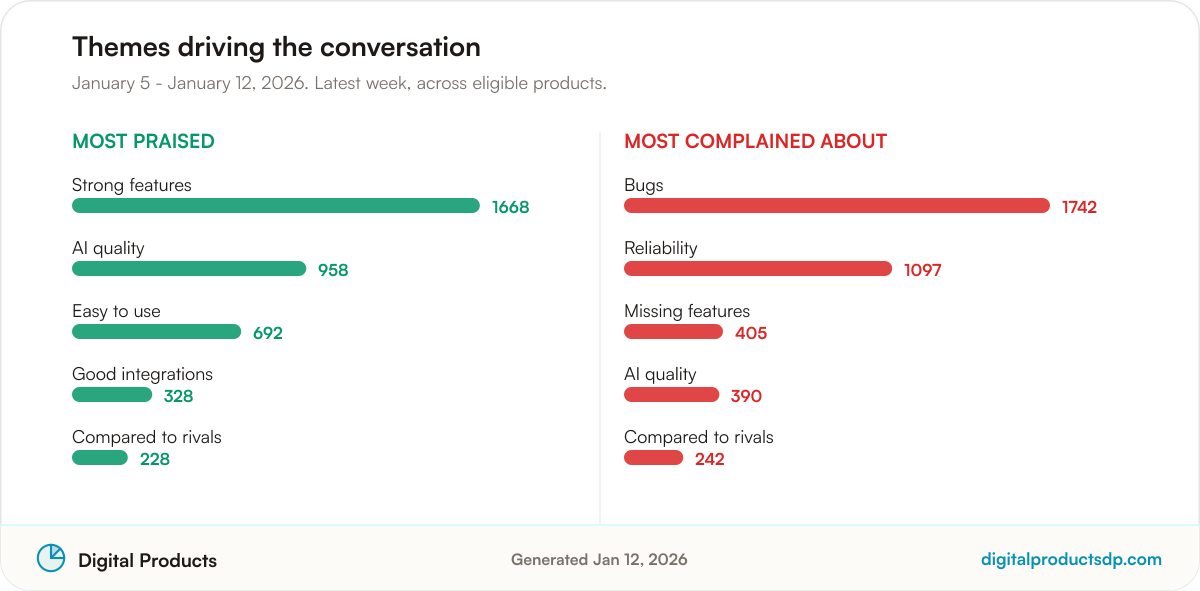
On the praise side, Strong features dominated with 1,668 mentions, far ahead of the rest. AI quality followed with 958 mentions, Easy to use with 692 mentions, Good integrations with 328 mentions, and Compared to rivals with 228 mentions. These themes show up across the heaviest-discussed products: Claude Code logged 249 mentions of Strong features, ChatGPT logged 183, and Claude logged 229, while AI quality was prominent for Claude (234 mentions), ChatGPT (159 mentions), and Gemini (149 mentions). Canva drove much of the Easy to use chatter with 66 mentions of its own.
On the complaint side, Bugs led decisively with 1,742 mentions, ahead of Reliability at 1,097 mentions, Missing features at 405 mentions, AI quality at 390 mentions, and Compared to rivals at 242 mentions. Bug and reliability chatter was concentrated in a few high-volume products: Stripe logged 188 mentions of Bugs and 158 of Reliability, Vercel logged 170 and 151, and ElevenLabs logged 118 and 74. AI quality appearing as a complaint theme, led by Gemini (112 mentions) and ChatGPT (109 mentions), shows that the same capability that earns praise also draws scrutiny when expectations are high.
Watchlist
Many tracked products did not reach the 10-mention threshold this period and are therefore excluded from rankings. This is a matter of discussion volume, not a judgment about quality. Products such as Surfshark (7 mentions), Wrike (7 mentions), Midjourney (7 mentions), WooCommerce (7 mentions), AVG (7 mentions), Trello (7 mentions), Asana (7 mentions), HubSpot (7 mentions), and Todoist (9 mentions) came close but fell short. Others sat lower, including Coursera (6 mentions), Carta (6 mentions), Kling (6 mentions), Pipedrive (6 mentions), xAI (6 mentions), Mailchimp (6 mentions), Amplitude (9 mentions), Zilliz (8 mentions), Ideogram (5 mentions), HeyGen (5 mentions), and Luma AI (5 mentions). A large set of tracked products recorded zero relevant mentions in the period.
Thin samples are unstable by nature, so we hold these products out of the leaderboard until they accumulate enough chatter for a steadier read. If discussion picks up for any of them next period, they may enter the rankings, and we will report the score with its sample size attached.
What To Watch Next Week
First, watch whether the small-sample leaders hold. SaneBox at 84 (10 mentions) and Tresorit at 73 (11 mentions) both rank highly on thin volume, so it is worth monitoring whether added discussion keeps them elevated or pulls them toward the middle of the table.
Second, watch the fallers for stabilization. DigitalOcean (-9), Cursor (-5), and ElevenLabs (-5) all carried heavy Bugs and Reliability chatter this period. Whether those complaint themes ease or persist will shape their next reads, especially for ElevenLabs and Cursor, which sit on larger samples.
Third, watch the design and ai-video categories, which moved up to 47 and 57 respectively. Canva (+7) and Webflow (+11) drove part of the design story, so it is worth tracking whether that warmer tone continues or settles back.
Frequently Asked Questions
Which product had the highest Pulse Score this period?
SaneBox had the highest Pulse Score at 84, based on 10 mentions over the period. Because the sample is small, the read is best treated as a positive but lightly sampled snapshot.
Which product moved the most this period?
Webflow rose the most, climbing from 34 to 45, a gain of 11 points based on 25 mentions. On the downside, DigitalOcean fell the most, sliding from 57 to 48, a drop of 9 points based on 13 mentions.
How many mentions were analyzed this period?
The system analyzed 1,859 relevant mentions for January 5, 2026 through January 12, 2026, with 47 products clearing the 10-mention threshold needed to be ranked.
What were the most-discussed themes?
Strong features led praise with 1,668 mentions, while Bugs led complaints with 1,742 mentions. Reliability was the second most-cited complaint with 1,097 mentions.
About This Data
Pulse Scores summarize the tone of public online discussion on a 0-100 scale and reflect community sentiment, not a verdict on a product's quality or a recommendation. We report on complete calendar weeks only, and products with fewer than 10 relevant mentions in the period are excluded from rankings to avoid unstable reads on thin samples.
Public discussion is collected from Hacker News, Stack Exchange, GitHub, Bluesky, the Apple App Store, and YouTube. Automated sentiment analysis can misread sarcasm, jokes, or niche context, mention volumes vary widely between products, and scores can move week to week. Any company that wants to respond is welcome to reach out. For more on how scores are calculated, see our methodology.