AI Tools and Software Sentiment Report: Week of January 5, 2026
January 5, 2026
This edition tracks aggregated public online discussion about AI tools and broader software products, from coding assistants and AI chat to CRM platforms, design tools, and email management. The figures here summarize the tone of community chatter, not any verdict on product quality. Every number below traces to a single period of collected discussion drawn from Hacker News and YouTube review-video comments.
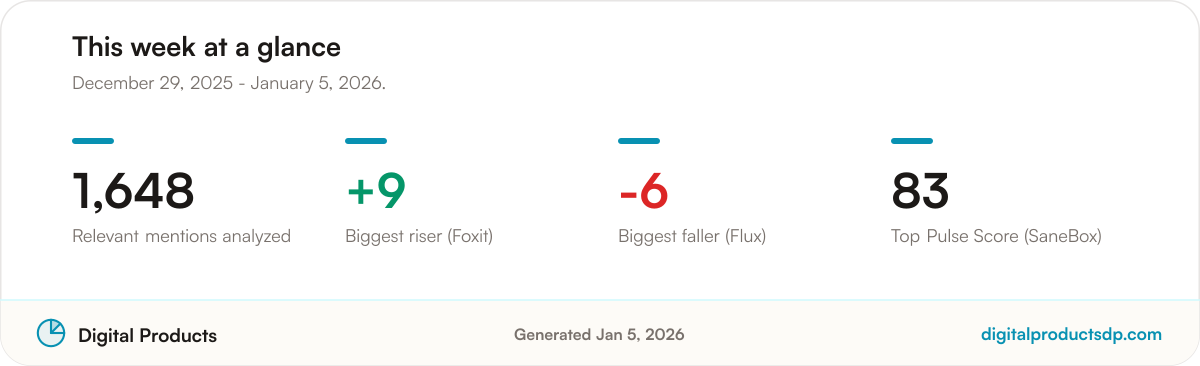
The numbers in this report reflect mentions analyzed for December 29, 2025 through January 5, 2026, the most recent complete calendar week in our digest. Across the broader digest window, 2,218 products were tracked, 44 cleared the threshold of at least 10 relevant mentions to be ranked, and 1,648 total relevant mentions were analyzed. That is a thin week by volume, which shapes how confidently any single score should be read.
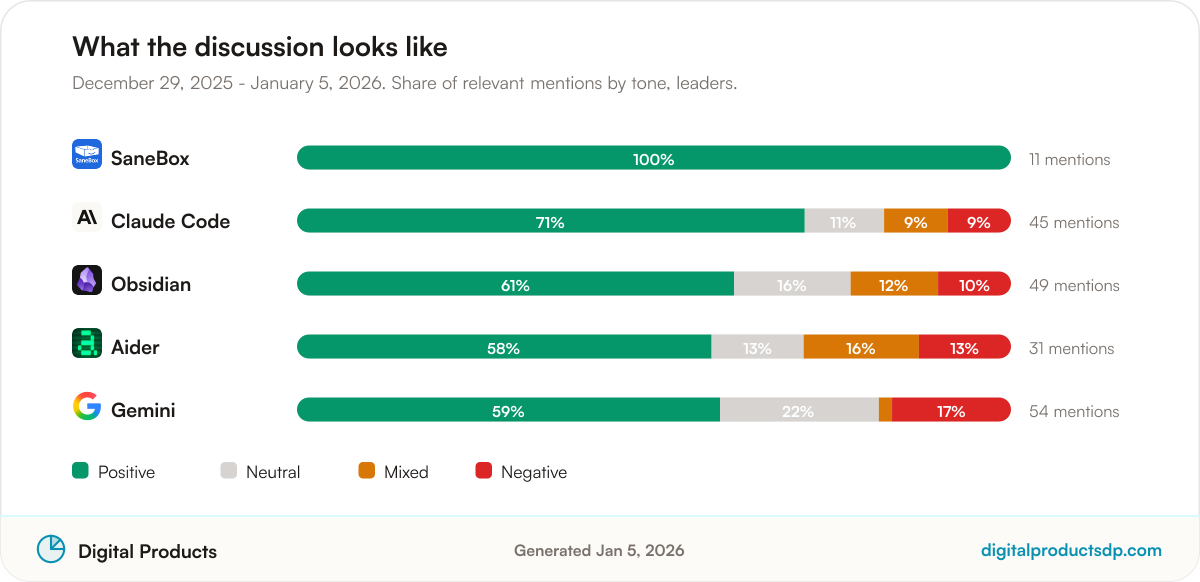
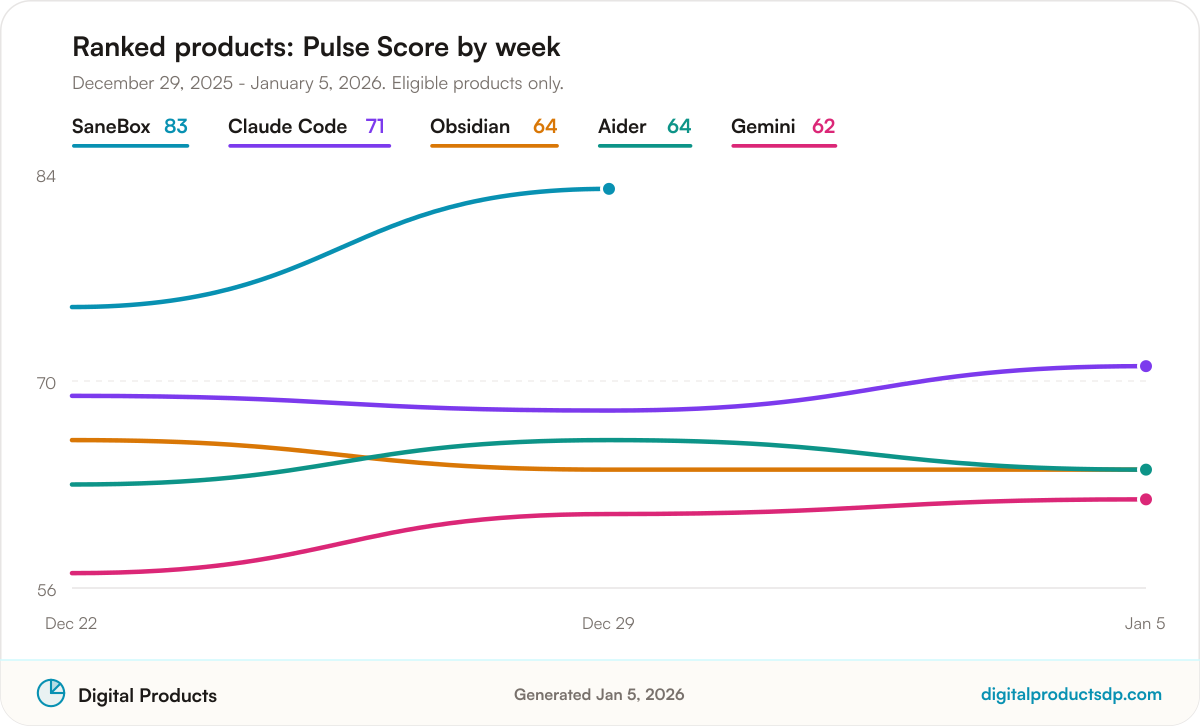
SaneBox, an email management tool in the business category, topped the latest week with a Pulse Score of 83, based on 11 mentions over the period. Behind it, the coding assistant Claude Code scored 71 based on 45 mentions, the note and project tool Obsidian scored 64 based on 49 mentions, the coding assistant Aider scored 64 based on 31 mentions, and the AI chat tool Gemini scored 62 based on 54 mentions.
The spread is worth noting. SaneBox sits at the top on the strength of a small sample, while Claude Code, Obsidian, and Gemini carry their scores on heavier discussion volume. A high score on 11 mentions is a less stable read than a mid-60s score on 49 mentions, so the gap between first and the pack should be treated as a snapshot of tone rather than a durable ranking. The leaders skew toward coding and AI chat, the two categories that drew the most discussion this period.
Category View
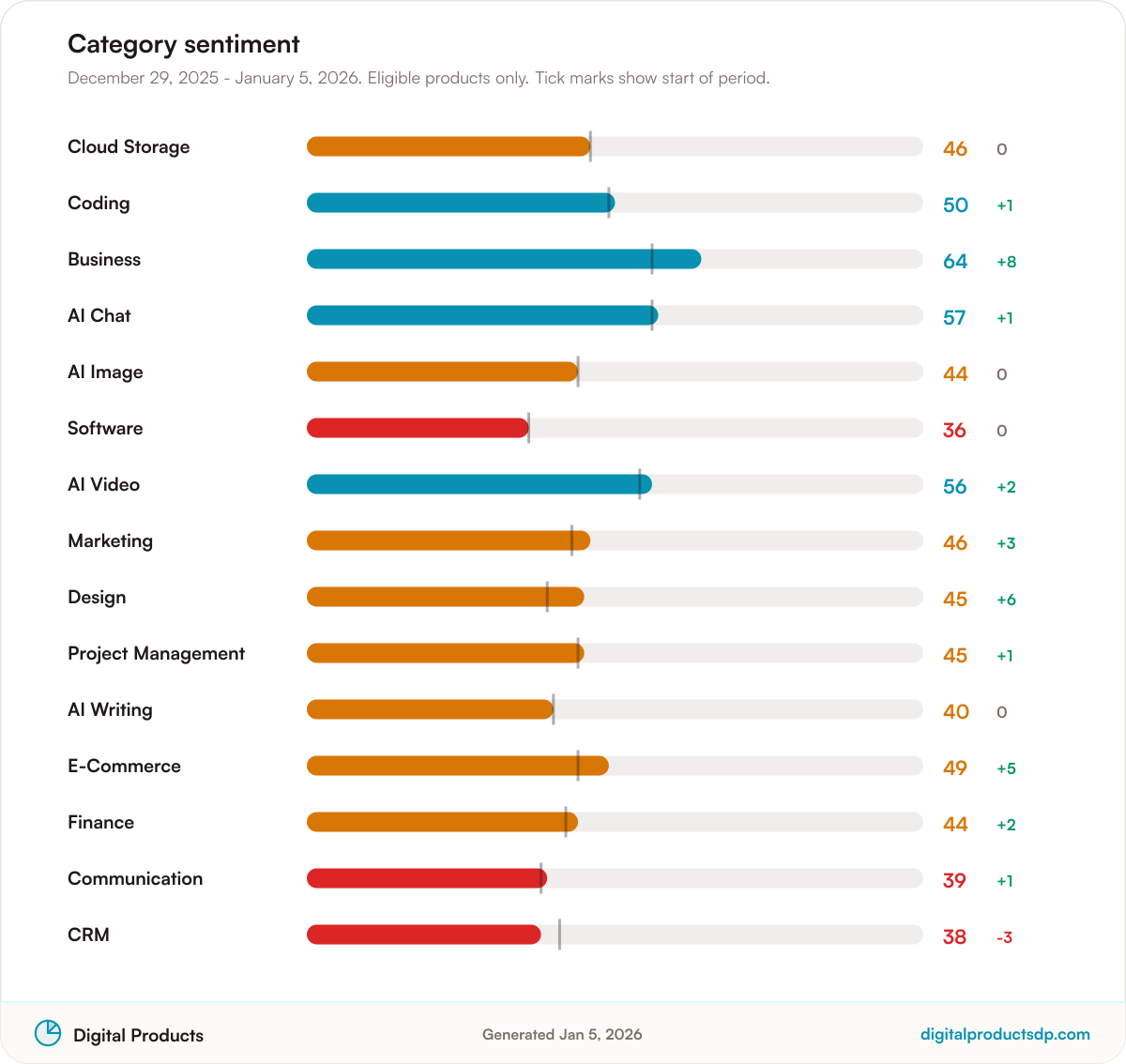
At the category level, business posted the largest move, climbing from 56 to 64 over the period, a shift heavily tied to SaneBox. Design rose from 39 to 45 and e-commerce from 44 to 49, both showing warming sentiment. Coding ticked up from 49 to 50, ai-chat from 56 to 57, and ai-video from 54 to 56. Several categories held flat, including cloud-storage at 46, ai-image at 44, software at 36, and ai-writing at 40. The only category to fall was crm, which slipped from 41 to 38, a move closely linked to Salesforce. The mood across categories was mostly stable to mildly positive, with business and design as the standout climbers and crm as the lone decliner.
Biggest Movers
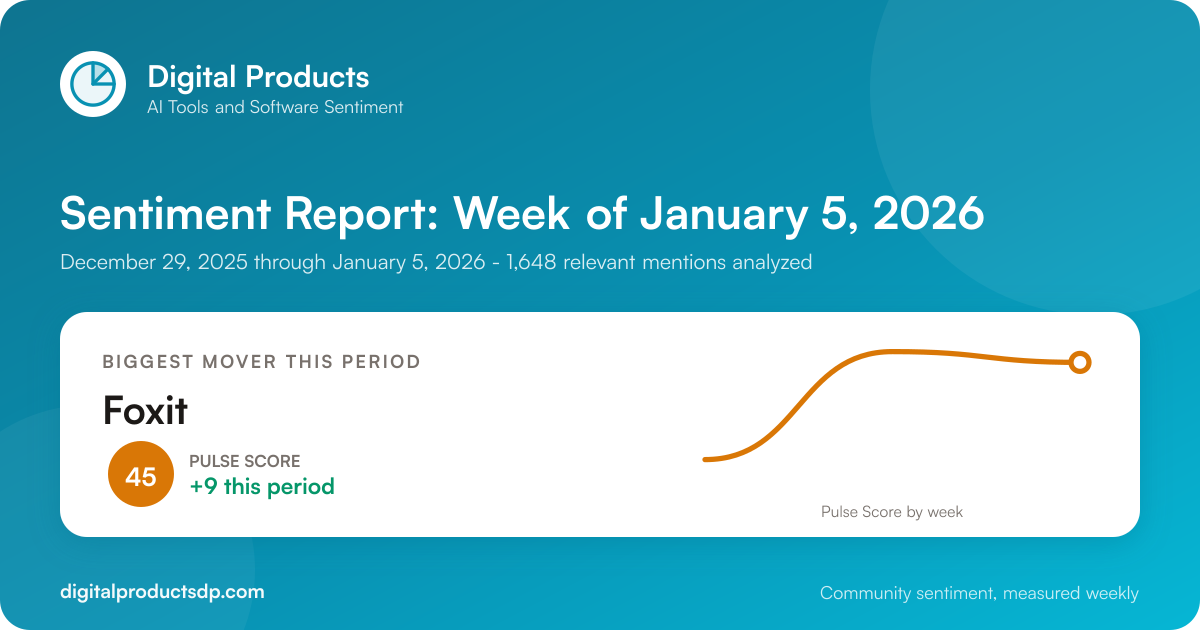
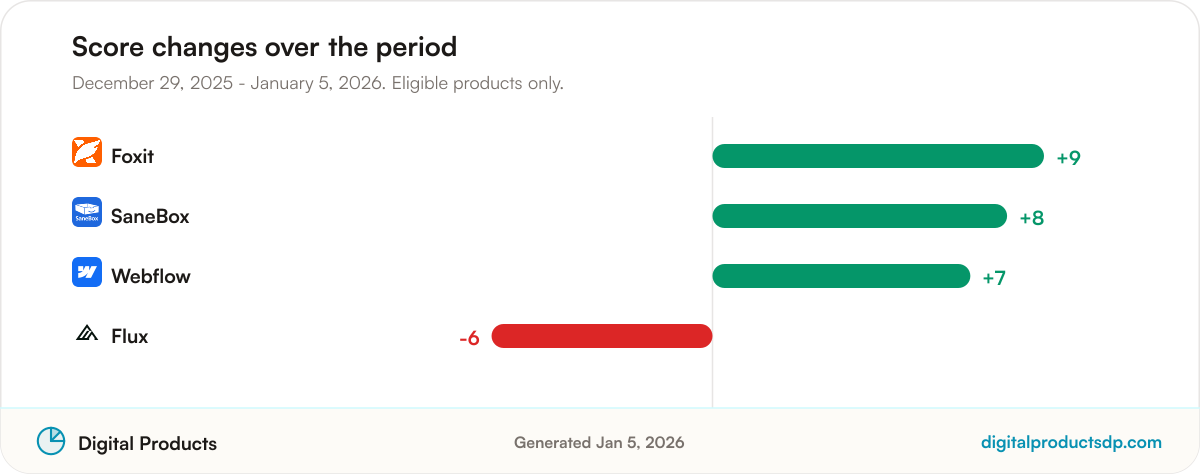
Foxit (up 9, from 36 to 45, based on 10 mentions). The PDF software saw the largest rise of the period. Its latest-week praise leaned on Strong features (10 mentions), Compared to rivals (6 mentions), and Performance (5 mentions), which fits a tool being weighed favorably against alternatives. The lift was not unqualified, with Bugs (5 mentions) and UI frustrations (3 mentions) still present in the complaint mix, so the climb reflects warmer but mixed chatter on a small sample.
SaneBox (up 8, from 75 to 83, based on 11 mentions). The email tool both led the board and ranked among the biggest risers. Its recorded latest-week themes were sparse, with praise split between AI quality (2 mentions) and Strong features (2 mentions), and complaints touching Bugs (2 mentions), AI quality (2 mentions), and Downtime (1 mention). The score is strong but rests on very thin discussion, so its move is best read as a positive tone signal rather than a settled consensus.
Webflow (up 7, from 33 to 40, based on 10 mentions). The design and web-build tool rose despite a complaint-heavy profile. Praise centered on Strong features (6 mentions), Easy to use (5 mentions), and Polished UI (3 mentions), while complaints were led by Learning curve (10 mentions), Compared to rivals (8 mentions), and UI frustrations (6 mentions). The rise suggests sentiment warming off a low base even as onboarding friction remains the dominant gripe.
Flux (down 6, from 37 to 31, based on 11 mentions). The AI image tool was the biggest faller. Its praise still featured AI quality (33 mentions), Strong features (22 mentions), and New releases (13 mentions), but complaints around Bugs (19 mentions), Performance (17 mentions), and Reliability (11 mentions) appear to have weighed the tone down. The split points to a tool people rate on output quality but increasingly flag for stability.
Windsurf (down 4, from 52 to 48, based on 27 mentions). The coding assistant slipped on a heavier sample than most movers. Praise covered Strong features (7 mentions), Good integrations (5 mentions), and New releases (3 mentions), while complaints were led by Bugs (8 mentions), Lacking integrations (7 mentions), and Reliability (5 mentions). Notably, integrations appear on both sides, suggesting uneven experiences are pulling sentiment in different directions.
Salesforce (down 3, from 41 to 38, based on 37 mentions). The CRM platform fell on the largest sample among the movers, which makes its decline one of the more grounded reads of the period. Praise leaned on New releases (9 mentions), Good integrations (8 mentions), and Strong features (8 mentions), but complaints dominated, led by Bugs (56 mentions), Reliability (30 mentions), and Missing features (22 mentions). That complaint weight mirrors the crm category dip from 41 to 38.
Spotlight: SaneBox
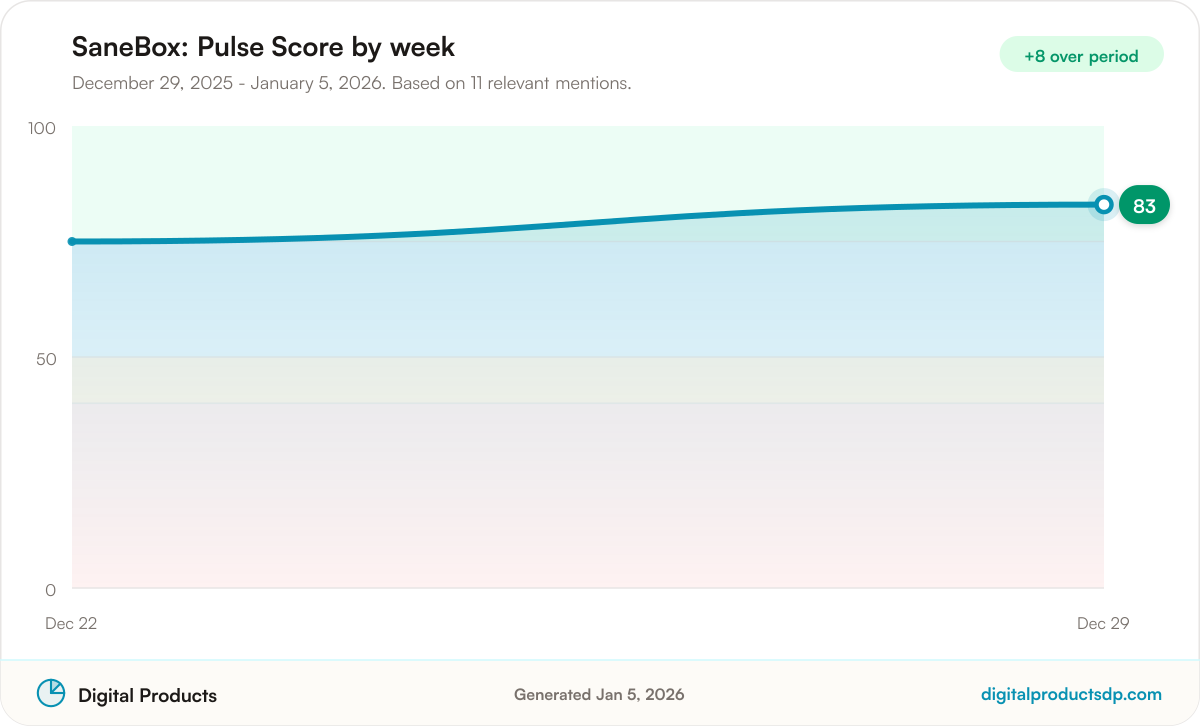
SaneBox finished as the top-scoring ranked product this period with a Pulse Score of 83, based on 11 mentions over the period. Its weekly series shows the move clearly: it sat at 75 in the week of December 22, 2025 and climbed to 83 in the week of December 29, 2025, an 8-point gain that put it both at the front of the leaderboard and among the biggest risers.
The themes behind that score are sparse, which is the key caveat. In the latest week, SaneBox drew praise on AI quality (2 mentions) and Strong features (2 mentions), set against complaints on Bugs (2 mentions), AI quality (2 mentions), and Downtime (1 mention). AI quality appears on both the praise and complaint sides, a sign that the small pool of discussion is not uniform. With only 11 mentions over the period, a handful of comments can swing the read substantially.
The practical takeaway is that SaneBox's lead reflects a genuinely positive tone in the discussion that exists, but it is a thin-sample signal. It is worth watching whether the score holds as volume builds, or whether it settles closer to the pack the way heavier-sampled leaders like Claude Code at 71 based on 45 mentions tend to behave week to week.
Themes Driving the Conversation
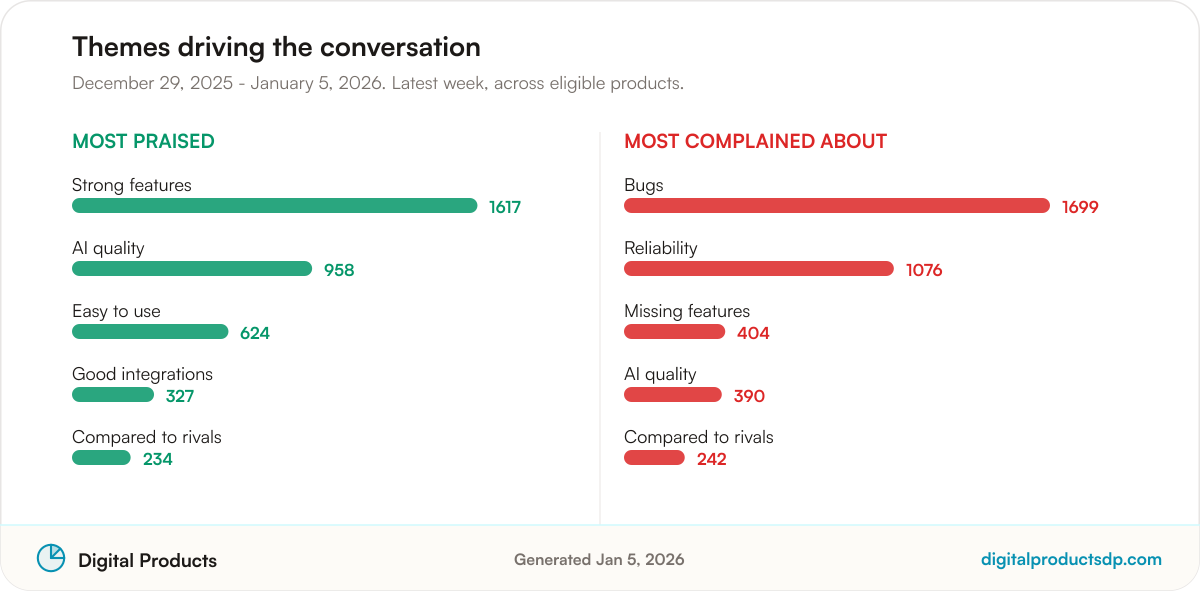
On the praise side, Strong features led the conversation with 1,617 mentions, followed by AI quality (958 mentions), Easy to use (624 mentions), Good integrations (327 mentions), and Compared to rivals (234 mentions). Strong features was the most common compliment across the leaders, showing up prominently for Claude Code (249 mentions), Claude (229 mentions), ChatGPT (183 mentions), and Gemini (140 mentions). AI quality was a defining strength for the chat and assistant tools in particular, with Claude (234 mentions), ChatGPT (159 mentions), and Gemini (149 mentions) all leaning on it.
On the complaint side, Bugs dominated with 1,699 mentions, ahead of Reliability (1,076 mentions), Missing features (404 mentions), AI quality (390 mentions), and Compared to rivals (242 mentions). Bugs and reliability were the recurring pain points across heavily discussed products: Stripe carried 188 bug mentions and 158 reliability mentions, Vercel 170 and 151, ElevenLabs 118 and 74, GitHub Copilot 113 and 74, Confluence 111 and 61, and Salesforce 56 and 30. AI quality appears on both lists, surfacing as a complaint for Gemini (112 mentions), ChatGPT (109 mentions), and Claude (110 mentions), the same tools that draw praise for it. That dual presence is a reminder that automated sentiment can capture both enthusiasm and frustration about the same capability.
Watchlist
Many tracked products did not clear the threshold of at least 10 relevant mentions this period and are not ranked. This is a measure of discussion volume only, not a judgment on quality. Among those just below the line were Canva (9 relevant mentions), Midjourney (8 relevant mentions), Adyen (8 relevant mentions), Surfshark (7 relevant mentions), Coursera (7 relevant mentions), HeyGen (7 relevant mentions), Asana (7 relevant mentions), and Zilliz (7 relevant mentions). Others with lighter footprints included Carta (6 relevant mentions), Klarna (6 relevant mentions), WooCommerce (6 relevant mentions), Gumroad (6 relevant mentions), Pipedrive (6 relevant mentions), edX (6 relevant mentions), and Bitbucket (6 relevant mentions).
A number of widely known names recorded zero relevant mentions in this window, including Notion, Slack, Zoom, Microsoft Teams, GitHub, GitLab, and Dropbox. Given that collection this period came only from Hacker News and YouTube review-video comments, low or zero counts often reflect where conversation happened to land during a quiet holiday-adjacent stretch rather than any shift in how these products are regarded. As volume returns in later weeks, several of these could cross back over the threshold.
What To Watch Next Week
First, watch whether SaneBox holds its 83. The score is the highest on the board but rests on only 11 mentions, with AI quality appearing as both praise and complaint. A return to heavier volume will show whether the positive tone is durable or a thin-sample spike.
Second, watch the crm category and Salesforce specifically. It was the only category to fall, slipping from 41 to 38, and Salesforce carried that move on a relatively heavy 37 mentions with complaints led by Bugs (56 mentions) and Reliability (30 mentions). Whether those complaint themes ease will indicate if the dip continues.
Third, watch the bugs and reliability themes overall. They led complaints at 1,699 and 1,076 mentions respectively and weighed on high-volume products like Stripe and Vercel. If those counts soften, scores across coding and finance-adjacent tools could firm up.
Frequently Asked Questions
Which product had the highest Pulse Score this period?
SaneBox led all ranked products with a Pulse Score of 83 in the latest week, based on 11 mentions over the period.
Which product moved the most this period?
Foxit was the biggest riser, climbing from 36 to 45, a gain of 9 points based on 10 mentions. Flux was the biggest faller, dropping from 37 to 31, a loss of 6 points based on 11 mentions.
What was the overall category mood?
Mostly stable to mildly positive. Business rose from 56 to 64 and design from 39 to 45, while crm was the only category to fall, slipping from 41 to 38.
How many mentions were analyzed this period?
A total of 1,648 relevant mentions were analyzed across 44 ranked products, out of 2,218 products tracked in the broader digest.
About This Data
Pulse Scores summarize the tone of public online discussion on a 0-100 scale and reflect community sentiment, not a verdict on a product's quality or a recommendation. We report on complete calendar weeks only, and products with fewer than 10 relevant mentions in the period are excluded from rankings to avoid unstable reads on thin samples.
Public discussion is collected from Hacker News, Stack Exchange, GitHub, Bluesky, the Apple App Store, and YouTube. Automated sentiment analysis can misread sarcasm, jokes, or niche context, mention volumes vary widely between products, and scores can move week to week. Any company that wants to respond is welcome to reach out. For how scores are calculated, see our methodology.