AI Tools and Software Sentiment Report: Week of December 29, 2025
December 30, 2025
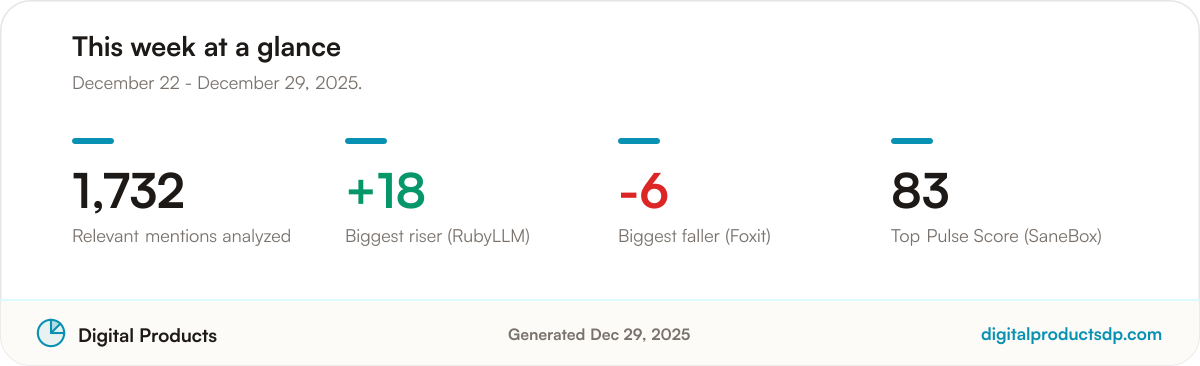
This edition tracks aggregated public online discussion of AI tools and software, drawn from mentions analyzed for December 22, 2025 through December 29, 2025. We focus on community sentiment, meaning the tone of how people are talking about these products in public, rather than any verdict on how well the products actually perform. Across the period, 1,732 relevant mentions were analyzed across the products that cleared our ranking threshold.
Of 2,218 products tracked, 46 had enough discussion to be eligible for rankings during the window running from December 22, 2025 through December 29, 2025. The mix spans AI tools alongside broader software like CRM, payments, design, and project-management platforms, so we name categories specifically rather than calling everything an AI tool. What follows reads the leaderboard, the category averages, the biggest movers, and the praise and complaint themes driving the conversation.
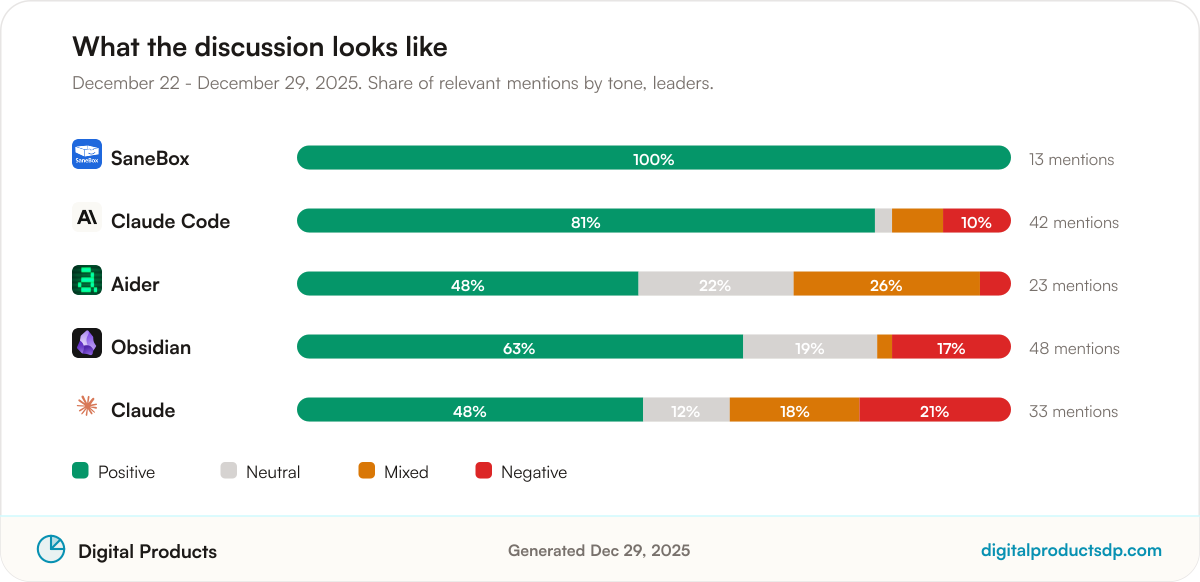
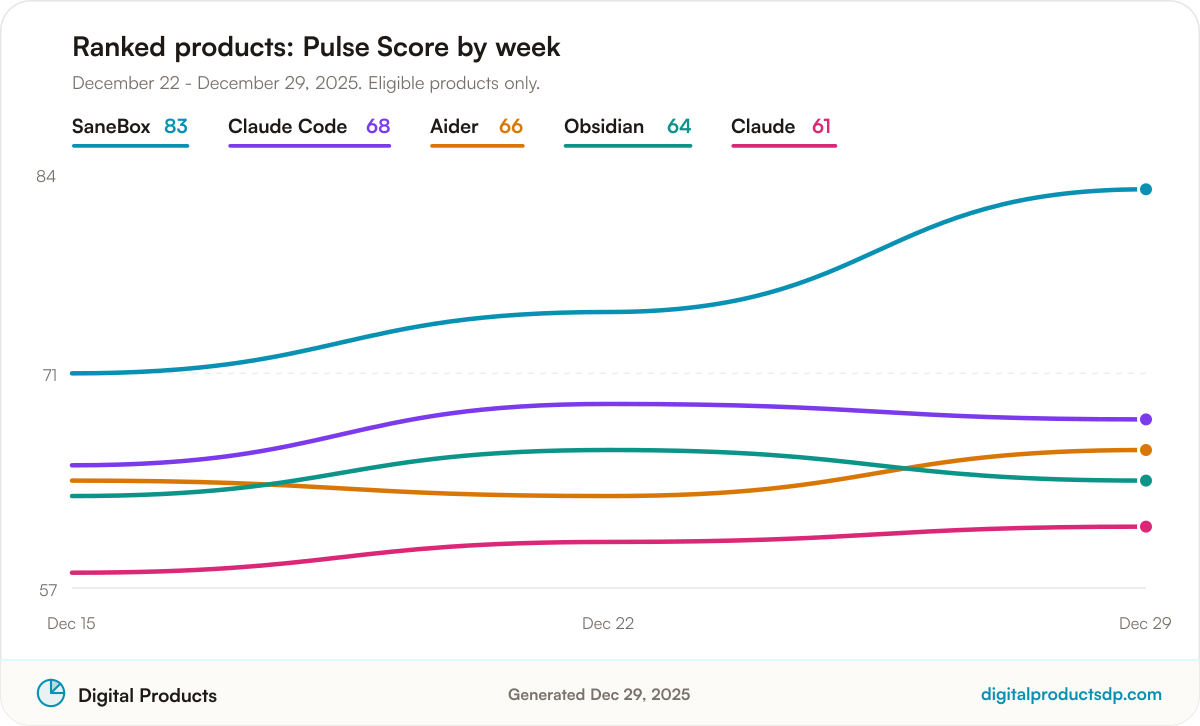
SaneBox sits at the top of the ranked products with a Pulse Score of 83, based on 13 mentions over the period. It is a business email tool rather than an AI chat assistant, and its sample is one of the thinner ones on the board, which is worth keeping in mind when reading a high score. Behind it, the coding category supplies two of the next three slots: Claude Code at 68, based on 42 mentions, and Aider at 66, based on 23 mentions.
Obsidian, a project-management and notes tool, scored 64, based on 48 mentions, the largest sample among the leaders. Claude rounds out the top five at 61, based on 33 mentions. The spread among these five is relatively tight once you move past SaneBox, with scores clustered in the 60s, suggesting steady rather than polarized discussion across the leading coding, notes, and AI chat products.
Category View
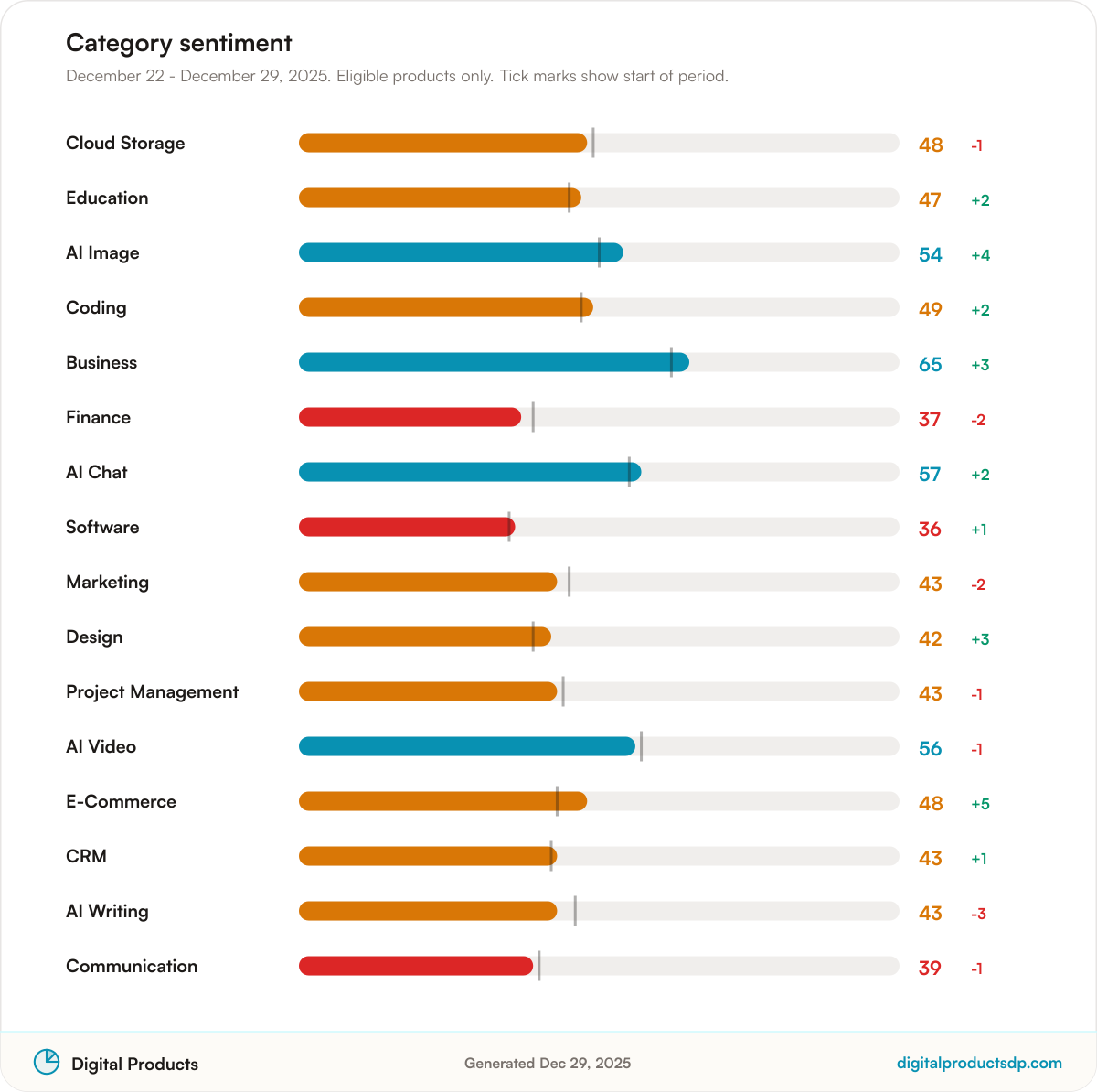
At the category level, business led the field and improved from 62 to 65 across the period, the highest average of any tracked category. AI chat also moved up, from 55 to 57, and ai-image rose from 50 to 54. E-commerce gained ground from 43 to 48, and design ticked up from 39 to 42. On the softer side, finance slipped from 39 to 37, marketing eased from 45 to 43, ai-writing fell from 46 to 43, and communication edged down from 40 to 39. Coding rose modestly from 47 to 49, while the broad software category remained near the bottom, moving only from 35 to 36. Most shifts were small, which fits a holiday-week window where discussion volume tends to be thinner and individual conversations carry more weight in each average.
Biggest Movers
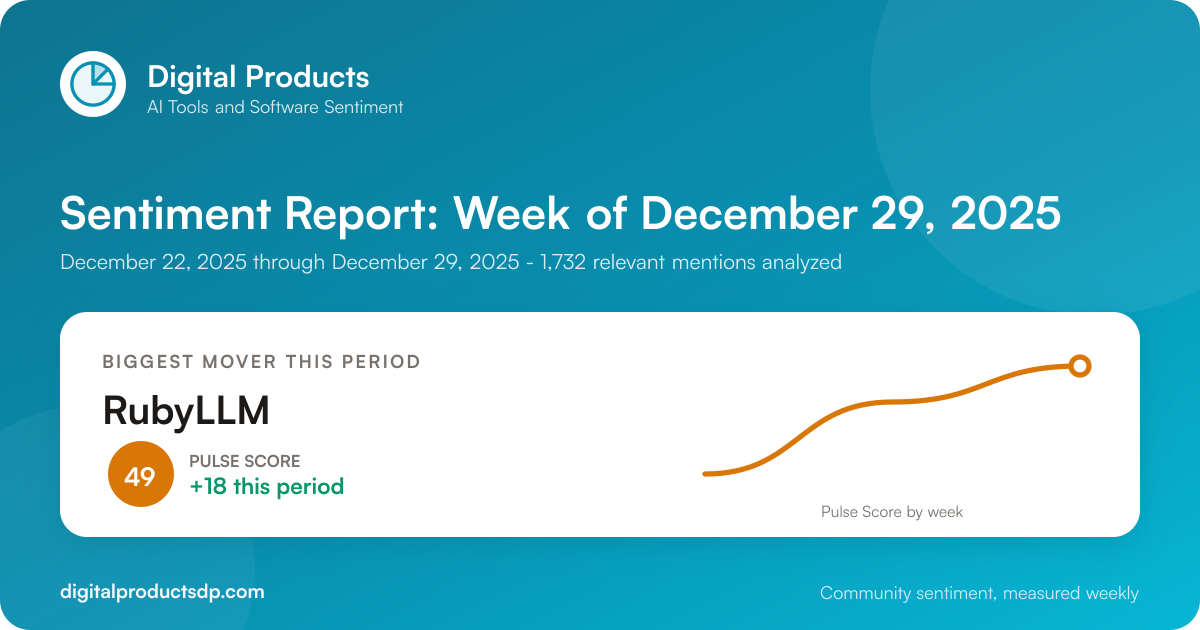
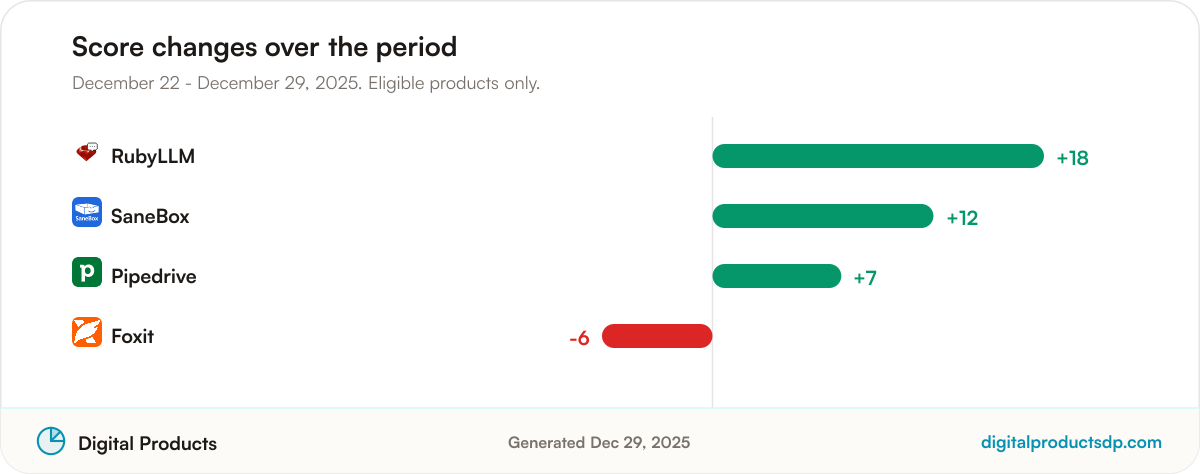
RubyLLM (riser, plus 18, from 31 to 49, based on 18 mentions). RubyLLM posted the largest gain of the period. Its latest-week praise leaned on Strong features (24 mentions), Good integrations (20 mentions), and Easy to use (16 mentions), which points to discussion welcoming what it ships and how it connects. The climb is notable given that its complaint side was still active, led by Bugs (27 mentions), Reliability (16 mentions), and Missing features (8 mentions). In other words, sentiment improved sharply even as reliability talk persisted, suggesting the praise themes carried more of the recent conversation.
SaneBox (riser, plus 12, from 71 to 83, based on 13 mentions). SaneBox both rose the second most and finished as the highest-scored product. Its themes are thin in absolute terms, with praise split between AI quality (2 mentions) and Strong features (2 mentions), and complaints across Bugs (2 mentions), AI quality (2 mentions), and Downtime (1 mention). With a small sample like this, the high score reflects a small set of largely positive public mentions rather than a broad wave of discussion, so it is best read with that caveat.
Pipedrive (riser, plus 7, from 39 to 46, based on 10 mentions). The CRM platform Pipedrive gained ground while sitting right at the ten-mention eligibility line. Its praise themes were modest, with Strong features (3 mentions), Good integrations (2 mentions), and Easy to use (2 mentions). Its complaint side was heavier in raw counts, led by Bugs (12 mentions), Lacking integrations (10 mentions), and Reliability (5 mentions). The rise alongside meaningful integration complaints suggests an improving but still mixed read.
Foxit (faller, minus 6, from 52 to 46, based on 11 mentions). Foxit slipped despite some supportive notes. Its praise included Strong features (10 mentions), Compared to rivals (6 mentions), and Performance (5 mentions), while complaints centered on Bugs (5 mentions), Security praise (4 mentions) appearing in the discussion, and UI frustrations (3 mentions). Its weekly path was volatile, moving from 52 down to 36 and back to 46, the kind of swing thin samples can produce.
Coinbase (faller, minus 6, from 45 to 39, based on 11 mentions). The finance product Coinbase declined across the period. Praise covered Strong features (20 mentions), Easy to use (17 mentions), and New releases (10 mentions), but complaints were prominent, led by Bugs (9 mentions), Poor support (8 mentions), and Missing features (8 mentions). The support and missing-features talk lines up with a category that softened overall this week.
Windsurf (faller, minus 6, from 55 to 49, based on 31 mentions). Among the fallers, the coding tool Windsurf had the deepest sample, which makes its decline more interesting to read. Praise was light, with Strong features (7 mentions), Good integrations (5 mentions), and New releases (3 mentions). Complaints outweighed praise, led by Bugs (8 mentions), Lacking integrations (7 mentions), and Reliability (5 mentions). The integration complaints stand out because integrations also showed up on the praise side, a sign of a split conversation.
Spotlight: SaneBox
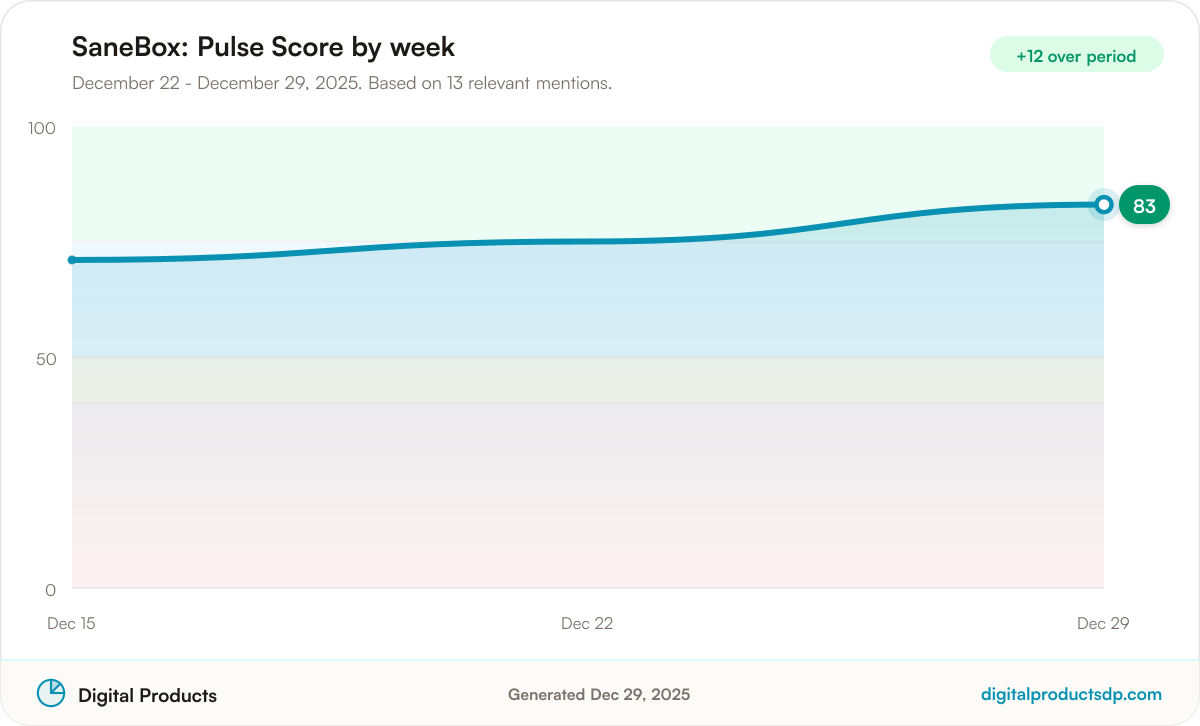
SaneBox, a business email-management product, finished the period as the highest-scored ranked product at 83, based on 13 mentions over the period. Its weekly series moved upward across all three reported weeks, from 71 on December 15, 2025 to 75 on December 22, 2025 and then to 83 on December 29, 2025. That is a consistent climb rather than a one-week spike, which is reassuring for a smaller sample, though the small mention count still means a handful of conversations move the number.
Its theme breakdown is light in raw counts. On the praise side, the latest week shows AI quality (2 mentions) and Strong features (2 mentions). On the complaint side, it records Bugs (2 mentions), AI quality (2 mentions), and Downtime (1 mention). AI quality appears on both sides, which is common when a small group of mentions pulls in different directions on the same topic.
The takeaway is that SaneBox is leading on tone, not on volume. Its position rests on a steady, mostly positive trickle of public discussion through a holiday window, and the 13-mention sample warrants the caution we apply to any thin read. It is a leader to watch as much for whether the volume grows as for whether the score holds.
Themes Driving the Conversation
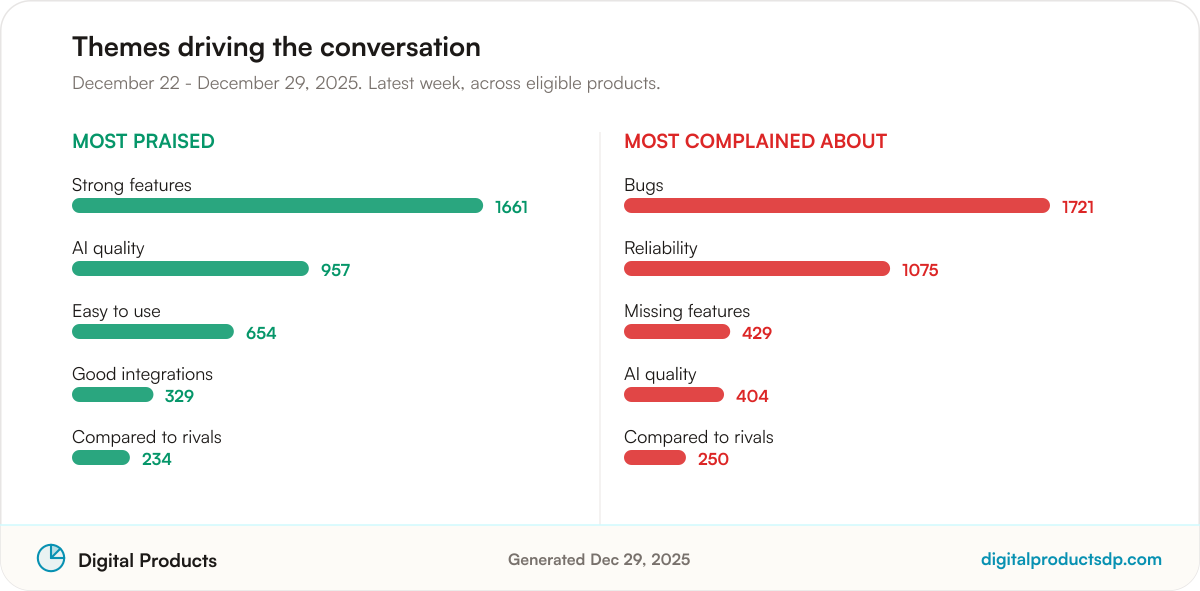
On the praise side, Strong features led the conversation with 1,661 mentions, well ahead of AI quality at 957 mentions and Easy to use at 654 mentions. Good integrations followed with 329 mentions and Compared to rivals with 234 mentions. The features theme shows up across the leaders, from Claude Code, where Strong features drew 249 mentions, to ChatGPT at 183 mentions and Claude at 229 mentions. AI quality praise concentrated in the chat and model products, with Claude at 234 mentions, Gemini at 149 mentions, and ChatGPT at 159 mentions, which is consistent with AI chat being one of the categories that gained this period.
On the complaint side, Bugs dominated with 1,721 mentions, ahead of Reliability at 1,075 mentions, then Missing features at 429 mentions, AI quality at 404 mentions, and Compared to rivals at 250 mentions. Bug and reliability talk clustered heavily around infrastructure and developer-facing products. Stripe alone recorded 188 Bug mentions and 158 Reliability mentions, Vercel logged 170 Bug and 151 Reliability mentions, and Confluence showed 111 Bug and 61 Reliability mentions. AI quality also surfaced as a complaint for the model products, including Claude at 110 mentions, ChatGPT at 109 mentions, and Gemini at 112 mentions, the same products where AI quality praise ran high. That two-sided pattern is the clearest signal of the week: features and AI quality drive enthusiasm, while bugs and reliability anchor the criticism.
Watchlist
Many tracked products did not clear the ten-mention threshold this period, so they are excluded from the rankings. This is a statement about discussion volume in public sources during a holiday week, not a judgment on quality. Several products landed just below the line, including Surfshark, Flux, Carta, Klaviyo, and DALL-E, each with 9 relevant mentions. Others sat close behind, such as HeyGen, Kling, and Loom with 8 mentions each, and Pika, Klarna, and HubSpot with 7 mentions each.
A further group registered light but non-zero discussion, including Canva and Trello at the higher end among design and project-management tools, plus Asana, WooCommerce, and Xata at 6 mentions each, and Todoist, Sudowrite, Luma AI, and HeyGen-adjacent video tools lower down. Many widely used names recorded zero relevant mentions in this window, which is a reminder that mention volume varies widely between products and weeks. If discussion picks up after the holiday period, several of these could re-enter the ranked set without any change in the underlying tools themselves.
What To Watch Next Week
First, watch whether SaneBox holds its lead or reverts. Its score rose for three straight weeks to 83, but on 13 mentions, so the thing to monitor is volume as much as score. A larger sample would tell us whether the positive tone is broad or concentrated.
Second, watch the bug-and-reliability cluster in payments and developer infrastructure. Stripe, Vercel, Confluence, and Airbyte all carried heavy Bug and Reliability counts this period, with Airbyte holding a low score of 20 across its reported weeks. Whether that complaint volume eases or persists is worth tracking as discussion normalizes after the holidays.
Third, watch the coding category, which rose from 47 to 49 even as Windsurf fell 6 points. Claude Code at 68 and Aider at 66 are holding the top of that category, so the question is whether the leaders stay steady while a faller like Windsurf stabilizes around its latest score of 49.
Frequently Asked Questions
Which tool had the highest Pulse Score this period?
SaneBox had the highest Pulse Score at 83, based on 13 mentions over the period, ahead of Claude Code at 68 and Aider at 66.
Which product moved the most this period?
RubyLLM moved the most among risers, climbing 18 points from 31 to 49, based on 18 mentions. Windsurf, Foxit, and Coinbase each fell the most, declining 6 points apiece.
What was the overall category mood this period?
Business led and improved from 62 to 65, with AI chat up from 55 to 57 and ai-image up from 50 to 54. Finance softened from 39 to 37, and the broad software category stayed near the bottom at 35 to 36.
How many mentions were analyzed this period?
A total of 1,732 relevant mentions were analyzed across the 46 products that cleared the ten-mention ranking threshold, out of 2,218 products tracked.
About This Data
Pulse Scores summarize the tone of public online discussion on a 0-100 scale and reflect community sentiment, not a verdict on a product's quality or a recommendation. We report on complete calendar weeks only, and products with fewer than 10 relevant mentions in the period are excluded from rankings to avoid unstable reads on thin samples.
Public discussion is collected from Hacker News, Stack Exchange, GitHub, Bluesky, the Apple App Store, and YouTube. Automated sentiment analysis can misread sarcasm, jokes, or niche context, mention volumes vary widely between products, and scores can move week to week. Any company that wants to respond is welcome to reach out. See our methodology for how scores are calculated.