AI Tools and Software Sentiment Report: Week of September 29, 2025
September 29, 2025
This edition of our weekly sentiment report covers aggregated public online discussion for tools and software products tracked across a set of common categories, from coding assistants and AI chat to design, CRM, and payments. The mentions analyzed for September 22, 2025 through September 29, 2025 form the basis for every score, ranking, and theme discussed below. Nothing here is a verdict on product quality. It is a reading of the tone of community chatter as it appeared in public sources.
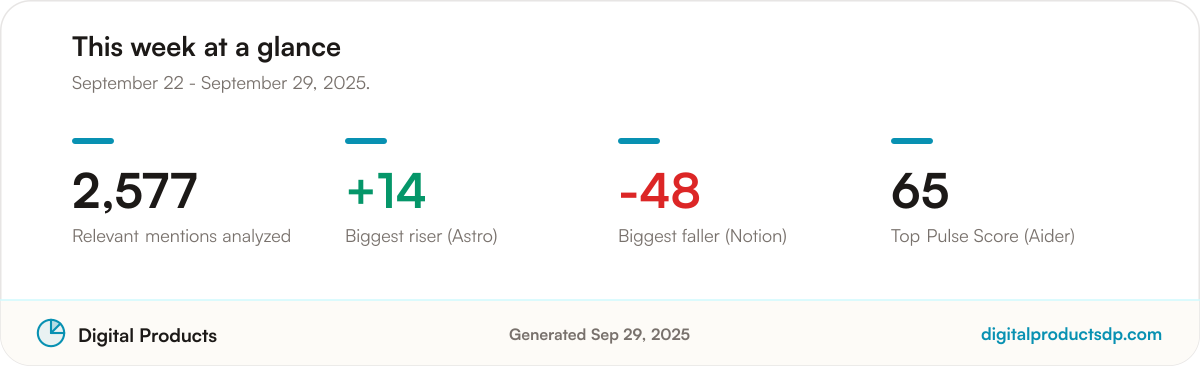
Across the period running from September 22, 2025 through September 29, 2025, we counted 2,577 relevant mentions. Of the 2,235 products tracked, 46 cleared the threshold of at least 10 relevant mentions and were eligible for rankings. That leaves a large field of products with too little discussion to score reliably this period, which is normal for a source mix weighted toward Hacker News and YouTube review-video comments.
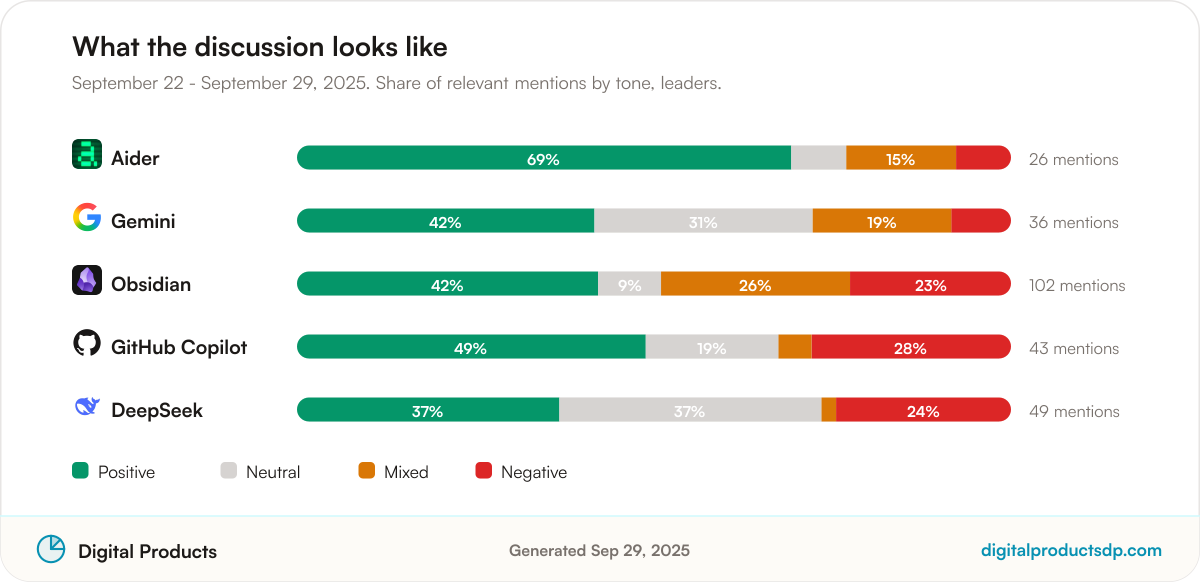
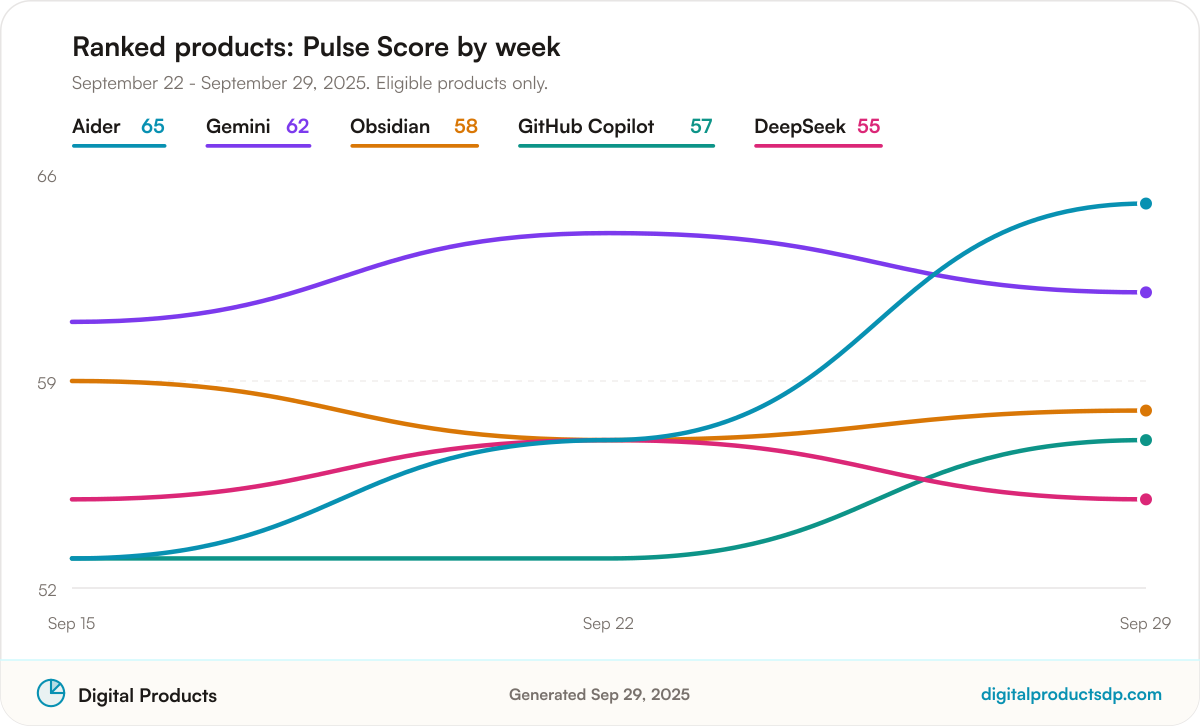
The top of the board this period is led by Aider, a coding assistant, with a Pulse Score of 65 based on 26 mentions over the period. Gemini, an AI chat tool, follows at 62 based on 36 mentions. Obsidian, a project-management and notes tool, sits at 58 based on 102 mentions, which is the deepest sample among the leaders. GitHub Copilot, another coding tool, holds 57 based on 43 mentions, and DeepSeek, an AI chat tool, rounds out the group at 55 based on 49 mentions.
The spread here is narrow, with only ten points separating the top and fifth spots. That tells us the leading products drew a broadly similar tone of public discussion this period rather than one standout dominating the conversation. It is also worth weighing sample sizes when reading these scores. Aider and Gemini sit on thinner samples than Obsidian and DeepSeek, so their reads can move more sharply week to week on relatively few comments.
Category View
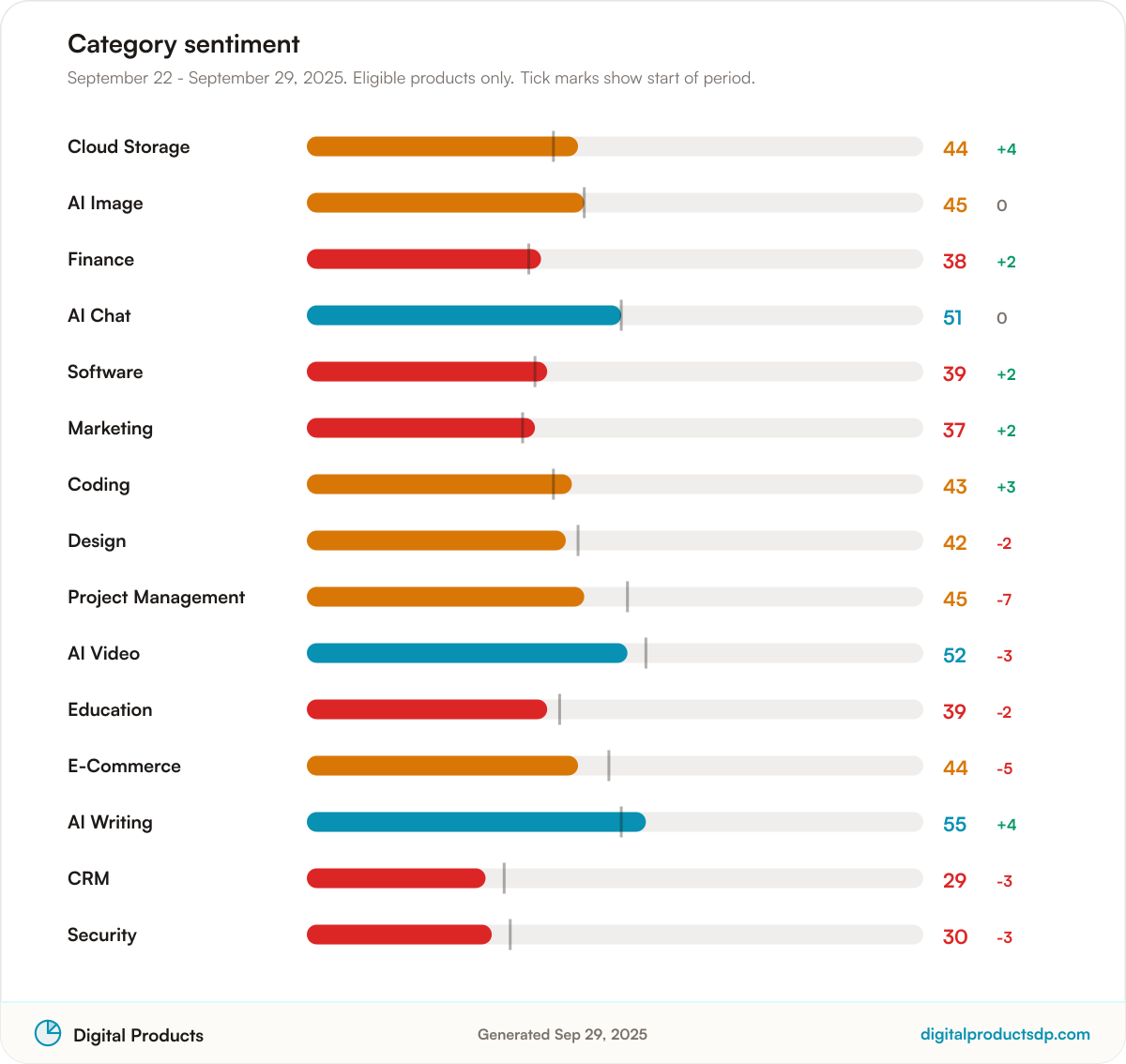
At the category level, the movement was mostly modest, with a few clear exceptions. AI writing rose from 51 to 55 and coding climbed from 40 to 43, the strongest gains among tracked categories. On the other side, project-management slipped from 52 to 45 and e-commerce eased from 49 to 44, the sharpest declines in the group. CRM stayed the weakest category overall, moving from 32 to 29, and security softened from 33 to 30. AI chat held flat at 51, and AI image was unchanged at 45. The steady categories suggest a period without a broad shift in mood, while the project-management drop is worth reading alongside the individual product moves below.
Biggest Movers
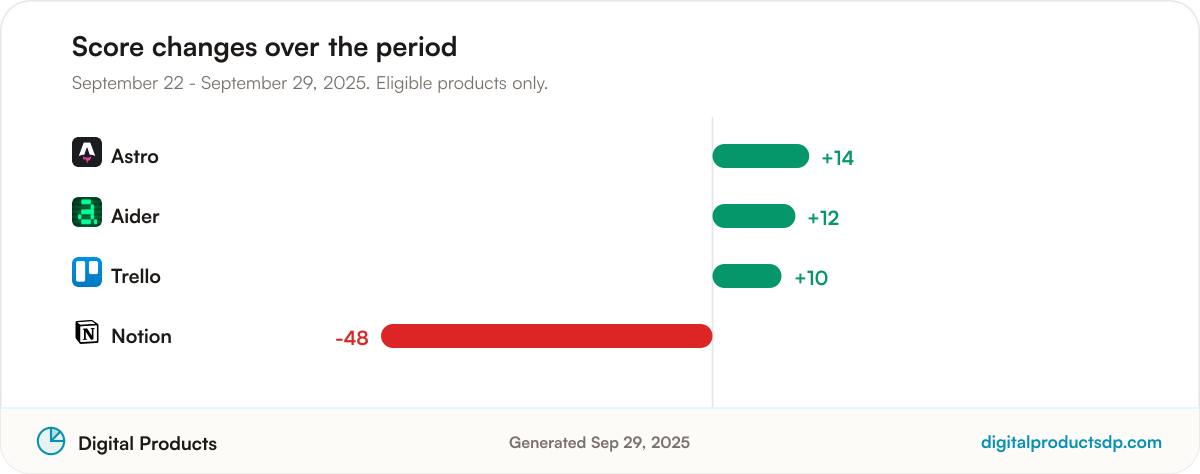
Astro (riser, plus 14, from 26 to 40, based on 136 mentions). Astro posted the largest climb of any eligible product. Its praise themes leaned on strong features with 27 mentions, easy to use with 21, and performance with 13. That said, its complaint side was still heavy, led by bugs with 36 mentions and reliability with 18. The gain looks like a recovery from a low starting point rather than a clean sweep of positive discussion, with performance and ease of use pulling the tone up even as stability grumbles persisted.
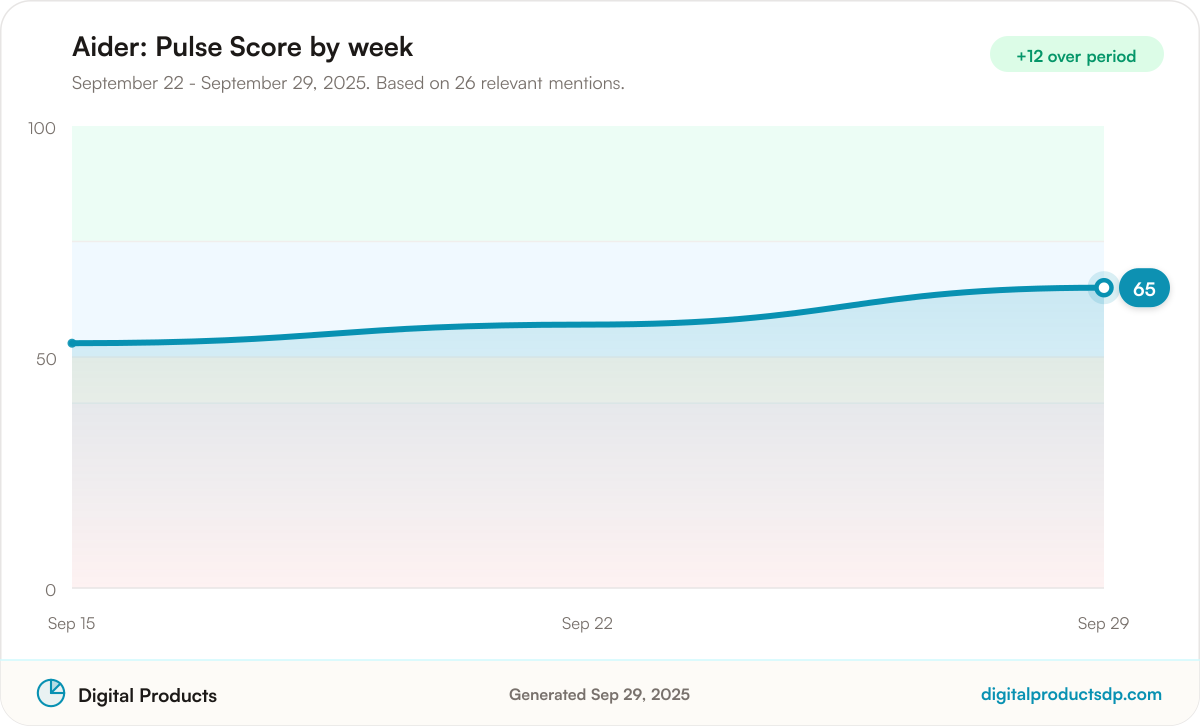
Aider (riser, plus 12, from 53 to 65, based on 26 mentions). Aider not only rose but finished the period as the top-scoring product. Its praise centered on strong features with 7 mentions, easy to use with 4, and good integrations with 3. Complaints were led by bugs with 9 mentions, missing features with 5, and feature requests with 4. On a thin sample the swing carries more week-to-week volatility, but the tone of the discussion tilted toward its feature set and workflow fit.
Trello (riser, plus 10, from 40 to 50, based on 11 mentions). Trello, a project-management tool, climbed to 50 on the smallest sample among the risers. Its praise was led by easy to use with 13 mentions, strong features with 8, and great collaboration with 4. Complaints were lighter and spread across missing features with 6, compared to rivals with 4, and UI frustrations with 4. With only 11 mentions, this read should be treated as provisional, but the balance of chatter favored its simplicity.
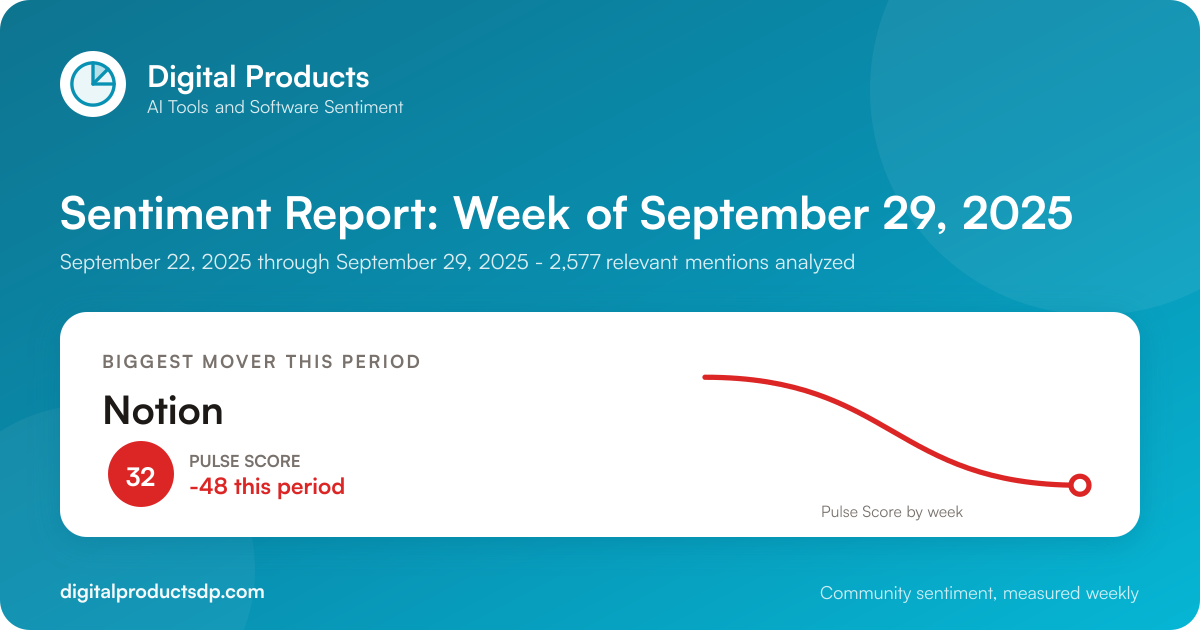
Notion (faller, minus 48, from 80 to 32, based on 29 mentions). Notion posted by far the steepest drop of the period. Its latest-week praise was sparse, with good integrations at 3 mentions, strong features at 2, and easy to use at 2. The complaint side dominated, led by bugs with 19 mentions, reliability with 8, and lacking integrations with 8. A move of this size on a modest sample reflects how quickly tone can flip when negative themes cluster, and it is the single biggest factor behind the project-management category decline noted above.
Grok (faller, minus 10, from 44 to 34, based on 89 mentions). Grok, an AI chat tool, fell on one of the deeper samples among movers. The discussion was polarized. Praise included strong features with 79 mentions, AI quality with 79, and compared to rivals with 68, but the complaints outweighed them, with AI quality drawing 183 mentions, bugs 177, and reliability 125. When the same themes appear prominently in both columns, it points to a divided community, and here the negative weight on AI quality pulled the score down.
Shopify (faller, minus 5, from 49 to 44, based on 47 mentions). Shopify, an e-commerce platform, slipped modestly. Praise leaned on strong features with 28 mentions, easy to use with 16, and AI quality with 11. Complaints were led by missing features with 41 mentions, compared to rivals with 28, and reliability with 15. The complaint volume around gaps and comparisons outpaced the praise, and Shopify's move mirrors the softer e-commerce category read this period.
Spotlight: Aider
Aider finished the period as the top-scoring eligible product, at 65 based on 26 mentions over the period. Its weekly series shows a steady climb: 53 on September 15, 2025, then 57 on September 22, 2025, then 65 on September 29, 2025. That is a clean upward path across the three complete weeks we track, and it is the trajectory behind its plus 12 move in the movers section.
The themes behind that tone favor capability and fit. In the latest week, praise leaned on strong features with 7 mentions, easy to use with 4, and good integrations with 3. The community discussion framed it as a coding tool that does what people want it to do inside their workflow. That framing is consistent with the broader coding category, which rose from 40 to 43 over the period.
The complaint side is a useful counterweight and worth watching. Bugs led with 9 mentions, followed by missing features with 5 and feature requests with 4. On a sample of 26 mentions, a small shift in any one of those themes could move the score meaningfully next period. For now, the read is positive, but the thin base is the main caveat on how durable the lead is.
Themes Driving the Conversation
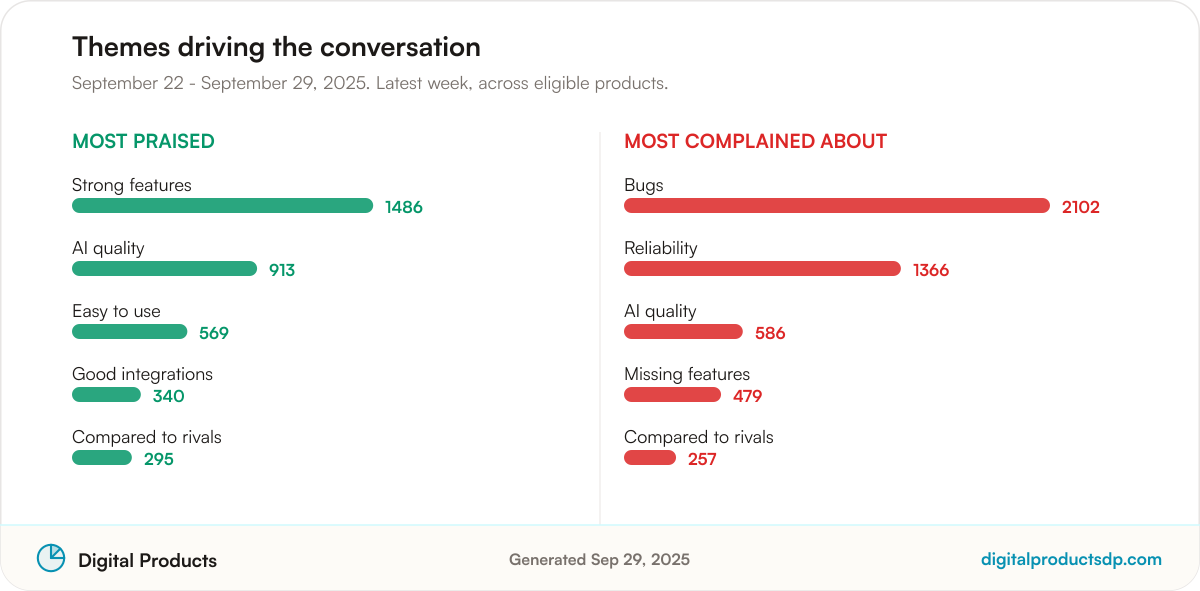
On the praise side, strong features led all themes with 1,486 mentions, followed by AI quality with 913, easy to use with 569, good integrations with 340, and compared to rivals with 295. The features and AI quality themes were carried by the high-volume AI chat and coding products. Claude drew 234 praise mentions for AI quality and 229 for strong features, ChatGPT drew 183 for strong features and 159 for AI quality, and Gemini added 149 for AI quality and 140 for strong features. DeepSeek's fair pricing note, with 118 mentions, and its 122 for AI quality show how positive comparisons and value framing fed the top praise themes.
On the complaint side, bugs dominated with 2,102 mentions, well ahead of reliability with 1,366, AI quality with 586, missing features with 479, and compared to rivals with 257. These complaint themes were concentrated in a handful of high-volume products. ArgoCD drew 231 bug mentions and 172 for reliability, Aspire drew 224 and 151, Stripe drew 188 and 158, Vercel drew 170 and 151, and Grok added 177 bug mentions and 125 for reliability. That AI quality appears in both the praise and complaint columns, at 913 and 586 respectively, underlines that the community's read on AI output remains split rather than settled.
Watchlist
Many tracked products did not reach the 10-mention threshold this period and are therefore not ranked. This is a matter of discussion volume, not a judgment on quality. Products with thin samples can produce unstable scores, so we hold them out until the chatter is deep enough to read reliably.
Among products that came close, Canva and TikTok each recorded 9 relevant mentions, and DigitalOcean, Babbel, Airbyte, and HubSpot each recorded 8. Just below them, Bitbucket and WooCommerce each drew 7, while Lovable, Semrush, Carta, Kling, Klarna, Gamma, and Monday.com each drew 6, and ClickUp, HeyGen, Jasper, and Anyscale each drew 5. A modest uptick in discussion could bring any of these into next period's rankings. Well-known names including Slack, Zoom, GitHub, GitLab, Docker, and Cloudflare recorded zero relevant mentions this period, a reminder that our source mix does not capture even the largest tools evenly from week to week.
What To Watch Next Week
First, watch whether Aider holds the top spot. Its climb to 65 came on 26 mentions, and its complaint themes of bugs, missing features, and feature requests could pull the score back if they gain volume. A leader on a thin sample is worth monitoring rather than assuming continuity.
Second, watch Notion for a possible stabilization or continued softness. Its drop from 80 to 32 was the largest of the period, driven by bugs at 19 mentions and reliability at 8. Whether that reflects a lasting shift in tone or a short-lived cluster of negative discussion should become clearer as more mentions accumulate.
Third, watch the coding and AI-writing categories, which rose to 43 and 55 respectively, against project-management, which fell to 45. If those directions hold, the gap between the strengthening and softening categories could widen, and the high bug and reliability volumes concentrated in coding-adjacent products like ArgoCD, Aspire, Vercel, and Stripe will be the main pressure to monitor.
Frequently Asked Questions
Which tool had the highest Pulse Score this period?
Aider, a coding assistant, had the highest Pulse Score at 65, based on 26 mentions over the period. Gemini followed at 62 based on 36 mentions.
Which product moved the most this period?
Notion posted the largest move, falling from 80 to 32 for a drop of 48, based on 29 mentions. On the upside, Astro rose the most, climbing 14 points from 26 to 40 based on 136 mentions.
How many mentions were analyzed this period?
We analyzed 2,577 relevant mentions across the period. Of 2,235 products tracked, 46 cleared the 10-mention threshold to be eligible for rankings.
What was the overall category mood this period?
The mood was mixed. AI writing rose to 55 and coding rose to 43, while project-management fell to 45 and CRM stayed the weakest at 29. Bugs was the most-discussed complaint theme overall with 2,102 mentions.
About This Data
Pulse Scores summarize the tone of public online discussion on a 0-100 scale and reflect community sentiment, not a verdict on a product's quality or a recommendation. We report on complete calendar weeks only, and products with fewer than 10 relevant mentions in the period are excluded from rankings to avoid unstable reads on thin samples.
Public discussion is collected from Hacker News, Stack Exchange, GitHub, Bluesky, the Apple App Store, and YouTube. Automated sentiment analysis can misread sarcasm, jokes, or niche context. Mention volumes vary widely between products, and scores can move from week to week. Any company that wants to respond is welcome to reach out. For how scores are calculated, see our methodology.