AI Tools and Software Sentiment Report: Week of September 15, 2025
September 16, 2025
This edition of our weekly sentiment report covers aggregated public online discussion of tracked tools and software, with mentions analyzed for September 8, 2025 through September 15, 2025. The figures here summarize community sentiment gathered from public sources, and they describe the tone of online chatter rather than any verdict on product quality.
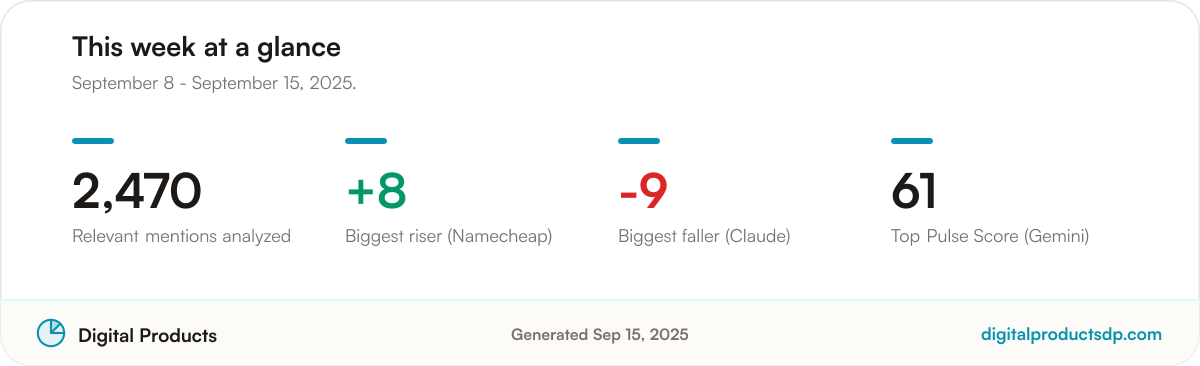
Across this period we analyzed 2,470 relevant mentions. Of the 2,235 products tracked, 47 cleared the threshold of at least 10 relevant mentions and were eligible for rankings. The rest sit below the line, where discussion volume was too thin to support a stable read. What follows walks through the leaderboard, category movement, the sharpest risers and fallers, and the praise and complaint themes shaping the conversation.
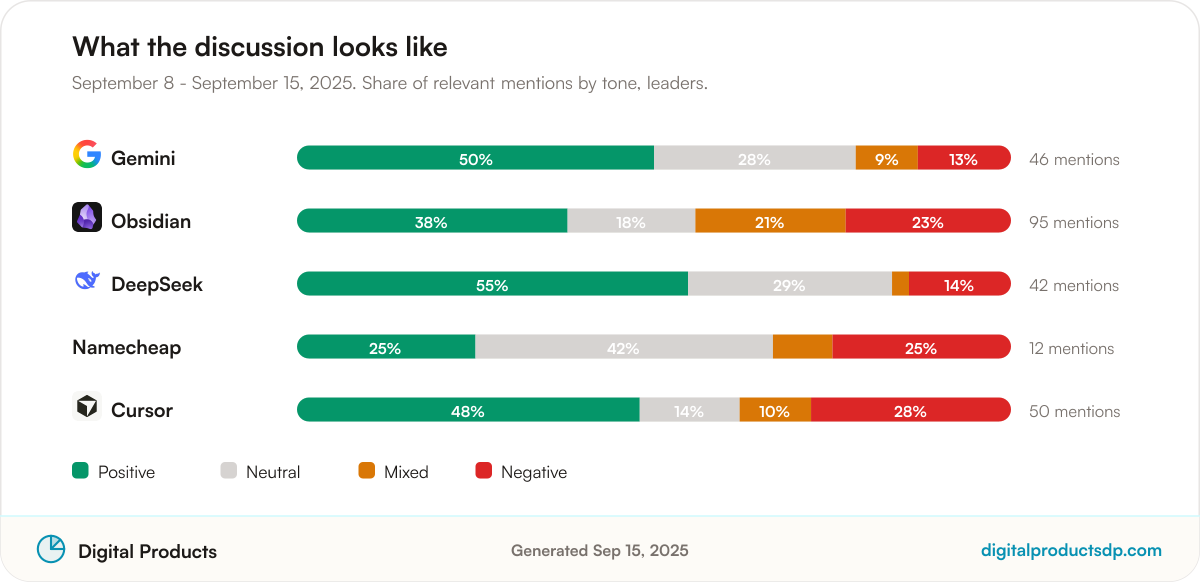
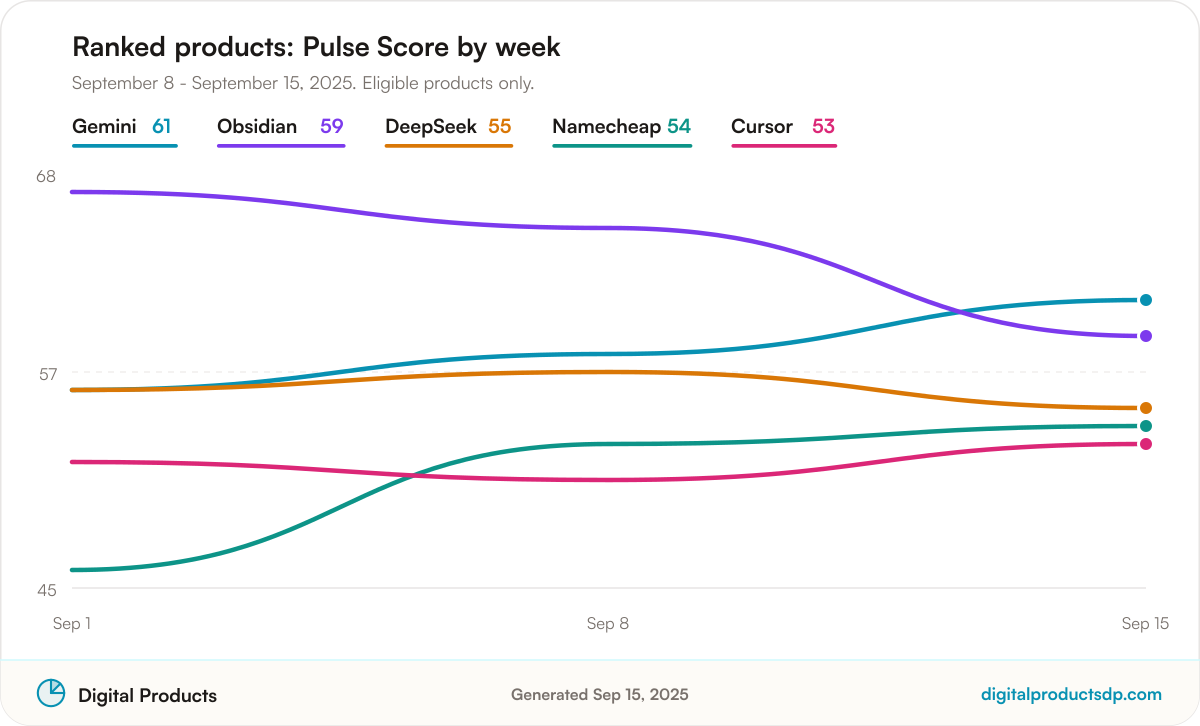
Gemini, an AI chat assistant, tops the eligible field with a latest-week Pulse Score of 61, based on 46 mentions over the period. Obsidian, a note-taking and project-management tool, follows at 59 on a much larger 95 mentions, the deepest sample among the leaders. DeepSeek, another AI chat product, sits at 55 based on 42 mentions.
Rounding out the top five, Namecheap, a domain and hosting software provider, reads 54 on a thin 12 mentions, and Cursor, an AI-assisted coding tool, reads 53 based on 50 mentions. The spread here is narrow, with only eight points separating first from fifth. Sample sizes vary widely, so Obsidian's 95 mentions carry a steadier signal than Namecheap's 12, and readers should weigh the thinner samples accordingly.
Category View
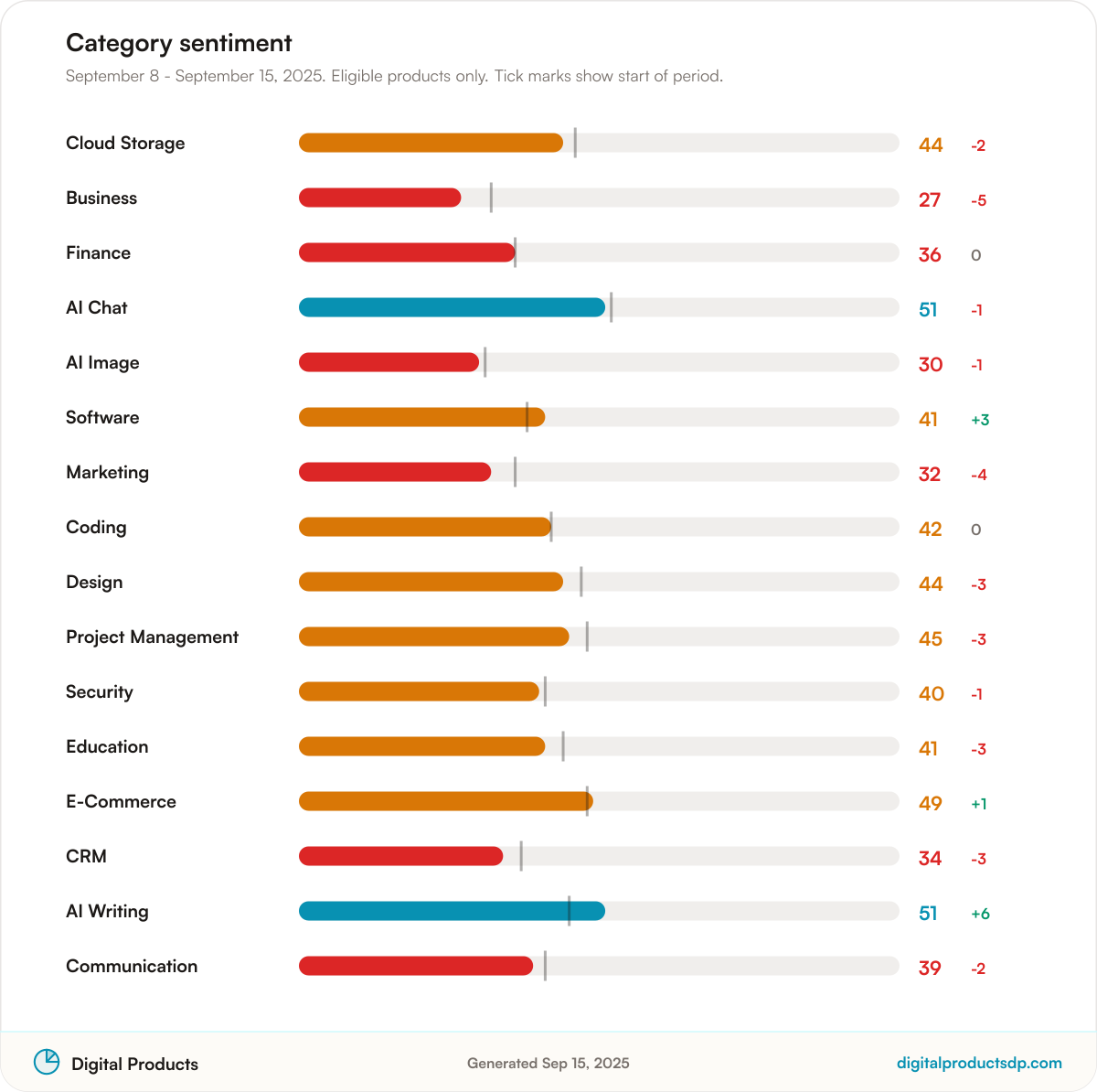
Category averages moved in mixed directions across the period. The ai-writing category was the standout riser, climbing from 45 to 51, while software edged up from 38 to 41 and e-commerce ticked from 48 to 49. On the downside, business slipped from 32 to 27, marketing fell from 36 to 32, crm dropped from 37 to 34, and design eased from 47 to 44. The ai-chat category, home to the leaderboard's top name, held roughly steady, moving from 52 to 51. Coding and finance were flat at 42 and 36 respectively. The picture is one of small shifts rather than sweeping swings, with the softest tone concentrated in business, marketing, and crm.
Biggest Movers
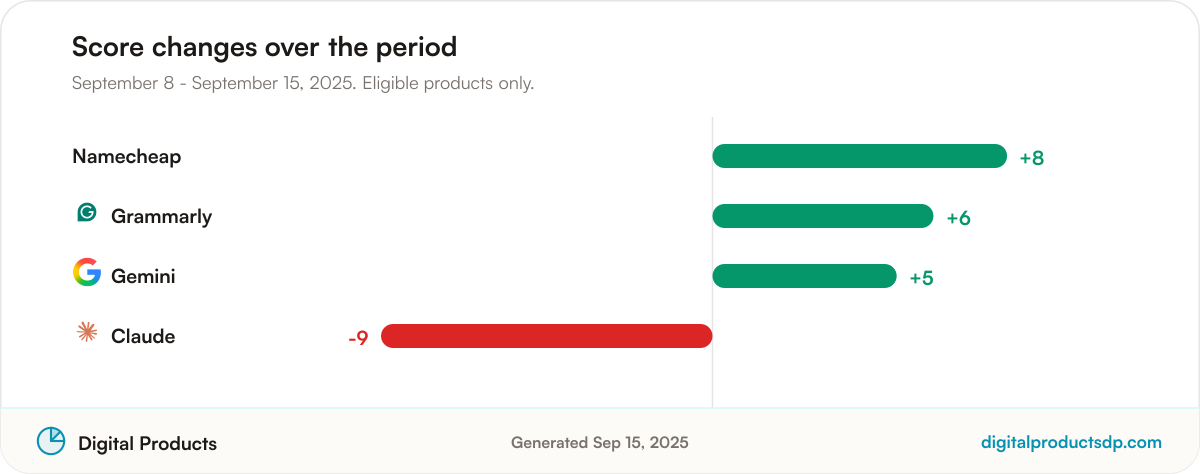
Namecheap (up from 46 to 54, based on 12 mentions). The domain and hosting provider posted the largest gain of the period. Its praise themes were modest and centered on being easy to use, fair pricing, and good integrations, each recorded only a handful of times. The complaint side was heavier, led by reliability with 38 mentions, poor support with 14, and bugs with 14. On a sample this thin, the upward move reflects a lighter tone in this specific window rather than a broad endorsement, and the reliability complaints are worth keeping in view.
Grammarly (up from 45 to 51, based on 12 mentions). The AI writing assistant rose six points. Its praise leaned on strong features with 17 mentions, easy to use with 14, and AI quality with 8. Complaints were still present and centered on AI quality with 24 mentions, bugs with 15, and UI frustrations with 15. The rise fits the wider ai-writing category lift from 45 to 51, suggesting the tone in that space warmed over the period even as AI quality remained a two-sided talking point.
Gemini (up from 56 to 61, based on 46 mentions). The leaderboard leader also ranks among the biggest risers, gaining five points on a healthier sample than the other two movers. Praise was driven by AI quality with 149 mentions, strong features with 140, and comparisons to rivals with 75. Complaints echoed some of the same ground, with AI quality cited 112 times, comparisons to rivals 86 times, and missing features 55 times. The product draws both its strongest praise and its loudest criticism from the same AI quality theme, a pattern common among heavily discussed assistants.
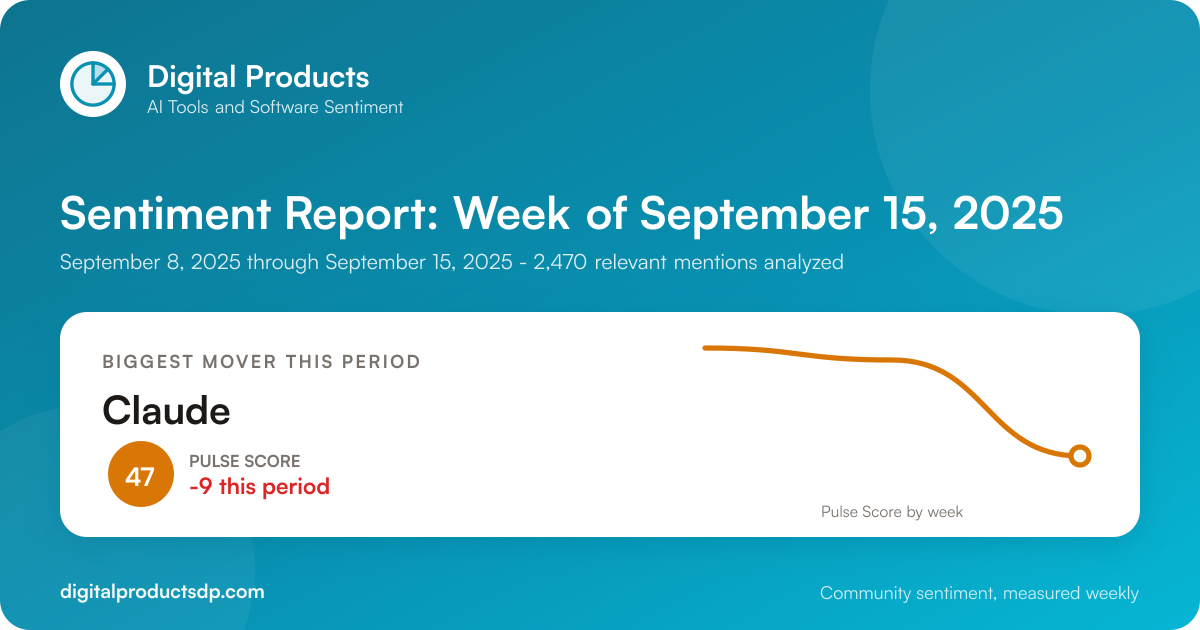
Claude (down from 56 to 47, based on 16 mentions). The AI assistant recorded the sharpest fall of the period at nine points. Its praise remained substantial, led by AI quality with 234 mentions and strong features with 229, followed by easy to use with 99. But the complaint side was also large, with bugs cited 134 times, AI quality 110 times, and reliability 80 times. The slide suggests the negative side of the conversation weighed more heavily in this window, with bugs and reliability the recurring pressure points.
Obsidian (down from 67 to 59, based on 95 mentions). The note-taking tool fell eight points, and it does so on the deepest sample of any mover, which makes the shift more notable. Praise centered on strong features with 40 mentions, good integrations with 25, and easy to use with 20. Complaints were led by bugs with 28 mentions, missing features with 20, and reliability with 13. Even after the drop it holds second place on the leaderboard, so the move reads as sentiment cooling from a high starting point rather than a collapse.
Amplitude (down from 37 to 31, based on 19 mentions). The analytics product slipped six points. Praise was sparse, spread thinly across new releases, strong features, and good integrations at two mentions each. Complaints dominated the picture, with bugs cited 10 times, reliability 6 times, and comparisons to rivals 3 times. With so little praise recorded against a steady stream of bug and reliability complaints, the downward move is unsurprising for this window.
Spotlight: Gemini
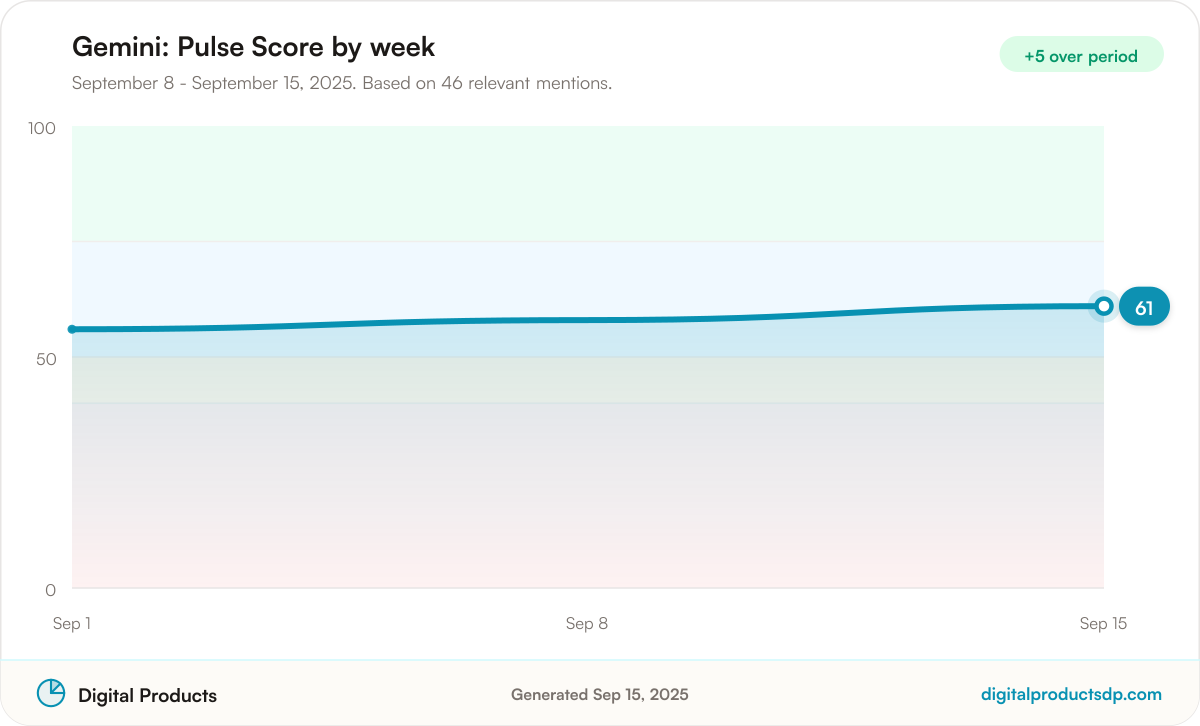
Gemini leads the eligible field with a latest-week Pulse Score of 61, based on 46 mentions over the period. Its weekly series shows steady improvement, moving from 56 on September 1, 2025 to 58 on September 8, 2025 and then 61 on September 15, 2025. That is a clean upward line across the three complete weeks, and it stands out against an ai-chat category that was essentially flat, moving from 52 to 51.
The theme breakdown explains both the strength and the friction. AI quality was the most-cited praise theme at 149 mentions, with strong features close behind at 140 and comparisons to rivals at 75. This is a product whose community discussion frequently frames it against competing assistants, and in this window those comparisons landed more on the positive side of the ledger.
At the same time, the complaint themes draw from familiar ground. AI quality appeared 112 times as a complaint, comparisons to rivals 86 times, and missing features 55 times. That AI quality sits atop both the praise and complaint lists is the defining tension in Gemini's discussion this period. The upward score trend suggests the positive framing outweighed the negative in this window, but the volume on both sides signals that sentiment could move if the balance shifts.
Themes Driving the Conversation
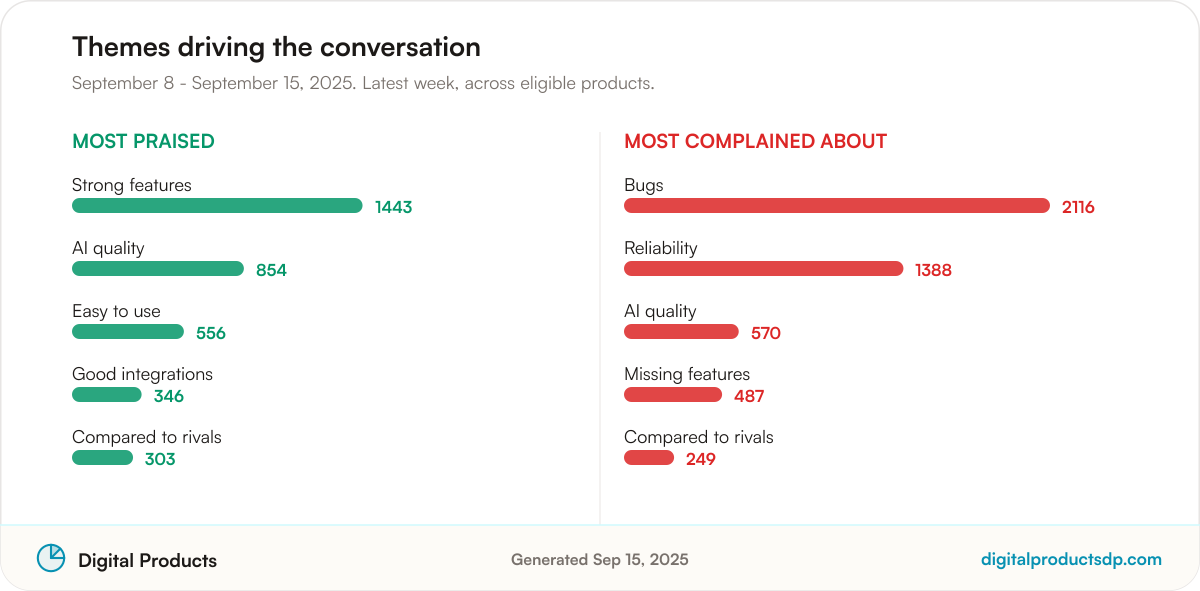
On the praise side, strong features led by a wide margin with 1,443 mentions, followed by AI quality with 854, easy to use with 556, good integrations with 346, and comparisons to rivals with 303. Strong features shows up as a top praise theme across many leaders, including Claude with 229 mentions, ChatGPT with 183, and Cursor with 100. AI quality praise concentrates among the assistants, with Claude at 234, ChatGPT at 159, and Gemini at 149. This tells us the community, in aggregate, most often reaches for feature depth and model output when speaking positively.
The complaint side is dominated by bugs, cited 2,116 times, well ahead of reliability at 1,388, AI quality at 570, missing features at 487, and comparisons to rivals at 249. Bugs and reliability recur across product after product: ArgoCD logged 231 bug complaints and 172 reliability complaints, Aspire logged 224 and 151, Stripe logged 188 and 158, and Vercel logged 170 and 151. These are the pressure points weighing on many scores, and they help explain why several infrastructure and platform products sit lower in the category averages. The recurrence of bugs and reliability across such different products is the clearest single pattern in this week's data.
Watchlist
Most tracked products did not clear the threshold of 10 relevant mentions this period, and they are excluded from rankings to avoid unstable reads on thin samples. This is a statement about discussion volume, not about quality. Several names came close and are worth watching as their volume develops.
Stable Diffusion, an ai-image tool, drew 9 relevant mentions.
Braintrust, a coding tool, drew 9 relevant mentions.
DALL-E, an ai-image tool, drew 8 relevant mentions.
Klarna, a finance product, drew 8 relevant mentions.
ClickUp, a project-management tool, drew 8 relevant mentions.
Bitbucket, a coding tool, drew 8 relevant mentions.
Semrush, a marketing tool, and Carta, a finance product, each drew 7 relevant mentions, alongside Astro and Loom at 7 each.
These products sit just under the line. A modest uptick in public discussion would bring any of them into eligible territory next period. Because thin samples move erratically, we hold them out rather than report scores that could swing on a handful of posts. Many other tracked products recorded zero relevant mentions in this window, which simply means the public sources we monitor were quiet on them.
What To Watch Next Week
Three things stand out to monitor, all grounded in this period's data. First, watch whether Gemini extends its climb. It rose across all three weeks, from 56 to 58 to 61, and it now leads the field on 46 mentions, but AI quality sits atop both its praise and complaint lists, so the balance there is worth tracking.
Second, watch Claude and Obsidian after their falls of nine and eight points. Claude still carries heavy praise for AI quality with 234 mentions even after dropping to 47, and Obsidian remains second on the leaderboard at 59 despite its slide from a high of 67. Whether these are one-week dips or the start of longer moves is an open question.
Third, watch the bugs and reliability themes, which led all complaints at 2,116 and 1,388 mentions. Products like ArgoCD, Aspire, Stripe, and Vercel each logged large counts on both. If those counts ease, several lower-scoring category averages could firm up, and if they persist, the pressure is likely to continue.
Frequently Asked Questions
Which tool had the highest Pulse Score this period?
Gemini had the highest Pulse Score among eligible products, at 61 based on 46 mentions over the period. Obsidian was second at 59 based on 95 mentions.
Which product moved the most this period?
Claude posted the biggest drop, falling from 56 to 47, a nine-point move based on 16 mentions. Namecheap posted the biggest rise, climbing from 46 to 54, an eight-point move based on 12 mentions.
What was the overall mood across categories?
The mood was mixed with small shifts. The ai-writing category rose from 45 to 51 while business fell from 32 to 27, marketing dropped from 36 to 32, and the ai-chat category held roughly steady from 52 to 51.
How many mentions were analyzed this period?
We analyzed 2,470 relevant mentions. Of 2,235 tracked products, 47 met the threshold of at least 10 relevant mentions and were eligible for rankings.
About This Data
Pulse Scores summarize the tone of public online discussion on a 0 to 100 scale and reflect community sentiment. They are not a verdict on a product's quality and not a recommendation. We report on complete calendar weeks only, and products with fewer than 10 relevant mentions in the period are excluded from rankings to avoid unstable reads on thin samples.
Public discussion is collected from Hacker News, Stack Exchange, GitHub, Bluesky, the Apple App Store, and YouTube. Automated sentiment analysis can misread sarcasm, jokes, or niche context. Mention volumes vary widely between products, and scores can move from week to week. Any company that wants to respond is welcome to reach out. For more on how scores are calculated, see our methodology.