AI Tools and Software Sentiment Report: Week of September 8, 2025
September 8, 2025
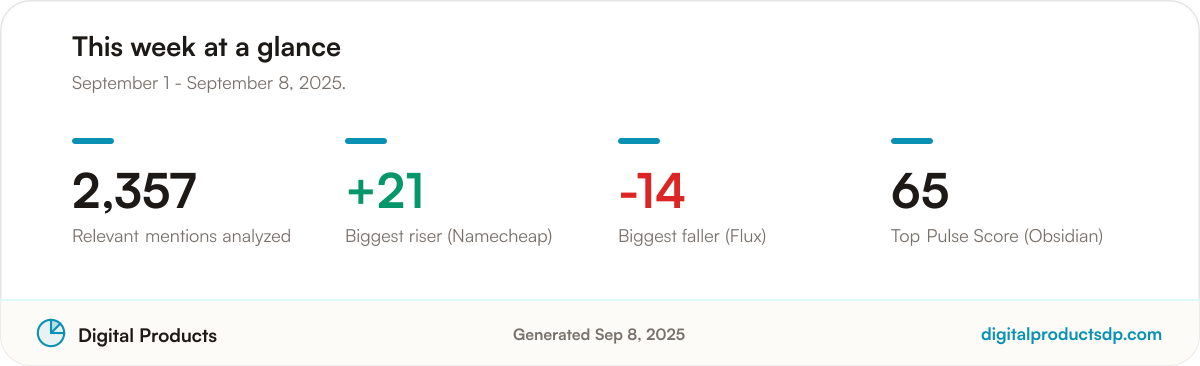
This edition of our sentiment report covers aggregated public online discussion of AI tools and software, drawing on mentions analyzed for September 1, 2025 through September 8, 2025. Across that window we processed 2,357 relevant mentions spanning tools and software in categories that range from AI chat and coding to CRM, cloud storage, and project management. As always, the numbers here summarize the tone of public online chatter, not any verdict on how well a product works.
The picture for the period running from September 1, 2025 through September 8, 2025 is one of a stable top tier and sharper movement further down the board. Out of 2,235 products tracked, 47 cleared the threshold of at least 10 relevant mentions and were eligible for ranking. That leaves a large field of quieter products, which we address in the Watchlist. Below, we read the leaderboard, the category averages, the biggest movers, and the praise and complaint themes shaping the conversation.
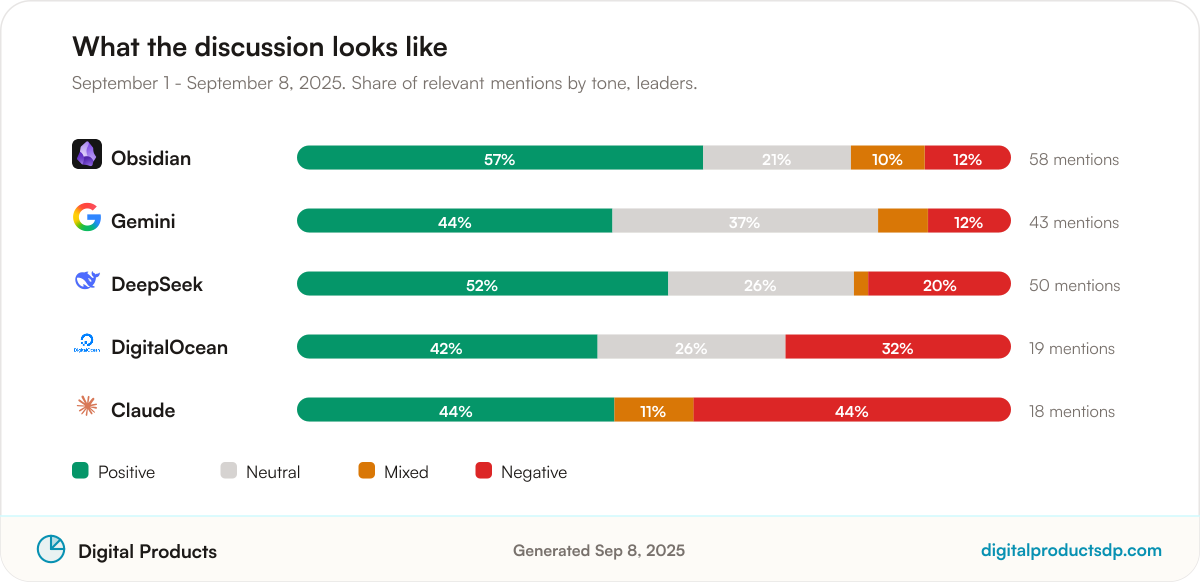
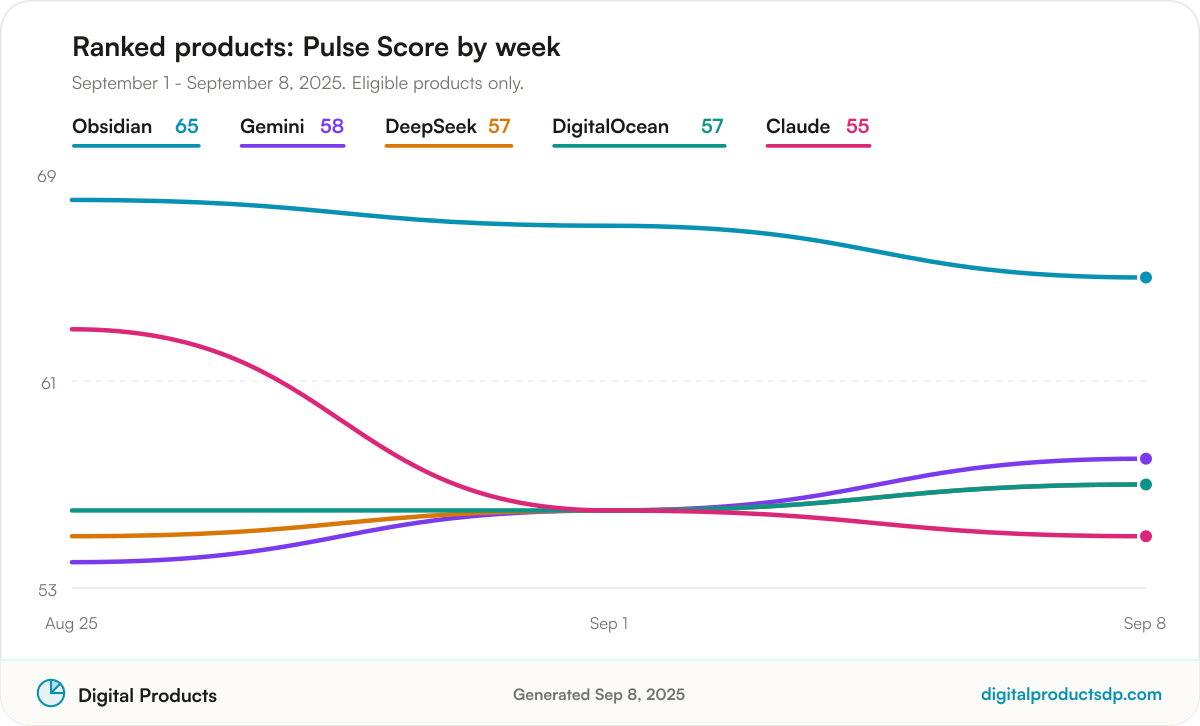
Obsidian sits at the front of the board with a Pulse Score of 65, based on 58 mentions over the period. Behind it, three of the next four places belong to AI chat products: Gemini at 58 based on 43 mentions, DeepSeek at 57 based on 50 mentions, and Claude at 55 based on 18 mentions. DigitalOcean, a cloud storage product, breaks that run with a score of 57 based on 19 mentions. The spread between first and fifth is only 10 points, which suggests the leading products drew broadly similar tone in public discussion this period.
Sample sizes matter when reading these positions. Obsidian and DeepSeek carry the heaviest mention counts among the leaders, at 58 and 50 respectively, so their scores rest on comparatively fuller discussion. Claude and DigitalOcean, at 18 and 19 mentions, sit on thinner samples that can move more easily week to week. The clustering of AI chat products near the top mirrors the category averages discussed below, where AI chat held steady at the highest level.
Category View
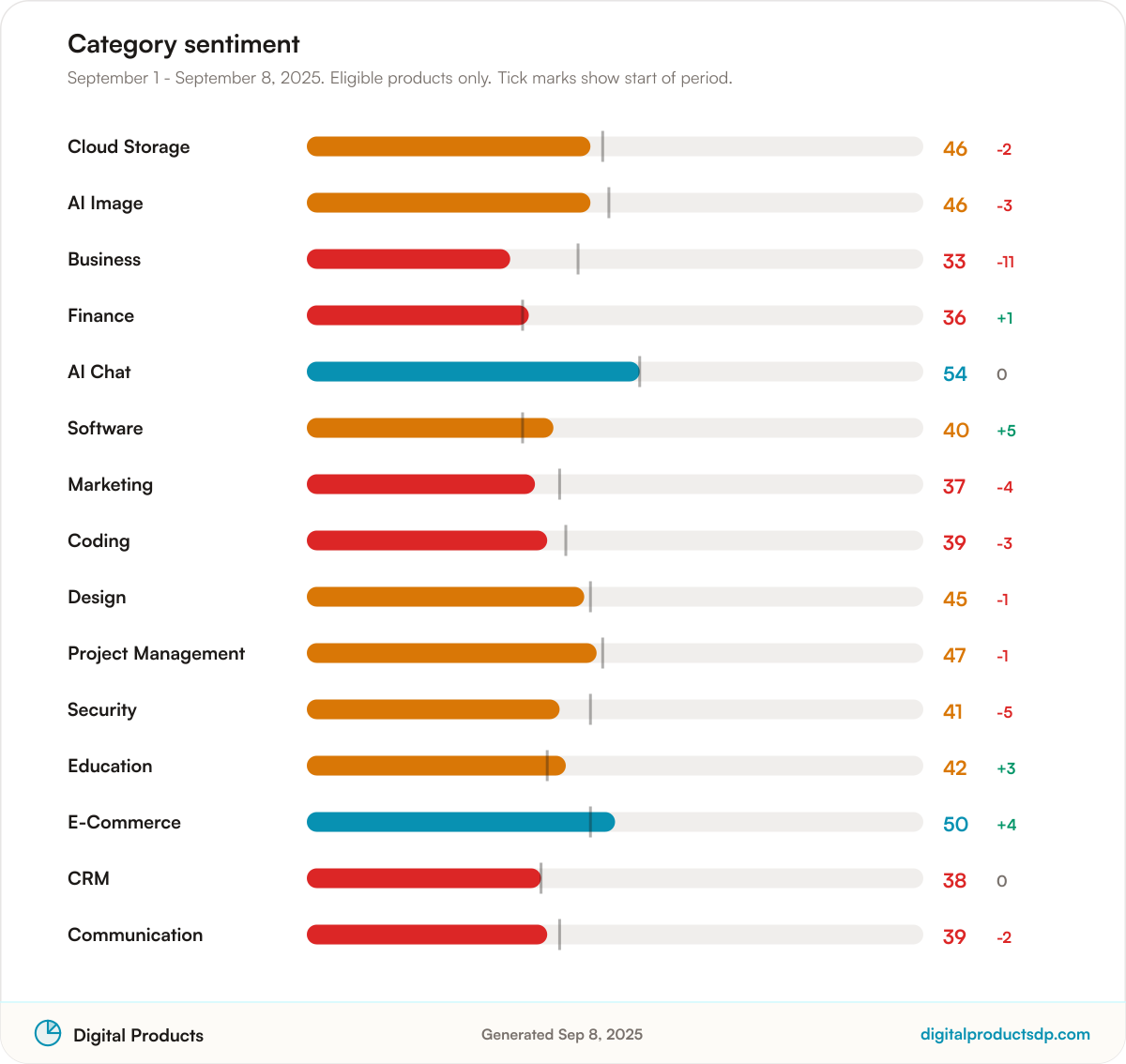
At the category level, AI chat held firm at 54 to 54, the highest average of any tracked category, while the sharpest slide belonged to business, which fell from 44 to 33 over the period. Software rose from 35 to 40 and e-commerce climbed from 46 to 50, the two clearest gains. Several categories drifted modestly lower, including security from 46 to 41, marketing from 41 to 37, coding from 42 to 39, and ai-image from 49 to 46. Others barely moved: crm held at 38 to 38, finance edged from 35 to 36, and project-management slipped from 48 to 47. The overall read is a mixed field, with AI chat as the steady anchor and business as the notable soft spot.
Biggest Movers
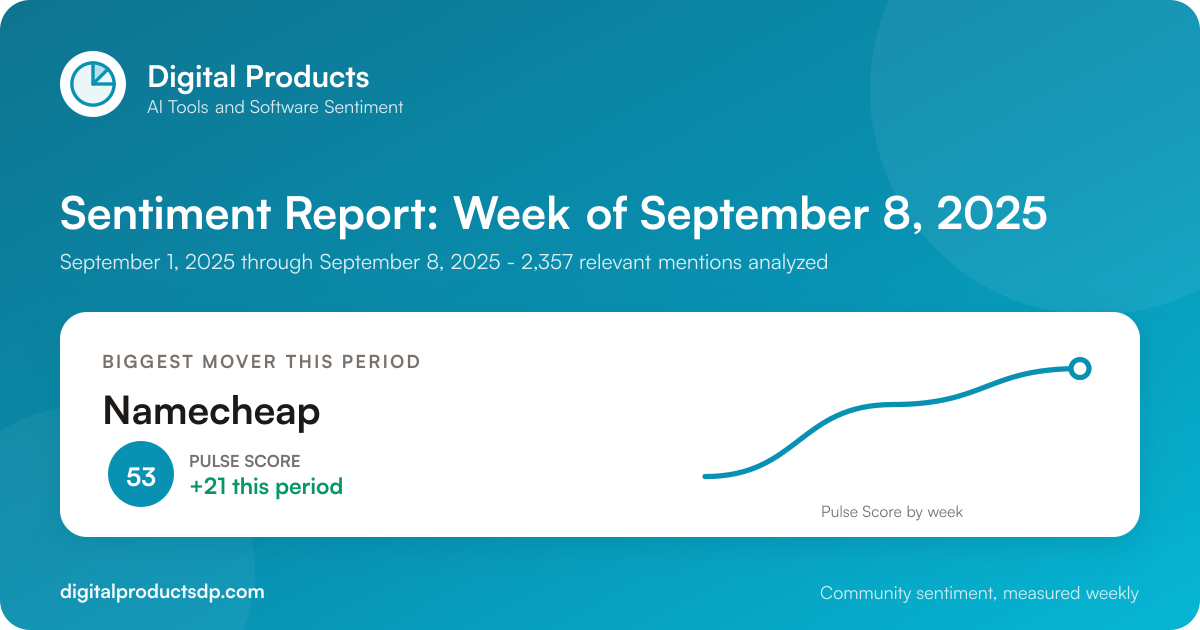
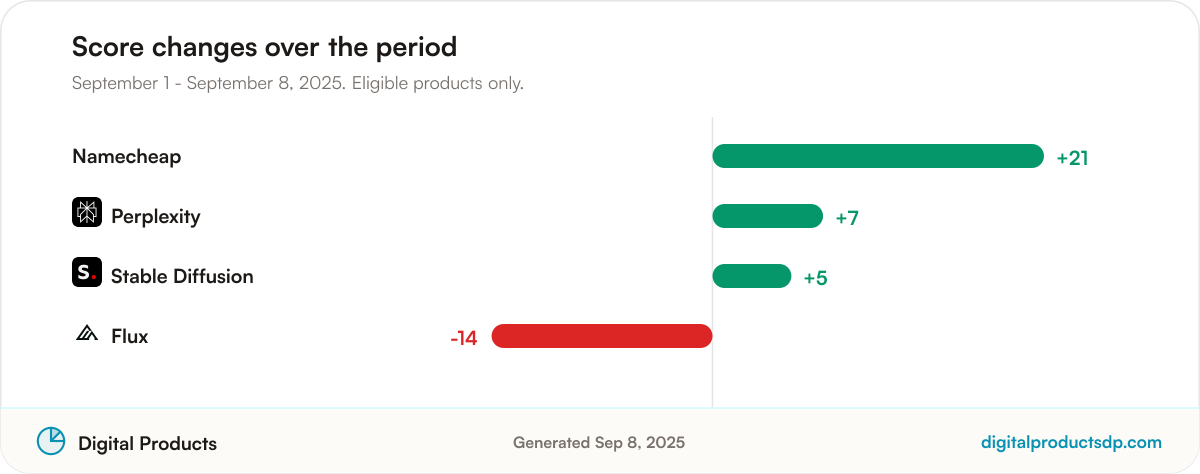
Namecheap (riser, +21, from 32 to 53, based on 12 mentions). Namecheap posted the largest gain of the period. Its latest praise themes were modest and practical, led by Easy to use with 3 mentions, Fair pricing with 3, and Good integrations with 1. The complaint side remained heavier in raw counts, with Reliability at 38, Poor support at 14, and Bugs at 14. The move up suggests the tone of public discussion improved off a low starting point rather than complaints disappearing, and with only 12 mentions this remains a thin sample to watch.
Perplexity (riser, +7, from 42 to 49, based on 41 mentions). Perplexity climbed steadily across the period. Its praise centered on Strong features with 19 mentions, AI quality with 18, and favorable comparisons to rivals with 13. Countering that, the leading complaints were Pricing too high at 21, Compared to rivals at 18, and Privacy concerns at 13. That the same rivalry theme shows up on both sides points to an active, contested conversation, and the 41-mention base makes this one of the better-supported riser reads.
Stable Diffusion (riser, +5, from 50 to 55, based on 14 mentions). Stable Diffusion improved through the period. Praise was led by Strong features at 16 mentions, AI quality at 11, and Easy to use at 5, while complaints tracked the familiar reliability cluster with Bugs at 12, Reliability at 6, and Performance at 6. The gain looks tied to positive feature and quality chatter outweighing the bug and reliability grumbles this period.
Flux (faller, -14, from 43 to 29, based on 13 mentions). Flux recorded the sharpest drop. Even with AI quality praise at 33 mentions, Strong features at 22, and New releases at 13, the complaint side carried real weight, with Bugs at 19, Performance at 17, and Reliability at 11. When performance and reliability concerns pile up alongside bug reports, positive feature talk can struggle to hold the score, and that appears to be the story here on a small 13-mention base.
Aider (faller, -13, from 64 to 51, based on 20 mentions). Aider started the period as one of the higher-scoring products and gave back much of that lead. Its latest praise themes were slim, with Strong features at 7 mentions, Easy to use at 4, and Good integrations at 3, while complaints led with Bugs at 9, Missing features at 5, and Feature requests at 4. The combination of thin praise and a bug-plus-gaps complaint mix lines up with the decline.
Foxit (faller, -11, from 44 to 33, based on 15 mentions). Foxit fell over the period. Praise appeared for Strong features at 10 mentions, favorable comparisons at 6, and Performance at 5, but complaints included Bugs at 5, a security-related note at 4, and UI frustrations at 3. With relatively low counts on both sides, the score is sensitive to shifts in tone, and this period the balance tilted downward.
Spotlight: Obsidian
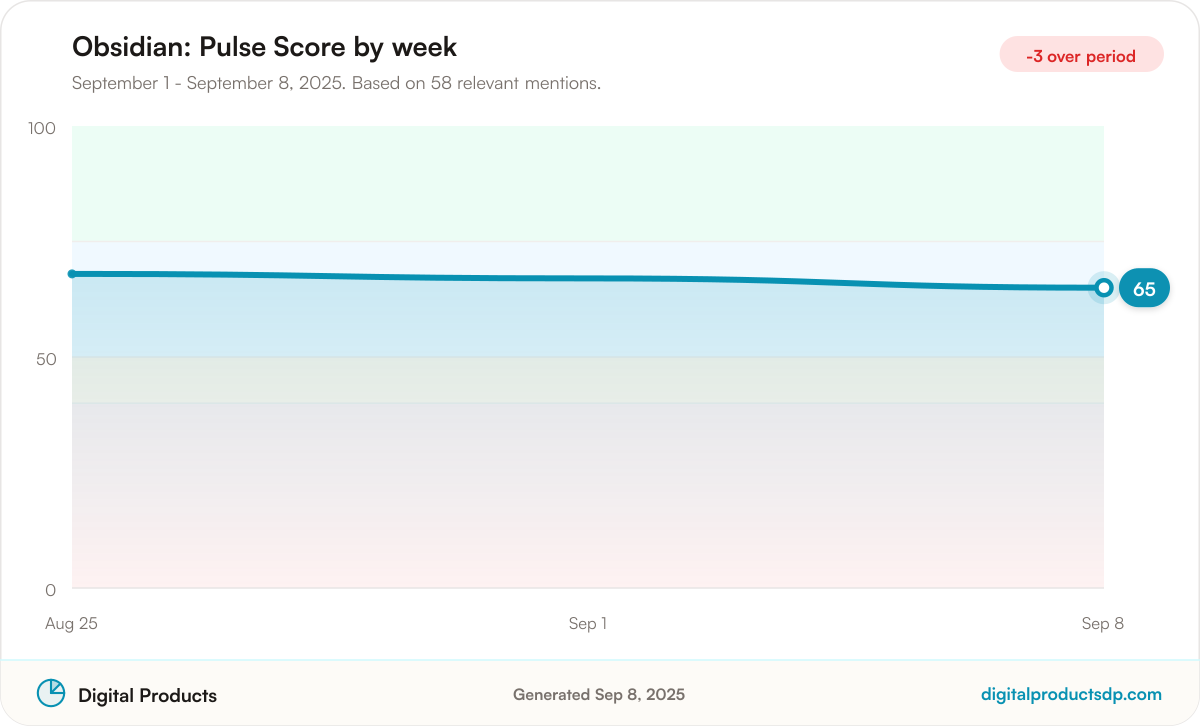
Obsidian, a project-management product, led the board this period with a Pulse Score of 65, based on 58 mentions. Its weekly series shows a gentle downward drift, from 68 on August 25, 2025 to 67 on September 1, 2025 and 65 on September 8, 2025. Even with that small slide, it remained the top-scoring eligible product across the field, which speaks to a broadly favorable tone in public online discussion relative to its peers.
The theme breakdown helps explain the standing. Praise was led by Strong features at 40 mentions, Good integrations at 25, and Easy to use at 20, a combination that points to a positive conversation around what the product does and how it fits into a wider workflow. On the complaint side, the leaders were Bugs at 28 mentions, Missing features at 20, and Reliability at 13.
That mix is worth reading carefully. Obsidian carried a heavier praise base than most of the field while still attracting a meaningful volume of bug and missing-feature discussion. The modest three-point slip across the period suggests those complaints were enough to soften the tone slightly without displacing the product from the top of the board. With 58 mentions behind it, this is one of the fuller samples among the leaders, which lends more weight to the read.
Themes Driving the Conversation
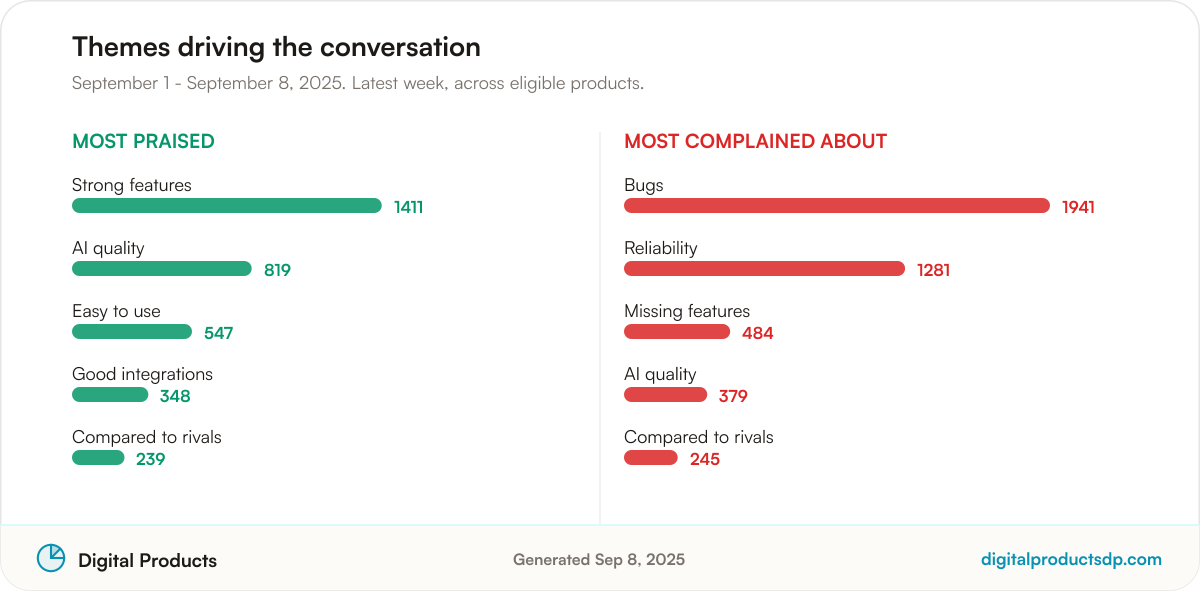
On the praise side, Strong features dominated with 1,411 mentions, well ahead of AI quality at 819, Easy to use at 547, Good integrations at 348, and favorable comparisons to rivals at 239. The features theme showed up across the board, from Claude with 229 feature mentions and ChatGPT with 183 to Cursor with 100 and ArgoCD with 60. AI quality praise clustered in the AI chat products, most visibly Claude at 234, ChatGPT at 159, Gemini at 149, and DeepSeek at 122, which reinforces why that category held the highest average score.
On the complaint side, Bugs led decisively with 1,941 mentions, followed by Reliability at 1,281, Missing features at 484, AI quality at 379, and comparisons to rivals at 245. The scale of the bug and reliability themes reflects heavy discussion around specific products: ArgoCD showed 231 bug mentions and 172 reliability mentions, Aspire 224 and 151, Stripe 188 and 158, Vercel 170 and 151, and Confluence 111 and 61. Notably, AI quality appears on both the praise and complaint lists, which underlines that model output was a contested topic, praised by some and criticized by others in the same period.
Watchlist
The great majority of tracked products did not clear the 10-mention threshold this period and are therefore excluded from the rankings. This is a matter of discussion volume, not a judgment on quality. Several products landed just short and are worth monitoring: Semrush and Klaviyo and Braze each drew 9 relevant mentions, while Lovable, Astro, ClickUp, Anyscale, Bitbucket, Loom, and Grammarly each drew 8. A little further back, Veo and Pangram Labs recorded 7 mentions, and VEED, Devin, ElevenLabs, and Klarna each recorded 6.
Others sat lower still, including HubSpot and Monday.com at 5, Leonardo AI, Canva, Carta, Asana, and Monolisa at 4, and a long tail at 3 or fewer such as Minimus, ActiveCampaign, Tidio, Coursera, Babbel, Ideogram, HeyGen, Kling, McAfee, Todoist, WooCommerce, Printify, Apollo.io, Bright Data, and Better Stack. Many more tracked products registered zero relevant mentions in the window. A quiet week in public discussion can reflect timing, niche audiences, or simply where conversation happened to concentrate, and any of these could re-enter the rankings in a future period if chatter picks up.
What To Watch Next Week
First, watch whether Obsidian holds the top spot. Its weekly series eased from 68 to 67 to 65 across the period, and its 28 bug mentions and 20 missing-feature mentions are the kind of themes that can pressure a score if they grow. A continued gentle drift would be worth noting against the tight 10-point gap among the top five.
Second, watch the risers for durability. Namecheap jumped from 32 to 53 but on only 12 mentions and against 38 reliability complaints, so its next reading will show whether the improved tone sticks. Perplexity, with 41 mentions and a +7 move, sits on firmer ground, but its Pricing too high theme at 21 mentions is a live tension to track.
Third, watch the bug and reliability themes at the category level. With Bugs at 1,941 mentions and Reliability at 1,281 leading all complaints, and business already down from 44 to 33, any further concentration of those themes could weigh on the softer categories in the next report.
Frequently Asked Questions
Which product had the highest Pulse Score this period?
Obsidian led with a Pulse Score of 65, based on 58 mentions over the period, ahead of Gemini at 58 and DeepSeek at 57.
Which product moved the most this period?
Namecheap was the biggest riser, climbing from 32 to 53 for a gain of 21 points, based on 12 mentions, while Flux was the biggest faller, dropping from 43 to 29 based on 13 mentions.
What was the overall category mood this period?
It was mixed. AI chat held steady at the top at 54 to 54, e-commerce rose from 46 to 50 and software from 35 to 40, while business fell most, from 44 to 33.
How many mentions were analyzed this period?
We analyzed 2,357 relevant mentions, with 47 of 2,235 tracked products clearing the 10-mention threshold to be ranked.
About This Data
Pulse Scores summarize the tone of public online discussion on a 0-100 scale and reflect community sentiment. They are not a verdict on a product's quality and not a recommendation. We report on complete calendar weeks only, and products with fewer than 10 relevant mentions in the period are excluded from rankings to avoid unstable reads on thin samples.
Public discussion is collected from Hacker News, Stack Exchange, GitHub, Bluesky, the Apple App Store, and YouTube. Automated sentiment analysis can misread sarcasm, jokes, or niche context, mention volumes vary widely between products, and scores can move from week to week. If your company would like to respond to anything reported here, please reach out. For more on how scores are calculated, see our methodology.