AI Tools and Software Sentiment Report: Week of September 1, 2025
September 1, 2025
This week's report covers aggregated public online discussion of the tools and software we track, drawing on mentions analyzed for August 25, 2025 through September 1, 2025. Across this window, 50 products cleared our threshold of at least 10 relevant mentions, and together they produced 2,367 relevant mentions of public chatter that we scored for tone. The figures here reflect community sentiment, meaning the mood of what people said online, and not any verdict on how well a product actually works.
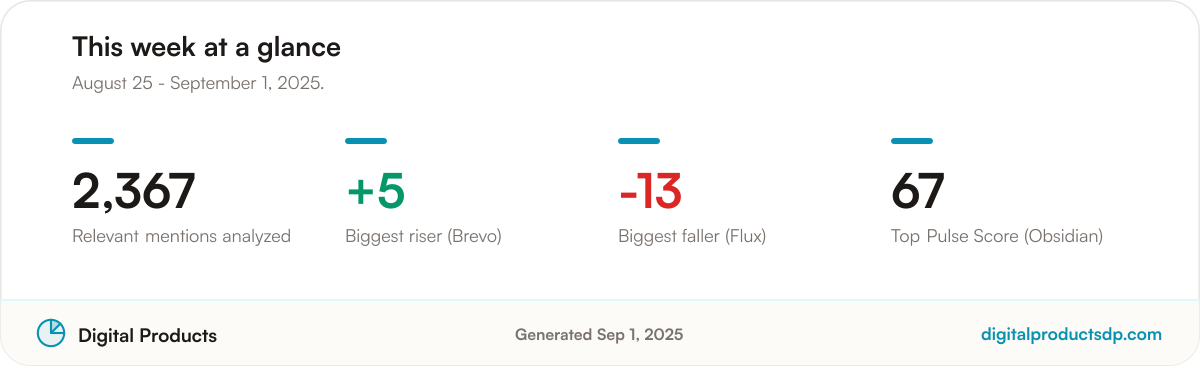
The period running from August 25, 2025 through September 1, 2025 was led by Obsidian, a project-management tool, which held the top Pulse Score at 67. At the other end, image tool Flux saw the steepest fall. Bugs and reliability dominated the complaint conversation, while strong features and AI quality anchored the praise. What follows reads those numbers against the specific praise and complaint themes attached to each product.
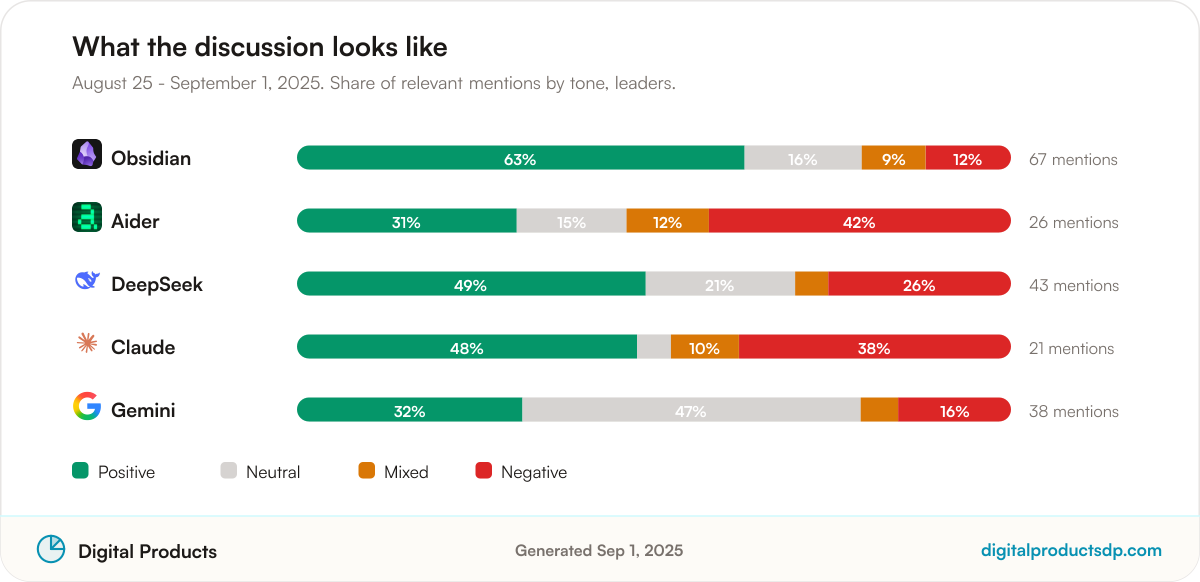
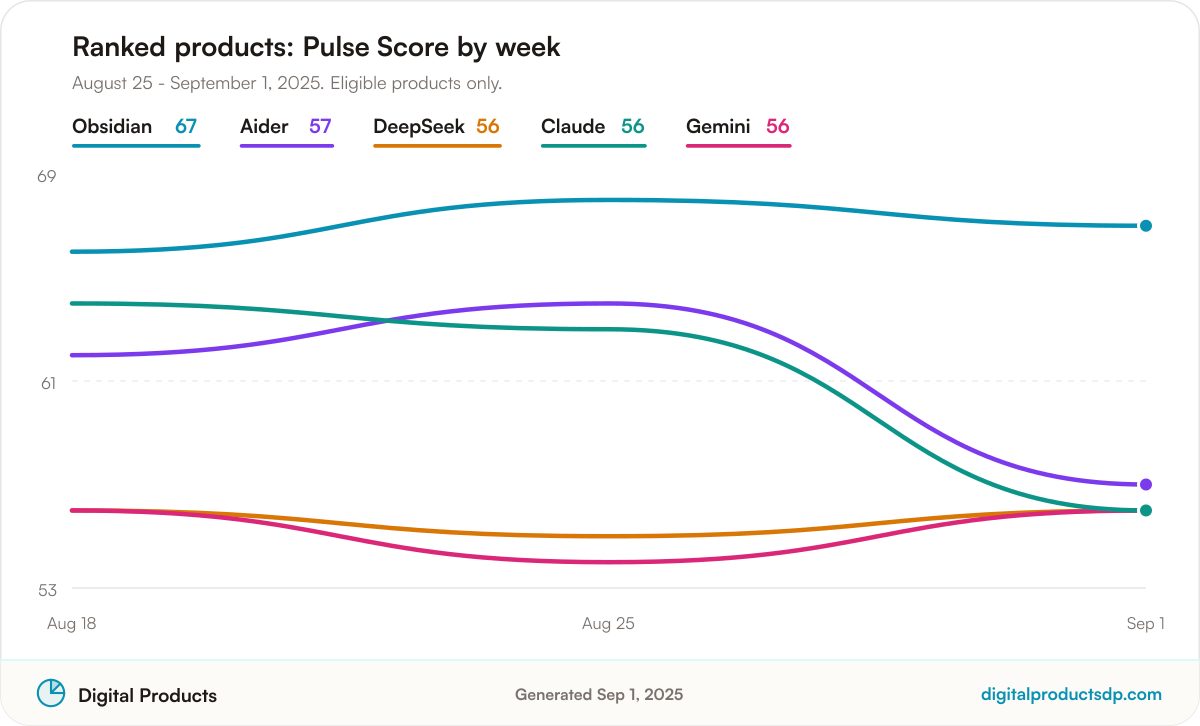
Obsidian sits clearly ahead of the field with a latest-week Pulse Score of 67, based on 67 mentions over the period, the largest sample among the leaders. Behind it, the top of the table clusters tightly. Aider, a coding tool, scored 57 based on 26 mentions, while three AI chat products, DeepSeek, Claude, and Gemini, all landed at 56, based on 43, 21, and 38 mentions respectively.
The narrow gap between second and fifth place is worth noting. With four products separated by a single point, small shifts in tone or sample size can reshuffle this order week to week. The AI chat category is heavily represented here, but each of these products carries its own praise and complaint mix, so a shared score of 56 does not mean a shared conversation.
Category View
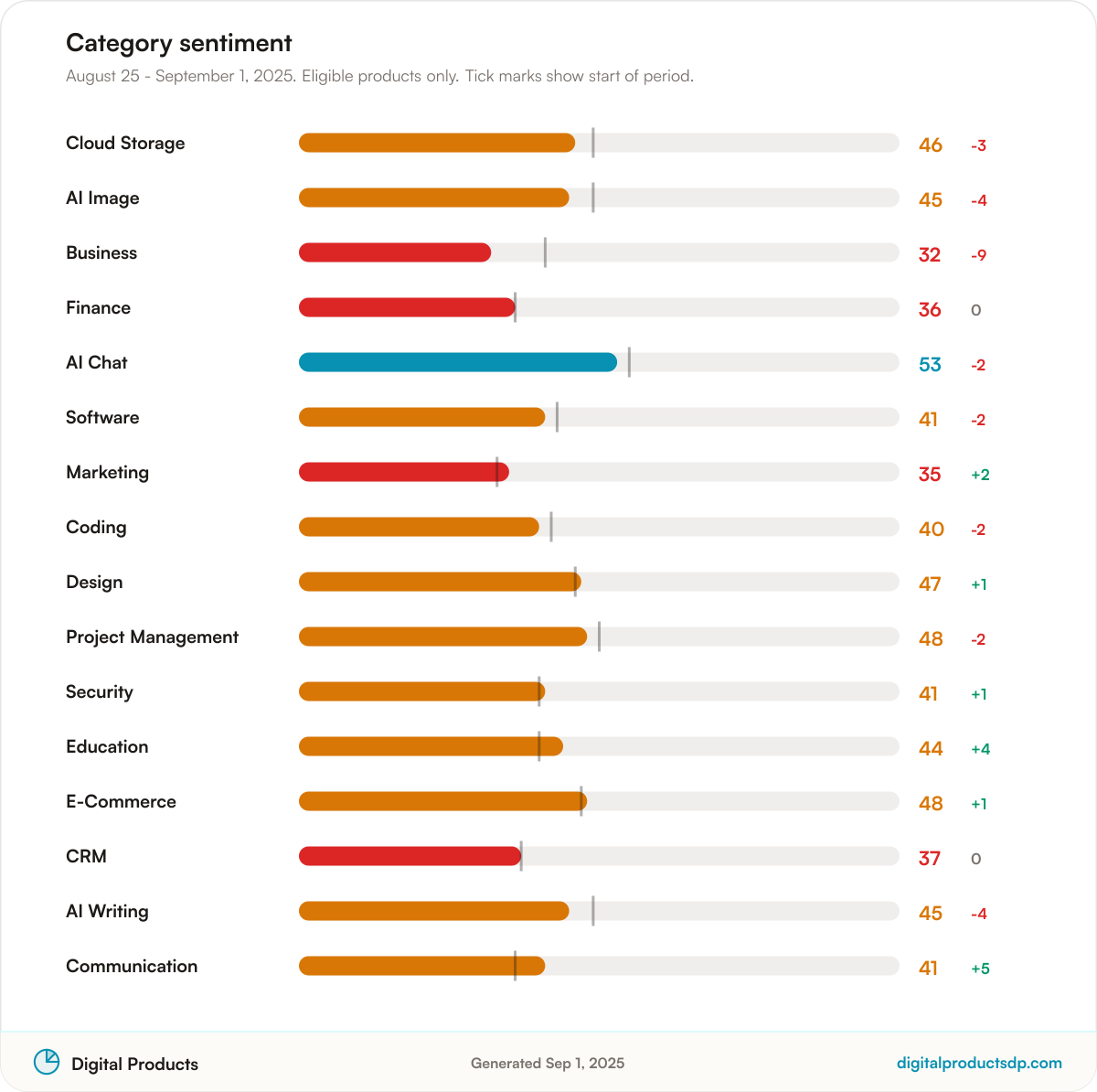
At the category level, ai-chat held the highest average mood but eased from 55 to 53 over the period. The sharpest category slide was business, which fell from 41 to 32. Several categories moved up: communication rose from 36 to 41, education from 40 to 44, and marketing from 33 to 35. Others held steady, with finance flat at 36 and crm flat at 37. Project-management, the category housing this week's leader, slipped from 50 to 48, while design edged up from 46 to 47 and e-commerce from 47 to 48. These are averages across eligible products only, so a single steep individual mover can pull a small category with it.
Biggest Movers
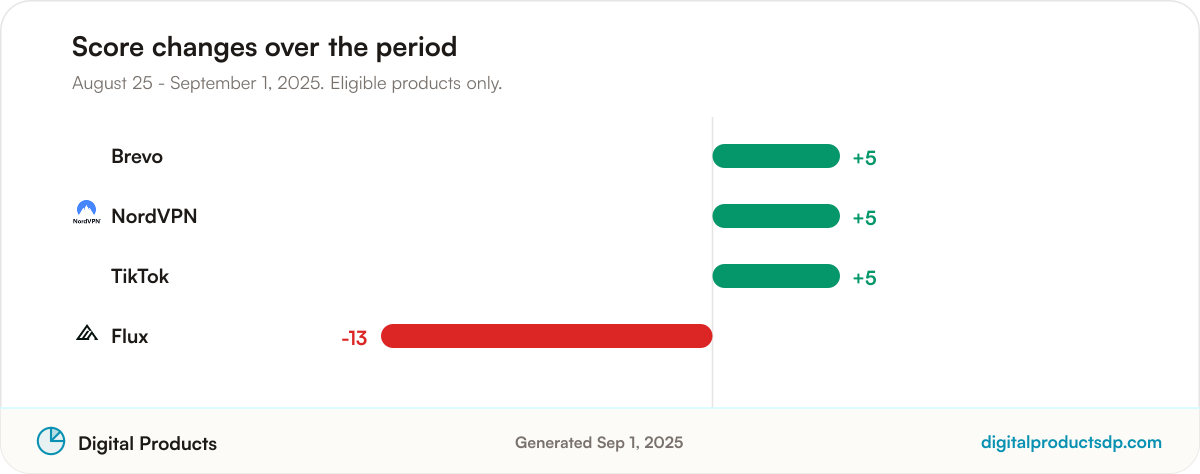
Brevo (up 5, from 37 to 42, based on 18 mentions). The marketing tool's praise conversation centered on strong features, mentioned 7 times, along with fair pricing at 6 and easy to use at 5. That value-and-simplicity framing appears to have lifted its tone, even as complaints about bugs, mentioned 7 times, matched its top praise theme. Reliability at 4 and lacking integrations at 3 rounded out the concerns.
NordVPN (up 5, from 44 to 49, based on 17 mentions). Discussion of the security product leaned on security praise at 8, fair pricing at 6, and strong features at 5. Its weekly path was not smooth, moving from 44 to 58 to 49, so the net gain sits on a volatile ride. Complaints included bugs at 12, reliability at 9, and privacy concerns at 6, the last of which is notable for a privacy-focused product.
TikTok (up 5, from 36 to 41, based on 30 mentions). The largest mention count among the risers, TikTok drew praise for strong features at 25 and easy to use at 10. Its complaint side was busier, with bugs at 34, UI frustrations at 28, and missing features at 22. The score rose from 36 to 41 and then held flat at 41 in the final week, suggesting the improvement stabilized rather than continuing to climb.
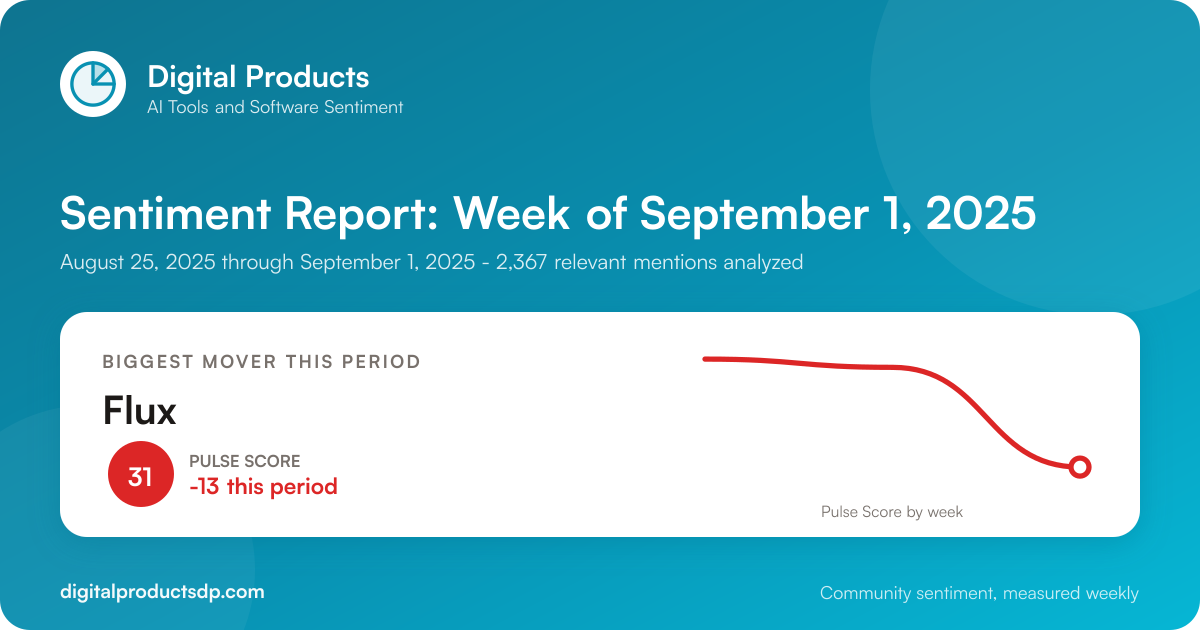
Flux (down 13, from 44 to 31, based on 13 mentions). The image tool posted the steepest fall of the period. Its praise still highlighted AI quality at 33 and strong features at 22, but the complaint side was heavy relative to its small sample, with bugs at 19, performance at 17, and reliability at 11. The score sat at 44 then 43 before dropping to 31, so the slide came late in the window and on thin volume.
Akamai (down 10, from 38 to 28, based on 16 mentions). The security product's complaint themes overwhelmed its praise. Bugs at 38 and reliability at 37 far outweighed strong features at 10, new releases at 7, and performance at 5. The steady weekly decline from 38 to 33 to 28 tracks a conversation dominated by stability concerns.
Foxit (down 9, from 41 to 32, based on 16 mentions). The software product actually rose to 44 in the middle week before falling to 32, a sharp reversal. Praise pointed to strong features at 10, compared to rivals at 6, and performance at 5, while complaints stayed comparatively modest at bugs 5, security praise 4, and UI frustrations 3. Given the small mention count, the late drop should be read with caution.
Spotlight: Obsidian
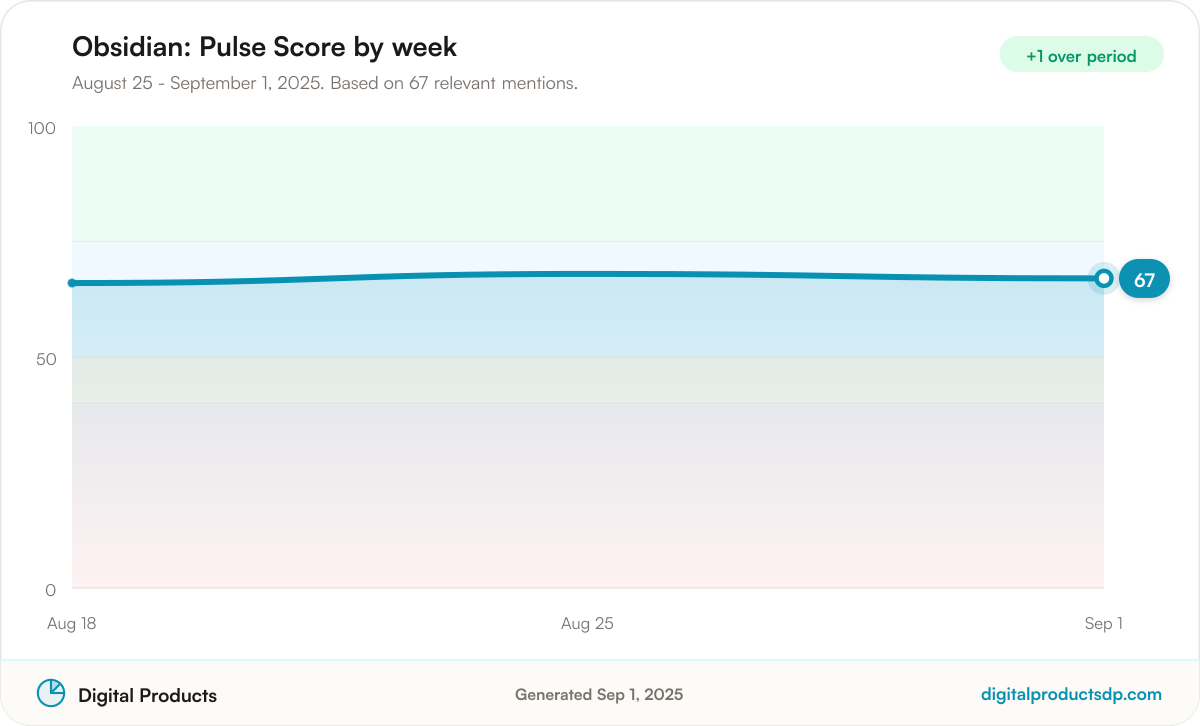
Obsidian led the period with a latest-week Pulse Score of 67, based on 67 mentions. Its weekly series was steady, running 66, then 68, then 67. That stability, combined with the largest mention base among the leaders, makes it the most consistently discussed positive signal this period. A leader that holds its score across three weeks is a different story from one that spikes once and settles back.
The praise conversation was anchored by strong features at 40, good integrations at 25, and easy to use at 20. That mix suggests the online mood values both the depth of what the tool can do and how it connects to a wider workflow. For a project-management product, integration talk carrying the second spot is a meaningful piece of the sentiment picture.
The complaint side was not empty. Bugs drew 28 mentions, missing features 20, and reliability 13. Those numbers show that even a top-ranked product sees stability and gap concerns in public discussion. The score stayed high because praise volume outweighed those complaints, not because complaints were absent.
Themes Driving the Conversation
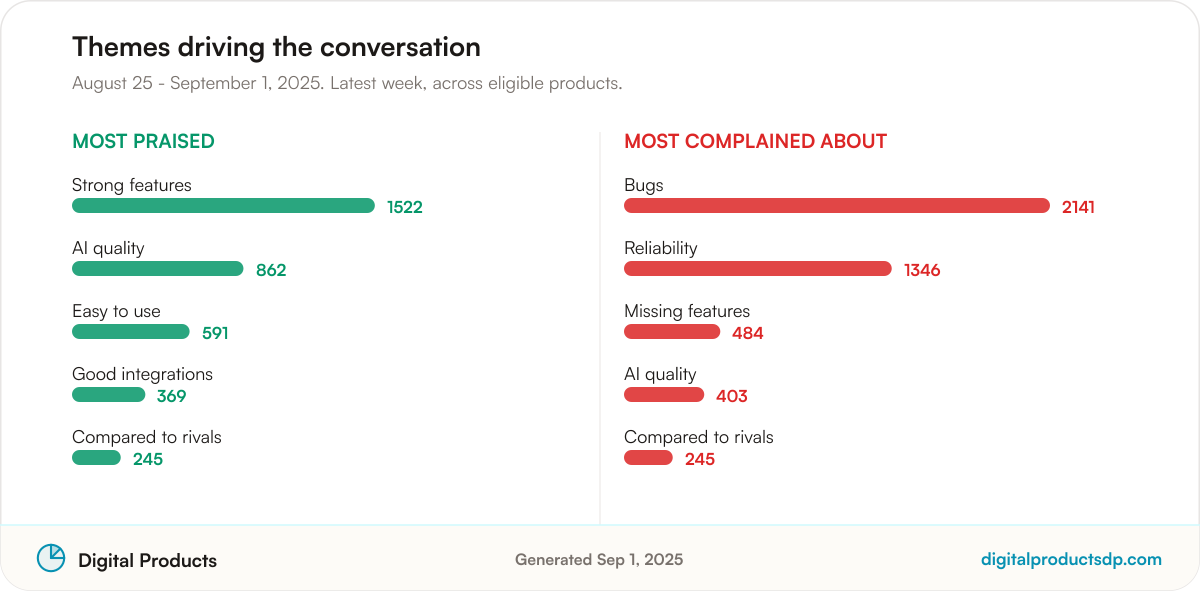
On the praise side, strong features led with 1,522 mentions, well ahead of AI quality at 862, easy to use at 591, good integrations at 369, and compared to rivals at 245. The strong-features theme showed up across the board, from ChatGPT at 183 and Gemini at 140 to Claude at 229 and Stripe at 84, making it the connective tissue of positive discussion. AI quality was concentrated in the chat and image products, with Claude at 234, ChatGPT at 159, and Gemini at 149 among the drivers.
The complaint side was heavier at the top. Bugs led all themes with 2,141 mentions, ahead of reliability at 1,346, missing features at 484, AI quality at 403, and compared to rivals at 245. Bugs and reliability were pervasive, appearing as top complaints for products like Stripe, with 188 bug mentions and 158 reliability mentions, ArgoCD at 231 bug mentions and 172 reliability mentions, and Aspire at 224 bug mentions. Notably, AI quality appears on both lists, praised for chat products yet also flagged as a complaint at ChatGPT with 109 mentions and Gemini with 112, which shows how the same theme can cut both ways depending on the specific product and the expectations attached to it.
Watchlist
A large number of tracked products did not clear the 10-mention threshold this period and so are not ranked. This is a matter of discussion volume, not a judgment on quality. Some drew a handful of mentions but stopped short, including Semrush at 9, Bitbucket at 9, Anyscale at 8, Braintrust at 8, Loom at 8, Klaviyo at 7, ClickUp at 7, Lovable at 7, and Pangram Labs at 7. Others sat lower, such as VEED at 6, Veo at 6, Devin at 6, Klarna at 6, Monday.com at 6, Forte at 6, Ideogram at 5, and Namecheap at 5.
Many well-known names recorded zero relevant mentions in the sources we scanned this period, including Notion, Slack, Zoom, GitHub, GitLab, and Dropbox. With sources limited to Hacker News and YouTube review-video comments for this digest, absence here simply means the conversation did not surface in those places during this window. These products are worth watching in case their volume rises enough to produce a stable read in a future week.
What To Watch Next Week
First, watch whether the top of the leaderboard reshuffles. DeepSeek, Claude, and Gemini all sit at 56, a single point behind Aider at 57, so any small movement in tone or sample could rearrange those positions. Obsidian's steadiness at 67 makes it the anchor to compare against.
Second, watch the fallers to see whether their late-period drops hold or reverse. Flux fell to 31, Akamai to 28, and Foxit to 32, but each moved on small samples of 13 to 16 mentions, and Foxit in particular had climbed to 44 before dropping. Thin-sample moves can swing back quickly.
Third, watch whether the bugs and reliability themes stay dominant. With bugs at 2,141 mentions and reliability at 1,346 leading all complaint themes, and both concentrated in products like Stripe, ArgoCD, and Aspire, any easing there would be the clearest sign of a shifting mood in the wider field.
Frequently Asked Questions
Which product had the highest Pulse Score this period?
Obsidian, a project-management tool, led with a latest-week Pulse Score of 67, based on 67 mentions over the period.
Which product moved the most this period?
Flux saw the largest swing, falling 13 points from 44 to 31 based on 13 mentions. Among risers, Brevo, NordVPN, and TikTok each gained 5 points.
What was the overall category mood?
The ai-chat category held the highest average at 53 in the final week, though it eased from 55. The business category fell the most, from 41 to 32, while communication and education both rose.
How many mentions were analyzed this period?
A total of 2,367 relevant mentions were analyzed across the 50 products that met the threshold of at least 10 relevant mentions.
About This Data
Pulse Scores summarize the tone of public online discussion on a 0-100 scale. They reflect community sentiment and are not a verdict on a product's quality or a recommendation. We report on complete calendar weeks only, and products with fewer than 10 relevant mentions in the period are excluded from rankings to avoid unstable reads on thin samples.
Public discussion is collected from Hacker News, Stack Exchange, GitHub, Bluesky, the Apple App Store, and YouTube. Automated sentiment analysis can misread sarcasm, jokes, or niche context. Mention volumes vary widely between products, and scores can move week to week, so single-week moves on small samples should be read with care. Any company that wants to respond is welcome to reach out. For how scores are calculated, see our methodology.