AI Tools and Software Sentiment Report: Week of August 11, 2025
August 12, 2025
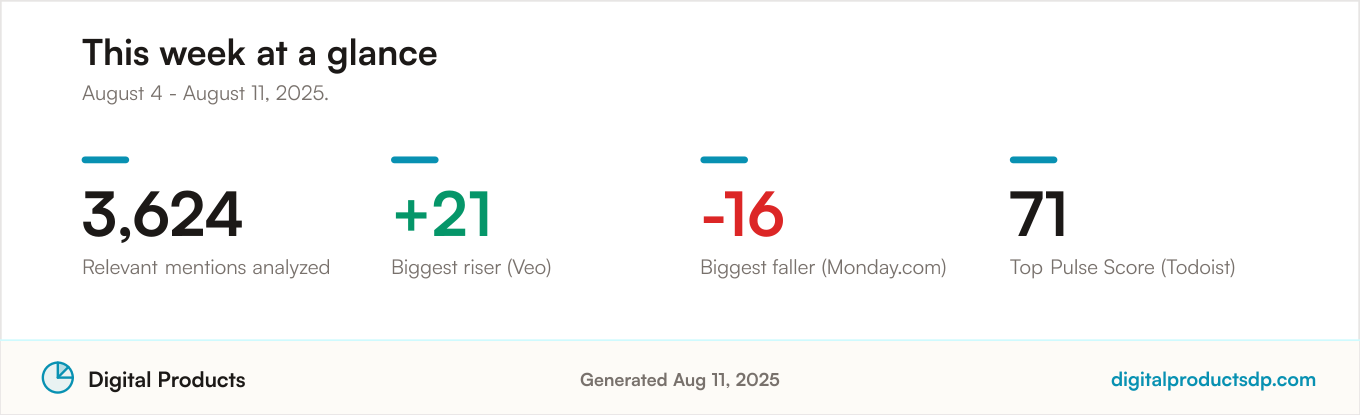
This edition of our sentiment tracker covers aggregated public online discussion of AI tools and broader software products, drawn from the mentions analyzed for August 4, 2025 through August 11, 2025. Across that window, 3,624 relevant mentions were collected and scored, spanning products from AI chat assistants and coding tools to CRM platforms, design apps, and cloud infrastructure. As always, these numbers describe the tone of community chatter, not a verdict on any product's quality.
The reporting period running from August 4, 2025 through August 11, 2025 sits inside a broader three-week digest covering the weeks of July 28 through August 11, which gives us the weekly trend lines used throughout this report. Of the 2,246 products tracked, 79 cleared the threshold of at least 10 relevant mentions and were eligible for ranking. The rest sit below the line, which we treat as a signal of thin discussion volume rather than any judgment on the products themselves.
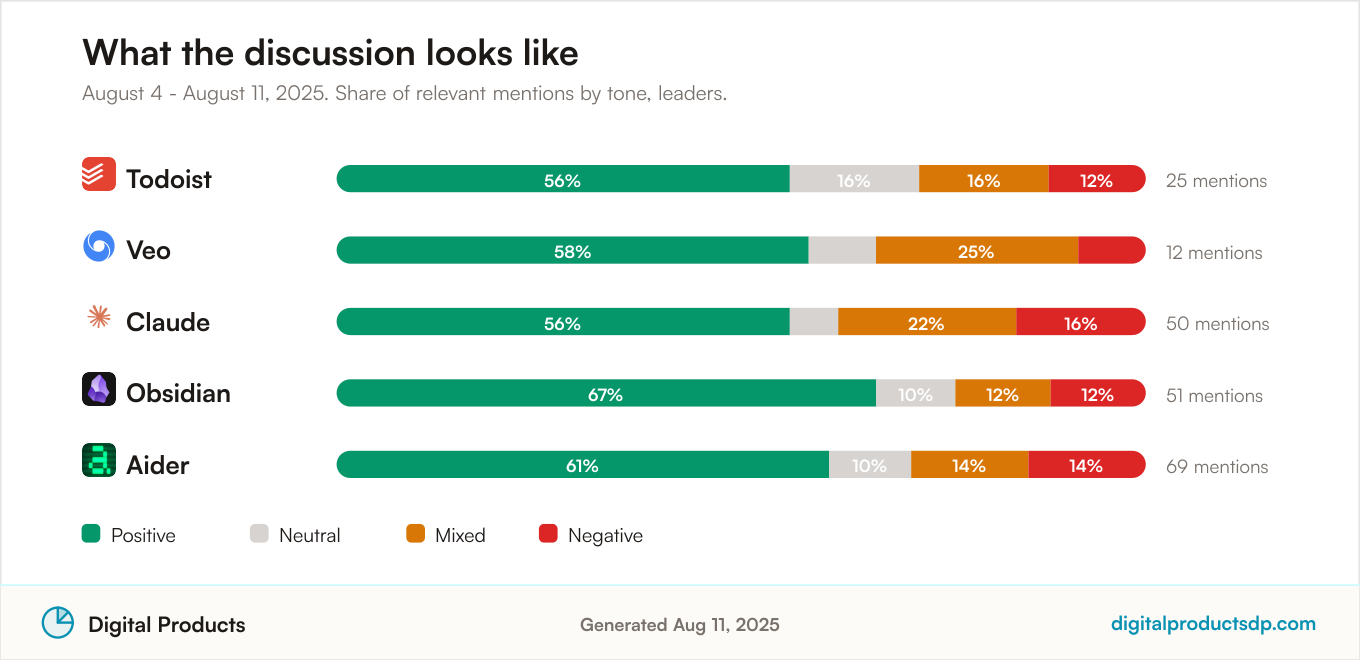
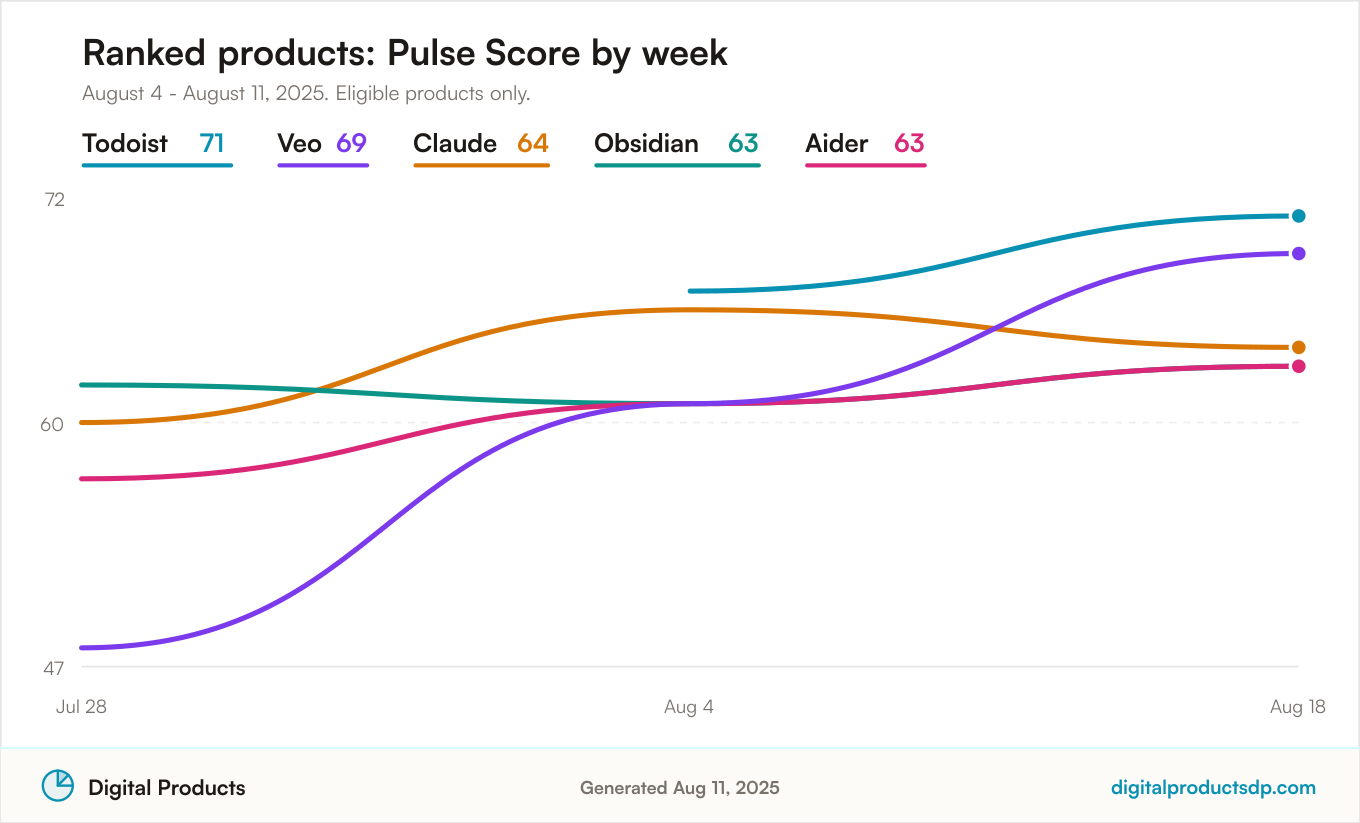
Todoist tops the leaderboard with a Pulse Score of 71, based on 25 mentions over the period, edging out Veo at 69, based on 12 mentions. Claude follows at 64, based on 50 mentions, with Obsidian at 63, based on 51 mentions, and Aider also at 63, based on 69 mentions. The spread between first and fifth is narrow, which suggests the tone of discussion at the top of the table clustered tightly this period rather than one product running away from the field.
It is worth noting how different these leaders are in category and mention volume. Todoist is a business productivity product, Veo is an AI video tool, Claude is an AI chat assistant, Obsidian is filed under project management, and Aider is a coding tool. Aider's 69 mentions give its 63 a broader base than Veo's 69 rests on only 12 mentions, so readers should weigh the leaner samples with more caution. Small samples can move quickly, which is exactly why we report the mention count alongside every score.
Category View
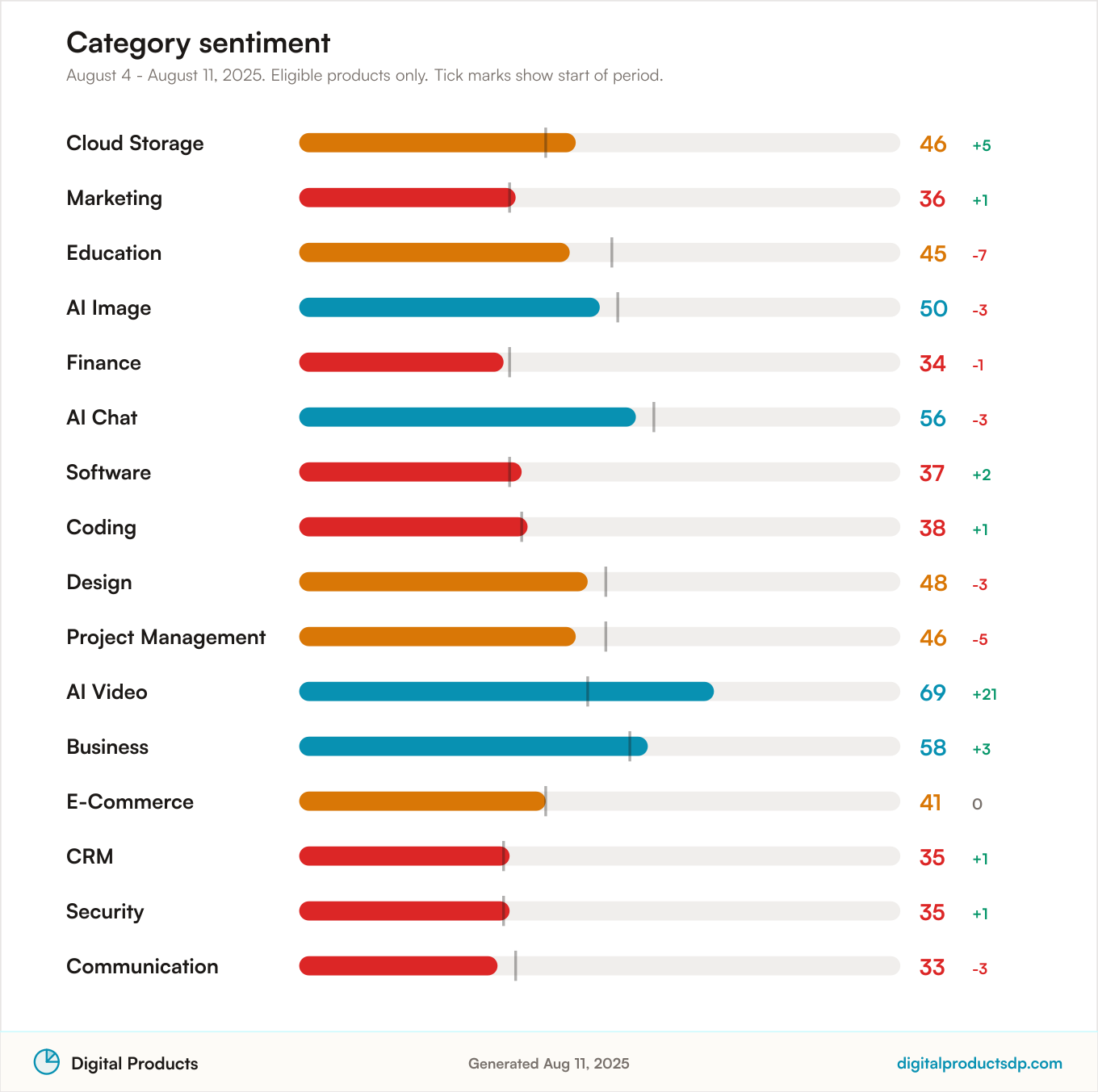
At the category level, the sharpest move belonged to ai-video, which climbed from 48 to 69 over the period, a shift driven heavily by Veo. Business rose from 55 to 58 and cloud-storage moved up from 41 to 46, while software ticked up from 35 to 37 and coding edged from 37 to 38. On the other side, education slipped from 52 to 45, project-management eased from 51 to 46, design fell from 51 to 48, ai-chat softened from 59 to 56, and communication dropped from 36 to 33. Several categories barely moved, including e-commerce holding flat at 41, finance drifting from 35 to 34, and crm nudging from 34 to 35. The overall picture is a market where AI chat and design mood cooled slightly while ai-video stood out as the clear positive outlier.
Biggest Movers
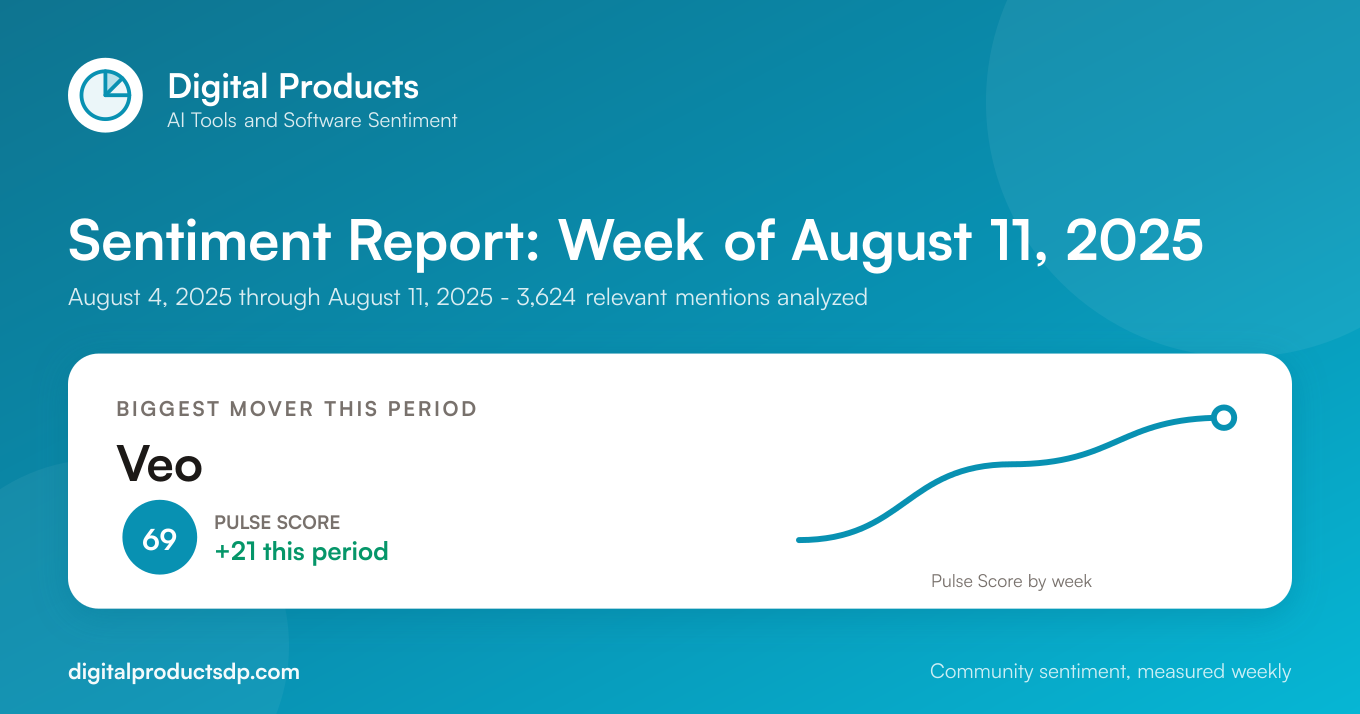
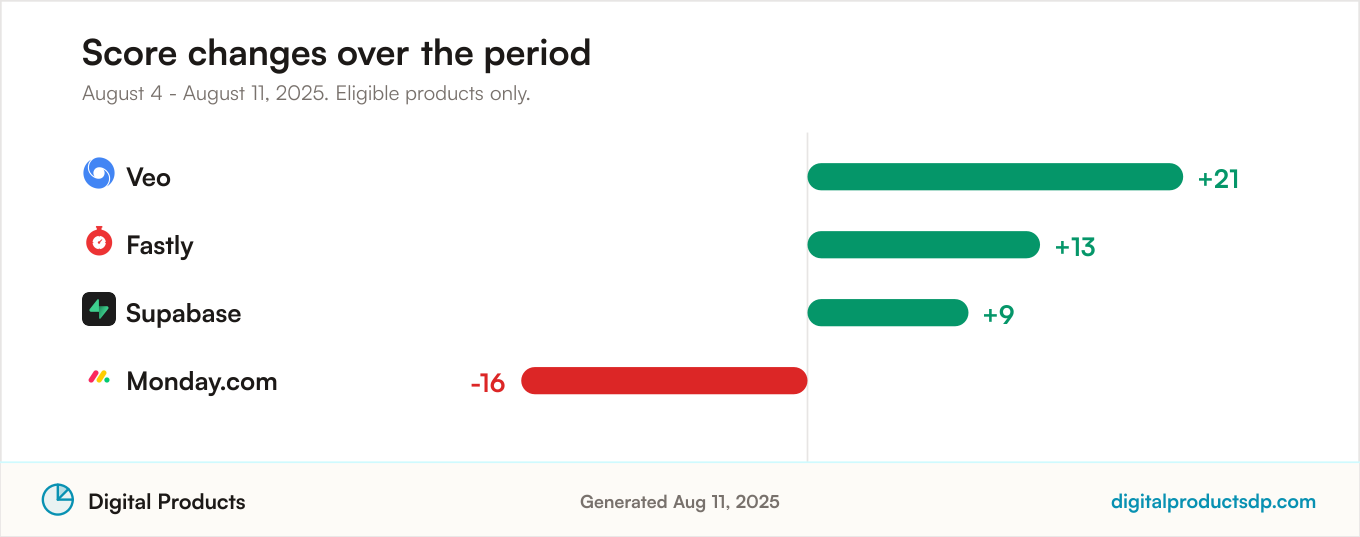
Veo (riser, +21, from 48 to 69, based on 12 mentions). Veo posted the largest positive swing of any ranked product. Its praise themes this period were led by Strong features (12 mentions), New releases (8 mentions), and AI quality (7 mentions), which fits the pattern of enthusiasm around a fast-moving AI video tool. The complaint side was thinner but present, with Bugs (10 mentions), Reliability (5 mentions), and Missing features (5 mentions). With only 12 mentions underpinning the score, the move is best read as a strong but lightly sampled tilt in tone.
Fastly (riser, +13, from 29 to 42, based on 24 mentions). Fastly climbed sharply off a low starting point. Its praise themes were modest, led by Strong features (3 mentions), Privacy concerns (2 mentions), and Performance (1 mention), while the complaint side was heavier, with Bugs (14 mentions), Reliability (13 mentions), and Downtime (3 mentions). The rise here looks like a recovery from a weak prior week rather than a wave of glowing discussion, since complaints still outnumbered praise mentions in the latest week.
Supabase (riser, +9, from 46 to 55, based on 70 mentions). Supabase paired its rise with the healthiest mention base among the risers. Its praise themes were unusually strong, led by Strong features (59 mentions), Easy to use (56 mentions), and Performance (41 mentions), while complaints were light, with Bugs (5 mentions), Downtime (4 mentions), and Reliability (4 mentions). That favorable ratio of praise to complaints gives this move more weight than the leaner risers, and its weekly series shows the jump landing between July 28 and August 4 before holding at 55.
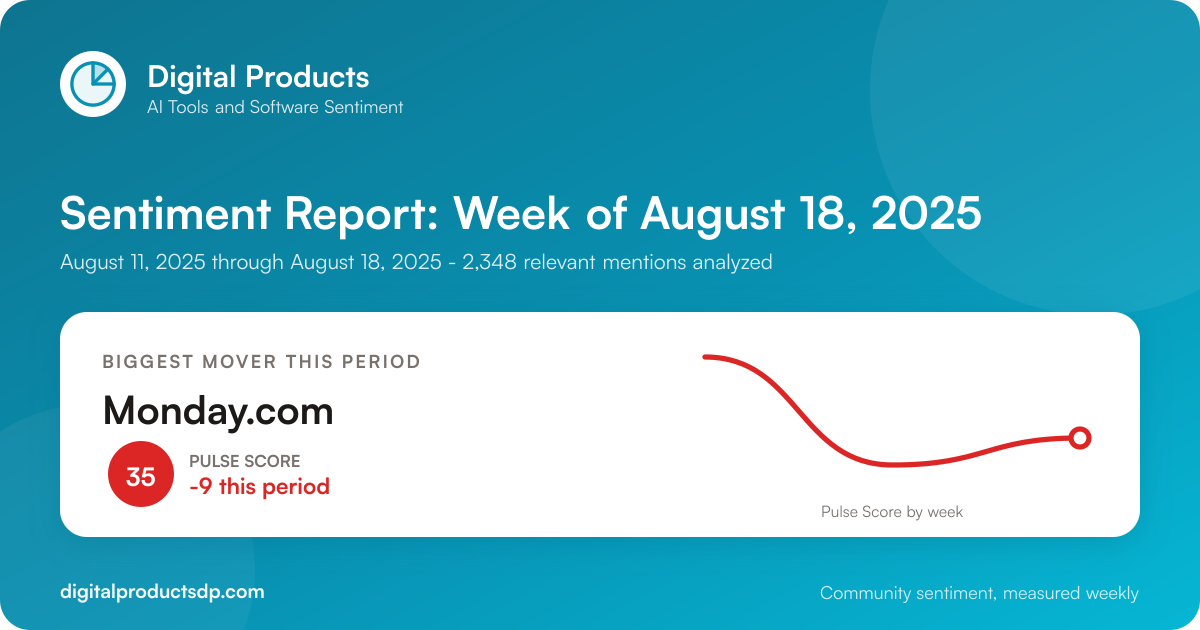
Monday.com (faller, -16, from 48 to 32, based on 16 mentions). Monday.com recorded the steepest decline of any ranked product. Its praise themes were sparse, led by Strong features (4 mentions), Good integrations (3 mentions), and AI quality (2 mentions), while complaints dominated, with Bugs (7 mentions), Compared to rivals (6 mentions), and Pricing too high (4 mentions). The mix of rival comparisons and pricing complaints against thin praise helps explain why the tone fell so far in this project-management CRM product.
Bun (faller, -15, from 56 to 41, based on 14 mentions). Bun gave back a strong prior read. Its praise themes centered on Performance (9 mentions), Easy to use (8 mentions), and Strong features (7 mentions), but complaints outweighed them, with Bugs (32 mentions), Reliability (24 mentions), and Lacking integrations (6 mentions) in the coding category. The heavy volume of bug and reliability chatter relative to praise is consistent with the drop from 56 to 41.
Coursera (faller, -12, from 62 to 50, based on 23 mentions). Coursera's education-category read cooled notably. Its praise themes were led by Strong features (14 mentions), Easy to use (9 mentions), and Fair pricing (6 mentions), while complaints included AI quality (4 mentions), Pricing too high (4 mentions), and Missing features (4 mentions). The mix of praise for fair pricing alongside complaints about pricing being too high points to a divided conversation, and the weekly series shows most of the decline arriving between July 28 and August 4.
Spotlight: Todoist
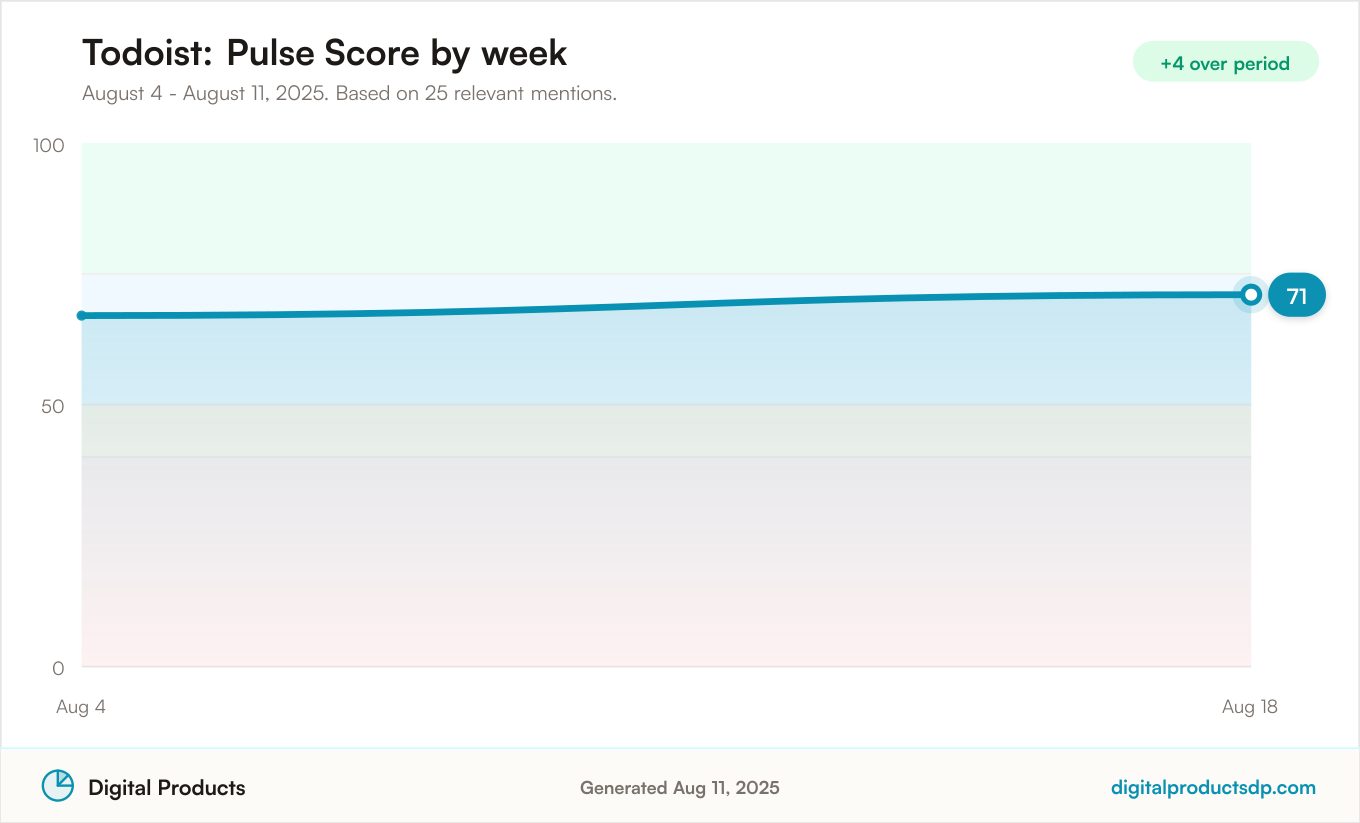
Todoist leads the period with a Pulse Score of 71, based on 25 mentions. Its weekly series is short, appearing on August 4 at 67 and August 11 at 71, which means the product entered our ranked view partway through the digest window and improved across the two weeks we have. That upward step, combined with the top score, is what places it at the head of the table.
The theme breakdown shows a conversation built mainly on usability. Todoist's praise themes were led by Easy to use (9 mentions), followed by Strong features (6 mentions) and Feature requests (2 mentions). Ease of use being the dominant praise driver fits a business productivity tool whose appeal often rests on smooth day-to-day workflow rather than headline capabilities.
The complaint side is not empty. Bugs (8 mentions), Reliability (6 mentions), and Missing features (4 mentions) all registered, and with only 25 mentions overall those counts are meaningful relative to the praise totals. That balance is worth watching: the top score reflects a favorable tilt in tone, but the presence of bug and reliability chatter shows the discussion is not uniformly positive. As always with a lean sample, a small shift in either direction could move the score noticeably next week.
Themes Driving the Conversation
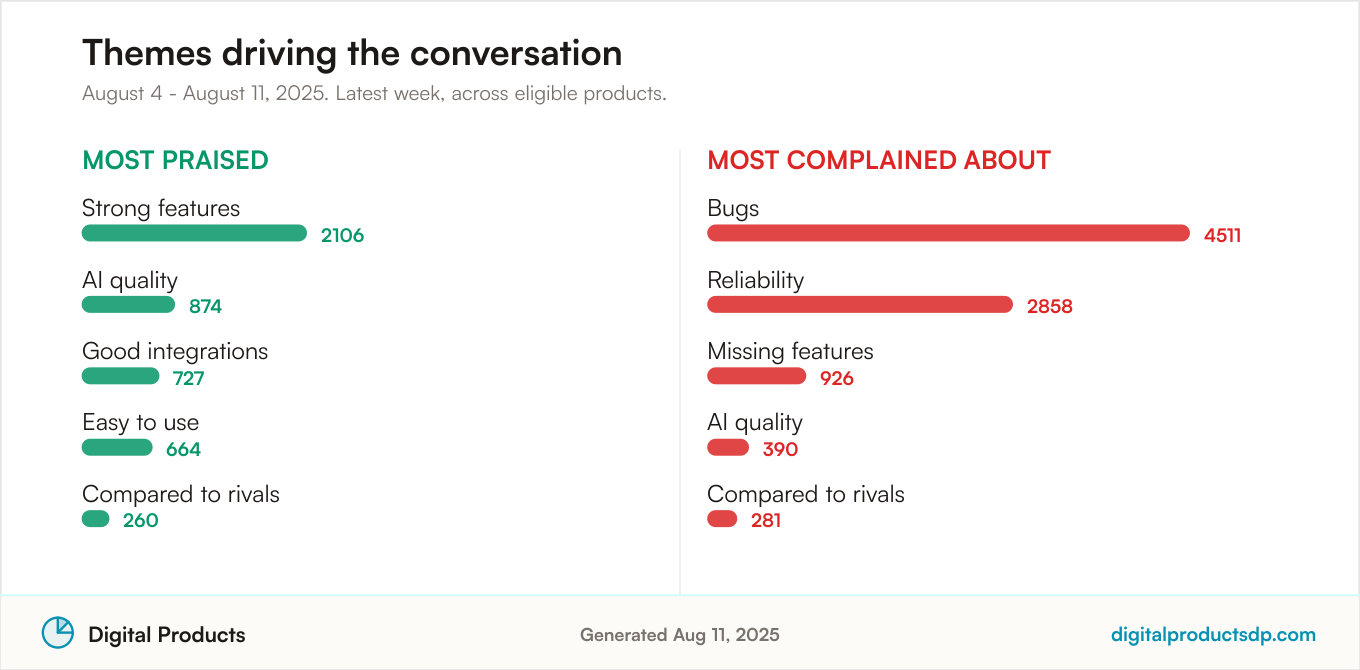
On the praise side, Strong features was the dominant theme at 2,106 mentions, far ahead of AI quality at 874 mentions, Good integrations at 727 mentions, Easy to use at 664 mentions, and Compared to rivals at 260 mentions. The feature theme shows up across many leaders, from Claude with 229 feature praise mentions and ChatGPT with 183, to Stripe with 84 and DuckDB with 157. AI quality praise concentrates in the chat and image tools, with Claude at 234 mentions and Gemini at 149, while Easy to use anchors products like Supabase at 56 mentions and Vercel at 35.
The complaint side is heavier in raw volume and led by Bugs at 4,511 mentions, followed by Reliability at 2,858 mentions, Missing features at 926 mentions, AI quality at 390 mentions, and Compared to rivals at 281 mentions. Bug and reliability chatter is widespread among high-volume infrastructure and data products, including ClickHouse with 441 bug mentions and 290 reliability mentions, dbt with 357 and 208, Grafana with 258 and 146, and Stripe with 188 and 158. AI quality appears on both lists, reflecting that the same models drawing praise for output quality also draw criticism for it, as seen with Claude registering 110 AI quality complaint mentions and Gemini 112.
Watchlist
Several tracked products drew some discussion this period but stayed under the 10-mention threshold, so they are not ranked. This is a statement about discussion volume, not quality. Canva (design) and Astro (coding) each landed at 9 relevant mentions, just shy of the cutoff, alongside Directus (coding), Doppler (security), and Helicone (coding), all at 9 mentions. A cluster sat at 8 mentions, including Lovable (coding), Ahrefs (marketing), and DigitalOcean (cloud-storage). Slightly lower, at 7 mentions each, were Sudowrite (ai-writing), Foxit (business), Asana (project-management), Devin (coding), IPFS (cloud-storage), Jina AI (coding), Anyscale (coding), Loom (video-editing), Customer.io (marketing), and DocuSign (software).
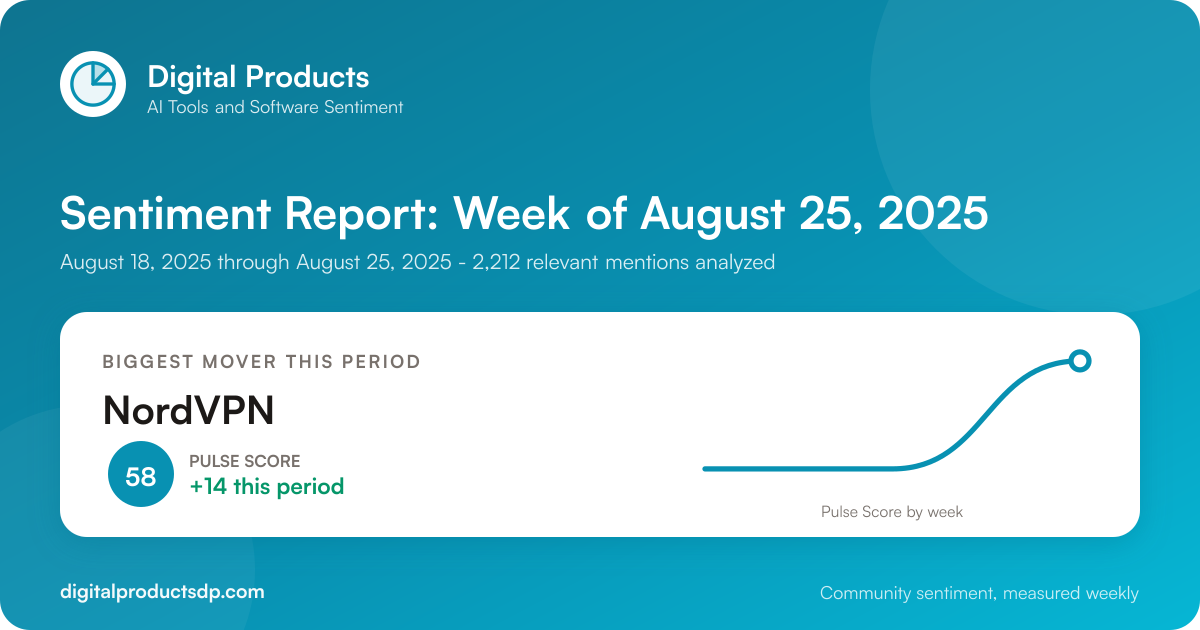
Further down, products such as Leonardo AI (7 mentions), HeyGen (6 mentions), NordVPN (6 mentions), Jasper (6 mentions), Hotjar (6 mentions), Great Expectations (6 mentions), and Dremio (6 mentions) each drew enough attention to note but not enough to score reliably. Many others registered only a handful of mentions or none at all this period. When a product sits below the line, a single active thread or review video could lift it into ranked territory next week, so the watchlist is best read as a pool of candidates rather than a fixed set.
What To Watch Next Week
First, watch whether ai-video holds its gain. The category jumped from 48 to 69 almost entirely on Veo, whose score rests on just 12 mentions. If mention volume stays thin, that number could prove volatile in either direction, so the question is whether the positive tone broadens or narrows.
Second, watch the fallers for signs of stabilization. Monday.com dropped to 32, Bun to 41, and Coursera to 50, each with complaint themes that outweighed praise this period. Whether their bug, reliability, and pricing conversations cool or persist will shape whether these were single-week dips or the start of a longer slide.
Third, watch Supabase and Todoist at the healthier end. Supabase paired a rise to 55 with 70 mentions and a strong praise-to-complaint ratio, while Todoist leads at 71 on a lean 25 mentions. Monitoring whether Supabase's favorable mix sustains and whether Todoist's top score survives a larger sample will tell us how durable this week's leaders are.
Frequently Asked Questions
Which product had the highest Pulse Score this period?
Todoist led all ranked products with a Pulse Score of 71, based on 25 mentions over the period, narrowly ahead of Veo at 69, based on 12 mentions.
Which product moved the most this period?
Veo posted the biggest rise, climbing from 48 to 69 for a gain of 21 points, based on 12 mentions. Monday.com had the steepest fall, dropping from 48 to 32 for a loss of 16 points, based on 16 mentions.
What was the overall category mood this period?
Mixed. Ai-video rose sharply from 48 to 69 and business ticked up from 55 to 58, while education fell from 52 to 45, project-management slipped from 51 to 46, and ai-chat eased from 59 to 56.
How many mentions were analyzed this period?
A total of 3,624 relevant mentions were analyzed. Of the 2,246 products tracked, 79 met the threshold of at least 10 relevant mentions and were eligible for ranking.
About This Data
Pulse Scores summarize the tone of public online discussion on a 0-100 scale and reflect community sentiment, not a verdict on a product's quality or a recommendation. We report on complete calendar weeks only, and products with fewer than 10 relevant mentions in the period are excluded from rankings to avoid unstable reads on thin samples.
Public discussion is collected from Hacker News, Stack Exchange, GitHub, Bluesky, the Apple App Store, and YouTube. Automated sentiment analysis can misread sarcasm, jokes, or niche context, mention volumes vary widely between products, and scores can move week to week. Any company that wants to respond is welcome to reach out. For how scores are calculated, see our methodology.