AI Tools and Software Sentiment Report: Week of July 21, 2025
July 22, 2025
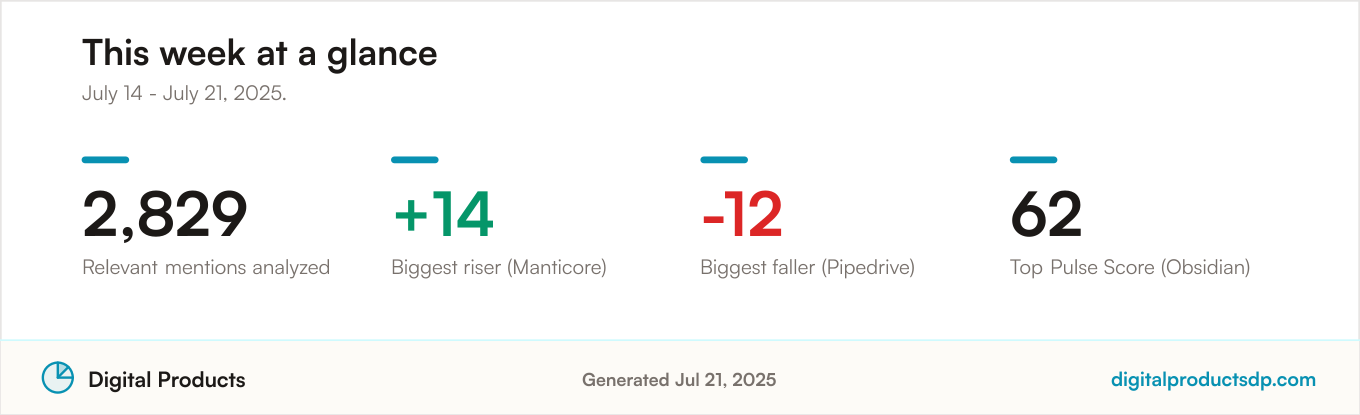
This edition of our sentiment report looks at aggregated public online discussion of tracked AI tools and software, with mentions analyzed for July 14, 2025 through July 21, 2025. Across this window we processed 2,829 relevant mentions spread across 73 products that cleared our minimum volume threshold for ranking, drawn from a wider tracked list of 2,246 products. The picture that emerges is one of a steady top tier of note-taking, AI chat, and AI image products, set against a much larger field where reliability and bug complaints dominate the conversation.
Everything here reflects the tone of community chatter, not a verdict on whether any product works well. Pulse Scores summarize sentiment on a 0-100 scale, and the sample sizes vary widely from one product to the next, so a single-week move on a thin sample should be read with care. With that framing in place, here is what the discussion looked like for July 14, 2025 through July 21, 2025.
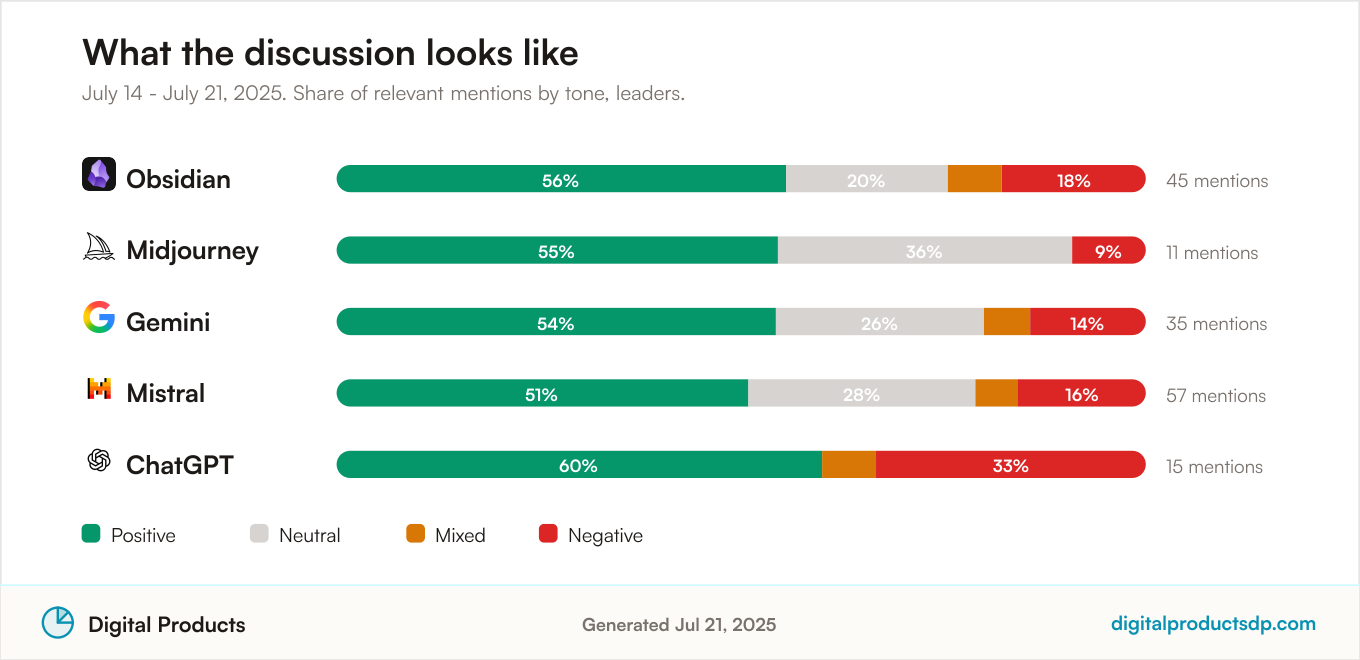
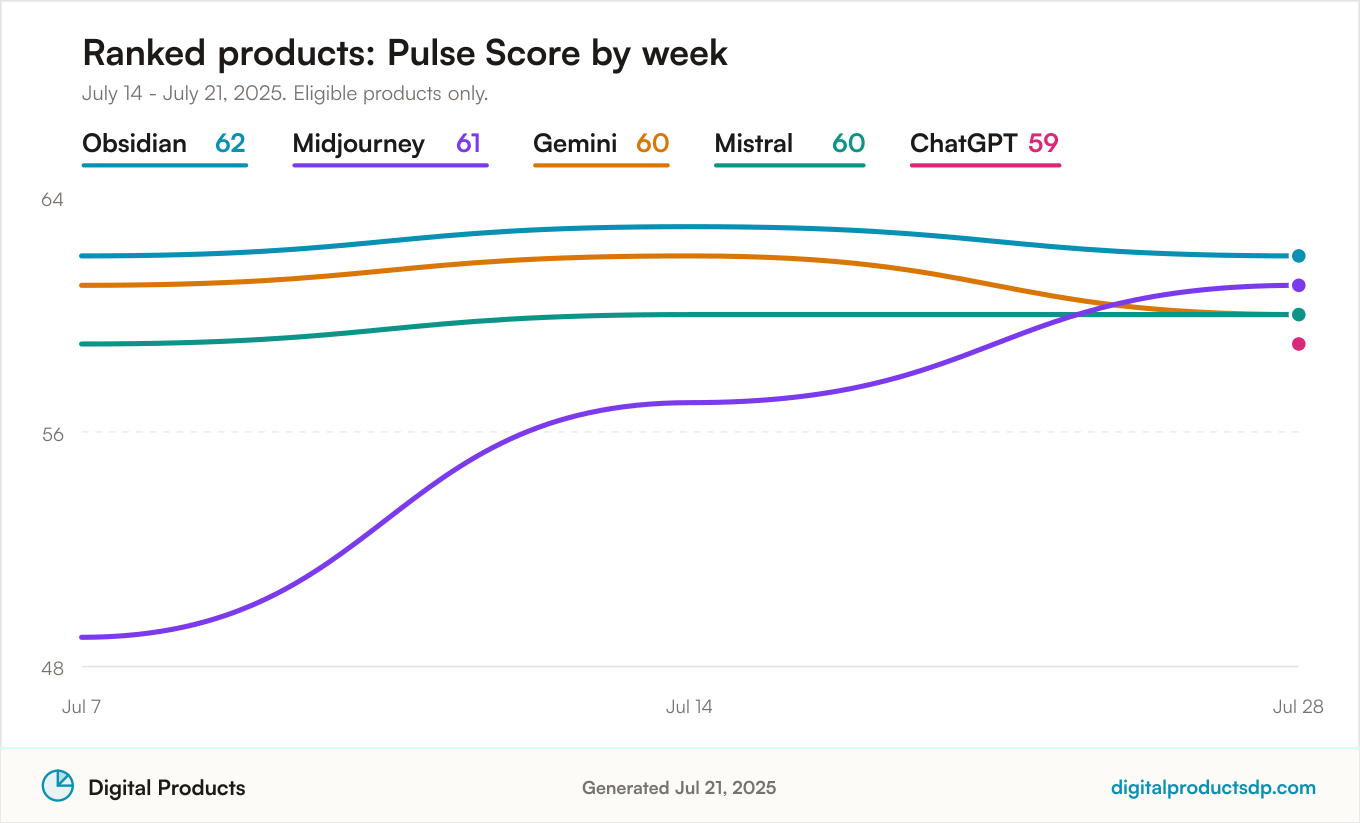
Obsidian sits at the top with a Pulse Score of 62, based on 45 mentions over the period. Behind it, the AI chat category is heavily represented: Gemini and Mistral both scored 60, based on 35 mentions and 57 mentions respectively, while ChatGPT registered 59, based on 15 mentions. Midjourney rounds out the leaders at 61, though on a thin base of 11 mentions, which is worth keeping in mind when comparing it against products carrying larger samples.
The clustering at the top is tight. Just three points separate the leader from ChatGPT, which means the ordering here reflects a narrow band of relatively favorable discussion rather than a wide gap in tone. The presence of three AI chat products in the top five underscores where the most upbeat sentiment concentrated this week, even as those same products carried heavy complaint volumes elsewhere in the data.
Category View
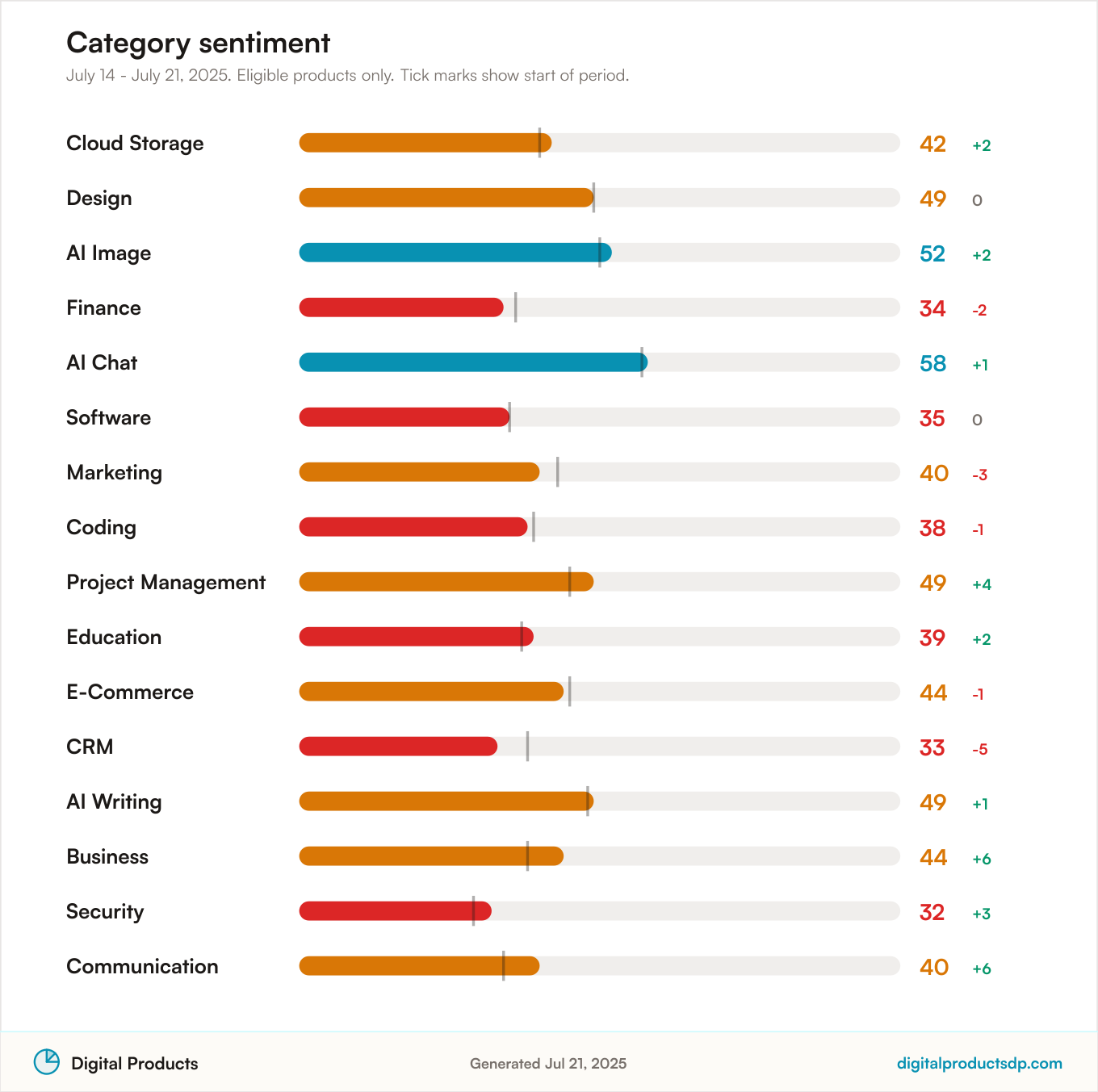
At the category level, ai-chat held the strongest average tone, moving from 57 to 58 across the period, with ai-image close behind rising from 50 to 52. The clearest upward shifts came in business, which climbed from 38 to 44, communication, up from 34 to 40, and project-management, which rose from 45 to 49. Moving in the other direction, crm fell from 38 to 33, marketing eased from 43 to 40, and finance slipped from 36 to 34. Categories such as design (49 to 49) and software (35 to 35) held flat, while coding drifted from 39 to 38. These are averages across eligible products only, so a single sharp mover within a small category can pull the group figure noticeably.
Biggest Movers
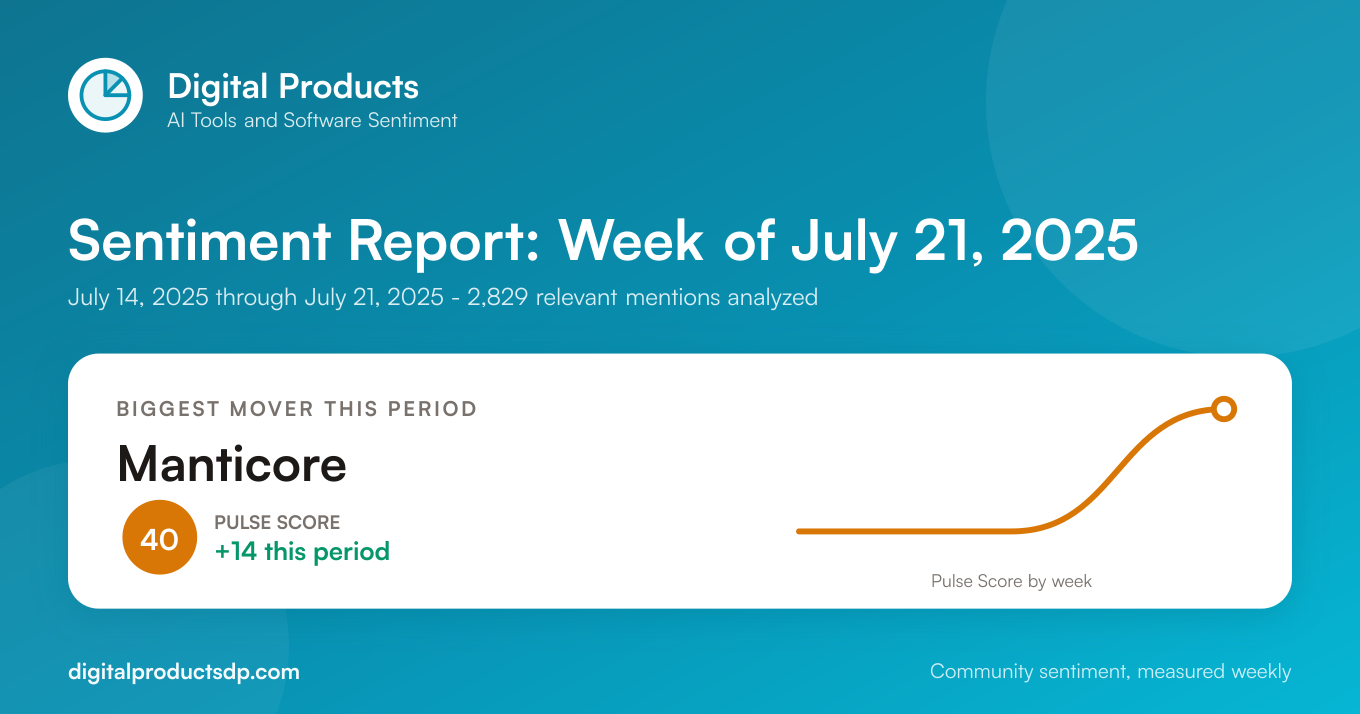
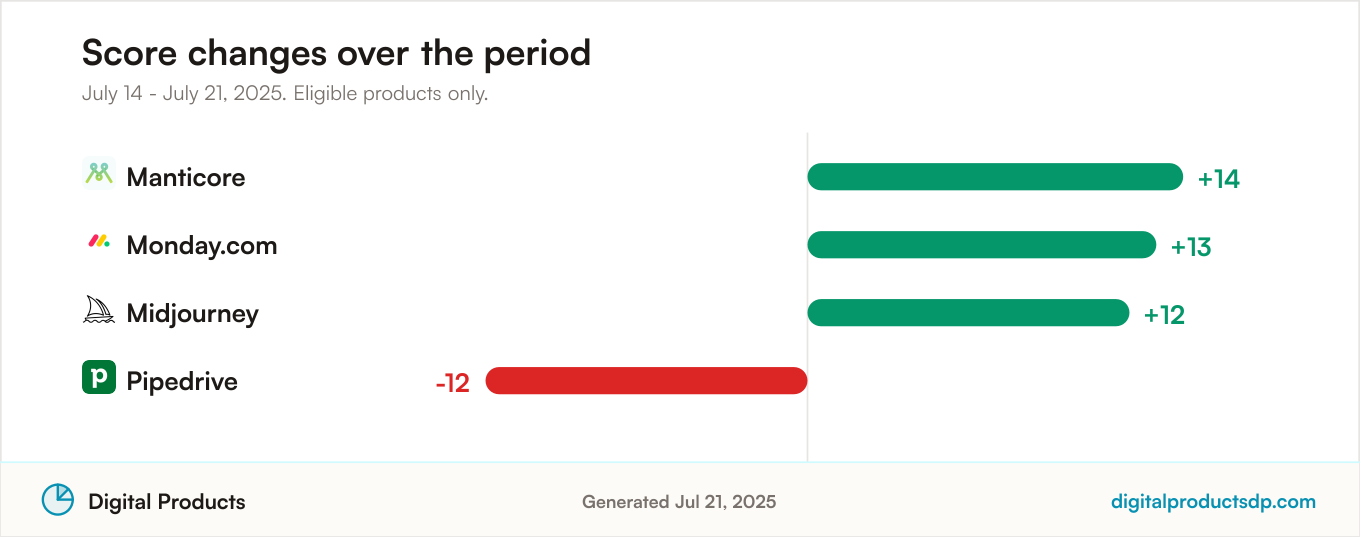
Manticore rose from 26 to 40, a gain of 14 points, based on 51 mentions. Its praise discussion this week leaned on strong features (6 mentions) alongside performance (4 mentions) and a sense that it feels fast (3 mentions). That said, the complaint side remained substantial, led by bugs (20 mentions) and reliability (14 mentions), so the improvement in tone came against a backdrop where stability concerns were still the loudest recurring theme.
Monday.com climbed from 35 to 48, up 13 points, based on 16 mentions. Its praise themes were modest in volume, with strong features (4 mentions), good integrations (3 mentions), and AI quality (2 mentions). Complaints centered on bugs (7 mentions), comparisons to rivals (6 mentions), and pricing seen as too high (4 mentions), suggesting the improved sentiment coexisted with ongoing debate about value and competitive positioning.
Midjourney moved from 49 to 61, a 12-point rise, based on 11 mentions. Discussion praised its AI quality (34 mentions) and strong features (33 mentions), with some noting it feels fast (15 mentions). The complaint side referenced AI quality (11 mentions), comparisons to rivals (8 mentions), and reliability (6 mentions), meaning the same output-quality theme appeared on both sides of the ledger. The small mention base warrants caution in reading the size of the move.
Pipedrive was the steepest faller, dropping from 36 to 24, a decline of 12 points, based on 10 mentions. Praise was sparse, with strong features, good integrations, and easy to use each drawing only a handful of mentions. The complaint mix was dominated by bugs (12 mentions), lacking integrations (10 mentions), and reliability (5 mentions), which lines up with the broader softening seen across the crm category this period.
Mailchimp fell from 55 to 44, down 11 points, based on 11 mentions. Its limited praise touched on good integrations (4 mentions) and easy to use (2 mentions), while complaints were led by comparisons to rivals (10 mentions), bugs (8 mentions), and missing features (5 mentions). The prominence of rival comparisons suggests much of the negative tone framed the product against alternatives rather than around outright failures.
Fivetran declined from 38 to 28, a 10-point drop, based on 18 mentions. Praise was minimal, with good integrations, strong features, and feature requests each appearing once. Complaints were concentrated in bugs (15 mentions), reliability (13 mentions), and lacking integrations (9 mentions), a pattern that points to stability and connectivity as the dominant drivers of the week's more critical discussion.
Spotlight: Obsidian
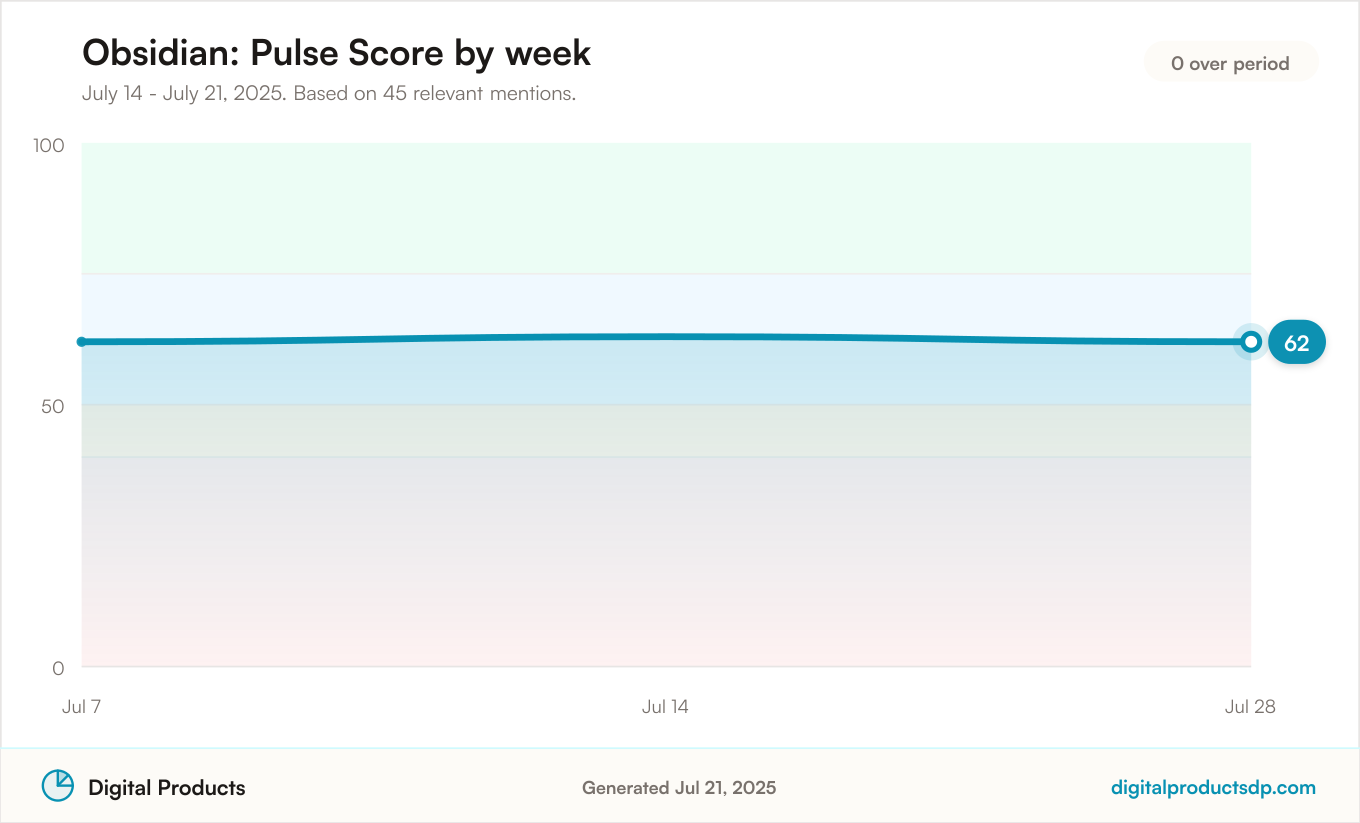
Obsidian, a project-management product, held the top Pulse Score at 62, based on 45 mentions over the period. Its weekly series was notably stable, moving from 62 on July 7, 2025 to 63 on July 14, 2025 and settling back at 62 on July 21, 2025. That consistency stands out in a field where several leaders and fallers swung by double digits, and it points to a settled and broadly favorable tone in the discussion around the product.
The praise themes help explain the position. Strong features led with 40 mentions, followed by good integrations at 25 mentions and easy to use at 20 mentions. Those three themes together describe a product that community discussion frames around capability and fit rather than novelty, which tends to produce steadier sentiment week to week.
The complaint side was not empty. Bugs drew 28 mentions, missing features 20 mentions, and reliability 13 mentions. That mix mirrors the wider pattern across the leaderboard, where even the highest-scoring products carry meaningful volumes of bug and reliability talk. In Obsidian's case, the favorable themes outweighed those concerns enough to keep it at the front, but the presence of the same complaint categories is a reminder that leading on tone does not mean an absence of criticism.
Themes Driving the Conversation
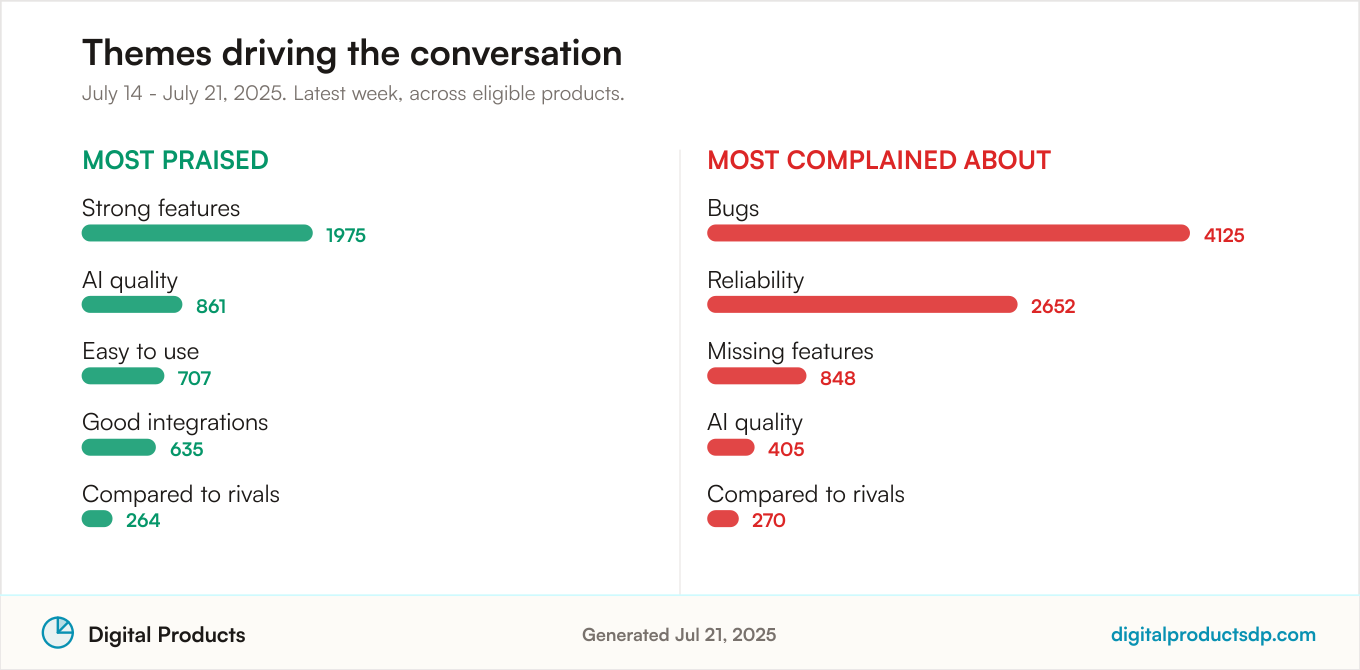
On the praise side, strong features dominated the latest week with 1,975 mentions, well ahead of AI quality at 861 mentions, easy to use at 707 mentions, and good integrations at 635 mentions, with comparisons to rivals trailing at 264 mentions. The feature theme showed up across the leaders and risers alike, from Obsidian and Cursor to Claude and ChatGPT, while AI quality anchored the positive discussion around products such as Gemini, Claude, and Midjourney. Good integrations recurred prominently for products like Cursor, Grafana, and Clerk, reinforcing that community praise clusters around capability, usability, and how well products connect to other tools.
The complaint side was heavier in absolute terms. Bugs led by a wide margin at 4,125 mentions, followed by reliability at 2,652 mentions, missing features at 848 mentions, AI quality at 405 mentions, and comparisons to rivals at 270 mentions. These two leading themes show up repeatedly across the field: ClickHouse carried 441 bug mentions, dbt 357, Grafana 258, and CockroachDB 259, while reliability drove much of the critical discussion around Stripe, Vercel, and ArgoCD. Notably, AI quality appears on both the praise and complaint lists, which reflects a divided conversation around AI chat and AI image products where the same output dimension earns both applause and criticism.
Watchlist
A large share of the tracked list did not clear the 10-mention threshold this period and is therefore excluded from rankings. This is a matter of discussion volume, not a judgment on quality. Several products sat just below the line and are worth monitoring: Astro (9 relevant mentions), Kinde (9 relevant mentions), Thinkific (9 relevant mentions), Cloudflare (9 relevant mentions), DigitalOcean (8 relevant mentions), and Bitbucket (8 relevant mentions) all came close. A tier down, products including Asana (7 relevant mentions), ClickUp (7 relevant mentions), Semrush (7 relevant mentions), Honeycomb (7 relevant mentions), Anyscale (7 relevant mentions), Braze (7 relevant mentions), Doppler (7 relevant mentions), Forte (7 relevant mentions), and Directus (7 relevant mentions) drew steady but thin discussion.
Many widely used names registered very little chatter in our sources this period, including DALL-E (7 relevant mentions), Veo (6 relevant mentions), LottieFiles (6 relevant mentions), Loom (6 relevant mentions), Foxit (6 relevant mentions), Klaviyo (6 relevant mentions), HubSpot (5 relevant mentions), Coursera (5 relevant mentions), Sudowrite (5 relevant mentions), Trello (5 relevant mentions), Jenkins (5 relevant mentions), and AVG (5 relevant mentions). A great many others recorded zero relevant mentions in the window. Low volume can reflect the specific sources sampled, seasonal quiet, or simply that a product was not a topic of conversation in the communities we track this week, and inclusion in rankings can change as volume rises.
What To Watch Next Week
First, watch whether the crm softening continues. The category fell from 38 to 33 this period, and Pipedrive's drop from 36 to 24 on 10 mentions was a large part of that. Whether that reflects a durable shift in tone or a thin-sample swing is worth confirming as volume accumulates.
Second, keep an eye on the small-sample leaders. Midjourney reached 61 on only 11 mentions and ChatGPT scored 59 on 15 mentions. Scores built on limited discussion can move sharply, so it will be informative to see whether their standing holds once mention counts grow.
Third, monitor the persistence of bugs and reliability as the dominant complaint themes. With 4,125 bug mentions and 2,652 reliability mentions in the latest week, these themes are shaping sentiment across the field, and their trajectory will be central to how category averages move next period.
Frequently Asked Questions
Which product had the highest Pulse Score this period?
Obsidian led with a Pulse Score of 62, based on 45 mentions over the period, narrowly ahead of Midjourney at 61 and a cluster of AI chat products at 60.
Which product moved the most this period?
Manticore posted the biggest rise, climbing from 26 to 40 for a 14-point gain based on 51 mentions, while Pipedrive was the steepest faller, dropping from 36 to 24 based on 10 mentions.
What was the overall category mood?
AI chat held the strongest average tone, edging from 57 to 58, while crm softened the most, falling from 38 to 33. Business, communication, and project-management all posted notable gains.
How many mentions were analyzed this period?
We analyzed 2,829 relevant mentions across 73 eligible products, drawn from a wider tracked list of 2,246 products for July 14, 2025 through July 21, 2025.
About This Data
Pulse Scores summarize the tone of public online discussion on a 0-100 scale and reflect community sentiment, not a verdict on a product's quality or a recommendation. We report on complete calendar weeks only, and products with fewer than 10 relevant mentions in the period are excluded from rankings to avoid unstable reads on thin samples.
Public discussion is collected from Hacker News, Stack Exchange, GitHub, Bluesky, the Apple App Store, and YouTube. Automated sentiment analysis can misread sarcasm, jokes, or niche context, mention volumes vary widely between products, and scores can move from one week to the next. Any company that wants to respond to what it sees here is welcome to reach out. For more on how these figures are produced, see our methodology.