Back to blog
Comparisons

Cursor vs GitHub Copilot: Week of July 6, 2026

July 6, 2026
Cursor vs GitHub Copilot: Week of July 6, 2026

Few matchups in the AI coding space draw as much attention as Cursor against GitHub Copilot. Both aim to speed up how developers write, refactor, and understand code, and both have loyal followings alongside vocal critics. To cut through the noise, we looked at aggregated public online discussion from the week of June 29 to July 6, 2026, and translated the tone of that conversation into Pulse Scores on a 0-100 scale.

This is not a verdict on which product is technically superior. It is a snapshot of how the community talked about each tool during a single calendar week, including what people praised, what frustrated them, and how the overall mood compared. The numbers below reflect sentiment, not facts about features, so read them as a directional signal rather than a scorecard.

RankProductCategoryPulse ScoreRelevant MentionsVisit
1CursorCoding561,300Visit ↗
2GitHub CopilotCoding47937Visit ↗

Cursor

Cursor Pulse Score trend from aggregated public discussion

Cursor posted a Pulse Score of 56 for the week, drawn from 1,300 total mentions. That makes it both the higher-scoring and the more-discussed of the two tools in this comparison, which suggests it was carrying momentum in community conversation during the period.

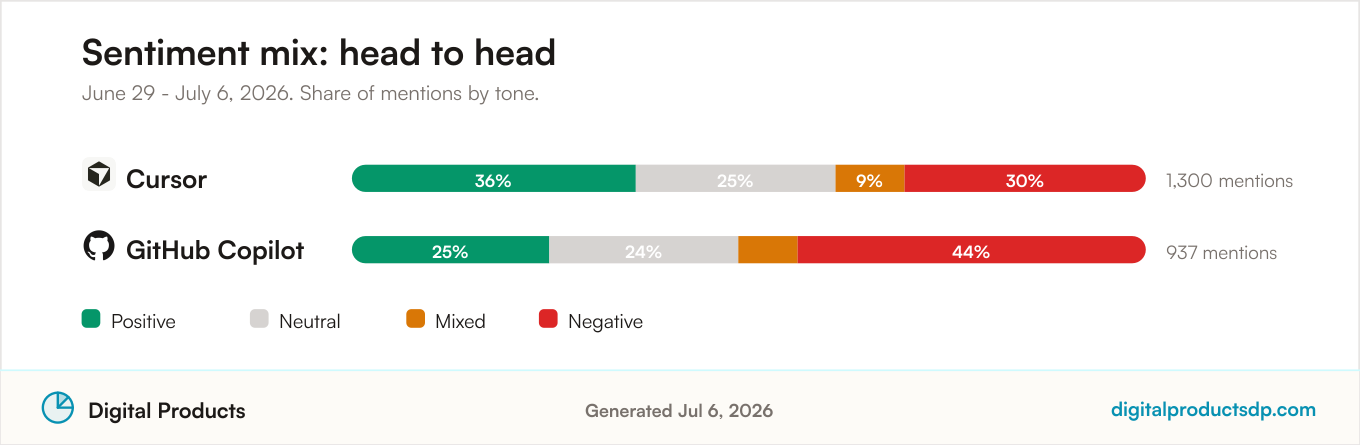
The sentiment mix leaned positive relative to its rival. Cursor saw 36% positive, 25% neutral, 9% mixed, and 30% negative mentions. A positive share that outweighs the negative share is a reasonably healthy sign, though the near-30% negative slice shows the enthusiasm was far from universal.

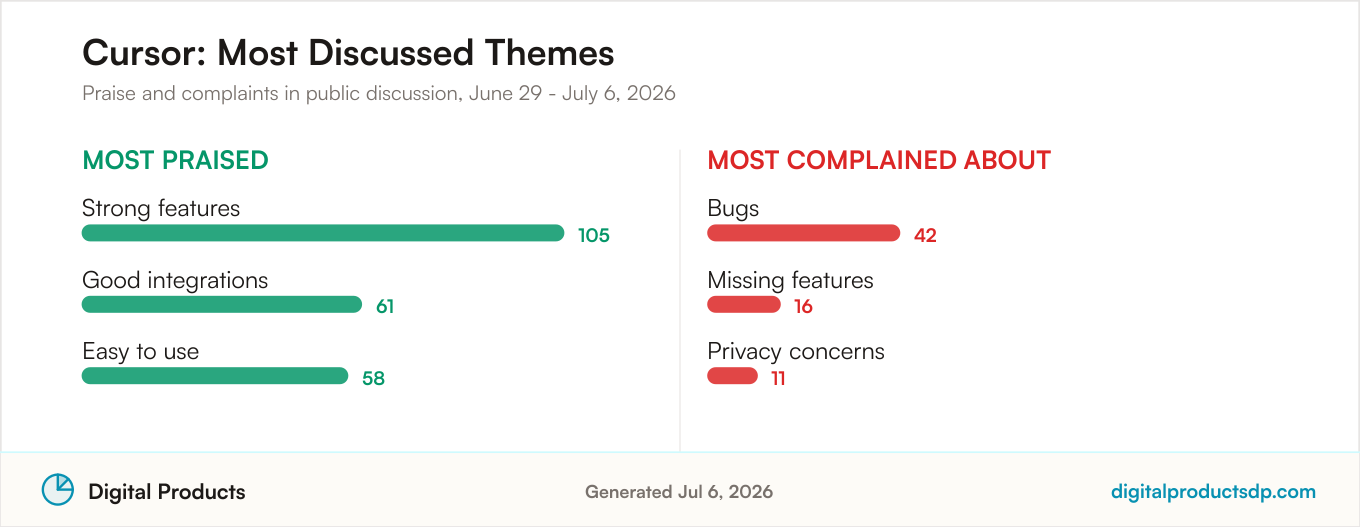
On the praise side, the standout theme was strong features, cited 105 times, followed by good integrations at 61 and easy to use at 58. That combination points to a tool that people find capable and approachable, with the editor integration story resonating in particular.

The complaints clustered around bugs, mentioned 42 times, with missing features at 16 and privacy concerns at 11 trailing behind. Notably, the volume of bug complaints was far lower than what the competing tool attracted, which helps explain the gap in overall tone.

Most praised and most complained about themes for Cursor from aggregated public discussion

GitHub Copilot

GitHub Copilot Pulse Score trend from aggregated public discussion

GitHub Copilot registered a Pulse Score of 47 across 937 total mentions. That places it below Cursor on both tone and volume for the week, though a mention count in the high hundreds still represents a substantial and active conversation.

Its sentiment mix was more challenging. GitHub Copilot saw 25% positive, 24% neutral, 7% mixed, and 44% negative mentions. A negative share approaching half of all discussion is the clearest single driver of its lower Pulse Score, and it stands in contrast to the more balanced picture around Cursor.

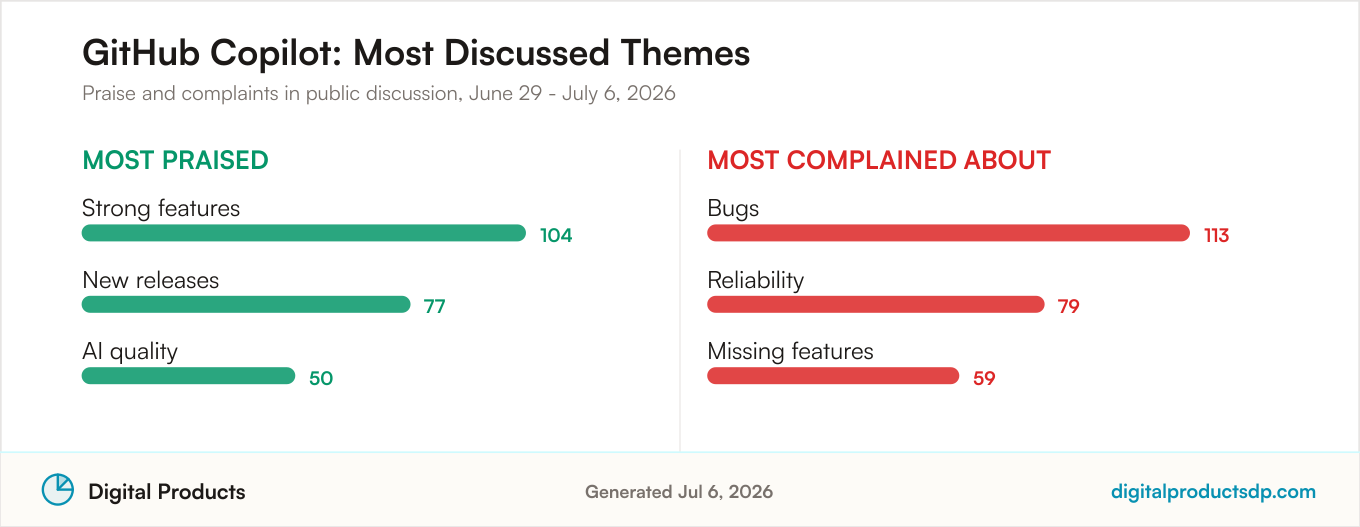
The praise was real, though. Strong features led with 104 mentions, almost identical to Cursor's tally, followed by new releases at 77 and AI quality at 50. The attention on new releases suggests active shipping was landing with at least part of the audience, and the AI quality praise is a meaningful differentiator that Cursor did not attract in the same way.

The problem was on the complaint side. Bugs dominated at 113 mentions, with reliability close behind at 79 and missing features at 59. Those are heavy numbers, especially the reliability theme, and together they explain why the negative sentiment ran so high despite genuine praise for the underlying capabilities.

Most praised and most complained about themes for GitHub Copilot from aggregated public discussion

How They Compare

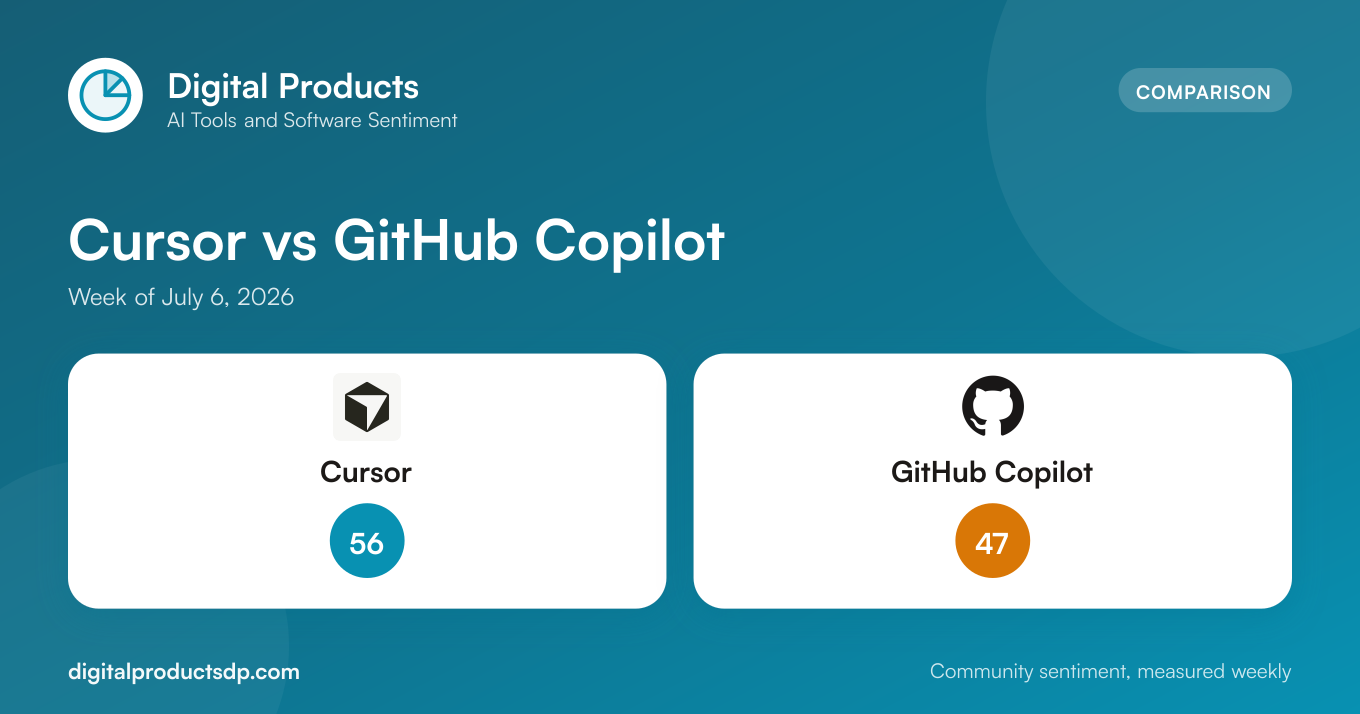
On the headline number, Cursor leads with a Pulse Score of 56 against GitHub Copilot's 47, a nine-point gap. Cursor also drew more conversation overall, with 1,300 mentions versus 937, so it was both more talked about and more warmly received during the week.

The sentiment mix tells the sharper story. Cursor's positive share of 36% comfortably exceeded its 30% negative share, while GitHub Copilot's picture inverted, with 44% negative against just 25% positive. In other words, the average GitHub Copilot mention during this window was more likely to be critical than complimentary, whereas the balance tilted the other way for Cursor.

Sentiment mix comparison for Cursor vs GitHub Copilot

Interestingly, both tools shared the same top praise theme. Cursor logged 105 mentions of strong features and GitHub Copilot logged 104, a near dead heat. The community clearly sees both as capable. The divergence appears on the complaint side. Cursor's leading gripe, bugs, was cited 42 times. GitHub Copilot's bug complaints reached 113, and it carried an additional 79 reliability mentions that Cursor's data did not surface as a top theme at all.

The trend chart above provides context on how each score moved over the review period rather than at a single instant. Read alongside the weekly numbers, it helps show whether the gap is a stable pattern or a short-term swing. Either way, the week of July 6, 2026 favored Cursor on the metrics we track.

Which Should You Choose

The data here measures conversation tone, not fit for your specific workflow, so treat the following as one input among many.

If you weight community sentiment heavily and want the tool that generated the most positive discussion this week, Cursor is the clear pick. Its higher Pulse Score, higher positive share, and lower bug and reliability complaint volume all point in the same direction. The recurring praise for integrations and ease of use suggests it lands well with developers who value a smooth in-editor experience.

That said, GitHub Copilot should not be dismissed on these numbers alone. It matched Cursor almost exactly on the strong features theme and uniquely drew praise for AI quality, cited 50 times, and for new releases, cited 77 times. If raw model quality and active shipping matter most to you, those are meaningful signals. The caveat is the reliability and bug conversation, which was heavy this week and worth investigating before committing.

For teams evaluating both, the pragmatic move is to trial each against your own codebase. Sentiment can reflect a rough patch, a recent release, or a vocal minority as much as it reflects lasting quality. Use these scores to frame your questions, not to close them.

About This Data

Pulse Scores summarize the tone of public online discussion on a 0-100 scale. They reflect community sentiment, not a verdict on a product's quality and not a recommendation to buy or avoid anything. A higher score means the aggregated conversation skewed more positive during the period, nothing more.

We report on complete calendar weeks only, and we exclude any product with fewer than 10 relevant mentions in the period to avoid unstable reads on thin samples. Public discussion is collected from Hacker News, Stack Exchange, GitHub, Bluesky, the Apple App Store, and YouTube. Automated sentiment analysis can misread sarcasm, jokes, or niche technical context, mention volumes vary widely between products, and scores can move week to week. Any company that wants to respond to its coverage is welcome to reach out. For how scores are calculated, see our methodology.

Frequently Asked Questions

Which has the higher Pulse Score, Cursor or GitHub Copilot?

Cursor had the higher Pulse Score for the week of July 6, 2026, at 56 compared with GitHub Copilot's 47, a nine-point difference based on aggregated public discussion.

Which tool was more positively received this week?

Cursor was more positively received. It recorded 36% positive sentiment against 30% negative, while GitHub Copilot recorded 25% positive against 44% negative, meaning its discussion skewed more critical during the period.

How many mentions did each tool have?

Cursor drew 1,300 total mentions and GitHub Copilot drew 937 total mentions across the week of June 29 to July 6, 2026, so Cursor was the more heavily discussed of the two.

Which is better if AI quality matters most to me?

Based on the themes in this data, GitHub Copilot uniquely attracted praise for AI quality, cited 50 times, alongside 77 mentions of new releases. If model output is your priority, that is a relevant signal, though you should weigh it against its higher bug and reliability complaint volume.