AI Tools and Software Sentiment Report: Week of July 7, 2025
July 8, 2025
This edition of our weekly sentiment tracker looks at aggregated public online discussion for tools and software, drawing on mentions analyzed for June 30, 2025 through July 7, 2025. The digest behind this report spans three complete calendar weeks running from June 23, 2025 through July 7, 2025, and the figures here describe the tone of community chatter rather than any verdict on how these products actually perform.
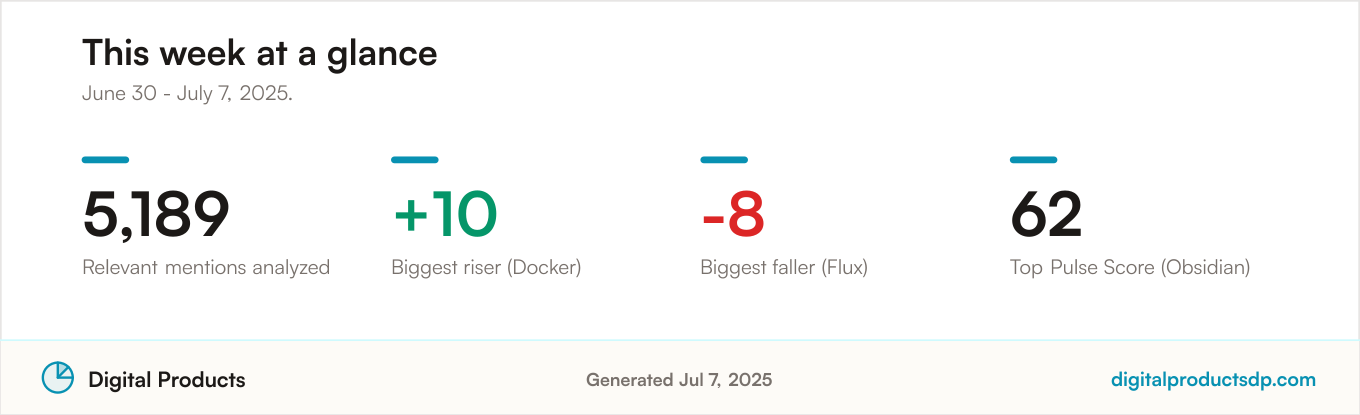
Across the period we analyzed 5,189 relevant mentions. Of the 2,246 products we track, 78 cleared the threshold of at least 10 relevant mentions and were eligible for rankings. The picture that emerges is one of steady leaders at the top, a handful of sharp movers, and a complaint conversation dominated by reliability and bugs. Everything below traces back to those numbers.
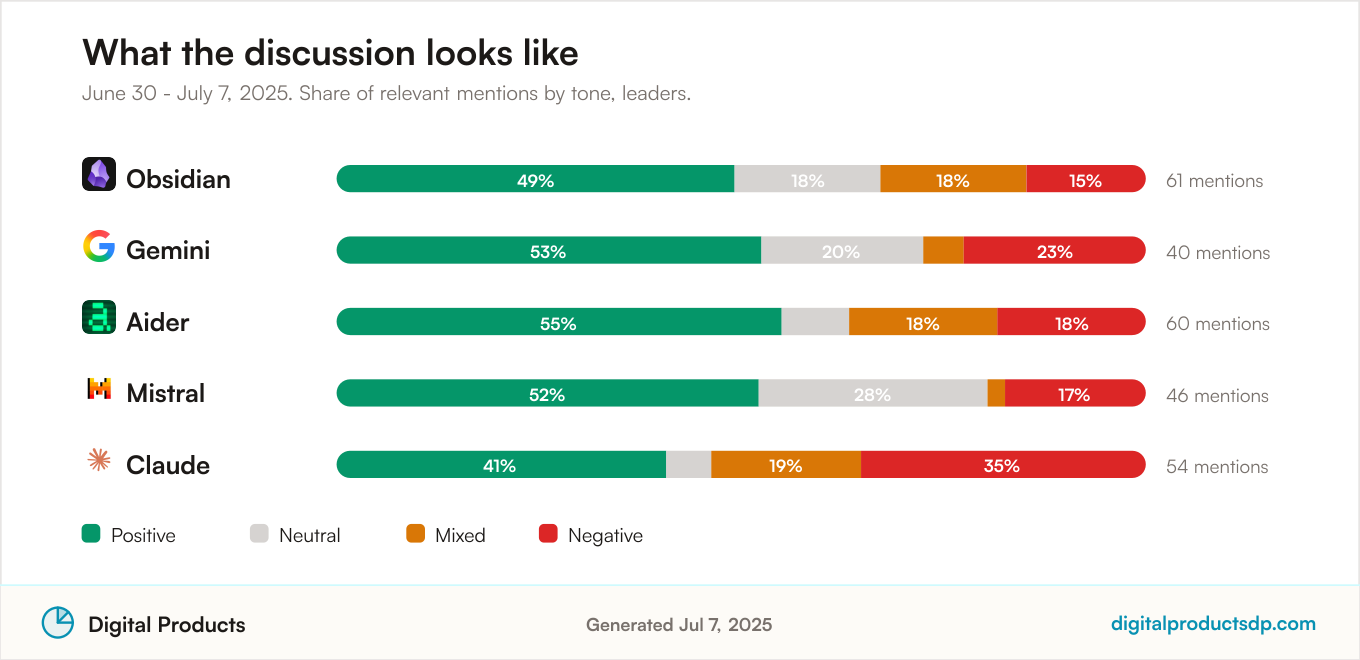
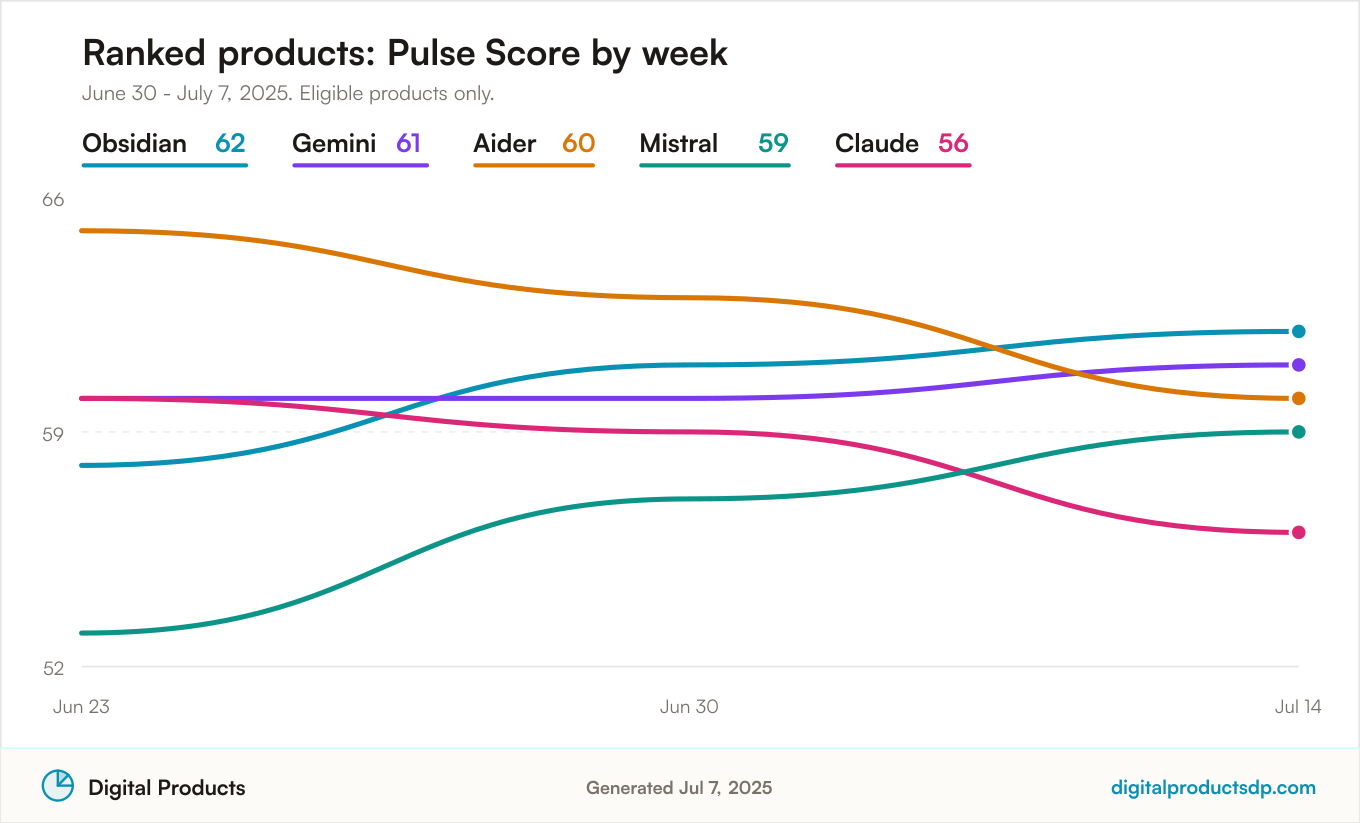
Obsidian topped the table with a Pulse Score of 62, based on 61 mentions over the period. It sat just ahead of Gemini at 61, based on 40 mentions, and Aider at 60, based on 60 mentions. Mistral followed at 59 across 46 mentions, and Claude rounded out the top five at 56 across 54 mentions. These are close scores, and with sample sizes in the dozens rather than the hundreds, small shifts in tone can move the order week to week.
Three of the five leaders are AI chat products (Gemini, Mistral, and Claude), while Obsidian is a project-management tool and Aider is a coding tool. That mix is worth noting: the strongest community sentiment this period was not confined to one category. It clustered instead among tools where praise for features and AI quality showed up prominently in the theme data.
Category View
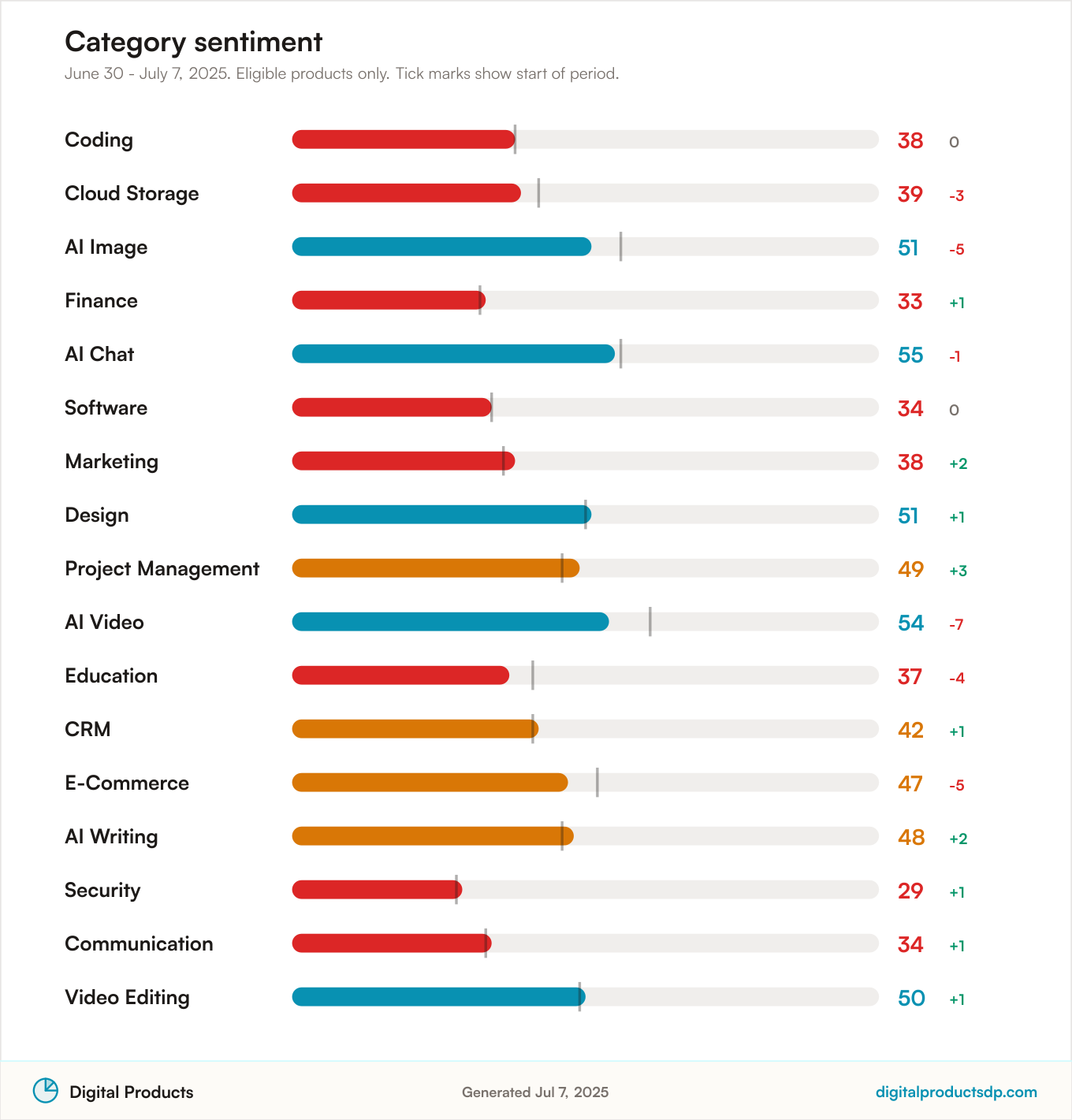
At the category level, most averages moved only slightly. Project-management rose from 46 to 49 and design edged up from 50 to 51, while ai-writing moved from 46 to 48 and marketing from 36 to 38. The clearest declines came in ai-video, which fell from 61 to 54, ai-image, which slipped from 56 to 51, and e-commerce, which dropped from 52 to 47. Coding held flat at 38, software held flat at 34, and ai-chat barely moved from 56 to 55. The security category remained the lowest average tracked, moving only from 28 to 29, which fits with the heavy reliability and bug complaint volume seen across infrastructure products.
Biggest Movers
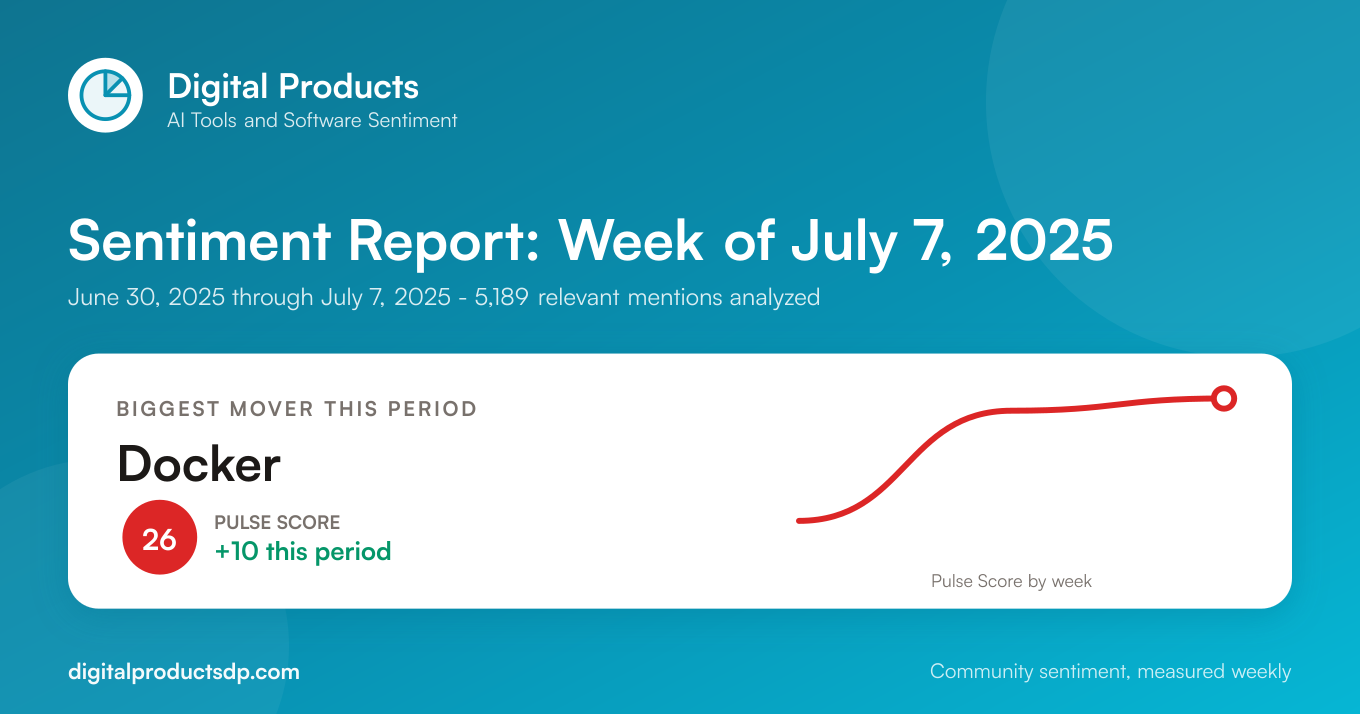
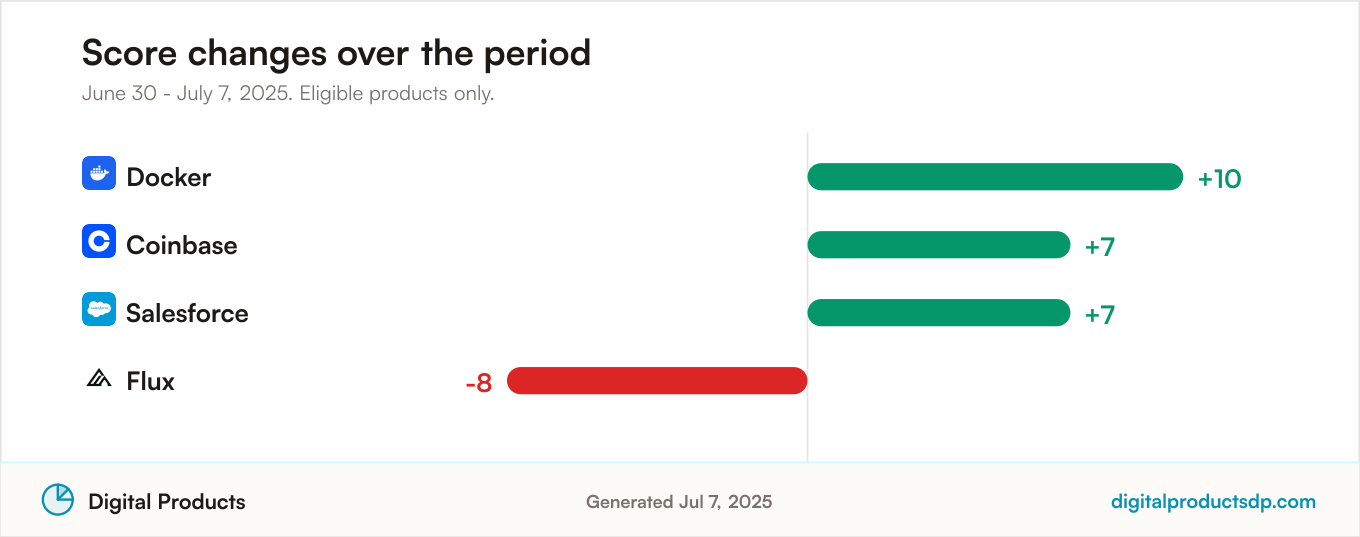
Docker (riser, +10, from 16 to 26, based on 93 mentions). Docker posted the largest gain of the period, though it started from a low base. Its latest-week praise themes centered on being easy to use (21 mentions), feature requests (17 mentions), and strong features (16 mentions). The complaint side remained heavy, with bugs (196 mentions), reliability (133 mentions), and missing features (48 mentions) all prominent. The rise in tone did not erase the volume of frustration in the discussion; it reflects a shift toward more favorable framing even as reliability chatter persisted.
Coinbase (riser, +7, from 29 to 36, based on 16 mentions). Coinbase moved up on a thin sample. Its praise themes were strong features (20 mentions), easy to use (17 mentions), and new releases (10 mentions), while complaints included bugs (9 mentions), poor support (8 mentions), and missing features (8 mentions). With only 16 mentions in the period, this read should be treated cautiously, but the balance of praise around features and releases lines up with the upward move.
Salesforce (riser, +7, from 32 to 39, based on 40 mentions). The Salesforce discussion leaned on new releases (9 mentions), good integrations (8 mentions), and strong features (8 mentions) in praise. Complaints were still substantial, led by bugs (56 mentions), reliability (30 mentions), and missing features (22 mentions). As a CRM platform rather than an AI tool, Salesforce shows the same pattern seen across enterprise software this period: rising sentiment driven by release and integration talk, set against a persistent bug and reliability backdrop.
Flux (faller, -8, from 57 to 49, based on 19 mentions). Flux fell the most. Its praise themes were AI quality (33 mentions), strong features (22 mentions), and new releases (13 mentions), but complaints around bugs (19 mentions), performance (17 mentions), and reliability (11 mentions) weighed on the tone. The performance and reliability chatter appears to be the drag here, pulling an ai-image tool that started the period strong back toward the middle.
Veo (faller, -7, from 61 to 54, based on 14 mentions). Veo slid on a small sample of 14 mentions. Praise centered on strong features (12 mentions), new releases (8 mentions), and AI quality (7 mentions), while complaints included bugs (10 mentions), reliability (5 mentions), and missing features (5 mentions). Its decline mirrors the broader ai-video category, which fell from 61 to 54 over the same window.
Fly.io (faller, -7, from 44 to 37, based on 23 mentions). Fly.io's discussion was dominated by reliability concerns. Even its praise list included reliability (16 mentions) alongside easy to use (17 mentions) and strong features (17 mentions), but the complaint side was far heavier, led by reliability (54 mentions), bugs (49 mentions), and downtime (13 mentions). When reliability appears at the top of both praise and complaints, the negative volume tends to set the direction, and here it pushed the score down.
Spotlight: Obsidian
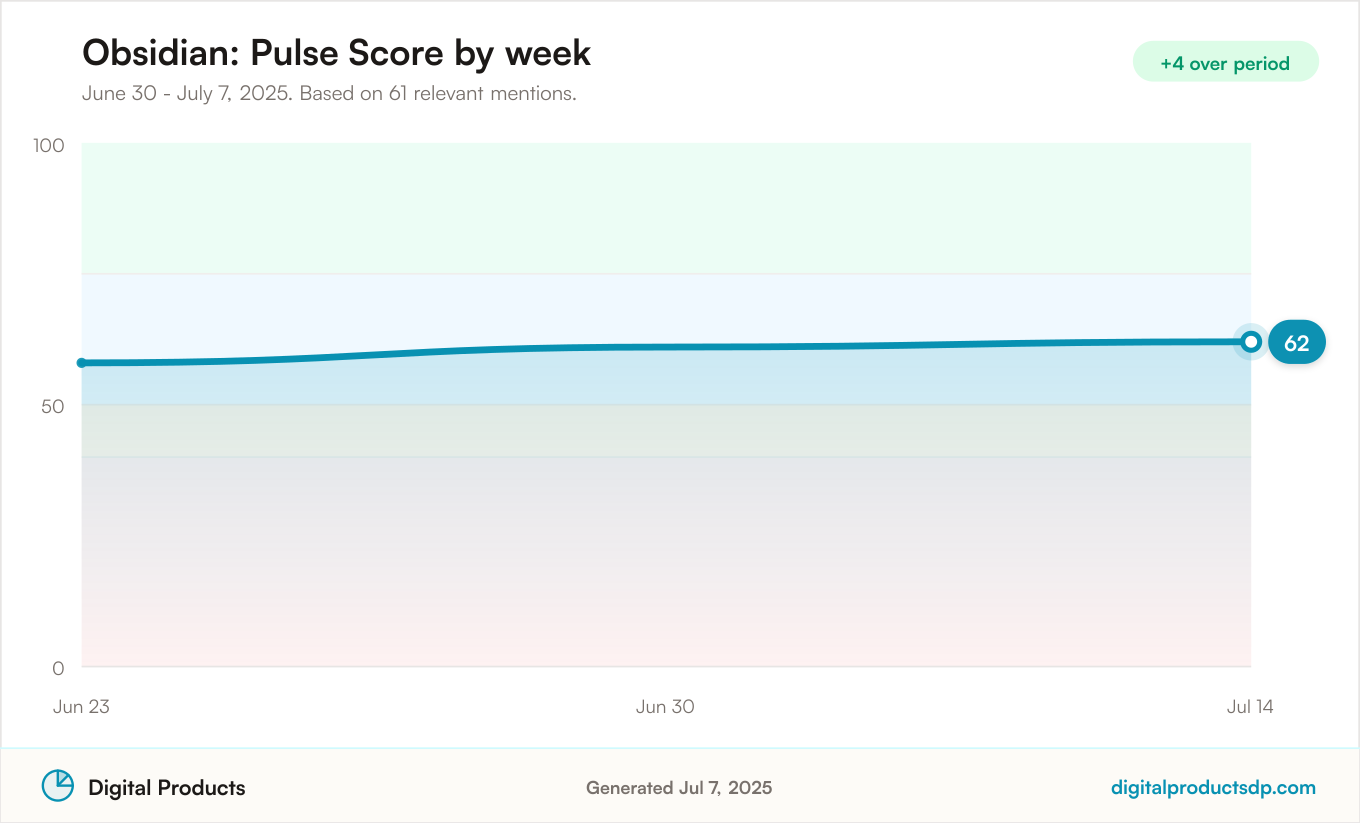
Obsidian led the period with a Pulse Score of 62, based on 61 mentions. Its weekly series shows a steady climb: 58 on June 23, 2025, rising to 61 on June 30, 2025, and reaching 62 on July 7, 2025. That is a gentle, consistent trend rather than a spike, which tends to signal durable community sentiment rather than a one-week reaction.
The theme breakdown helps explain the position. Obsidian's latest-week praise was led by strong features (40 mentions), good integrations (25 mentions), and easy to use (20 mentions). That combination of capability, extensibility, and approachability is a favorable mix in the public discussion, and it is consistent with the project-management category average rising from 46 to 49 over the period.
The conversation was not entirely positive. Obsidian's complaint themes included bugs (28 mentions), missing features (20 mentions), and reliability (13 mentions). Those are meaningful counts, but relative to the praise volume they did not offset the overall tone. The takeaway is that Obsidian led on balance, not on the absence of criticism.
Themes Driving the Conversation
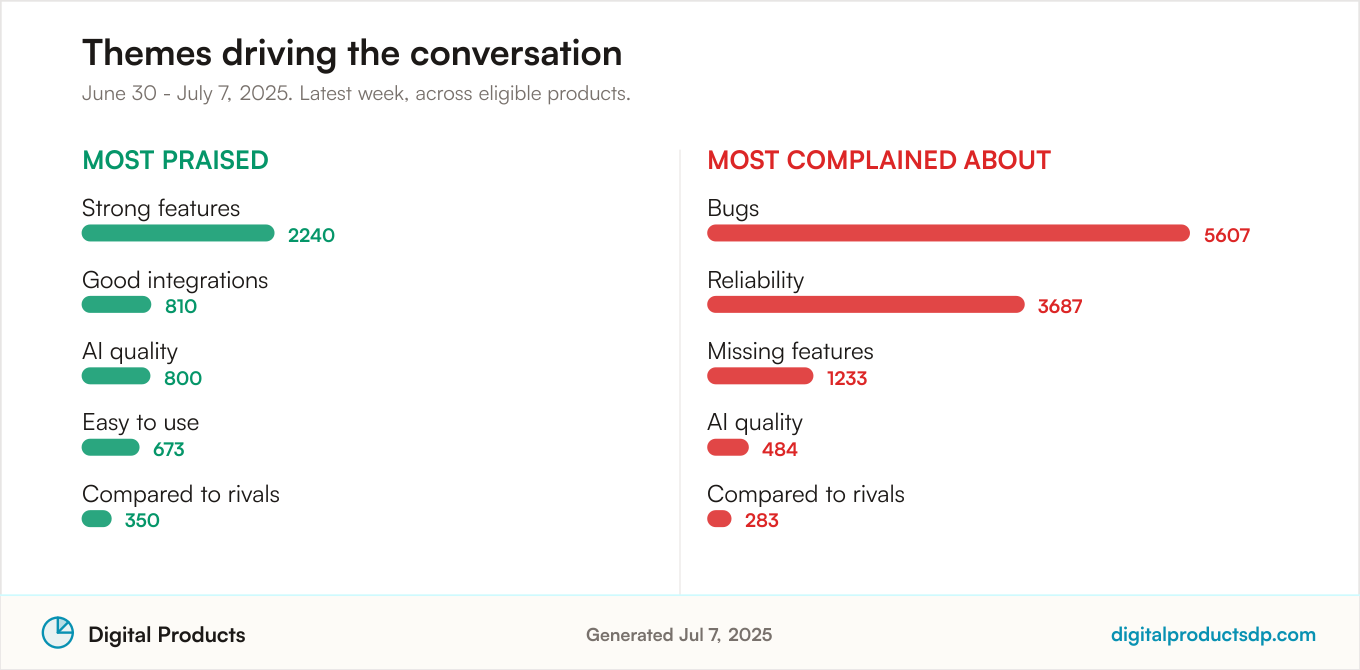
On the praise side, strong features dominated with 2,240 mentions in the latest week, well ahead of good integrations at 810 mentions, AI quality at 800 mentions, easy to use at 673 mentions, and compared to rivals at 350 mentions. Strong features and easy to use showed up repeatedly among the leaders, including Obsidian, Aider, and Cursor, while AI quality was the top praise theme for Gemini (149 mentions), Claude (234 mentions), and DeepSeek (122 mentions). Good integrations anchored the praise for products like Grafana (95 mentions) and Cloudflare, reflecting how much the community values how well tools connect.
The complaint conversation was far louder in raw volume. Bugs led with 5,607 mentions, followed by reliability at 3,687 mentions, missing features at 1,233 mentions, AI quality at 484 mentions, and compared to rivals at 283 mentions. Bugs and reliability were the top two complaints for many infrastructure and data products, including ClickHouse (441 and 290 mentions), DuckDB (375 and 256 mentions), dbt (357 and 208 mentions), and Cloudflare (203 and 177 mentions). The presence of AI quality on both the praise and complaint lists is notable: it was praised for products like Gemini and Claude while also drawing complaints for Grok (183 mentions) and Gemini (112 mentions), a sign that expectations around AI output are sharply divided in public discussion.
Watchlist
A large number of tracked products did not clear the threshold of 10 relevant mentions this period and were left out of the rankings. This is a reflection of discussion volume, not quality. Several well-known names sat just under the line, including Semrush with 9 relevant mentions, Gumroad with 9 relevant mentions, Klaviyo with 9 relevant mentions, Akamai with 9 relevant mentions, Dremio with 9 relevant mentions, and Braintrust with 9 relevant mentions. Others were close behind, such as Thinkific with 8 relevant mentions, Trello with 8 relevant mentions, Asana with 8 relevant mentions, Calendly with 8 relevant mentions, Forte with 8 relevant mentions, Fastly with 8 relevant mentions, and Hasura with 8 relevant mentions.
Further down, Devin, Jina AI, and Affirm each drew a handful of mentions but stayed well under the bar, and a long tail of products registered only a few mentions or none at all in the period. When a product has fewer than 10 relevant mentions, any score built on that base would swing wildly on a single post, which is exactly why we exclude it. If discussion around these names picks up in future weeks, several of them could enter the rankings quickly given how close some already are.
What To Watch Next Week
First, watch whether Docker's upward move holds. It rose from 16 to 26 over the period, based on 93 mentions, but its complaint volume around bugs and reliability remained heavy. Whether the more favorable tone sticks or reverts is worth monitoring.
Second, watch the ai-video and ai-image categories. Both declined this period, with ai-video falling from 61 to 54 and ai-image from 56 to 51, and their fallers Veo and Flux drove much of that. It is worth seeing whether the softer tone continues or stabilizes.
Third, watch the tight cluster at the top. Obsidian at 62, Gemini at 61, and Aider at 60 are separated by only two points, and with sample sizes in the dozens the ordering could easily shift. Small changes in praise or complaint volume for any of them could reshuffle the leaderboard.
Frequently Asked Questions
Which product had the highest Pulse Score this period?
Obsidian had the highest Pulse Score at 62, based on 61 mentions over the period, narrowly ahead of Gemini at 61 and Aider at 60.
Which product moved the most this period?
Docker was the biggest riser, moving from 16 to 26 for a gain of 10 points across 93 mentions, while Flux was the biggest faller, dropping from 57 to 49 across 19 mentions.
What was the overall mood across categories?
Most categories moved only slightly, with project-management rising from 46 to 49 and ai-chat nearly flat from 56 to 55, while ai-video fell from 61 to 54 and ai-image slipped from 56 to 51.
How many mentions were analyzed this period?
We analyzed 5,189 relevant mentions across 78 eligible products, drawn from the 2,246 products we track.
About This Data
Pulse Scores summarize the tone of public online discussion on a 0-100 scale and reflect community sentiment, not a verdict on a product's quality or a recommendation. We report on complete calendar weeks only, and products with fewer than 10 relevant mentions in the period are excluded from rankings to avoid unstable reads on thin samples.
Public discussion is collected from Hacker News, Stack Exchange, GitHub, Bluesky, the Apple App Store, and YouTube. Automated sentiment analysis can misread sarcasm, jokes, or niche context, mention volumes vary widely between products, and scores can move from week to week. If your company would like to respond to anything in this report, we welcome you to reach out. For more on how scores are calculated, see our methodology.