AI Tools and Software Sentiment Report: Week of June 23, 2025
June 24, 2025
This report tracks aggregated public online discussion about AI tools and broader software products, translating the tone of that chatter into Pulse Scores on a 0-100 scale. The figures here summarize community sentiment collected from public sources, and they describe how people are talking, not whether a product is good or bad. The window covered is the complete calendar week analyzed for June 16, 2025 through June 23, 2025, read against the two weeks that preceded it for context.
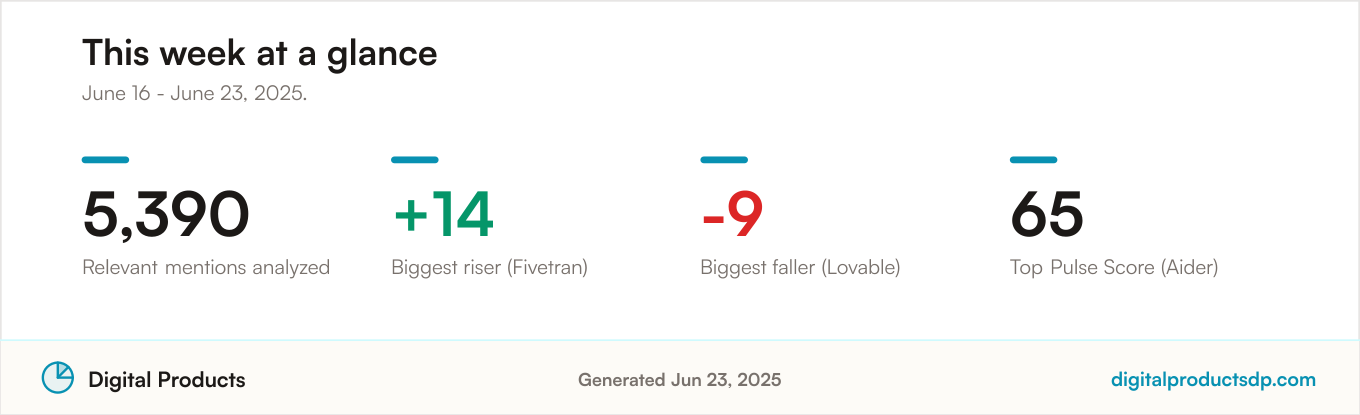
Across the period running from June 16, 2025 through June 23, 2025, we analyzed 5,390 relevant mentions spread across 85 products that cleared the minimum volume needed to rank. Those products span many categories, from coding tools and AI chat assistants to CRM platforms, payment infrastructure, and cloud services. The sections below walk through the leaderboard, category-level movement, the biggest sentiment swings, and the themes that shaped the conversation.
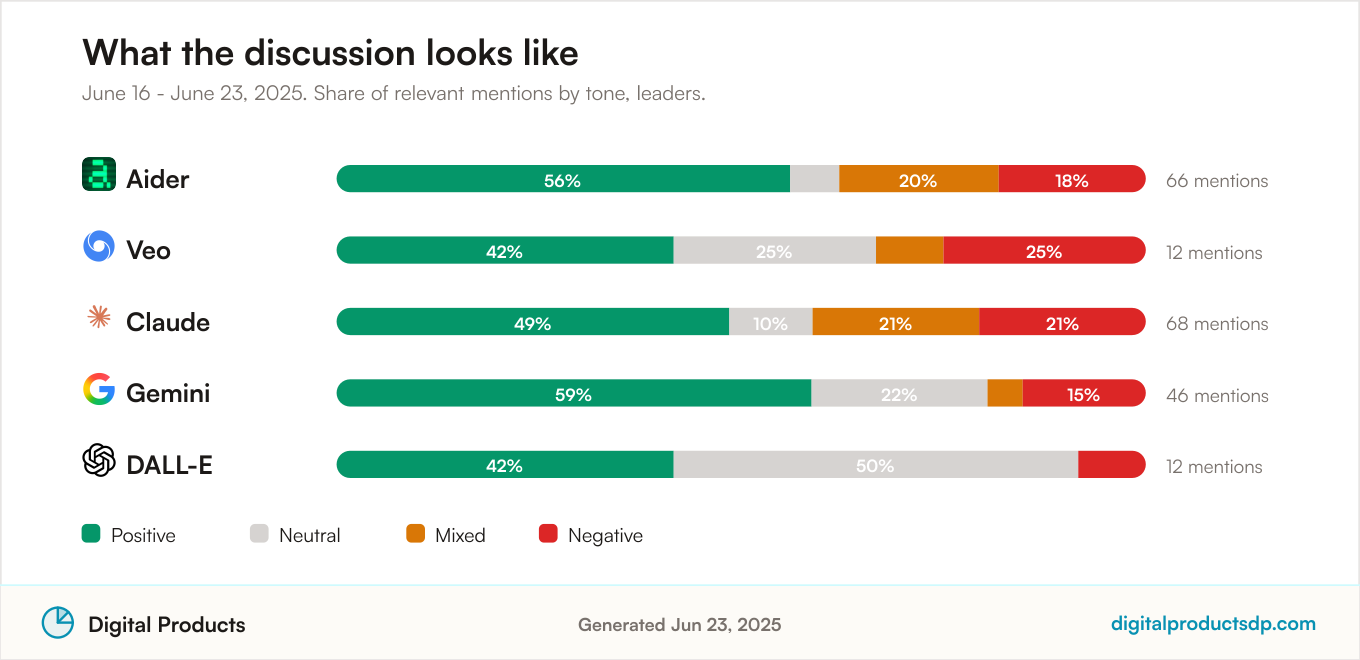
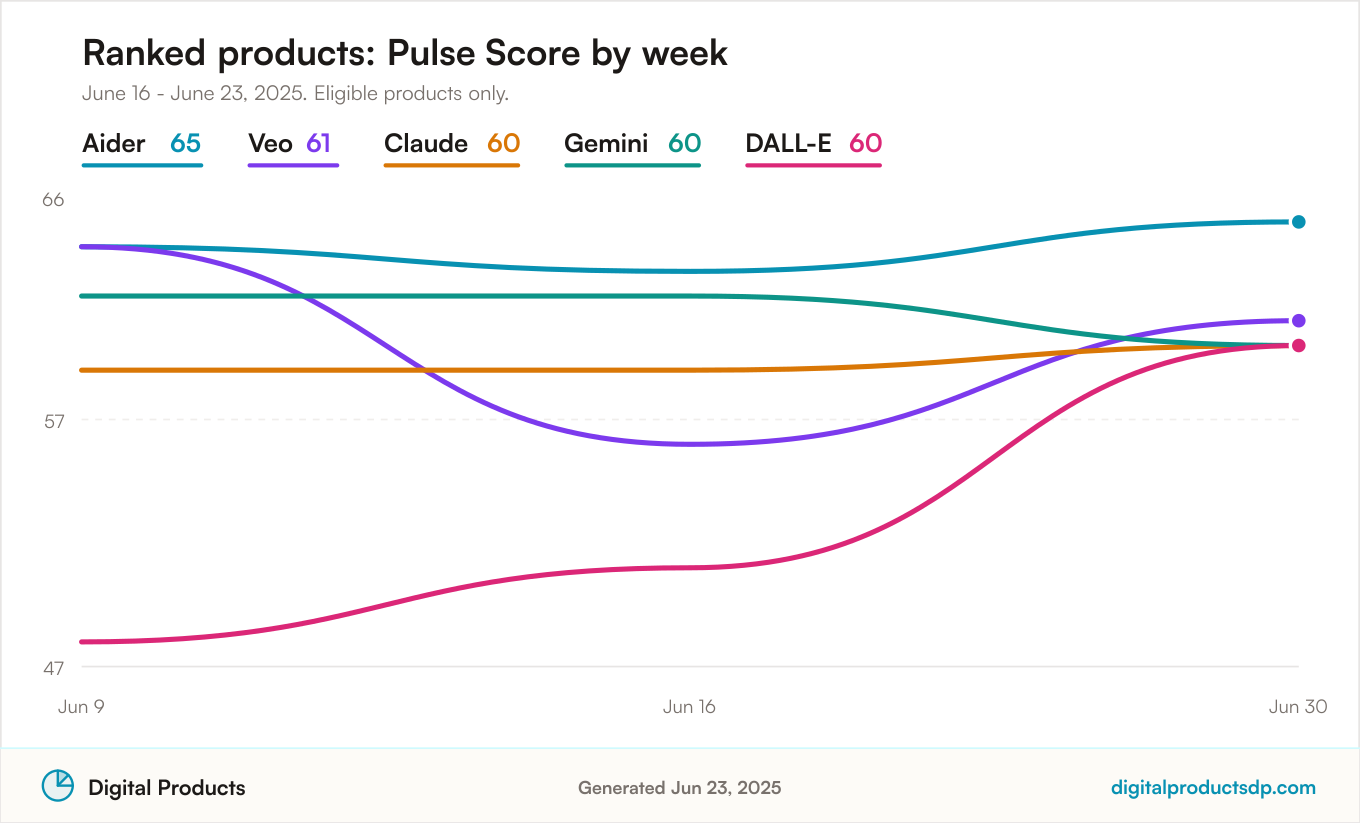
Aider sits at the top of the ranked products this period with a Pulse Score of 65, based on 66 mentions over the period. Behind it, Veo registered a 61 from a thin base of 12 mentions, while Claude posted a 60 from 68 mentions and Gemini matched that 60 from 46 mentions. DALL-E rounds out the leaders with a 60 drawn from 12 mentions.
The spread here is worth noting. Aider, Claude, and Gemini carry the largest mention counts among the leaders, so their scores rest on more discussion than Veo or DALL-E, both of which cleared the threshold but only just. That difference matters when reading a leaderboard: a score built on a dozen mentions can move sharply from a handful of new comments, while a score built on 60 or more tends to be steadier. All five leaders sit at 60 or above, which places them well clear of the broad middle and bottom of the ranked field.
Category View
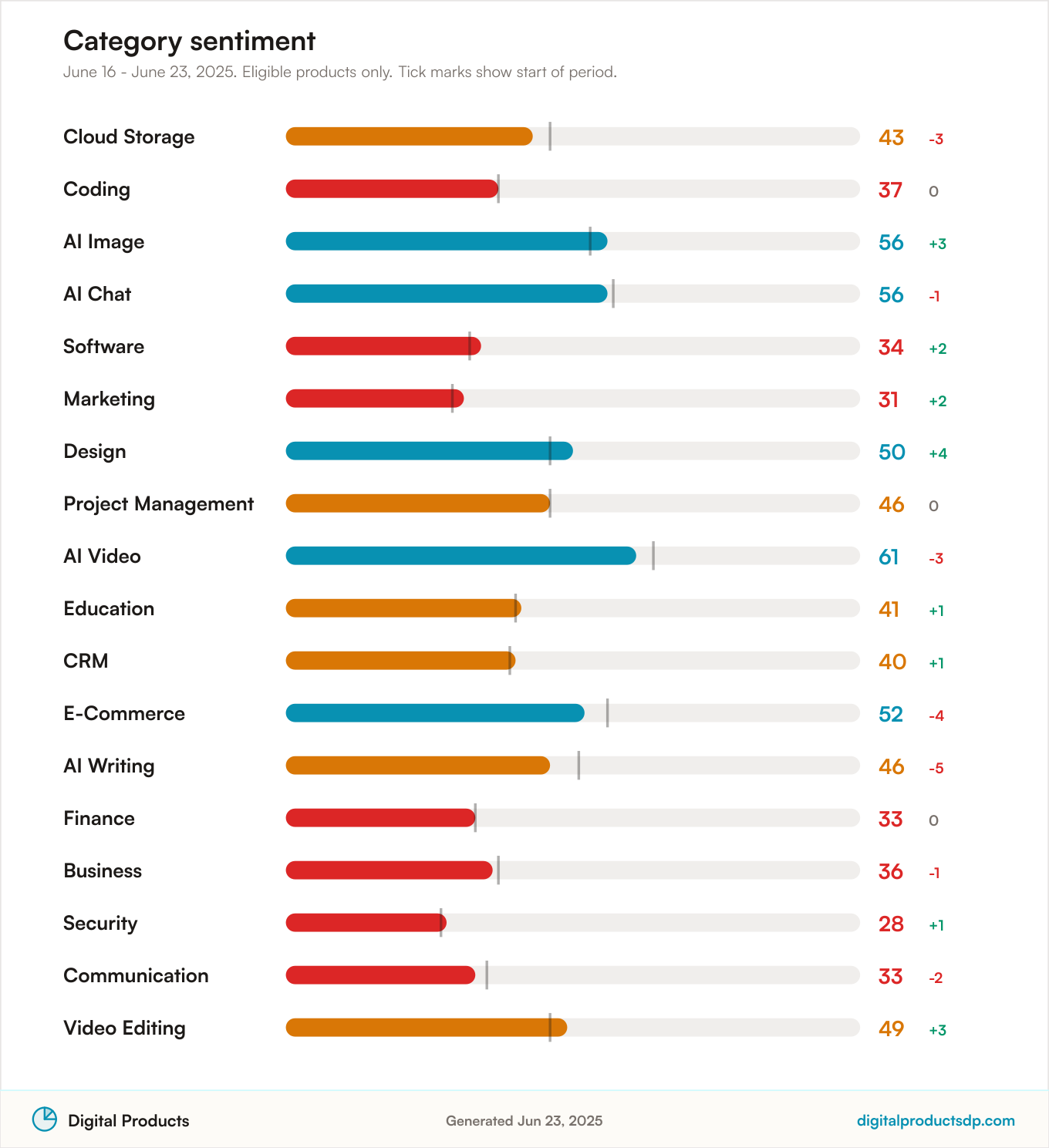
At the category level, sentiment was mostly steady with a few clear shifts. AI video held the highest average despite easing from 64 to 61, and AI chat stayed strong moving from 57 to 56. Design rose from 46 to 50 and video editing climbed from 46 to 49, the two most visible upward moves. On the softer side, AI writing slipped from 51 to 46 and e-commerce eased from 56 to 52. Coding held flat at 37, project management stayed at 46, and finance held at 33. The lowest averages sat in security, which nudged from 27 to 28, and communication, which slipped from 35 to 33. Most categories moved only a point or two, which points to a period of small adjustments rather than a broad swing in public mood.
Biggest Movers
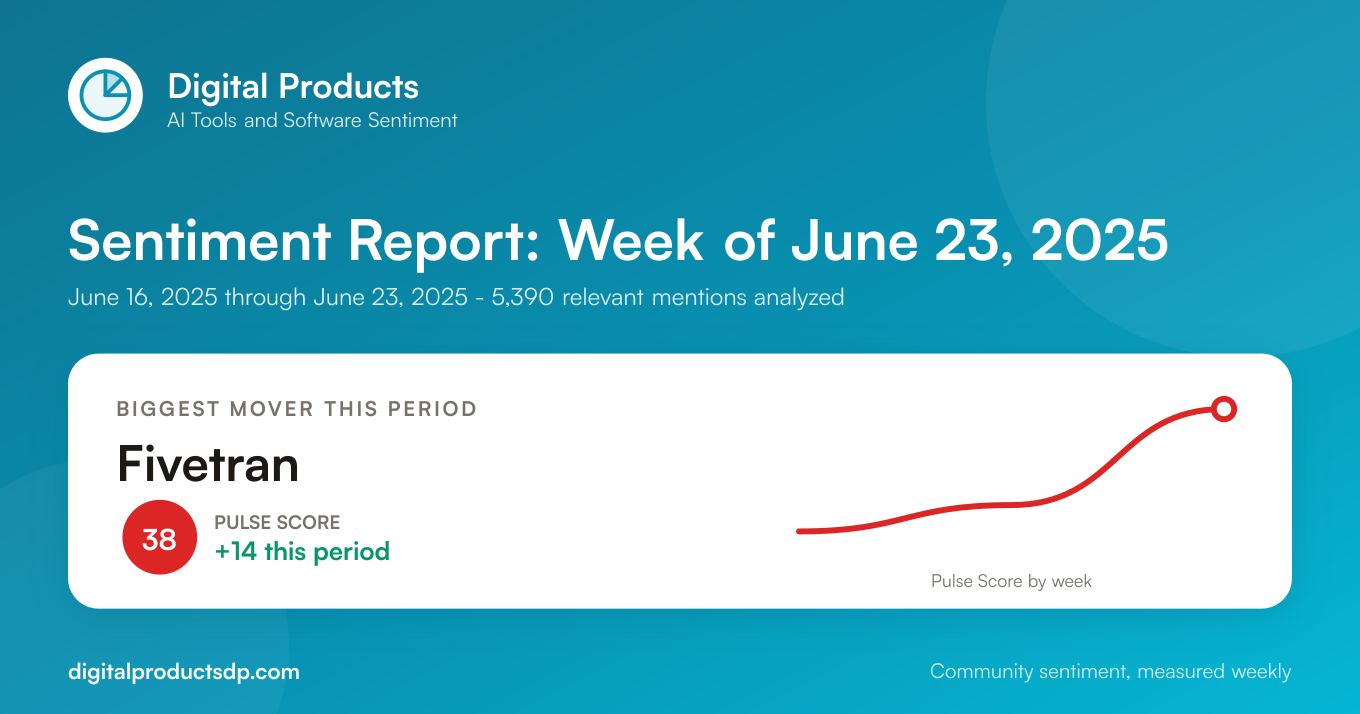
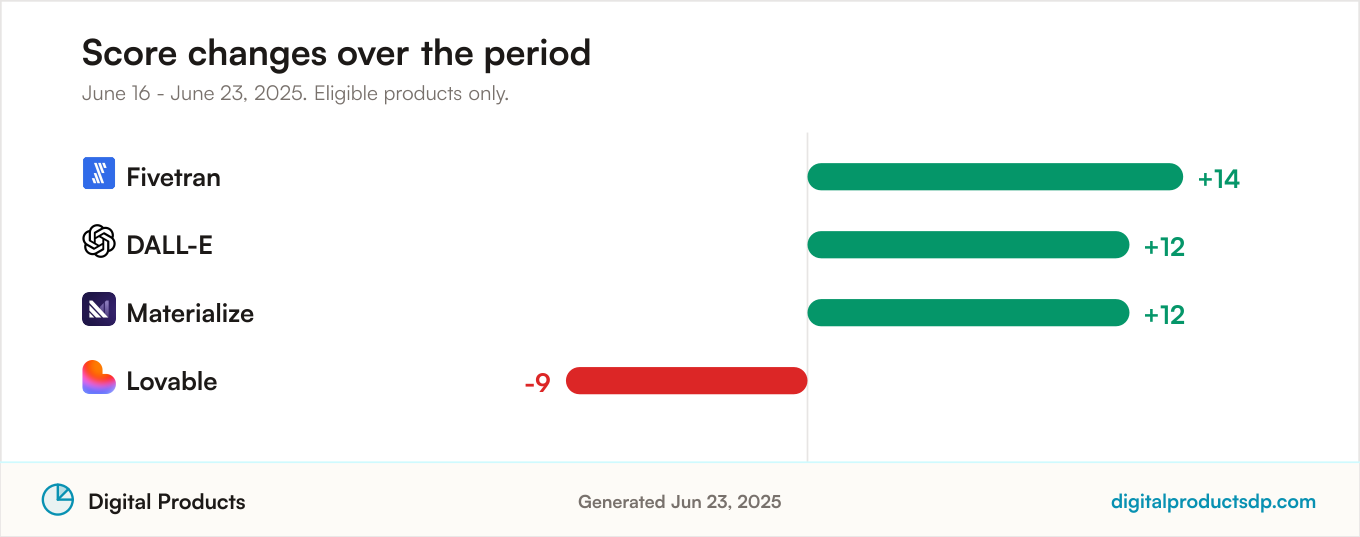
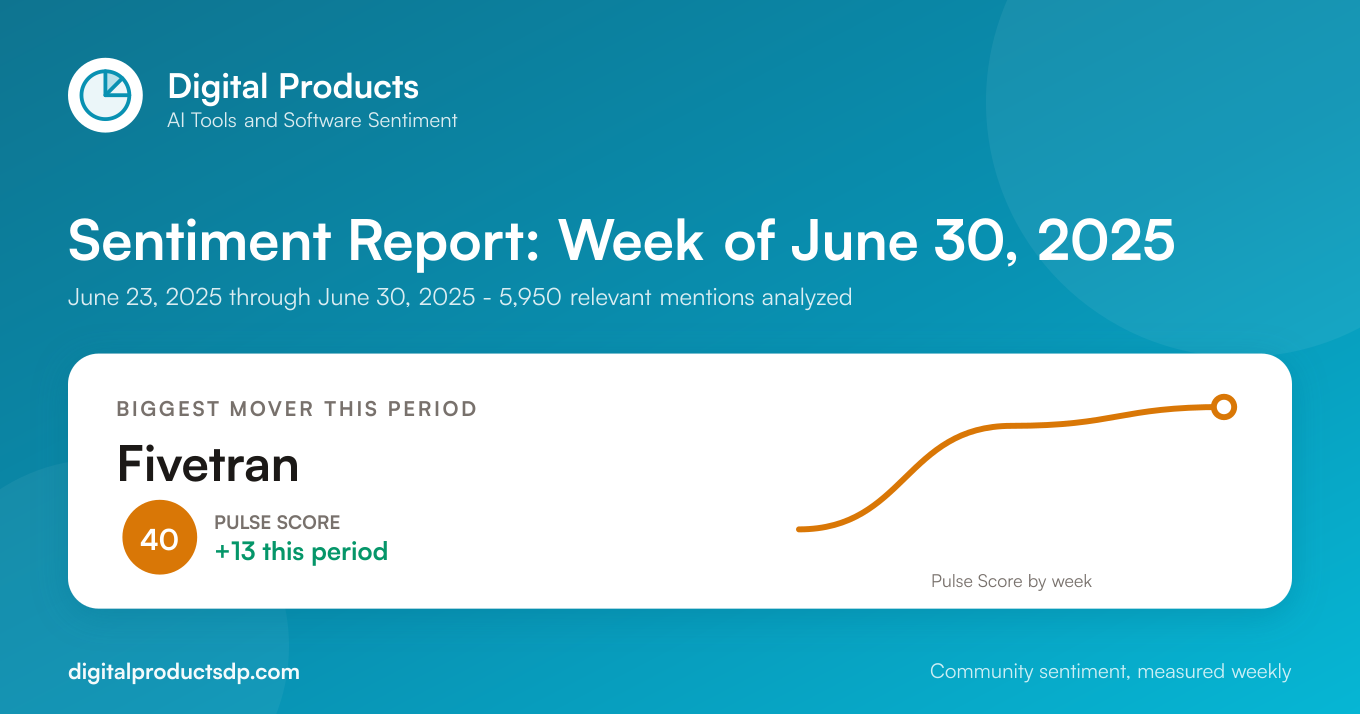
Fivetran posted the largest rise, climbing from 24 to 38 for a 14-point gain based on 24 mentions. That said, its recorded themes this period lean heavily negative, with complaints led by Bugs at 15 mentions, Reliability at 13, and Lacking integrations at 9, against only single-mention praise notes for Good integrations, Strong features, and Feature requests. A rise off a low base like this often reflects the tone stabilizing rather than a wave of enthusiasm, and the complaint mix suggests reliability and integration concerns remain part of the conversation even as the score moved up.
DALL-E rose from 48 to 60, a 12-point gain based on 12 mentions. Its praise themes centered on AI quality with 7 mentions and Strong features with 5, alongside a couple of notes about new releases. Complaints were close behind, with Bugs at 6, AI quality at 5, and Reliability at 4. The split shows AI quality cutting both ways in the discussion, praised and criticized at similar volumes, which is common for image tools where output expectations vary widely between users.
Materialize climbed from 23 to 35, also a 12-point gain, based on 11 mentions. Its theme record is sparse, with only single praise notes for Feature requests and Strong features, and complaints led by Bugs at 5, Reliability at 2, and UI frustrations at 2. As one of the thinnest ranked products this period, its move should be read cautiously, since a small number of new comments can shift a score of this kind meaningfully.
Lovable recorded the steepest decline, falling from 57 to 48 for a 9-point drop based on 11 mentions. Its praise themes included Polished UI at 8, Strong features at 5, and New releases at 3, while complaints were light in raw count, with single mentions each for Downtime, Reliability, and Privacy concerns. With so few mentions overall, the fall likely reflects a shift in a small conversation rather than a broad turn in sentiment.
Lightning AI fell from 41 to 33, an 8-point drop based on 25 mentions. Its praise leaned on Strong features at 8 and Good integrations at 6, but complaints were led by Bugs at 13 and Reliability at 9, with a couple of AI quality notes. Here the reliability and bug volume outweighs the praise, which lines up with the downward move.
Algolia also dropped 8 points, moving from 42 to 34 based on 37 mentions, the largest sample among the fallers. Its praise themes were modest, with Strong features at 9, Good integrations at 5, and Easy to use at 3, while complaints ran heavier, led by Bugs at 26, Reliability at 14, and Missing features at 10. With a healthier mention count than the other movers, this decline rests on a clearer signal, and the bug-heavy complaint mix is the throughline.
Spotlight: Aider
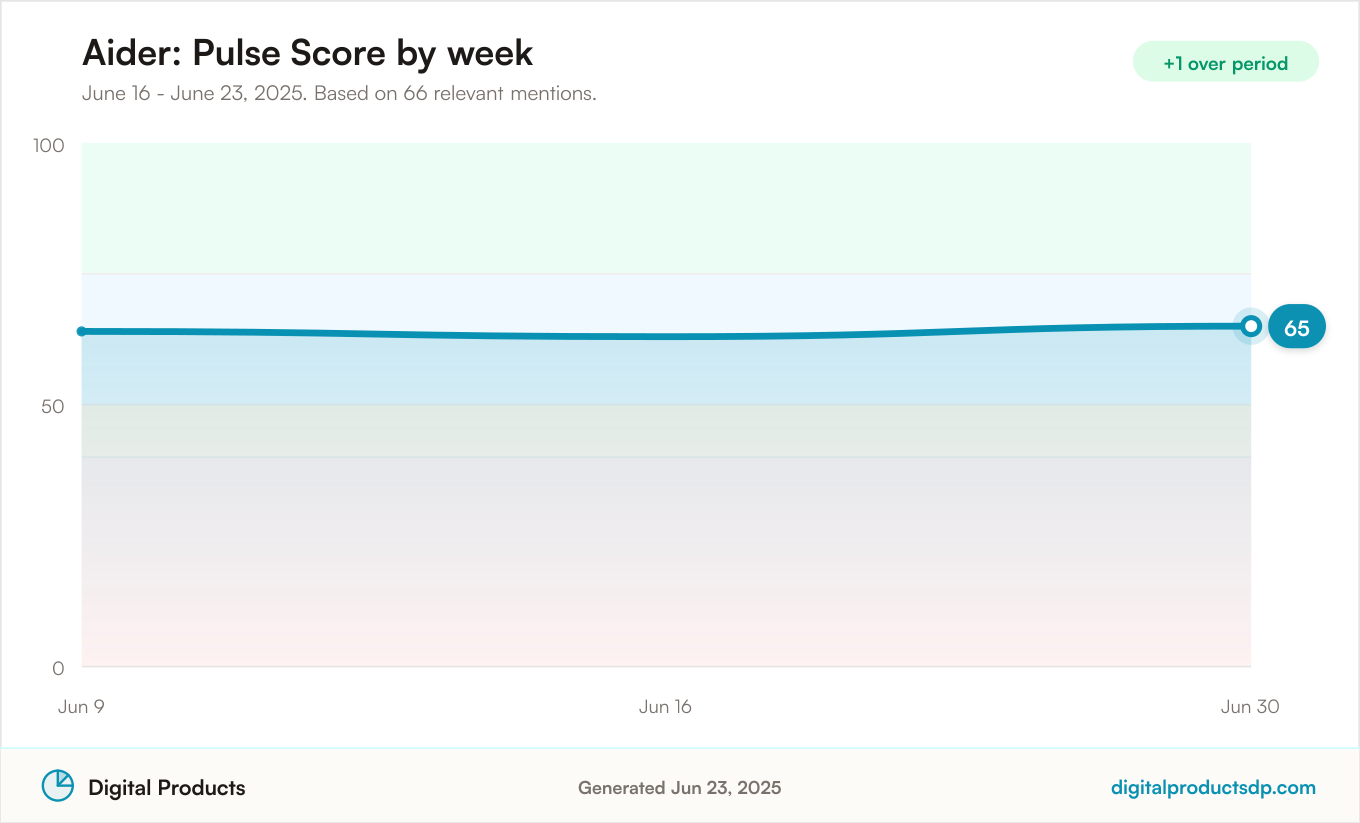
Aider, a coding tool, took the top Pulse Score of the period at 65, based on 66 mentions over the period. Its weekly series held remarkably steady across the three weeks tracked, reading 64 on June 9, 2025, then 63 on June 16, 2025, and 65 on June 23, 2025. That is a narrow band, and it suggests public discussion about the tool has been consistent rather than volatile, which is part of what places it at the front of the leaderboard.
The theme record for the latest week is modest in volume, which is notable given the score. Praise centered on Strong features at 7 mentions, followed by Easy to use at 4 and Good integrations at 3. Complaints were led by Bugs at 9 mentions, with Missing features at 5 and Feature requests at 4. The complaint side outnumbers the praise side in raw counts, yet the score sits high, a reminder that Pulse Scores reflect overall tone rather than a simple tally of positive against negative theme mentions.
Taken together, the picture for Aider is one of a coding tool with a small but favorable base of discussion. The feature requests and missing-feature notes read as the kind of feedback that tends to accompany an actively used tool, where people are engaged enough to ask for more. The steadiness of the weekly line is the standout detail: in a period where several products swung by 8 or more points, Aider moved within a single point.
Themes Driving the Conversation
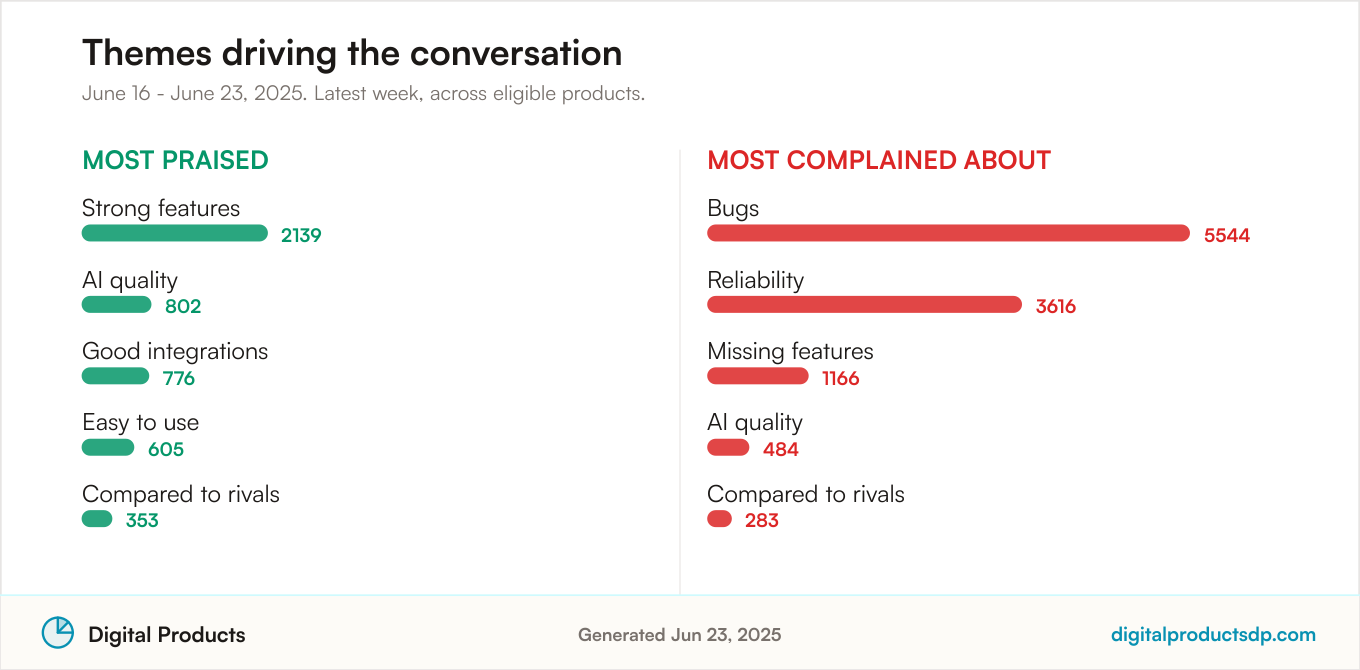
On the praise side, Strong features dominated with 2,139 mentions, far ahead of any other positive theme. AI quality followed at 802 mentions, Good integrations at 776, Easy to use at 605, and Compared to rivals at 353. The weight of Strong features shows up across the ranked field, from Claude with 229 feature praise mentions and Gemini with 140 to DuckDB with 157 and Kubernetes with 68. AI quality praise clustered around the AI chat and image tools, with Gemini at 149, Claude at 234 on AI quality, DeepSeek at 122, and Grok at 79, reflecting how central model output is to how those products are discussed.
The complaint side was heavier in absolute volume, led by Bugs at 5,544 mentions and Reliability at 3,616, the two largest themes of any kind this period. Missing features followed at 1,166, AI quality at 484, and Compared to rivals at 283. These bug and reliability themes recur across many high-volume products: ClickHouse recorded 441 bug mentions and 290 reliability mentions, dbt 357 and 208, Grafana 258 and 146, ArgoCD 231 and 172, and Stripe 188 and 158. The pattern is clear across infrastructure, data, and developer tooling, where reliability and defect discussion carries much of the conversation. It also frames why several fallers this period, including Algolia and Lightning AI, moved down alongside bug-heavy complaint mixes.
Watchlist
Many tracked products did not clear the minimum of 10 relevant mentions this period and so were left out of the rankings. This is a matter of discussion volume, not a judgment on quality. Thin samples produce unstable reads, so we hold these products back until there is enough conversation to report responsibly.
Several were close to the line and worth watching. Hasura and Cloudflare each drew 9 relevant mentions, Trello 8, Affirm 8, and Bubble, Great Expectations, Dremio, Klaviyo, and Gamma each 7. A little more discussion in a future week could bring any of these into the ranked field. Others sat lower, including NordVPN at 6, Asana at 6, Monday.com at 6, and Semrush at 5. A long tail of tracked products recorded only a handful of mentions or none at all this period, including widely known names such as ChatGPT, Notion, Slack, and Zoom, which registered zero relevant mentions in the sources we collected for this window. Absence here simply means the public discussion we track did not surface enough about them this week.
What To Watch Next Week
First, watch whether the risers off low bases hold their gains. Fivetran jumped 14 points to 38 and Materialize 12 points to 35, but both carry thin mention counts and complaint-heavy theme records led by Bugs and Reliability. Whether those scores stick or slide back is the clearest open question heading into the next window.
Second, keep an eye on the bug and reliability drumbeat. With Bugs at 5,544 mentions and Reliability at 3,616 leading the complaint themes by a wide margin, and with high-volume products like ClickHouse, dbt, and Grafana carrying much of that load, any shift in that discussion could move several category averages at once, particularly in coding and data-adjacent software.
Third, watch the leaders for steadiness. Aider held within a single point across three weeks to reach 65, while Veo swung from 64 to 56 to 61 and DALL-E climbed from 48 to 60. Whether the top of the board settles or reshuffles depends on how those thinner-sample leaders like Veo and DALL-E behave with more mentions.
Frequently Asked Questions
Which tool had the highest Pulse Score this period?
Aider, a coding tool, had the highest Pulse Score at 65, based on 66 mentions over the period. It was followed by Veo at 61 and by Claude, Gemini, and DALL-E, each at 60.
Which product moved the most this period?
Fivetran posted the largest rise, climbing from 24 to 38 for a 14-point gain based on 24 mentions. On the downside, Lovable fell the most, dropping from 57 to 48, a 9-point decline based on 11 mentions.
What was the overall category mood this period?
Sentiment was mostly steady, with most categories moving only a point or two. AI video held the highest average at 61 after easing from 64, while security remained the lowest, moving from 27 to 28, and design rose from 46 to 50.
How many mentions were analyzed this period?
A total of 5,390 relevant mentions were analyzed across 85 products that cleared the minimum volume needed to rank, out of 2,246 products tracked overall.
About This Data
Pulse Scores summarize the tone of public online discussion on a 0-100 scale and reflect community sentiment. They are not a verdict on a product's quality and not a recommendation. We report on complete calendar weeks only, and products with fewer than 10 relevant mentions in the period are excluded from rankings to avoid unstable reads on thin samples.
Public discussion is collected from Hacker News, Stack Exchange, GitHub, Bluesky, the Apple App Store, and YouTube. Automated sentiment analysis can misread sarcasm, jokes, or niche context, and it is not perfect. Mention volumes vary widely between products, and scores can move week to week. Any company that would like to respond is welcome to reach out. For more on how scores are calculated, see our methodology.