Back to blog
Best Of

9 Best Project Management Tools in June 2026

July 3, 2026
9 Best Project Management Tools in June 2026

This ranking looks at the nine project management tools that generated the most discussion-worthy signal across public online communities during June 2026, ordered by their Pulse Score. A Pulse Score is a 0-100 summary of the tone of that public conversation, and it lets us compare tools on a single, consistent scale rather than relying on scattered anecdotes or marketing claims. Everything here reflects what people were saying in the open, from developer forums to app store reviews, not a lab test of features or an editorial verdict on which product is technically superior.

We measured each tool across the full calendar weeks that fall inside June 1 to June 30, 2026, counting total mentions and breaking each conversation into positive, neutral, mixed, and negative shares. The result is a snapshot of momentum and mood: which tools earned warm praise, which drew heavy criticism, and which sat quietly in neutral territory. Read the numbers as a read on sentiment, not as an objective scoreboard of quality. With that framing in mind, here is how the nine tools stacked up.

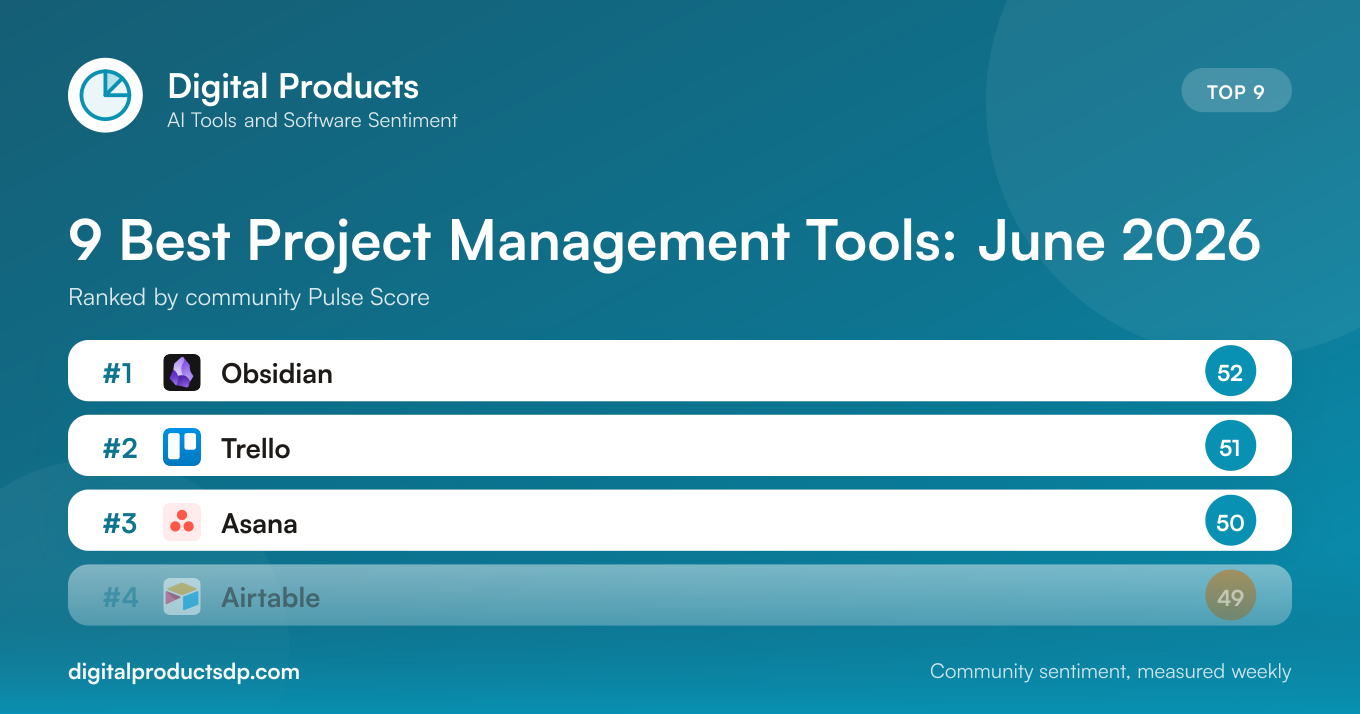
RankProductCategoryPulse ScoreRelevant MentionsVisit
1ObsidianProject Management52176Visit ↗
2TrelloProject Management5194Visit ↗
3AsanaProject Management5054Visit ↗
4AirtableProject Management4972Visit ↗
5LinearProject Management48131Visit ↗
6ClickUpProject Management4762Visit ↗
7NotionProject Management4699Visit ↗
8Monday.comProject Management4543Visit ↗
9ConfluenceProject Management32226Visit ↗

Taken as a whole, the June 2026 field was tightly bunched at the top and then dropped off sharply at the bottom. Eight of the nine tools landed within a narrow band from a Pulse Score of 45 to 52, which suggests public sentiment did not strongly separate the leading options from one another. Neutral discussion dominated most conversations, with tools like Trello, Asana, Linear, and Notion all showing majorities of neutral mentions. The clearest outlier was Confluence at the bottom, whose score of 32 was driven by an unusually large and unusually negative discussion volume. What follows is a section-by-section read of each tool, in rank order, based only on what the community said.
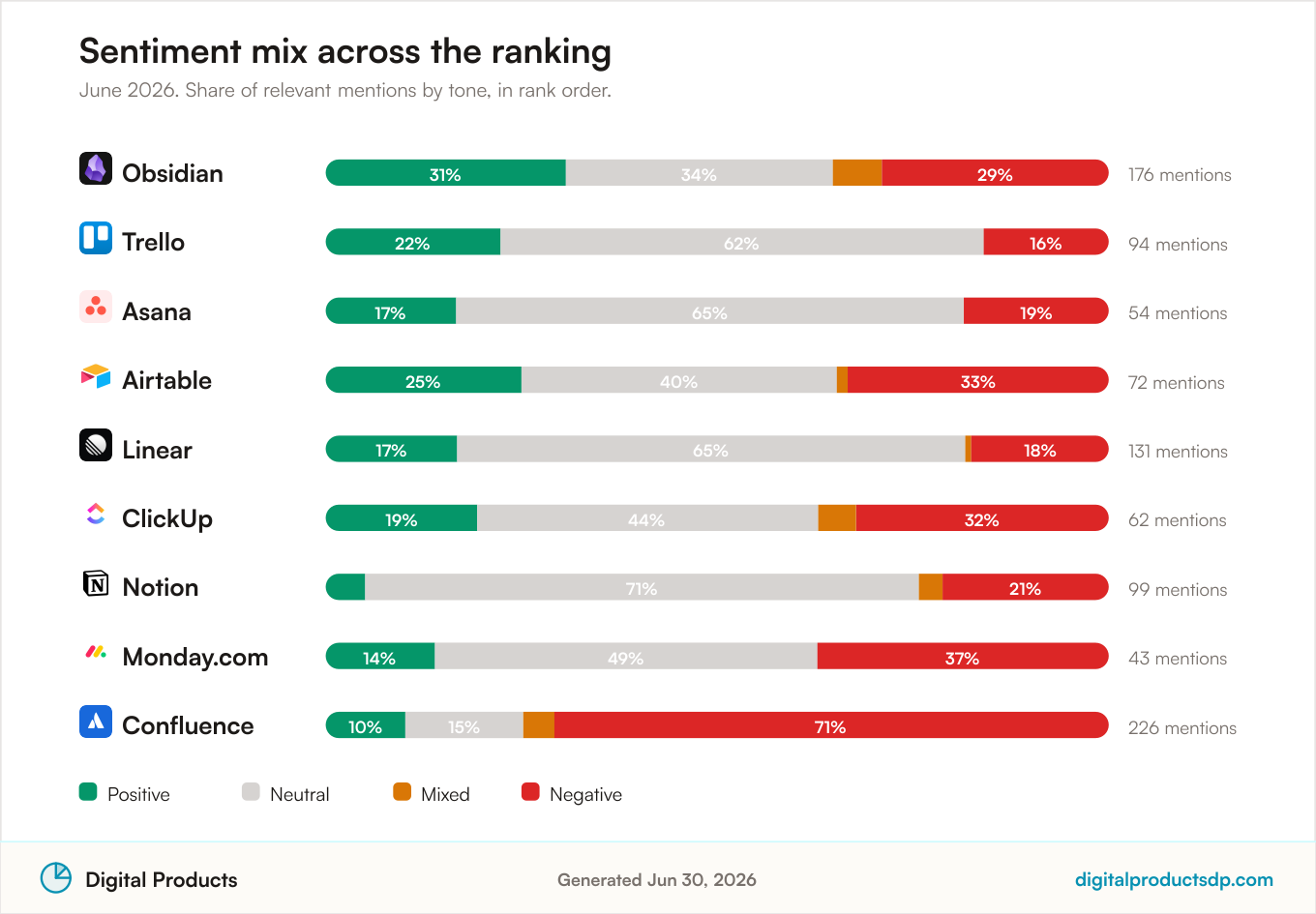
Positive, neutral, mixed, and negative discussion share for the 9 ranked Project Management Tools, June 2026

1. Obsidian

Obsidian Pulse Score trend from aggregated public discussion

Obsidian took the top spot in June with a Pulse Score of 52, edging out a crowded field. It also carried the second-highest mention count in the ranking at 176, which means its lead rests on a substantial base of conversation rather than a handful of loud voices. The sentiment mix was lively rather than lukewarm: 31 percent positive, 34 percent neutral, 6 percent mixed, and 29 percent negative. That near-even split between praise and criticism is notable, and it is part of why Obsidian sits at the top without being uncontroversial.

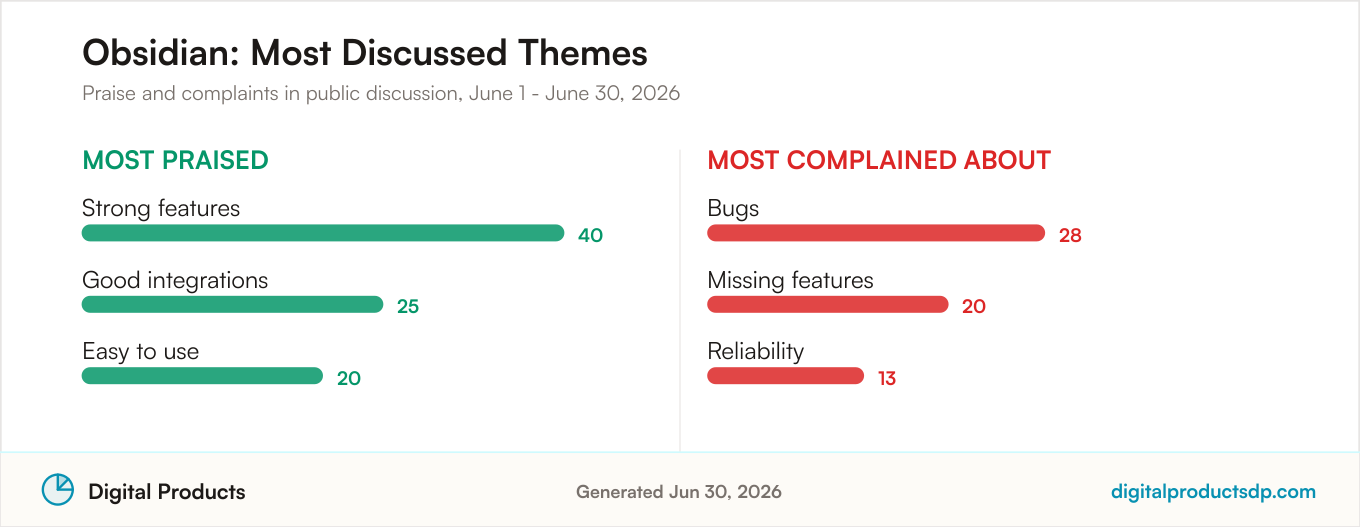
What the community praised most often was strong features, cited in 40 mentions, followed by good integrations at 25 and ease of use at 20. People clearly value what the tool can do and how it fits into their wider workflow. The criticism, though, was real and pointed. Bugs led the complaints with 28 mentions, missing features drew 20, and reliability concerns appeared 13 times. Read together, the picture that public discussion paints is of a capable, well-liked tool that still frustrates a meaningful slice of its users when things break.

Most praised and most complained about themes for Obsidian from aggregated public discussion

Visit Obsidian

2. Trello

Trello Pulse Score trend from aggregated public discussion

Just one point behind the leader, Trello landed at number two with a Pulse Score of 51 across 94 mentions. Its profile could hardly be more different from Obsidian's. Where the leader drew sharp positive and negative reactions, Trello's conversation was overwhelmingly calm: 62 percent of mentions were neutral, with 22 percent positive and only 16 percent negative. There was no mixed sentiment recorded at all. This is the signature of a mature, familiar tool that people reference matter-of-factly rather than argue about.

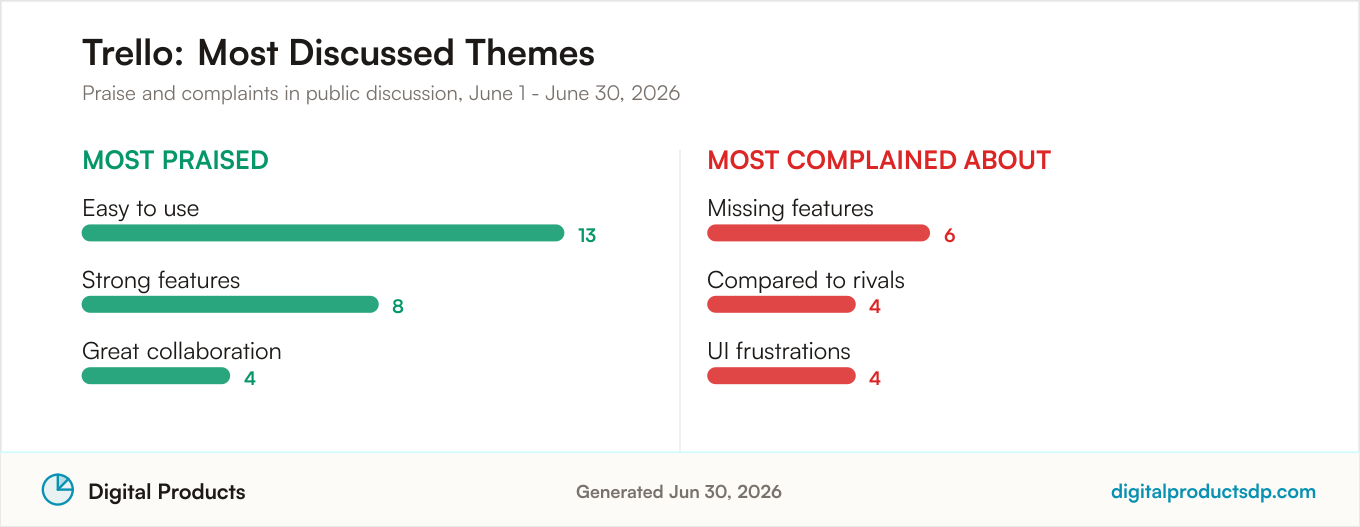
Ease of use was the standout theme in Trello's favor, cited 13 times, with strong features at 8 and great collaboration at 4 rounding out the praise. The complaints were modest in volume and spread thin: missing features appeared 6 times, comparisons to rivals came up 4 times, and UI frustrations were mentioned in another 4. Nothing in the negative column dominated. What public discussion suggests here is a dependable, approachable board tool whose main knock is that some users feel it has been outgrown by more feature-rich competitors.

Most praised and most complained about themes for Trello from aggregated public discussion

Visit Trello

3. Asana

Asana Pulse Score trend from aggregated public discussion

Asana holds third place with a Pulse Score of 50, built on a comparatively small sample of 54 mentions. That thinner volume is worth keeping in mind, because a smaller pool of conversation can shift more easily from one period to the next. Its sentiment mix leaned heavily neutral at 65 percent, with 17 percent positive and 19 percent negative, so the positive and negative camps were close to balanced with a small edge to the critics.

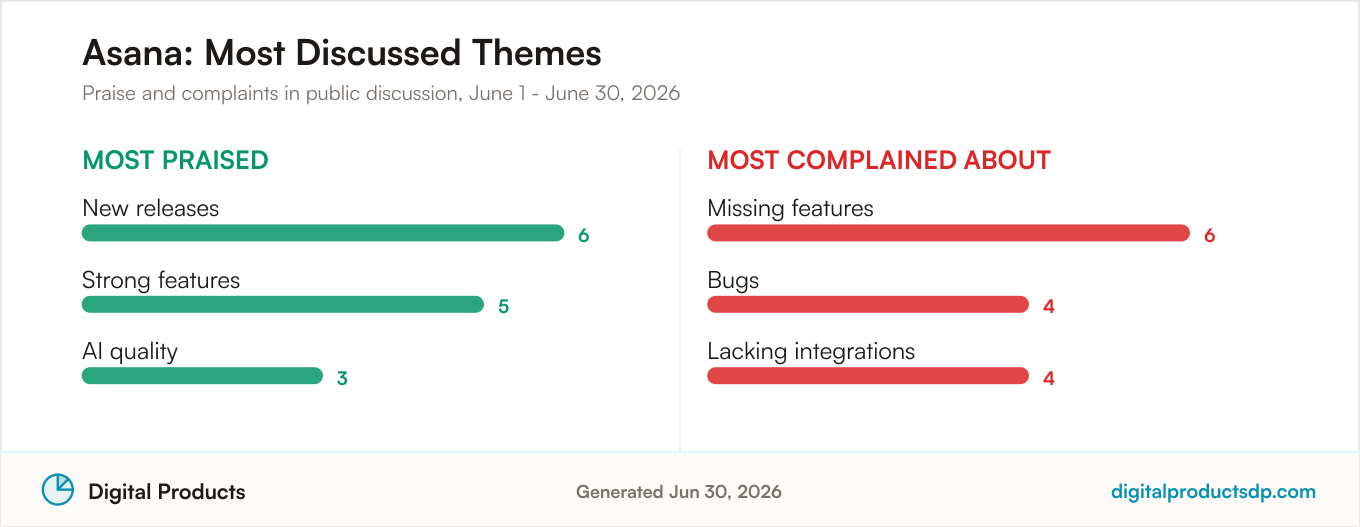
On the positive side, new releases drew the most attention with 6 mentions, a sign that people were noticing and discussing product updates during the month. Strong features followed at 5 and AI quality at 3, hinting that Asana's newer capabilities got some airtime. The complaints centered on missing features with 6 mentions, bugs with 4, and lacking integrations with another 4. The read from public discussion is of a steady enterprise-grade tool that keeps shipping, though some users still feel gaps in its feature set and its connections to other software.

Most praised and most complained about themes for Asana from aggregated public discussion

Visit Asana

4. Airtable

Airtable Pulse Score trend from aggregated public discussion

At number four, Airtable posted a Pulse Score of 49 over 72 mentions. Its discussion was the most polarized in the middle of the pack: 25 percent positive against a hefty 33 percent negative, with 40 percent neutral and 1 percent mixed. That larger negative share is the main reason it sits below the tools above it despite drawing a healthy amount of enthusiasm.

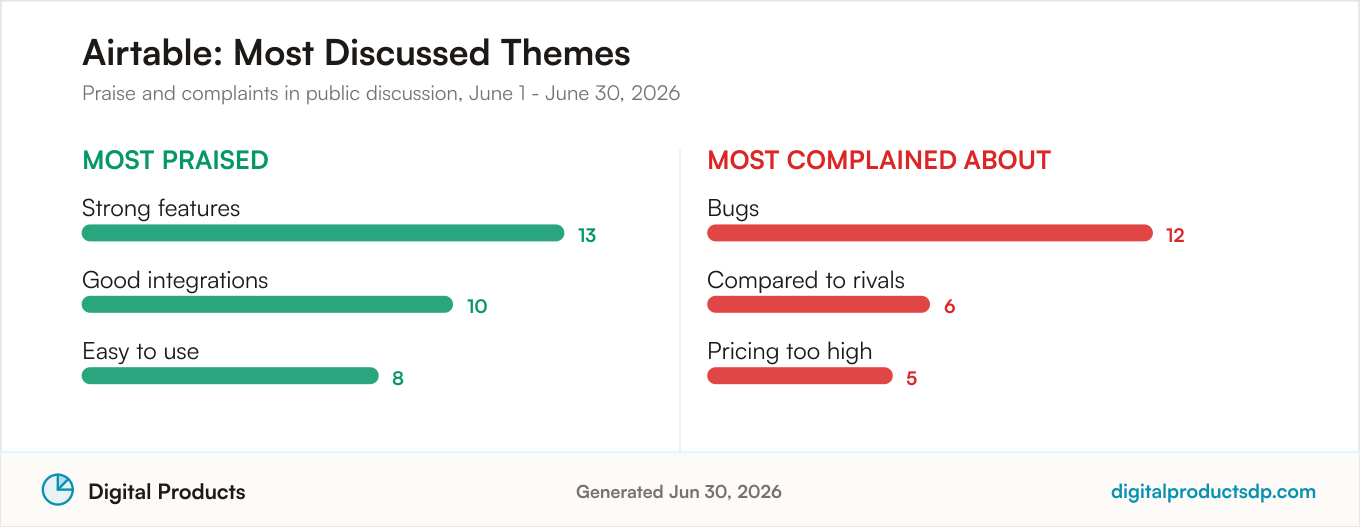
Fans of Airtable pointed to strong features 13 times, good integrations 10 times, and ease of use 8 times, a well-rounded set of praise for a tool that blends databases with project workflows. The frustrations, though, were substantial. Bugs led the negative column with 12 mentions, comparisons to rivals appeared 6 times, and pricing that people felt was too high came up 5 times. Public discussion suggests a powerful and flexible platform that wins over users who need its structure, but one where cost and stability complaints keep the overall mood from tipping firmly positive.

Most praised and most complained about themes for Airtable from aggregated public discussion

Visit Airtable

5. Linear

Linear Pulse Score trend from aggregated public discussion

Linear settled into fifth with a Pulse Score of 48, and it did so on strong volume: 131 mentions, the third-highest total in the group. Its sentiment split closely mirrored several of the tools around it, with 65 percent neutral, 17 percent positive, 18 percent negative, and 1 percent mixed. The high neutral share suggests Linear is now a common reference point in developer and team workflows, discussed as a given rather than debated.

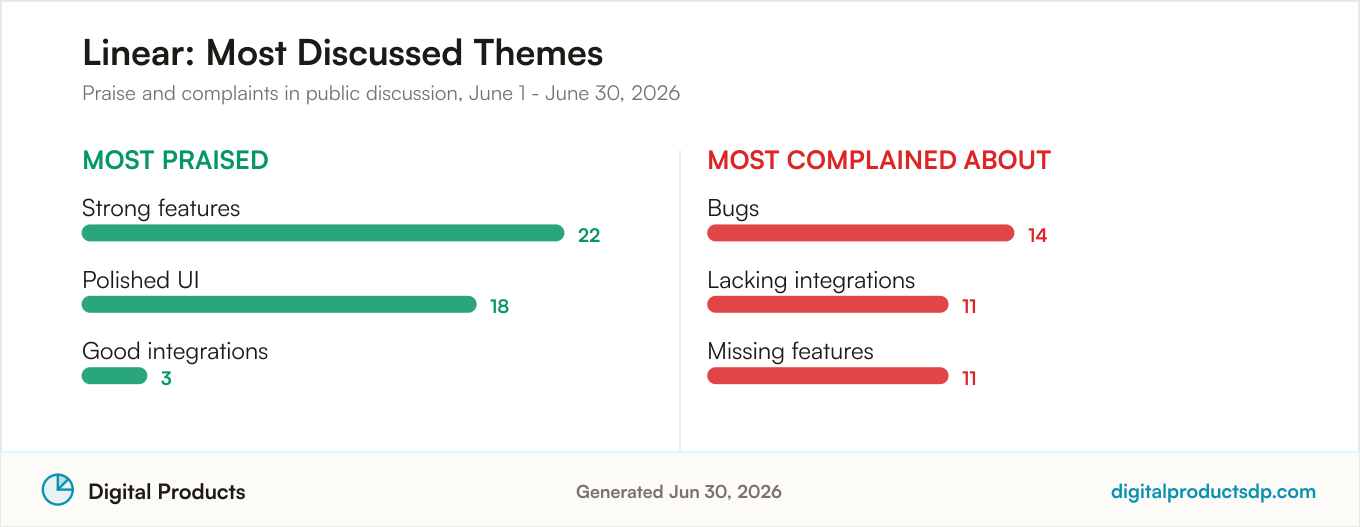
The praise skewed toward the qualities Linear is known for. Strong features led with 22 mentions and a polished UI followed close behind at 18, which together speak to the tool's reputation for craft and speed. Good integrations added another 3. On the other side, bugs drew 14 mentions, while lacking integrations and missing features tied at 11 each. The community read is of a well-designed, well-liked issue tracker whose main friction points are around connecting to other tools and filling remaining gaps in its feature coverage.

Most praised and most complained about themes for Linear from aggregated public discussion

Visit Linear

6. ClickUp

ClickUp Pulse Score trend from aggregated public discussion

ClickUp comes in sixth with a Pulse Score of 47 across 62 mentions. Its conversation carried a heavier negative tilt than the tools just above it: 32 percent negative against 19 percent positive, with 44 percent neutral and 5 percent mixed. That gap between critics and fans is the clearest reason it sits in the lower half despite a broadly capable reputation.

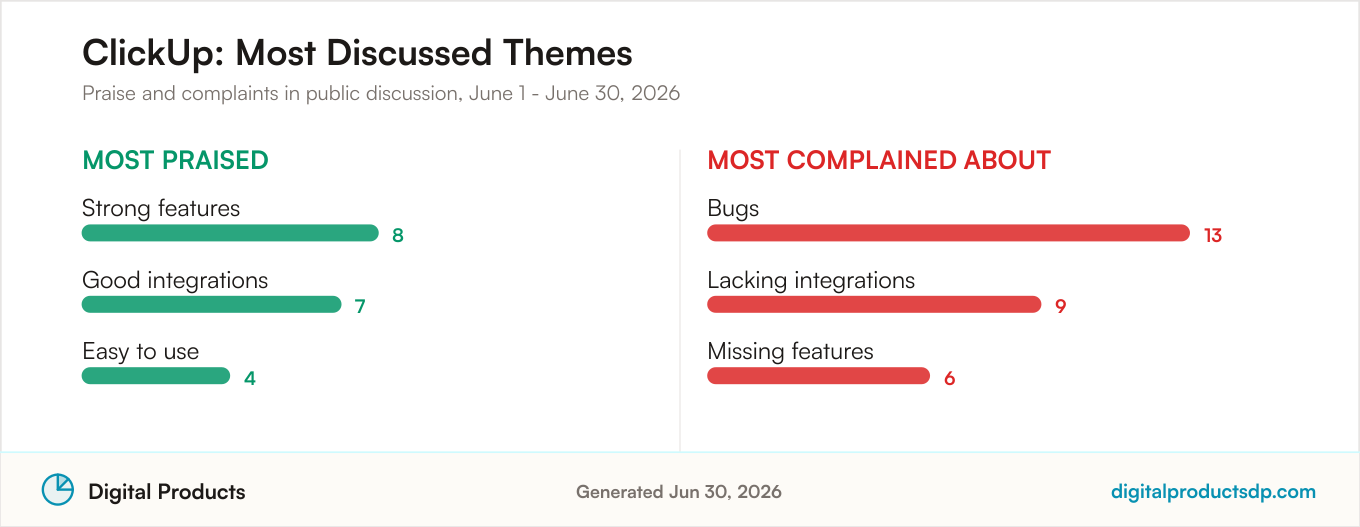
People who praised ClickUp cited strong features 8 times, good integrations 7 times, and ease of use 4 times, a pattern that reflects the tool's all-in-one ambitions. The complaints, however, were concentrated and familiar. Bugs led with 13 mentions, lacking integrations followed at 9, and missing features appeared 6 times. Public discussion suggests a feature-packed platform that appeals to teams wanting everything in one place, but where stability issues and integration gaps weigh noticeably on the overall mood.

Most praised and most complained about themes for ClickUp from aggregated public discussion

Visit ClickUp

7. Notion

Notion Pulse Score trend from aggregated public discussion

Notion lands at seventh with a Pulse Score of 46 over 99 mentions. Its sentiment profile stands out for how little positive discussion it drew: just 5 percent positive, alongside 71 percent neutral, 21 percent negative, and 3 percent mixed. That is the lowest positive share of any tool in the top eight, and the very high neutral proportion suggests most references to Notion were informational or offhand rather than enthusiastic.

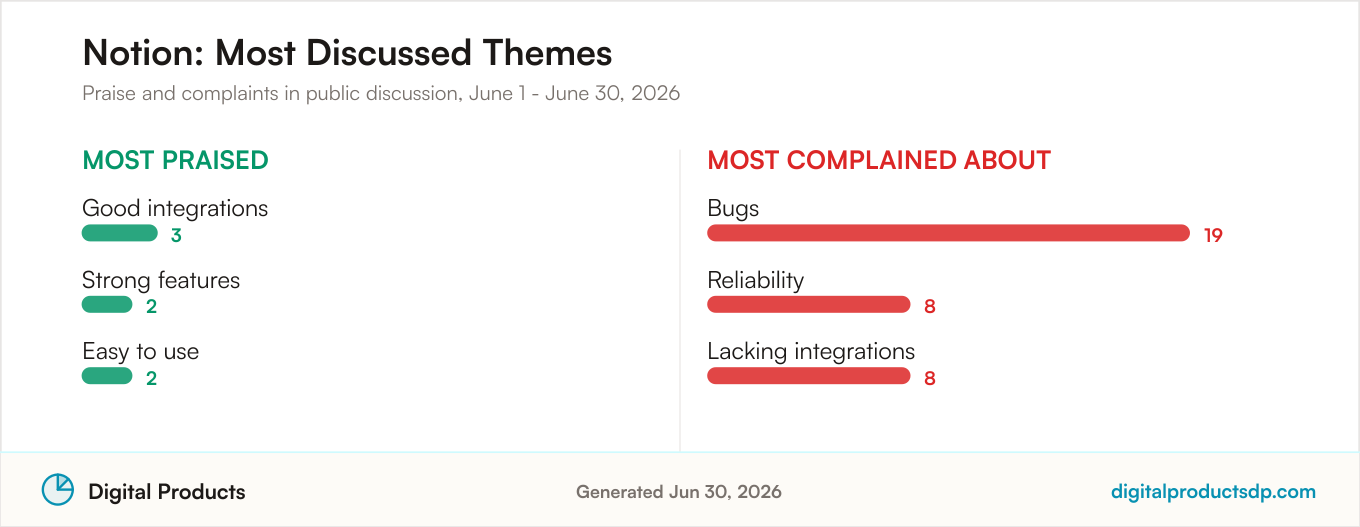
The praise it did receive was thin and spread out, with good integrations at 3 mentions, strong features at 2, and ease of use at 2. The negative side was more concentrated. Bugs dominated with 19 mentions, reliability concerns appeared 8 times, and lacking integrations came up another 8. What public discussion suggests is a widely used tool that people mention constantly but do not often celebrate, and whose recurring stability complaints pulled its June mood into the lower tier despite its broad footprint.

Most praised and most complained about themes for Notion from aggregated public discussion

Visit Notion

8. Monday.com

Monday.com Pulse Score trend from aggregated public discussion

Eighth place goes to Monday.com, which recorded a Pulse Score of 45 on the smallest sample in the ranking at 43 mentions. With such thin volume, its read should be treated cautiously, since a few conversations carry outsized weight. Its sentiment mix was the most negative of the tools above Confluence: 37 percent negative against 14 percent positive, with 49 percent neutral and no mixed mentions.

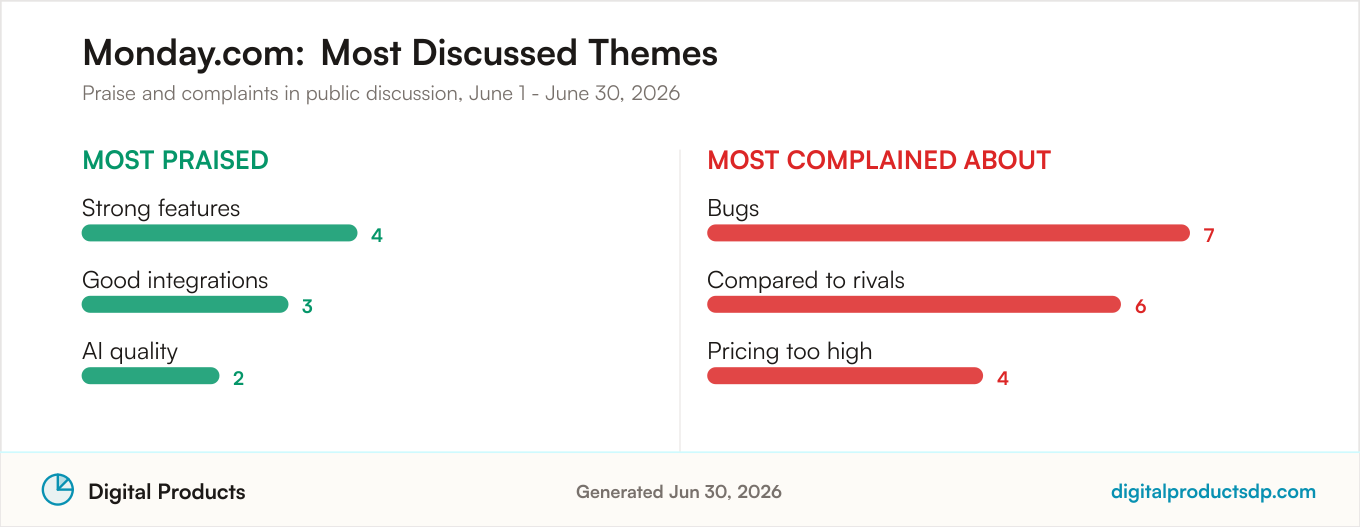
Supporters highlighted strong features 4 times, good integrations 3 times, and AI quality twice, so there is a thread of appreciation for what the platform offers. The criticism outweighed it, though. Bugs led with 7 mentions, comparisons to rivals appeared 6 times, and pricing that people considered too high came up 4 times. Public discussion paints Monday.com as a capable but expensive option in June, one where the volume of complaints about cost and reliability kept its overall tone below the middle of the pack.

Most praised and most complained about themes for Monday.com from aggregated public discussion

Visit Monday.com

9. Confluence

Confluence Pulse Score trend from aggregated public discussion

Confluence closes out the ranking in ninth with a Pulse Score of 32, well below the tightly packed eight above it. Strikingly, it did so on the highest mention volume of any tool here, with 226 total mentions. This was not a case of thin data producing a shaky low score. The sentiment mix was heavily negative: 71 percent negative, 15 percent neutral, 10 percent positive, and 4 percent mixed. A large audience was talking about Confluence, and much of that talk was critical.

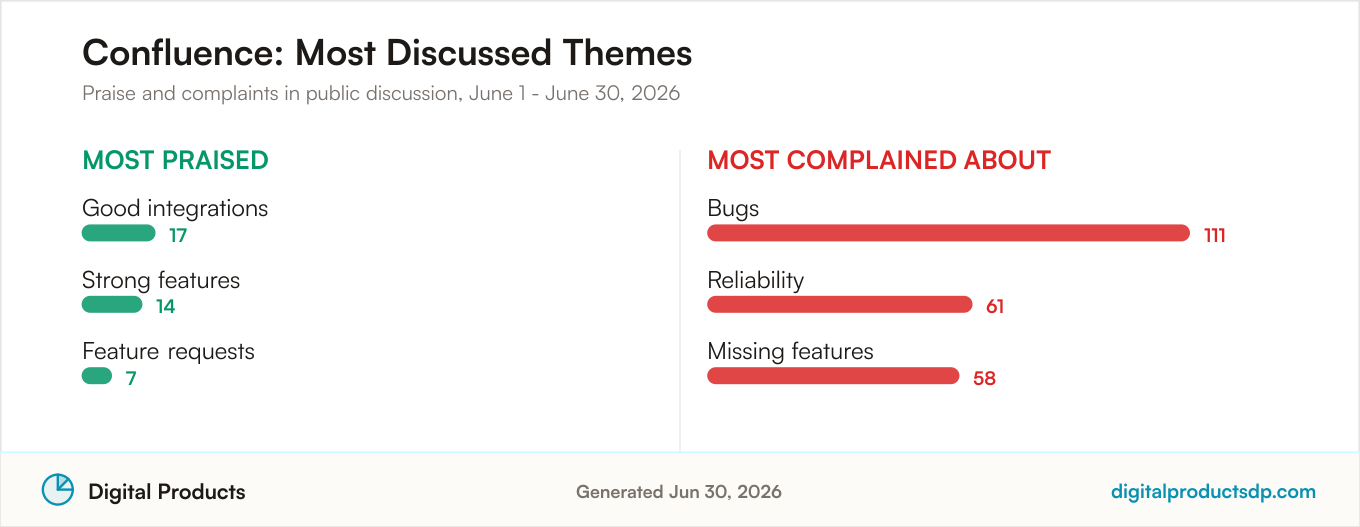
There were bright spots. Good integrations drew 17 mentions, strong features earned 14, and feature requests appeared 7 times, which shows an engaged base that still wants the product to succeed. But the negative themes were enormous by comparison. Bugs were cited a remarkable 111 times, reliability concerns came up 61 times, and missing features appeared 58 times. The story public discussion tells for June is of a widely deployed tool weighed down by persistent frustration over stability and dependability, and that volume of complaint is what anchored its Pulse Score at the bottom of the ranking.

Most praised and most complained about themes for Confluence from aggregated public discussion

Visit Confluence

How This Ranking Works

The order of this list comes directly from each tool's Pulse Score over the June 1 to June 30, 2026 period. A Pulse Score condenses the tone of public online discussion into a single number on a 0-100 scale, so the higher a tool's score, the more favorable the overall balance of its conversation during the month. Obsidian topped the list at 52, and the scores descend from there down to Confluence at 32.

Because the top eight tools were separated by only a few points, small differences in position reflect small differences in sentiment, not large gaps in capability. A tool with a heavy neutral share can score similarly to one with a more lopsided positive-versus-negative split, which is why reading the individual sentiment mix and theme breakdowns matters as much as the rank itself. Mention counts also vary widely here, from 43 for Monday.com to 226 for Confluence, and a larger sample generally produces a steadier read than a smaller one. Treat the ranking as a structured summary of what the community said in June, not as a definitive quality scoreboard.

About This Data

Pulse Scores summarize the tone of public online discussion on a 0-100 scale. They reflect community sentiment during a specific period, and they are not a verdict on a product's quality, a certification, or a recommendation to buy. A high score means the balance of public conversation leaned favorable during the window we measured, and a low score means it leaned unfavorable. That is all it means.

We report on complete calendar weeks only, and we exclude any product with fewer than 10 relevant mentions in the period to avoid unstable reads on thin samples. Ranked products also need at least 2 complete weeks of discussion data within the period, so a single-week spike cannot push a tool into the ranking on its own. Public discussion is collected from Hacker News, Stack Exchange, GitHub, Bluesky, the Apple App Store, and YouTube. Automated sentiment analysis is imperfect: it can misread sarcasm, jokes, or niche context, mention volumes vary widely between products, and scores can move from week to week. If you represent one of these companies and want to respond to how your product is discussed, please reach out. Some Visit links may be affiliate links, and the site may earn a commission if you use them, but this never influences Pulse Scores or rankings. For the full detail on how scores are calculated, see our methodology.

Frequently Asked Questions

Which project management tool ranks first in June 2026 and why?

Obsidian ranks first with a Pulse Score of 52. It combined a large discussion base of 176 mentions with a relatively positive tone for the category, drawing 31 percent positive sentiment and heavy praise for strong features, good integrations, and ease of use. It edged out Trello at 51 and Asana at 50, both of which had far more neutral and less positive conversation.

How is this ranking calculated?

Each tool is ordered by its Pulse Score across the June 1 to June 30, 2026 period. The Pulse Score is a 0-100 summary of the tone of public online discussion gathered from sources including Hacker News, Stack Exchange, GitHub, Bluesky, the Apple App Store, and YouTube. We count total mentions and break each conversation into positive, neutral, mixed, and negative shares, then rank the tools from highest score to lowest.

How often does this ranking update?

The ranking is built from complete calendar weeks within the reporting period, and we only include products with at least 10 relevant mentions and at least 2 complete weeks of discussion data. Because scores are recalculated as new weeks of public discussion come in, rankings can shift from one period to the next as sentiment and mention volumes change.

Does a high Pulse Score mean the tool is right for me?

No. A high Pulse Score means public discussion leaned favorable during the measured window, not that a tool fits your specific team, budget, or workflow. For example, Airtable and Monday.com both drew complaints about pricing, while Confluence carried heavy criticism about bugs despite being widely used. Use the scores and theme breakdowns as one input, then weigh your own needs before deciding.