Back to blog
Comparisons

Notion vs Obsidian: Week of June 29, 2026

June 29, 2026
Notion vs Obsidian: Week of June 29, 2026

Few tools spark as much debate among knowledge workers and note-takers as Notion and Obsidian. Both aim to be the home for your ideas, projects, and reference material, but they take very different paths to get there. To cut through the noise, we looked at how people actually talked about each tool in public online discussion during the week of June 22 to June 29, 2026.

The figures below reflect aggregated community sentiment, not a technical audit or a verdict on either product's quality. They capture the tone of conversation across public platforms during a single calendar week. With that framing in mind, here is how the two stack up on their Pulse Scores, sentiment mix, and the themes driving the discussion.

RankProductCategoryPulse ScoreRelevant MentionsVisit
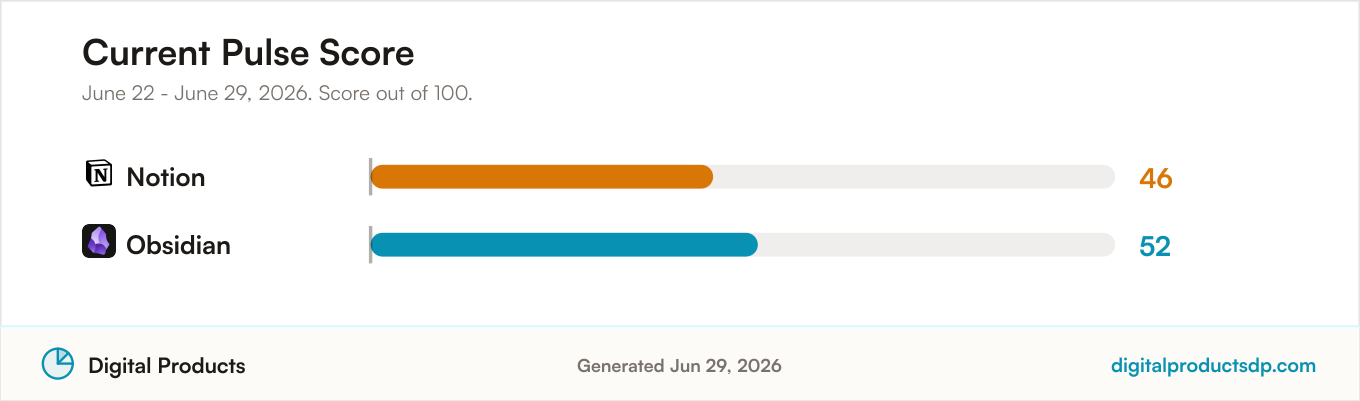
1ObsidianProject Management52720Visit ↗
2NotionProject Management46118Visit ↗
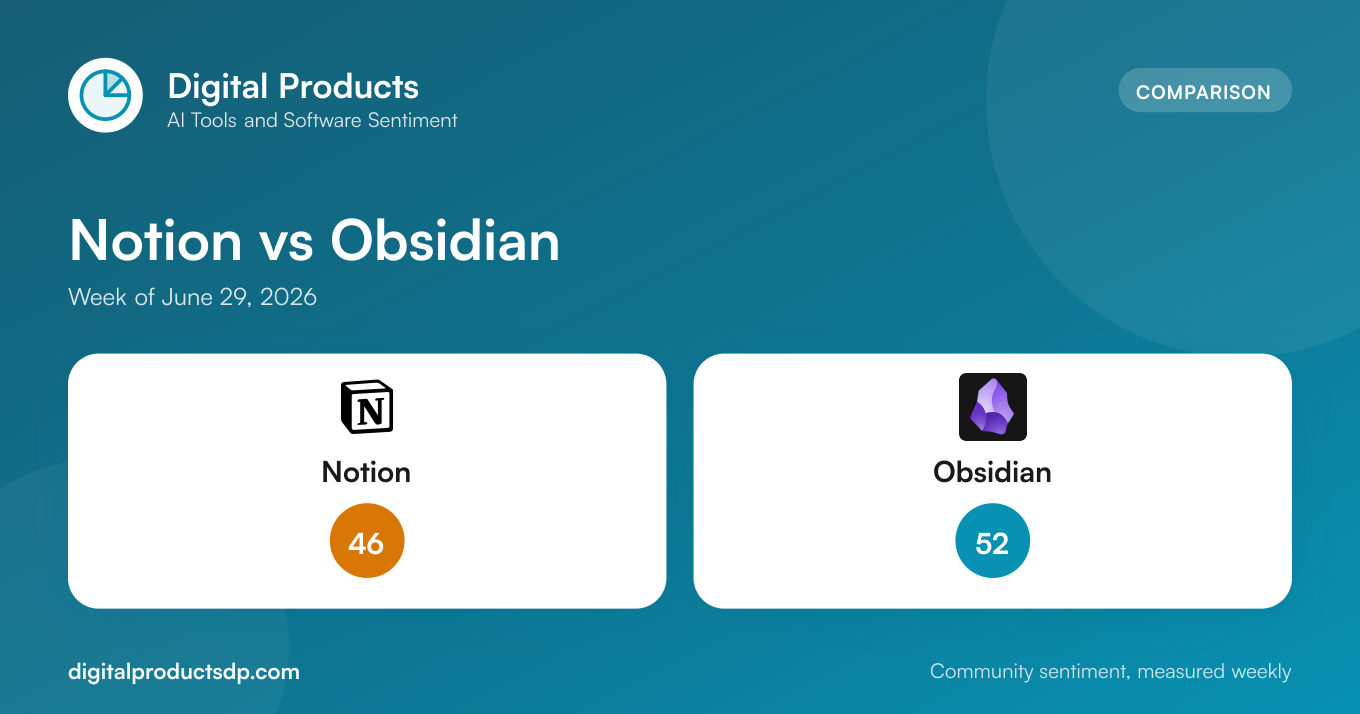
Current Pulse Score comparison for Notion vs Obsidian

Notion

Notion Pulse Score trend from aggregated public discussion

Notion closed the week with a Pulse Score of 46 across 118 total mentions. That places it below the midpoint of the 0-100 scale and behind its rival in this matchup. The volume of conversation was moderate compared with Obsidian, which gives the score a reasonably stable base to read from.

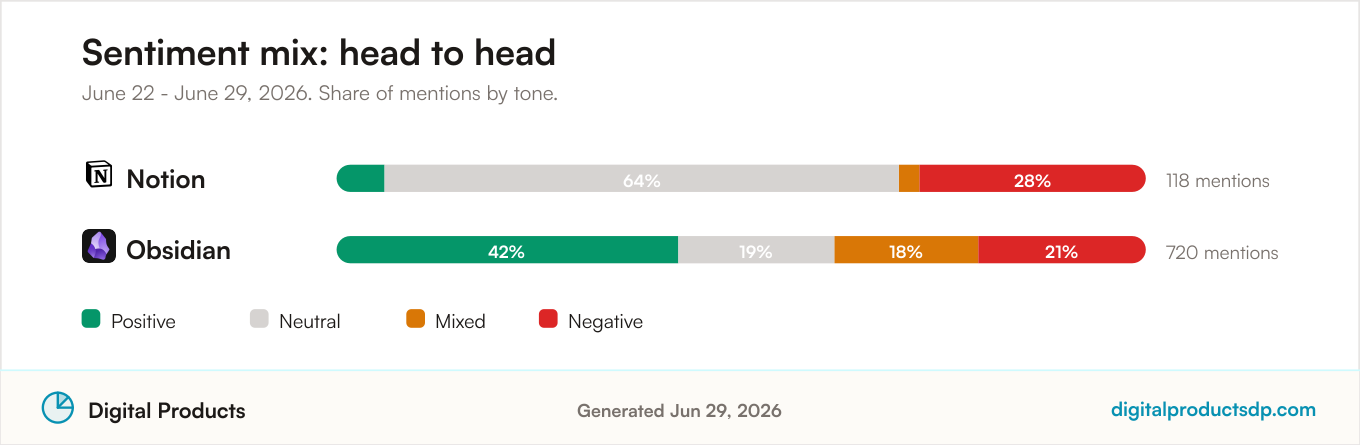
The sentiment mix is where Notion's week looks challenging. Only 6% of mentions were positive, while 64% landed as neutral, 3% were mixed, and 28% were negative. A heavily neutral distribution like this usually signals discussion that is more transactional than enthusiastic, with people asking questions, sharing setups, or noting problems rather than praising the tool.

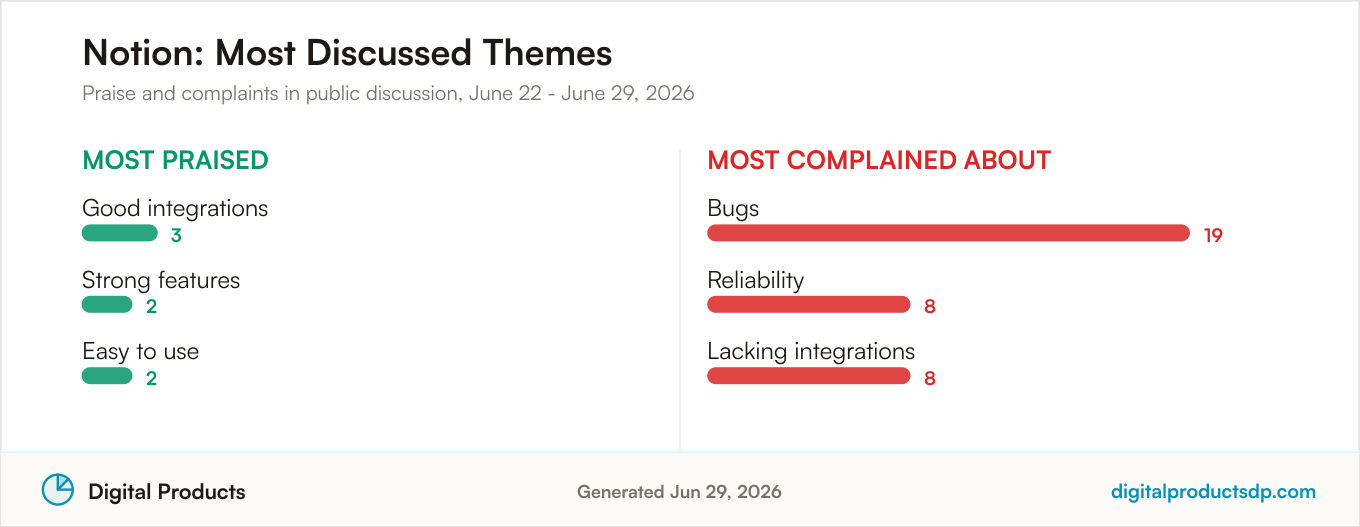
On the positive side, the themes that drew the most appreciation were good integrations (3 mentions), strong features (2 mentions), and ease of use (2 mentions). These are modest counts, reflecting how little of the week's conversation was outright positive.

The complaints were louder and more concentrated. Bugs led the list with 19 mentions, followed by reliability concerns at 8 mentions and, notably, lacking integrations also at 8 mentions. That last theme is worth flagging because integrations also appeared on the praise list, a sign that user experiences with the same feature area diverged. Taken together, the negative themes explain most of the gap between Notion's neutral bulk and its low positive share this week.

Most praised and most complained about themes for Notion from aggregated public discussion

Obsidian

Obsidian Pulse Score trend from aggregated public discussion

Obsidian finished the week with a Pulse Score of 52 on a much larger base of 720 total mentions. That is roughly six times the discussion volume Notion saw, which makes Obsidian's read the more robust of the two and gives its sentiment mix more weight.

The sentiment breakdown is notably warmer. 42% of mentions were positive, 19% neutral, 18% mixed, and 21% negative. Compared with Notion's heavily neutral profile, Obsidian's community generated far more explicit enthusiasm, though it also carried a meaningful mixed share, which suggests plenty of nuanced, on-the-fence opinions in the conversation.

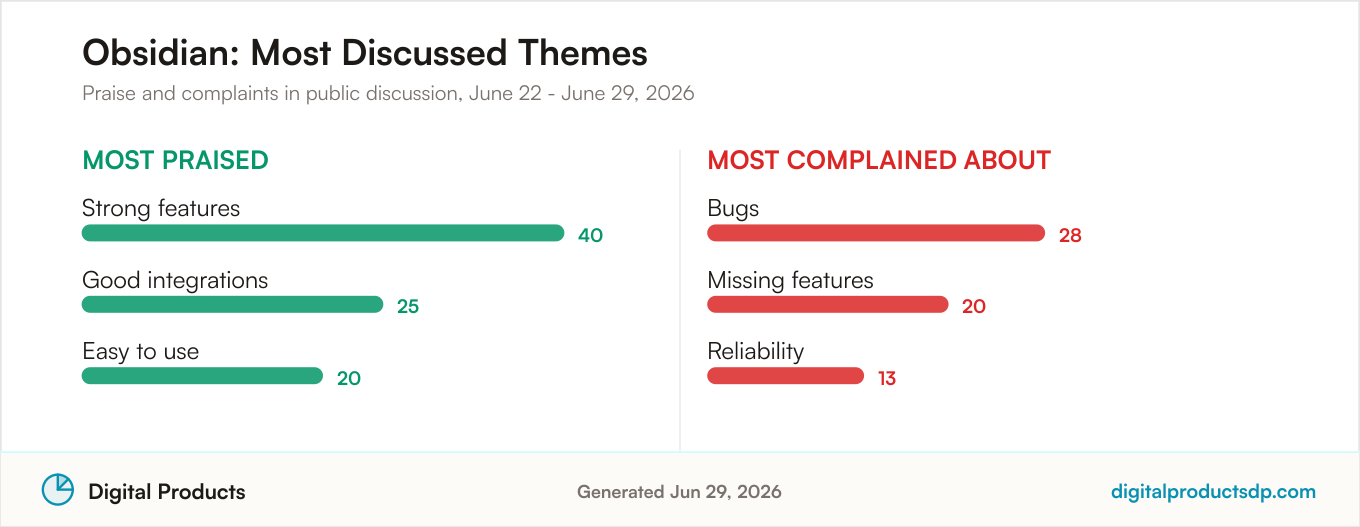
Praise clustered around substantive product qualities. Strong features topped the list with 40 mentions, followed by good integrations at 25 mentions and ease of use at 20 mentions. These are the same three praise categories that appeared for Notion, but at roughly ten times the volume, reflecting both the larger discussion pool and the stronger positive tilt.

Obsidian was not without friction. Bugs drew 28 mentions, missing features accounted for 20 mentions, and reliability issues appeared 13 times. The presence of both strong features as a top praise and missing features as a top complaint mirrors the split we saw with Notion's integrations, a reminder that different users bump into different edges of the same product.

Most praised and most complained about themes for Obsidian from aggregated public discussion

How They Compare

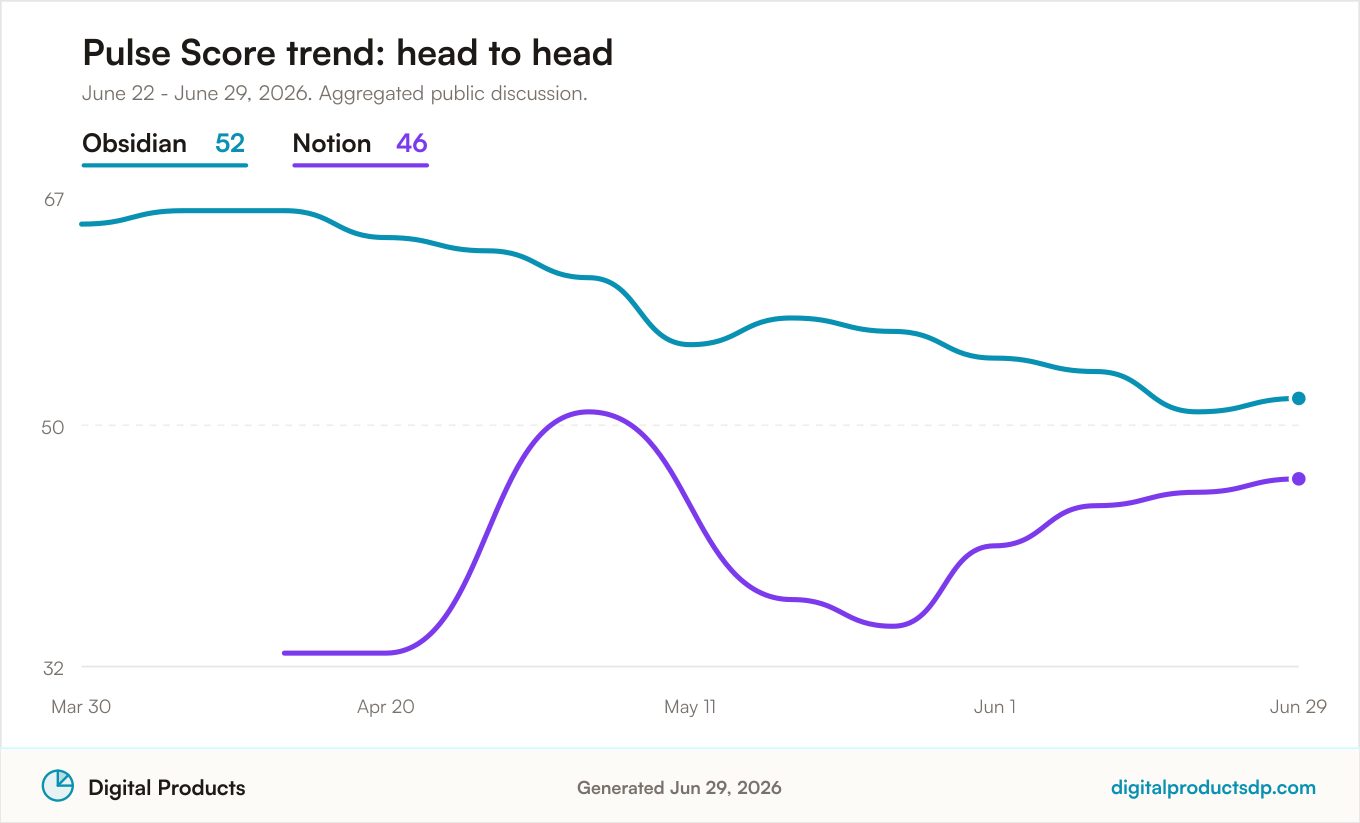
On the headline number, Obsidian leads with a Pulse Score of 52 to Notion's 46, a six-point gap. That difference is meaningful but not enormous, and it should be read alongside the wide difference in sample size.

Volume is the first big contrast. Obsidian's 720 mentions dwarf Notion's 118, so Obsidian's score rests on a considerably deeper pool of discussion. When a sample is that much larger, the resulting sentiment read tends to be steadier and less prone to swing on a handful of loud voices.

Sentiment mix comparison for Notion vs Obsidian

The sentiment shapes differ sharply. Notion's week was defined by neutrality, with 64% neutral and just 6% positive. Obsidian's was defined by enthusiasm and debate, with 42% positive and 18% mixed. Interestingly, the two are closer on outright negativity: Notion sat at 28% negative versus Obsidian's 21%. The bigger separator is not how much criticism each drew, but how much active praise Obsidian generated that Notion did not.

On themes, the overlap is striking. Both tools share the same top three praise categories: strong features, good integrations, and ease of use. Both also list bugs as their single most-complained-about theme, at 19 mentions for Notion and 28 for Obsidian. Where they part ways is the secondary complaints. Notion's users flagged lacking integrations, while Obsidian's flagged missing features, hinting at different expectations from the two audiences.

Pulse Score trend comparison for Notion vs Obsidian

Which Should You Choose

These numbers describe sentiment for one week, not the full picture of either product, so treat them as one input among many rather than a final answer.

If you weight community warmth and depth of discussion, Obsidian has the edge this week. Its higher Pulse Score of 52, its 42% positive sentiment, and its heavy praise for strong features suggest an engaged base that talks enthusiastically about what the tool does well. The tradeoff visible in the data is a notable mixed share and complaints about missing features, so it may reward users who are comfortable extending and configuring their setup.

Notion's picture this week is quieter. Its 64% neutral tone points to a lot of practical, matter-of-fact discussion rather than strong feelings in either direction. If you value the integration and ease-of-use qualities that did earn praise, those signals are present, but the concentration of bug and reliability complaints is worth weighing before you commit.

For anyone deciding, the honest read is that the six-point gap and the volume difference favor Obsidian on sentiment alone this week, while both tools share the same core strengths and the same top pain point in bugs. Match the secondary complaints against your own priorities: worry more about lacking integrations and Notion's data is instructive, worry more about missing features and Obsidian's is. Neither result should override a hands-on trial with your actual workflow.

About This Data

Pulse Scores summarize the tone of public online discussion on a 0-100 scale. They reflect community sentiment during a given period and are not a verdict on a product's quality, nor a recommendation to buy or avoid anything. A higher score simply means the conversation skewed more positive during the week we measured.

We report on complete calendar weeks only, and we exclude any product with fewer than 10 relevant mentions in the period to avoid unstable reads on thin samples. Public discussion is collected from Hacker News, Stack Exchange, GitHub, Bluesky, the Apple App Store, and YouTube.

Automated sentiment analysis is imperfect. It can misread sarcasm, jokes, or niche context, and mention volumes vary widely between products, which is why we show counts alongside scores. Scores can also move from week to week as the conversation shifts. If you represent either product and want to respond, we welcome you to reach out. For a fuller explanation of how these numbers are produced, see our methodology.

Frequently Asked Questions

Which has the higher Pulse Score, Notion or Obsidian?

Obsidian had the higher Pulse Score for the week of June 29, 2026, at 52 compared with Notion's 46, a six-point difference across the two tools.

Which tool was more positively received this week?

Obsidian was more positively received, with 42% of its mentions rated positive versus just 6% for Notion. Notion's discussion was mostly neutral at 64%, while both tools drew comparable negative shares of 21% and 28% respectively.

How many mentions did each tool have?

Notion recorded 118 total mentions during the week, while Obsidian recorded 720. The larger sample gives Obsidian's score a more robust base to read from.

Which is better for someone focused on features and integrations?

Both tools shared the same top praise themes of strong features, good integrations, and ease of use, but Obsidian drew far more volume there, including 40 mentions for strong features and 25 for good integrations. Notion's users flagged lacking integrations 8 times, so if integrations are your priority, weigh that complaint carefully.