
Between May 1 and May 31, 2026, aggregated public discussion across 158 total mentions covering 12 products revealed a community mood best described as mixed but leaning positive. A handful of tools climbed sharply in perceived quality, while others absorbed some of the steepest sentiment drops we have tracked in a single snapshot period. Here is what the numbers looked like and what patterns emerged from the noise.
In this article
- 01How We Measure Community Sentiment
- 02Claude and ChatGPT: Solid Ground With Different Stories
- 03Gemini's 35-Point Climb Is the Month's Defining Swing
- 04DeepSeek Slides as Coding Tools Take the Hardest Hits
- 05Obsidian Holds Steady as the Quiet Consistency Leader
- 06What People Are Praising and What They Are Complaining About
- 07How to Use This Data When Evaluating AI Tools
How We Measure Community Sentiment
The figures in this article come from our Pulse Score methodology, which aggregates public online discussion and weights mentions by tone, context, and recency. A score above 50 indicates net positive sentiment; below 50 indicates net negative. Pulse Scores reflect how communities are talking about a product at a given moment. They are not product ratings, editorial endorsements, or factual assessments of software quality. With that framing in place, here is what May 2026 looked like across the board.
Claude and ChatGPT: Solid Ground With Different Stories
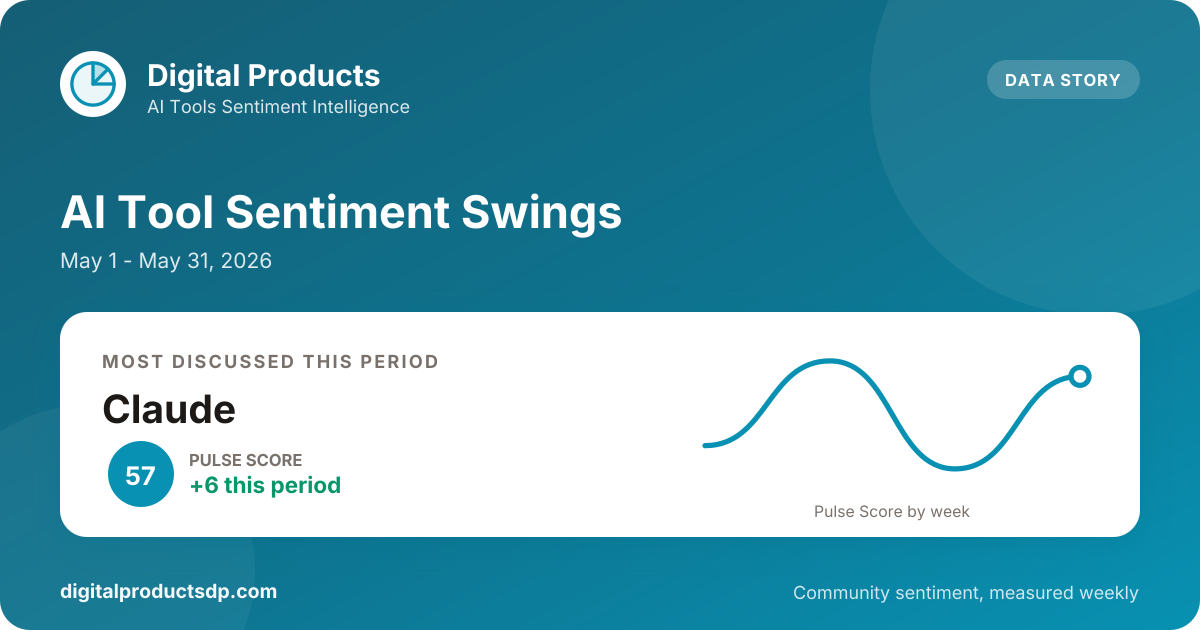
Claude led all AI chat tools in raw mention volume, drawing 35 mentions and holding a Pulse Score of 57, up 6 points from the prior snapshot period. The tone in community threads leaned toward appreciation for output quality and conversational consistency, though the modest 6-point gain suggests the enthusiasm is incremental rather than dramatic. Claude appears to occupy a stable, well-regarded position in the community conversation right now.
ChatGPT followed with 21 mentions and a Pulse Score of 49, which technically sits just below the neutral midpoint. But the more interesting number is the 14-point gain compared to the prior period. That kind of upward movement inside a single month suggests community impressions may be shifting in a more favorable direction, even if the overall score has not crossed into clearly positive territory yet. It is worth watching whether that momentum carries into June or whether it reflects a short-term reaction to a specific release or update.
Gemini's 35-Point Climb Is the Month's Defining Swing
If one number from May 2026 stands out above the rest, it is Gemini's 35-point Pulse Score gain. Across 13 mentions, Gemini landed at a Pulse Score of 55, up from what would have been a notably low baseline. Community threads appeared to tie this shift to perceived improvements in AI quality, with commenters describing outputs as more reliable or more useful than they had been in earlier periods.
A 35-point swing in a single snapshot is significant. It does not automatically mean Gemini has solved the problems that generated earlier criticism, but it does suggest that the community perception is actively shifting rather than staying flat. For anyone who wrote off Gemini based on older impressions, this month's data is at least a signal worth revisiting.
Mistral also moved in a positive direction, reaching a Pulse Score of 52 across 16 mentions, up 3 points. That score puts Mistral just above neutral, and the steady if unspectacular gain indicates a community that is cautiously warming to the model rather than expressing strong enthusiasm in either direction.
DeepSeek Slides as Coding Tools Take the Hardest Hits
Not every product moved up. DeepSeek absorbed a 28-point drop to land at a Pulse Score of 43 across 19 mentions, making it one of the more discussed products this month despite the negative tilt in community tone. What is notable here is the volume. Nineteen mentions is the second-highest total in the dataset, which means DeepSeek is generating real conversation, just not uniformly favorable conversation right now.
The coding category showed the sharpest swings of any segment this month. Devin, which drew 11 mentions from coding-focused commenters, fell 45 points to a Pulse Score of 45. That is a steep drop, and the community threads appeared to reflect genuine concern rather than casual criticism. For a tool positioned around autonomous software development, a 45-point single-period decline in sentiment is a notable data point, even if it does not tell us definitively what caused the shift.
GitHub Copilot fared even worse on the Pulse Score scale. Across just 5 mentions, it registered a score of 15, down 44 points from the prior period. Recurring themes in community threads pointed to reliability problems and dissatisfaction with AI quality. A score of 15 represents one of the lowest readings in this dataset, and while the low mention count means the signal carries more uncertainty, the directional message from those 5 discussions was clearly negative.
The one bright spot in the coding segment was Claude Code, which climbed 34 points to reach a Pulse Score of 70 across 8 mentions. That score places Claude Code among the higher-rated products in this entire dataset, and the large positive swing suggests communities that tested or discussed it in May came away with a meaningfully better impression than they had held previously.
Obsidian Holds Steady as the Quiet Consistency Leader
In the project-management category, Obsidian stood apart not for dramatic movement but for the absence of it. The tool held a Pulse Score of 75 across 14 mentions with zero change from the prior period. That flatline at a high score is arguably more meaningful than a big gain from a low baseline. Community commenters appeared to read the consistency as a sign of sustained satisfaction rather than stagnation.
Seventy-five is the highest Pulse Score in this entire dataset, and Obsidian earned it across a solid 14-mention sample. For anyone evaluating note-taking or knowledge-management tools, the community conversation around Obsidian in May 2026 suggests a product that has built a stable and genuinely satisfied user base.
Perplexity also deserves a mention in the positive column. It scored 43 across just 6 mentions, but that represented a 15-point gain from the prior period. The mention count is low enough to treat cautiously, but the directional shift is consistent with a tool that is gradually improving its community reputation.
What People Are Praising and What They Are Complaining About
Looking across the full dataset, the praise themes clustered around three areas. Strong features led all positive signals with 42 mentions, suggesting that when communities are enthusiastic about a product, they are most often pointing to specific capabilities rather than vague impressions. AI quality came in second at 27 mentions, and ease of use followed at 16 mentions.
On the complaint side, bugs were the most commonly cited frustration at 12 mentions. AI quality also appeared as a complaint theme at 11 mentions, which is interesting because it appears on both sides of the ledger. That means communities are applying AI quality as a standard in both directions: it drives praise when it impresses and drives criticism when it disappoints. Reliability was close behind at 10 mentions, which aligns with the specific frustrations cited in the GitHub Copilot and Devin threads.
Privacy concerns appeared in 7 instances. That number is modest relative to the full dataset, but it is consistent enough to note as a persistent thread in how communities evaluate AI tools. For products that handle sensitive data or operate in enterprise environments, privacy perception is not going away as a factor in community sentiment.
How to Use This Data When Evaluating AI Tools
Community sentiment data is most useful as a directional signal, not a verdict. A few practical ways to apply what May 2026 showed:
- Treat large swings as prompts for deeper research. Gemini's 35-point gain and GitHub Copilot's 44-point drop are both worth investigating through hands-on testing or reading the specific threads that drove those scores. The numbers flag where attention is worth spending.
- Weight mention volume alongside the score. A Pulse Score of 15 across 5 mentions carries more uncertainty than a score of 57 across 35 mentions. Both are worth noting, but they carry different confidence levels.
- Look for stability as a signal of its own. Obsidian's flat 75 across 14 mentions is a different kind of positive signal than a sharp upward swing. Consistency at a high score often indicates a mature product with a settled community.
- Track the complaint themes that matter to your use case. If reliability is a dealbreaker for your workflow, the patterns around GitHub Copilot and Devin are directly relevant. If privacy is your primary concern, the 7-instance thread across the dataset is worth tracing to specific product discussions.
- Revisit tools with big negative swings before writing them off. Devin's 45-point drop and DeepSeek's 28-point drop may reflect a specific moment in community perception rather than a permanent state. Sentiment can recover, as ChatGPT's 14-point gain and Gemini's 35-point surge both illustrate.
The May 2026 snapshot across 158 mentions and 12 products reflects a community in active evaluation mode. The strongest tools in the dataset, Claude at 57, Obsidian at 75, and Claude Code at 70, are holding or gaining ground on the strengths that communities value most: features, AI quality, and reliability. The tools generating concern right now are being pushed down primarily on those same axes. That consistency in what communities care about is itself a useful data point for anyone trying to understand where the AI tool conversation is heading.