
Back to blog
General

Inside the Numbers: How AI Chat Tools Split Opinion

June 8, 2026
Inside the Numbers: How AI Chat Tools Split Opinion

Community discussion is one of the fastest signals we have for tracking how AI tools are landing with the people who actually use them. Between June 1 and June 8, 2026, the tracked landscape of four products generated 291 total mentions across aggregated public discussion, and the sentiment behind those mentions moved in notably different directions depending on which tool was in focus. This article breaks down what that conversation looked like, using Pulse Scores and mention counts to map where enthusiasm grew and where frustration crept in.

Before diving in, a quick note on method. Pulse Scores reflect aggregated public online discussion, not verified facts about product performance. A score can shift because of a single viral thread, a pricing change, or a wave of comparison posts. Treat these figures as a read on community mood during one specific week, not a verdict on any tool's underlying quality.

What the Week's Mention Volume Tells Us

The headline figure is concentration. Of the 291 mentions tracked, Claude alone accounted for 263 of them. That is the kind of share that makes a single product effectively define the week's conversation. ChatGPT, by contrast, surfaced in just 14 mentions, DeepSeek in 8, and Claude Code in 6.

This imbalance matters when reading the numbers that follow. A tool with hundreds of mentions produces a stable, well-averaged sentiment signal. A tool with single-digit mentions can swing dramatically on a handful of strongly worded posts. So while DeepSeek and Claude Code produced the most eye-catching movements this week, those movements rest on much thinner evidence than Claude's steadier baseline.

The breakdown across categories was straightforward. Three of the four tracked products sit in the AI chat category, while Claude Code occupies the coding category. That clustering meant most of the week's debate played out as a comparison between conversational assistants, with the coding tool standing somewhat apart.

Claude: High Visibility, Slightly Cooler Mood

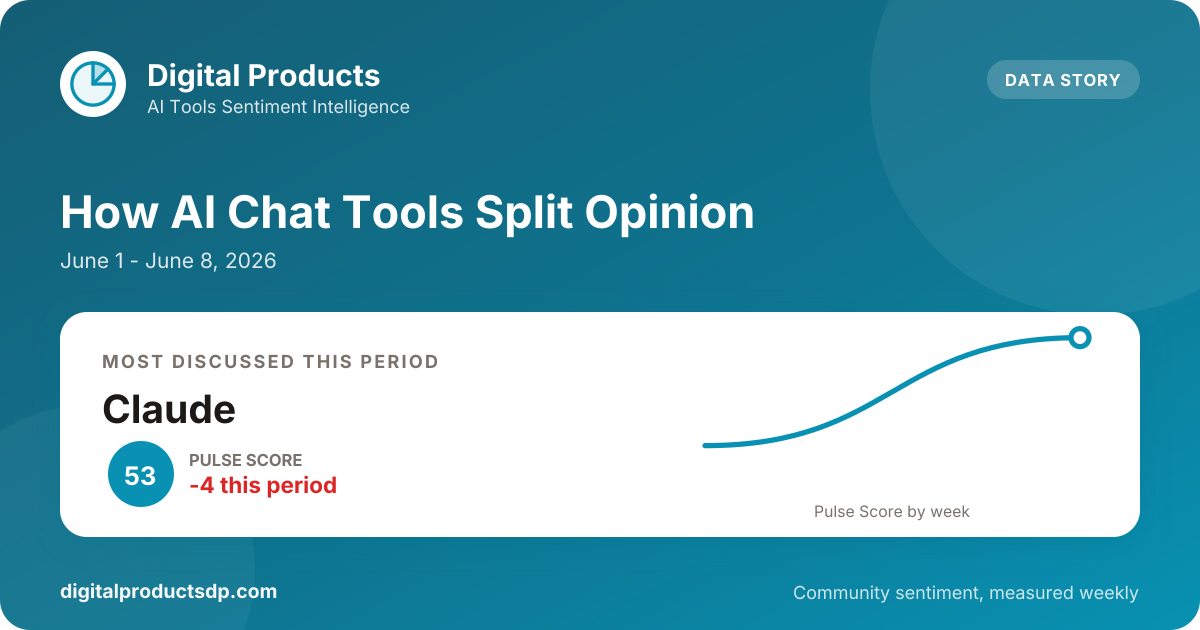
Claude finished the week with a Pulse Score of 53, down 4 points from the prior snapshot. Paired with its 263 mentions, the picture is one of dominant visibility tempered by a mildly mixed reception. A score sitting just above the midpoint suggests commenters were broadly engaged but not uniformly enthusiastic.

A 4-point dip on such a high mention volume is meaningful precisely because the sample is large. It is harder to move a number when hundreds of comments are pulling it in different directions, so even a modest decline points to a real, if gentle, softening in mood. Much of that appears tied to the broader debate over output quality, which we will return to later, since AI quality was both the leading praise driver and the leading complaint driver across the whole dataset.

For anyone researching Claude right now, the takeaway is nuance rather than alarm. The tool remained the center of gravity for the entire tracked landscape, and a Pulse Score above 50 indicates net positive engagement. The slight decline simply reflects that not every conversation went its way this week.

Claude Pulse Score trend from aggregated public discussion

ChatGPT: Quieter Week, Softer Sentiment

ChatGPT appeared in only 14 mentions during the window, a striking contrast to Claude's volume. Its Pulse Score slipped 5 points to land at 44, placing it below the midpoint and marking a cooler week in the community's eyes.

It would be a mistake to read low mention volume as low relevance. ChatGPT remains one of the most widely used AI tools in the world, and a quiet week in tracked community discussion often reflects where the most active, vocal commenters happened to focus rather than overall adoption. What the data does suggest is that within these particular communities, ChatGPT was not the conversation people gravitated toward, and the sentiment that did surface leaned mildly negative.

A Pulse Score of 44 is not a crisis signal. It indicates that complaint-side mentions modestly outweighed praise during the week. For researchers comparing tools, the more useful insight is the direct rivalry data, which we cover next, since much of the ChatGPT discussion happened in the context of comparisons rather than standalone praise or criticism.

ChatGPT Pulse Score trend from aggregated public discussion

The Claude Versus ChatGPT Debate Stays Unresolved

One of the more revealing slices of this week's data sits in the rivals category, where commenters directly weighed the two leading chat tools against each other. Those comparison discussions produced 26 complaint-side mentions and 17 praise-side mentions.

That ratio tells a clear story: the comparison conversation was active, but it skewed toward criticism and remained unsettled. When complaints outnumber praise in head-to-head discussion, it usually signals that users are frustrated with tradeoffs rather than convinced one tool clearly wins. People comparing these services this week were more likely to voice what bothered them than to declare a favorite.

For anyone trying to choose between the two, the practical lesson is that the community has not reached consensus. The debate over which holds the edge continues, and the volume of complaint-side comparison mentions suggests both tools carry real friction points worth testing against your own workflow before committing.

DeepSeek: The Week's Standout Gainer

If one product clearly outperformed expectations on sentiment, it was DeepSeek. Its Pulse Score climbed 24 points to reach 67, the largest positive move in the dataset, across 8 mentions.

The caveat is the same one that applies to any low-volume signal: 8 mentions is a small base, and a swing of this size can come from a concentrated burst of positive discussion rather than a broad shift in opinion. That said, the direction is unambiguous. Every available signal in those conversations leaned positive, and a score of 67 sits comfortably in favorable territory.

For tool researchers, DeepSeek is worth watching rather than dismissing. A 24-point jump, even on modest volume, often marks a product gaining momentum among early and vocal adopters before broader discussion catches up. Whether that enthusiasm sustains into the following weeks is the question the data cannot yet answer, but the trajectory this week was the most encouraging of any tool tracked.

DeepSeek Pulse Score trend from aggregated public discussion

Claude Code: The Steepest Decline Tracked

At the opposite end of the spectrum sits Claude Code, the only coding-focused tool in the dataset. Commenters pushed its Pulse Score down 37 points to just 33 across 6 mentions, the sharpest single-week movement of any product tracked.

A 37-point drop is severe, and it is worth being precise about what it means and does not mean. With only 6 mentions, the score is highly sensitive to a small number of pointed comments, so this reflects concentrated criticism rather than a broad referendum. But the magnitude is still notable. The coding tool drew specific, sharp criticism this week, and that produced the steepest decline in the entire snapshot.

Developers evaluating Claude Code should read this as a prompt to investigate rather than a conclusion. Sharp single-week swings on low volume frequently correct in either direction once more discussion accumulates. The useful action is to look at what the criticism centered on, which aligns with the broader complaint themes covered below, and test whether those issues apply to your use case.

What Drove Praise and Complaints Across the Board

Looking past individual tools, the themes behind the sentiment are where the most actionable insight lives. On the praise side, AI quality led with 86 mentions, followed by strong features at 47. When communities liked a tool this week, they overwhelmingly cited the caliber of its output and the depth of its feature set.

The complaint side reinforces just how central output quality has become. AI quality also topped the complaint list at 45 mentions, meaning the same dimension that drove the most praise also drove the most frustration. That tension is the defining theme of the week. Output caliber is the battleground on which these tools are judged, and expectations have risen high enough that quality cuts both ways.

The remaining complaint drivers fill out a familiar picture:

  • Pricing concerns: 33 mentions, reflecting ongoing sensitivity to cost and value across tools.
  • Missing features: 31 mentions, where users wanted capabilities that were not yet present.
  • Bugs: 23 mentions, covering reliability and stability frustrations.

For anyone choosing an AI tool right now, this distribution is a useful checklist. Prioritize hands-on evaluation of output quality, since that is what the community cares about most in both directions. Then weigh pricing against the features you actually need, and read recent discussion for bug reports relevant to your workflow.

Reading the Week in Context

The June 1 to June 8 window painted a layered picture. Claude held overwhelming attention with a slightly cooler mood at a Pulse Score of 53. ChatGPT had a quiet, mildly negative week at 44. DeepSeek surged to 67 on small but enthusiastic volume, and Claude Code fell hard to 33 on concentrated criticism. Underlying all of it, output quality remained the single most important factor shaping how these communities felt.

The most reliable takeaway is also the simplest: high-volume signals like Claude's tell you about steady mood, while low-volume swings like DeepSeek's and Claude Code's tell you about emerging momentum that may or may not hold. Use both, but weight them according to the evidence behind them. As always, these scores reflect aggregated public discussion during one specific week, and the smartest move for any researcher is to pair them with your own testing before drawing conclusions.