Back to blog
Comparisons

Bubble vs Webflow: Week of June 29, 2026

July 1, 2026
Bubble vs Webflow: Week of June 29, 2026

No-code and visual development tools continue to draw a wide range of builders, from solo founders shipping their first product to agencies managing client sites at scale. Two of the most recognizable names in this space, Bubble and Webflow, often come up in the same conversations, even though they lean toward different jobs. Bubble is frequently discussed as a full-stack app builder, while Webflow is more often framed as a visual web design and CMS platform.

This head-to-head comparison is built from aggregated public online discussion collected between June 22 and June 29, 2026. It reflects the tone of community sentiment during that specific week, not a definitive judgment on either product. Below we break down each tool's Pulse Score, its sentiment mix, and the themes people praised or complained about, then weigh the two against each other using only that data.

RankProductCategoryPulse ScoreRelevant MentionsVisit
1BubbleCoding755Visit ↗
2WebflowDesign51158Visit ↗

Bubble

Bubble Pulse Score trend from aggregated public discussion

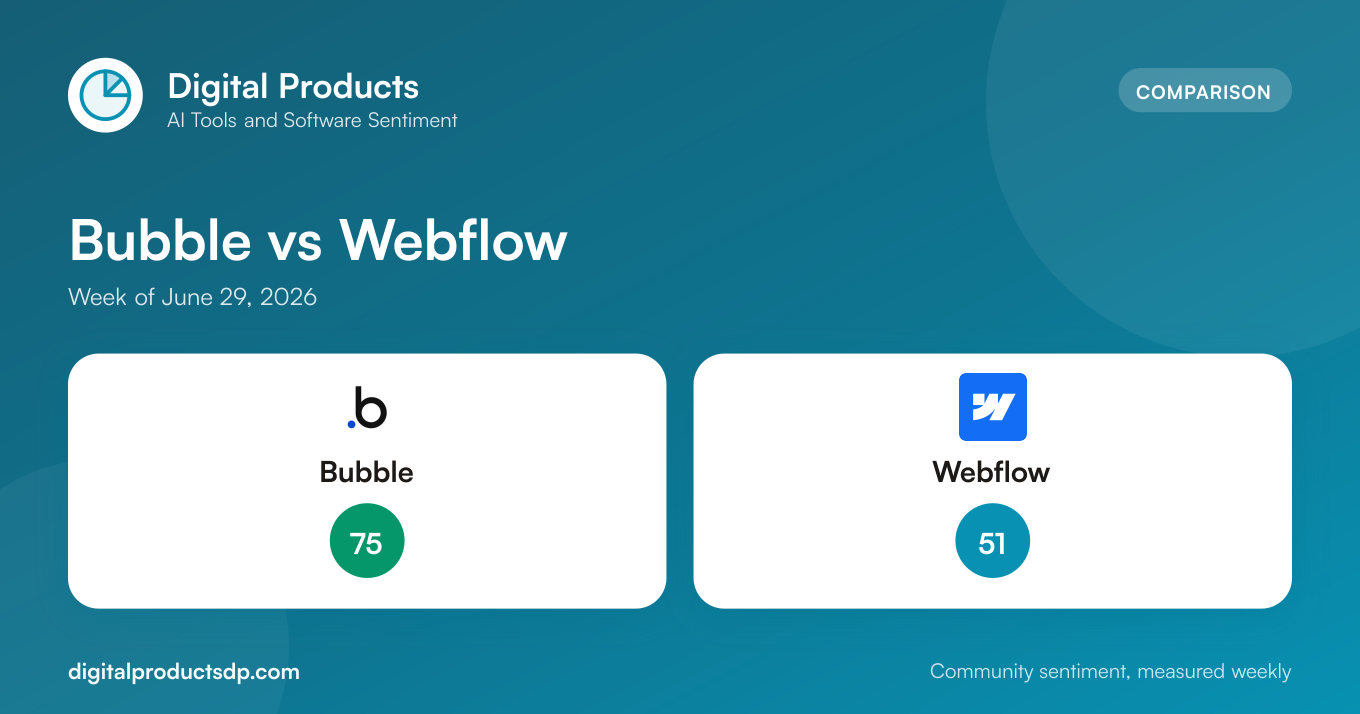
Bubble posted a Pulse Score of 75 for the week, the higher of the two tools in this matchup. That score sits on a relatively thin base of just 5 total mentions, so it should be read with more caution than a score built on a larger sample. Fewer mentions can mean a single enthusiastic thread moves the read considerably.

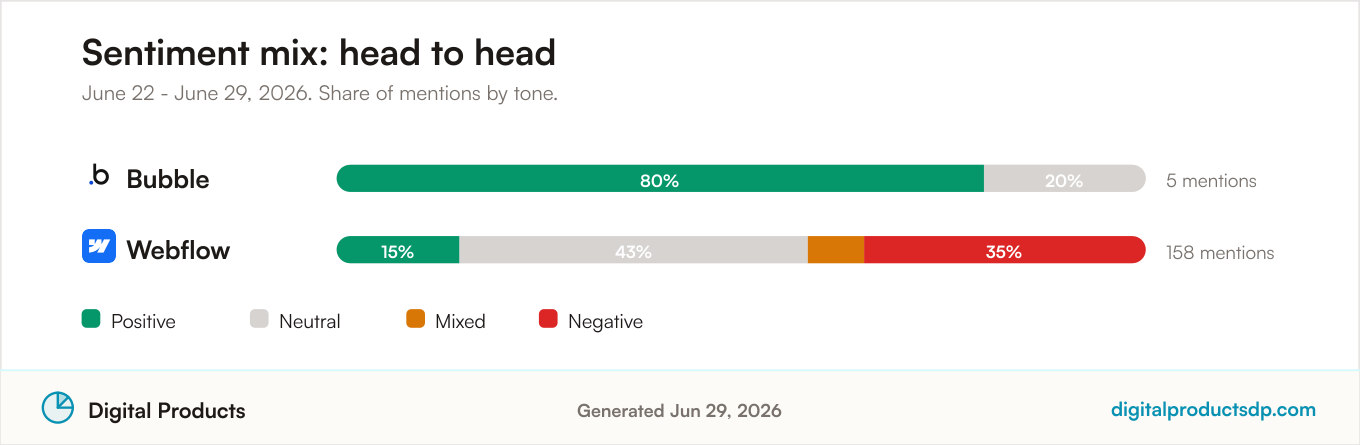
The sentiment mix was strongly favorable. Discussion broke down as 80% positive, 20% neutral, and 0% mixed or negative. In other words, none of the tracked conversation about Bubble carried a negative tone during this window, which is a clean result even if the volume was modest.

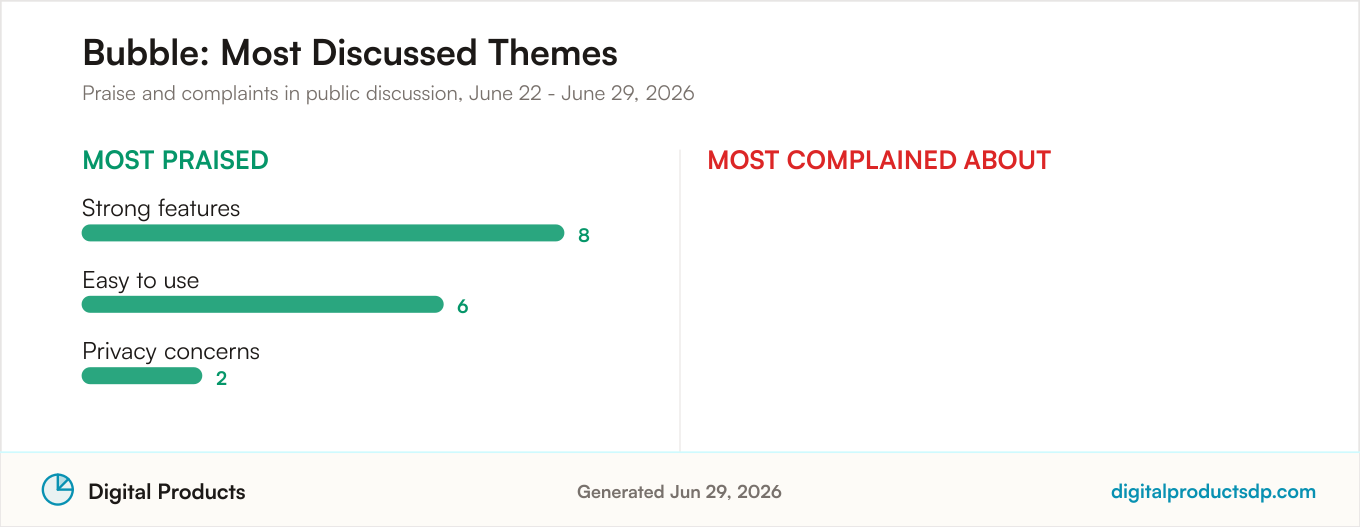
On the themes side, the most praised topics were Strong features, cited 8 times, and Easy to use, cited 6 times. A smaller thread raised Privacy concerns, mentioned twice, though this did not surface as an outright complaint in the tracked data. Notably, Bubble had no meaningfully recurring complaints during the week. For a full-stack builder that ambitious builders often push hard, an absence of tracked gripes is a positive signal, tempered again by the small sample size.

Most praised and most complained about themes for Bubble from aggregated public discussion

Webflow

Webflow Pulse Score trend from aggregated public discussion

Webflow recorded a Pulse Score of 51 for the same week, built on a much larger base of 158 total mentions. That is more than thirty times the discussion volume Bubble saw, which makes Webflow's read considerably more stable. A score of 51 sits near the middle of the 0-100 scale, indicating discussion that was neither strongly enthusiastic nor overwhelmingly negative on balance.

The sentiment mix explains that middle position. Webflow's conversation broke down as 15% positive, 43% neutral, 7% mixed, and 35% negative. The largest single slice was neutral, which is common for a widely used platform where much of the talk is practical and how-to oriented. Still, the 35% negative share is substantial and it pulled the score down from where the praise alone would have placed it.

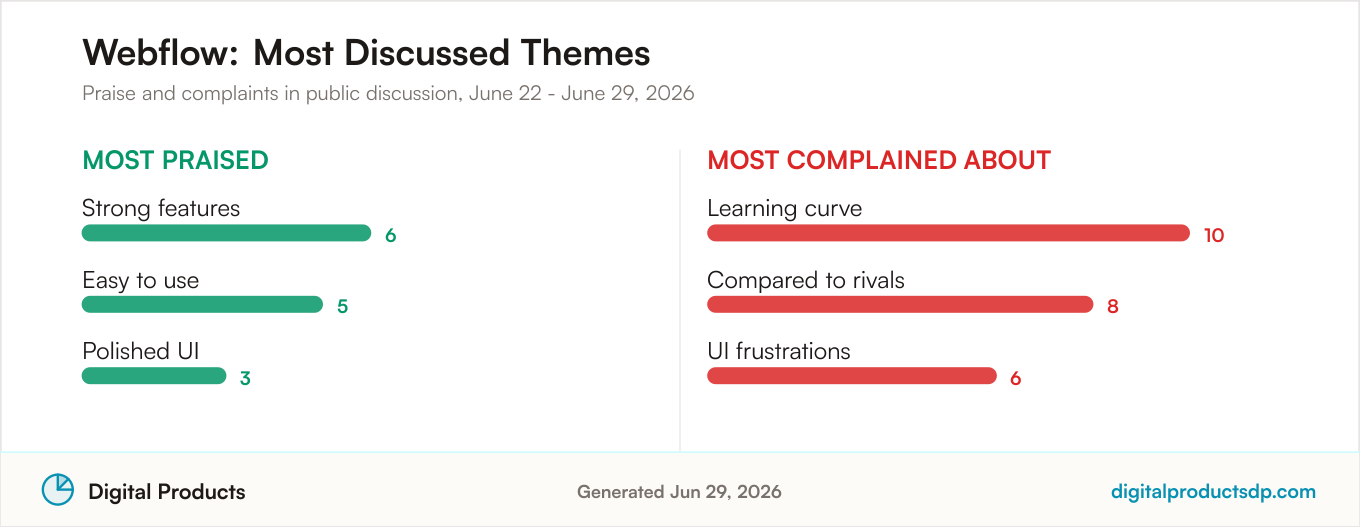
On themes, Webflow was praised for Strong features (6 mentions), Easy to use (5 mentions), and a Polished UI (3 mentions). The complaints were more concentrated and more numerous. The leading grievance was Learning curve, cited 10 times, followed by Compared to rivals at 8 mentions and UI frustrations at 6 mentions. The pattern suggests that while people appreciate Webflow's capabilities and polish, a meaningful segment of the community found it hard to learn and frequently weighed it against alternatives.

Most praised and most complained about themes for Webflow from aggregated public discussion

How They Compare

On raw score, Bubble leads with a 75 against Webflow's 51, a 24-point gap. But the two numbers are not built on equal foundations. Bubble's score rests on just 5 mentions, while Webflow's rests on 158. A high score on a thin sample is more fragile and can swing sharply week to week, whereas Webflow's score reflects a broad and settled body of discussion.

The sentiment mix comparison is where the contrast is clearest. Bubble's discussion was 80% positive with no negativity at all, while Webflow's was only 15% positive and 35% negative. Even accounting for the volume difference, the tone of conversation around Bubble was distinctly warmer during this window.

Sentiment mix comparison for Bubble vs Webflow

Interestingly, both tools were praised for the same two strengths, Strong features and Easy to use, which topped each product's positive themes. The divergence appears on the complaints side. Bubble logged no recurring complaints in the tracked data, while Webflow carried three, led by a Learning curve theme cited 10 times. That difference is a large part of why the scores separated the way they did.

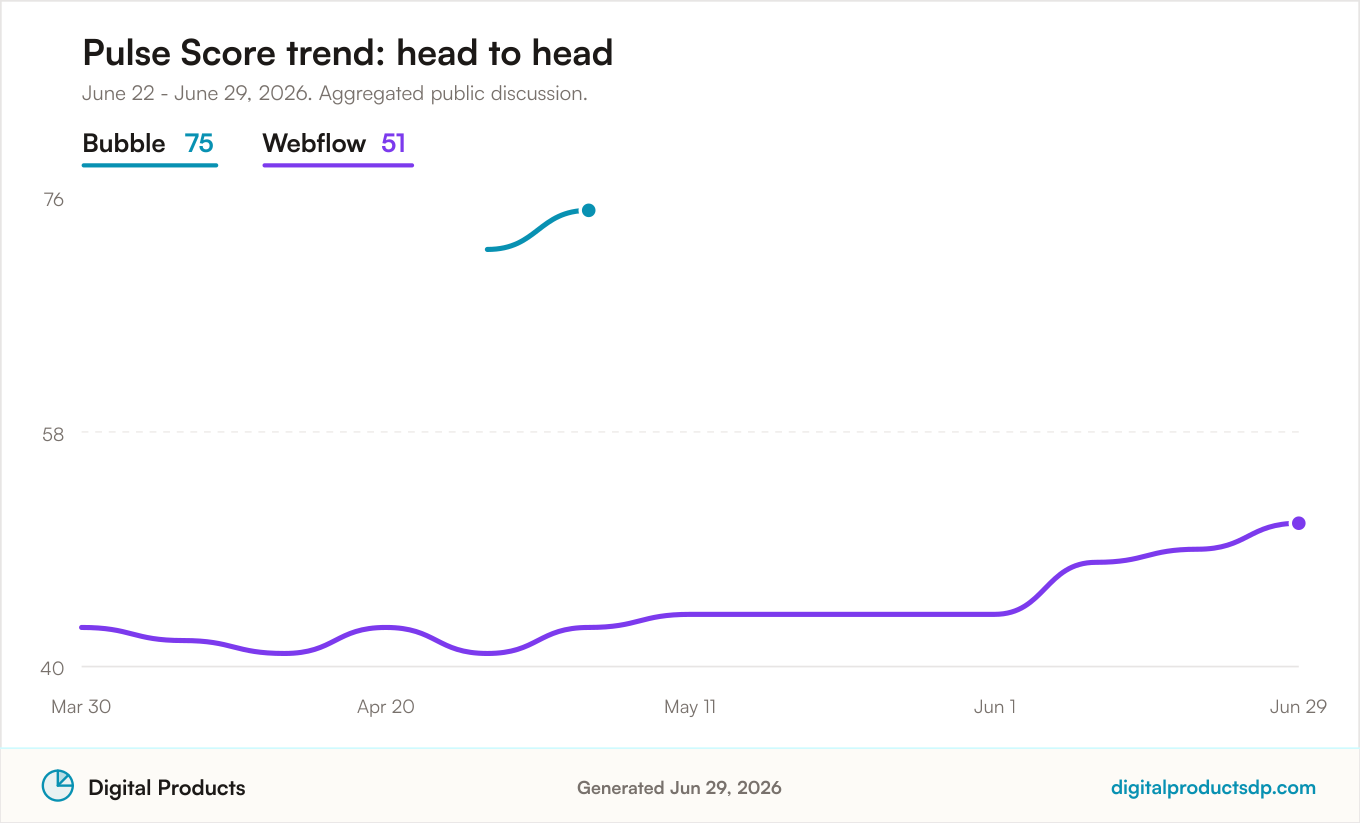
The trend chart below shows how each tool's Pulse Score moved over the surrounding period, offering context beyond this single week's snapshot.

Pulse Score trend comparison for Bubble vs Webflow

Which Should You Choose

The data here describes sentiment, not fit, so the right choice still depends on what you are building. That said, the numbers offer useful signals.

If you are drawn to what people were most enthusiastic about this week, Bubble's clean 80% positive read and absence of complaints stand out. Keep in mind, though, that this reflects only 5 mentions, so it is a warm but narrow signal. Bubble tends to appeal to builders who want full-stack app logic, and the tracked praise for Strong features and Easy to use aligns with that use case.

If you need a mature visual web design and CMS platform, Webflow's 158 mentions show a large, active community, and its praise for Strong features, Easy to use, and a Polished UI is real. The tradeoff surfaced in the data is the Learning curve theme, cited 10 times, plus frequent comparisons to rivals. New users should budget time to climb that curve. The middling 51 Pulse Score reflects a community that respects the product but is vocal about its friction.

In short, Bubble drew warmer sentiment on a small sample, while Webflow drew more measured sentiment on a much larger one. Weigh the volume difference heavily before treating the score gap as decisive.

About This Data

Pulse Scores summarize the tone of public online discussion on a 0-100 scale. They reflect community sentiment during a given week and are not a verdict on a product's quality, nor a recommendation to buy or avoid any tool.

We report on complete calendar weeks only. Products with fewer than 10 relevant mentions in a period are normally excluded to avoid unstable reads on thin samples, which is worth remembering when a score rests on very few mentions. Public discussion is collected from Hacker News, Stack Exchange, GitHub, Bluesky, the Apple App Store, and YouTube.

Automated sentiment analysis is not perfect. It can misread sarcasm, jokes, or niche context, mention volumes vary widely between products, and scores can move from one week to the next. If you represent either company and want to respond, we welcome you to reach out. For more on how scores are calculated, see our methodology.

Frequently Asked Questions

Which has the higher Pulse Score, Bubble or Webflow?

Bubble had the higher Pulse Score for the week of June 29, 2026, at 75, compared with Webflow's 51. However, Bubble's score was based on just 5 mentions while Webflow's was based on 158, so the two are not directly equivalent in reliability.

Which tool was more positively received this week?

Bubble showed the more positive sentiment mix, with 80% positive discussion and no negative mentions. Webflow's discussion was 15% positive, 43% neutral, 7% mixed, and 35% negative, giving it a more measured overall tone.

How many mentions did each tool receive?

Webflow received 158 total mentions during the week, far more than Bubble's 5. That larger volume makes Webflow's Pulse Score a more stable read, while Bubble's should be treated as a narrower signal.

Which is better for building a web design and CMS project?

The data does not judge fit directly, but Webflow was discussed heavily as a visual web design and CMS platform, praised for Strong features, Easy to use, and a Polished UI. Its main tracked drawback was a Learning curve, cited 10 times, so plan for some ramp-up time.